You can spend months negotiating a deal, agree a sensible headline price, and still walk straight into a financial mess. That usually happens when the buyer focuses on growth, staff, customers, and “fit”, but misses the debts, tax exposures, weak controls, or dispute history buried inside the legal entity they're buying. By the time the problem surfaces, the money has gone and the argument has started.
That's where many business owners hesitate. They assume their solicitor will catch everything, or that their regular accountant already knows the numbers well enough. In practice, neither role usually tests a transaction the way a forensic accountant does. A forensic review looks for what doesn't reconcile, what was omitted, what changed late in the process, and what could turn into a claim after completion.
If you're asking what is a Share Purchase Agreement, the legal answer is only the start. The practical answer is this: it is the contract that decides who carries risk when the numbers, disclosures, or promises behind a business sale turn out to be wrong.
The Hidden Risks in Buying a Business
A business can look clean from the outside and still carry problems that only appear after completion. I've seen buyers inherit overdue tax issues, customer disputes that weren't properly reserved, and profits that looked solid until you stripped out one-off entries and aggressive assumptions. None of that feels theoretical when you've already signed.

That's why the document at the centre of the deal matters so much. In UK private-company M&A, the use of SPAs is almost universal, with 13,276 takeover or merger transactions involving UK companies in 2021 alone, and the vast majority were structured as share purchases for tax efficiency and continuity, according to Sirion's UK SPA overview.
Where buyers get caught out
The danger isn't "bad paperwork" itself. The danger is assuming the paperwork reflects reality.
A buyer may read that the company has no material disputes, only to discover later that a customer had already threatened a substantial claim. A seller may provide accounts showing healthy margins, while stock valuation, revenue cut-off, or debtor recoverability tells a different story. The SPA can protect a buyer, but only if the buyer identifies the risk early enough to negotiate proper wording.
Practical rule: If a risk affects price, cash flow, or liability after completion, it should appear somewhere in diligence, disclosure, or the SPA. If it appears nowhere, that's a warning sign.
Why legal review alone isn't enough
Solicitors draft and negotiate the contract. They should. But they usually don't recast management accounts, test unusual journal entries, or trace whether cash has leaked out before handover. Those are financial verification exercises.
That matters most in buying a business in the UK, where continuity often makes a share sale attractive. The contracts, staff relationships, trading history, and operating structure remain in place. Unfortunately, so can the financial baggage.
The strongest deals don't rely on trust. They convert commercial assumptions into tested facts, then translate those facts into enforceable protections.
What Exactly Is a Share Purchase Agreement
A buyer agrees a price for the shares, signs the paperwork, and takes control on completion. Six months later, a tax exposure, an overstated debtor balance, or a warranty claim lands on the desk. The SPA is the document that decides who carries that loss.
A Share Purchase Agreement, or SPA, is the binding contract for the sale of shares in a company. In a UK private company deal, it sets out who is buying and selling, how many shares are transferring, the price, the conditions to completion, and the promises each side is prepared to give. The legal framework is well established in UK corporate practice, including the mechanics for transferring shares and updating the company's register, as reflected in the Companies House guidance on issuing and transferring shares.
What matters in practice is what the buyer is acquiring. A share purchase transfers ownership of the company itself. The bank accounts, contracts, employees, tax history, accounting policies, and unresolved issues stay inside that legal entity. So do mistakes in the numbers.
That is why I treat the SPA as more than a legal definition. It is the document that converts financial findings into contractual protection. If due diligence identifies weak stock valuation, aggressive revenue recognition, or unexplained payments to connected parties, the SPA should deal with those points through price adjustment terms, warranties, indemnities, or specific disclosure.
In most UK transactions, the process has two parts. First, the parties agree the commercial terms in the SPA. Then the shares are transferred at completion with the supporting paperwork, which usually includes board minutes, stock transfer forms, and updated statutory records.
A sound SPA usually has four practical jobs:
- Record the commercial deal: what is being sold, for how much, and when.
- Allocate financial risk: what the seller is confirming about the business, and what remedy the buyer gets if those statements are wrong.
- Set the completion mechanics: what must happen before money and control change hands.
- Preserve evidence for disputes: what was agreed, what was disclosed, and how a later claim will be judged.
Price is often the area where business owners underestimate the detail. A headline figure can change materially once the SPA defines debt, cash, normalised working capital, and permitted leakage. Buyers who want to avoid paying for value that is not really there should understand how working capital adjustment mechanisms affect deal value.
Cross-border deals add another layer of risk. If disclosures, side letters, or key commercial contracts were translated during the deal, the enforceability of translated contracts may affect how safely the SPA works in practice.
An SPA is the buyer's main route to recovery if the business delivered is not the business described. A solicitor drafts the wording. A forensic accountant tests whether the wording matches the financial reality. That combination is what protects value after completion.
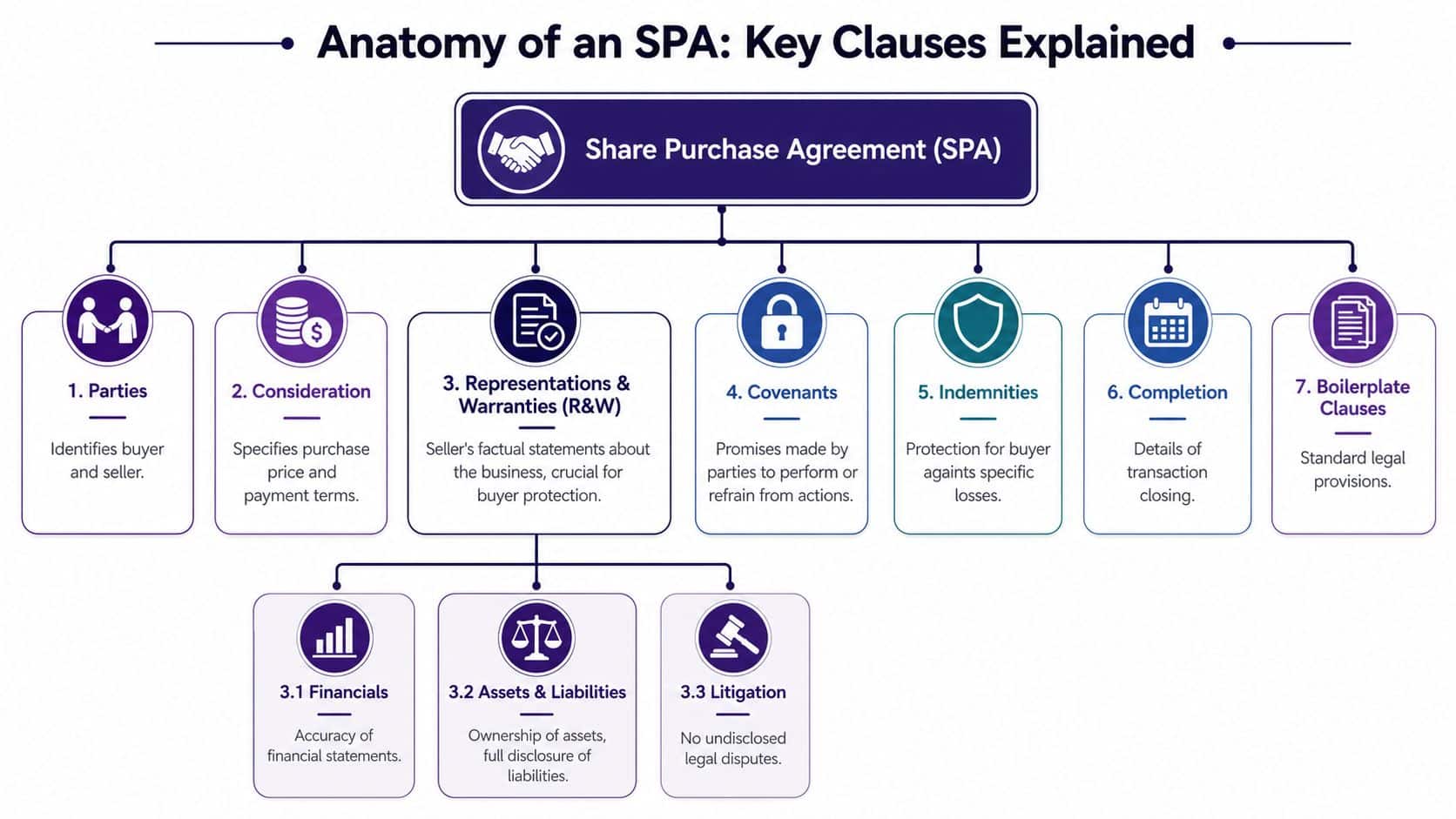
Anatomy of an SPA Key Clauses Explained
Every SPA looks dense on the page, but only a handful of clauses usually drive financial outcomes. Those are the clauses that set price, control leakage, allocate risk, and preserve a route to recovery if something goes wrong.
Purchase price and adjustment mechanics
The headline price rarely tells the full story. Many SPAs include a locked-box or completion-account mechanism. In practical terms, the price may be recalculated by reference to net assets or working capital at a specified date, and the seller may be restricted from extracting value before handover, as outlined in this SPA explanation of price adjustment mechanisms.
Forensic review matters here because small drafting choices can produce large value swings. Buyers need to test whether working capital is normal, whether debt-like items sit outside the agreed definition, and whether cash balances are in fact available to the business.
If you want to understand how these mechanisms affect the final deal value, this guide to working capital adjustment analysis is worth reading.
Warranties and indemnities
Warranties are the seller's statements about the business. They often cover financial statements, tax, legal compliance, material contracts, and disputes. Indemnities go further. They allocate liability for specific known risks.
According to Thomson Reuters' practitioner note on stock purchase agreements, SPAs often contain representations and warranties that survive for a defined period, such as 12 months for limited warranties and up to 6 years for fundamental warranties in UK deals. When a breach arises, forensic accountants help trace the misstatement and quantify the loss.
That distinction matters. A legal team can argue the wording. A forensic accountant can test whether the accounts were misstated, whether the breach caused loss, and how much that loss is worth.
A warranty claim usually fails on evidence, not indignation. Buyers need proof of breach, proof of causation, and proof of quantum.
Conditions precedent and completion mechanics
Some deals can't complete until specific events occur. Consent from a landlord, lender approval, regulatory sign-off, or group restructuring may all sit inside the conditions precedent. Completion mechanics then govern what happens on the day the deal closes, including delivery of documents, board approvals, payment, and release of security.
These clauses often look procedural. They aren't. If the SPA doesn't tie financial issues to completion deliverables, the buyer can lose advantage at the point where advantage matters most.
A contract review platform such as PDF AI's legal agent can help teams scan dense drafting quickly, but software won't tell you whether a provision reflects the commercial risk in the numbers. That still needs judgement.
Here is a concise visual walkthrough before the more contentious points arise in negotiation:
Escrow and holdback protection
In larger deals, the buyer may hold back part of the purchase price in escrow for a period to secure future claims. The verified market examples show that this can range from 10% to 20% in some larger UK deals, while one SEC-filed cross-border SPA set aside £1 million out of £3.2 million in escrow, as shown in the SEC-filed share purchase agreement example.
Escrow works when the underlying claim mechanics work. If the SPA defines loss poorly, allows broad disclosure carve-outs, or creates accounting ambiguity, the money may sit there without giving the buyer real protection.
Share Purchase vs Asset Purchase A Critical Choice
One of the first strategic decisions in an acquisition is whether to buy the shares of the company or buy selected assets from it. The legal form changes the commercial risk immediately.
A share purchase usually preserves continuity. Customers, staff arrangements, licences, and trading relationships remain within the same corporate shell. That can make the transaction smoother in operational terms. It also means the buyer acquires the business as a going concern, including contingent and unknown liabilities, which exposes the buyer to pre-existing misstatements and tax risks unless the SPA is tightly drafted with strong warranties, as noted in Accounts and Legal's SPA guide.
Share Purchase vs. Asset Purchase at a Glance
| Consideration | Share Purchase | Asset Purchase |
|---|---|---|
| Liabilities | Buyer acquires the company with its known, contingent, and unknown liabilities | Buyer can usually select assets and leave more liabilities behind with the seller |
| Contracts and continuity | Existing company remains in place, so commercial continuity is often easier | Contracts may need assignment or novation, which can be slow or resisted |
| Employees | Workforce continuity is often built into the existing company structure | Employee transfer issues need close handling, often including TUPE considerations |
| Tax and structuring | Often attractive where parties want continuity and a clean transfer of the entity | May suit buyers who want to isolate assets and avoid inherited exposures |
| Due diligence focus | Heavy focus on hidden liabilities, accounting quality, tax, and historical conduct | Heavy focus on title to assets, transfer mechanics, and what liabilities still follow the assets |
What usually drives the decision
Sellers often prefer a share sale because it can produce a cleaner exit. Buyers often prefer an asset deal when they see legacy risk, patchy records, unresolved disputes, or weak controls. Neither route is automatically better.
The question is what risk sits in the entity itself. If the business has stable records, clear compliance, and manageable exposures, a share purchase may make sense. If the target has messy intercompany balances, uncertain tax treatment, or unexplained provisions, the buyer should examine whether an asset structure would remove avoidable risk.
Buyers get into trouble when they choose structure for convenience instead of risk containment.
Even where a share purchase remains the right route, the decision should push deeper diligence and sharper drafting. The structure doesn't create the problem. It determines who owns it after completion.
The Critical Role of Forensic Due Diligence
A buyer can agree a fair price, instruct a solicitor, review the accounts, and still inherit a problem that was visible before signing. I see this most often in deals where the documents looked tidy but the underlying numbers had not been tested hard enough. The SPA then becomes the battleground for an issue that should have been identified and priced before completion.
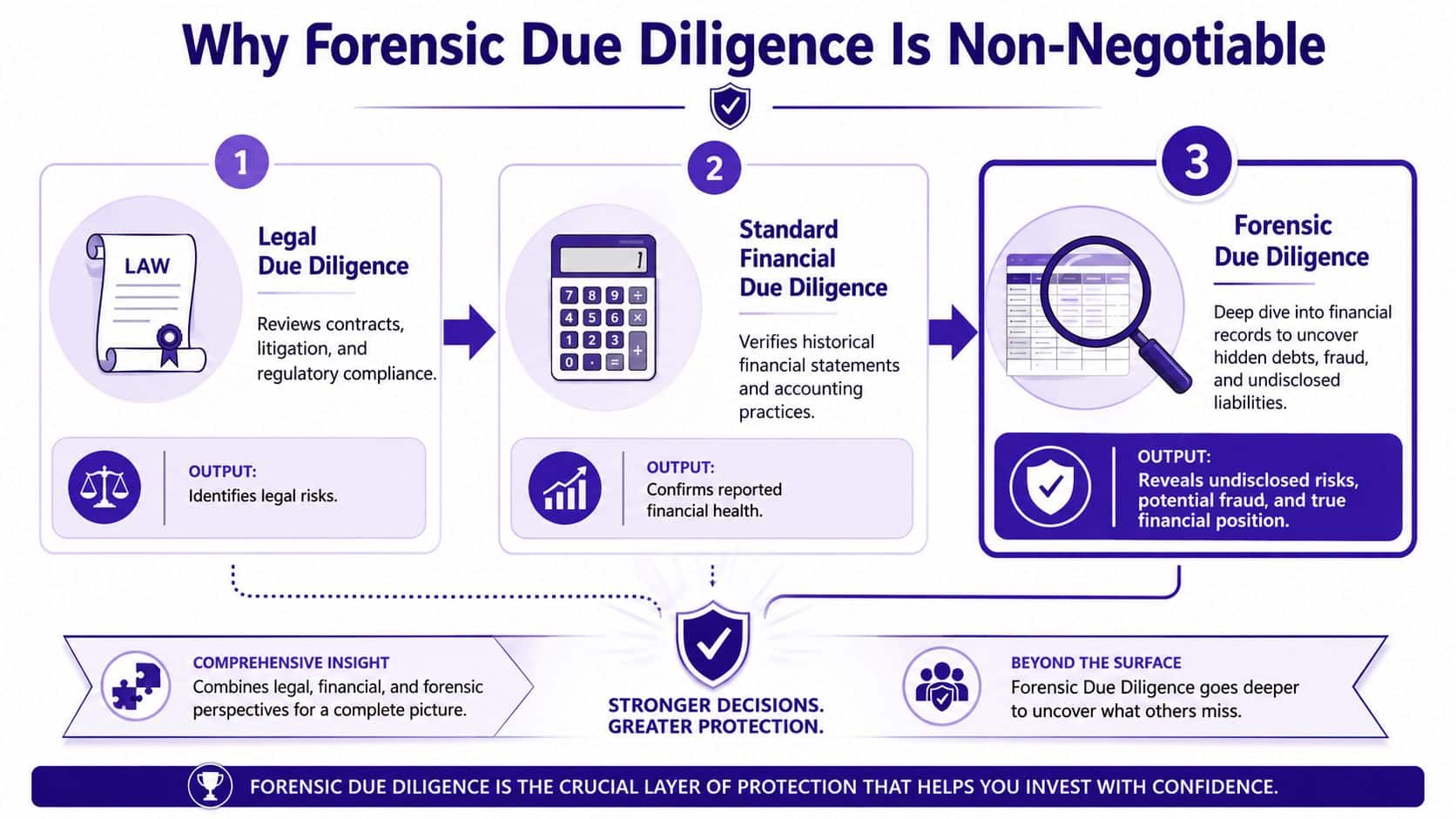
Legal diligence checks rights, obligations, disputes, and compliance. Financial diligence often tests whether headline performance supports the valuation. Forensic due diligence examines whether the reported position can be relied on at all, whether earnings were flattered before sale, whether liabilities are complete, and whether value has been taken out of the business in ways the buyer has not fully understood.
What forensic work actually examines
A forensic accountant goes past the management pack and asks where the pressure points sit. The review usually includes quality of earnings, unusual journals, cut-off around period end, stock valuation, debtor recoverability, payroll anomalies, related-party transactions, tax exposures, and movements through directors' loan accounts.
That work matters because the SPA may give a buyer a legal route to claim, but recovery is often restricted by the drafting. Liability caps, baskets, time limits, knowledge qualifiers, and disclosure wording can reduce what is recoverable even where the underlying issue is real. The Practical Law note on limitation of liability clauses in share and asset sale agreements gives a useful overview of how these provisions are commonly structured in UK deals.
In practical terms, if the buyer can only recover within a tightly drafted claims framework, finding the issue before signing is worth far more than arguing about it afterwards.
Why routine accounting is not enough
A good external accountant or finance director may know how a business reports. That is different from investigating whether a seller had an incentive to present the business in the best possible light during a sale process.
Forensic work is sceptical by design.
Useful procedures often include:
- Testing revenue quality: checking whether sales are repeatable or boosted by late invoicing, one-off deals, channel stuffing, or credits raised after period end
- Reviewing liability completeness: comparing supplier statements, legal correspondence, HMRC records, and board papers against what appears in the accounts
- Checking control failures: identifying weak approvals, inconsistent reconciliations, unsupported journals, or override of normal finance processes
- Tracing cash leakage: examining dividends, management charges, related-party payments, and directors' balances to see whether deal value has already been extracted
For readers assessing whether a deeper review is justified, this guide to performing a forensic due diligence explains the scope in practical terms.
Standard diligence tells you what has been presented. Forensic diligence tests whether the presentation matches the underlying reality.
The real return is fewer disputes after completion
Buyers sometimes treat forensic work as an optional extra because it adds cost before exchange. That is the wrong comparison. The true comparison is between a targeted pre-deal review and a post-completion argument over disclosure, warranty wording, causation, quantum, and whether the seller can pay a claim.
If weak stock controls are identified before signing, the buyer can reduce price, hold money in escrow, tighten the completion accounts mechanism, ask for a specific indemnity, or decide the risk is not acceptable. If the same issue appears after completion, the buyer is already holding the problem.
That is why forensic due diligence protects more than the entry price. It protects the buyer's position under the SPA and the value of the business once the deal is done.
Negotiation Pitfalls and Financial Red Flags
The most revealing part of a transaction often isn't the draft SPA itself. It's how the seller reacts when the buyer pushes on detail. Resistance, delay, vagueness, and selective disclosure can tell you far more than a polished management presentation.
Red flags that deserve immediate scrutiny
Some warning signs appear repeatedly in troubled deals:
- Compressed disclosure late in the process: A long disclosure bundle delivered near signing often hides issues in volume rather than addressing them clearly.
- Resistance to financial backup: If the seller offers high-level summaries but avoids aged debtors, stock reports, reconciliations, or tax correspondence, ask why.
- Overly narrow warranties: A seller who insists on light wording around accounts, compliance, or disputes may already know those areas are exposed.
- Unclear adjustments: If the parties can't define debt, cash, or working capital cleanly, completion disputes often follow.
- Informal explanations for formal issues: “That's how we've always done it” isn't evidence.
Economic crime clauses now matter more
Recent UK guidance on economic crime has increased pressure on buyers to include specific anti-bribery and sanctions-related warranties, and many SMEs remain under-prepared for how those clauses are tested after the deal and how forensic evidence supports a warranty claim, as discussed in Harper James' practical UK SPA guide.
That point is easy to underestimate. Buyers often treat anti-bribery, fraud, sanctions, and internal controls language as specialist drafting for larger transactions. It isn't. If the target has weak controls, opaque payments, poor expense oversight, or unusual third-party relationships, those warranties become central.
When a seller says a warranty is “just legal wording”, check whether they're avoiding the factual statement underneath it.
What works in negotiation
The strongest negotiating position comes from joining legal drafting to financial evidence. If you can show that receivables are ageing badly, stock is overvalued, or expenses were deferred, you can ask for a specific fix. That may mean a lower price, a focused indemnity, a tighter disclosure standard, or an escrow holdback.
What doesn't work is raising general anxiety without evidence. Sellers dismiss broad concerns. They struggle more when the buyer can point to a ledger, reconciliation gap, tax query, or inconsistency between board papers and management accounts.
Negotiation is where risk allocation becomes real. Vague concern produces weak protection. Specific evidence provides an advantage.
Your SPA Checklist and Securing Your Investment
A strong SPA process is disciplined long before the signing meeting. The businesses that avoid ugly post-completion disputes usually do the basics well, then go further on verification where the risk justifies it.
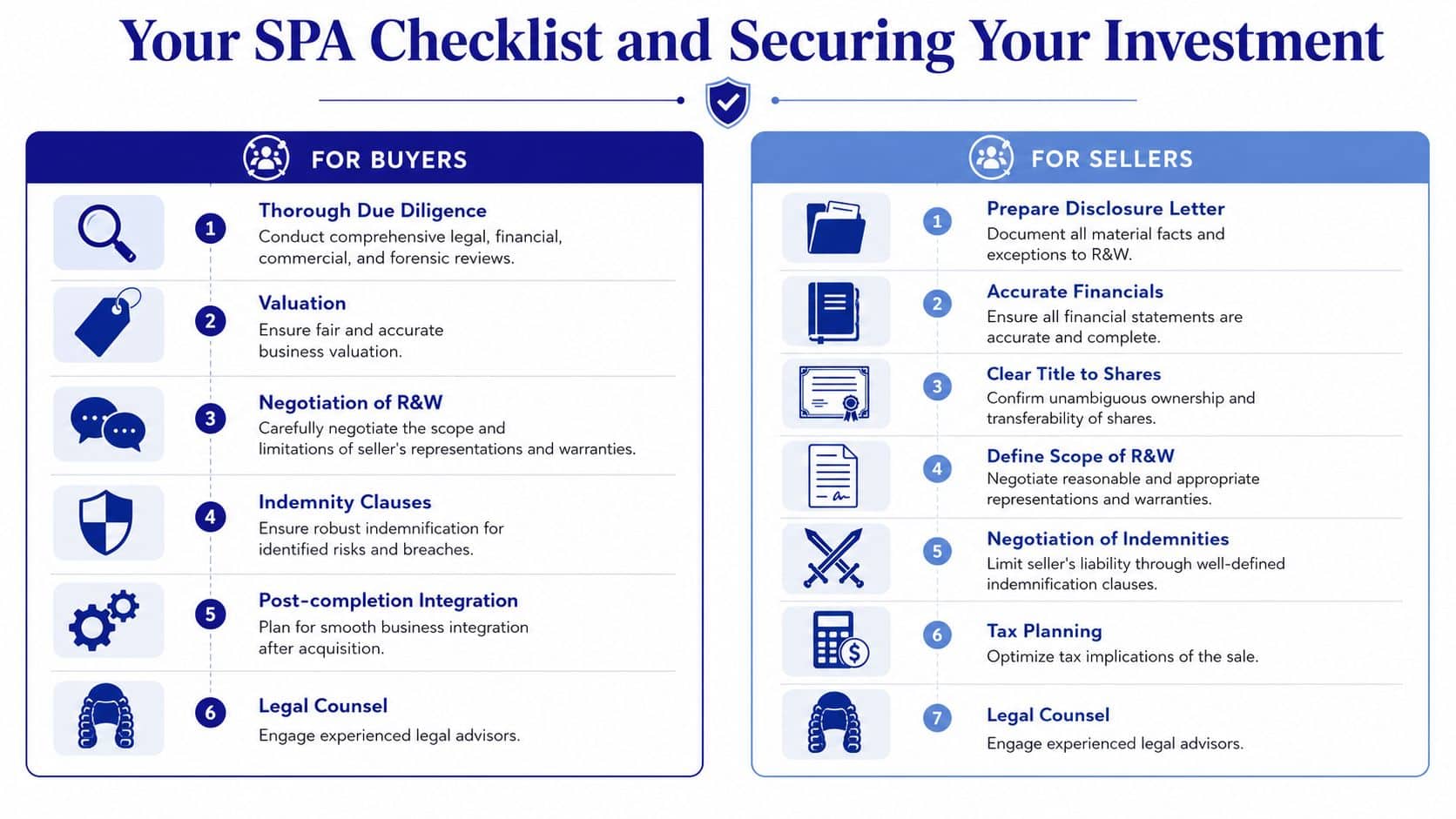
Buyer checklist
- Define the diligence scope early: Don't wait for draft documents to decide what financial testing matters.
- Tie findings to the SPA: If diligence reveals a risk, reflect it in price, indemnities, disclosure standards, or escrow.
- Challenge the quality of earnings: Profit isn't the same as maintainable profit.
- Check cash extraction controls: Locked-box and pre-completion leakage provisions only work if someone tests them.
- Plan claims before you need them: Keep evidence trails, document assumptions, and preserve access to records.
For wider control thinking, this practical guide on how to identify and mitigate fraud threats is useful because many transaction problems start with weak internal controls long before the sale process begins.
Seller checklist
Sellers need discipline too. A rushed, incomplete, or overly defensive process often damages value.
Key seller actions include:
- Prepare a proper disclosure exercise. Don't rely on memory or informal explanations.
- Make sure the financials reconcile. Buyers lose confidence quickly when board packs, ledgers, and tax records don't align.
- Support statements with documents. If a point matters, evidence it.
- Address difficult issues directly. Hidden issues become pricing problems later. Open issues can often be negotiated sensibly.
The practical takeaway
If you're still asking what is a Share Purchase Agreement, the best answer is this. It is a contract for transferring ownership, but it is also a mechanism for transferring risk. The quality of the deal depends on how accurately that risk is identified, priced, documented, and evidenced.
A buyer should never sign an SPA on the assumption that broad warranties will sort everything out later. A seller should never assume that a light disclosure process will survive scrutiny if a dispute follows. Good deals happen when both sides replace assumption with proof.
If you're buying, selling, or disputing a business transaction, Lighthouse Consultants can help you secure the financial side of the deal. Their London-based forensic accountants investigate the numbers behind the SPA, test warranties against evidence, quantify losses, and support solicitors, investors, boards, and business owners with clear, independent analysis. Start with a free discovery call, get a scoped action plan, and move forward with certainty, quality, and care.