Are you staring at a multi-million-pound deal that seems perfect on paper, yet a nagging feeling tells you something is off? You’re not alone. The biggest pitfall for UK businesses isn’t a lack of effort; it’s the dangerous over-reliance on a standard due diligence report template. This approach often becomes a box-ticking exercise, leaving your investment exposed to catastrophic risks lurking just beneath the surface. You diligently fill in the blanks, but the process fails to uncover the very threats—like inflated revenues, hidden liabilities, or outright fraud—that can turn a promising acquisition into financial ruin.
The Crushing Cost of a Superficial Review

Too many UK businesses fall into the trap of treating due diligence as a mere formality. They follow a standard template, verifying the information they’re given without ever truly questioning its integrity. It’s an oversight that can have disastrous consequences. After the deal closes, you might discover massive unforeseen liabilities, inflated revenues, or even outright fraud. What looked like a brilliant strategic move can quickly turn into financial and reputational ruin.
The real problem isn’t a lack of effort; it’s the missing investigative mindset. A standard review confirms what is presented. A forensic investigation, on the other hand, interrogates what is hidden. It is the difference between simple acceptance and genuine scrutiny, and it is the key to protecting your investment.
Dangers Lurking Beyond the Checklist
Using a generic due diligence report template creates a false sense of security. It pushes teams to focus on filling in fields rather than thinking critically about the information itself. This kind of superficial approach almost always misses the red flags that only a deeper analysis would catch. For example, a standard checklist is likely to miss:
- Hidden Financial Manipulations: This could be aggressive revenue recognition, off-balance-sheet entities, or strange inventory write-downs that artificially boost a company’s value.
- Operational & Compliance Gaps: Think weak internal controls, non-compliance with crucial regulations like the Modern Slavery Act, or undisclosed risks deep in the supply chain.
- Reputational Threats: Undisclosed litigation, integrity problems with key executives, or negative market sentiment that can destroy value post-acquisition.
The most expensive mistake in any transaction is the risk you failed to identify. Superficial due diligence doesn’t just miss details; it misses the entire story, leaving you to pay the price for a narrative you never knew existed.
Why Forensic Accounting is Non-Negotiable
This is exactly why integrating forensic accounting services is no longer an optional extra for high-stakes deals—it’s essential. A forensic accountant doesn’t just review the numbers; they investigate the story behind them. They are trained to actively hunt for anomalies, inconsistencies, and patterns that point toward financial misconduct or misrepresentation. By adopting a forensic mindset, you change the due diligence process from a defensive chore into a powerful strategic tool. It stops being about just avoiding losses and becomes about gaining the clarity you need to negotiate better terms and make decisions with real confidence.
Overcoming Common Objections to Forensic Due Diligence
Even with a major deal on the line, clients often hesitate before bringing in a specialist for forensic due diligence. We understand. The concerns nearly always circle back to the same three things: cost, time, and trust. Let’s tackle these head-on, because they are based on misconceptions about what a forensic investigation truly delivers.
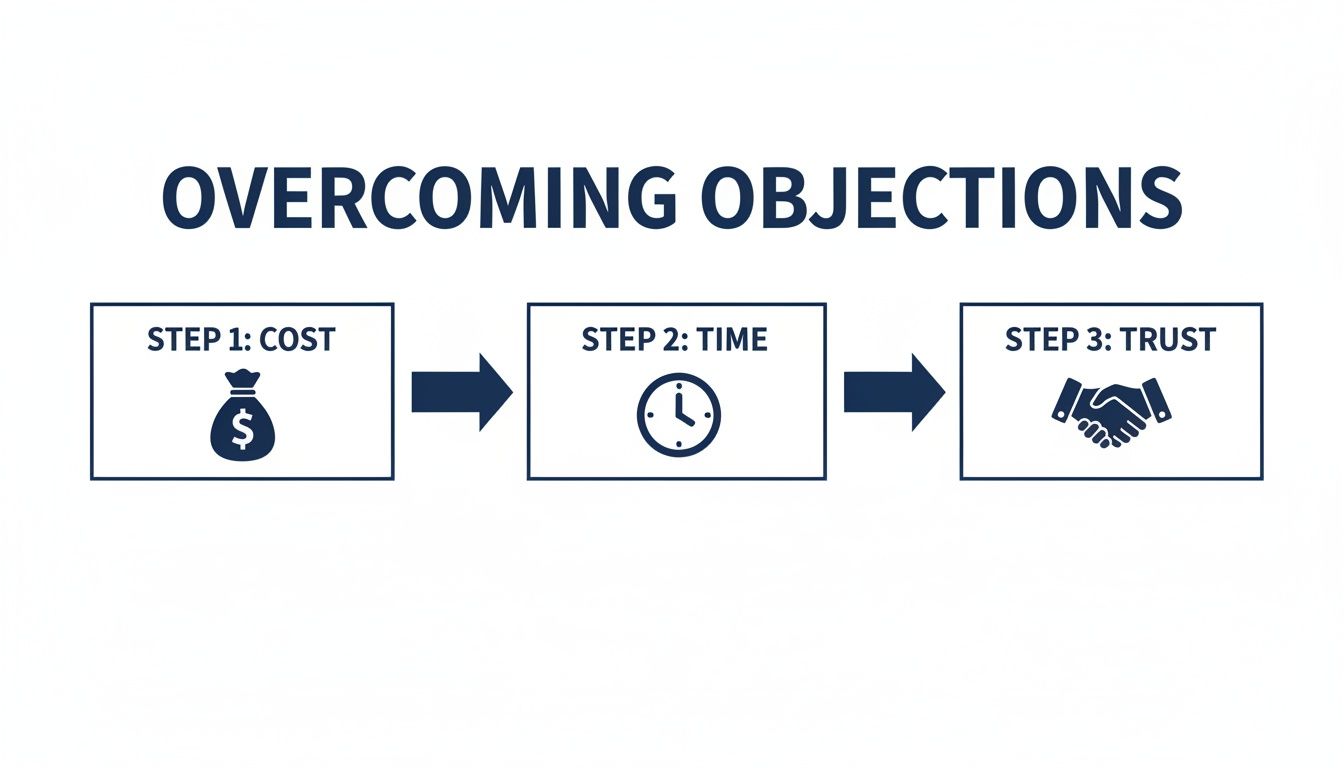
Objection 1: “It Costs Too Much. Our Team Can Handle It.”
The most common pushback is, without a doubt, the perceived expense. Leaders rightly focus on managing costs, and they often believe their internal team can manage just as well with a good report template. However, this view mistakes an investment for a cost. Think of specialist due diligence as insurance against a multi-million-pound mistake. The fee for a thorough, independent investigation is a tiny fraction of the potential seven-figure losses from just one undisclosed liability, a hidden fraud, or an inflated asset value that comes to light after the deal is signed. The real question isn’t about what it costs today, but what it could cost you if you get it wrong.
Objection 2: “We Don’t Have Time for a Deep Dive.”
Another major worry is the timeline. Executives are concerned that a meticulous forensic review will kill the deal’s momentum and blow past a tight deadline. In our experience, the opposite is true. It’s the shallow, disorganised reviews that cause delays. They generate vague questions and endless follow-up requests, leaving the board with more uncertainty than clarity. A structured forensic process, on the other hand, actually speeds up confident decision-making. We know precisely what to look for and how to analyse it with purpose. You get a clear, prioritised report with actionable findings, not a mountain of raw data. You can learn more by exploring the common objections to forensic accounting.
Objection 3: “We Know Them. We Trust Them.”
Finally, there’s the ‘trust’ objection. When you have a good relationship with a target company, commissioning an intensive investigation can feel like an act of distrust. But forensic due diligence isn’t about a lack of faith; it’s about professional verification and good governance. Even the most honest businesses can have issues they don’t know about, such as unintentional financial errors or hidden supply chain risks. Only a proper forensic investigation can bring these hidden risks to the surface. Engaging experts doesn’t undermine trust—it validates it with objective, irrefutable evidence.
A Forensic Framework for Your Due Diligence Report
You’re buried in documents, trying to finalise the due diligence report. There’s a nagging feeling, though, that you’re simply going through the motions. You’re ticking boxes on a generic template, but are you really uncovering the truth about the business? This is the fundamental failing of most standard due diligence templates. They offer a structure but lack the investigative edge needed to expose hidden risks. An effective report is more than a checklist; it’s a forensic framework designed to interrogate the facts, not just verify them.

The Anatomy of an Investigative Report
A proper forensic due diligence report is built differently. It’s structured to not only confirm the data you’ve been given but to actively hunt for what might be missing, misrepresented, or deliberately concealed. This level of scrutiny is essential in the current climate. For example, recent data shows 90% of UK retailers now include Modern Slavery Act audits in their due diligence. Overlooking these details isn’t just a compliance failure; it’s a massive financial and reputational liability waiting to happen. When pulling together a report with this much at stake, applying rigorous technical writing best practices is crucial. Every word must be clear, precise, and defensible.
The Lighthouse Consultants Framework: Beyond the Template
At Lighthouse Consultants, we don’t just hand you a template. We deliver a comprehensive, investigative service that brings it to life. Our work transforms due diligence from a box-ticking exercise into a powerful tool for finding the truth. We provide the expert forensic accounting services needed to ask the tough questions and get definitive answers. Our structured process includes:
- Deep Financial Forensics: We go far beyond the profit and loss statement, using advanced techniques to analyse cash flows and scrutinise the integrity of the balance sheet.
- Operational and Compliance Audits: We conduct deep dives into critical areas standard templates often miss, including supply chain vulnerabilities and internal control weaknesses.
- Integrity and Background Checks: We investigate the key people involved, because a company’s integrity is often a reflection of its leadership.
A due diligence report template is only as good as the questions it forces you to ask. Our framework is designed to ask the uncomfortable questions that expose uncomfortable truths before they become costly surprises.
A Deeper Dive Into Key Report Sections
Our forensic due diligence report template integrates specialised modules that standard formats simply overlook. Instead of a simple financial summary, we provide a detailed forensic analysis. Where a normal template might have a brief legal section, we incorporate a thorough review of potential litigation risks and regulatory exposures. The table below breaks down the essential components, showing how a forensic approach provides a much deeper level of analysis.
| Report Section | Standard Focus | Forensic Accounting Enhancement |
|---|---|---|
| Executive Summary | A high-level overview of key findings. | A concise, hard-hitting summary of quantified risks, red flags, and a clear “go/no-go” recommendation backed by evidence. |
| Financial Analysis | A review of historical financial statements and projections. | Forensic analysis of revenue recognition, quality of earnings assessment, and stress-testing of financial models to look for manipulation. |
| Operational & HR | A review of organisational charts and key contracts. | Deep analysis of employee turnover, incentive structures that may encourage misconduct, and a dive into supplier dependencies. |
| Legal & Compliance | A summary of existing legal agreements and compliance statements. | Proactive identification of potential litigation risks, regulatory exposures, and hidden liabilities in contracts or corporate structure. |
| Tax Review | Verification of tax compliance and historical payments. | Identification of aggressive tax planning schemes, potential transfer pricing issues, and unrecorded tax liabilities. |
This investigative approach delivers the actionable intelligence needed for confident M&A decisions. You can also explore our ten-step financial due diligence checklist for more practical insights. Our reports are built to give you certainty and the peace of mind that comes from knowing you’ve looked where others haven’t.
Thinking Like a Forensic Accountant to Identify Red Flags
The costliest mistake in due diligence is rarely the obvious fraud you spot from a mile away. It’s the tiny anomaly you dismiss as a rounding error or a typo. That single number that looks slightly off is often the thread that, when pulled, unravels a much larger problem. This is where a standard review falls short and a forensic mindset becomes essential. Many business leaders feel they lack the expertise for this kind of deep dive, but you don’t need to be a chartered accountant to start thinking like one. It begins with professional scepticism—a refusal to accept information at face value.
Adopting an Investigative Mindset
Thinking like a forensic accountant means you stop being a reviewer who simply verifies information. You become an investigator who validates it. Every document is potential evidence, and your job is to find what doesn’t add up. While specialist courses in auditing build a robust technical foundation, you can immediately sharpen your focus by looking for patterns. For example, don’t just accept the stated revenue figure. Ask why:
- Why did sales suddenly spike in the final month of the quarter?
- Are there unusual discounts or returns just after the period ends?
- Does the revenue data align with operational data, like shipping volumes?
This simple shift in perspective transforms any due diligence report template from a checklist into an investigative tool.
Your Practical Red Flag Checklist
A forensic accountant actively hunts for red flags. These are some of the critical areas we at Lighthouse Consultants scrutinise in every single engagement.
Financial Red Flags:
- Inconsistent Revenue Recognition: Look for sudden changes in accounting policy or aggressive booking of sales that are not yet earned.
- Complex Corporate Structures: Overly complicated group structures or off-balance-sheet vehicles can be used to hide debt and liabilities.
- Frequent Auditor Changes: While sometimes legitimate, regular changes in auditors or key finance staff often signal disputes over accounting treatment.
Operational Red Flags:
- High Staff Turnover in Finance: This can indicate a poor culture or that employees are uncomfortable with the company’s financial practices.
- Weak Internal Controls: A lack of segregated duties or poor oversight creates clear opportunities for fraud to occur.
- Dominant Senior Management: A CEO or CFO who consistently overrides controls and operates without challenge is a significant risk factor.
A minor anomaly is often a symptom of a major liability. The true value of forensic analysis lies in connecting those seemingly unrelated dots to reveal the full picture before you commit to a deal.
From Template to Certainty with Lighthouse Consultants
This is where a template ends and our expertise begins. A checklist gives you the questions; our forensic accounting work delivers the definitive answers. In one recent case, our forensic analysis uncovered clauses in customer contracts allowing full returns up to six months post-sale. The company was booking 100% of the revenue on day one, artificially inflating its value by millions. That discovery completely altered the deal’s valuation and protected our client from a disastrous acquisition. We don’t just fill in your due diligence report template; we bring it to life with investigative rigour. You can learn more about the specific forensic accounting techniques we use in our work.
How Lighthouse Consultants Delivers Certainty Beyond a Template
You’ve structured your findings, perhaps using a solid due diligence report template. Yet a nagging question remains. Your analysis is built on data from the very people who have the most to gain. Will your report hold up under scrutiny from the board, lenders, or even in court? This is where even the best template falls short—the gap between a well-organised report and defensible certainty. Many businesses feel the urge to simply “get it done” internally, worried about extra costs or delays. This view, however, overlooks a crucial point: an internal report, however thorough, lacks the independence required to withstand a legal challenge.
The Lighthouse Solution: Clarity from Discovery to Delivery
Our entire process was built to deliver objective financial quantification that withstands any challenge, turning your due diligence from a defensive task into a strategic asset. Our approach is transparent and built for clarity.
- Free Discovery Call: Everything begins with a no-obligation call. We listen first to understand your transaction, its context, and the specific risks you’ve identified.
- Clearly Scoped Action Plan: Following our call, we create a precise plan of action. You get a clear outline of what we’ll investigate, the timeline, and the cost upfront. No surprises, no scope creep.
- Independent, Defensible Reporting: The final report delivers the hard numbers and objective analysis you need. It is structured from the ground up to be clear, concise, and ready for scrutiny in any boardroom or courtroom.
True confidence in a deal doesn’t come from a template; it comes from an independent, expert validation of the facts. Our reports are crafted not just to inform but to defend your position under pressure.
Our Directors as Expert Witnesses: A Critical Advantage
This is where Lighthouse Consultants provides a level of assurance that a standard review cannot match. Our directors are not just accountants; they are seasoned professionals who regularly act as expert witnesses in high-stakes commercial disputes. This means every report we produce is created with the same rigour required for court evidence. When we quantify a financial risk or uncover a hidden liability, it is not an opinion. It is a figure we are prepared to stand behind and defend under cross-examination. This forensic, litigation-ready mindset is part of our DNA. Our expert forensic accounting services, combined with deep sector experience, give you an unmatched advantage. We equip you to negotiate from a position of strength, armed with irrefutable facts. Don’t let uncertainty jeopardise your next major transaction.
Common Questions About Forensic Due Diligence
Once business leaders see the risks of a standard tick-box review, they start asking different questions. You’re right to be concerned about spiralling costs or losing control of a deal’s timeline. These are valid points. We’ll tackle the most frequent questions we hear, showing how a proper investigation brings clarity, not more complexity.
How Long Does a Forensic Due Diligence Investigation Take?
This is always a key question, especially when a transaction deadline is closing in. A focused review on a smaller business might only take two to four weeks, while a complex investigation into a company with international operations could run for several months. However, a professional firm won’t leave you with an open-ended timeline. We always start with a rapid scoping phase to map out the work required. This means you get a realistic timeline upfront, ensuring we hit your deadlines without ever cutting corners on rigour.
What Is the Difference Between Standard and Forensic Due Diligence?
In simple terms, standard due diligence checks the information you’ve been given. Forensic due diligence investigates it.
Standard due diligence is like checking the map the seller gives you. A forensic approach is like hiring an expert guide to scout the territory for hidden cliffs and dangerous paths the map conveniently leaves out.
A standard due diligence report template is designed to confirm information. Our forensic method, on the other hand, actively hunts for red flags, signs of fraud, and hidden liabilities that never make it into the official records. It’s the critical difference between acceptance and investigation.
Can I Use a Due Diligence Report Template for My Own Investigation?
Of course. A good template can be an excellent starting point for an internal audit or a preliminary review. It provides a solid framework to organise your thoughts and make sure you’re covering the basic areas. However, when you’re dealing with significant financial risk, a shareholder dispute, or the possibility of litigation, you need an independent firm like Lighthouse Consultants. Our independence is what makes our findings credible and defensible in court. An internal report simply can’t meet that standard of impartiality.
Is This Level of Due Diligence Necessary for an SME?
Yes, and you could argue it’s even more critical. A large corporation can often absorb a multi-million-pound loss from a bad acquisition. For a small or medium-sized enterprise, a single hidden liability can be an existential threat. The key is making the work proportional. Our expert forensic accounting services are designed to be scalable. We focus our investigation on the specific risks that are most relevant to your deal size and industry. This gives you maximum protection for a proportionate investment, so you can move forward with confidence.
Don’t let unanswered questions create unnecessary risk. At Lighthouse Consultants, we deliver the clarity you need to act decisively. Our independent, expert analysis turns due diligence from a source of anxiety into a real strategic advantage.
Ready to move forward with complete confidence? Book a free, no-obligation discovery call with us today.