When an HMRC penalty notice lands on your desk, the immediate problem rarely stays “just tax”. A missed Self Assessment return can come from a family crisis, a bookkeeping backlog, a shareholder dispute, lost records, a cash squeeze, or someone inside the business not doing what they said they'd do. By the time the brown envelope arrives, you're not just dealing with a deadline. You're dealing with pressure, uncertainty, and a paper trail that may already be weak.
That's why self assessment late filing penalties deserve more than a quick payment and a shrug. In practice, they often expose a wider control failure. A forensic accountant looks at that failure differently from a standard compliance adviser. The question isn't only “What does HMRC say you owe?” It's also “Why did this happen, what evidence exists, and is there a deeper financial issue that needs investigating before the position gets worse?”
That Dreaded Brown Envelope from HMRC
Most business owners know the feeling. You open the envelope, scan the first lines, and your attention goes straight to the word “penalty”. Your mind then jumps ahead. Is this enforceable? Did the accountant miss something? Was a return even required? If no tax was due, why has HMRC fined me at all?
That reaction is understandable. The notice arrives as an administrative event, but it often lands in the middle of something messier. A director may be untangling records after a dispute with a former partner. A landlord may be trying to rebuild figures from scattered statements. A consultant may have delayed filing because income records were incomplete and no one wanted to submit a return that might later prove wrong.
A penalty notice is often the first visible sign of an invisible records problem.
Forensic accounting becomes relevant at exactly that point. Not because every late filing case involves fraud or litigation, but because many involve evidence gaps, weak controls, disputed figures, or unclear responsibility. If a finance function has broken down, you need more than deadline reminders. You need someone to reconstruct what happened and support a defensible position.
Why the first reaction is often the wrong one
Many people either ignore the notice or pay it immediately to make it disappear. Both responses can be costly.
If you ignore it, the administrative problem can harden into a larger financial one. If you pay without reviewing the background, you may miss a valid appeal, overlook a records failure, or fail to address the conduct that caused the late filing in the first place. That matters if the same weakness affects other returns, other taxes, or even a live dispute.
What the notice may really be telling you
A late filing penalty can point to several underlying issues:
- Broken record keeping: Records exist, but they're incomplete, duplicated, or spread across personal and business accounts.
- Control failure: One person handled submissions with no oversight, and nobody checked whether the return was filed.
- Dispute conditions: Access to books, bank statements, or source documents has become restricted.
- Financial distress: The filing delay may reflect broader avoidance because the taxpayer feared the payment position.
In those situations, a forensic accountant doesn't just look at the penalty. They test the narrative against the documents.
The Real Cost of Self Assessment Late Filing Penalties
Self assessment late filing penalties escalate quickly. The regime is designed to punish delay, not merely non-payment. That distinction catches many taxpayers off guard, especially those who assume no tax due means no real exposure.
According to HMRC's Self Assessment penalties guidance, the late-filing regime starts with an automatic £100 penalty as soon as the filing deadline is missed, even if no tax is due. After 3 months, HMRC can charge £10 per day for up to 90 days, creating a further maximum of £900. At 6 months, a further charge of 5% of the tax due or £300, whichever is greater, applies. At 12 months, another 5% or £300 applies. That means a return left outstanding for a year can generate a minimum late-filing penalty of £1,600, even where no tax is due.
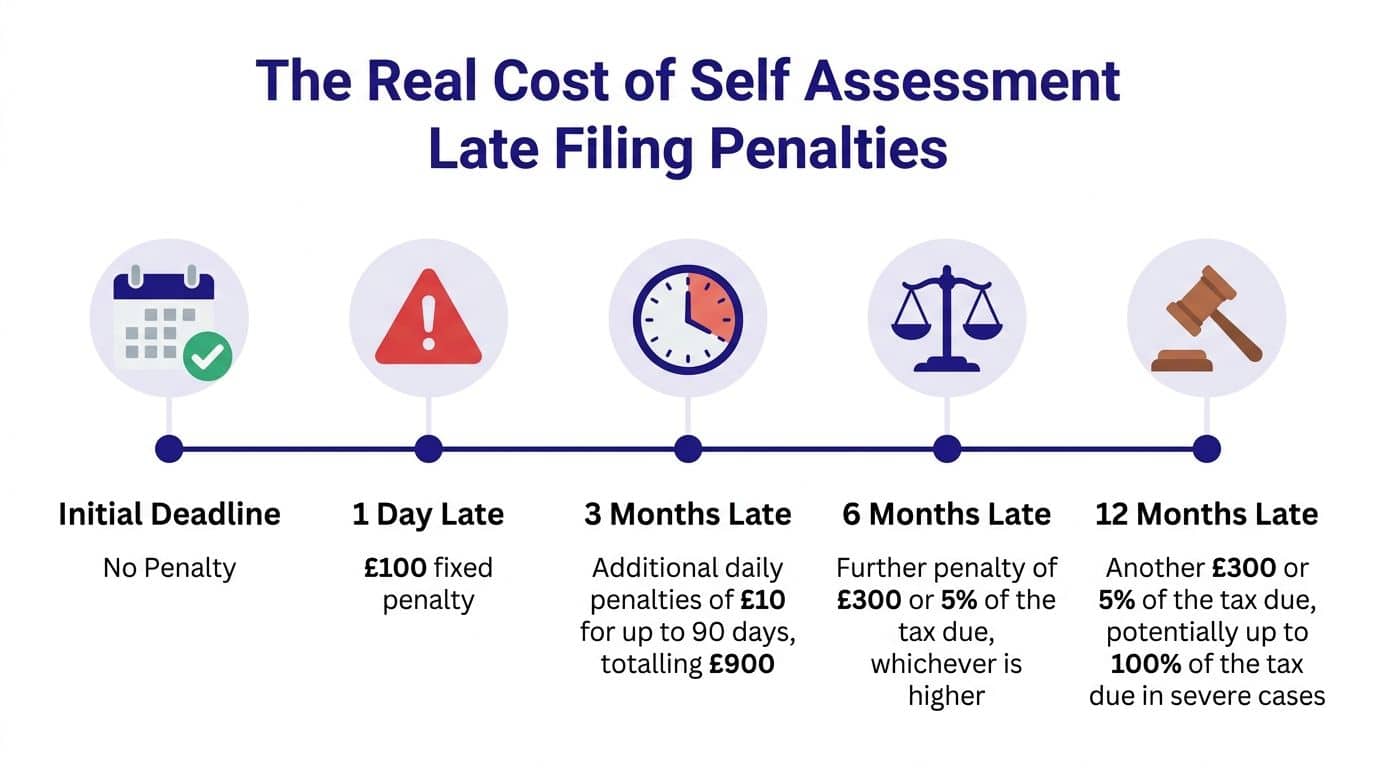
The penalty timeline in plain English
| Point in time | What happens |
|---|---|
| Miss the filing deadline | £100 automatic penalty |
| After 3 months | £10 per day for up to 90 days |
| After 6 months | Extra 5% of tax due or £300, whichever is greater |
| After 12 months | Another 5% of tax due or £300, whichever is greater |
The practical point is simple. Delay costs money fast, and the structure doesn't care whether the original reason was forgetfulness, confusion, or an unresolved records issue.
Why owners underestimate the exposure
People often fixate on the first penalty notice. They treat the £100 as the whole problem. It isn't. It's the entry point into a timetable that keeps running until the return is filed or the position is regularised.
That matters in disputes and investigations. If records are missing because of a breakdown with a co-director, for example, “we were still sorting it out” won't stop the clock by itself. Someone has to gather evidence, establish the actual filing position, and decide whether to submit, appeal, or both.
Practical rule: File or address the filing issue first. Debating fairness while the return remains outstanding usually makes the position worse.
Where forensic accounting adds value
A forensic accountant helps when the difficulty isn't arithmetic but evidence. Common examples include:
- reconstructing income and expense records from fragmented data
- separating business and personal transactions
- testing whether a late filing arose from poor controls, concealment, or genuine disruption
- preparing a chronology that supports an appeal where the taxpayer had a real obstacle to filing
That kind of work is often what turns a vague explanation into a credible submission.
Beyond Penalties Unseen Costs of Interest and Surcharges
Late filing is only one side of the problem. The other side is payment. Taxpayers often conflate the two, then make a damaging assumption that if they can't yet pay, there's no point filing. In practice, that's one of the worst decisions you can make.
Filing and paying are separate obligations. A person can file on time and still face charges for late payment. Equally, a person can pay but still receive self assessment late filing penalties if the return itself was not submitted. When both happen together, the financial pressure becomes harder to control and much harder to explain away.
Why the distinction matters
The filing penalty punishes missing the return deadline. Payment consequences arise because tax remains unpaid after the due date. Interest can also continue to run on unpaid amounts. The longer the matter sits unattended, the more the position shifts from a manageable compliance issue into a debt problem.
That's why businesses in distress need a joined-up response. If your records are uncertain, file what you can support. If your payment position is weak, address that directly. A practical overview such as this founder's guide to tax levies helps explain how unpaid tax issues can escalate into formal collection action if left unchecked.
What works and what doesn't
Some responses reduce damage. Others usually increase it.
- What works: taking the filing issue seriously even when cash is tight
- What works: assembling records early enough to understand the exposure
- What works: opening a dialogue with HMRC once the true position is clear
- What doesn't: assuming silence buys time
- What doesn't: waiting for “perfect” records before doing anything
- What doesn't: treating every HMRC letter as if it concerns the same type of charge
A forensic accountant can be useful here because they don't approach the matter as a generic admin error. They isolate the obligations, identify document weaknesses, and help produce a financial narrative that can support a payment discussion or a challenge where appropriate.
Common Pitfalls and Why Small Problems Escalate
Late filing isn't rare. TaxWatch reported that over 1.1 million UK taxpayers missed the Self Assessment deadline for the 2023/24 tax year, whose deadline was 31 January 2025, and that HMRC levied over £100 million in late-filing penalties in that context, as noted in TaxWatch's discussion of penalty charges when no tax is owed. That tells you two things. First, many people get this wrong. Second, HMRC applies these penalties at scale.
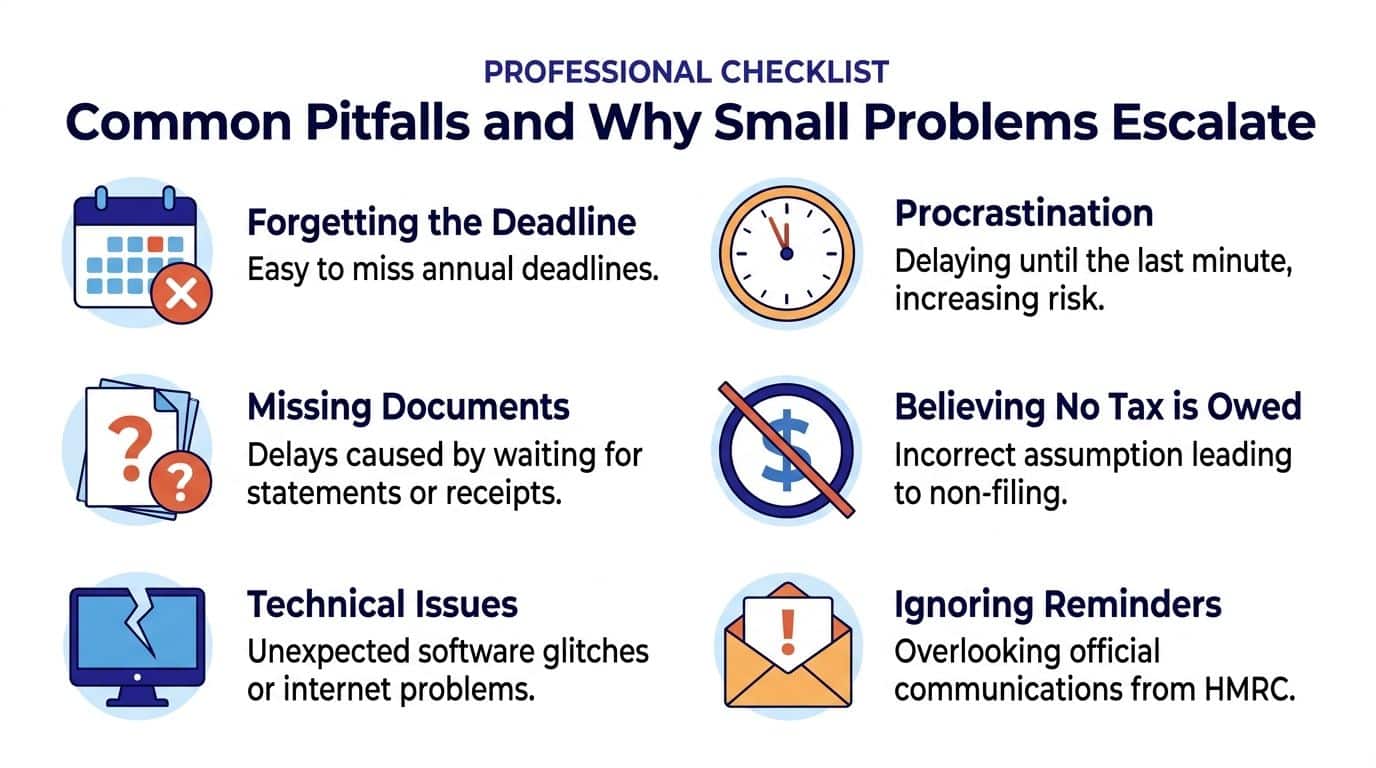
The usual operational failures
Most missed returns don't start with defiance. They start with friction.
A business owner may postpone the task because one bank account hasn't been reconciled. A contractor may wait for missing paperwork. A director may assume an adviser has filed when nobody checked submission confirmation. Weak retention practices also play a part, which is why disciplined record management matters. This guide on how long to keep UK tax records is a useful reminder that evidence problems often begin long before the filing deadline.
The myths that cause the most damage
Several assumptions repeatedly make bad situations worse:
- “No tax due means no penalty.” It doesn't.
- “I'll wait until every figure is perfect.” Delay often costs more than controlled correction.
- “My accountant had it in hand.” If you can't evidence what was filed and when, that belief won't help much.
- “It's only a small delay.” Small delays turn into formal penalties surprisingly quickly.
The smallest compliance failures often reveal the biggest weaknesses in financial control.
Why professional help isn't an unnecessary extra
Some owners hesitate because they see specialist help as disproportionate. That's understandable if the issue looks minor on paper. But once late filing connects with unclear records, disputed access, suspected wrongdoing, or repeated compliance lapses, the actual task isn't form filling. It's fact-finding.
A forensic accountant helps identify who had responsibility, what records existed, whether documents were withheld, and whether the explanation offered to HMRC can be evidenced. That approach prevents a one-off penalty from masking a repeated systems failure.
How to Appeal Penalties with a Reasonable Excuse
An HMRC penalty notice isn't always the final word. Some penalties can be challenged if you had a reasonable excuse for filing late. The phrase sounds straightforward, but appeals often fail because the taxpayer gives HMRC a story instead of evidence.

A persuasive appeal does three things. It identifies the event that prevented filing. It ties that event to the actual period of delay. It shows that the taxpayer acted without undue delay once the obstacle ended.
Evidence first, argument second
Many appeals falter at this point. People write emotionally, explain how busy life was, or blame an adviser in general terms. HMRC tends to respond better to chronology, records, and corroboration.
Useful evidence may include correspondence, medical material, access logs, engagement records, document requests, internal messages, or proof that key financial information was unavailable for reasons outside the taxpayer's control. In more complex cases, the issue may overlap with a wider complaint about HMRC handling or process. Where that happens, guidance on how to complain to HMRC can help you separate the penalty appeal from the complaints route.
Don't ask HMRC to infer the facts. Put the facts in order and make each one provable.
Situations that need forensic accounting input
Some appeals involve more than a simple explanation. For example:
- Business disputes: one party controls the accounting records and refuses access
- Fraud discovery: the person responsible for finance concealed transactions or failed to maintain books
- Document loss: records were damaged, removed, or rendered inaccessible
- Control failure: no one can establish what was filed, by whom, or on what basis
In those cases, a forensic accountant can reconstruct the timeline, test the records, and prepare an evidence pack that reads as credible rather than defensive.
For a non-UK comparison of how structured penalty challenges are approached in another tax system, this article on how to challenge IRS penalties is useful because it shows the same core principle. Tax authorities respond better to documented facts than to general frustration.
A short explainer may also help frame the issue before drafting the appeal.
What usually weakens an appeal
A weak appeal tends to have one or more of these faults:
- No timeline: events are described, but not dated or connected
- No proof: the narrative may be true, but nothing independently supports it
- No follow-up action: the taxpayer can't show they acted promptly once able to do so
- Misplaced blame: responsibility is pushed onto another person without documents to support that position
A strong appeal is rarely dramatic. It is organised.
When Penalties Signal Deeper Trouble
A penalty can be a symptom, not the disease. In forensic accounting work, missed filings often sit alongside poor cash control, inaccessible records, internal conflict, or suspected financial misconduct. The penalty gets attention because it is formal and immediate. The root cause often remains hidden until someone tests the underlying records.
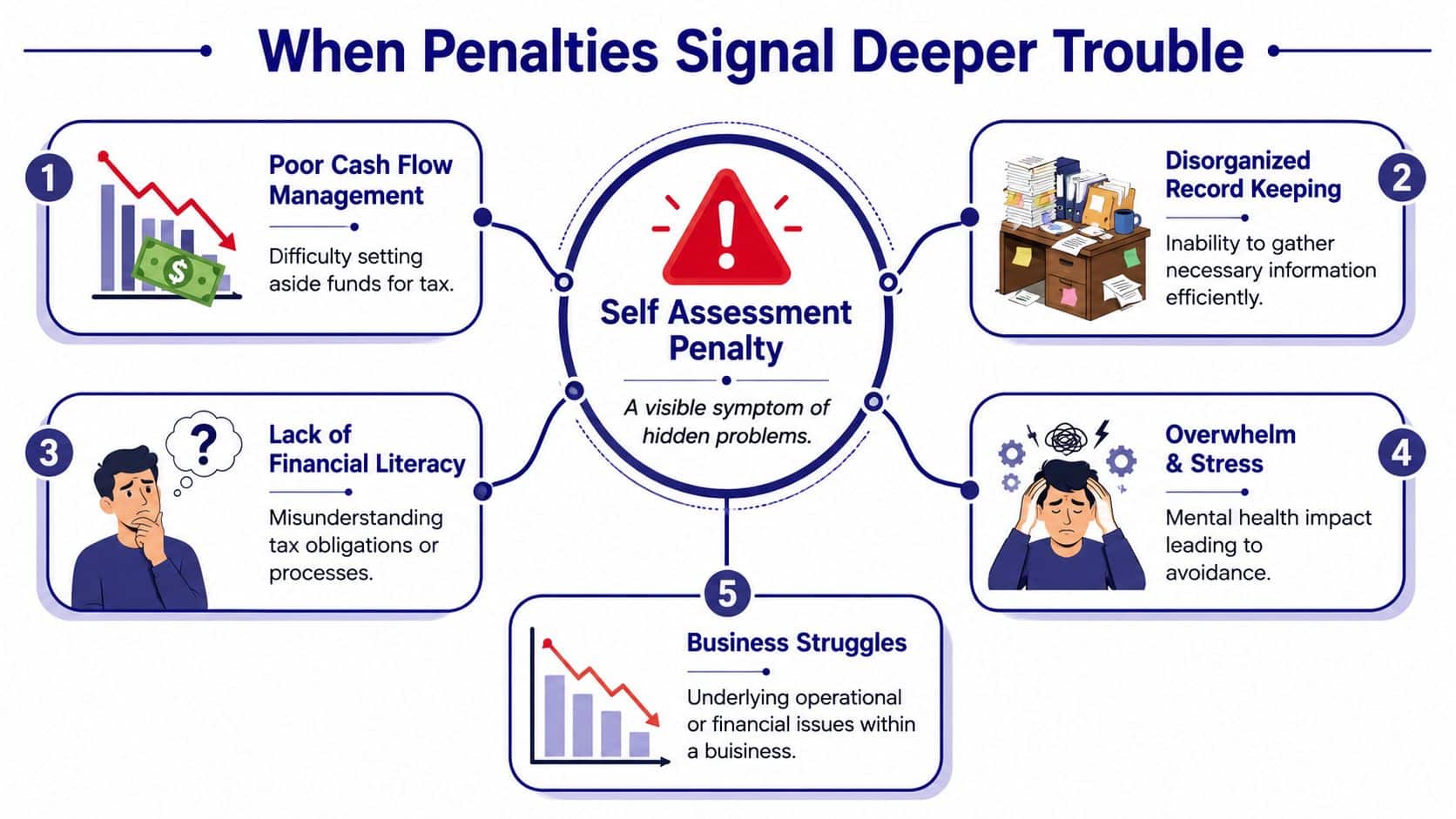
The warning signs behind the notice
When a late filing issue arrives with any of the following, it's worth pausing before treating it as routine:
- Missing source documents: invoices, statements, and ledgers can't be matched
- Conflicting explanations: directors or advisers give different accounts of what happened
- Restricted access: one individual controls the finance systems or bank information
- Recurring problems: missed deadlines appear across more than one obligation
- Unusual transactions: the records contain entries that no one can explain clearly
Those aren't just tax admin points. They can indicate poor governance, negligence, or deliberate concealment.
What a forensic investigation changes
A forensic accountant brings a different discipline to the problem. Instead of compiling figures for submission, they test whether those figures can be supported, whether the record set is complete, and whether the apparent explanation fits the documentary trail.
That can matter if HMRC starts asking broader questions. It also matters in parallel disputes. A late filing caused by a shareholder fallout, for instance, may overlap with allegations about diverted funds, blocked access to records, or inaccurate management information. Where matters begin to move towards formal scrutiny, this guide to investigation by HMRC is a useful starting point for understanding the wider context.
Some tax problems are really evidence problems wearing a tax label.
Why this matters to lawyers and business owners
Lawyers need facts that will stand up under challenge. Business owners need clarity fast enough to stop a records issue becoming a litigation issue. In both cases, the value of forensic accounting lies in independence, reconstruction, and quantification. It turns suspicion into tested findings and disorganisation into an evidence-led position.
Your Next Steps and Preparing for Future Changes
If you're facing self assessment late filing penalties, the immediate goal is control. Identify whether the return is still outstanding, what records support it, whether there is a credible basis for appeal, and whether the payment position needs separate attention. Avoid the common mistake of treating the problem as purely administrative if the records are weak or the explanation is disputed.
The longer-term goal is resilience. Good compliance doesn't come from panic in January. It comes from orderly books, clear ownership of filing responsibilities, retained evidence, and oversight strong enough to detect when something hasn't been submitted.
The regime is changing
HMRC has confirmed that from 6 April 2027 it will replace the automatic £100 late-filing penalty for Self Assessment with a points-based system. Under that system, annual filers will need 2 points before a £200 penalty is charged, and points expire after two years if the taxpayer stays below the threshold, according to PEM's summary of the upcoming HMRC penalty changes.
That change may reduce some one-off nuisance penalties, but it also creates a different management problem. Businesses and individuals will need to track compliance history more carefully. A missed obligation may no longer hurt immediately, yet it can leave a point on the record that makes the next error more expensive.
What to put in place now
A sensible response includes a mix of process and evidence discipline:
- Create filing ownership: one named person prepares, another verifies submission
- Keep proof of submission: save confirmations, dates, and supporting schedules
- Review record quality early: don't wait until the deadline month to discover gaps
- Escalate unusual delays: if records are blocked by a dispute or suspected fraud, investigate that cause directly
- Use the right advisers: a standard bookkeeper helps with routine administration, while a forensic accountant helps when facts are disputed or records need reconstruction
If you're comparing support models, this guide for small business accounting firms is a useful high-level resource for thinking about what different advisers do well and where specialist input becomes necessary.
Act early. Penalties are easier to contain than to unwind, and underlying financial problems are cheaper to investigate before they harden into formal disputes.
If a penalty notice has exposed missing records, disputed figures, suspected fraud, or a wider HMRC issue, Lighthouse Consultants can help you take control. Their London-based forensic accountants investigate complex financial problems, reconstruct evidence, quantify losses, and prepare clear, independent analysis that stands up in negotiations, complaints, and court. If you need certainty, quality, and care in a difficult tax or dispute matter, contact Lighthouse Consultants for a confidential discussion.