You sell your business. Heads of terms are agreed. Lawyers push the documents over the line. Then the argument starts after completion, when everyone thought the hard part had finished.
That argument often centres on a working capital adjustment. Owners who negotiated hard on enterprise value can still lose real money if the adjustment mechanics are weak, vague, or based on the wrong benchmark. Commercial litigators see the aftermath when parties accuse each other of manipulation. Finance teams feel it when they have to rebuild the closing balance sheet under pressure. By that point, the dispute has already become expensive.
The mistake is treating working capital as a routine formula. It isn't. In UK deals, it's often a pricing mechanism, a drafting exercise, and a forensic evidence problem all at once.
The Deal Is Done But the Dispute Is Just Beginning
A familiar version of this dispute often begins subtly. A seller believes the agreed price is settled. The buyer then delivers a completion statement that says closing working capital came in below target. The buyer says the shortfall reduces the final consideration. The seller says the business was handed over in the ordinary course. Both sides think the numbers are obvious. They rarely are.
What makes this so frustrating is that the disagreement often doesn't begin with fraud or bad faith. It begins with ambiguity. One side includes an accrual. The other excludes it. One side treats a debtor balance as fully recoverable. The other increases the bad debt provision. A stock line that looked routine in due diligence becomes “slow-moving” after completion.
A weak working capital clause doesn't remove conflict. It postpones it until the money is harder to recover and the positions are more entrenched.
For sellers, this can feel like a price chip after the event. For buyers, it can feel like they inherited a business with less day-to-day liquidity than they paid for. Both concerns can be genuine. That's why the issue belongs in the core deal mechanics, not in the footnotes.
Why this catches owners out
Many owners focus on headline price, tax, and warranties. They assume working capital will sort itself out because the finance team already produces monthly accounts. That confidence is misplaced. Monthly management accounts are useful, but they don't answer the deal question on their own. The deal question is narrower and harsher: what level of operational liquidity was the seller required to deliver at completion, using agreed rules?
That's also why strong pre-deal work matters. Good diligence doesn't just identify risk. It frames the accounting arguments before they turn into legal ones. If you're dealing with a sale process now, due diligence that prevents post-deal disasters is not an optional extra.
Where the real fight usually sits
The arithmetic is rarely the true battlefield. The fight usually sits in three places:
- Definition risk: Which balance sheet accounts count as working capital, and which do not.
- Policy risk: Whether completion accounts follow historic practice, buyer policy, or a bespoke hierarchy in the SPA.
- Evidence risk: Whether either side can prove why a number is normal, exceptional, or wrong.
Once those points are unclear, the dispute stops being an accounting tidy-up and becomes a value leakage problem.
What Is a Working Capital Adjustment
At its simplest, a working capital adjustment makes sure a business is handed over with enough operating liquidity to keep trading normally after completion. It's similar to buying a car and expecting enough fuel to drive it away. If the tank is nearly empty, you haven't really received what you thought you bought.
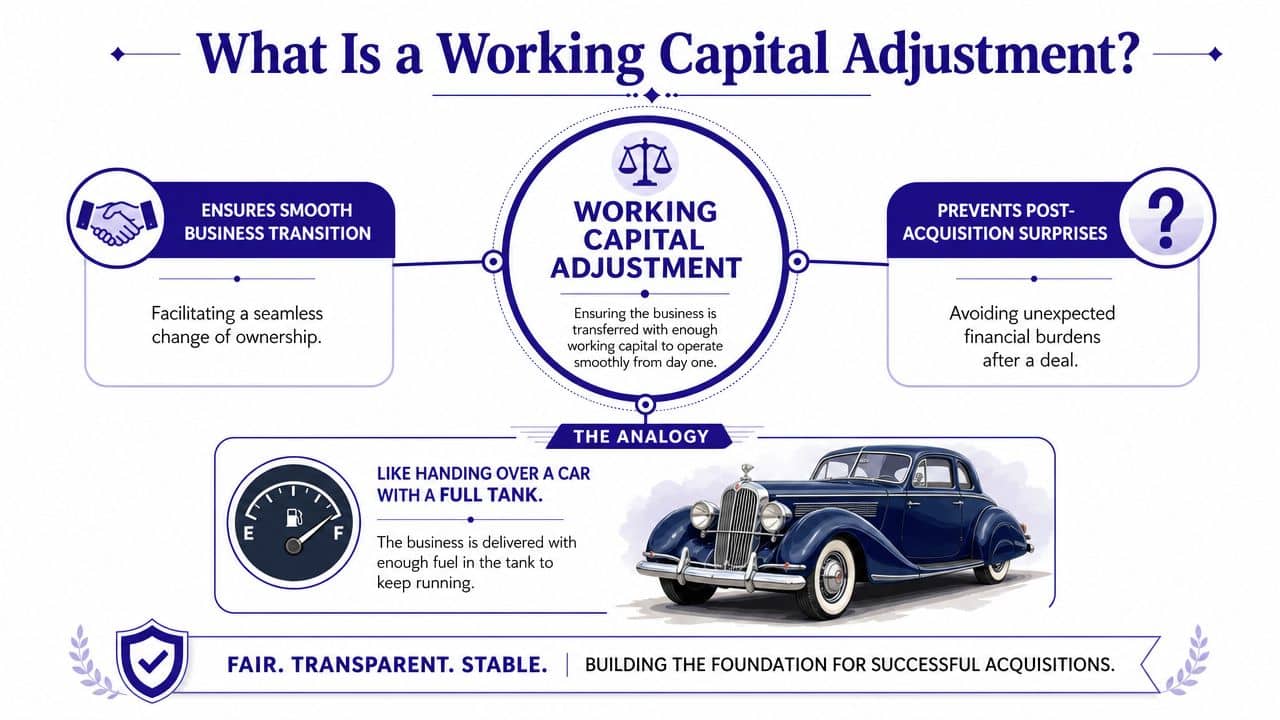
In UK-style M&A, the basic mechanism is usually straightforward. The parties agree a target level of net working capital, then compare that target with the actual level at closing. If closing net working capital is below target, the price moves against the seller. If it is above target, the seller usually receives the benefit. Holland & Knight summarises the principle clearly in its note on working capital adjustments in M&A transactions: purchase price is adjusted pound-for-pound where closing net working capital differs from the agreed target.
What usually goes into the calculation
The technical definition often starts with current assets minus current liabilities. In practice, the deal usually narrows that to operating items. Cash, debt, and non-operating balances are often carved out because the buyer wants the business delivered with the right operating liquidity, not with financing items mixed into the same bucket.
A simple working definition often includes:
- Trade receivables: money due from customers in the ordinary course.
- Inventory: stock needed to fulfil ongoing trading.
- Trade payables and accruals: ordinary operating liabilities the business carries as it trades.
Why buyers and sellers both need it
A buyer needs protection against receiving a business that looks profitable but arrives short of trading liquidity. A seller needs protection too. Without an agreed mechanism, a buyer can later argue that ordinary timing differences justify a price reduction.
Practical rule: A working capital adjustment should preserve normal trading liquidity at completion. It should not become a second negotiation on value after the deal has closed.
That distinction matters. If the mechanism is drafted and measured properly, it protects both sides. If it's drafted loosely, it gives both sides fresh territory to fight over after completion.
Calculating the Working Capital Target
The target, often called the peg, matters more than many owners realise. Measuring closing working capital is only half of the exercise. The financial consequence comes from comparing that closing figure with a benchmark that is supposed to represent normal operations.
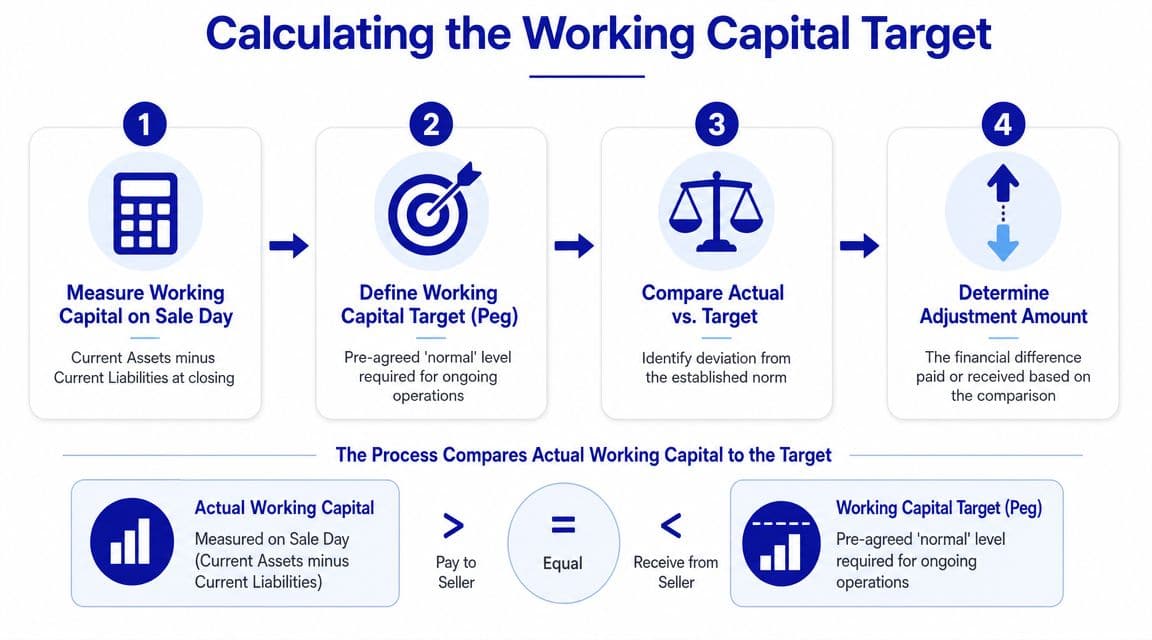
A lazy peg causes avoidable disputes. If you merely lift the number from the latest month-end balance sheet, you can hand one side a windfall and saddle the other with an unfair adjustment. Retail, manufacturing, recruitment, construction, logistics, and insurance-related businesses all show this in different ways. A single date can capture a seasonal spike, a payment backlog, or an unusual stock build.
Why one snapshot usually fails
Practitioners often use normalised working capital measures to account for seasonality and routine operations. BDO's explanation of working capital targets notes that a normalised 12-month average is commonly used, but there is no universal calculation. The reference period may use historical figures, forecasts or a combination, depending on the business and the negotiated deal.
The lesson for UK deals is practical. A closing peg should reflect the liquidity the business ordinarily needs, not an accidental high or low point in receivables, inventory, or payables.
What a sound peg analysis looks like
In practice, a thorough peg exercise usually includes a review of monthly balance sheet movements across a meaningful historical period, followed by careful normalisation. That means stripping out items that distort the picture of ordinary trading.
A sensible review asks questions such as:
- Receivables quality: Were collections normal, or did management chase cash unusually hard before completion?
- Inventory profile: Does stock include build-ups that don't reflect normal turnover?
- Payables timing: Were suppliers paid later than usual, making working capital look stronger than it really was?
- Accrual consistency: Were costs accrued on the same basis throughout the review period?
A buyer's diligence team will test each of those points. A prepared seller should do the same before the buyer does. That is one reason financial due diligence can change the outcome of a negotiation, not just document it.
Normalisation is where judgement matters
Normalisation isn't mechanical. It requires judgement grounded in records, board papers, post-period trading, and accounting policy. If the business won a one-off contract, carried an unusual stock reserve, or changed how it booked bonuses, you need to decide whether that should influence the target.
Here is the core trade-off:
| Approach | What it gets right | Where it fails |
|---|---|---|
| Single month-end peg | Quick and easy to explain | Highly vulnerable to timing distortions |
| Historic average with no adjustments | Better than a snapshot | Can still embed abnormal items |
| Normalised trailing analysis | Best reflection of routine operations | Requires more work and stronger evidence |
The extra work is worth it. A weak peg invites a post-completion argument. A well-supported peg narrows it.
Common Disputes and Normalisation Minefields
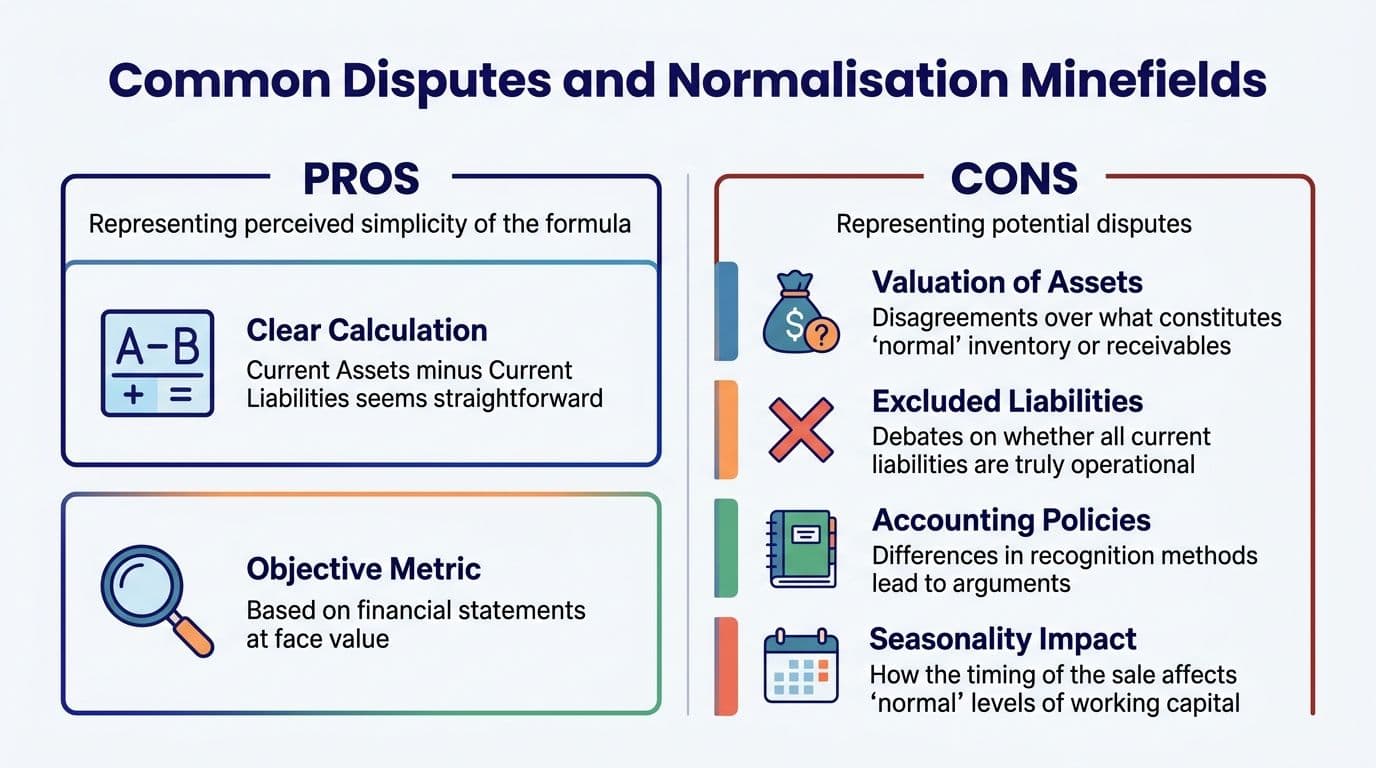
The formula looks simple on paper. That's why so many people underestimate it. The line items inside a working capital adjustment carry accounting judgements, legal consequences, and tactical incentives.
Public commentary from practitioners is blunt on this point. Thompson Coburn notes in its discussion of working capital adjustments and common pitfalls that these adjustments account for 50% or more of post-closing disputes in some studies. That statistic should change how you treat the issue. This is not routine completion admin.
The accounts that spark arguments
Some balances create trouble far more often than others.
- Trade debtors: Buyers may challenge recoverability and push for higher provisions.
- Inventory: Obsolescence, slow-moving stock, cut-off, and valuation basis can all move the number.
- Accruals: If costs were understated historically, the buyer may argue the closing figure is incomplete.
- Deferred revenue: Sellers may say it is ordinary working capital. Buyers may argue it behaves more like a debt-like obligation.
- Customer credits and rebates: These often sit in messy ledgers and surface late.
None of those issues can be solved by saying “that's how we've always done it” unless the SPA makes historic practice the governing rule and the records support that position.
Accounting policy is often the real issue
Most disputes presented as number disputes are policy disputes. Should the buyer apply stricter provisioning? Should the closing statement follow UK GAAP in the abstract, or the seller's historic methodology as applied in practice? If the hierarchy is unclear, both parties can produce a plausible number and still be miles apart.
The more general the drafting, the more room each side has to recast the balance sheet after completion.
That's why a model completion statement or illustrative schedule is so valuable. It forces the parties to stop speaking in abstractions and commit to treatment line by line.
A short explainer can help if your internal team needs a refresher before negotiations:
What doesn't work
Several habits make disputes worse:
| Weak practice | Why it fails |
|---|---|
| Relying on generic SPA wording | It leaves room for competing accounting interpretations |
| Using the latest management accounts without challenge | They may contain timing issues or incomplete accruals |
| Leaving grey areas for “commercial discussion later” | Later usually means after completion, when incentives harden |
| Assuming maths will settle it | The disagreement is often about classification and basis, not arithmetic |
If you want fewer disputes, agree the rules before closing, not after the numbers become money.
Why UK Market Conditions Make This Harder Than Ever
Historic averages are useful until the market stops behaving normally. That is the problem many UK businesses have faced. A neat trailing average can become a poor proxy for operational reality when payment patterns, stock levels, and supplier terms move sharply.
UK-specific commentary cited in market guidance notes that late payment remains a structural issue for SMEs, constraining liquidity and absorbing management time. That matters in a working capital adjustment because delayed receipts can inflate debtor balances at closing and distort what “normal” looks like. The source summarised in this context is the discussion at Breaking Into Wall Street on working capital adjustment.
Late payment changes the quality of the peg
A historical debtor average may tell you the quantum of receivables. It may tell you very little about their timing, ageing, or practical collectability in current conditions. For an SME with stretched customers, that difference is commercially serious. A headline receivables number can look healthy while cash conversion deteriorates underneath it.
That is where generic M&A guidance often falls short in UK transactions. It explains the formula, but not the commercial stress sitting inside the formula.
Supply-chain volatility distorts inventory and payables
Businesses have also had to change ordering patterns, hold more buffer stock, or accept disrupted lead times. Some have pushed suppliers harder. Others have paid earlier to secure supply. Those responses may be commercially sensible, but they can make a historic average look detached from current operating needs.
A buyer may say the peg should rise because the business now needs more inventory to trade safely. A seller may say the recent stock build was temporary and shouldn't depress proceeds. Both can sound reasonable. The answer depends on evidence from current trading, not on slogans about “normal working capital”.
What better analysis looks like in this market
In tougher conditions, a stronger peg exercise often uses a wider lens:
- Payment behaviour review: Look beyond the debtor total and study ageing and collection patterns.
- Supplier-term analysis: Check whether payment timing changed for commercial or tactical reasons.
- Inventory rationale: Separate prudent operational buffers from unusual build-ups.
- Current trading evidence: Use recent board reporting and operational data to support or challenge historical benchmarks.
If you ignore those issues, the closing target may be mathematically neat and commercially wrong.
Negotiation Tactics and Dispute Resolution
The best way to win a working capital argument is to prevent it from becoming one. That starts in the SPA. Vague drafting gives each side room to reverse-engineer a favourable result after completion. Precise drafting narrows the space for opportunism.
A good clause doesn't merely define working capital in broad accounting language. It specifies the included accounts, excluded accounts, governing policies, preparation basis, and review process. Better still, it attaches an illustrative completion statement. That single document often prevents weeks of argument later.
The drafting points that matter most
The strongest negotiations usually focus on a handful of pressure points.
- Definitions: Spell out what sits inside working capital and what sits outside it.
- Accounting hierarchy: State whether the completion accounts follow historic practice, specific SPA rules, or a named accounting basis where there is no prior treatment.
- Consistency requirement: Prevent a buyer from changing methodology after completion because it would result in a lower number.
- Evidence protocol: Require supporting schedules and ledger-level detail for disputed items.
- Expert determination: Route unresolved accounting disputes to an independent expert rather than defaulting immediately to court.
A clear example schedule attached to the SPA often saves more money than another round of headline price negotiation.
When the dispute spills into the wider business
These disputes rarely stay confined to the finance team. They pull in founders, boards, lenders, lawyers, and sometimes staff who hear that the transaction has “gone wrong”. If the disagreement becomes public or affects counterparties, communication discipline matters as much as accounting discipline. Legal and finance teams dealing with a live issue can borrow useful principles from these 10 crisis communication best practices, especially around message control, internal alignment, and timing.
Why expert determination usually beats a broader fight
Court is rarely the smartest first destination for a pure completion accounts dispute. If the issue is whether a reserve, accrual, or classification follows the agreed accounting basis, an independent accounting expert is often the better route. The process is narrower, faster, and more likely to focus on the technical question that matters.
What works in those processes is disciplined evidence. What doesn't work is indignation. A party who can show historic treatment, ledger support, board approval, and a consistent rationale usually lands better than a party arguing from general fairness.
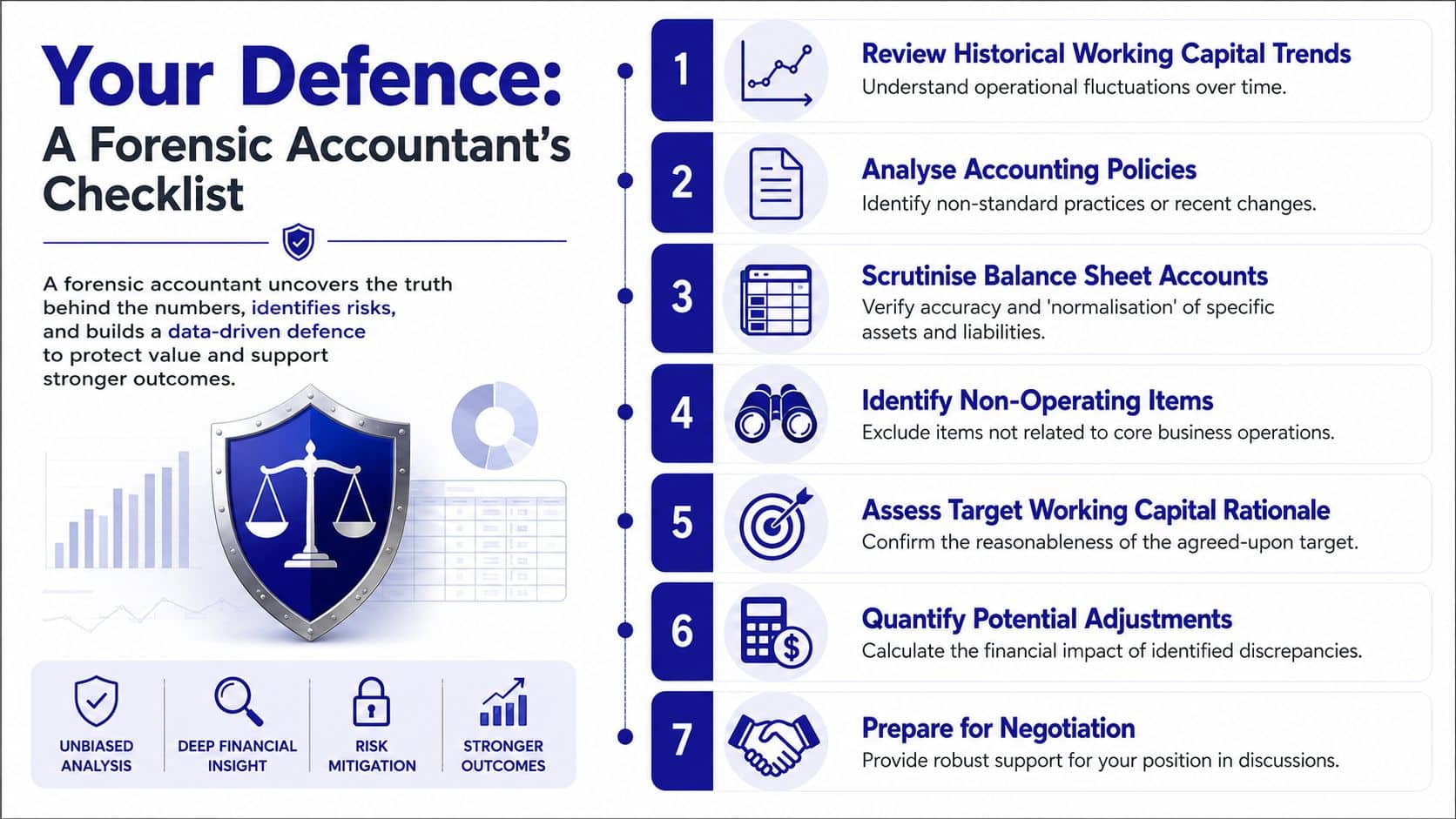
Your Defence A Forensic Accountant's Checklist
Many owners resist bringing in a forensic accountant because they see it as another transaction cost. That objection makes sense only until the adjustment turns contentious. By then, the cost of not having expert input is usually much higher than the cost of getting the mechanics right early.
Working capital adjustments now appear in more than 90% of private-target M&A transactions, according to Livmo's discussion of working capital targets and closing adjustments. This means it isn't a niche issue. For UK SMEs, it's a standard pricing mechanism that affects the final cash the seller receives.
Use this checklist before you sign
Run through these points before the documents harden:
- Define the exact accounts: Don't settle for “current assets less current liabilities” without a deal-specific schedule.
- Lock the accounting basis: If historic practice governs, say so clearly and identify exceptions.
- Test the peg properly: Use normalised historical analysis, then compare it with current trading reality.
- Inspect soft balances: Debtors, stock, accruals, deferred income, and rebates need specific treatment.
- Prepare support files: Keep reconciliations, month-end packs, policy notes, and ledger extracts organised.
- Agree the dispute route: Set out how objections are raised, evidenced, and referred to an independent expert.
- Review incentives around completion: Watch for payment timing, accelerated collections, and delayed liabilities.
If you need additional technical support
Some businesses supplement their internal finance team with specialist accounting resource during a transaction. If you need broader accountancy support, a directory such as Hire CPAs can help you understand the types of professionals available. For matters that require investigative scrutiny around deal mechanics, completion accounts, and evidential support, more specialised forensic input is usually the better fit.
Good preparation doesn't guarantee agreement. It does make weak arguments easier to defeat.
Where the risk is material, forensic review before signing is often the difference between a manageable true-up and a prolonged post-deal dispute. If you want a deeper view of how that process works, see performing a forensic due diligence.
If you're negotiating a sale, challenging a completion statement, or already in dispute over a working capital adjustment, Lighthouse Consultants can help you protect the value at stake. Their London-based forensic accountants analyse the peg, test the accounting basis, quantify the adjustment, and prepare evidence that stands up in negotiation, expert determination, and court.