That niggling feeling that something’s not quite right with the numbers—it's a dread many UK business owners know all too well.
You sense a problem lurking just beneath the surface, but pinpointing it feels like an impossible task. The thought of disruption, spiralling costs, and complex issues is often enough to make you hesitate. It’s why so many firms avoid a formal risk assessment altogether. They worry it will unearth problems too big to handle, or worse, result in a generic report that just gathers dust.
The Real Dangers Hidden in Your Business

Ignoring these instincts allows small cracks to widen into catastrophic failures. What if a trusted employee quietly manipulates expenses? What if a critical weakness in your supply chain could halt operations without warning? These aren't just hypotheticals; they're the real-world dangers that can cripple a business.
A proper risk assessment isn't a one-off task. Instead, it’s a continuous cycle: identify the threats, analyse their potential impact, evaluate where to focus, and implement controls to protect the business.
Overcoming Objections to a Formal Risk Assessment
"We don't have the time or resources for this." It's a common and understandable objection. Many leaders see a proper risk assessment as a costly, drawn-out exercise reserved for huge corporations, pulling key people away from their real jobs for little practical gain.
Another frequent concern is the fear of what you might find. What if you uncover evidence of fraud? The potential legal and reputational fallout seems daunting. Consequently, this leads to a "what you don't know can't hurt you" mindset—a dangerous gamble in any business. Inaction isn't a strategy; it’s a vulnerability.
A proactive risk assessment isn’t an admission of weakness. It’s a demonstration of strong, responsible leadership. By confronting potential threats head-on, you take back control of your company's future and protect its value.
A Targeted Solution with a Forensic Edge
This is where a targeted approach, infused with a forensic accounting mindset, proves its worth. A specialist doesn't just work through a generic checklist. Instead, they apply sharp, investigative techniques to zero in on the most significant threats—especially the financial ones. A forensic accountant instinctively knows where to look for the red flags that standard procedures miss.
We turn the daunting task of risk assessment into a powerful strategic tool. Here’s how our forensic accounting services deliver a clear solution:
- Targeted Investigation: We focus on high-risk areas like financial transactions and internal controls, saving you valuable time and resources.
- Expert Analysis: Our team of Chartered Management Accountants quantifies risks, turning vague worries into concrete data you can act on.
- Actionable Plans: We don't just identify problems. We deliver a clear, bespoke action plan to mitigate them.
Instead of a template report, you get a detailed analysis built on decades of experience in high-stakes investigations. Our findings are robust enough to withstand scrutiny in a boardroom or even as expert witness testimony. We handle the complexity, so you can get back to running your business with confidence.
If you’ve noticed unexplained losses or suspect fraudulent activity, don't wait for the problem to escalate. Take decisive action with a team that delivers certainty.
Ready to replace uncertainty with a clear, actionable plan for protection? Schedule your free, confidential discovery call with Lighthouse Consultants today and let’s secure your business's future.
Using Historical Data to Predict Future Losses
A powerful risk assessment doesn’t begin with guesswork. It starts with a forensic look at your company's past. Too many business leaders, when tasked with a risk assessment, feel lost and start by trying to imagine future threats. It's an abstract and often unproductive exercise.
The most effective approach is to turn hindsight into foresight. Before you can predict what might go wrong, you must understand what’s gone wrong before. This is where the investigative mindset of a forensic accountant becomes invaluable.
The Problem with Ignoring Your Past
Many businesses hesitate to dig into their own history. The idea of poring over old reports feels tedious, and there’s often a fear of what might be uncovered – past failures or, worse, internal misconduct. You hear the same things: "We're a different company now," or "That was a one-off issue."
This reluctance creates a significant blind spot. Ignoring historical data means you are likely to repeat the same mistakes, leaving your business exposed to the same financial and operational risks, time and again. Without an evidence-based foundation, your risk assessment becomes a subjective exercise that fails to address the real vulnerabilities that have already cost you money.
At Lighthouse, we show you exactly how to use your past to protect your future. Our forensic accounting services systematically analyse historical data, transforming it from a source of anxiety into your most powerful predictive tool. We handle the investigation so you can focus on the strategic insights it provides.
A forensic review of your history isn't about assigning blame. It's about gathering intelligence to build a stronger, more resilient business for the future.
This process involves a structured review of both your internal records and external market trends. Consequently, it’s what gives you the context needed to identify hidden vulnerabilities and recurring patterns.
Gathering Your Internal Intelligence
Your own records are a treasure trove of risk information. Begin by collecting and analysing data from several key sources. This initial step is critical for building a picture of your financial health and forms the backbone of your risk assessment.
What to look for:
- Past Incident Reports: Review all documented incidents, from minor health and safety slips to significant data breaches or asset losses. Look for common themes, locations, or departments.
- Audit and Compliance Findings: Examine reports from both internal and external audits. Pay close attention to repeated control weaknesses or compliance issues that were flagged but never fully resolved.
- Financial Discrepancies: Investigate unexplained variances in financial statements, unusual spikes in expenses, or patterns of write-offs. These are classic red flags for potential fraud or mismanagement that our forensic accounting expertise can quickly decipher.
- Employee Data: High staff turnover in one department, a surge in grievances, or an increase in absenteeism can all signal underlying operational or cultural risks that often precede financial losses.
Connecting Internal Data to External Trends
Once you have a clear picture of your internal history, you need to see how it fits within the wider UK market. This external context helps validate your findings and can uncover industry-wide threats you may have overlooked.
For instance, the UK Health and Safety Executive (HSE) reported over 123,000 work-related ill-health cases annually in recent years. This cost the economy a staggering £18.8 billion in 2023/24 alone, a figure that underscores why historical comparisons are so vital.
By combining your internal findings with external intelligence, such as fraud statistics from the SFO or economic forecasts, you create a comprehensive risk profile. This forensic approach provides an evidence-based foundation for your entire risk assessment, ensuring your efforts are focused on the threats that matter most. If you need support with this deep dive, check out our guide on how to do a financial analysis.
Identifying Your Unique Business Risks
Figuring out what could actually harm your business is often where the risk assessment process stalls. It's easy to get overwhelmed, trying to list every possible disaster. We see it all the time.
Business owners either end up with an impossibly long list of vague worries or, worse, become so paralysed by the "what ifs" that they do nothing at all. The fear is you'll miss something crucial, like a sophisticated internal fraud, while you're busy worrying about hypothetical problems.
This is where many business owners tell us, "We can't possibly think of everything," or "This just feels like guesswork." They worry about wasting time when they could be running their business. That's why a structured, investigative approach is so important.
Moving Beyond Guesswork to Structured Identification
You don't need a crystal ball. You just need a proper process. Instead of asking you to guess what might go wrong, we guide you through a methodical review that systematically uncovers your real financial and operational weak spots.
Our team of Chartered Management Accountants looks at your business with an investigator’s eye. We’re trained to spot the subtle red flags that a standard brainstorming session will always miss, focusing your attention on the risks that truly matter.
A brilliant starting point is to use an established framework. One of the most effective is a PESTLE analysis, which forces you to look outside your own walls at the bigger picture.
- Political: How could a change in government policy, new trade tariffs, or import regulations affect your operations?
- Economic: Are you exposed to interest rate hikes, inflation, or a recession that could hammer customer spending and your cash flow?
- Social: Are changing consumer attitudes, demographics, or lifestyle trends a threat to demand for your products or services?
- Technological: What’s the real risk of a cyber-attack? Could new technology make your business model obsolete?
- Legal: Are you ready for changes in employment law, data protection rules like GDPR, or new health and safety regulations?
- Environmental: How could climate events, sustainability rules, or fragile supply chains disrupt your business?
Using a framework like PESTLE ensures you're not just reacting to internal issues. You're proactively scanning the horizon for external threats that could blindside you.
Categorising Risks for Clarity and Action
Once you have a list of potential threats, the next job is to bring order to the chaos. An unstructured list is useless for any practical purpose. Grouping risks into logical categories is crucial for analysing them and assigning responsibility.
Our forensic accounting approach often categorises risks to highlight areas of financial vulnerability. Common categories include:
- Financial Risks: This is our core area of expertise. It covers everything from simple cash flow problems to complex internal fraud, like authorised push payment (APP) scams or phantom employee schemes.
- Operational Risks: These are the risks in your day-to-day processes. Think of a critical supplier going bust, a key piece of machinery breaking down, or a major failure in your logistics network.
- Compliance Risks: This is the danger of failing to meet your legal or regulatory duties, which can lead to heavy fines or legal action. Think GDPR breaches or health and safety violations.
- Reputational Risks: This is the threat of damage to your brand and public image. It could come from a product recall, a scandal hitting the press, or even a wave of terrible online reviews.
By methodically identifying and then categorising your risks, you turn a vague sense of unease into a structured, actionable list. This becomes the foundation for everything that follows. For more insight into what this looks like in practice, you can learn more about the key business risks in the UK in our detailed article.
Analysing and Prioritising Risks
Right, you've identified a list of potential risks. Now what?
A long list of threats can feel overwhelming. You’ve done the hard part of brainstorming what could go wrong, but now you’re staring at a mix of major worries, like a cyber-attack, and smaller concerns, like a minor compliance slip-up. The biggest danger at this stage is paralysis. When everything feels important, it's easy to do nothing at all.
This is a common sticking point for many businesses. They get this far, but then stall because they don't have a clear way to sort the critical threats from the background noise. They think the next step involves complex software or a statistics degree, so the list gets put in a drawer, and the chance to act is lost.
The Forensic Accountant’s Approach to Prioritisation
We see this scenario play out all the time. The main objection is that scoring risk feels too subjective, too much like pure guesswork. Our forensic accounting approach removes that uncertainty. We bring a structure that turns your list of worries into an objective, data-driven map, showing exactly where to focus your resources first.
Instead of feeling overwhelmed, you gain control. We help you create a simple but powerful scoring system that stands up to scrutiny from boards, insurers, and even in court. This isn't about baffling algorithms; it's about applying clear, logical criteria with an investigator’s precision.
A visual breakdown is the fastest way to get a clear overview.
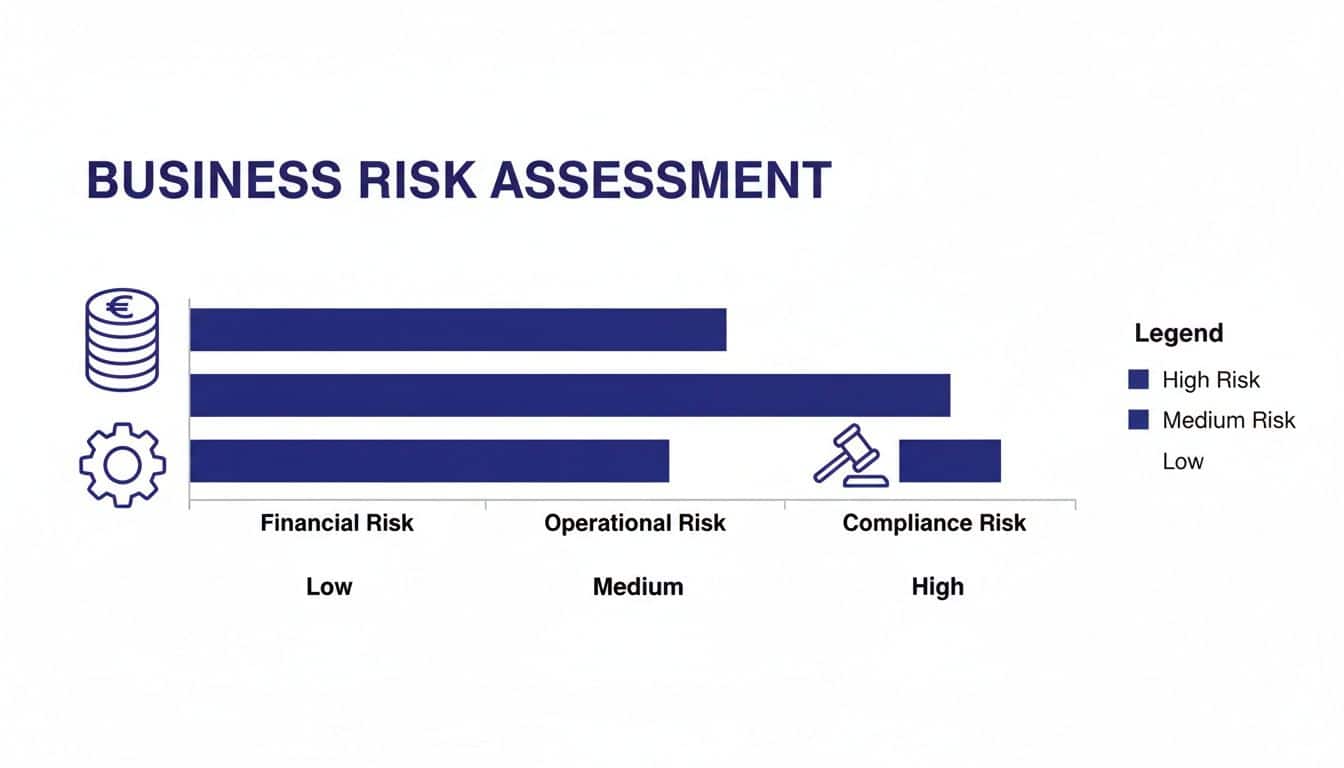
A chart like this instantly separates the high-priority financial, operational, and compliance risks from those that are less urgent.
Building Your Probability-Impact Matrix
The go-to tool for this job is the probability-impact matrix, a cornerstone of professional risk management. It’s a straightforward method that works by assigning two scores to each risk you’ve identified:
- Likelihood (or Probability): How likely is this risk to actually happen?
- Impact (or Severity): If it does happen, how badly will it hurt the business?
You plot these scores on a grid, often called a risk heatmap, to see which threats land in the high-probability, high-impact zone. These are your red-alert risks that need immediate attention.
To properly score and prioritise threats, it’s worth understanding the different risk assessment techniques available, but the matrix is an excellent and widely-used starting point.
Defining Your Scoring Scales
For this system to work, you need to define your scales. A simple 1-5 scale is perfectly effective for most small and medium-sized firms. The trick is to be absolutely clear what each number means for your business.
For a forensic accountant, defining the impact scale is non-negotiable. What does 'catastrophic' really mean? Is it a £50,000 loss, a 10% drop in market share, or a major regulatory fine? Without a quantified scale, your risk assessment remains subjective and difficult to defend.
For example, a financial impact scale could look something like this:
- 1 (Negligible): Financial loss under £1,000, with minimal operational disruption.
- 2 (Minor): Loss between £1,000 – £10,000, causing minor operational delays.
- 3 (Moderate): Loss between £10,000 – £50,000, with noticeable disruption.
- 4 (Major): Loss between £50,000 – £250,000, causing significant operational impact.
- 5 (Catastrophic): Loss over £250,000, threatening business continuity.
Sample Risk Scoring Matrix
Here's a simplified look at how impact and likelihood come together in a 5×5 matrix. The goal is to calculate a risk score (Impact x Likelihood) for each threat and then plot it on a grid like this. The colours—from green to red—give you an instant visual cue about where your priorities lie.
| Impact Level | 1 (Negligible) | 2 (Minor) | 3 (Moderate) | 4 (Major) | 5 (Catastrophic) |
|---|---|---|---|---|---|
| 5 (Almost Certain) | 5 | 10 | 15 | 20 | 25 |
| 4 (Likely) | 4 | 8 | 12 | 16 | 20 |
| 3 (Possible) | 3 | 6 | 9 | 12 | 15 |
| 2 (Unlikely) | 2 | 4 | 6 | 8 | 10 |
| 1 (Rare) | 1 | 2 | 3 | 4 | 5 |
Risks landing in the top-right corner (scores 15-25) are your highest priorities. Those in the bottom-left (scores 1-5) can be monitored with fewer resources. This simple calculation turns a subjective list into a clear, defensible action plan.
Once you score all your risks, prioritisation becomes logical. A risk scoring 5 for impact and 5 for likelihood is a critical, top-tier priority. In contrast, a risk scoring 1 for impact and 2 for likelihood can be managed with minimal resources. This data-driven process is the key to moving from worry to effective action.
Developing Effective Control Measures

You’ve identified your risks and scored them. Now you have a colourful heatmap showing exactly where the danger lies. This is where many risk assessments grind to a halt. A beautiful risk register is useless if it doesn't lead to concrete action.
Let's be honest. The real struggle isn't spotting the problems; it's fixing them. You know you have a high risk of internal fraud, but what specifically do you do about it? You see a supplier dependency risk, but where do you even start to untangle that knot?
It’s easy to feel like you’ve just created an expensive to-do list. Business owners often worry that the solutions will be more disruptive than the risks themselves, telling me, "We can't afford all these controls," or "My team is already stretched too thin."
From Analysis to Action
This is where a forensic accounting perspective makes all the difference. We don't just point out problems; we design practical solutions. Instead of a generic list of "best practices," we develop targeted, cost-effective controls that directly address the specific financial and operational risks you face.
The goal isn't to wrap your business in cotton wool. It’s to build smart, efficient controls that protect your assets without strangling your operations. We focus on delivering maximum protection for minimum disruption.
A risk without a control is just a problem waiting to happen. The purpose of a risk assessment is not to admire the problem, but to neutralise it with precise, documented actions.
The key is to implement a blend of preventative and detective controls, drawing from real-world forensic cases.
Preventative Controls: Stopping Fraud Before It Starts
Preventative controls are your first line of defence. They are designed to stop an incident—especially financial fraud—from ever happening. Building these walls high is a forensic accountant's primary goal.
Common examples include:
- Segregation of Duties: Making sure the person who raises a purchase order is not the same person who authorises the payment. This simple split makes it significantly harder for one individual to create and conceal a fraudulent transaction.
- Dual Authorisation for Payments: Requiring two signatories for any payment over a certain threshold. This is a powerful deterrent against unauthorised fund transfers or paying fake invoices.
- Robust User Access Controls: Strictly limiting access to financial software and sensitive data only to those who absolutely need it for their role.
These aren't just bureaucratic hurdles. They are smart, targeted defences against the most common fraud schemes we see in practice.
Detective Controls: Uncovering What Slips Through
No preventative system is foolproof. Detective controls are your second line of defence, designed to spot irregularities after they occur so you can act quickly and minimise the damage. A forensic investigation often relies on the evidence these controls unearth.
Effective detective controls are:
- Regular Bank Reconciliations: A manager, independent of the payment process, should review and sign off on bank reconciliations weekly or monthly. This is vital for spotting unauthorised transactions.
- Budget vs Actual Variance Analysis: Scrutinising significant, unexplained variances between your budget and actual spending can reveal hidden costs or misallocated funds.
- Surprise Audits and Spot Checks: Unannounced reviews of petty cash, inventory, or expense claims can uncover issues that routine, predictable checks might miss.
Documenting all identified risks, your scoring rationale, and the specific controls you've implemented is non-negotiable. This formal risk register is critical evidence of due diligence for regulators, auditors, and insurers. To dig deeper into this, you can learn more about what good control means in our detailed guide.
From Assessment to Action with Lighthouse
So, you have your risk roadmap. But turning that map into a fortress for your business is where the real work begins. Staring at a list of potential threats, it’s natural to wonder, "How do I fix all this without bringing my entire operation to a standstill?"
This is a common and perfectly valid concern. Many business owners we talk to share the same fear: that the solutions will be too complex, too expensive, or just too much for their team to handle. They tell us, "We've identified the risks, but now we're stuck. We need practical steps, not just more problems to worry about."
Turning Insight into Impact with a Forensic Accountant
This is precisely where a generic report falls short and a forensic accounting specialist excels. We don’t just hand you a list of issues and walk away.
Our Chartered Management Accountants bridge the gap between identifying risks and implementing robust, practical controls that protect your bottom line. We deliver a bespoke action plan, not a one-size-fits-all template.
While other consultants might point out the problems, we provide quantified solutions built on decades of experience in high-stakes financial investigations. Our focus is on making your business more resilient, without drowning you in unnecessary red tape. We handle the complexity so you can lead with confidence.
Why Our Forensic Approach Delivers Certainty
Our method is designed to uncover what standard assessments miss and deliver findings that withstand scrutiny. The real value of any risk assessment lies in its ability to prioritise effectively and put a number on potential losses.
Recent data highlights this perfectly. The FRC's 2025 Audit Quality Report noted that 28% of inspected audits failed due to poor risk prioritisation. Meanwhile, UK cyber incidents cost businesses a staggering £27.3 billion, and insurers recovered £450 million in 2025 using advanced analytics. The power of a quantified, forensic approach is clear. You can learn about how risk analytics elevate management plans on optro.ai to explore this further.
When you suspect fraud or see unexplained losses, you need more than a consultant; you need an investigator. Our findings are designed to be used—in the boardroom, with insurers, or as expert witness testimony.
This is the Lighthouse difference. We replace uncertainty with a clear, actionable plan for protection. Our expertise in forensic accounting ensures that every risk is not just identified but also understood, quantified, and controlled. We deliver the quality and certainty you need to protect your organisation.
If you are ready to take decisive action against financial threats, we are here to guide you.
Schedule a free discovery call with Lighthouse Consultants today, and let’s build your defence together.
Common Questions About Risk Assessment
You've got the framework for your risk assessment, but actually starting the process can feel like a final hurdle. It's completely normal to have a few last-minute questions and a bit of hesitation. You want to be sure you're getting it right.
Common questions often crop up at this stage. How often should we be doing this? Can we manage this internally or do we need to call in an expert? These are smart questions to ask. A poorly executed assessment can be just as risky as doing nothing at all.
Do We Need an Expert or Can We Do It Ourselves?
While your own team can certainly handle basic operational hazards, an expert is essential when you get into complex areas like financial fraud or cyber security.
A forensic accountant, like the specialists at Lighthouse, has the training to uncover sophisticated schemes that an internal team might naturally overlook. For instance, if you're trying to understand what a cybersecurity risk assessment entails, a specialist provides a level of clarity you simply won't find on a generic checklist.
An external forensic accounting expert also brings a crucial, independent perspective that adds significant credibility to your findings.
A risk assessment is forward-looking, identifying what could go wrong. An audit is backward-looking, verifying what has happened against established controls. They are distinct but related processes. A strong risk assessment informs the audit plan by highlighting high-risk areas for deeper investigation.
If you need certainty and quality in your risk management process, Lighthouse Consultants delivers. Our forensic accounting expertise turns your risk assessment into a powerful protective shield for your business.
Contact us today to discuss your needs and take control of your financial security.