A UK acquisition due diligence checklist should cover financial records, tax exposures, fraud and bribery risks, revenue quality, liabilities, asset values, working capital, internal controls, regulatory permissions and employment obligations. For each area, record the evidence requested, the issue identified, who will investigate it and its possible effect on the deal. This guide explains those ten checks from a financial investigation perspective.
On paper, the target looks clean. Revenue appears stable. Management sounds confident. The seller says the business has “no surprises”. Yet, despite this positive facade, buyers often get hurt. Hidden debts, weak controls, inflated profits, side agreements, employment liabilities, and poor register integrity rarely announce themselves in the headline numbers.
That's why a standard document chase often fails. You receive packs of PDFs, a few management calls, and a spreadsheet summary. Then the deal closes, and the actual work begins. A customer contract doesn't survive change of control. Working capital collapses. A tax position looks less strong than promised. A fraud issue turns out not to be historic at all.
Many business leaders hesitate before bringing in a forensic accountant. They worry it will slow the deal, create friction, or cost more than it saves. In practice, the opposite is often true. A forensic accounting approach narrows attention to what can damage price, structure, warranties, and post-completion cash flow. It turns broad concern into evidence.
In the UK, buyers commonly anchor financial due diligence in the target's historical financial statements, working capital, debt obligations, and off-balance-sheet liabilities, and a practical screening benchmark is to request at least three years of financials so revenue trends and cash-flow stability can be tested over time, as outlined in this UK due diligence overview. That baseline matters, but it isn't enough on its own.
This checklist focuses on red flags, hidden liabilities and the evidence behind the reported figures. It can help you scope a financial due diligence review alongside legal, tax and other specialist advice appropriate to the transaction.
1. Financial Statements and Accounting Records Review
Completion is six weeks away. The seller's numbers look tidy, EBITDA has been “normalised,” and the board wants a quick answer on price. Then the ledger review starts. Revenue posted on the last day of the month has no delivery support, accruals reverse without a clear basis, and a director-connected balance sits in trade debtors as if it were routine. That is why financial statements need testing, not admiration.

The accounts are a set of assertions. A buyer needs to prove which ones hold up under pressure. In practice, that means reviewing at least three years of financial information, then tying reported results back to the underlying records where risk justifies the time and cost. I want to see how the annual accounts connect to the general ledger, trial balance, bank activity, VAT returns, payroll data, and key reconciliations. If those links are weak, the reported result is weaker than it looks.
A standard finance review asks whether the statements comply with accounting rules. A forensic review asks a harder question. What in these records could change price, debt-like items, working capital, warranty protection, or the chance of a post-completion dispute?
That shift matters.
A polished profit and loss account can still mask cut-off errors, underprovided liabilities, capitalised costs that should have been expensed, or related-party transactions buried in nominal codes. Monthly data is often more useful than annual totals because manipulation tends to show up in timing, reversals, and unexplained swings. One strong quarter does not offset a pattern of poor cash conversion or repeated late journals.
A useful starting point is financial due diligence explained, but the main value comes from testing the records at transaction level where the risk is highest.
Focus the review on points that change the deal:
- Revenue to cash conversion: Compare reported sales to receipts, aged debtors, credit notes, and post-year-end collections.
- Manual journals: Review late entries, senior-user postings, and unsupported adjustments near period end.
- Accounting policy judgments: Test revenue recognition, stock provisioning, capitalisation, accruals, and bad debt reserves against actual trading evidence.
- Balance sheet support: Inspect reconciliations for debtors, creditors, stock, tax, payroll, and intercompany accounts.
- Related-party and non-trade items: Identify balances recorded as ordinary trading activity that may be personal, exceptional, or non-recurring.
- Management representations: Obtain completeness statements, but never treat them as a substitute for document testing.
Practical rule: If management can explain a result commercially but cannot support it with records, hold that number open until the evidence is produced.
The trade-off is straightforward. Ledger-level work takes more effort than relying on board packs, but it gives the buyer something far more useful than reassurance. It gives evidence that stands up in negotiation and, if necessary, in a warranty or completion accounts dispute.
One pattern appears often in acquisitions. The seller presents adjusted earnings that look reasonable in summary. The detail shows recurring “one-offs,” accruals that move to hit target margins, and old debtor balances with little sign of collection. That does not always stop the transaction. It often leads to a lower price, a tighter locked-box or working-capital mechanism, specific indemnities, or a decision to defer part of the consideration until the numbers prove themselves.
2. Tax Compliance and Contingent Liabilities
Tax problems rarely look dramatic until completion. Then they become your problem, not the seller's story.
A tax review in an acquisition due diligence checklist needs more than copies of filed returns. You need to know how the business behaves under pressure. Does it take cautious positions, or does it stretch judgments and hope no one asks questions later? A forensic accounting mindset helps because it links tax risk to source transactions, not just tax schedules.
Where hidden exposure sits
Contingent liabilities often live in the gaps between finance, payroll, and operations. VAT treatment may not match the commercial reality. Contractor arrangements may not align with status rules. Intercompany balances can mask transfer pricing or permanent establishment issues in cross-border structures. If the target has grown quickly, tax governance often lags behind.
Review correspondence with HMRC, open enquiries, prior disclosures, and the logic for major provisions. Then compare those positions with the actual ledger trail and contracts. If a business claims one thing in its tax analysis and another in its invoicing flow, that discrepancy matters.
Use a short challenge list:
- Open years and enquiries: Identify where HMRC can still revisit earlier positions.
- Indirect tax treatment: Test whether VAT coding matches what was supplied.
- Payroll and employment taxes: Review benefits, bonuses, termination payments, and contractor classifications.
- Deferred tax and provisions: Ask whether booked amounts reflect realistic outcomes or management optimism.
A familiar problem in deals is the “tidy” tax pack that leaves out judgment-heavy areas. Management may say there's no issue because there's no formal dispute. That isn't enough. Buyers need to ask what could crystallise, not only what already has.
When I review tax diligence from a forensic accounting angle, I'm less interested in polished tax memos and more interested in whether the supporting transactions stand up. The gap between policy and practice is often where contingent liability sits.
3. Fraud Risk Assessment and Anti-Corruption Compliance
Some deals fail because the business underperforms. Others fail because the buyer inherits conduct risk.
Fraud and bribery reviews often receive superficial treatment unless the target operates in an obviously high-risk sector. That's a mistake. You don't need dramatic allegations for fraud risk to matter. Weak control environments, dominant founders, opaque vendor relationships, and poor journal discipline can create fertile ground for manipulation long before anyone uses the word “fraud”.

Red flags a forensic accountant looks for
Start with behaviour, then move to records. Does management answer directly? Are explanations consistent across finance, operations, and sales? Are there counterparties with vague service descriptions or repeated round-sum payments? Is there a habit of bypassing approval routes when “commercial urgency” arises?
Bank analysis, vendor testing, journal reviews, and focused interviews usually reveal more than policy documents.
- Examine third-party payments: Consulting fees, commissions, and agent payments deserve special attention.
- Review connected parties: Check for suppliers, customers, or landlords linked to directors or shareholders.
- Challenge override culture: Frequent exceptions to approval processes often signal a wider control problem.
- Inspect the anti-bribery framework: Policies alone don't help if no one follows them.
For UK buyers, bribery and corruption exposure isn't a side issue. It affects valuation, warranties, indemnities, and reputation. If the target has weak controls over intermediaries, gifts, expenses, or public-facing sales channels, your legal and financial risks both rise. For a useful grounding, see what bribery and corruption in business looks like.
In practice, fraud risk assessment works best when you treat every unexplained exception as a lead, not a clerical oddity.
A frequent scenario is this. The target insists there has never been fraud. Yet no one reviews supplier master-file changes, one finance lead controls too many steps, and commission payments lack documentary support. You may still buy the business. But you should buy it on revised terms, with stronger protections and a post-close control plan.
4. Revenue Quality and Customer Due Diligence
Revenue is where deal optimism tends to gather. It's also where sellers know buyers are most eager to believe.
A forensic accountant doesn't ask only whether revenue exists. The sharper question is whether it will survive ownership change, challenge, and normal scrutiny. That means checking customer concentration, contract mechanics, side promises, returns patterns, credit quality, and the relationship between invoicing and cash collection.
Test substance, not just sales
The most useful exercise is to walk backwards from reported revenue into the underlying commercial reality. Pick material customers. Read the contract. Check the purchase order pattern. Trace invoices to cash. Then ask sales and finance to explain any mismatch. If the story changes depending on who speaks, keep digging.
Some practical checks belong in every acquisition due diligence checklist:
- Review major contracts for change-of-control clauses: Revenue can disappear even when the customer relationship looks longstanding.
- Inspect receivables ageing: Old balances often point to disputed invoices or overstated sales quality.
- Ask about rebates, credits, and returns: Margin and revenue quality both suffer when side arrangements sit outside standard terms.
- Speak to operational staff: They often know which customers are profitable, difficult, or drifting away.
A common mid-market scenario is a target with a handful of loyal customers and reassuring headline retention. Then you discover one account is buying ahead of a product change, another is in informal renegotiation, and a third can terminate if ownership changes. Reported revenue may still be accurate. Future maintainable revenue may not be.
Buyers often overpay when they diligence turnover as a number instead of a relationship.
Forensic accounting adds value. It does not solely verify that revenue happened. It judges whether that revenue had commercial substance, whether it was earned on strong terms, and whether it can support the valuation after completion.
5. Liabilities, Contingencies, and Legal Claims Assessment
Most serious acquisition mistakes come from liabilities that were technically “known” somewhere in the business but never properly quantified.
Legal claims, regulatory correspondence, environmental issues, warranty disputes, indemnity exposures, and threatened actions all need financial translation. A seller may disclose a dispute and still underestimate its significance. Legal language alone won't protect you if no one has modelled cash impact, timing risk, defence cost, insurance limitations, and operational distraction.
Where buyers miss the point
Board minutes, management meeting notes, insurer correspondence, complaints logs, and settlement discussions often reveal more than the formal litigation schedule. If you only review what outside counsel labels as material claims, you can miss the early-stage matters that later become expensive.
I'd also compare legal disclosures with accounting treatment. If management says a matter is minor but there's no supporting assessment behind the provision, challenge it. If a claim is uninsured, partially insured, or subject to coverage dispute, the practical exposure can be very different from the legal summary.
Use this framework:
- List every live and threatened matter: Include customer disputes, employment claims, regulator queries, and contract breaches.
- Check provisioning logic: Match the accounting treatment to legal advice and management assumptions.
- Review insurance support: Policies, exclusions, deductibles, and notification history all matter.
- Read internal communications: They often show whether management really viewed the issue as serious.
A classic deal-room problem is the “one-off dispute” that turns out to reflect a recurring operational weakness. For example, several customer claims may indicate a product quality issue, not isolated noise. That can affect reserves, reputation, and future trading.
A forensic accountant's role here is to move from narrative to quantified downside. That gives the board something usable in price negotiations and something defensible if the transaction later comes under scrutiny.
6. Asset Valuation and Impairment Analysis
Buyers often focus hard on earnings and not hard enough on what sits on the balance sheet. That creates trouble when assets don't convert into value after completion.
Stock may be slow-moving. Fixed assets may still be recorded even though they're operationally redundant. Capitalised development costs may depend on assumptions no longer justified. Goodwill-heavy explanations may hide the fact that the underlying assets need substantial reinvestment.
To get a feel for this workstream, it helps to see how impairment and asset scrutiny are approached in practice.
How to challenge balance sheet comfort
A forensic accountant doesn't stop at the register. The true test is recoverability. Can inventory sell at booked values? Are debtors collectible? Do intangible asset assumptions still fit market reality? Are there leased, encumbered, or impaired assets that management has left untouched because the business has “always done it that way”?
This item often benefits from site visits and operational input. Walk the warehouse. Ask which lines are dead stock. Inspect fixed asset additions against physical existence and use. Review capex patterns beside depreciation and maintenance history. If a business has underinvested for years, the balance sheet may overstate economic value while understating future cash needs.
A sensible challenge list includes:
- Inventory quality: Ageing, obsolescence, returns history, and post-period sales.
- Fixed asset reality: Physical existence, usage, condition, and ownership status.
- Intangible assumptions: Forecast support, useful lives, and dependence on key people or contracts.
- Investment and loan recoverability: Related-party balances deserve particular care.
One practical scenario appears often in owner-managed businesses. The accounts show healthy asset backing, but a site walk reveals redundant equipment, poor stock discipline, and assets that support neither current output nor future strategy. The numbers aren't necessarily false. They're not decision-useful until someone tests them properly.
7. Working Capital and Cash Flow Analysis
Two weeks after completion, the buyer discovers the acquired company cannot meet payroll without an emergency cash injection. The profit forecast looked acceptable. The cash profile did not.
Working capital is where sale narratives often come apart under pressure. A seller can present stable earnings and still leave the buyer funding slow debtors, excess stock, deferred contract costs, or stretched creditors from day one. The job here is not to tick off a current ratio and move on. It is to establish how much cash the business needs to trade normally, what has been flattered for the deal process, and which items belong in debt, quasi-debt, or a price adjustment.
Test the cash cycle, not just the balances
Year-end balances rarely tell the full story. Review monthly trends, peak trading periods, and the weeks either side of the reporting date. If collections improved sharply just before diligence began, ask how. If payables days lengthened, find out whether suppliers agreed new terms or have not been paid. If inventory rose, test whether it supports confirmed demand or covers operational inefficiency.
A forensic review links accounting numbers to conduct. That means reading aged receivables with dispute histories, tracing inventory build-up to purchasing patterns, and checking whether management has delayed payments to preserve a clean cash position for the market.
Focus the analysis on points that affect purchase price and post-close funding:
- Set a defensible working capital peg: Use multiple months, seasonal patterns, and known one-offs, not a convenient closing snapshot.
- Separate real liquidity from accounting optimism: Old receivables, slow-moving stock, and capitalised costs can absorb cash quickly.
- Identify debt and quasi-debt completely: Invoice finance, unpaid taxes, director balances, customer deposits, and accrued bonuses often sit outside management's headline debt number.
- Model immediate cash strain after closing: Integration costs, covenant headroom, deferred maintenance, and customer concentration can turn a tight position into a breach.
One point gets missed often. Deferred income is not free money. It may represent cash already received, but it usually carries a delivery obligation that still consumes staff time, materials, or subcontractor spend after completion.
I have seen buyers argue for hours over EBITDA adjustments worth relatively little, then accept a loose working capital mechanism that costs far more in the first month. That is poor risk allocation. The better approach is to document normal working capital with the same discipline used on earnings quality and to support it with evidence that would stand up in a dispute. A buyer who wants that level of scrutiny should treat internal audit work on control and cash disciplines as part of the diligence picture, not as a post-deal clean-up exercise.
A profitable business can still be a cash trap. Working capital analysis is where that risk becomes measurable.
8. Operational and Internal Controls Assessment
Weak controls don't just create fraud risk. They also make every other diligence finding less reliable.
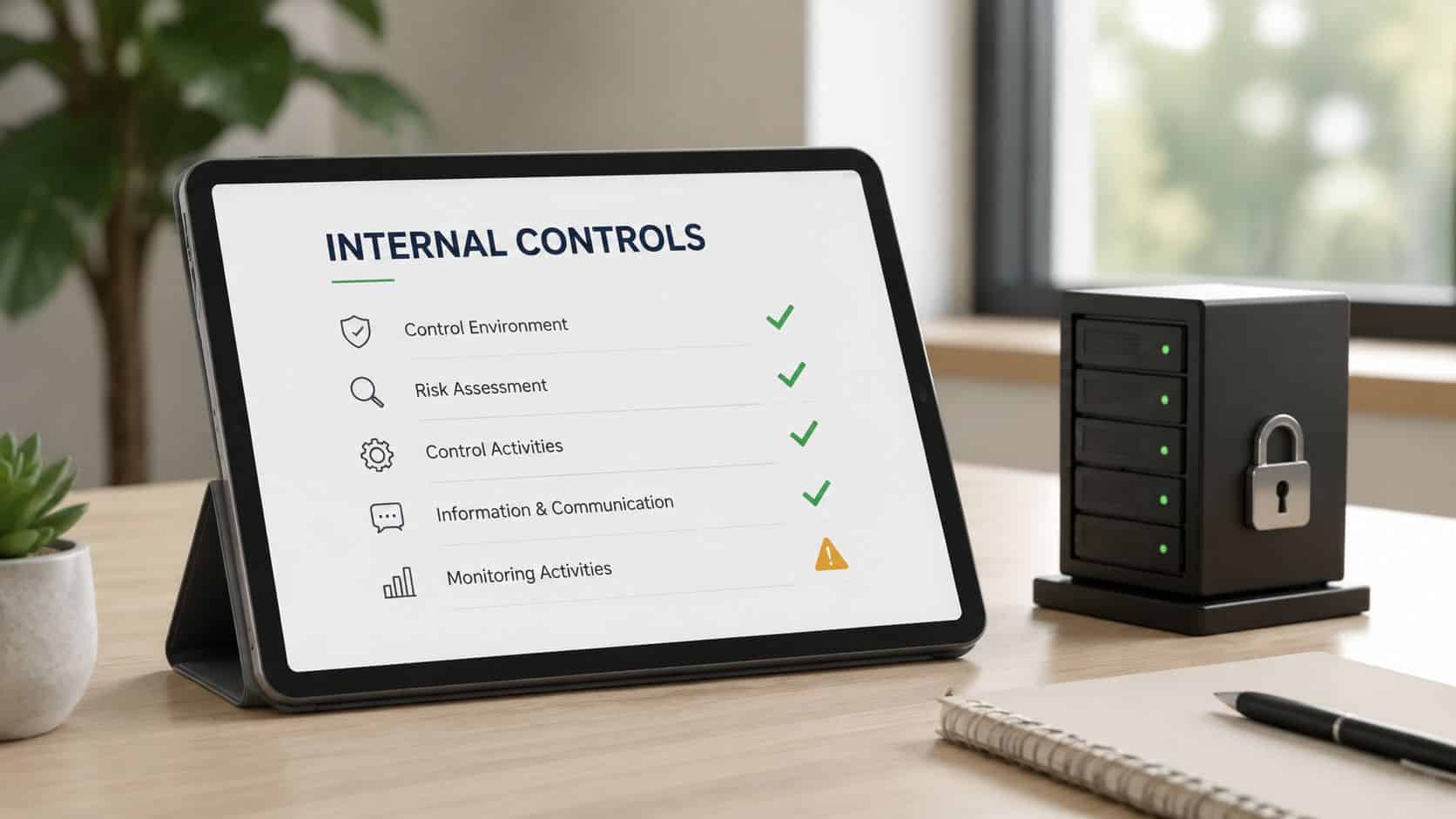
When control design is poor, data becomes harder to trust. Revenue reports may depend on manual intervention. Journals may bypass review. Supplier onboarding may be loose. Payroll changes may happen without clear approval. In that environment, even honest management may struggle to produce dependable information.
Data rooms, cloud tools, and cyber checks
UK practice has moved well beyond email chains and uncontrolled attachments. Cloud computing adoption among UK businesses reached 53% in 2024, and usage among businesses with 50 or more employees reached 81%, according to UK market evidence on acquisition due diligence workflow and cloud adoption. That matters because a modern diligence process should run through a permissioned workspace with indexed folders, issue logs, and evidence links, rather than unmanaged document requests.
The practical lesson is simple. Better workflow tooling improves control over the diligence process itself. It gives you audit trails, version management, and clearer accountability across legal, finance, tax, HR, cyber, and ESG workstreams.
Within the target, review:
- Segregation of duties: Especially in cash, purchasing, payroll, and journals.
- System access controls: Leavers, privileged access, and override rights.
- Documentation quality: Process notes, approval evidence, and exception handling.
- Internal audit maturity: If there is one, ask what it tests.
For a sharper explanation of how this discipline works in organisations, see what internal audit is and why it matters.
UK government cyber guidance also makes cyber due diligence relevant in M&A, including security controls, incident history, and supplier risk. In practice, that means your acquisition due diligence checklist should treat cyber as a gate, not a footnote to IT. If the target's controls are weak, assume remediation cost, transition risk, and possible disclosure issues after close.
9. Regulatory Compliance and Licensing Assessment
Regulatory diligence is where many buyers become too legalistic and not operational enough. They ask whether licences exist, but not whether the business has been complying in a way that will survive scrutiny after the deal closes.
Companies House integrity is a good example. Many teams treat filings as an administrative formality. That approach is now too light. The UK government has introduced mandatory identity verification for directors and people with significant control to improve trust in the register, and Companies House now has stronger powers to query and remove false or misleading information, as discussed in this note on UK M&A due diligence and register integrity. If filings conflict, buyers need to know whether they face delay, uncertainty, or a deeper governance problem.
Go beyond the licence list
Regulatory review should include beneficial ownership, PSC consistency across filings, late-filing patterns, and whether historical register data appears reliable enough to support deal certainty. Compare annual accounts, confirmation statements, constitutional documents, shareholder records, and transaction papers. If names, dates, or control positions don't align, stop treating it as clerical noise.
Then move into sector-specific compliance. Ask what permissions the business relies on, what conditions attach to them, whether renewals were timely, and whether any regulator has raised concerns. A licence can be formally active and still be vulnerable if the underlying compliance culture is weak.
A practical review should cover:
- Register integrity: Directors, PSCs, share capital history, and filing consistency.
- Licence status: Existence, scope, renewal history, and transfer implications.
- Regulator correspondence: Queries, notices, inspections, and undertakings.
- Operational compliance evidence: Training, reporting, monitoring, and remediation history.
This is one area where forensic accounting helps by testing whether documentary compliance matches economic reality. If the beneficial ownership trail is blurred or filings conflict with deal documents, that's more than a paperwork issue. It may affect authority, warranties, and confidence in management disclosures.
10. Employee, Benefits, and Labour Compliance Review
A buyer can fix systems. Rebuilding trust with a disrupted workforce is harder.
Employment diligence often gets reduced to collecting contracts and counting heads. That misses the core issues. The buyer needs to know which people are essential, what liabilities sit in payroll and benefits practices, whether restrictive covenants will hold, and what post-close fragility looks like if key staff leave.
Workforce risk needs modelling, not filing
The UK labour market context matters. The Office for National Statistics reported an employment rate of 75.1% and an unemployment rate of 4.7% in the three months to April 2026, as referenced in this guide to M&A due diligence and workforce risk. In practical terms, retention, replacement cost, and wage pressure remain material considerations for integration planning.
That means your acquisition due diligence checklist should press beyond personnel files. Review holiday pay practices, bonus accrual logic, overtime exposure, IR35 risk, visa sponsorship dependencies, disciplinary histories, grievance patterns, and change-of-control terms in key contracts. Also assess whether the business depends on a few individuals whose departure would undermine value.
- Identify key people early: Don't wait until signing to discover who the business really depends on.
- Review contingent liabilities: Holiday pay, commissions, bonuses, and misclassification issues can surface fast.
- Test covenant enforceability: Restrictive covenants that won't stand up are poor protection.
- Connect HR diligence to integration: Retention planning should start before completion.
A useful wider reference point is managing benefits regulations, but the essential discipline lies in linking employment data to financial exposure and operational continuity.
If HR diligence produces only a document index, it hasn't gone far enough.
In forensic accounting terms, workforce diligence means quantifying hidden cost and execution risk. A business may look healthy until one sponsored worker cannot transfer smoothly, one senior salesperson resigns, or one bonus scheme has been under-accrued for years. Those are not soft issues. They hit cash, continuity, and deal value.
10-Point Acquisition Due Diligence Comparison
| Item | Implementation Complexity 🔄 | Resource Requirements ⚡ | Expected Outcomes 📊 | Key Advantages ⭐ | Ideal Use Cases 💡 |
|---|---|---|---|---|---|
| Financial Statements and Accounting Records Review | High, time‑intensive forensic accounting and transactional testing | Medium‑High, accounting team, audit tools, detailed ledgers | Verified historical financials; detection of misstatements and adjustments | Early fraud detection; reliable EBITDA / cash‑flow normalization | M&A valuation, high‑risk or complex accounting histories |
| Tax Compliance and Contingent Liabilities | High, multi‑jurisdictional law and interpretive complexity | High, tax advisors, returns, external counsel and opinions | Quantified tax exposures and transfer‑pricing risks | Prevents surprise tax bills; informs price adjustments and indemnities | Cross‑border deals, targets with complex tax planning |
| Fraud Risk Assessment and Anti-Corruption Compliance | High, investigative work, sanctions and integrity checks | High, forensic specialists, bank analysis, interviews, screening tools | Identification of fraud/bribery risks and remediation needs | Protects reputation/legal exposure; supports deal structuring | High‑risk sectors, emerging markets, prior control weaknesses |
| Revenue Quality and Customer Due Diligence | Medium, contract review and customer verification work | Medium, sales data, contract access, customer outreach | Validated revenue sustainability; customer concentration insight | Accurate revenue forecasting; uncovers fictitious or one‑off revenue | Customer‑concentrated businesses, subscription/contract models |
| Liabilities, Contingencies, and Legal Claims Assessment | High, legal privilege and uncertainty complicate assessment | High, legal counsel, claims schedules, insurance reviews | Identification and quantification of contingent liabilities | Prevents acquiring hidden liabilities; informs indemnities | Targets with litigation, regulatory or environmental exposure |
| Asset Valuation and Impairment Analysis | Medium‑High, valuation expertise and physical inspections needed | Medium‑High, valuers, asset registers, possible site visits | Adjusted asset values; impairment identification and write‑downs | Ensures fair asset valuation; reveals obsolete or overstated assets | Asset‑heavy businesses, significant intangibles or inventory risk |
| Working Capital and Cash Flow Analysis | Medium, data‑intensive but methodical analysis | Medium, AR/AP aging, inventory data, cash‑flow models | Normalized working capital; cash requirement and timing insights | Accurate post‑close cash forecasting; identifies liquidity gaps | Seasonal firms, fast‑growing companies, cash‑sensitive targets |
| Operational and Internal Controls Assessment | Medium‑High, subjective control testing and IT review | Medium, internal audit, IT/cybersecurity specialists, process docs | Control weakness mapping and remediation cost estimates | Reveals integration risks, IT/cyber vulnerabilities | Integration planning, tech consolidation, weak control environments |
| Regulatory Compliance and Licensing Assessment | Medium‑High, jurisdictional rules and documentary verification | Medium, regulatory advisors, license records, inspection files | Identification of compliance gaps and license risks | Prevents loss of licences; quantifies remediation and enforcement risk | Regulated industries, multi‑jurisdiction operations, compliance‑sensitive sectors |
| Employee, Benefits, and Labor Compliance Review | Medium, benefits/pension complexity and jurisdictional variance | Medium‑High, HR data, payroll records, actuary or labor counsel | Total employment cost, severance/pension exposures, compliance risks | Reveals hidden employment liabilities; informs retention strategy | Labor‑intensive businesses, pension schemes, unionized workforces |
Turn Risk into Advantage: Secure Your Next Acquisition
A standard due diligence pack won't protect you from a weak deal. It may confirm that documents exist. It won't necessarily tell you whether the profits are sustainable, whether the liabilities are fully surfaced, whether the controls can be trusted, or whether the workforce and governance structure will hold together after completion.
That's where a forensic accountant changes the quality of the decision. Forensic accounting in M&A isn't an academic extra. It's a practical discipline built around evidence, contradiction testing, quantification, and scrutiny that can stand up later in negotiations, disputes, warranty claims, or litigation. It asks tougher questions and insists on reconciling the answer to records, behaviour, and commercial reality.
The most effective acquisition due diligence checklist doesn't just gather documents. It ranks risk. It forces unresolved points into issue logs. It links findings to pricing, deal structure, indemnities, completion accounts, earn-outs, covenants, and post-close integration priorities. It also shows the board where management assumptions are solid and where they are not.
This matters most in the deals that appear straightforward. Mid-market transactions, owner-managed businesses, distressed situations, and competitive auctions all create pressure to move quickly. Under that pressure, buyers often accept broad explanations instead of hard support. They focus on adjusted EBITDA and overlook cash conversion, hidden claims, register integrity, tax behaviour, and weak controls. Those omissions often become expensive after the signatures are dry.
A forensic-led review brings discipline back into the process. It helps you separate timing issues from structural issues. It shows which problems can be priced, which need legal protection, and which should stop the deal altogether. Just as important, it gives you a record of how the decision was reached. That matters in the boardroom, with lenders, with investors, and if a dispute appears later.
Lighthouse Consultants is one relevant option for businesses that need that level of work. The firm is a London-based team of Chartered Management Accountants specialising in forensic accounting, due diligence, audit, and financial analysis for complex matters. In an acquisition, that kind of support can help a buyer challenge unsupported assumptions, quantify downside risk, test the reliability of reported figures, and present findings in a form decision-makers can use.
If you're weighing a target right now, don't settle for a checklist that only proves the seller uploaded documents. Use an acquisition due diligence checklist that hunts for what can damage value. Check the ledger against the narrative. Check the contracts against the revenue. Check the filings against control and ownership reality. Check the workforce against integration risk. And where the answers don't align, pause and push harder.
That's how you stop uncertainty from controlling the deal. That's how you make diligence your advantage.
For support assessing the financial evidence before signing, explore Lighthouse Consultants’ due diligence and financial analysis services or book a consultation. Explain the proposed transaction, your timetable, the records available and the risks you want investigated so the scope and fees can be discussed.