A deferred prosecution agreement usually enters the conversation at the worst possible moment. A payment doesn't match the contract. A whistleblower raises bribery concerns. External auditors ask for backup you can't produce quickly. Suddenly, the issue isn't just accounting. It's fraud risk, board risk, regulatory risk, and personal risk for the people signing off the response.
At that point, most directors and in-house lawyers face the same pressure. Keep it quiet, move fast, and try to work it out internally. That instinct is understandable, but it often creates a second problem. If staff preserve evidence poorly, interview witnesses in the wrong order, or let conflicted managers shape the narrative, the review loses credibility before it reaches a prosecutor, court, insurer, or claimant solicitor.
That's where a forensic accountant changes the position. In a UK corporate crisis, forensic accounting isn't just about finding suspicious entries. It's about securing records, tracing funds, testing explanations, quantifying exposure, and producing a defensible account of what happened. If deferred prosecution agreements become a realistic option, that work sits near the centre of the process.
The Moment of Crisis Uncovering Financial Misconduct
The first signs are rarely dramatic. A finance director notices duplicate vendor payments routed through a new intermediary. A general counsel receives an allegation that hospitality spending hid bribes. A board member asks why revenue recognition shifted just before year end. None of those facts proves criminal conduct. All of them justify immediate concern.

The mistake I see most often is delay dressed up as caution. Management asks the internal team to “have a quick look” before escalating. Meanwhile, emails continue to circulate, accounting records get amended in the ordinary course, and key people start aligning their stories. By the time external advisers arrive, the organisation has already weakened its own evidence base.
Why internal handling often goes wrong
An internal finance team may know the systems, but it usually doesn't have the independence required for a matter that could trigger regulator scrutiny. The same applies to legal privilege strategy, interview planning, and digital evidence preservation. If the issue later touches bribery, fraud, false accounting, or laundering concerns, every early decision matters.
Boards also underestimate how wide the factual net needs to be. A credible investigation may require:
- Transaction testing: Following invoices, journals, bank movements, and approval chains.
- Data review: Comparing supplier patterns, round-sum payments, split invoices, and unusual timing.
- Document control: Locking down contracts, emails, chat records, and expense files.
- Witness sequencing: Speaking to the right people before stories harden.
Practical rule: Treat the first 72 hours as evidence-preservation time, not conclusion-reaching time.
For directors dealing with allegations that may involve dishonest statements or investor-facing misconduct, Kons Law's fraud element guide is a useful primer on how fraud allegations are analysed at a legal level. It won't replace UK-specific advice, but it does help frame why intent, reliance, and factual detail can become so important so quickly.
What a forensic accountant does first
A strong forensic accounting response starts with control. Secure the data. Define the allegations. Identify who should be ring-fenced from the review. Build a chronology from accounting records before memory and office politics distort it.
That work gives directors something they badly need in a crisis. A reliable factual map. Without it, every next decision is weaker, including whether to self-report, suspend staff, notify insurers, inform lenders, or consider whether a deferred prosecution agreement could ever be on the table.
What Are Deferred Prosecution Agreements in the UK
A deferred prosecution agreement is best understood as corporate prosecution paused on conditions. In the UK, the company is charged, but the prosecution is suspended while the organisation complies with agreed terms. Those terms can include a financial penalty, compensation, and a corporate compliance programme under the CPS Deferred Prosecution Agreements Code of Practice.
This is a UK statutory process under the Crime and Courts Act 2013. It applies to organisations, not individuals, and it sits in the field of fraud, bribery, and economic crime. That distinction matters to directors. A DPA can protect the company from the full consequences of conviction if it cooperates and reforms, but it doesn't give individuals immunity.
Why the regime exists
Prosecutors need a mechanism that punishes serious misconduct without automatically destroying a viable business that employs people, serves customers, and supports supply chains. A conviction can trigger consequences far beyond the wrongdoing itself. A DPA gives the court and prosecutor a middle route, but it is a demanding one.
The company must usually show much more than regret. It needs credible facts, meaningful cooperation, and a remediation plan that can survive scrutiny from prosecutors and the court.
A DPA isn't a private settlement with a regulator. It's a public, court-supervised resolution for serious corporate wrongdoing.
For directors who want wider policy context on why corruption enforcement remains high on the international agenda, addressing G20 corruption gives a helpful overview of the pressure on governments to treat financial crime seriously.
What a DPA is not
It is not a quiet deal to make a problem disappear. It is not available on demand. It is not a substitute for a proper forensic investigation. And it is not a sign that the underlying conduct was minor.
From a forensic accounting perspective, that last point matters. If a company wants any realistic chance of persuading authorities that a DPA is appropriate, it must present reliable financial analysis, identify control failures, and show that remediation is real rather than cosmetic.
The DPA Process and Timeline from Discovery to Approval
A DPA journey usually starts long before the first draft agreement. It starts when someone decides whether to investigate properly or merely react. In practice, that choice shapes almost everything that follows.
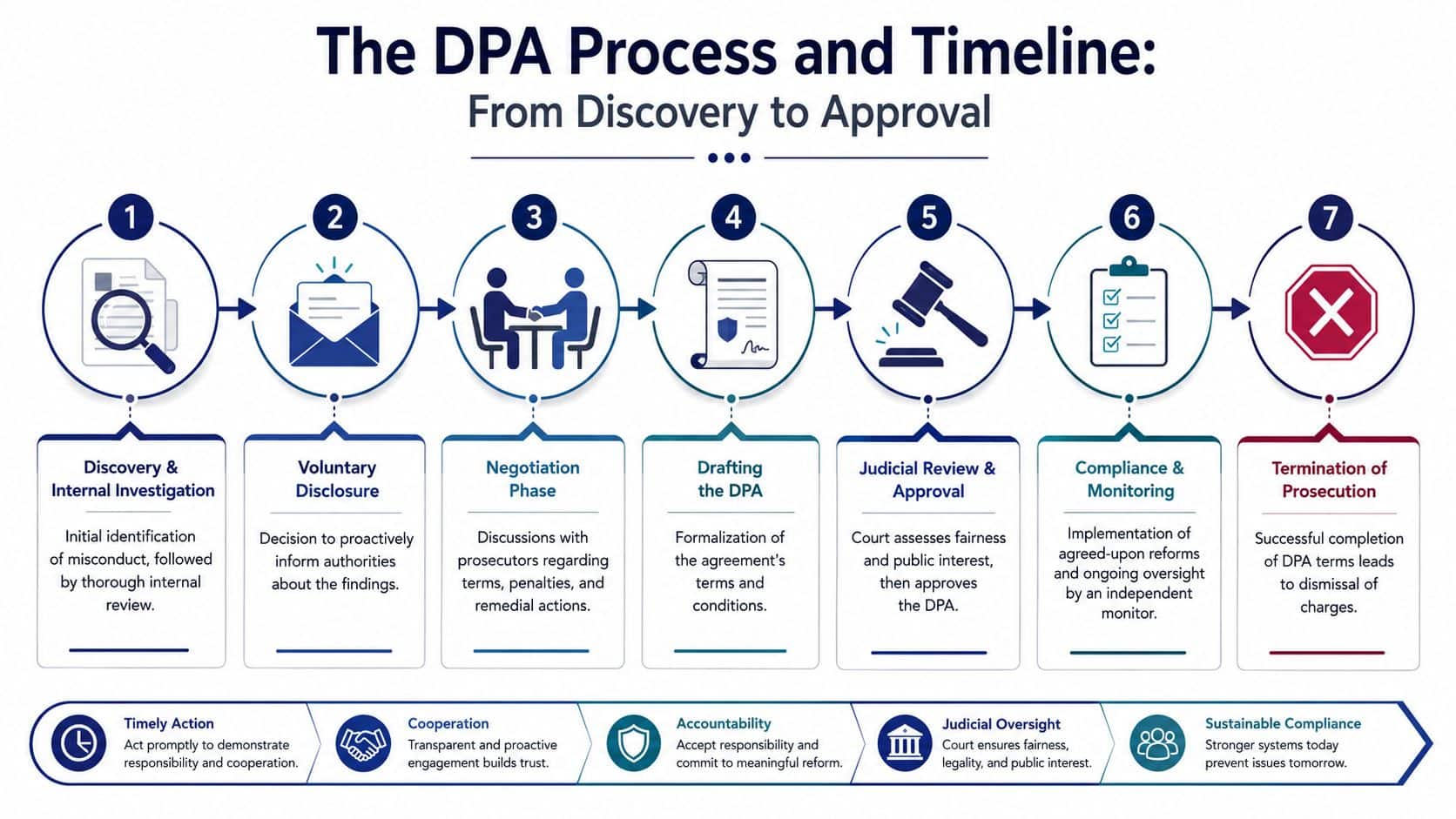
Stage one through three
Discovery and scoping
The organisation identifies suspicious conduct and defines the immediate risk. Forensic accountants preserve accounting records, pull transactional data, and begin testing the allegation against the books and underlying documentation.Internal investigation
The review becomes structured. Teams trace money flows, test explanations given by staff, identify whether misconduct was isolated or systemic, and estimate financial impact. If you need a practical foundation for this work, this guide to fraud investigations sets out the investigative disciplines that matter early.Self-reporting decision
Legal advisers and the board decide whether to approach the Serious Fraud Office or another authority. This is never just a legal question. It depends on the quality of the facts, the extent of misconduct, and whether the organisation can demonstrate genuine cooperation.
Stage four through seven
A concise view helps.
| Stage | What the company must do | What the forensic accountant contributes |
|---|---|---|
| Negotiation | Present a reliable account of events and discuss proposed terms | Quantifies gain, loss, suspicious flows, and possible restitution or disgorgement issues |
| Drafting | Agree obligations, controls, reporting, and cooperation terms | Tests whether compliance promises are practical, measurable, and evidenced |
| Judicial approval | Support the legal case that the outcome is proper | Produces clear schedules, summaries, and explanations that help the court understand the financial picture |
| Post-approval compliance | Deliver the reforms and reporting promised | Monitors implementation, validates remedial action, and tracks adherence |
Where businesses weaken their own position
Companies often damage credibility in one of three ways:
- They report before they know enough. An incomplete story can create avoidable inconsistencies later.
- They wait too long. Delay can look tactical rather than responsible.
- They overstate remediation. Prosecutors and courts can tell when a control framework exists only on paper.
The strongest DPA candidates usually do the opposite. They establish the facts quickly, preserve independence, cooperate in a disciplined way, and back every major assertion with evidence that can be tested.
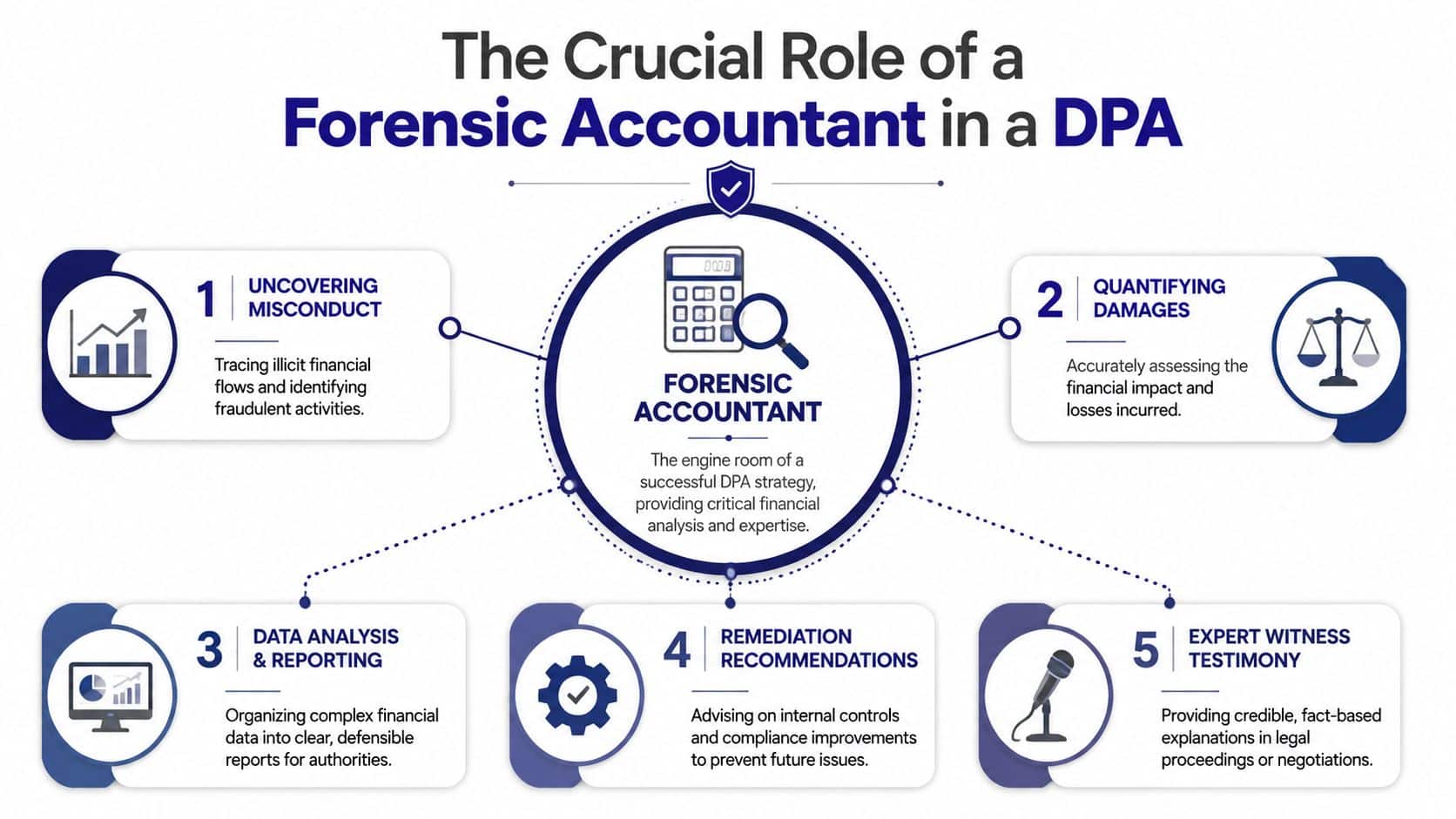
The Crucial Role of a Forensic Accountant in a DPA
If lawyers define the legal route, the forensic accountant often builds the factual road underneath it. Deferred prosecution agreements depend on detail. Not broad assurances, not management optimism, and not slide-deck compliance language. Detail.
Independence and evidence
The first value is independence. A forensic accountant can examine journals, supplier records, bank movements, rebates, commission structures, and approval trails without being tied to the internal reporting lines that may have failed in the first place. That independence matters when prosecutors assess whether the company has really confronted the misconduct.
A second value is translation. Financial misconduct usually hides inside ordinary business processes. Rebates can conceal kickbacks. Marketing support can conceal bribes. Consultancy fees can conceal diversion. A forensic accounting report turns those patterns into evidence a lawyer, prosecutor, judge, board, or insurer can follow.
For readers looking for a broader overview of this discipline, the role of forensic accountants gives a useful summary of how financial investigation supports disputes, fraud cases, and regulatory scrutiny.
Quantification and remediation
Numbers drive consequences. Penalties, compensation discussions, disgorgement analysis, insurance positions, and board decisions all depend on what the misconduct cost or generated. That requires more than rough estimates.
A forensic accountant will usually test:
- Illicit benefit: What profit or advantage did the organisation gain?
- Direct loss: What money left the business improperly?
- Third-party impact: Who may require compensation or restitution?
- Control failure points: Which approvals, reconciliations, or oversight mechanisms failed?
“If you can't explain the money clearly, you can't expect a prosecutor or judge to trust the remediation.”
The post-approval phase is often overlooked. Yet UK DPAs require ongoing cooperation and compliance reforms, and if the organisation breaches the agreement, prosecution can resume, as noted in the UNAFEI analysis of UK DPA supervision. That is exactly why forensic accounting remains central after the headlines fade.
What works and what doesn't
What works is disciplined remediation tied to identified failures. If procurement controls failed, redesign procurement controls. If third-party due diligence was weak, rebuild that process and test it. If senior oversight was missing, document escalation and board reporting properly.
What doesn't work is generic compliance theatre. New policy manuals won't rescue a company if no one can show who approved suspect transactions, why they passed, and how the same weakness has now been removed.
Corporate Consequences and Compliance After a DPA
The court has approved the agreement. The market has seen the headline. The board now faces the harder test: proving, month after month, that the company has fixed the conditions that allowed the misconduct to happen.
A DPA prevents an immediate prosecution, but it does not restore normality. It places the business under sustained scrutiny from prosecutors, the court, auditors, lenders, counterparties, and its own employees. Financial penalties, compensation, reporting obligations, and reform programmes can reshape budgets, management time, and board agendas for years. From a forensic accountant's perspective, this stage often determines whether the company regains credibility or slips back into old habits with better paperwork.
What the business actually lives with
After approval, the pressure becomes practical. Management must keep trading while also proving that remediation is real, documented, and working in daily operations. That usually means tighter approval routes, better third-party due diligence, clearer records, retraining, and regular evidence that controls are being followed rather than merely announced.
Three pressure points appear repeatedly.
- Leadership capacity: Directors and senior managers must supervise remediation without losing control of performance, cash flow, and customer relationships.
- Evidence demands: Prosecutors and monitors, where appointed, will expect records that show who changed what, when it changed, and how the company tested the result.
- Internal resistance: Staff may support reform in principle but resist slower approvals, more challenge, and less discretion over high-risk transactions.
Here, forensic work remains highly practical. Someone has to test whether new controls would have stopped the original conduct, whether suspicious payment patterns have indeed ceased, and whether management information gives the board a reliable picture of risk. Without that testing, remediation turns into policy drafting and status reports.
Compliance after approval means proving change
Boards should treat the post-DPA period as a live assurance exercise, not a legal afterthought. The right question is not whether a new policy exists. It is whether the company can demonstrate that gifts, commissions, onboarding decisions, journal entries, expense claims, and third-party payments now pass through controls that are understood, used, and checked.
In practice, that calls for disciplined follow-through:
- map each remedial action to a specific control failure identified in the investigation
- assign ownership at executive and board level
- test a sample of transactions after each control change
- keep a clear audit trail of decisions, exceptions, and escalations
- report progress in a form the board can challenge, not merely receive
Boards that want remediation to sit inside broader oversight should align it with a UK board guide to roles, risk and reporting. That helps prevent the DPA workstream from becoming isolated from mainstream governance.
Rebuilding trust after the agreement
Reputation repair does not happen because the agreement has been signed. Customers want continuity. Lenders want confidence in forecasting and controls. Employees want to know whether leadership has changed conduct, not just language. Good external communications matter, and for that aspect of the response, Carlos Alba Media's trust advice is a useful complement to legal and forensic planning.
The underlying point is simple. A DPA gives the company a chance to correct course. Whether that chance is used well depends on evidence, discipline, and board attention after the court hearing, not at it.
Notable UK Deferred Prosecution Agreement Case Studies
A board usually reaches this section of the story late. Allegations have surfaced, counsel is involved, and management wants to know whether the company is looking at prosecution, settlement, or something in between. The UK record on DPAs shows how narrow that path is. They are used sparingly, and the cases that reach approval tend to involve serious misconduct, detailed cooperation, and hard evidence that the company has examined its own failures properly.
Two cases illustrate the point clearly. Rolls-Royce remains the reference point for scale, duration, and international complexity. Glencore shows how bribery failures, weak controls, and the quality of the corporate response come under close scrutiny together. For directors and external advisers, the lesson is practical. A DPA is not won by aspiration or polished submissions. It is built on facts that can survive challenge.
Rolls-Royce
The Rolls-Royce matter still stands out because of the breadth of the conduct and the financial consequences attached to it. For a company facing a similarly complex fact pattern, the immediate problem is rarely legal analysis alone. It is reconstruction. Someone has to trace payments, test supporting records, identify how third parties were used, and explain how misconduct passed through finance functions, subsidiaries, and approval chains over time.
That is where forensic accounting work often determines whether the company can present a coherent account at all.
In practice, a case like this requires more than a review of headline transactions. It requires transaction testing across periods, reconciliation of incomplete records, careful treatment of overseas data, and a clear methodology for quantifying benefit, loss, or exposure. Without that discipline, management cannot answer basic questions with confidence, and counsel cannot present a convincing picture of what happened.
Glencore and the wider pattern
Glencore highlights a different, but related, lesson. Prosecutors will examine the misconduct itself, but they will also test the company's response after the issue is identified. That includes the quality of the internal investigation, the reliability of financial evidence, the speed of document preservation, and whether remediation addresses the actual failure rather than the public relations problem.
I have seen boards underestimate that second point. They assume cooperation means being available and responsive. In a DPA context, cooperation has to be organised. Records need to be preserved early. Data sets need to be complete. Financial analysis needs to be consistent with the company's narrative and capable of standing up in court, under prosecutorial review, and before the board.
Other UK DPA cases follow the same pattern. Different industries produce different fact patterns, but the recurring questions are familiar. What happened. Who knew. How much money moved. Which controls failed. What changed after discovery.
What boards should take from these cases
The case studies point to a small set of board-level conclusions.
| Case lesson | Why it matters |
|---|---|
| Complex misconduct needs financial reconstruction | Counsel and the board need a tested account of transactions, records, and control failures, not assumptions |
| Cooperation has to be evidenced | Timely assistance carries more weight when the company can produce organised data, clear chronologies, and defensible analysis |
| Remediation has to match the mechanism of misconduct | Prosecutors and the court will look for changes tied to the actual failure in payments, approvals, oversight, or third-party management |
These are cautionary cases, but they also offer a workable roadmap. Companies that handle the position best usually identify the facts early, measure the financial impact properly, and link remediation to evidence rather than sentiment. That is why forensic accountants are involved throughout the DPA process, not only at the end when numbers are needed for settlement discussions.
A Practical Checklist for Boards and Compliance Officers
Most boards don't prepare for deferred prosecution agreements directly. They prepare by reducing the chance of misconduct and improving their response if it appears. That's the right approach.
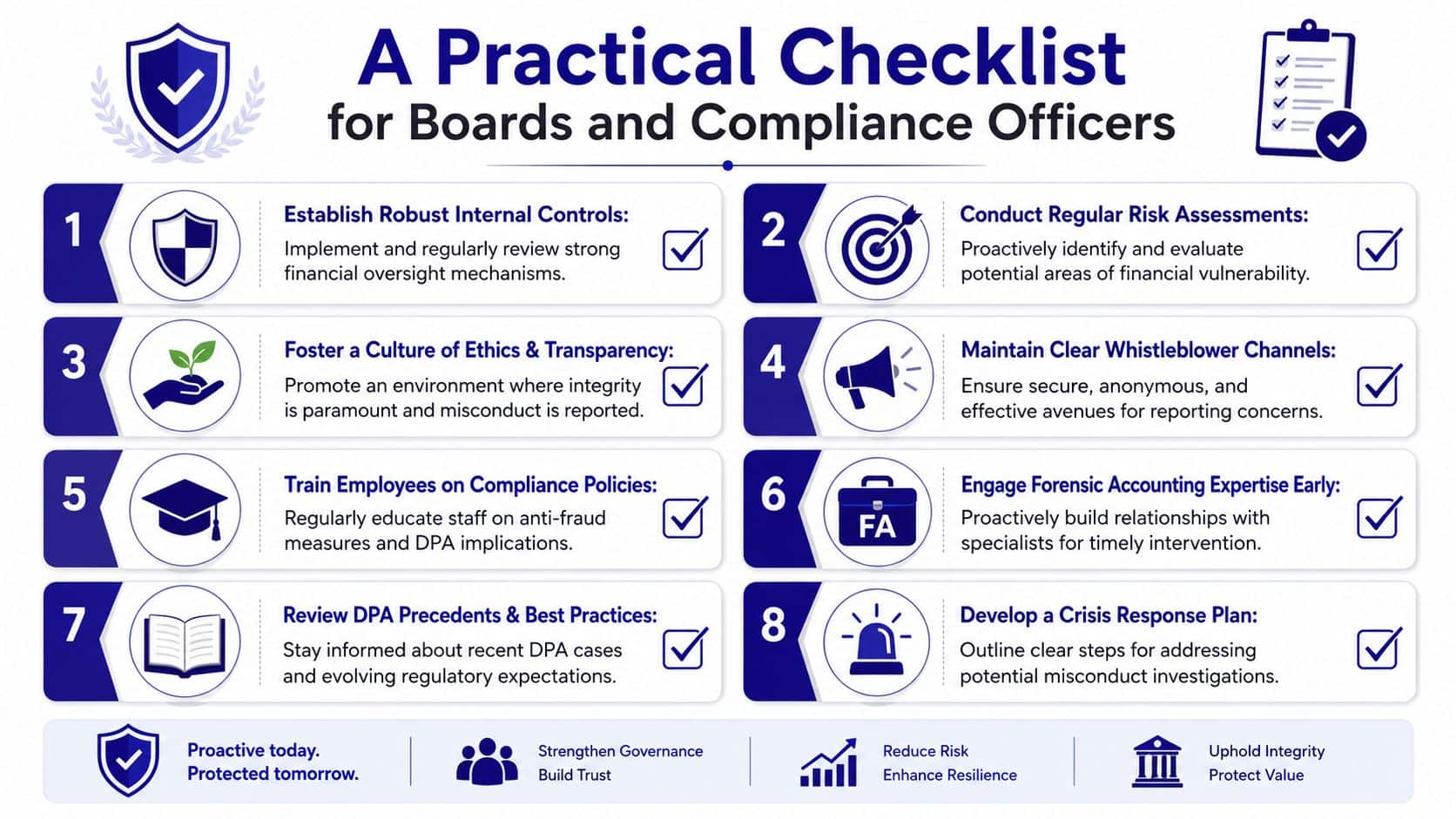
The working checklist
- Lock down internal controls: Review approval limits, segregation of duties, journal entry oversight, supplier onboarding, and unusual payment pathways.
- Run targeted risk assessments: Focus on bribery exposure, intermediary relationships, cross-border payments, rebates, commissions, and manual overrides.
- Protect whistleblowing routes: Staff must know where to report concerns and trust that the issue won't be buried.
- Train with real scenarios: Generic annual slides won't do much. Use examples relevant to procurement, sales incentives, expenses, and third-party use.
- Plan the first response: Decide now who preserves evidence, who instructs counsel, who informs the board, and who speaks externally.
- Bring in specialists early: If the issue may involve fraud, bribery, corruption, false accounting, or suspicious payments, early forensic accounting support usually saves time later.
- Review precedent and governance: Keep pace with current expectations and stress-test board reporting lines before a crisis lands.
Questions worth asking this quarter
Ask your finance lead whether they can quickly extract and analyse suspect transactions across entities. Ask your general counsel whether privilege, reporting, and investigation protocols are ready. Ask your audit committee who would conduct an independent review if the allegation implicated senior management.
If those answers are vague, the gap is already real.
A company doesn't need to wait for a dawn raid, whistleblower dossier, or regulator letter to improve its position. It needs a response plan, credible controls, and access to forensic accountants who can investigate fast, quantify accurately, and support legal strategy without losing sight of the business reality.
If you're dealing with suspicious transactions, a whistleblower allegation, bribery concerns, or an investigation that could threaten the business, Lighthouse Consultants can help you take control quickly and credibly. Their forensic accountants support boards, lawyers, and compliance teams with independent investigations, financial quantification, expert reporting, and practical remediation planning across complex UK corporate disputes and crisis matters.