You bought a business to gain market share, customers, capability, or advantage. Instead, your finance team now can't reconcile margins, the seller disputes the earn-out, your lawyer keeps asking for support that nobody prepared at completion, and every month-end raises a new question about what you acquired.
That's where acquisition accounting stops being a technical finance exercise and starts becoming a dispute issue. In practice, the damage rarely comes from one dramatic error. It comes from a series of small decisions: an optimistic valuation, a missed liability, a weak definition in the SPA, or a goodwill figure nobody can defend once the relationship between buyer and seller turns hostile.
Many owners assume their usual accountant will “sort the entries out later”. Sometimes that works for straightforward deals. In a mid-market acquisition with pressure, personalities, and imperfect records, it often doesn't. Standard compliance work records what management presents. Forensic thinking asks a harder question. What was missed, softened, delayed, or framed too favourably?
When Your Dream Acquisition Becomes a Financial Nightmare
The pattern is familiar. The deal completes. Everyone moves on. Then the problems arrive in sequence.
A key contract disappears after handover. Stock turns out to be slow-moving. A tax query that sounded minor before signing becomes expensive after completion. Management forecasts used to support value don't convert into cash. Then the actual fight begins. Was the business worth what you paid, or did the numbers flatter the target at exactly the wrong moment?

Why this goes wrong so often
Most post-acquisition trouble starts before the first journal entry. Buyers focus on headline price, headline synergies, and completion mechanics. They spend less time on the quality of the underlying balances and even less on the assumptions needed to turn a legal acquisition into a reliable opening balance sheet.
That gap matters because acquisition accounting forces a buyer to translate a commercial story into defensible numbers. If the target carried assets at outdated book values, or if liabilities sat outside the obvious ledgers, the buyer inherits the problem and records it in the combined accounts.
Practical rule: If the transaction rationale sounds stronger than the financial evidence, slow down and test the evidence again.
A lot of people resist bringing in forensic support at this stage. They think it will complicate the deal, upset the seller, or duplicate the work of the reporting accountant. Those objections are understandable. They're also expensive when left unanswered.
The objection that causes the most damage
The most common objection is simple. “Isn't this just normal accounting?” Not quite.
Normal accounting answers the compliance question. A forensic approach deals with the conflict question. It tests whether the numbers can survive challenge from a buyer, seller, lender, auditor, tax authority, insurer, or court. That means tracing unusual entries, pressure-testing assumptions, checking whether liabilities have been minimised, and asking whether the narrative around the business matches the underlying records.
Here's what tends to work, and what usually doesn't:
| Approach | What happens in practice |
|---|---|
| Relying only on year-end compliance | Issues surface after completion, when leverage is gone |
| Treating the SPA and accounting work separately | Definitions conflict, especially around debt, working capital, and contingent exposure |
| Testing fair value assumptions early | Weak valuations get challenged before they become filed numbers |
| Reviewing management explanations without documentary support | Disputes harden because nobody can prove the original basis |
What a sensible buyer should do
A disciplined buyer or legal team should focus on four things before problems crystallise:
- Pin down the acquisition date mechanics: Control can pass in legal documents before the finance team is ready to measure it properly.
- Interrogate non-obvious liabilities: Tax exposures, warranty claims, litigation risk, and deferred obligations rarely present themselves cleanly.
- Separate value from optimism: Forecasts can support a negotiation. They don't automatically support fair value.
- Create a record fit for challenge: If a dispute emerges, contemporaneous working papers matter far more than confident recollections.
The purpose of good acquisition accounting isn't to make the deal look neat. It's to make the economics of the deal visible. When that work is weak, buyers overpay, sellers overclaim, and lawyers end up arguing about numbers that should have been settled at the start.
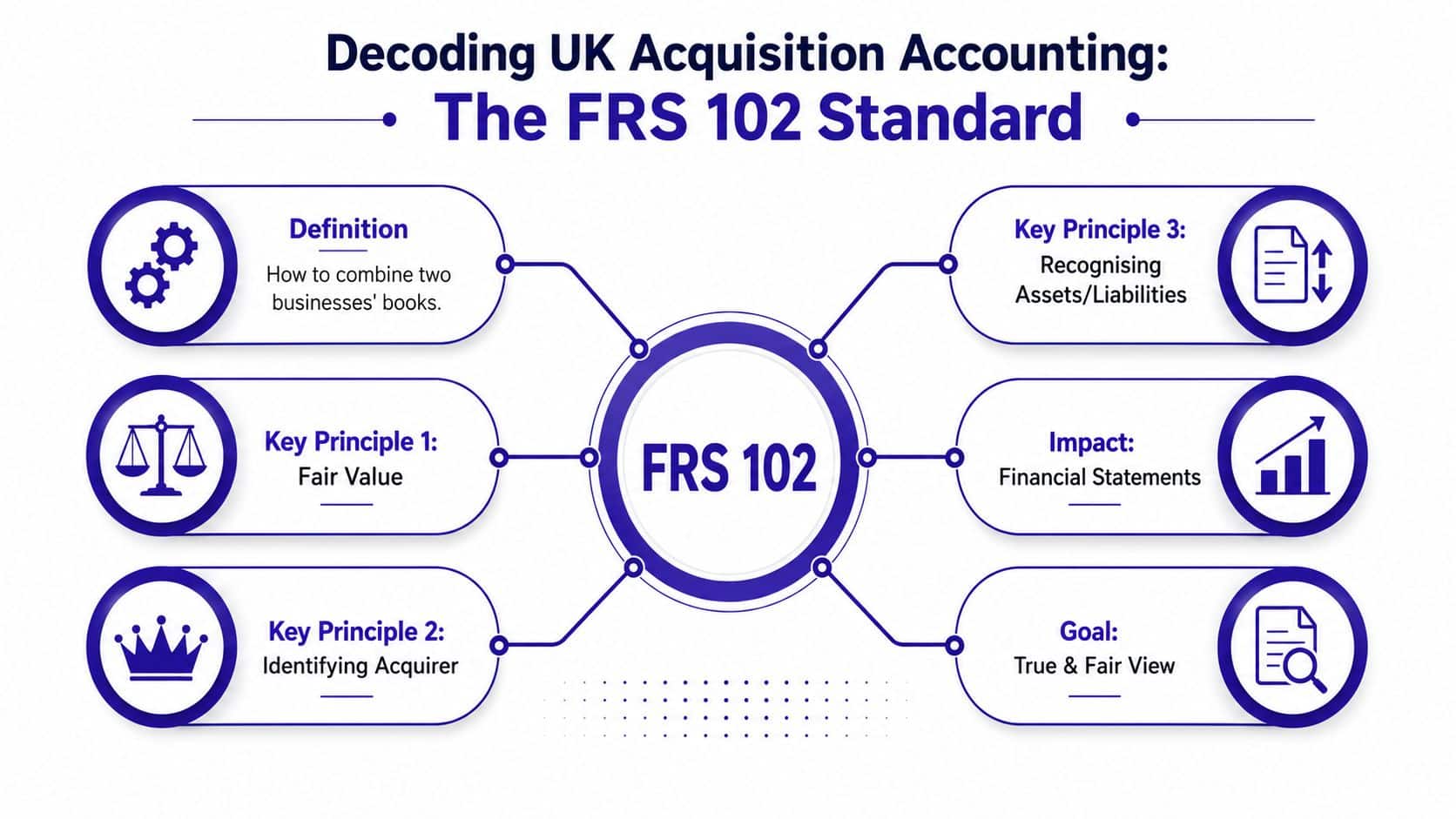
Decoding UK Acquisition Accounting The FRS 102 Standard
At the UK mid-market level, acquisition accounting sits under FRS 102, specifically Chapter 19. That standard requires assets and liabilities acquired to be recorded at fair value at the date of transfer, not carried forward at the target's old book values. That matters even more in an active market. Fair4All Finance's Appendix on accounting for acquisitions notes that inward UK M&A transactions in Q1 2025 reached £19.2 billion, a £15.2 billion increase from Q4 2024.
Fair value is the core discipline
Think of a business acquisition like buying a complex machine. You don't pay one undifferentiated price and stop there. You need to know what sits inside the machine, what works, what is worn out, what has hidden repair costs, and what only appears valuable because someone described it well.
That's exactly what FRS 102 forces you to do with a company. You identify the individual assets and liabilities and measure them at fair value on the acquisition date. Property, stock, debtors, contracts, customer relationships, contingent exposures, deferred obligations, and intangible assets all need proper attention.
The rule sounds straightforward. The work isn't.
What non-finance owners often miss
Book value and fair value are not the same thing. A target may have assets carried at historic cost, liabilities that are incomplete, or intangibles that were never separately recognised. Once you acquire control, you cannot automatically inherit those balances and hope the reporting outcome looks sensible later.
That is why a rushed opening balance sheet creates so many downstream problems. The first set of post-acquisition accounts becomes the foundation for impairment reviews, earn-out arguments, profit analysis, tax discussions, and lender reporting. If the starting point is wrong, everything built on top of it becomes harder to trust.
A technically compliant answer isn't enough if the assumptions behind it would collapse under cross-examination.
The practical point behind the standard
FRS 102 isn't trying to make life difficult. It's trying to stop weak deals from being hidden inside stale accounting numbers.
Three practical consequences follow:
- Old carrying values lose authority: Historic numbers in the target accounts may have little relevance once control transfers.
- The buyer needs evidence, not summaries: Management packs and adjusted EBITDA bridges don't replace valuation work.
- The combined balance sheet becomes a negotiation battlefield: If the seller, buyer, and advisers never aligned on what was being valued, the accounts become the place where that argument reappears.
For owners and lawyers, that's the key point. Acquisition accounting under FRS 102 is not admin. It is the formal conversion of a commercial transaction into evidence.
The Purchase Price Allocation Process Explained
Purchase price allocation, or PPA, is where acquisition accounting becomes operational. This is the process that turns “we bought the company” into a documented allocation of value across the things you acquired and the obligations you assumed.
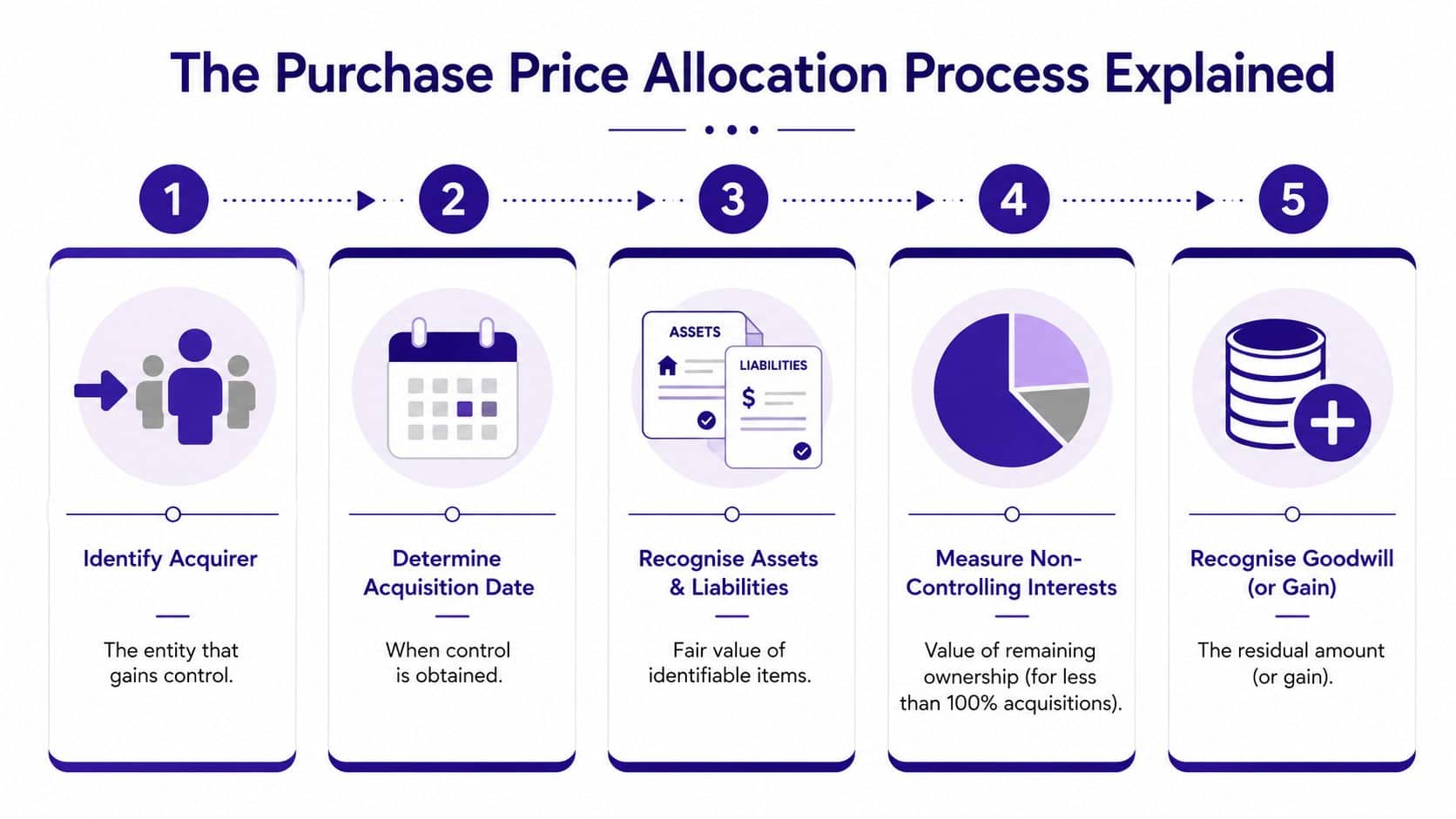
A useful starting point is to think in sequence, not in one grand valuation exercise.
The five decisions that matter
Identify the acquirer
This sounds obvious until group structures, management buy-ins, or partial stakes muddy the analysis. The legal buyer is not always the full accounting answer if the structure is layered.Fix the acquisition date
The date matters because fair value is measured at the point control passes. If teams use signing assumptions for a later completion reality, they build timing error into the accounts.Measure the consideration transferred
Cash is easy. Shares, deferred consideration, and contingent earn-outs are not. Every part of the deal package affects the amount being allocated.Recognise identifiable assets and liabilities at fair value
Quality work earns its keep at this stage. Tangible assets are only part of the picture. Customer relationships, brands, contracts, and contingent liabilities often drive the hardest judgement calls.Recognise goodwill or a gain
If the consideration exceeds the net fair value of identifiable assets and liabilities, the residual is goodwill.
Later in the process, if the acquisition is less than a full buyout, non-controlling interests also need proper measurement.
To see the underlying mechanics in a simple walkthrough, this short explainer is useful:
Where buyers make avoidable mistakes
The most common error is treating PPA as a valuation tidy-up after the commercial terms are already fixed. In reality, PPA should influence how you negotiate. If the target's value rests heavily on customers, contracts, or intellectual property, you need those categories tested before completion, not explained away afterwards.
A second error is letting legal drafting and accounting measurement drift apart. If the SPA handles working capital, debt-like items, indemnities, and earn-outs using language that doesn't match the accounting treatment, you create friction immediately after closing. That's why early financial due diligence support often matters more than people expect.
Goodwill is not a harmless balancing figure
Under UK GAAP, the acquisition method is mandatory for commercial business combinations. VJM Global's overview of UK GAAP acquisition accounting states that any excess of consideration over net fair value is recognised as goodwill, and that goodwill must be amortised over its useful economic life, capped at 10 years if the life cannot be estimated.
That has a direct commercial consequence. Goodwill doesn't sit passively in the balance sheet as a historical plug. It creates an ongoing profit and loss charge. Buyers who celebrate a deal on adjusted metrics sometimes confront a harsher statutory reporting outcome once amortisation starts running through the accounts.
The strongest PPA reports don't just explain the numbers. They explain why rival treatments were rejected.
Common Pitfalls and Forensic Red Flags to Watch For
A tidy trial balance can hide a messy acquisition. In disputed deals, the warning signs are often visible early, but nobody reads them as red flags because they arrive dressed as ordinary accounting judgement.

Red flag one: contingent liabilities that remain “under review”
Many mid-market buyers often get caught by situations like these. A pending tax enquiry, a customer claim, a warranty issue, or a brewing employment matter may be known internally but left unresolved at completion. Management may present it as uncertain, remote, or not yet quantifiable. After closing, uncertainty becomes your problem.
That risk becomes sharper because the measurement window is not open-ended. Grant Thornton's discussion of the acquisition method notes a practical gap around the mandatory 12-month measurement period under FRS 102. In practice, valuing contingent liabilities such as pending HMRC enquiries can outlast that period, leaving SMEs to make risky management estimates.
Red flag two: over-engineered intangible values
Some buyers and sellers both prefer lower goodwill. Sellers may want a cleaner story around what has been sold. Buyers may like the appearance of a more detailed asset base. The danger is that teams start assigning confidence to intangible values that the evidence doesn't support.
Watch carefully when customer relationships, brands, proprietary processes, or contract assets absorb a large share of value without a clear link to actual earnings durability. If the assumptions rely on exceptional retention, unusually smooth growth, or management explanations that aren't backed by records, the valuation may be doing negotiation work rather than accounting work.
If an intangible asset is easy to describe but hard to evidence, it deserves more scrutiny, not less.
Red flag three: earn-outs designed for future argument
Earn-outs often solve a pricing gap. They also create a future litigation file if the drafting is loose. Performance metrics can be manipulated by accounting policy choices, post-deal integration decisions, cost allocations, or changes in management control.
The forensic question isn't whether an earn-out exists. It's whether a third party can reconstruct the calculation later without relying on one side's memory. If the answer is no, the structure invites dispute.
What a forensic review actually tests
A serious review usually follows clues rather than management labels. Useful lines of enquiry include:
- Ledger anomalies: Unusual journals near completion, manual postings, or reclassifications that improve optics.
- Commercial inconsistency: Strong EBITDA stories paired with weak cash conversion or deteriorating collections.
- Document mismatch: Board papers, legal correspondence, and finance schedules telling slightly different stories.
- Timing pressure: Valuations signed off quickly because the deal timetable left no room for challenge.
These aren't merely accounting defects. They can point to misrepresentation, incomplete disclosure, or a governance failure in the acquisition process itself.
Disclosure Tax and Litigation Implications for Your Business
Poor acquisition accounting doesn't stay in the finance department. It moves into board minutes, tax correspondence, lender conversations, and dispute bundles.
The disclosure angle is the first place many businesses feel pressure. In a significant acquisition, the parent company may need to show both the pre-acquisition book values and the fair values at acquisition for each class of asset and liability, along with the goodwill or negative difference arising. That comparison gives readers a map of what changed and why.
Why disclosure becomes evidence
Once those disclosures appear in group accounts, they stop being internal working assumptions. They become formal statements that other parties can analyse.
That matters in contentious situations. The KPMG Fraud Barometer summary states that reported alleged fraud cases over £100k surged by 151% to £1.12 billion in 2022. Against that backdrop, the requirement under the UK Companies Act 2006 to disclose both book values and fair values for each class of asset and liability in a major acquisition gives forensic accountants a precise route to test whether value has been overstated, liabilities understated, or losses shifted.
The same accounting choice can affect three battles at once
A single PPA decision often lands in three places at the same time:
| Decision area | Business effect | Dispute effect |
|---|---|---|
| Asset valuation | Shapes future amortisation and reported profit | Can support or undermine overpayment claims |
| Liability recognition | Changes opening balance sheet strength | Drives warranty, indemnity, or misrepresentation arguments |
| Working capital treatment | Affects completion adjustments and cash expectations | Often sits at the centre of post-closing challenge |
This is why legal teams should read the accounting file and finance teams should understand the legal definitions. If they work in parallel without aligning, avoidable inconsistencies appear.
A common pressure point is completion accounts and post-closing adjustments. Where value disputes overlap with completion mechanics, a focused review of working capital adjustment issues often reveals whether the disagreement is commercial, accounting-based, or both.
Tax is not separate from valuation quality
Businesses often hear that goodwill amortisation may create tax advantages. The practical point is narrower. Any tax position that depends on acquisition accounting only stands up if the underlying valuation is coherent, documented, and internally consistent.
If the fair values were stretched to make the transaction look attractive, the tax analysis rests on unstable ground. If they were prepared carefully, the buyer has a far better chance of defending the treatment later. In disputes, tax often becomes the secondary battleground because weak accounting papers invite wider challenge.
The key lesson is simple. Acquisition accounting entries don't just report the deal. They shape the legal and tax story that follows it.
Proactive Due Diligence is Your Best Defence
The best time to solve acquisition accounting problems is before they become “post-acquisition issues”. Once the deal closes, influence wanes, memories change, and parties become far less cooperative.
That's why the strongest buyers treat acquisition accounting as part of due diligence, not a compliance task for later. They challenge the target's assumptions before signing. They test whether reported performance converts into reliable value. They make sure the legal drafting, valuation analysis, and finance work all point to the same economic reality.
What proactive work looks like
Good pre-deal work is not just more diligence. It is better-directed diligence.
- Interrogate the bridge from EBITDA to value: If margin quality is weak, fair value conclusions will usually be weak as well.
- Review the records behind key assumptions: Customer concentration, contract life, stock quality, and unresolved claims need evidence.
- Document judgement points early: If a valuation issue is likely to become contentious, create a contemporaneous record before parties split into camps.
- Use technology carefully: Tools can help teams triage statements and patterns faster, especially when paired with a sensible practical guide for AI financial analysis, but no software removes the need for judgement over fair value, disclosure, and dispute risk.
Why reactive fixes rarely satisfy anyone
A hurried post-closing review often tells you what went wrong, but it can't restore the negotiating position you had before completion. By then, you are no longer asking whether to proceed. You are asking how to contain the damage.
This highlights the importance of planning ahead. The cost is not in doing careful work early. The cost is in defending weak work later.
A disciplined acquisition process should include a documented framework, clear ownership, and a tested checklist. A structured acquisition due diligence checklist helps boards, CFOs, and legal advisers keep the transaction grounded in evidence rather than deal momentum alone.
If you're facing unexplained losses after a deal, a value dispute with a seller, pressure around completion accounts, or concerns that the acquisition accounting won't withstand challenge, Lighthouse Consultants can help you get clarity fast. Their team supports businesses, lawyers, boards, and insurers with forensic accounting, due diligence, expert analysis, and independent reporting that stands up in negotiation and court.