A deal can look clean on paper and still blow up six months later.
A supplier dispute starts with missed deliveries, then a solicitor discovers the counterparty was already appearing in enforcement notices and court reporting before the contract was signed. A senior hire arrives with polished references, then a shareholder dispute uncovers links to a failed venture and allegations of misconduct that nobody checked. An investor promises stability, then adverse press, litigation history, or regulatory attention drags the whole transaction into delay, cost, and distrust.
That's where businesses often call a forensic accountant too late. By then, the fraud has moved, the records are messy, positions have hardened, and the legal bill is climbing. Adverse media screening helps much earlier. Used properly, it isn't just a KYC exercise. It is a practical way to spot hidden litigation risk, reputational exposure, financial misconduct, and relationship danger before they become a forensic investigation, insurance claim, insolvency problem, or courtroom fight.
Some business owners resist it because they assume it's expensive, over-engineered, or only relevant to banks and law firms. That objection makes sense until the first preventable crisis lands on the desk. A sensible, risk-based screening process costs far less than untangling a failed acquisition, a corruption allegation, a money laundering concern, or a contract dispute built on bad counterparties.
The Hidden Risk That Derails Businesses
The most damaging business problems rarely announce themselves clearly. They sit in public view, scattered across news archives, court records, enforcement notices, and insolvency filings, while directors focus on sales, staffing, funding, and operations.
A common pattern runs through fraud work and dispute support. The warning signs were available. Nobody joined them up. Then the consequences arrived all at once: frozen payments, broken contracts, reputational panic, internal accusations, and urgent legal advice.
When a routine transaction turns toxic
A property transaction, distribution agreement, or investment round can move quickly. The documents look in order. The directors seem credible. The commercial pressure to proceed is high. Then one issue surfaces and everything changes.
The counterparty is named in ongoing litigation. A beneficial owner has a record of regulatory trouble. A linked entity appears in reporting around fraud allegations, labour disputes, or suspicious restructuring activity. Even if none of that proves wrongdoing on its own, it changes the risk picture immediately.
Problems in fraud and litigation work often begin long before the first formal allegation. Public information usually leaves clues first.
The UK data shows why that matters. The total value of reported alleged fraud cases of £100,000 or above heard in UK courts surged by 151% from £444.7 million in 2021 to £1.12 billion in 2022, according to KPMG's UK Fraud Barometer. That isn't abstract compliance noise. It reflects a serious volume of high-value disputes and allegations moving into formal proceedings.
The cost of finding out late
By the time a lawyer or accountant is instructed after the event, the work becomes more invasive and expensive. Teams need to reconstruct events, preserve evidence, quantify losses, assess solvency, and explain who knew what and when. Management time disappears into witness meetings and document requests.
That is why screening matters beyond AML. It can stop a business from:
- Entering the wrong relationship with a party already associated with unresolved allegations or claims
- Appointing the wrong individual into a position of authority where trust and control matter
- Underestimating dispute exposure in a merger, supply arrangement, or shareholder negotiation
- Missing reputational risk that later affects customers, lenders, insurers, or investors
For many SMEs, the actual threat isn't a dramatic criminal conspiracy. It's the quieter failure to spot obvious public warning signs before money, trust, and legal exposure are committed.
What Is Adverse Media Screening
Adverse media screening is the structured review of publicly available information to identify negative reporting or records linked to a person, company, owner, director, or connected party. In practice, it is a financial and reputational background check that goes much further than a quick search engine query.
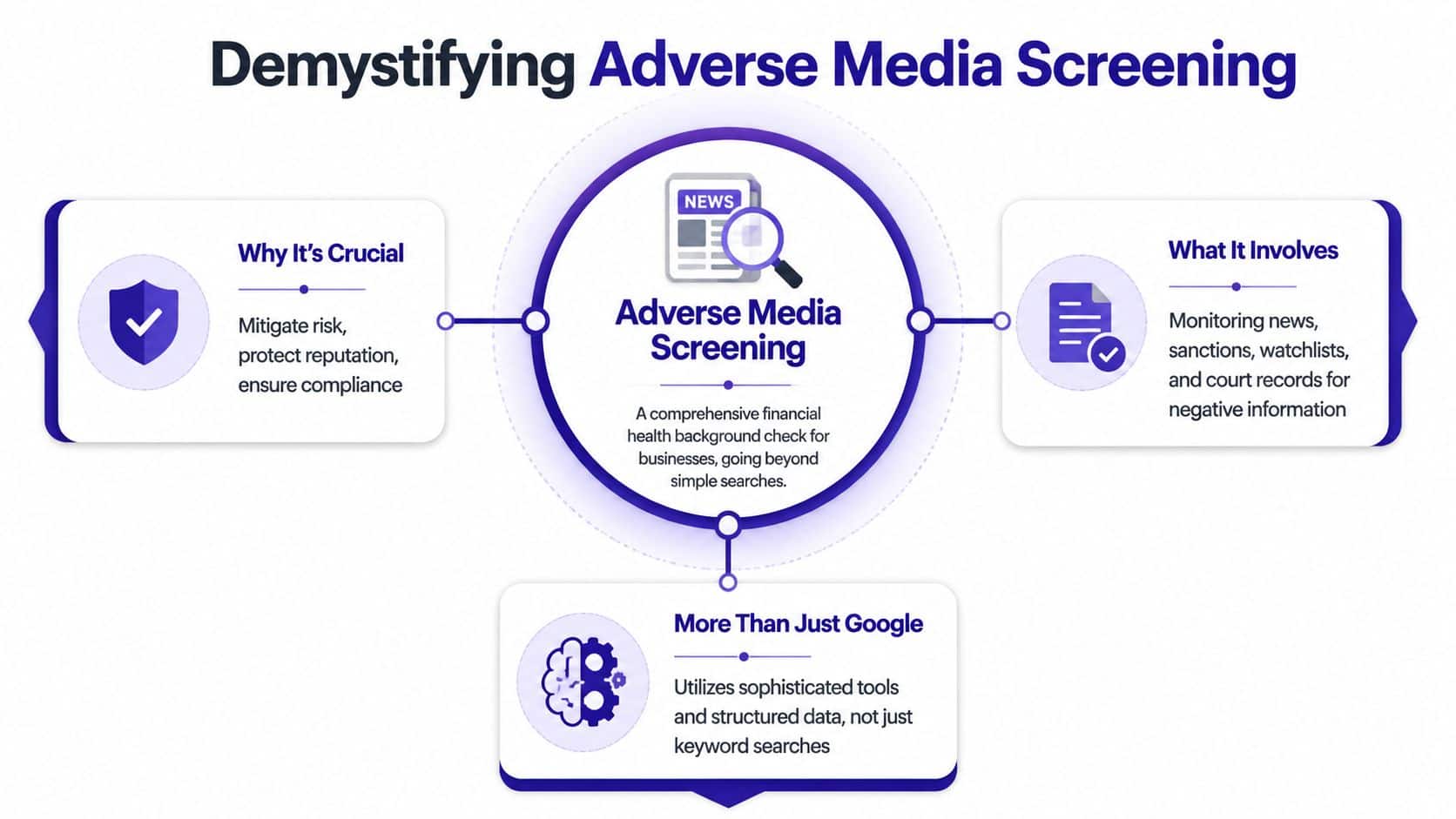
A useful way to think about it is sonar. Your onboarding file shows what is above the surface. Screening helps detect what sits below it.
What it actually looks for
The process reviews sources that may reveal financial crime, litigation, misconduct, or serious reputational concerns. For higher-risk UK matters, that can include mainstream UK and international news, court records, regulatory enforcement notices, insolvency registers, and law enforcement press releases.
It also works best when it covers connected people, not only the trading entity. Directors, beneficial owners, senior officers, and associates often tell you more than the company profile alone.
A practical screening exercise usually asks:
- Is this the correct person or business?
- What exactly is being alleged or reported?
- How credible is the source?
- Is the issue current, historical, resolved, or ongoing?
- Does it change the risk of this relationship?
More than a Google search
A manual search can pick up obvious issues. It can also miss critical context. Search engines are inconsistent, results move, and common names produce noise. A proper screening method is more disciplined and easier to evidence later.
Businesses that already screen for politically exposed persons should treat adverse media as part of the same wider control environment. If you need context on adjacent risk checks, PEP screening for higher-risk relationships sits naturally alongside adverse media review.
The short explainer below gives a clear overview of how the process fits into due diligence workflows.
Why the process matters outside compliance teams
Lawyers use it to test counterparties before litigation strategy hardens. Finance leaders use it before a new distributor, investor, or acquisition target is approved. Boards use it before appointing directors or entering sensitive markets. Insurers and claims professionals may use it to understand the conduct background around a disputed loss.
Practical rule: If a relationship would hurt your business if it went wrong, it deserves more than a basic internet search.
Done properly, adverse media screening provides early intelligence. It helps you decide whether to proceed, ask harder questions, tighten contractual protection, escalate to enhanced due diligence, or walk away.
Why UK Businesses Cannot Afford to Ignore Screening
Some firms still treat adverse media screening as an optional enhancement. In the UK, that view is now too casual for any business operating in a regulated environment or handling higher-risk relationships.
The legal position matters. So does the enforcement mood.
The UK standard has tightened
Under the UK framework, adverse media screening is effectively mandatory as part of ongoing monitoring for high-risk clients. The April 2025 Law Society guidance and the SRA's enforcement stance treat failure to document this screening as a measurable compliance failure, not just best practice, as set out in this UK adverse media screening overview.
That changes the discussion completely. A policy that says the firm screens isn't enough. The file has to show that someone reviewed the results, recorded the rationale, and acted where needed.
For property professionals, legal practices, and other firms exposed to AML duties, that means adverse media screening belongs inside customer due diligence and enhanced due diligence, not in a vague compliance appendix.
What regulators expect to see
If your work falls within higher-risk categories, regulators expect evidence, not assertions. In practical terms, firms should be able to show:
- A defined trigger point for screening at onboarding and during the relationship
- Coverage of relevant public sources for the customer and connected parties
- A documented review of any adverse results, including the reasoning
- A clear escalation path when findings raise suspicion or reputational concern
A business owner may ask whether this only matters to regulated financial institutions. The answer is no. Law firms, property-related businesses, and companies dealing with high-risk counterparties can all be drawn into consequences if they ignore public warning signs.
In parallel, other sectors are borrowing discipline from regulated screening models because the commercial logic is obvious. Organisations that rely on trust, safeguarding, or reputation often review broader vetting options, including specialist resources such as this guide to choosing a nonprofit background check company, because screening standards increasingly influence governance expectations beyond classic banking compliance.
Why this matters to directors and owners
The issue isn't only whether a firm ticks a regulatory box. It's whether directors can later defend the decision to enter or continue a relationship after adverse information was available in public view.
That matters in money laundering concerns, but it also matters in negligence allegations, internal investigations, failed transactions, and shareholder disputes. Once something goes wrong, opposing lawyers and regulators often ask the same question: what checks were done, and what did the firm know?
If the file contains no adverse media record, the problem is no longer only the customer. It becomes your process, your judgement, and your governance.
For UK businesses, screening is now part legal discipline, part commercial self-defence.
Implementing a Screening Process That Works for You
Most SMEs don't need a bank-sized compliance department. They do need a process they can repeat, justify, and afford.
The biggest mistake is copying a large institution's control framework without adjusting it for transaction size, sector, geography, and actual exposure. That usually creates cost without clarity.
Start with scope, not software
Before choosing any tool, decide who you will screen and when. Build the process around your real risk profile.
A workable SME framework often starts with these categories:
- New higher-risk customers where ownership, geography, or transaction profile raises concern
- Directors and beneficial owners behind corporate counterparties
- Suppliers and intermediaries who could expose the business to bribery, fraud, labour abuse, or reputational fallout
- Trigger events such as unusual payment requests, disputes, control changes, or sudden urgency around deal completion
This is also where standard due diligence has to connect with broader know-your-customer work. A sensible adverse media process is much easier to manage when it sits inside a wider customer due diligence framework, rather than operating as an isolated check.
Use sources that reflect UK realities
For higher-risk matters, screening should cover the categories expected under UK guidance: mainstream news, court records, enforcement notices, insolvency material, and law enforcement releases. That gives you a more defensible view than relying on whatever appears first in a casual search.
Regulators also expect firms to evidence review. At the same time, SMEs often struggle to define a clear risk appetite because they lack the forensic resources to validate every alert, which can lead to compliance paralysis where investigation cost outweighs actual risk, a problem highlighted in Dow Jones best-practice material referenced for adverse media screening.
That is the trade-off. More screening without clear thresholds usually creates more unresolved work.
Adverse Media Screening Approaches Compared
| Feature | Manual Screening (e.g., Google) | Automated Screening (Specialist Tools) |
|---|---|---|
| Set-up cost | Lower at the outset | Usually higher upfront or on subscription |
| Consistency | Depends heavily on the individual reviewer | More structured and repeatable |
| Audit trail | Often weak unless staff document every step | Easier to record and reproduce |
| Coverage | Can miss relevant records and older material | Broader if configured properly |
| False matches | Common, especially with shared names | Still happens, but tools can help organise review |
| Best use | Low-volume, lower-risk matters | Ongoing monitoring and larger caseloads |
Many firms land somewhere in the middle. They use a specialist platform for screening volume and a human reviewer for judgement. Providers that focus on workflow and integration can help organise those reviews. For example, teams comparing operational options may look at Intelligent Contacts' compliance solutions to understand how case handling and risk management processes can be structured more efficiently.
Build thresholds before alerts arrive
Decide in advance what triggers escalation. For example:
- Proceed and record when the hit is clearly irrelevant or trivial.
- Request clarification when reporting is credible but context is incomplete.
- Escalate for enhanced review when allegations involve fraud, corruption, money laundering, major disputes, or repeated misconduct themes.
- Pause the relationship when identity is confirmed and the issue creates unacceptable legal or reputational exposure.
If you don't define that framework beforehand, every alert turns into an argument.
Navigating the Noise Common Pitfalls and Solutions
Adverse media screening often fails for one reason. Firms drown in rubbish results and conclude the whole exercise isn't worth the effort.
That reaction is understandable. It's also dangerous.
Why teams get overwhelmed
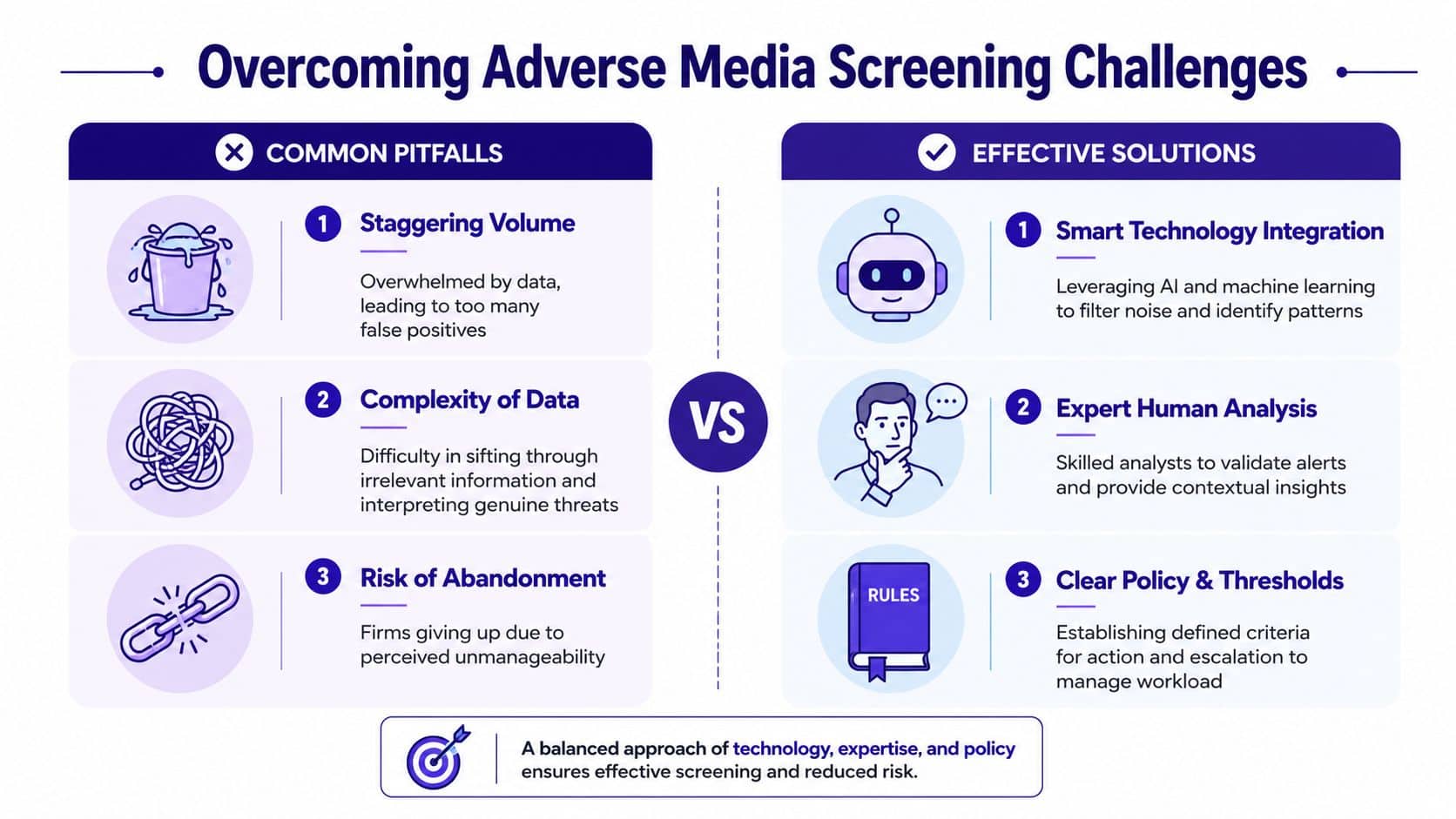
The industry has wrestled for years with poor matching logic and weak context handling. Despite 93% of UK financial leaders rating adverse media screening as critical, a historical false-positive rate between 85% and 95% has caused compliance teams to spend up to 90% of their alert-investigation time on outcomes that require no action, according to Fintechly's analysis of the UK adverse media screening gap.
That happens when systems match names without enough verified identity detail. Common names produce irrelevant articles. Historic stories remain in circulation long after context has changed. A person may appear as a witness, adviser, or victim, but the alert presents them as a suspect because the system saw a keyword and stopped there.
What doesn't work
Several habits make the problem worse:
- Treating every hit as equal when source credibility and context differ sharply
- Using only names without date of birth, company links, jurisdiction, or role information
- Leaving review criteria vague so analysts escalate everything
- Running checks without documenting reasoning which creates panic later during file review
Those mistakes turn a useful control into an expensive inbox.
What works in practice
The answer isn't to abandon screening. It is to apply judgement early.
A strong reviewer asks whether the article identifies the same individual, whether the source is reliable, whether the conduct is relevant to the relationship, and whether the issue is current enough to matter. That triage process cuts noise before the matter escalates into unnecessary investigation.
A good screening process doesn't try to prove every allegation. It sorts credible risk from background noise quickly and defensibly.
That is where experienced forensic judgement adds value. A forensic accountant won't treat every mention as a five-alarm event. Instead, the review focuses on relevance, corroboration, financial implications, and next steps. Some alerts need only a file note. Others justify more documents, better contractual protection, or a full investigation.
The quality of adverse media screening depends less on how many alerts you generate and more on how sensibly you dispose of them.
From Red Flag to Resolution A Forensic Approach
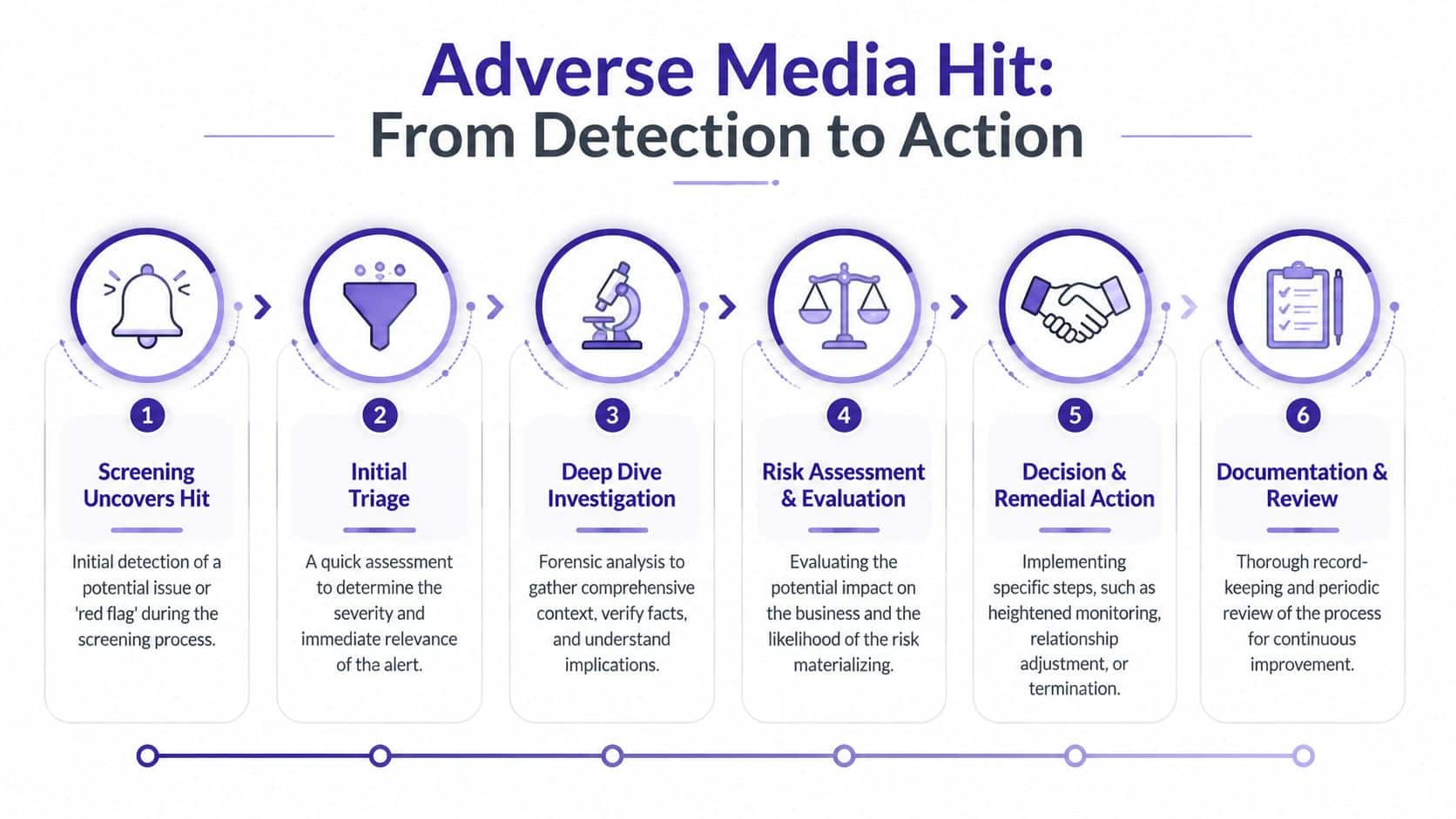
A screening hit is not the conclusion. It is the start of a decision process.
Handled badly, it creates panic or paralysis. Handled properly, it gives management the evidence needed to proceed, pause, or exit with confidence.
Scenario one with a director appointment
A company plans to appoint a new director before a financing round. Screening identifies reporting that links the individual to a dissolved company and allegations of fraud in connected commentary. The articles alone don't prove the allegations. They do show enough to stop treating the appointment as routine.
The next step is not accusation. It is verification.
The business should confirm identity, check the corporate history, review the timeline, request explanation, and assess whether the allegations were tested, dismissed, settled, or left unresolved. If lenders or investors are involved, the reputational effect may matter even if no formal finding was made.
Scenario two with a supplier dispute
A UK importer is onboarding a supplier in a higher-risk jurisdiction. Screening picks up adverse reporting about labour disputes and regulatory concern around an associated entity. That may not trigger an automatic rejection. It may justify tighter contract terms, more documentation, additional site assurance, or a decision to source elsewhere.
Where money movement or ownership transparency is also in issue, the review often needs to sit beside source of funds verification for higher-risk transactions so the business assesses the relationship as a whole rather than as disconnected checks.
What forensic review adds
Once a matter passes initial triage, a forensic accountant can help in ways a basic compliance note cannot. The work may include:
- Link analysis between individuals, entities, and prior disputes
- Document reconstruction to test whether the adverse material aligns with commercial records
- Financial impact review if the risk could affect valuation, recoverability, solvency, or claim exposure
- Reporting for lawyers or boards so a decision can withstand challenge later
This is particularly important because, in the UK, forensic accounting is a growing discipline but has no specific regulator, which means clients must verify the credentials and experience of the experts they instruct, as discussed in this review of the forensic accounting landscape.
Choose investigators the way you choose expert witnesses. Ask about methodology, reporting quality, sector familiarity, and whether their work will survive scrutiny.
Value lies in turning a vague red flag into a supported conclusion. Proceed. Proceed with controls. Pause. Report. Or walk away. That is what businesses and legal teams need when outcomes are critical.
Achieve Financial Certainty with Lighthouse
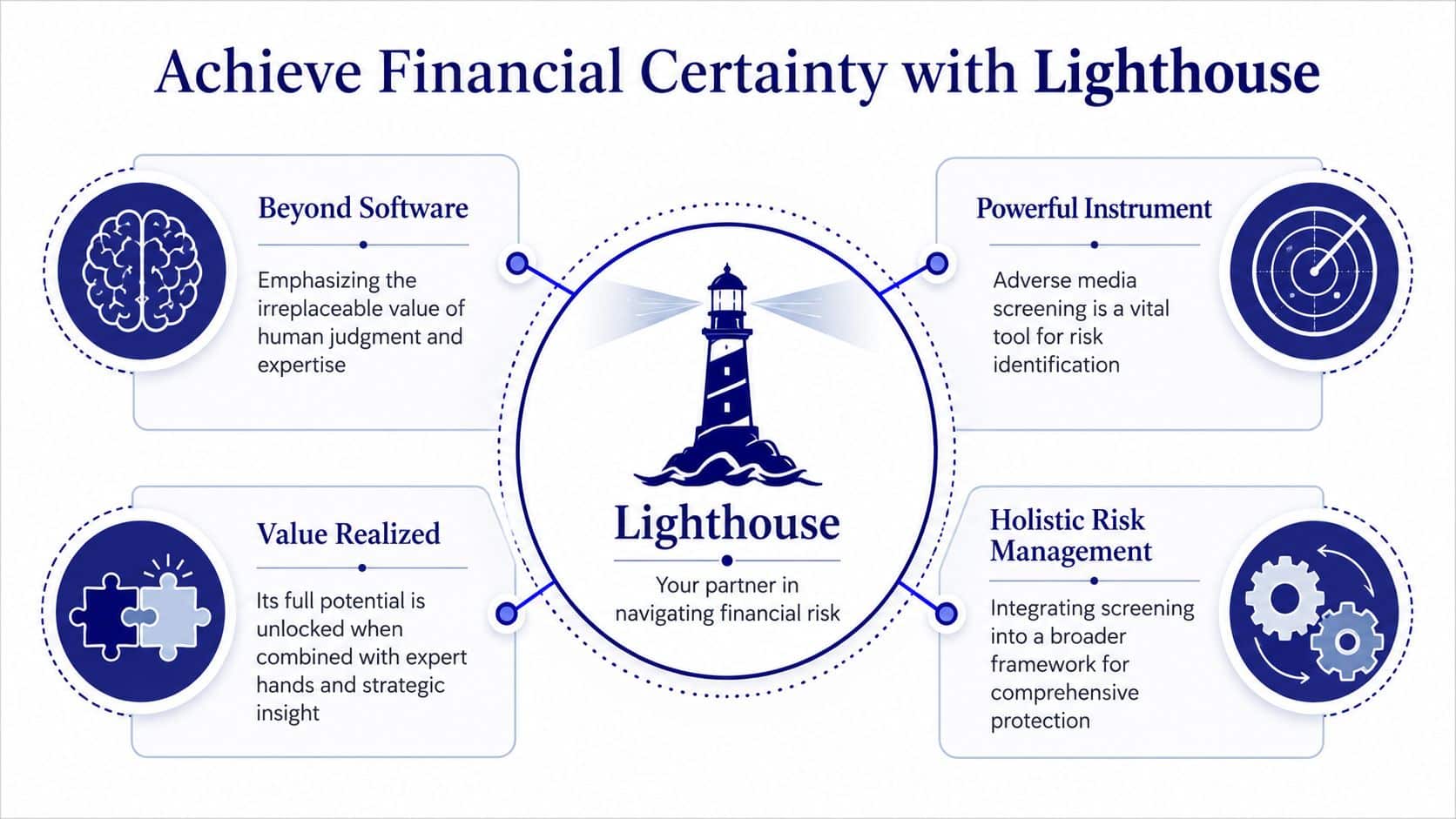
Software can surface names. It cannot replace judgement.
That's the point many businesses realise after the first difficult alert. They don't need more noise. They need a reliable way to interpret risk, quantify exposure, and decide what to do next.
Why judgement matters
Adverse media screening sits at the point where compliance, reputation, finance, and dispute risk meet. A result may affect whether you appoint a director, complete a transaction, continue a client relationship, pursue litigation, or notify a concern. Those are commercial decisions with legal consequences.
The wider market reflects that demand for specialist support. The UK Forensic Accounting Services industry is projected to reach £2.5 billion in revenue in 2026, according to IBISWorld's UK forensic accounting services outlook. That projection underlines how often complex financial problems require structured investigation and defensible analysis.
What a strong adviser should bring
Businesses and law firms should expect more than a search result and a red, amber, green label. They should expect:
- A risk-based process that fits the size and nature of the organisation
- Clear escalation judgement on what matters and what does not
- Financial understanding of how a red flag affects claims, disputes, valuations, recoveries, and control failures
- Reporting discipline that stands up in negotiations, internal reviews, and court if necessary
That combination is where Lighthouse stands out. Lighthouse Consultants brings London-based forensic accounting expertise, Chartered Management Accountants, and hands-on experience across fraud, bribery, corruption, due diligence, litigation support, business interruption, and complex financial disputes. The team doesn't just identify a concern. It helps clients understand the commercial consequence and the next sensible step.
If you are dealing with unexplained losses, a risky counterparty, a disputed transaction, or a file that already feels uncomfortable, early screening and forensic review can prevent far more expensive problems later.
If you want clarity before a relationship, transaction, or dispute gets worse, speak with Lighthouse Consultants. A focused review can help you spot hidden risk early, document your decision-making properly, and move forward with far more confidence.