You've found something that doesn't add up. The stock figures are off. An expense trail looks engineered. A manager has flagged unusual supplier payments. Or an employee has gone quiet the moment questions started. At that point, most business owners aren't thinking about process. They're thinking about damage, cash loss, staff morale, client confidence, and whether they can trust what they're being told.
That's exactly when mistakes happen.
A disciplinary hearing process looks simple from a distance. Send a letter, hold a meeting, make a decision. In practice, it's one of the easiest places for an employer to damage a defensible case. If the issue involves fraud, money laundering concerns, manipulated records, valuation disputes, insurance claims, shareholder fallouts, or any other financially sensitive allegation, a weak process doesn't just create HR risk. It can also destroy evidence, blur accountability, and leave the actual loss unquantified.
Many employers hesitate to bring in specialist help because they assume it's too formal, too expensive, or too much for a “staff matter”. Usually, the opposite is true. The right support narrows the issue, protects fairness, and helps you act with confidence instead of frustration.
The High Stakes of a Flawed Disciplinary Process
A common scenario starts with a finance report that doesn't reconcile. Then someone spots duplicate payments, unexplained write-offs, or a contract that was approved outside authority. You ask a few questions. The answers don't fit. Suddenly, you're not dealing with a routine conduct issue. You're dealing with a potential financial misconduct matter that could end in dismissal, litigation, insurance notifications, or even regulatory scrutiny.

That's where employers often split into two camps. One camp freezes and delays. The other camp rushes in, suspends quickly, confronts the employee without a proper evidence plan, and treats the hearing as a formality. Both approaches create avoidable risk.
Why speed alone doesn't protect you
In the UK, financial misconduct is hardly theoretical. The total monetary value of reported fraud in 2022 was £1.1 billion, with 267 reported fraud cases, representing a 4% increase from the previous year, according to BDO's FraudTrack 2023 report. That matters because disciplinary cases increasingly overlap with live financial disputes, contested losses, and evidence that needs proper analysis before anyone reaches a conclusion.
A flawed hearing can create two separate problems at once. First, you may lose the employment case because your procedure was unfair. Second, you may fail to establish what happened to the money, data, or asset in question.
Practical rule: If the allegation has financial complexity, don't treat the disciplinary hearing as the investigation. Treat it as the stage where a properly prepared case is tested fairly.
What employers often get wrong
The riskiest mistakes are rarely dramatic. They're procedural and ordinary:
- They decide too early. Managers sometimes form a view before evidence has been tested.
- They confuse suspicion with proof. A pattern may look bad without yet being complete.
- They use the wrong people. A line manager with strong feelings about the employee should not run every stage.
- They ignore the money trail. HR evidence and financial evidence are not the same thing.
That last point matters more than many realise. In allegations involving false invoicing, expense abuse, procurement manipulation, business interruption loss, bribery indicators, or hidden conflicts, the documents often tell a different story from the witnesses.
Why specialist support isn't overkill
Some employers still think a forensic accountant only belongs in court. That's too late. In serious workplace allegations, specialist financial analysis can help much earlier by tracing transactions, checking chronology, testing whether losses are real, and separating error from deception. That gives the hearing chair something far more useful than suspicion. It gives them a factual base.
A fair process protects the business as much as it protects the employee.
When the process is organised, impartial, and evidence-led, you reduce legal exposure and improve your chances of reaching the right outcome for the right reasons.
Before the Hearing Your Investigation and Preparation
At 8:30 on a Monday, a finance director has a manager saying an employee "must have fiddled the numbers", IT has pulled login records, and HR wants to issue a hearing invite by lunchtime. That is the point where good employers either steady the process or create expensive problems for themselves. Before anyone fixes a hearing date, get clear on what is being alleged, what evidence exists, and whether the issue is misconduct, poor process, or something more serious such as fraud.
A disciplinary hearing is not the place to work out the case for the first time. The hearing should test a case that has already been investigated properly. If the groundwork is rushed, the chair is left trying to make sense of gaps, contradictions, and late evidence. That is where unfairness arguments start.
Start with a precise allegation. "Financial irregularities" tells nobody enough. "Unauthorised approval of supplier payments between March and May" or "suspected manipulation of mileage claims on five submitted expenses" gives the investigation a boundary. Then separate the roles. One person investigates, another chairs the hearing, and a different person hears any appeal.
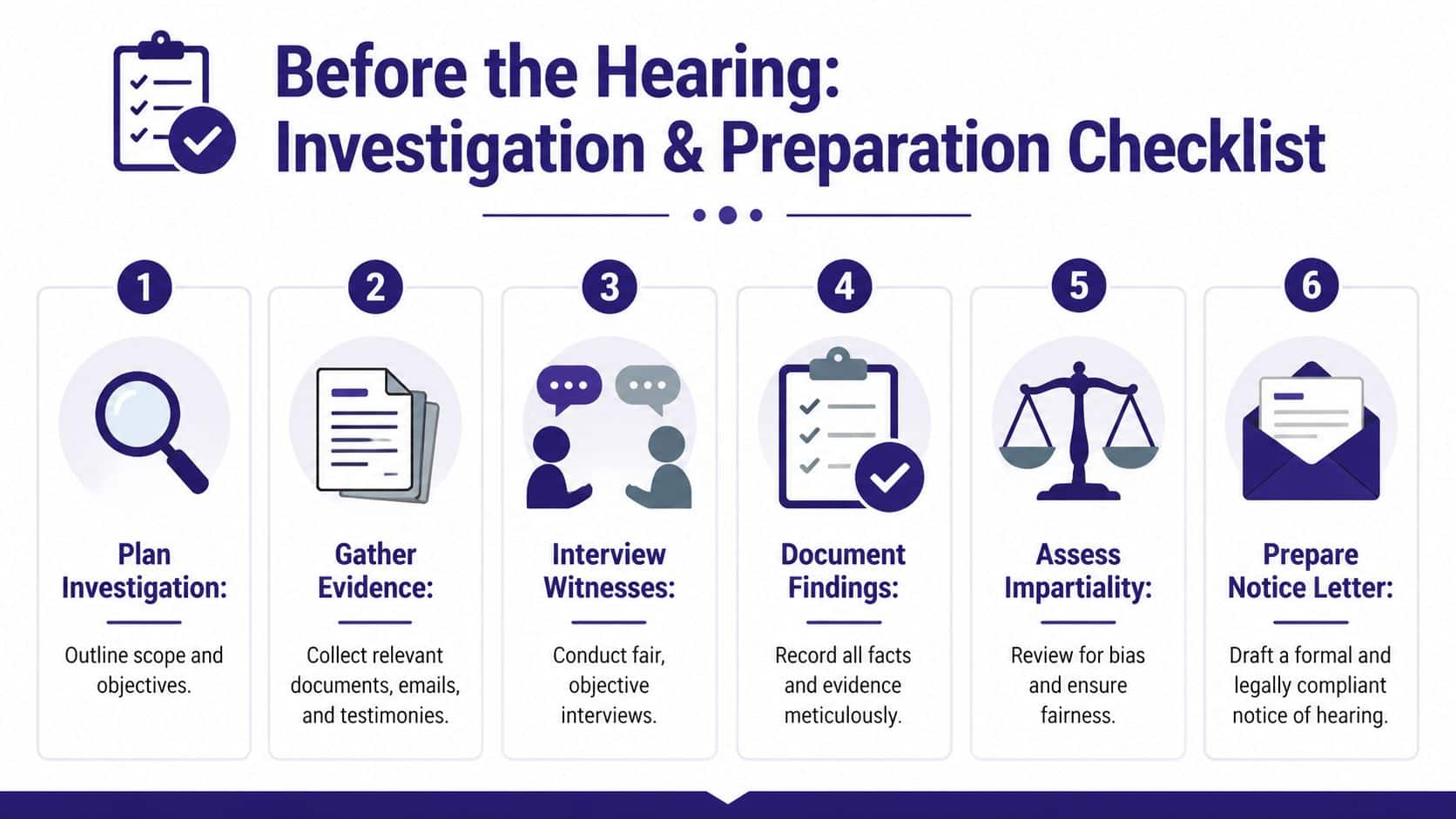
Build the evidence file before you commit to a disciplinary case
A fair investigation follows the documents and the chronology. It does not start with a conclusion and search for support afterwards. In financial misconduct cases, that distinction is critical because witness confidence can be completely out of step with what the records later show.
Gather the material that can prove, disprove, or narrow the allegation. That often includes emails, approval workflows, purchase ledger entries, expense claims, contracts, bank details changes, audit logs, witness notes, and the relevant policies.
A practical preparation checklist looks like this:
- Define scope: Identify the allegation, the time period, and the transactions or decisions in question.
- Preserve records: Secure documents and system data before anything is edited, overwritten, or deleted.
- Interview in a sensible order: Start with the people and records least likely to be influenced by office politics or hindsight.
- Check the rule against the conduct: Make sure the alleged act breaches a policy, procedure, or contractual duty.
- Test the timeline: Match witness accounts against timestamps, approvals, and financial entries.
- Prepare the hearing pack: Assemble the material the employee will need to understand and answer the case.
There is a real trade-off here. Move too slowly and risks continue inside the business. Move too quickly and you end up disciplining on an incomplete record. In cases involving suspicious payments, altered supplier details, stock losses, commission manipulation, or expense abuse, taking a little longer to verify the money trail often saves far more time and cost later.
If managers need a visual overview before formal action begins, this short explainer may help.
Fairness points need attention before the hearing, not during it
The employee must know the allegation, the possible consequences, and the evidence they need to answer. If the investigation report or supporting documents are held back until the meeting, the process is already under strain. If important new material appears shortly before or during the hearing, adjourn and give the employee a fair chance to respond.
The right to be accompanied by a colleague or trade union representative at a disciplinary hearing is protected under the Employment Relations Act 1999. Denying that right is a basic procedural error.
Fairness also includes the employee's ability to take part properly. Concentration issues, processing differences, anxiety, or a need for adjustments can affect how evidence should be presented and how the meeting should be run. If that may be relevant, this guide to legal rights and ADHD at work is a useful reference for workplace considerations in the UK.
A hearing can look orderly on paper and still be unfair if the employee did not have a proper chance to understand and answer the case.
Know when HR investigation needs forensic accounting support
Some cases can be investigated perfectly well by HR and management. Others cannot. If the allegation includes false invoicing, duplicate payments, supplier conflicts, hidden related parties, manipulated revenue, commission irregularities, cash leakage, or disputed loss values, involve a forensic accountant early enough to shape the investigation rather than merely comment on it afterwards.
That usually means before the hearing letter goes out, and sometimes before witness interviews are finished.
| Trigger | Why early forensic input helps |
|---|---|
| Complex transaction trails | It identifies what happened, in what order, and who approved or benefited |
| Suspected collusion | It can link activity across systems, accounts, and individuals |
| Disputed financial loss | It tests whether there was real loss, attempted loss, or only a control failure |
| Incomplete or conflicting records | It helps separate innocent error from deliberate manipulation |
| Parallel legal or insurance issues | It preserves analysis that may later matter beyond the disciplinary process |
For a closer look at how a structured financial inquiry works in practice, see this guide to fraud investigations.
In disciplinary work, the hearing chair needs evidence that can withstand challenge, not a pile of documents nobody has properly analysed. That is the point at which specialist financial review earns its keep. It can sharpen the allegation, reduce the risk of accusing the wrong person, and give the decision-maker a sound basis for action.
Running the Hearing From Notice to Final Questions
A hearing often goes wrong in the first five minutes. The letter is vague, the bundle is incomplete, or the chair starts arguing the case instead of testing it. In a routine misconduct matter that creates delay. In a fraud or financial misconduct case, it can damage the fairness of the process and weaken your position if the employee later challenges the outcome.
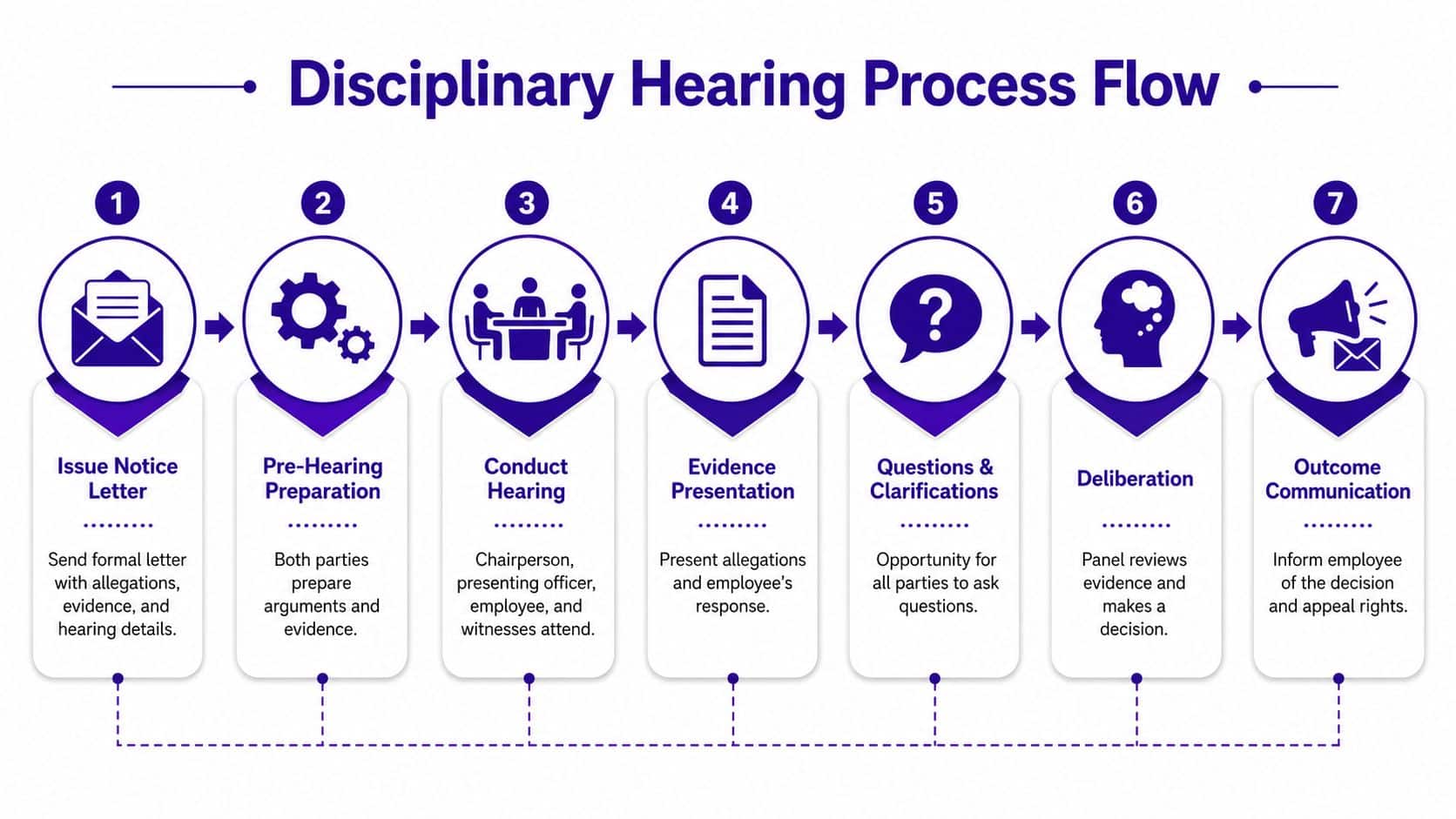
Start with the notice letter
The notice letter sets the frame for the hearing. It should identify the allegation clearly, explain the possible outcomes, confirm the date and format of the meeting, include the evidence you plan to rely on, and remind the employee of the right to be accompanied. Give enough time for the employee to read the material and prepare a response. What counts as enough will depend on the volume and complexity of the documents.
Specificity matters. Do not write “serious concerns have arisen” and leave the employee guessing. State the conduct complained of, the relevant dates, the transactions or incidents in issue, and the policy said to be breached.
If you need a clearer sense of how formal notice should be drafted in legally sensitive situations, this guide to notice of intent meaning is a useful reference point for precise wording.
Financial cases need extra care here. If the allegation involves false invoices, expense manipulation, stock irregularities, payroll abuse, or concealed conflicts, the letter should define the alleged misconduct in a way the chair can test. I have seen hearings drift because the allegation was framed too broadly, then collapse into a debate about poor controls rather than personal misconduct. A forensic accountant can help tighten that wording before the hearing starts by separating suspicious patterns from provable acts.
Use a clear agenda in the room
A disciplined structure keeps the meeting fair and keeps the chair in control. A hearing usually works best in this order:
- Introductions and roles
- Statement of allegation
- Presentation of management evidence
- Employee response
- Questions from the chair
- Questions from the employee or companion
- Any final comments
- Adjournment
Open plainly. State the purpose of the meeting, confirm that no decision has yet been made, and explain how the hearing will run.
Useful wording is simple:
“This hearing is to consider the allegations set out in the letter, review the evidence, and give you a full opportunity to respond before any decision is made.”
That approach helps for two reasons. It shows the employee they will be heard. It also reminds managers in the room that the hearing is not there to patch defects in the investigation.
Ask questions that test the evidence
The chair's role is to examine the case fairly and keep the discussion tied to the allegation. Questions should be focused and neutral. Ask what happened, who approved it, what records support that account, and whether there is an innocent explanation you need to consider.
In financial misconduct cases, avoid turning the hearing into an accounting seminar. The better approach is to isolate the points that matter. Which transactions are said to be false? What does the ledger show? Was the employee the approver, the beneficiary, or otherwise involved in the process? If the employee disputes the numbers, the chair needs to understand whether that dispute is real or cosmetic. That is often the point at which forensic input earns its place, because a concise schedule or transaction analysis can answer in minutes what an unfiltered document bundle leaves muddled for hours.
Short questions are usually better than speeches.
Handle hard situations properly
An employee may refuse to attend, call in sick, or argue they have not had time to review the material. Do not treat that as obstruction without checking the facts. A reasonable employer should be able to show that proper notice was given, alternatives were considered, and any health or practical barriers were addressed.
If absence continues, record the steps taken. Consider postponement, written representations, or remote attendance where appropriate. Proceeding without the employee can sometimes be justified, but only after you have acted reasonably and can evidence that you did.
Late evidence needs similar discipline. If important new material appears during the hearing, pause and consider fairness before using it. In a financial case, a late schedule that changes the loss figure, identifies an extra supplier link, or alters the transaction chronology can shift the whole allegation. If the employee has not had a proper chance to review it, adjourn and disclose it properly. A short delay is usually cheaper than defending a flawed process later.
Keep the legal test in mind
This is not a criminal court. The question is whether the employer reaches a reasonable belief, based on reasonable grounds, after a reasonable investigation.
That does not give the chair permission to be casual. It requires careful separation of what is proved, what is inferred, and what remains uncertain. If one witness is credible on access to a system but weak on motive, record that. If the records show control failures but not personal gain, record that too. If the financial evidence supports part of the allegation but not all of it, narrow the finding rather than overstating the case.
A fair hearing is usually a measured one. Keep the allegation tight, the questions clear, and the evidence organised. In higher-value or fraud-related cases, use forensic analysis to help the chair understand what the numbers prove, what they do not prove, and where further explanation is still needed.
The Decision How to Determine and Deliver the Outcome
The most dangerous moment in a disciplinary hearing process often comes at the end of the meeting. Everyone is tired. The employee wants an answer. Managers want closure. That is exactly why the chair should adjourn.
A critical pitfall is announcing the outcome immediately. ACAS and employment tribunal benchmarks indicate that failing to adjourn for deliberation significantly increases the risk of a finding of unfair dismissal, because employers must show a reasonable belief formed after proper consideration, as noted in this guide to the UK disciplinary procedure.
What the adjournment is for
The adjournment isn't theatre. It gives the chair time to test the evidence against the allegation calmly. That means checking whether the factual findings really support the charge, whether the investigation filled the important gaps, and whether the employee's explanation changes the picture.
Use the deliberation period to ask:
- What facts do we accept?
- Which documents support those facts?
- Did the employee raise a credible explanation or mitigation?
- Is each allegation proved to the level of reasonable belief?
- What outcome is proportionate in light of policy and precedent?
Where the case involves financial records, make sure the decision-maker understands what the numbers do and do not prove. A missing reconciliation may show negligence rather than dishonesty. An override in a system may be authorised but poorly documented. A suspicious sequence of payments may still require further analysis before gross misconduct is a safe conclusion.
Match the sanction to the finding
Not every upheld allegation should end in dismissal. The sanction must fit the misconduct, the policy framework, and the employee's record. Employers usually consider outcomes such as no further action, an informal outcome where appropriate, a first written warning, a final written warning, or dismissal.
A sensible decision matrix often turns on three questions:
| Decision point | What to test |
|---|---|
| Seriousness | Was this dishonesty, negligence, breach of trust, or poor judgment? |
| Impact | What was the operational, financial, or reputational harm? |
| Context | Was there mitigation, unclear training, health impact, or inconsistent practice? |
Consistency matters, but blind consistency is risky. Two employees may commit similar acts under very different circumstances. The outcome letter should show that the chair considered the specific facts of this case.
Policies also matter more than many employers think. If your rules, investigation pathway, and sanction range are vague or inconsistently applied, the hearing chair starts from unstable ground. Strong internal rules act as a reference point for fairness and proportionality. That's one reason many organisations revisit their governance framework after a difficult case, and this discussion of the importance of policies as agreement captures that wider governance point well.
Put the outcome in writing
The outcome letter should state:
- the finding on each allegation
- the key reasons for that finding
- the sanction
- when the sanction takes effect
- any improvement expectations or restrictions
- the right of appeal and how to use it
Keep the tone measured. Don't write as if you're punishing the employee in anger. Write as if a tribunal, regulator, insurer, or external adviser may later read every line. Because they might.
When You Need Certainty The Lighthouse Consultants Solution
At a certain point, general HR handling stops being enough. That point usually arrives when the allegation turns on contested numbers, unclear loss, disguised transactions, document manipulation, business interruption, bribery indicators, or allegations that may later sit in both an employment file and a court bundle.
That's where specialist forensic support earns its place.

Why financial evidence changes the quality of the process
A hearing chair can only decide on the material put in front of them. If the documents are incomplete, the chronology is weak, or the alleged loss is little more than an estimate, the process remains exposed. By contrast, a properly scoped forensic review can identify the transaction path, test the reliability of records, quantify loss, distinguish control failure from dishonesty, and present findings in a way non-accountants can follow.
That approach isn't niche. The UK Forensic Accounting Services industry is projected to reach a market size of £2.5 billion in 2026, with professionals specifically analysing financial information for legal proceedings such as fraud and embezzlement, according to IBISWorld's industry outlook. The market is growing because disputes increasingly turn on financial interpretation, not just witness recollection.
Common objections and the practical answer
Business owners often raise sensible objections.
“Isn't this too much for an internal matter?”
Not if the allegation may lead to dismissal, litigation, recovery action, insurer notification, or board scrutiny. The more financially complex the issue, the more dangerous guesswork becomes.
“Can't our finance team just review it?”
Sometimes they can help. But internal staff may lack independence, forensic method, or experience preparing evidence that can survive challenge from lawyers, regulators, or opponents.
“Won't this slow everything down?”
Not necessarily. In many cases, targeted forensic work shortens the process because it isolates the key transactions quickly and stops managers chasing the wrong points.
Specialist support should narrow the issue, not inflate it.
What a disciplined engagement looks like
A strong forensic engagement should be structured and proportionate. The best approach usually includes an initial discussion, a clearly scoped action plan, defined reporting lines, and findings that answer practical questions. What happened? What can be proved? What's the likely loss? What remains uncertain? What should happen next?
That's particularly useful where one workplace issue spills into another area, such as:
- Insurance claims: where business interruption or loss values need careful quantification
- Shareholder or contract disputes: where internal conduct may overlap with wider commercial allegations
- Insolvency or inheritance disputes: where records, valuations, and asset movements need independent review
- Money laundering or bribery concerns: where the financial trail matters as much as the personnel issue
The value isn't just in finding wrongdoing. Often, it lies in ruling out the wrong allegation before a flawed disciplinary outcome causes further damage.
Frequently Asked Questions about Disciplinary Hearings
Employers usually need quick answers when a hearing is live. The questions below come up often, especially where conduct and financial issues overlap.
Quick reference answers
| Question | Answer |
|---|---|
| Can I suspend an employee as soon as I suspect fraud? | You can suspend where there's a legitimate reason, but don't treat suspension as a shortcut to guilt. Record why it's necessary and keep it under review. |
| Do I need to share the evidence before the hearing? | Yes. The employee should know the case they have to answer. In practical terms, that means giving the investigation material in advance. |
| What if the employee brings up new facts in the hearing? | Consider whether the new point changes the case. If it does, adjourn and investigate it properly rather than forcing a rushed conclusion. |
| Can the same manager investigate and chair the hearing? | That's best avoided. Separation of roles helps preserve impartiality and makes the outcome easier to defend. |
| Is a disciplinary hearing the right place to work out a disputed financial loss? | Only if the financial groundwork has already been done. If the numbers are contested or technically complex, separate analysis may be needed before a fair decision can be made. |
| Must I dismiss if I believe dishonesty occurred? | Not automatically. Dismissal may be justified in many dishonesty cases, but the employer still needs to consider evidence, context, mitigation, and proportionality. |
| Can a companion answer questions for the employee? | A companion can support and address the hearing within the usual limits, but the employee should still answer for their own case where they can. |
| What if the employee appeals? | Treat the appeal as a genuine review, not a rubber stamp. Use a different decision-maker where possible and look carefully at both procedure and substance. |
Two final judgment calls
The first is whether the hearing is ready. If the evidence file still feels messy, it probably is. Delay for a proper reason beats a fast but defective process.
The second is whether the issue is really an HR matter alone. If the allegation involves accounting entries, hidden liabilities, procurement irregularities, unusual transfers, insurance loss, valuations, or wider legal exposure, the disciplinary hearing process may sit inside a much larger dispute.
The strongest disciplinary outcomes come from calm preparation, clear evidence, and a chair who is willing to pause when the facts aren't ready.
If you're dealing with a disciplinary hearing tied to fraud, disputed losses, financial misconduct, business interruption, bribery concerns, or any matter where the numbers matter as much as the witness evidence, Lighthouse Consultants can help you bring certainty to the process. Their London-based forensic accounting team supports employers, lawyers, insurers, and business owners with independent financial analysis, fraud investigation, loss quantification, and expert reporting that stands up to scrutiny. If you need clarity before you take action, speak to Lighthouse Consultants.