When a director suspects someone has been skimming stock, when a solicitor receives a disclosure bundle that makes no commercial sense, or when an insurer pushes back on a business interruption claim, the pressure lands fast. You already know the numbers matter. The problem is that the ledger doesn’t explain itself, and the people involved often have every reason to muddy the trail.
At that point, searching for a uk tax accountant can feel sensible but incomplete. You may need tax expertise, yes. But if the issue involves fraud, missing money, a hostile shareholder, a divorce with disputed income, an insolvency challenge, or a claim that has to survive legal scrutiny, you need more than routine compliance work. You need someone who can reconstruct events, test evidence, challenge assumptions, and quantify loss in a way that holds up under pressure.
That Sinking Feeling When the Numbers Don’t Add Up
It often starts with something small. Margins dip, but sales look steady. A supplier balance keeps growing, yet no one can explain why. Your co-director insists everything is timing. Your finance manager says the system is messy. Your lawyer asks for clean schedules, and all you have is a pile of exports, emails, and half-finished explanations.

That’s the point where many business owners start doubting themselves. They wonder if they’ve missed something obvious. They worry about overreacting. They also know that if they wait too long, records get overwritten, recollections change, and the commercial damage gets worse.
When ordinary accounting records stop being enough
In straightforward times, bookkeeping and annual accounts do their job. In a dispute, they often don’t. You need to know which transactions were genuine, which were manipulated, who approved them, and whether the financial story matches the operational one.
That’s why basic record keeping still matters so much. The importance of keeping accurate accounts becomes painfully clear when someone has to prove what happened months or years later.
Good records don’t prevent every dispute. They do make it harder for bad facts to survive.
If HMRC is already involved, the stress rises again. Questions arrive before the full picture is clear, and careless early answers can lock you into the wrong position. If that’s where you are, this guide to investigation by HMRC is a useful place to get your bearings.
The real problem is hidden in the detail
A denied insurance claim may turn on gross profit definitions. A shareholder dispute may depend on director loan movements and related-party transactions. A divorce may hinge on whether business income has been suppressed or deferred. A fraud concern may sit inside journals that look harmless until someone tests the supporting documents.
None of that feels tidy when you’re living through it. It feels exhausting. It also requires a different kind of accountant than the one who usually files your returns.
Why Your Regular Accountant May Not Be the Right Ally
Many businesses already have an accountant they trust. That relationship matters. But trust and familiarity aren’t the same as investigative skill.
A regular uk tax accountant usually focuses on compliance, reporting, deadlines, and efficiency. That work is important. It keeps businesses on track. It does not automatically prepare someone to investigate procurement fraud, rebuild a claim model after a fire, or write an expert report that opposing counsel will try to dismantle line by line.
Compliance work and forensic work are not the same job
This is the gap that catches people out. Standard advice in the market still leans heavily toward returns, filing, allowances, and planning. Yet an underserved area remains the integration of forensic accounting with tax work. According to Titan Wealth International’s discussion of this market gap, recent HMRC data from 2024 to 2025 shows over 15,000 businesses reported suspected tax fraud, with £2.5 billion recovered via investigations, while only 20% of SMEs had forensic audits integrated with their tax services.
That matters because the skill set changes completely once a case turns contentious.
A forensic accountant asks different questions. What evidence exists outside the accounting system? Which records were created contemporaneously? Where do the bank records conflict with management explanations? Can the loss calculation survive disclosure? Does the narrative fit the source documents?
For businesses and law firms dealing with missing money, this explanation of what a forensic accountant does when money goes missing helps draw that distinction clearly.
What works and what doesn’t
What works is bringing in a specialist early enough to preserve evidence, frame the issues, and stop weak assumptions hardening into “facts”.
What doesn’t work is expecting a compliance-led adviser to pivot overnight into investigator, interviewer, loss expert, and courtroom-ready analyst.
Consider the trade-offs:
- Routine tax support: Strong for returns, filings, reconciliations, and normal HMRC interactions.
- Forensic accounting support: Strong for tracing funds, testing explanations, quantifying loss, reviewing suspicious patterns, and preparing evidence for disputes.
- Hybrid need: Sometimes you need both. One adviser keeps the compliance position tidy. Another handles the contentious work independently.
The wrong accountant can still be competent. They can simply be competent at the wrong task.
The objection I hear most often
“We already have an accountant.”
That may be true, and you may want to keep them involved. But when fraud, litigation, shareholder conflict, bribery concerns, insolvency issues, or insurance quantification enters the picture, specialist forensic work stops being optional. It becomes part of protecting your position.
Decoding UK Accountant Qualifications and Specialisms
The UK accountancy profession is large enough to confuse anyone who doesn’t work inside it every day. Titles overlap. Roles blur. Good people often wear several hats. That’s useful in normal trading conditions, but less so when you need a specialist urgently.
According to the CCAB accountancy report, the UK profession included 357,200 registered members in 2022 and supported over 828,000 jobs. HMRC also notes around 43,000 paid tax agent firms exist, with many professionals identifying across more than one role, including 75% as accountants and 56% as tax advisers. That breadth is a strength. It also means not every qualified accountant is built for the same assignment.
What the letters usually mean in practice
A business owner doesn’t need a lecture on every body and pathway. You need a practical read on specialism.
- ACA or ACCA: Often associated with financial reporting, audit, tax, and broad practice work.
- CIMA or CGMA: Often associated with management accounting, performance, commercial analysis, controls, and business decision support.
- Tax-focused adviser: Usually strongest on compliance, planning, returns, reliefs, correspondence, and technical tax analysis.
- Forensic accountant: Built for disputes, investigations, evidence review, quantification of loss, fraud analysis, and expert witness work.
Qualifications tell you someone has passed a professional standard. They do not, by themselves, tell you whether that person can investigate a manipulated ledger or defend a damages calculation under cross-examination.
Choosing the right expert for the job
Here is the distinction that matters most.
| Choosing Your Financial Expert: Compliance vs. Investigation | Best Fit: UK Tax Accountant | Best Fit: Forensic Accountant |
|---|---|---|
| Annual tax return and normal filing obligations | Yes | Usually no |
| VAT, corporation tax, and routine HMRC correspondence | Yes | Sometimes, if dispute-driven |
| Suspected employee theft or expense fraud | No | Yes |
| Shareholder dispute over profits, drawings, or hidden transactions | Sometimes | Yes |
| Business interruption or insurance loss quantification | No | Yes |
| Expert report for solicitors, court, or arbitration | Rarely | Yes |
For a broader consumer-level perspective on selecting an adviser, this guide on how to choose an accountant is worth reading. Use it as a starting point, then go further if your issue is contentious.
Match the accountant to the pressure point
If you need a tax return filed, don’t overcomplicate it. If you need monthly dashboards, cash flow forecasting, or board packs, look for management accounting strength. If someone has siphoned funds through suppliers, if HMRC is asking difficult questions about disputed figures, or if your solicitor needs an independent quantification, ask for forensic experience first and qualifications second.
That shift in thinking saves time. It also prevents the expensive mistake of hiring a professional who is good, diligent, and entirely unsuited to the fight in front of you.
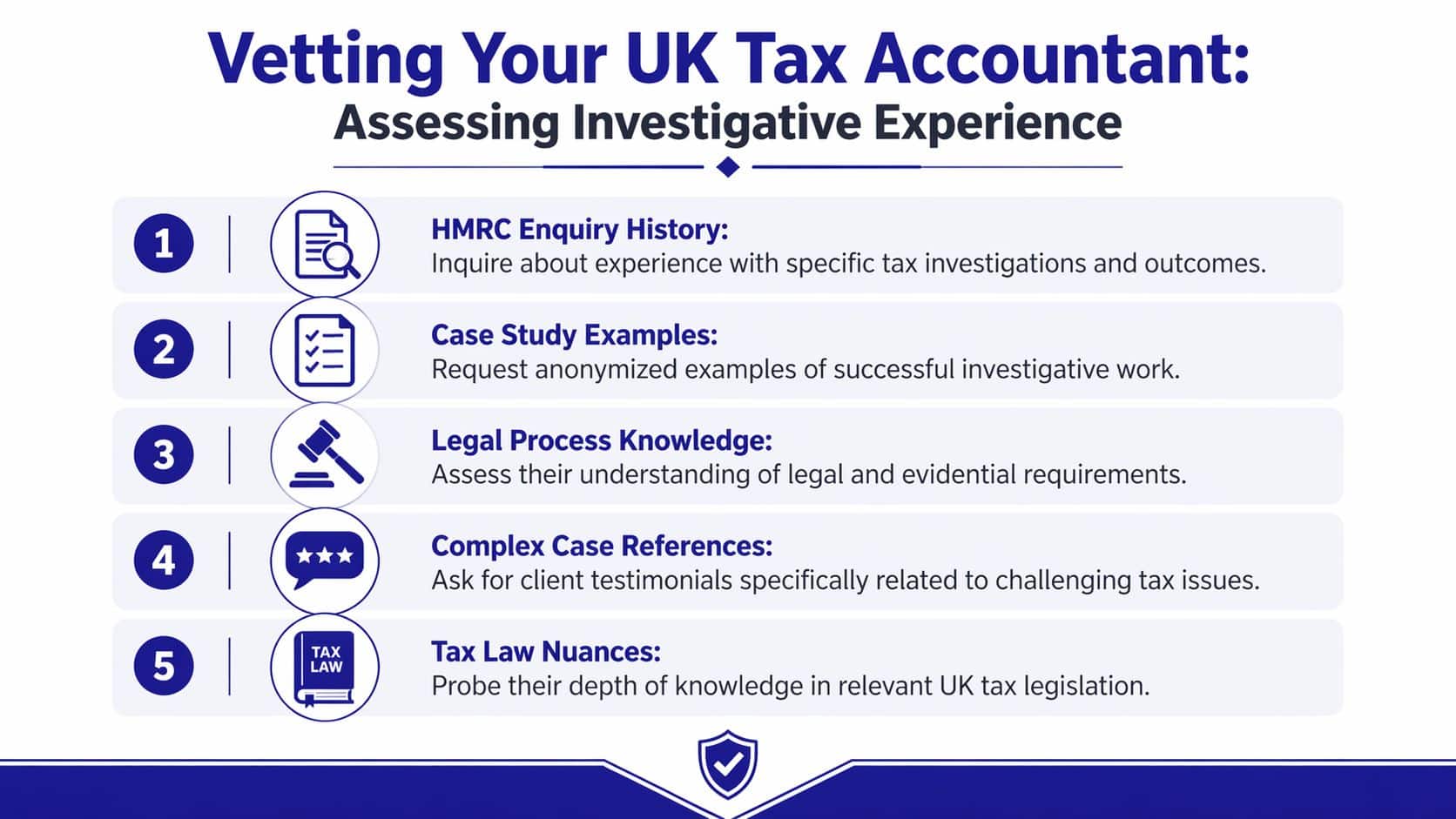
Vetting for Battle How to Assess True Investigative Experience
Once a matter turns serious, credentials aren’t enough. You need to know whether the person in front of you has handled ugly files, incomplete records, aggressive counterparties, and deadlines that matter.
Ask about pressure, not theory
A polished meeting can hide a lack of real case experience. Don’t ask only what they know. Ask what they’ve done.
Useful questions include:
- Describe a matter involving disputed figures: Listen for process, evidence handling, and how they resolved inconsistencies.
- How do you approach incomplete books and records: Strong investigators explain reconstruction methods, corroboration, and limits.
- Have you worked with solicitors or insurers on contentious matters: You want someone who understands deadlines, privilege boundaries, and document discipline.
- Can you explain your role if the matter reaches court or tribunal: Evasive answers usually mean limited exposure.
- How do you challenge assumptions made by HMRC or the other side: Good answers are specific and calm, not theatrical.
If you’re comparing firms, this guide to choosing a forensic accountant gives a sensible framework for the decision.
Know the costs of weak representation
Tax disputes often become more expensive because nobody challenged the first draft of the facts. In UK tax investigations, common failures include accepting HMRC’s figures without proper review and missing the 30-day appeal deadline. The same TaxWatch analysis notes that unchallenged settlements can result in 20% to 50% higher liabilities, that 24.4% of R&D tax relief claims in 2020-21 were fraudulent or erroneous, and that engaging a chartered forensic accountant who rectifies facts and argues penalty mitigation can lower effective tax exposure by up to 30% according to TaxWatch UK.
Those numbers tell you something important. This is not a box-ticking exercise. The quality of the person handling your case can change the financial outcome materially.
Practical rule: If an adviser won’t challenge source data, they can’t protect you in a dispute.
What a strong answer sounds like
A capable investigator usually talks about evidence in layers. They’ll mention bank records, ledgers, contracts, correspondence, stock movements, access logs, or payroll data. They’ll talk about reconciliation, testing alternative explanations, documenting assumptions, and identifying where the evidence runs out.
A weak candidate usually speaks in slogans. They promise to “sort it” without explaining method. They focus on confidence instead of proof. They may also rush past legal process, which is dangerous in contentious work.
There’s a parallel here with any specialist hire. This general guide to hiring specialised experts isn’t about accounting, but it captures a useful principle. General competence isn’t enough when the assignment is specialised and the consequences are real.
Check for independence and written discipline
Forensic work fails when the expert becomes an advocate instead of an analyst. You want someone who will test your position, not merely repeat it. That independence makes the final output stronger.
Look for these signs:
- Clear scoping: They define what they will investigate and what sits outside scope.
- Evidence trail: They keep track of documents reviewed, assumptions made, and unresolved issues.
- Cautious language: They don’t promise an outcome before seeing records.
- Commercial awareness: They understand that speed matters, but they don’t sacrifice rigour for reassurance.
One practical option in this market is Lighthouse Consultants, which provides forensic accounting, fraud investigation, litigation support, business interruption quantification, and expert witness-capable reporting within a structured model of discovery, scoped action, and reporting. That kind of structure is useful when management needs visibility without losing control of the day job.
Understanding Fees and Structuring the Engagement
Cost matters, especially when cash is already tight and the dispute itself may be draining management time. Most problems with fees start before any work begins. The scope is vague, assumptions are unstated, and everyone acts surprised later.

The three fee models you’re most likely to see
Hourly rates suit matters where the facts are still moving. If records are incomplete, allegations are broad, or the other side keeps shifting position, hourly billing is often the honest model. The drawback is uncertainty. If scope expands, cost expands with it.
Fixed fees work for defined tasks. Examples include an initial review of key records, a preliminary loss assessment, or a response to a specific set of HMRC questions. Fixed fees give budgeting clarity, but only if the task is clearly bounded.
Retainers suit ongoing support. This can help in longer disputes, internal investigations, or matters where legal teams need rolling input. The trap is paying for availability without a clear work plan.
What to insist on before work starts
Ask for a written scope that answers these points:
- What is the exact question being answered
- Which records are included in the review
- What assumptions are being made at the outset
- What deliverables will you receive
- What events trigger a change in fee or scope
If a firm can’t explain those points clearly, the engagement is still too loose.
A professional engagement letter should remove uncertainty, not create it.
How to keep the matter under control
Break the work into phases. An initial triage phase is often enough to tell you whether there is a real issue, what records matter, and whether legal privilege should be considered. After that, move into a scoped investigation or quantification exercise.
That phased approach helps on cost and strategy. It also stops businesses from commissioning a full report before they know what story the documents support.
This short video gives a helpful frame for thinking about accountant costs and engagement expectations:
What should be in the engagement letter
The strongest engagement letters usually cover:
- Purpose of the work: Investigation, claim quantification, rebuttal, advisory support, or expert report.
- Intended users: Management, solicitors, insurers, board, or court-related use.
- Limitations: What the accountant is not being asked to determine.
- Confidentiality and data handling: Critical when allegations involve employees, counterparties, or regulatory issues.
- Reporting format: Oral findings, memo, formal report, appendices, schedules, and meeting support.
If the matter is contentious, clarity at this stage saves arguments later. It also makes comparing one uk tax accountant or forensic specialist against another much easier.
The Final Interview Checklist and Critical Red Flags
By the final interview stage, you’re not looking for the most charming adviser in the room. You’re looking for the person whose work will survive challenge.

Questions that reveal substance
Ask a few direct questions and listen carefully to how they answer.
- How would you start this assignment in the first week: A serious professional talks about records, chronology, people, and issue framing.
- What would make you uncomfortable about taking this on: This tests honesty and independence.
- How do you present findings when the evidence is mixed: You want balance, not bravado.
- Who will do the work: Partners sell. Teams deliver. Know the difference.
- How often will you update us and in what format: Good communication prevents panic and drift.
If they answer with method, caveats, and evidence discipline, that’s a good sign.
Red flags that should stop you
Some warning signs are obvious. Others are subtle.
- Guaranteed outcomes: No ethical expert guarantees success in a fraud case, HMRC dispute, or litigation matter before seeing the records.
- Little curiosity about the facts: If they don’t ask for documents, timelines, counterparties, or system context, they’re not thinking like investigators.
- Opaque pricing: If scope and fee triggers remain fuzzy after the second conversation, expect trouble.
- No sense of evidential standards: Anyone handling contentious financial work should understand that unsupported opinion is fragile.
- Defensiveness when challenged: Your expert will be challenged by HMRC, opposing experts, or counsel. If they can’t handle pushback in a meeting, that won’t improve later.
If an adviser talks more about winning than proving, step back.
Trust the right instincts
A strong forensic adviser usually makes you feel clearer, not dazzled. The path may still be difficult, but the next steps become practical. You understand what records matter, what the risks are, and what can and cannot be said yet.
That quiet clarity is worth more than a dramatic sales pitch. In disputes, disciplined thinking beats confidence theatre every time.
Your Path to Certainty with Lighthouse Consultants
The UK tax consultancy market is projected to reach £5.6 billion in 2026 and comprise 8,967 businesses, according to IBISWorld’s UK tax consultants market data. In a market that large, the challenge isn’t finding an accountant. It’s finding one with the right specialist focus when the matter is contentious, document-heavy, and financially significant.
If your problem is routine tax compliance, a standard uk tax accountant may be enough. If the issue involves fraud, bribery concerns, unexplained losses, business interruption, litigation support, shareholder conflict, or evidence that must withstand scrutiny, the brief changes. You need forensic accounting discipline, not just tax familiarity.
Lighthouse Consultants works in that narrower, more demanding lane. The work centres on investigating financial irregularities, quantifying losses, supporting disputes, and producing independent analysis that can be used in negotiations, disciplinary processes, insurance matters, and legal proceedings. That structure matters when directors, solicitors, insurers, or claims teams need a clear path through chaos.
The practical advantage is simple. You get a structured start, a scoped plan, and reporting that stays focused on facts. That helps clients make decisions early, preserve evidence properly, and avoid wasting time on the wrong theory of the case.
If you’re already under pressure, don’t wait for the records to get colder or the dispute to get louder. Get the facts tested properly and decide from evidence, not assumptions.
If you need clarity on fraud, a tax dispute, a loss claim, or any financially complex dispute, speak with Lighthouse Consultants. A focused discovery conversation can help you understand what’s gone wrong, what evidence matters, and what to do next.
Tags: forensic accountant, forensic accounting