A deal can look clean on paper and still blow up in your face. The trigger is often small. A beneficial owner turns out to be linked to a minister overseas. A new investor's family connection was never disclosed. A supplier at the centre of a payment dispute appears in adverse media tied to procurement corruption. Suddenly the issue isn't just commercial. It's regulatory, forensic, and potentially litigious.
That's why politically exposed person screening matters far beyond onboarding. In practice, it sits right in the middle of fraud investigations, bribery allegations, shareholder disputes, insolvency reviews, asset tracing, and damaged business relationships. If you treat it like a tick-box compliance task, you'll miss the point. If you handle it like a forensic accountant, you'll spot risk earlier, document it properly, and make decisions you can defend.
When Hidden Risks Threaten Your Business
A UK managing director signs off on a new overseas distribution arrangement. The numbers work. The contract terms look acceptable. The counterparty passes standard onboarding checks. Then a dispute breaks out over missing funds, unexplained commissions, and a sudden refusal to disclose ownership records. Legal advisers start asking harder questions. Compliance joins the room. Someone finally screens the wider network around the counterparty and finds links to a politically exposed person.
At that stage, the problem has already grown teeth. Payments may be delayed. Banks may ask questions. Internal emails become evidence. Directors need answers they should have had before the first transfer left the account.

Why routine due diligence often fails
Standard due diligence usually focuses on the obvious. Company registration. Filed accounts. Sanctions. Basic identity checks. That helps, but it doesn't answer the harder questions that matter in a crisis:
- Who really controls the relationship behind nominee directors, trusts, or layered entities?
- Who benefits economically from unusual payments, consulting fees, or cross-border commissions?
- Who has public influence that could distort a tender, procurement process, investment approval, or regulatory decision?
A forensic accountant looks at those issues differently. We follow money, control, and motive. We don't stop at a name match. We ask whether a relationship creates bribery risk, concealment risk, or dispute risk.
A hidden PEP connection rarely arrives alone. It often comes bundled with weak disclosure, awkward transaction patterns, and records that don't reconcile cleanly.
Where politically exposed person screening becomes decisive
You need rigorous politically exposed person screening when stakes are high, especially in:
| Situation | What can go wrong |
|---|---|
| Acquisitions and investments | Undisclosed political links distort valuation and risk |
| Supplier and agency disputes | Commissions or facilitation payments trigger scrutiny |
| Fraud investigations | Related parties hide behind public-office networks |
| Litigation | Opponents attack your controls, governance, and oversight |
| Audit and internal review | Historic onboarding failures become current exposure |
In these moments, speed matters. So does evidence. A weak review creates noise. A forensic review creates a defensible record.
Understanding Politically Exposed Persons
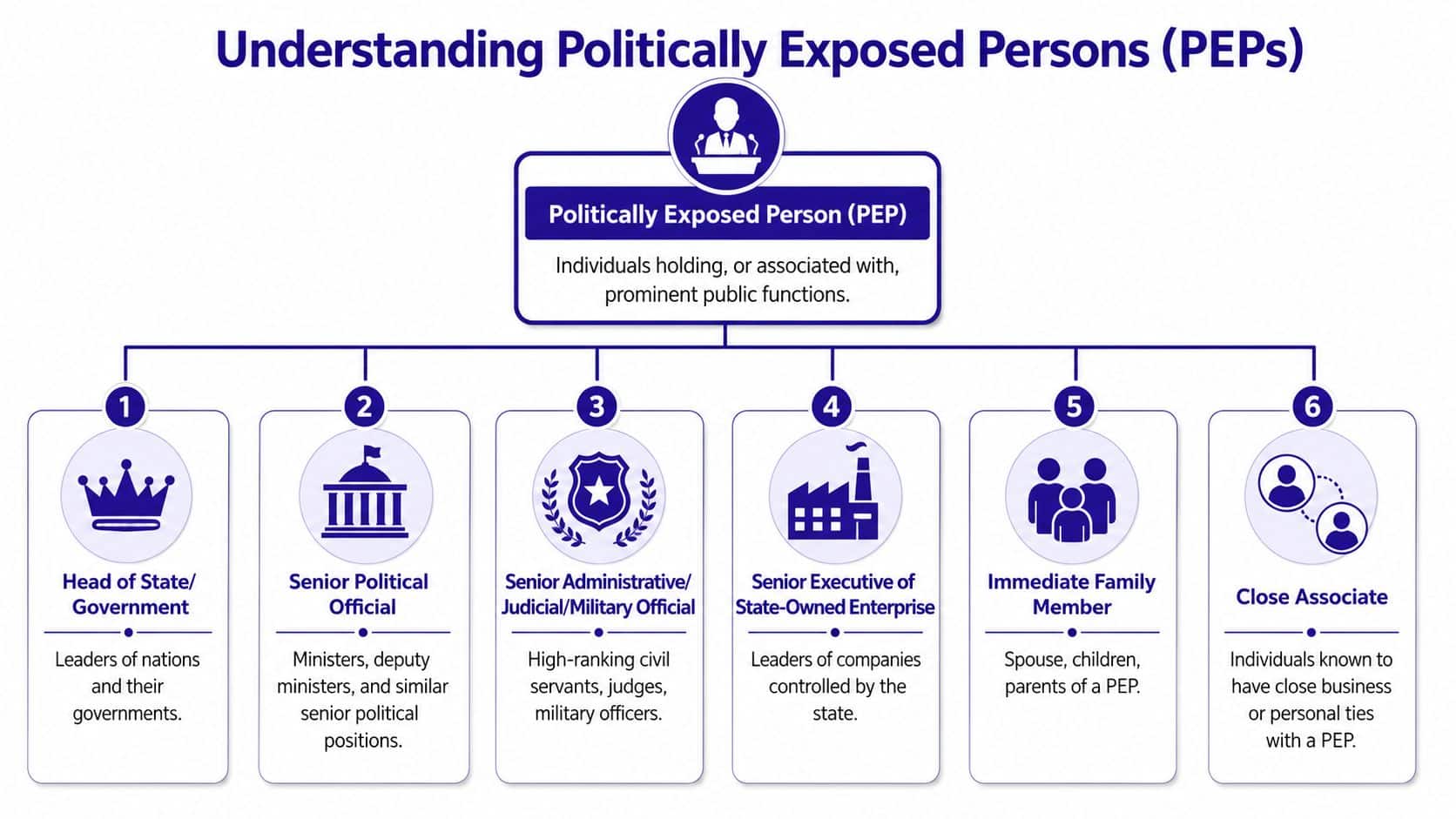
A politically exposed person, or PEP, isn't just a prime minister or cabinet minister. The concept is broader and more practical than many businesses assume. It covers people who hold, or have held, a prominent public function. That includes senior political figures, judges, military leaders, and senior executives of state-owned enterprises. It also extends beyond the office holder.
The important point is this. Risk often sits in the network around the official, not only in the official's own name.
The categories that matter in practice
For operational purposes, businesses usually think about PEP exposure in three broad groups:
- Domestic PEPs. Individuals with prominent public functions in their own country.
- Foreign PEPs. Individuals with equivalent influence in another jurisdiction.
- International organisation PEPs. Senior figures within major international bodies.
Then you have the people around them. Immediate family members and close associates can create equal or greater risk because they may hold assets, own companies, or act as transaction counterparties.
A useful way to think about it is this. If public power creates opportunity, family and associates may provide the route through which value moves.
Why PEP status matters to a forensic accountant
PEP status does not mean someone is corrupt. That lazy assumption leads to poor decisions and bad compliance. The core issue is exposure to bribery, corruption, favour trading, procurement abuse, and hidden conflicts.
A forensic accountant cares about PEP exposure because it changes the questions that need asking. For example:
- Is the source of wealth consistent with the person's role and known commercial activity?
- Are transaction flows commercially rational, or do they suggest influence-driven payments?
- Has ownership been structured to keep politically sensitive names out of the file?
Those aren't abstract compliance questions. They matter in shareholder disputes, post-acquisition claims, matrimonial asset tracing, insolvency investigations, and contested probate matters where hidden influence or concealed assets can alter outcomes.
Practical rule: Don't ask only whether someone is a PEP. Ask how their role, relationships, and access to state influence could affect the transaction in front of you.
The common misunderstanding that causes trouble
Many firms still reduce politically exposed person screening to list matching. That's too shallow. A software tool may flag a name, but names alone don't explain control, proximity, or significance. Nor do they tell you whether the issue is manageable or fatal.
The better approach is to treat PEP identification as the start of analysis, not the end of it. You're trying to understand influence. Forensic accounting is built for exactly that task.
Meeting UK Regulatory Demands for PEP Screening
UK firms need to stop treating PEP screening as a detached compliance ritual. The legal position is risk-based. Under the UK's Money Laundering, Terrorist Financing and Transfer of Funds Regulations 2017, PEP screening is required where there is a “reasonable risk” of money laundering or terrorist financing, so the objective is not blanket exclusion but risk-based identification and escalation of higher-risk relationships, as noted in this explanation of the UK PEP screening position.
That point changes how your process should work. If the legal trigger is risk exposure, then politically exposed person screening must sit inside your broader AML risk methodology. It shouldn't operate as a disconnected pass or fail check.
What the risk-based approach means in real life
A proper UK framework does three things well.
- It identifies relevant people and beneficial owners rather than screening only the contracting entity.
- It escalates relationships by actual exposure instead of treating every PEP outcome as identical.
- It documents judgment clearly so senior management can explain why a relationship was accepted, restricted, or rejected.
That's the difference between a system designed for audits and one designed for scrutiny in a dispute.
If your team still runs PEP checks separately from customer due diligence, fix that. The workflow should connect directly to customer risk rating, ownership review, source-of-funds review, and transaction monitoring. A useful starting point is a stronger customer due diligence process for UK businesses.
What boards and finance leaders often get wrong
The most common mistake is overreaction. A match appears, someone panics, and the business either freezes the relationship without analysis or waves it through because “nothing illegal has been proven”. Both responses are weak.
A better decision path looks like this:
| Weak response | Better response |
|---|---|
| Treat every PEP as untouchable | Assess role, jurisdiction, ownership, and transaction context |
| Ignore linked parties | Review family, associates, and beneficial ownership |
| File the alert and move on | Record rationale, approvals, and mitigating controls |
| Use screening only at onboarding | Tie it to ongoing AML risk management |
Why defensibility matters
Regulators, auditors, counterparties, and claimants all ask the same thing after a problem surfaces. What did you know, when did you know it, and what did you do about it?
That is why forensic discipline matters here. A defensible politically exposed person screening process doesn't just produce alerts. It produces a file that shows careful judgment, proper escalation, and evidence-based decision-making.
Building a Robust Risk-Based Screening Process
A rigorous politically exposed person screening programme protects your business only if it drives decisions under pressure. In a fraud review, a sanctions scare, or a shareholder dispute, nobody cares that you bought screening software. They care whether your process identified the risk, escalated it properly, and left a clear record of why the relationship was approved, restricted, or declined.
Start with design, not technology. Screening must fit the way money, ownership, and authority move through your organisation. If the workflow sits in a silo, it will miss the transaction pattern, ownership link, or control failure that matters most.
According to expert guidance on PEP screening workflows, a process that works in practice combines accurate customer identity data, date-of-office data, ongoing re-screening, fuzzy matching, and risk scoring based on role, jurisdiction, and adverse media severity. That approach matters because PEP status changes, names vary across borders, and weak identifiers create missed matches at exactly the wrong moment.
A process that works in practice
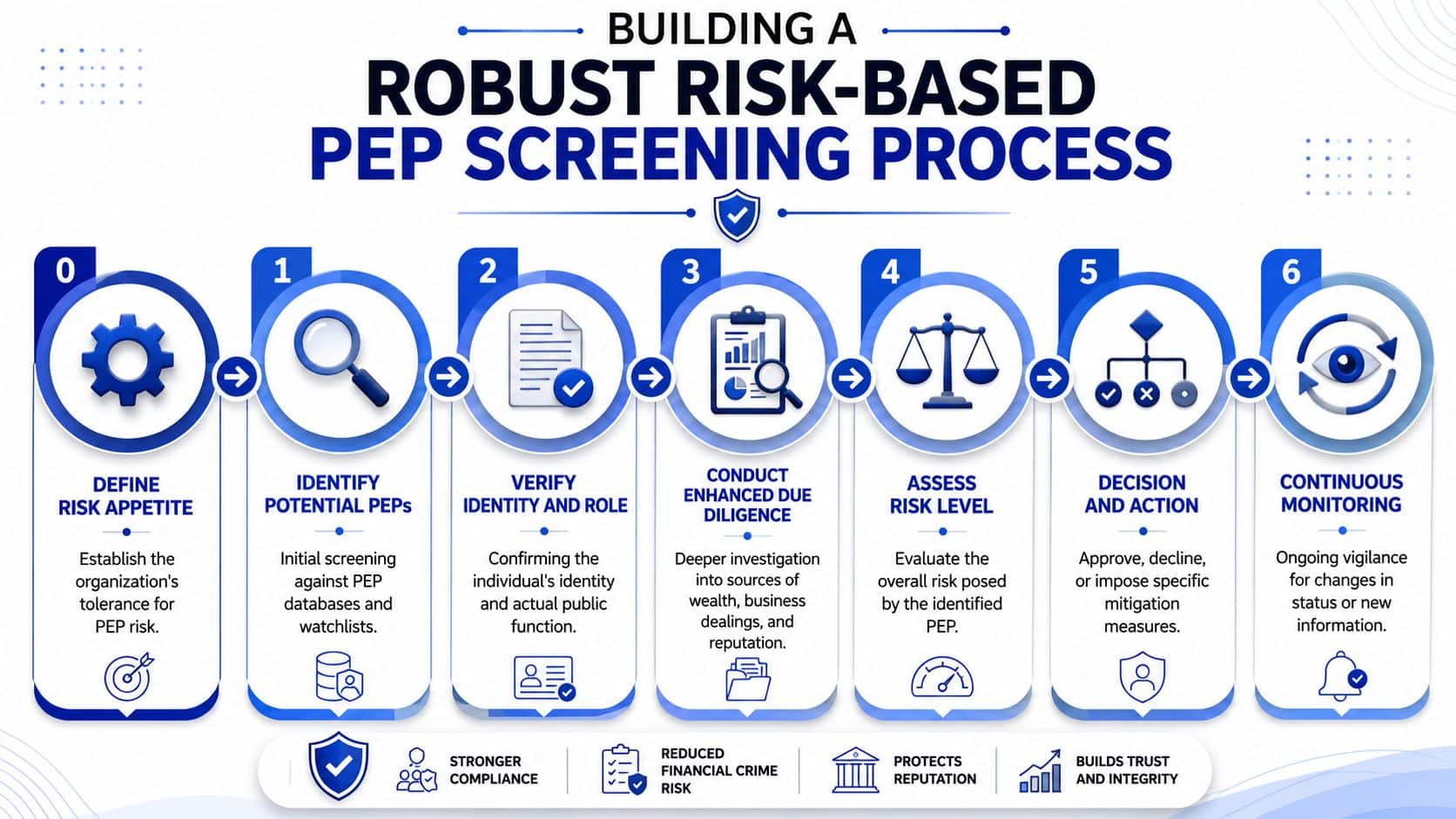
Build the workflow in this order.
Set risk appetite before the first alert lands
Define which PEP relationships are acceptable, which need senior sign-off, and which fall outside policy. Without that, analysts improvise under pressure and create inconsistent files that fail in audits and disputes.Collect identity data that can survive scrutiny
Capture full legal names, aliases, dates of birth, nationality, beneficial ownership, control rights, and current or former public roles. Weak onboarding data contaminates every review that follows.Use matching logic that reflects cross-border reality
Exact-match screening is too blunt. Transliteration, naming order, spelling variation, and incomplete records are routine in international business. Your system must account for them.Assess exposure in context
A name match proves nothing on its own. Review the office held, jurisdiction, state influence, ownership chain, source of wealth indicators, and the purpose of the relationship. That is how you separate manageable exposure from a genuine corruption or bribery risk.Escalate fast and record the reasoning
Significant alerts need named decision-makers, documented analysis, and a clear approval trail. In litigation or regulatory review, undocumented judgment is treated as if it never happened.Trigger re-screening when risk changes
Re-screening should follow ownership changes, director appointments, geographic expansion, unusual payments, or credible adverse media. Annual checks alone are too slow.
What SMEs and mid-market firms should prioritise
Mid-market firms do not need bloated systems. They need control, clarity, and discipline.
Focus on three things:
- Tooling that supports audit trails and linked reviews across screening, adverse media, and case management.
- Clear accountability between finance, compliance, legal, and senior management for who investigates, who challenges, and who approves.
- Scenario testing using real counterparties, real ownership structures, and plausible fraud or dispute fact patterns.
If you're comparing practical systems and workflows, Visbanking's AML solutions guide is a useful reference point for how firms structure AML tooling around risk rather than around isolated checks.
Where forensic accounting improves the process
Forensic accountants close the gap between a screening alert and a defensible risk decision. That matters when the issue is no longer theoretical and the board wants answers.
They test whether onboarding data is reliable. They trace ownership through nominees, trusts, and layered entities. They compare stated source of wealth with actual transaction behaviour. They identify whether the PEP connection is incidental, concealed, or central to the deal.
That work changes outcomes. A compliance team may see a possible match. A forensic accountant can show whether the relationship exposes the business to bribery risk, undisclosed conflicts, asset diversion, procurement fraud, or evidential problems in court.
For teams building a usable framework rather than a theoretical one, this risk management process for UK organisations sets the right standard. Keep the process clear. Keep the evidence organised. Tie every alert to a decision that can be defended later.
Screening at onboarding only is lazy compliance. Real risk management tracks the relationship after the file is opened.
Cutting Through the Noise of False Positives and Data Challenges
False positives waste time, bury genuine risk, and exhaust internal teams. But the answer isn't to loosen controls until the alerts go quiet. That's how firms miss the one match that later drives a regulatory inquiry, frozen transaction, or ugly disclosure in litigation.
The answer is smarter review.
Why the data problem is harder than it looks
Cross-border screening creates confusion fast. Definitions of who counts as a PEP vary across jurisdictions. Family links may be clear in one data source and absent in another. Adverse media may point to credible governance risk even where the official classification is unclear.
As discussed in this analysis of modern PEP screening challenges, a key problem for UK firms is inconsistent PEP definitions across jurisdictions and the difficulty of incorporating family members and adverse media when sources disagree. That same analysis notes that screening is moving from static lists toward continuous monitoring, and that PEP status alone should not determine outcome. A key risk sits in the combination of role, geography, and source-of-wealth anomalies.
That is exactly right. A list hit is just one data point. It becomes useful only when someone tests it against commercial reality.
How to reduce noise without weakening controls
Most firms improve results by tightening the review method rather than changing the policy. Focus on these points:
- Use secondary identifiers such as date of birth, nationality, office held, and ownership links before escalating a hit.
- Separate naming noise from relationship risk. A common surname isn't a case. A common surname plus ownership of a relevant entity might be.
- Treat adverse media carefully. It should inform judgment, not replace it.
- Review beneficial owners and connected parties. Risk often hides one step away from the contracting name.
A short decision table helps teams stay disciplined.
| Alert type | Wrong move | Better move |
|---|---|---|
| Common name match | Escalate everything | Check identifiers and context first |
| Partial family link | Ignore as indirect | Review control, benefit, and transaction relevance |
| Adverse media mention | Assume guilt | Assess credibility, recency, and linkage |
| Foreign public role | Treat as automatic decline | Analyse exposure and mitigating controls |
Why expert analysis beats alert fatigue
Here, a forensic accountant earns their keep. We're trained to distinguish coincidence from linkage. We test whether a result changes the risk of fraud, bribery, hidden ownership, or asset dissipation. We also know how to preserve the reasoning behind the decision.
That matters when a board asks why a relationship was approved. It matters even more when opposing counsel asks the same question later.
How Forensic Accountants Uncover and Resolve PEP Risks
Screening software tells you that a name deserves attention. A forensic accountant tells you whether the relationship is dangerous, manageable, or already contaminated.
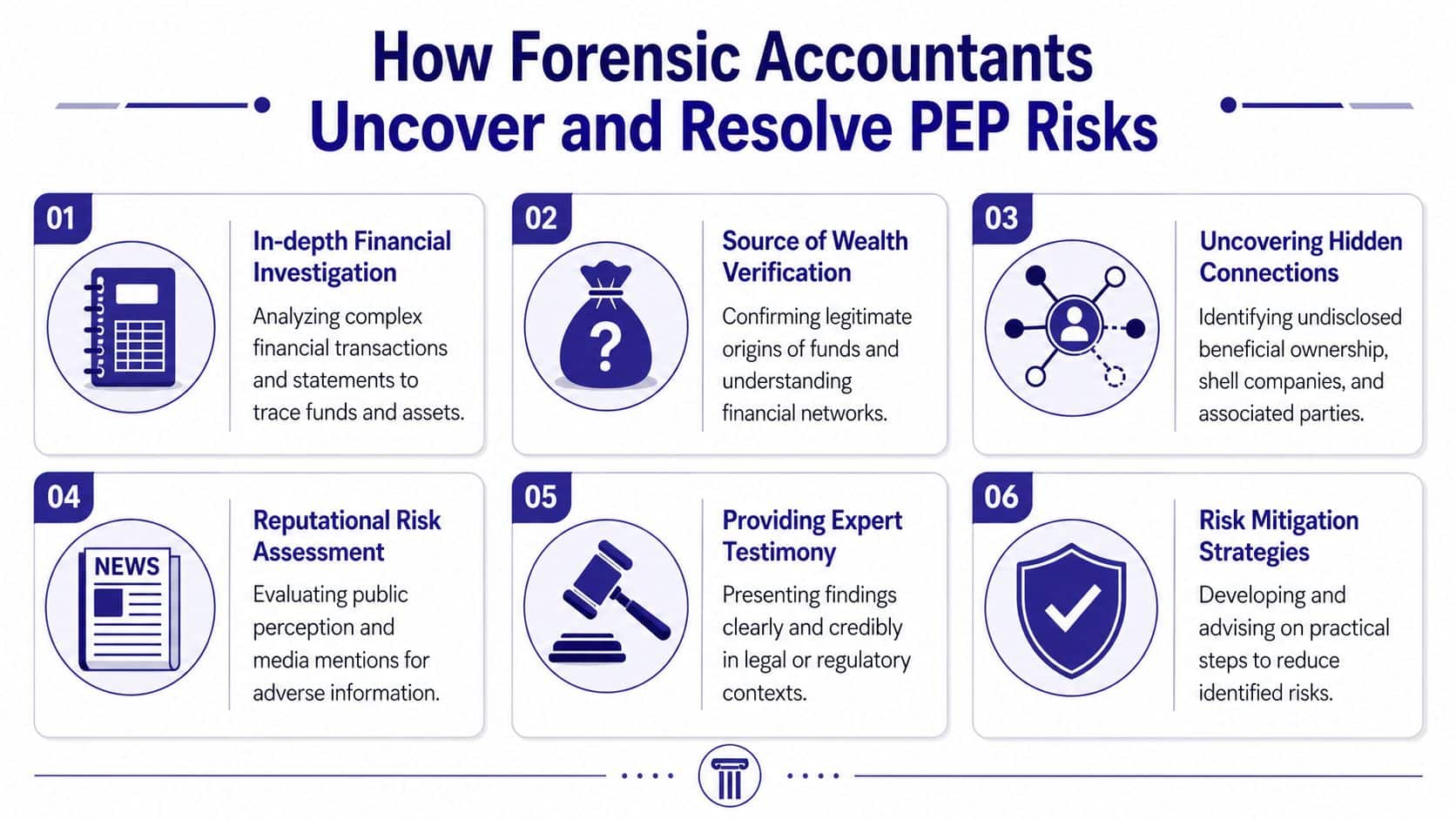
That distinction is critical in live disputes. Once a PEP issue surfaces, the work usually expands fast. You may need to trace source of funds, test source of wealth, identify hidden beneficial owners, assess related-party transactions, review suspicious journal entries, and reconstruct payment flows across multiple entities and accounts. None of that is automated judgment. It's forensic accounting.
What forensic accountants actually do after a PEP alert
A serious review usually involves several workstreams at once.
Follow the money
We map payments, round-tripping patterns, unusual commissions, loan movements, and withdrawals that don't fit the commercial story.Test ownership and control
We examine company records, shareholder chains, beneficial ownership indicators, and connected-party relationships to find who really benefits.Assess source of wealth and source of funds
If claimed wealth doesn't align with business history, remuneration, or transaction structure, the alert deserves escalation.Build the evidential file
A good forensic report explains findings clearly, supports each conclusion, and survives challenge from regulators, lawyers, and auditors.
Why this matters in disputes and investigations
PEP issues rarely stay confined to compliance. They spill into:
- Shareholder disputes, where one side alleges concealed relationships or conflicted transactions.
- Post-deal claims, where buyers say political exposure was hidden during due diligence.
- Fraud and bribery investigations, where public-office links explain unusual payment behaviour.
- Expert witness work, where courts need financial evidence presented in plain English.
That last point matters. Judges and tribunals don't want jargon. They want a coherent narrative backed by records, reconciliations, and professional reasoning.
A strong overview of how this kind of work exposes concealed financial misconduct appears in this piece on how a forensic accounting firm can uncover hidden financial crimes.
The best PEP review answers three questions quickly. Who is connected, how did value move, and what does the evidence prove?
The advantage of forensic thinking
Compliance teams often ask, “Is this a match?” Forensic accountants ask, “What does this relationship do to the risk profile, the money trail, and the legal position?”
That shift matters. It turns politically exposed person screening from a filtering exercise into a decision-making tool. In contentious situations, that's the difference between reacting late and acting with control.
Protect Your Organisation with Expert Support
Weak politically exposed person screening leaves businesses exposed in exactly the wrong places. It undermines transactions, inflames disputes, weakens board oversight, and creates records you won't want examined later. By the time a regulator, bank, insurer, investor, or opponent in litigation starts asking questions, the damage usually isn't limited to compliance. It reaches cash flow, reputation, deal certainty, and legal strategy.
A stronger approach is straightforward. Build screening around actual risk. Tie it to AML controls and ownership review. Escalate intelligently. Re-screen when facts change. Document every important judgment. Most of all, stop pretending a database hit is the same as an investigation.
That's where forensic accounting makes the difference. It brings financial analysis, evidential rigour, and commercial judgment into a process that too many firms still treat as administrative. If you're dealing with cross-border counterparties, unexplained wealth, hidden ownership, fraud concerns, or a dispute already in motion, you need more than policy wording. You need a defensible position.
The businesses that handle PEP risk best don't wait for a crisis. They pressure-test counterparties early, investigate anomalies properly, and keep a clear record of why decisions were made. That approach protects the organisation long before any formal allegation appears.
If politically exposed person screening has become a live issue in your business, or you need forensic accounting support on fraud, disputes, AML risk, source-of-funds concerns, or expert evidence, speak to Lighthouse Consultants. Their London team helps organisations investigate complex financial risk, build defensible processes, and produce clear analysis that stands up in negotiations, audits, and court.