The deal has closed. Heads of terms are behind you. Management wants integration to move fast. Then the friction starts.
The seller disputes the earn-out. Your auditors push back on the value assigned to customer relationships or technology. Tax queries arrive later than anyone expected. If the transaction becomes contentious, lawyers start asking a blunt question: who decided these values, on what basis, and where is the support?
That’s where purchase price allocation stops being a routine accounting exercise and becomes a dispute issue. In practice, it often sits at the centre of audit challenge, litigation support, warranty claims, fraud investigation work, and post-deal financial argument. A forensic accountant sees that risk early. Good forensic accounting doesn’t just produce numbers. It builds a position that management, auditors, tax advisers, lenders, and if necessary the court can follow.
The Post-Deal Financial Minefield
A surprising number of post-acquisition problems start with the same assumption. People think purchase price allocation is something finance can tidy up after completion.
That view causes trouble. Once the price is fixed and the paperwork is signed, the allocation drives what lands on the balance sheet, what hits profit in later periods, and what can be defended if someone challenges the deal economics. If the underlying assumptions are weak, the weakness spreads into the audit file, tax computations, board reporting, and any later dispute.

Where the problems usually begin
In the UK mid-market, measurement uncertainty is a real issue. PKF notes continued deal flow and cross-border activity in ONS 2024 merger and acquisition statistics, alongside the dispute risk created when IFRS 3 requires fair value measurement at acquisition date but market evidence is thin. That matters because thin evidence invites argument. Buyers, sellers, auditors, lenders, and tax advisers may all read the same facts differently.
The recurring flashpoints are usually familiar:
- Earn-outs and contingent consideration: If the model is too optimistic or too vague, the purchase price allocation can unravel later.
- Intangible assets: Customer relationships, brands, technology, and contractual rights often carry the most judgement and the most challenge.
- Liabilities taken on: Buyers sometimes focus on upside assets and underwork the liabilities and contingent exposures.
- Documentation: A weak file turns a technical debate into a credibility problem.
Practical rule: If a value would be hard to explain to a sceptical auditor or cross-examining barrister, it’s not ready.
Why a forensic accountant gets involved early
Forensic accounting services add value. A forensic accountant approaches the file as if someone will challenge it later. That changes the work. We test assumptions, reconcile the transaction documents to the accounting outcome, look for inconsistencies between management forecasts and valuation inputs, and preserve an audit trail that can survive pressure.
That same mindset also supports wider transaction work, including due diligence that helps prevent post-deal disasters. Strong due diligence and strong purchase price allocation belong together. If they’re separated, businesses often discover too late that the numbers agreed in the deal room don’t sit comfortably with the accounting that follows.
What Is Purchase Price Allocation Under IFRS 3
At its simplest, purchase price allocation means assigning the total acquisition price across the assets acquired and liabilities assumed. In UK reporting, the governing framework is IFRS 3.
That sounds dry. It isn’t. The allocation decides what the buyer bought in accounting terms. It converts a headline deal price into specific balance sheet entries.
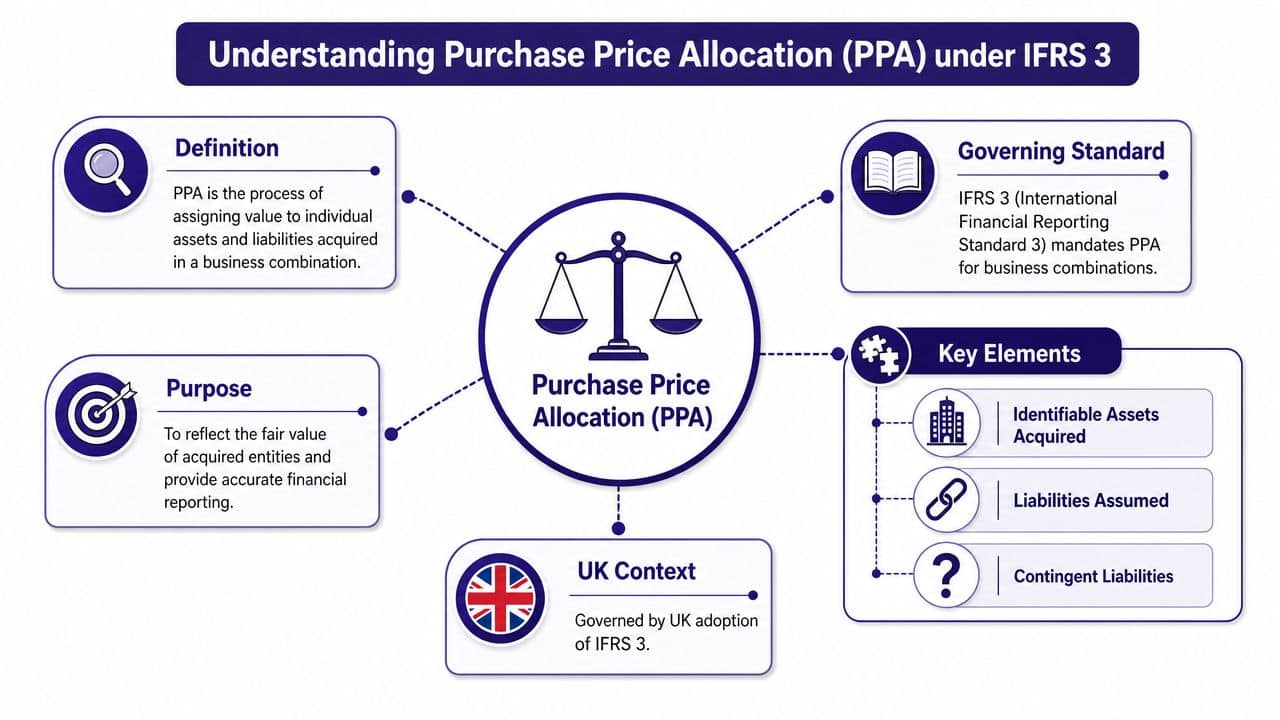
The business reality behind the rule
Think of it as buying a business and then unpacking what sits inside the price. Some of the price may relate to property, plant, equipment, stock, contracts, customer relationships, software, patents, or other identifiable assets. Some may relate to borrowings, provisions, or other liabilities. What remains after all identifiable items are measured becomes goodwill.
Under IFRS 3 in the UK reporting framework, effective for accounting periods beginning on or after 31 March 2004, the acquirer must measure every identifiable acquired asset and assumed liability at fair value on the acquisition date, and any excess of purchase price over net fair value is recorded as goodwill. That same framework matters because fair value step-ups in intangibles create later amortisation or impairment effects, while liabilities and contingent consideration can alter capital structure and profit metrics.
Why business owners should care
Owners sometimes see this as an accounting compliance task for year-end. It isn’t optional, and it isn’t cosmetic.
A poor allocation can affect:
- Reported profits: Intangible assets recognised on acquisition can create future charges.
- Debt discussions: Liability recognition can change covenant conversations and lender perception.
- Tax analysis: Accounting and tax don’t always move together.
- Disputes: If the allocation looks engineered, counterparties and auditors will notice.
The purchase price allocation should explain the economics of the deal. If it doesn’t, someone will challenge it.
A forensic audit approach is useful here because it asks a tougher question than standard preparation work. Not merely “does this balance?” but “would an informed third party accept this reasoning?”
The Step-by-Step Purchase Price Allocation Process
A strong purchase price allocation follows a disciplined sequence. Skip a step or blur the evidence, and the whole exercise becomes harder to defend.
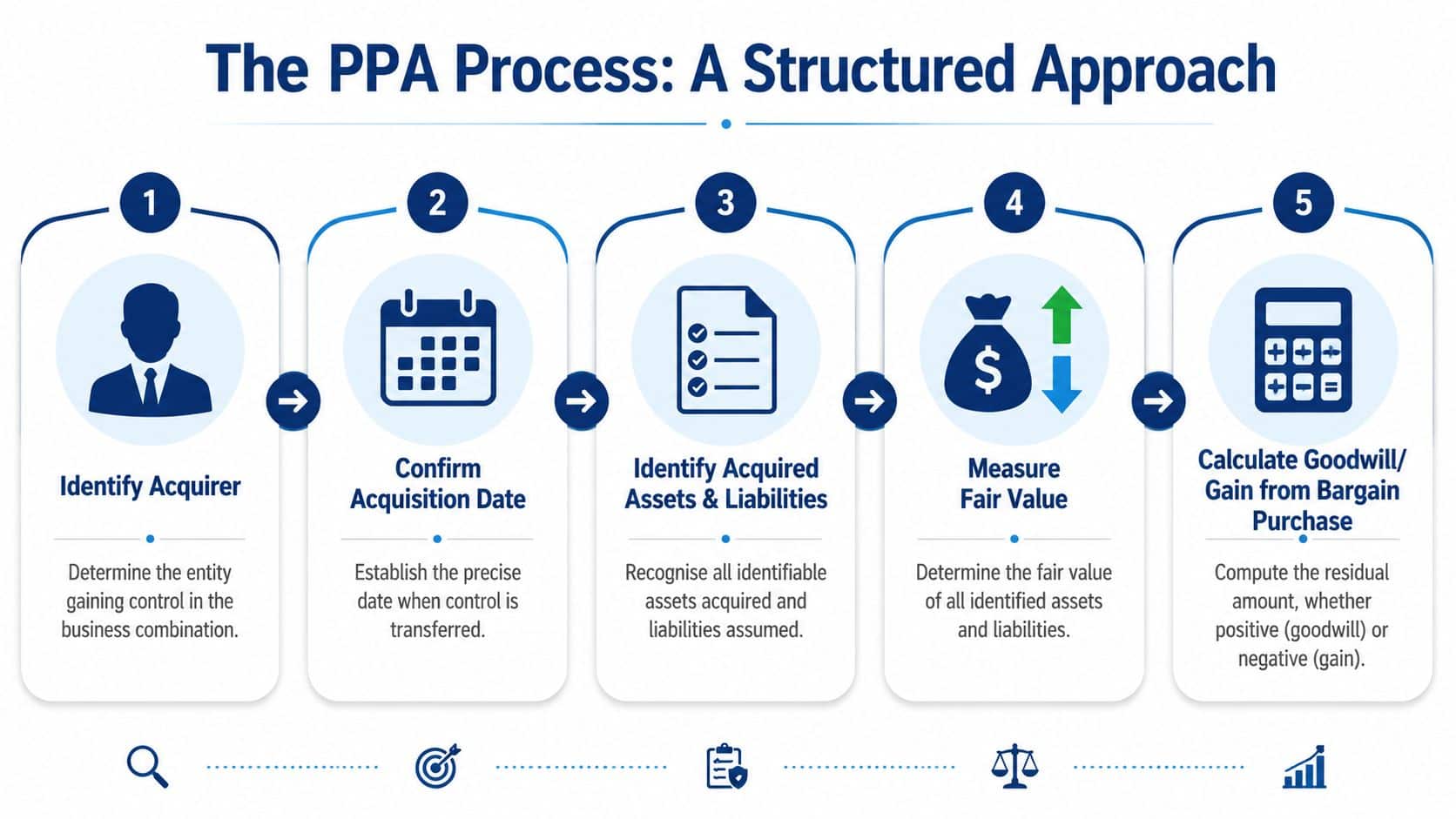
The five core stages
-
Identify the acquirer
This sounds obvious, but group structures, rollovers, or unusual control rights can complicate it. The accounting acquirer must be clear before the rest of the analysis can stand. -
Fix the acquisition date
Fair value is measured at the acquisition date. If the date is wrong, the valuation date is wrong, and the numbers may drift from the legal and commercial reality. -
Calculate consideration transferred
Buyers often focus on cash paid. That’s only part of the story. Shares issued, liabilities assumed, and contingent consideration all matter. -
Identify acquired assets and assumed liabilities
Within these, hidden value and hidden exposure reside. Contracts, customer relationships, technology, and claims positions all need scrutiny. -
Measure fair value and calculate goodwill
Goodwill comes last, not first. It is a residual, not a plug figure to make the numbers fit.
Later in the process, it helps to pause and compare accounting treatment with transaction drafting. Lawyers dealing with asset deals may also find this legal guide for asset acquisitions useful because legal structure and accounting outcome don’t always align neatly in practice.
The point where many files go wrong
A key control point is contingent consideration. Wall Street Prep explains that goodwill is only the residual after all separable assets and liabilities are fair-valued, and that deal teams must model contingent consideration and earn-outs at the acquisition date because changes in those assumptions shift the allocation itself. In practice, this is one of the first places an auditor or dispute adviser will look.
Here is a useful visual overview before diving deeper into valuation detail.
What a defensible process looks like
A defensible file usually includes:
- A clean reconciliation: Transaction documents tie back to the accounting entries.
- Clear valuation inputs: Forecasts, attrition assumptions, discount rates, and legal rights are documented.
- Cross-checks: Management case, deal model, and valuation model don’t contradict one another.
- Contemporaneous evidence: The support reflects what was known at acquisition date, not what was convenient later.
That discipline is what separates a routine workbook from work that can withstand audit review, insurance scrutiny, or litigation support.
Valuing Key Assets A Forensic Accountant’s Approach
The technical heart of purchase price allocation is valuation. This is also where a forensic accountant earns their keep. Not by producing an elegant spreadsheet alone, but by linking valuation method to commercial facts, available evidence, and challenge risk.
Tangible assets are usually more straightforward. Property, plant, machinery, and equipment can often be anchored to market evidence, replacement cost, condition, and remaining useful life. The judgement is still real, but the path is usually visible.
Intangible assets need closer scrutiny
Intangible assets create the harder questions. Customer relationships, brands, proprietary technology, contracts, licences, and other non-physical assets may never have appeared clearly in the target’s old accounts, yet they can carry substantial value in the acquisition analysis.
The method must fit the asset:
- Relief from royalty: Often used for brands, trade names, or technology where one can assess the value by considering what a third party might pay to license the asset.
- Multi-period excess earnings method: Common for customer relationships, where value is isolated from expected future earnings after charging returns to contributory assets.
- Cost approach: Sometimes relevant where replacement or recreation cost is a better indicator than income.
- Market approach: Useful where comparable transactions or market evidence exist and are genuinely comparable.
A reliable model depends on inputs that are commercially coherent. If forecast cash flows assume rapid customer retention but due diligence identified churn concerns, that inconsistency will become a weakness. The same applies if legal rights are narrower than the valuation suggests.
What forensic accounting changes
A business dispute accountant doesn’t stop at method selection. The actual work includes testing whether the chosen method matches the legal and operational facts, whether the assumptions agree with board papers, and whether the model can be explained in plain English under pressure.
A valuation that works only when the modeller is in the room is a fragile valuation.
For that reason, valuation analysis often overlaps with broader forensic accounting and dispute support. When a buyer later alleges misrepresentation, when an insurer questions loss quantification, or when auditors ask whether the assumptions are supportable, the same underlying discipline matters.
Where income methods are appropriate, businesses often benefit from understanding the mechanics of discounted cash flow for valuations. DCF analysis is not a universal answer, but it is frequently central to intangible asset measurement where future economic benefit drives value.
PPA in Practice A Sample Allocation
A simple worked example helps show how purchase price allocation operates. The numbers below are illustrative only.
Assume a buyer acquires a target for £5,000,000. After review, the buyer identifies the following fair values for acquired assets and liabilities.
Sample Purchase Price Allocation
| Item | Fair Value (£) |
|---|---|
| Property | 1,500,000 |
| Equipment | 500,000 |
| Customer contracts | 1,000,000 |
| Patent | 800,000 |
| Bank loans assumed | (300,000) |
| Net identifiable assets | 3,500,000 |
| Goodwill | 1,500,000 |
| Total consideration | 5,000,000 |
How the residual is derived
The arithmetic is direct. Start with the total consideration of £5,000,000. Deduct the fair value of net identifiable assets of £3,500,000. The remaining £1,500,000 is goodwill.
This example matters because it shows two practical points. First, goodwill only appears after the identifiable assets and liabilities have been measured. Second, recognising customer contracts and a patent means future accounting won’t look the same as it would if the entire excess had been parked in goodwill.
Why the example matters in disputes
If a later dispute arises, this schedule becomes more than a closing exercise. A seller may argue the buyer undervalued the acquired intangible assets to support a later warranty claim. An auditor may ask why the patent has a particular value and useful life. A tax adviser may question how the accounting allocation interacts with the tax treatment.
That’s why a forensic accountant support mindset is useful even in a simple-looking allocation. The numbers should reconcile cleanly, but the reasoning must also hold up.
A typical journal entry would recognise the acquired assets at fair value, record the assumed liability, and post goodwill as the balancing figure. The exact entries depend on the legal form of the acquisition and the acquirer’s accounting records, but the principle remains the same.
Common PPA Pitfalls and How Forensic Accounting Mitigates Risk
Most weak purchase price allocations don’t fail because someone missed the arithmetic. They fail because the judgement was rushed, biased, poorly documented, or disconnected from the commercial facts.
That is why PPA often becomes a forensic audit issue later. By the time the problem surfaces, the transaction team has moved on, the target’s management may have left, and the file has to stand on its own.
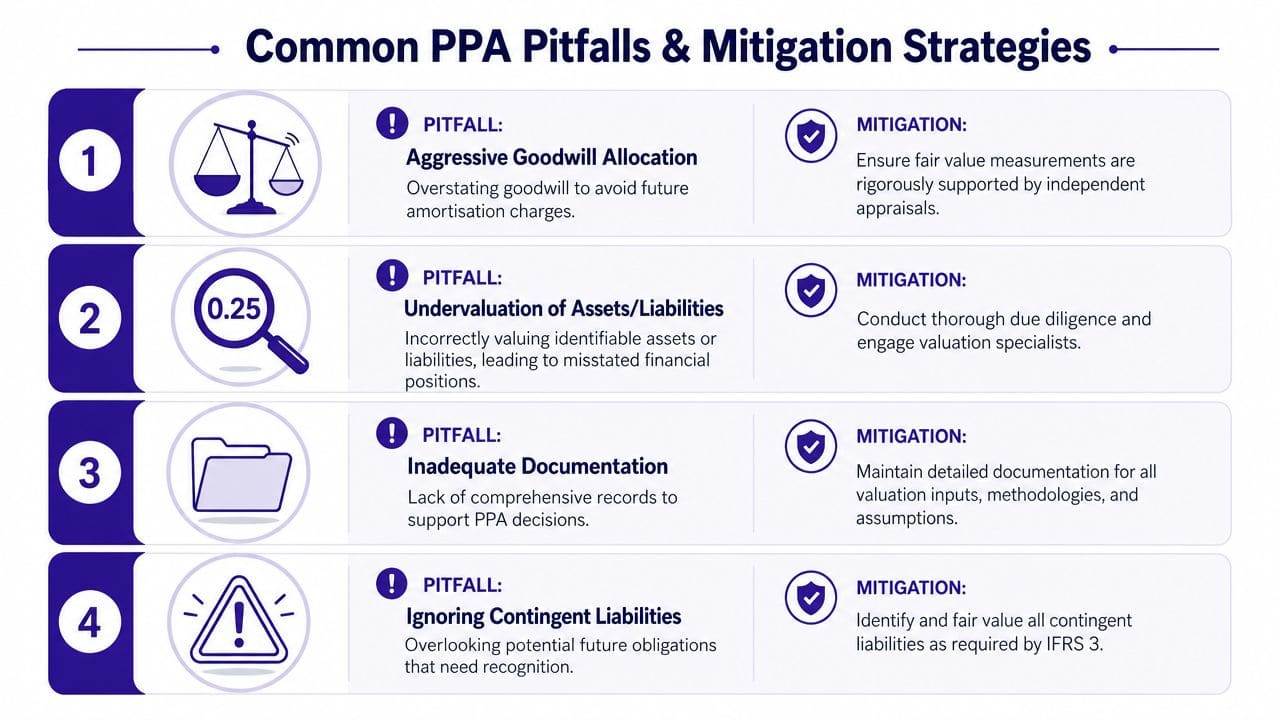
The mistakes that create expensive problems
- Overloading goodwill: Teams sometimes leave too much value in goodwill because it feels simpler than identifying and valuing separable intangibles. That can attract audit challenge and distort later reporting.
- Weak treatment of contingent items: Earn-outs, contingent consideration, or disputed liabilities need proper fair value analysis. If they are handled casually, the allocation can shift materially later.
- Ignoring tax interaction: Accounting entries don’t exist in a tax vacuum.
- Thin evidence: If assumptions are not documented at the time, they become much harder to defend later.
One of the most neglected UK points is the tax side. Sofer Advisors notes that while IFRS 3 governs accounting, UK tax outcomes depend on capital allowances and corporation tax rules, and with HMRC collecting about £98.5 billion in corporation tax in 2023-24, even small misallocations can materially affect post-deal tax cash flow.
How forensic accounting reduces the risk
Forensic accounting mitigates these issues in a practical way.
- Independent challenge: A forensic accountant questions management assumptions instead of merely processing them.
- Fraud awareness: If figures appear engineered, inconsistent, or unsupported, the review can widen into a fraud investigation or misrepresentation analysis.
- Loss quantification discipline: The same rigour used in litigation and insurance claims helps with acquisition modelling and valuation support.
- Court-ready reporting: If the matter turns contentious, the groundwork for expert witness work already exists.
The cheapest time to defend a purchase price allocation is before anyone attacks it.
This is also where structured forensic accounting services and wider business dispute support and audit services can be relevant. In practice, businesses often need one adviser who can move from allocation review to dispute analysis, fraud investigation services, audit issues, or expert financial evidence without rebuilding the file from the ground up.
When to Engage a Forensic Accounting Expert Witness
Some transactions plainly need specialist help from the start. If the deal includes disputed earn-outs, volatile trading, complex intangible assets, or concerns about the quality of the seller’s financial information, early specialist involvement is usually the sensible route.
The same applies where there is a realistic prospect of litigation. If your board may later need to explain the allocation to auditors, funders, opposing solicitors, or the court, it makes sense to build the analysis with that audience in mind. A seasoned expert witness accountant won’t just comment after the event. They can help shape a file that is coherent, transparent, and much harder to undermine.
Situations that justify early action
- A contested deal structure: Where completion accounts, earn-outs, or warranty positions are likely to be disputed.
- Hard-to-value assets: Technology, intellectual property, regulated rights, niche contracts, and customer assets often attract challenge.
- Signs of misstatement or concealment: These can require immediate fraud investigation support.
- Audit friction: If the auditors are already uneasy, the issue rarely gets better by waiting.
A specialist can also bridge the gap between accounting detail and legal evidence. That matters in mediation, arbitration, and court proceedings, where complex valuation concepts must be explained clearly and impartially. For matters likely to proceed into formal dispute, forensic accountant expert witness support in the UK can help frame the issues properly from the outset.
Lighthouse Consultants can assist with forensic accounting, fraud investigation services, loss quantification, audit issues, litigation support, and expert financial analysis where purchase price allocation has become contentious or high risk.
If your transaction has already raised questions about valuation, audit evidence, tax treatment, earn-outs, or financial misstatement, contact Lighthouse Consultants. The team provides forensic accountant support for disputes, forensic audits, fraud investigations, expert witness work, and broader forensic accounting services across the UK.