You can buy the right UK property, agree the price, line up the funds, and still watch the transaction stall.
That usually happens when the buyer focuses on the legal headline and ignores the financial file underneath it. A solicitor asks for source of funds evidence. A lender questions overseas income. Tax costs come in higher than expected. Documents from several jurisdictions don't align. Then momentum disappears, and the seller starts looking elsewhere.
For an overseas buyer, the key question isn't merely can a foreigner buy a property in UK. The legal answer is straightforward. The practical answer depends on whether your finances can survive scrutiny. That is where forensic accounting, forensic audit work, and disciplined financial analysis often make the difference between completion and collapse.
The Hidden Financial Traps in UK Property Purchases
A foreign buyer often starts with confidence. Funds are available. The property looks clean. The estate agent is responsive. Yet once the offer is accepted, the transaction becomes a documentary test.

The first shock is usually not the price of the property itself. It is the depth of questioning around where the money came from, how it moved, who ultimately owns the structures involved, and whether the paperwork tells one consistent story. For high value purchases, that review can become highly technical very quickly.
Where purchases usually start to drift
I see the same pressure points repeatedly in cross-border matters:
- Source of wealth confusion: A buyer may have substantial means, but if those means sit across family companies, trusts, investment accounts, or a recent business disposal, the evidence can look fragmented.
- Document mismatch: Names, addresses, translations, banking references, and company records often differ slightly across jurisdictions. Small inconsistencies trigger bigger questions.
- Timing problems: Buyers leave verification too late. By the time the solicitor or lender raises concerns, the seller expects exchange, not a fresh evidence-gathering exercise.
- Tax budgeting gaps: Buyers budget for deposit and fees, then discover that tax treatment makes the acquisition materially more expensive than planned.
Practical rule: In UK property transactions, being wealthy is not enough. You must also be able to prove the journey of your money in a clear, documented, and coherent way.
Why this matters to a forensic accountant
A forensic accountant adds real value. Not by replacing the solicitor or mortgage broker, but by making the financial evidence usable. That means tracing funds, reconciling transactions, identifying weak spots, and preparing explanations before a compliance team asks for them.
A strong file also helps when risk expands beyond conveyancing. If a transaction later leads to a dispute, a business dispute accountant or expert witness accountant may need to reconstruct what happened, quantify losses, or examine whether someone misrepresented funds, ownership, or liabilities. Good preparation at the outset reduces that risk.
Many buyers hesitate to bring in forensic accounting support because they think it will complicate matters or signal a problem. In practice, the opposite is usually true. Early financial review tends to shorten arguments, expose weak assumptions, and stop avoidable delays before they become expensive.
The Legal Right to Buy vs The Practical Hurdles
Yes. A foreigner can buy property in the UK. There is no general nationality-based ban on owning UK property, and that broad position has remained after Brexit. Market activity confirms overseas participation remains meaningful. In 2023, 20% of new homes in London were sold to overseas buyers, while less than 3% of London homes were owned by non-residents, according to Wise's summary of CBRE data on overseas ownership in London.
That simple legal answer hides three practical hurdles that stop transactions every day.
Financing is not automatic
If you need borrowing, a UK lender won't assess you like a standard domestic applicant. The review becomes more intensive when income arises overseas, when assets sit in multiple entities, or when your banking history spans several countries. Legal eligibility to buy doesn't make a lender comfortable.
Tax changes the economics
Many foreign buyers ask whether they're allowed to buy. The sharper question is whether the transaction still makes sense after UK property taxes, holding costs, and future disposal issues are properly modelled. A property can be legally available and still financially unattractive.
AML controls shape the whole deal
Solicitors, lenders, and estate agents have their own obligations. They must understand who the buyer is, where the money comes from, and whether the transaction raises any red flags. If your documents are incomplete or inconsistent, the process can freeze.
For broader market context, 2025 UK property analysis is a useful read because it helps place transaction decisions within a wider investment backdrop rather than treating conveyancing as the whole story.
The legal question is the easy part. The operational question is whether your funding, tax position, and compliance file are ready for examination.
Securing a Mortgage as a Non-UK Resident
Non-resident mortgage applications fail for ordinary reasons dressed up as technical ones. The lender doesn't always reject the borrower because wealth is lacking. More often, the lender can't get comfortable with the evidence.

According to DavidsonMorris guidance for foreign buyers in the UK, non-UK resident mortgage applicants may face tighter underwriting, including larger deposits often in the 25%–40% range. That changes the shape of the deal immediately. More capital must sit ready, and the lender will want to understand where that capital came from.
What lenders tend to scrutinise
A lender usually wants a story it can follow from start to finish. Problems arise where the story is true, but poorly assembled.
| Issue | What the lender wants to see | What often goes wrong |
|---|---|---|
| Income | Stable, evidenced earnings | Foreign documents don't align or need clarification |
| Deposit | Clean proof of origin | Funds moved through several accounts without explanation |
| Structure | Clear beneficial ownership | Company, trust, or family arrangements obscure control |
| Credit profile | Consistent financial behaviour | Cross-border history is hard to interpret quickly |
What works better
The strongest applications are prepared like an audit file, not a hopeful submission.
- Build one reconciled pack: Passport, address evidence, bank statements, income records, company ownership records, and supporting explanations should agree with each other.
- Explain complexity early: If funds came from a dividend, disposal, inheritance, or investment redemption, set that out clearly before underwriting asks.
- Translate the financial history: Overseas documents may be perfectly valid but still difficult for a UK lender to interpret in context.
- Use specialist mortgage context: Eligibility for non-resident UK mortgages gives a practical overview of how lenders frame these applications.
A forensic accountant can support this process by tracing funds, testing consistency, and presenting a cleaner evidential trail. That isn't mortgage broking. It is financial verification. When the funding profile is complex, that distinction matters.
Understanding Your UK Tax Obligations
Buyers often underestimate tax because they treat it as an administrative add-on. In reality, tax changes the economics of the purchase from day one.
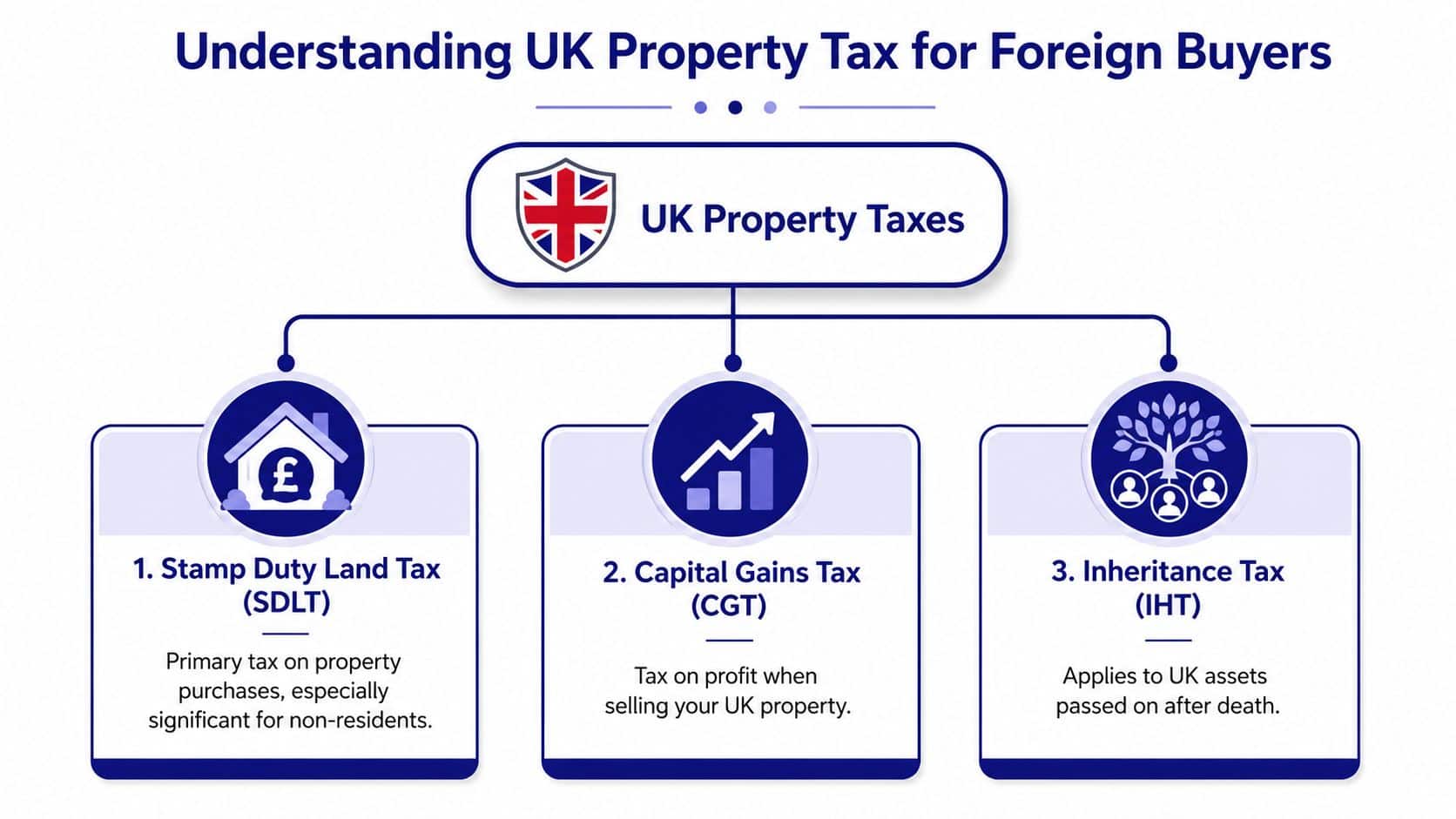
For non-UK residents, the immediate issue is Stamp Duty Land Tax. As noted in Pacaso's guide to buying a house in the UK, non-UK residents pay a 2% SDLT surcharge on top of normal rates. The same guidance notes that second homes can attract an additional surcharge, creating a materially higher upfront cost in some cases.
The tax points buyers need straight at the start
The first step is to calculate purchase taxes before negotiating the deal, not after. If the property is a second home or investment asset, the acquisition cost can rise well beyond what a buyer initially expects.
The second step is to think past completion. A buyer should understand how the property will be held, how future gains may be taxed, and whether inheritance planning requires a different structure. I regularly find that buyers focus on getting the keys and leave the harder questions until a later refinancing, disposal, divorce, probate matter, or shareholder disagreement. By then, options are narrower.
A practical checklist
- Acquisition tax: SDLT needs to be budgeted as part of total cash required, not treated as a minor completion item.
- Exit tax: Capital Gains Tax may matter when the property is sold.
- Estate exposure: Inheritance Tax can affect UK assets and should not be left out of planning.
- Residence position: Tax residence and immigration status are separate issues. For UK tax residence planning, the UK tax residence test is a useful starting point.
Buyers who ask only “Can I buy?” usually miss the more expensive question, which is “What will this property cost me to acquire, hold, and exit?”
Forensic accounting services and tax-led financial analysis complement legal advice. A solicitor completes the conveyancing. A tax adviser addresses tax law. A forensic accountant helps connect the numbers, the evidence, and the economic reality of the transaction so decisions are made on facts rather than optimism.
Passing Anti-Money Laundering and Source of Funds Checks
This is the stage where many overseas transactions unravel. Not because the buyer has done anything improper, but because the evidence is incomplete, disorganised, or difficult to interpret across borders.
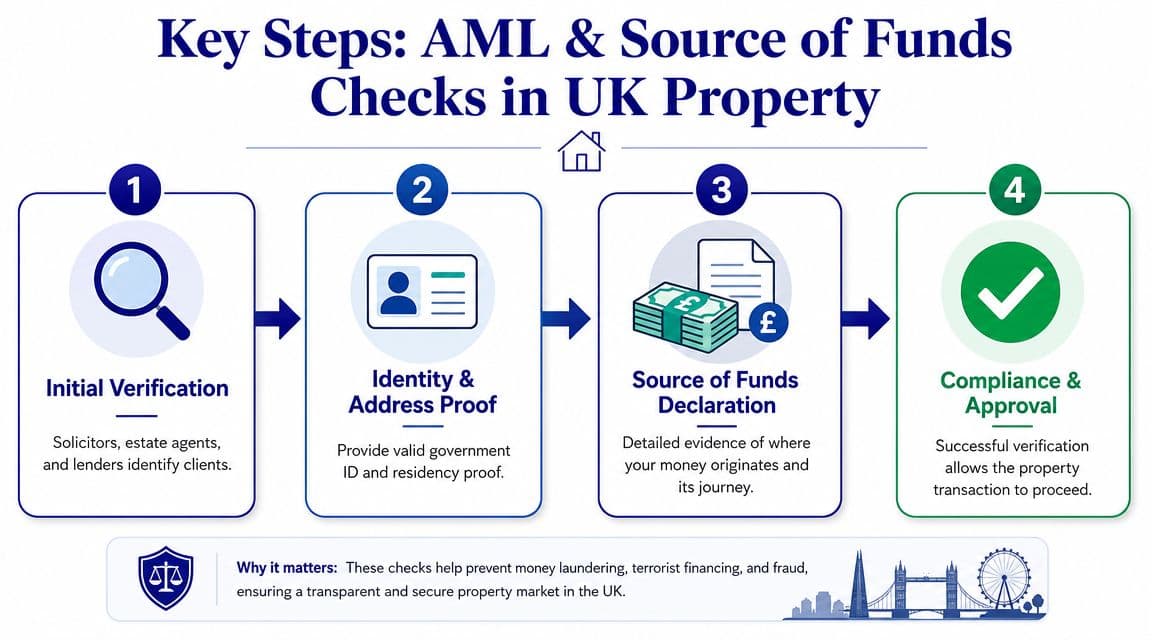
Solicitors and lenders don't just ask whether the money is legitimate. They ask for documents that prove origin, ownership, movement, and consistency. If the transaction involves family gifting, offshore entities, nominee arrangements, private business income, or assets realised shortly before purchase, the file can become highly technical.
Source of funds is not a bank statement exercise
Many buyers think source of funds means showing current account balances. It doesn't. The review usually goes deeper.
A compliance team may want to understand:
- Where the capital first arose: salary, dividends, sale proceeds, inheritance, investment liquidation, or retained business profits.
- How it moved: through which accounts, in which names, and under which legal relationships.
- Who controls it: especially where companies, trusts, or family members are involved.
- Whether the documents tell one story: names, dates, values, and transfer paths must align.
That is why this work often becomes a forensic accounting exercise rather than ordinary admin. A forensic accountant can reconstruct the trail, reconcile anomalies, and prepare a coherent source of funds narrative that a solicitor or lender can use.
A short explainer can help frame the issue before documents are assembled:
What usually fails and what tends to work
The weakest approach is reactive. A buyer sends partial statements, then waits for the next objection. That creates delay and suspicion, even where the funds are entirely clean.
The stronger approach is proactive:
- Gather evidence for the origin of wealth, not just the final account balance.
- Reconcile significant transfers between entities and individuals.
- Explain unusual movements in writing.
- Check that identity, address, ownership, and banking records all match.
- Prepare for questions about politically exposed persons, sanctions screening, and beneficial ownership where relevant.
For buyers facing complicated structures or heightened scrutiny, proceeds of crime triggers that can freeze funds overnight is worth reading because it shows how quickly a transaction can become a compliance problem if the evidence is weak or badly timed.
This is one area where specialist help pays for itself in avoided delay. Lighthouse Consultants' forensic accounting services can support source of funds analysis, financial tracing, and document-led review where a transaction needs independent financial clarity. The same skill set also supports a later fraud investigation, forensic audit, insurance claim, or litigation support exercise if the purchase becomes contentious.
Clean money still needs clean evidence. UK compliance teams approve documents, not assumptions.
Managing Post-Purchase Risks and Disputes
Completion doesn't end the financial risk. It changes its form.
Foreign participation is especially visible in buy-to-let structures. Liquid Expat Mortgages, citing Hamptons analysis, reports that one in five buy-to-let companies established in Britain in the first half of the year involved foreign shareholders, with projections of more than 13,000 such companies with non-UK nationals by the end of 2025. That matters because multi-owner and investment structures create fertile ground for disputes.
The risk shifts after purchase
A straightforward residential purchase can later become a financial dispute if the property is held with partners, family offices, or investment vehicles. Common trouble spots include undeclared withdrawals, agent misreporting, rent diversion, disputed refurbishment costs, and disagreements over who funded what.
A business dispute accountant or expert witness accountant becomes useful when the argument is no longer about legal title alone, but about money flows, losses, valuations, and accountability. That might involve a forensic review of rent receipts, a reconstruction of service charge movements, or a loss quantification exercise tied to negligent management.
Where forensic accounting adds value after the deal
- Fraud investigation services: Useful when money appears to have gone missing through an agent, tenant arrangement, or internal management failure.
- Forensic audit work: Helpful where records are incomplete, controls are weak, or partners no longer trust the reported figures.
- Litigation support: Necessary when solicitors need objective schedules, reconciliations, and financial evidence that can survive challenge.
- Insurance claims and loss quantification: Relevant where property damage, interruption, or a related business loss requires measured financial support.
- Audit services and review support: Important where governance, reporting, or internal controls around a property vehicle are under strain.
If a property holding turns contentious, forensic accounting for property disputes outlines the kind of analysis often required to establish what happened and what the financial impact has been.
A property dispute rarely turns on emotion alone. It usually turns on records, reconciliations, and who can prove the numbers.
This is why a forensic accountant's role extends well beyond the initial acquisition. The same disciplines that help a buyer pass source of funds checks also help them protect the asset later.
Secure Your UK Property Investment with Expert Support
So, can a foreigner buy a property in UK? Yes. But the legal permission to buy is the least interesting part of the problem.
The challenge is execution. You need a funding trail that withstands scrutiny, a tax position that makes commercial sense, and records that remain defensible if the investment later leads to a dispute, claim, or investigation. That is why prudent buyers treat the transaction as a financial due diligence exercise, not just a conveyancing matter.
What experienced buyers get right
They don't wait for a lender or solicitor to expose weak paperwork. They organise the financial narrative in advance. They test assumptions on tax and ownership. They separate immigration issues from property ownership. A foreign national who wants to live in the property needs a suitable visa, because ownership and residency rights are separate, as noted in Prosperity Wealth's explanation of UK property ownership and visa status.
They also think beyond completion. Portfolio concentration, governance, and downside planning matter, especially where properties sit within wider investment structures. For that broader perspective, SM Elite's risk management strategies offer a useful way to think about protecting value rather than focusing only on acquisition.
Where professional support fits
You may need a solicitor, broker, tax adviser, and immigration lawyer. Those roles are distinct. A forensic accountant sits alongside them when the financial evidence is complex, disputed, or potentially vulnerable to challenge.
That support can include:
- Forensic accounting services: tracing source of funds, testing financial consistency, and preparing evidential schedules.
- Fraud investigation services: where funds, rents, or investment contributions don't reconcile.
- Forensic audit review: where records need independent examination.
- Expert witness accountant input: for litigation, arbitration, or settlement support.
- Business dispute support: when co-investors, shareholders, or family stakeholders disagree on money, value, or control.
- Audit services and financial analysis: where governance around the purchase or holding vehicle needs strengthening.
If your transaction involves cross-border wealth, multiple entities, family capital, or any unexplained movement of funds, don't treat that as a side issue. It is often the main issue.
If you're buying UK property from abroad and want clear forensic accountant support before funds are queried, tax assumptions harden, or a dispute develops, contact Lighthouse Consultants. Their forensic accounting services and broader business dispute support and audit services can help you organise source of funds evidence, assess financial risk, support fraud investigation work, and provide expert financial analysis for complex UK property matters.