A secured property loan rarely fails in a neat, orderly way. It usually unravels while directors are juggling overdue creditors, strained cash flow, anxious staff, and a lender that has stopped asking politely. In that moment, the immediate question is whether the lender will enforce. The harder question is whether the financial story you've been relying on is even true.
Sometimes the default is straightforward. Rent has fallen away, a refinance has collapsed, and the numbers no longer work. Sometimes it isn't. Missing cash, unexplained journals, inflated asset values, side agreements, related-party payments, and weak management information often sit behind the crisis. That is where legal enforcement and forensic accounting start to overlap.
The Crisis Point When a Secured Loan Goes Wrong
A common scenario runs like this. A company borrows against an investment property, a development site, or a trading premises. Income softens or costs rise. Covenant pressure builds. Then the lender issues a formal default notice and reserves its rights over the charged asset.

For directors, the practical fear isn't only loss of property. It's loss of control over timing, information, and value. For lenders, the concern is different. They need to know whether the asset still supports recovery and whether rents, records, or sale prospects have already been compromised.
Where the pressure usually lands first
The warning signs tend to cluster:
- Demand letters escalate: The lender stops discussing short-term tolerance and starts focusing on enforcement rights.
- Records become contested: Occupation status, rent arrears, service charge balances, and title issues suddenly matter.
- Trust breaks down: The lender suspects concealment. Directors suspect the lender is moving too fast.
- Other problems surface: Tax arrears, disputed invoices, and weak internal controls often appear at the same time.
A lot of people look for simple parallels with overseas enforcement. If you're trying to understand how asset-led enforcement differs across jurisdictions, BatchData's guide to foreclosures is a useful comparison point. It isn't a UK fixed charge receivership guide, but it helps show why local legal structure matters so much when creditors move from warning letters to action.
Practical rule: By the time a lender mentions appointing a receiver, you should assume every ledger entry, tenancy document, and transfer linked to the secured asset may become commercially important.
Why clarity matters early
At this stage, many businesses make the same mistake. They treat the issue as purely legal and wait for solicitors to define the field. Legal advice is essential, but if the books are unreliable, the wrong strategy can harden quickly.
A forensic accountant can help test whether the default reflects a genuine asset problem, a broader insolvency issue, a fraud investigation issue, or a business dispute accountant brief waiting to happen. That matters because the answer affects value, recoverability, negotiations with the lender, and the risk of later litigation.
What Is Fixed Charge Receivership in the UK
A common turning point looks like this. A lender has lost confidence in the borrower, but the security still has value and can be dealt with separately from the rest of the company. In that position, fixed charge receivership is a targeted enforcement route over a specific charged asset, usually property, rather than a whole-business insolvency process.
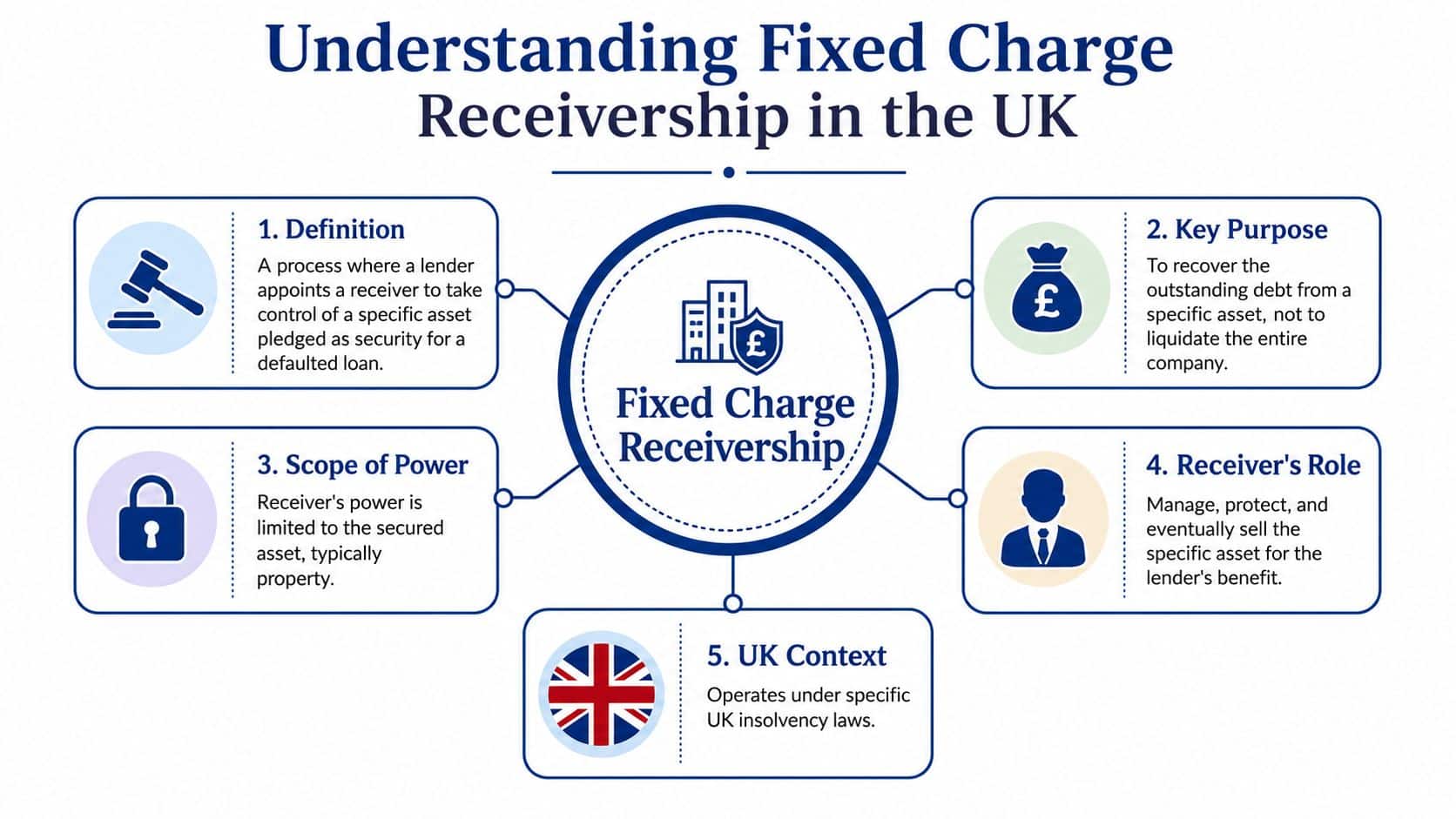
For directors, that distinction matters. For lenders, it is often the reason this route is chosen. The appointment is aimed at controlling, protecting, and realising the charged asset so the secured debt can be reduced.
The legal foundation
In England and Wales, the starting point is the Law of Property Act 1925. Section 101 gives a fixed-charge lender a statutory power to appoint a receiver in certain circumstances, and section 103 sets conditions for when that power becomes exercisable, as outlined in the RICS discussion of fixed charge receivership.
In practice, the statute is only part of the picture. The wording of the legal charge or debenture often determines how useful the appointment will be on the ground. A well-drafted security document may widen the receiver's powers beyond the basic statutory position. A narrow document can leave the lender with a formal remedy that is less effective than expected.
That is one reason I treat the security review as more than a legal box-ticking exercise. If rental streams are unclear, asset ownership is disputed, or money has moved in unusual ways, the value of the appointment depends on what can be controlled and evidenced.
A short visual summary helps before going further.
What the process is designed to do
The purpose is narrow and commercial. The lender seeks control of the charged asset, not a rescue of the company as a whole. In property cases, that usually means collecting rent, dealing with arrears or occupier issues, preserving the asset, and selling it if that is the best route to recovery.
That focus is also the process's main advantage. Where the secured asset is identifiable, income-producing, or at risk of deteriorating, fixed charge receivership can be faster and more economical than wider insolvency procedures.
Fixed charge receivership works best when the commercial target is clear, ring-fenced, and capable of being managed separately from the rest of the business.
What it does not do
It does not solve every problem sitting behind the default. If the borrower has falsified records, diverted income, granted side agreements to occupiers, or moved value away from the charged asset, the receiver still has to work from the facts available.
Forensic accounting changes the quality of decision-making. Before appointment, it can test whether the asset is really intact and income is what the borrower says it is. During the receivership, it can trace receipts, examine related-party dealings, and identify conduct that affects recoveries or creates claims. After the event, the same work often becomes central in disputes about asset value, transaction history, director conduct, or alleged shortfalls.
A fixed charge receivership is therefore best understood as an asset-enforcement tool with legal, evidential, and financial limits. If the problem is a wider insolvency, fraud issue, or multi-party dispute, the appointment may still be appropriate, but only as one part of the response.
The Appointment and Powers of a Fixed Charge Receiver
The appointment is usually faster and less theatrical than directors expect. In England and Wales, a fixed charge receiver is typically appointed by a secured lender under the Law of Property Act 1925 or the charge document itself, and the appointment is usually informal and outside court proceedings. The receiver acts as agent of the borrower, but their practical duty is to the appointor, as explained in Frettens' note on fixed charge receiverships.
How appointment usually happens
The lender first checks the security documents and default position. If the trigger conditions are satisfied, it serves the required documentation and appoints the receiver under the legal charge or related security instrument.
That speed is one of the route's attractions. There is usually no need to wait for a wider insolvency application to wind through court. If the property is deteriorating, vacant, poorly managed, or exposed to rent leakage, delay can destroy value.
Where the receiver's powers come from
The title "LPA receiver" sometimes creates a false impression that statute does all the work. It doesn't. The security document is often the more important practical document because it may expand powers beyond the minimum statutory position.
Sanderson Weatherall explains that fixed charge receivers are not licensed insolvency practitioners and, unlike formal insolvency processes such as administration or liquidation, the appointment can be made with very few restrictions on who can take it. The same guide also notes that the receiver's fees are paid in priority to the appointor's debt, which is an important commercial consideration for any recovery analysis, as discussed in the Sanderson Weatherall guide to fixed charge receivers.
What the receiver can actually do
In practical terms, powers often include:
- Collecting rent: This matters where tenanted property still generates income and the lender wants immediate control over cash.
- Managing the asset: Insurance, repairs, agent instructions, tenant communication, and security often need quick decisions.
- Preparing for sale: Title issues, tenancy summaries, arrears schedules, and marketing packs all affect outcome.
- Protecting value: A receiver can stabilise a distressed asset before disposal, which may be more sensible than an immediate sale into disorder.
The receiver may be the borrower's agent in law, but no director should misunderstand the commercial reality. The receiver is there to recover value for the appointing lender.
Limits that often surprise people
A receiver's world is narrow by design. If directors want the receiver to solve supplier claims, payroll issues, HMRC pressure, or shareholder disputes, they're likely to be disappointed. The mandate usually stops at the charged asset.
That narrowness can still be useful. But it only works well when the charged property can be isolated from the wider mess.
Why Forensic Accounting Is Crucial in Receivership
A loan default often looks like a property problem when it is really an information problem. If rent ledgers are inaccurate, tenant arrears are misstated, intercompany balances have been manipulated, or funds have moved off-book, both lender and borrower risk making the wrong call. That is where forensic accounting changes the quality of decision-making.
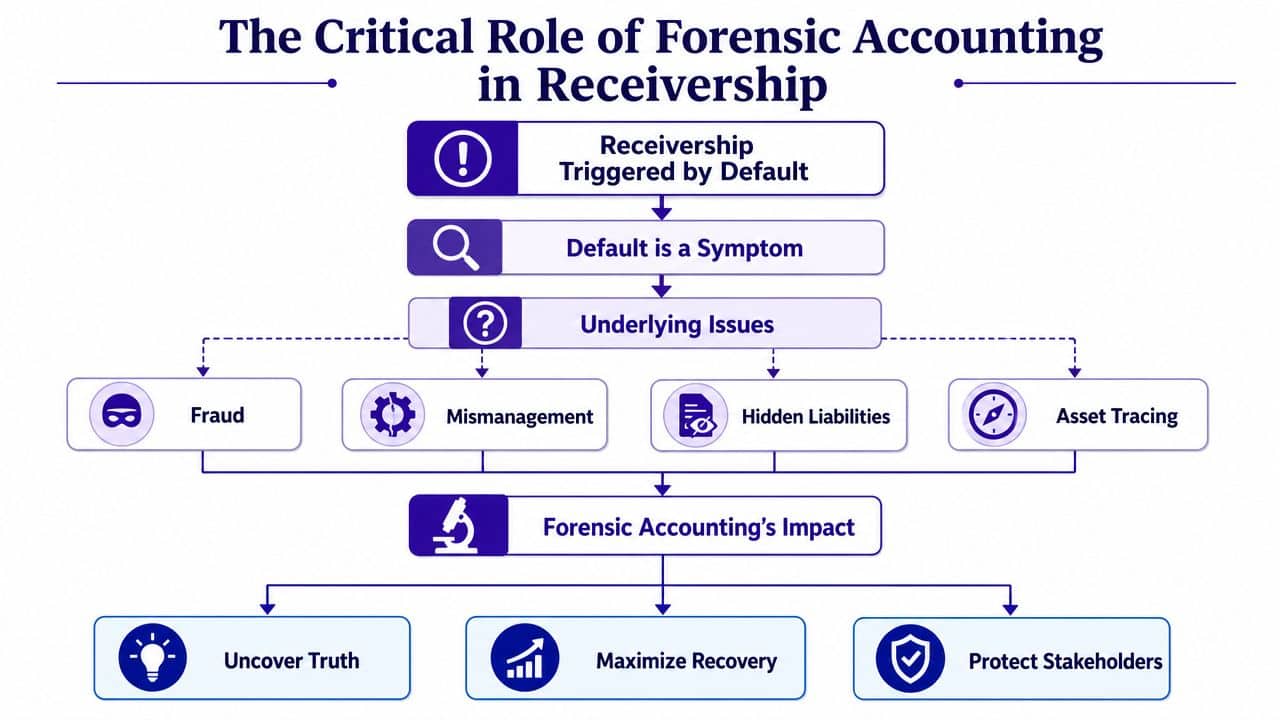
Default is often a symptom
A forensic accountant doesn't start by assuming the property tells the whole story. The first question is whether the reported position can be trusted. That means testing bank flows, lease data, management accounts, related-party transactions, and unusual adjustments made close to default.
When those records don't reconcile, the issue may no longer be simple distress. It may involve a fraud investigation, hidden liabilities, or a dispute over what the lender was told before enforcement began.
For readers wanting a practical overview of how these assignments are scoped and delivered, this guide to forensic accounting services and processes is useful background.
What a forensic accountant adds
The benefit isn't abstract. A forensic accountant helps turn suspicion into evidence and confusion into quantified analysis.
- Fraud investigation services: If money has been diverted, rents withheld, or records altered, forensic work helps identify the pattern and likely impact.
- Asset tracing: In distressed cases, value doesn't always disappear. Sometimes it moves. Tracing transactions can expose transfers that matter to recovery or litigation.
- Loss quantification: If enforcement timing, management failures, or misconduct caused extra loss, a forensic accounting report can quantify it in a defensible way.
- Expert witness accountant support: If the dispute reaches court, mediation, or a negotiated settlement, a clear expert-led schedule of financial loss can carry far more weight than internal complaint emails.
- Forensic audit thinking: A targeted forensic audit can test control weaknesses, journal anomalies, and unsupported balances without pretending the exercise is a routine statutory audit.
Why this matters to both sides
Lenders often focus on speed. Directors often focus on survival. Both can miss the same point. If the records are wrong, speed alone doesn't maximise recovery and resistance alone doesn't protect the company.
Commercial insight: Receivership decisions improve when someone independently tests where the money went, what the asset is really producing, and whether the reported liabilities are complete.
A good business dispute accountant can also help where the argument shifts from enforcement to responsibility. Was the value erosion caused by market conditions, mismanagement, an undisclosed side deal, or deliberate misconduct? That is a financial question before it becomes a legal one.
Receivership vs Administration and Liquidation
Most distressed businesses don't choose in a vacuum. They compare fixed charge receivership, administration, and liquidation because each leads to a different balance of speed, control, cost, and creditor outcome.
NARA's guidance describes fixed charge receivership as quicker and usually more cost-effective than administration, but also less powerful because it doesn't create the same debtor-wide moratorium or broad control over other assets and claims. In practice, that makes it best suited to single-asset collateral, as set out in NARA's explanation of fixed charge receivership.
The core commercial difference
Administration is broad. It can create breathing space and deal with the company more holistically. Liquidation is terminal. It is focused on winding up, realising assets, and distributing what remains.
Fixed charge receivership is narrower. It is often the cleaner tool where the lender's interest is concentrated in one asset and the rest of the company's affairs are either secondary or beyond rescue.
You can explore the wider procedural distinctions in this explanation of the difference between liquidation and administration.
Fixed Charge Receivership vs. Administration vs. Liquidation
| Feature | Fixed Charge Receivership | Administration | Liquidation |
|---|---|---|---|
| Primary focus | Specific charged asset | Company-wide rescue or better realisation | Winding up the company |
| Who it mainly serves | Secured lender with fixed charge | Wider creditor body, subject to statutory purpose | Creditors through terminal realisation |
| Speed in practice | Often quicker | Usually slower than receivership | Can vary, but not aimed at rapid asset-specific enforcement |
| Cost profile | Usually more cost-effective than administration in the right case | Broader process, so often heavier | Depends on estate and disputes |
| Control scope | Narrow, asset-led | Broad, company-wide | Broad enough to realise and close down affairs |
| Moratorium | No debtor-wide moratorium of the same kind | Yes, administration offers broader protection | No rescue moratorium in the same sense |
| Best fit | Single asset or ring-fenced collateral | Rescue, restructuring, or broader investigation | No viable rescue and end of trade |
What tends to work and what doesn't
Receivership tends to work when the property can be managed and sold without needing control over the entire debtor group. It works less well when value depends on keeping a wider trading business alive, investigating connected-party dealings across entities, or stopping pressure from multiple creditor directions at once.
Liquidation may be unavoidable where trade has ended and there is no credible route back. Administration may be better where the company still has a business worth preserving. The difficult cases sit in the middle, where one property matters a great deal, but the company around it is also unstable.
Practical Steps for Lenders and Company Directors
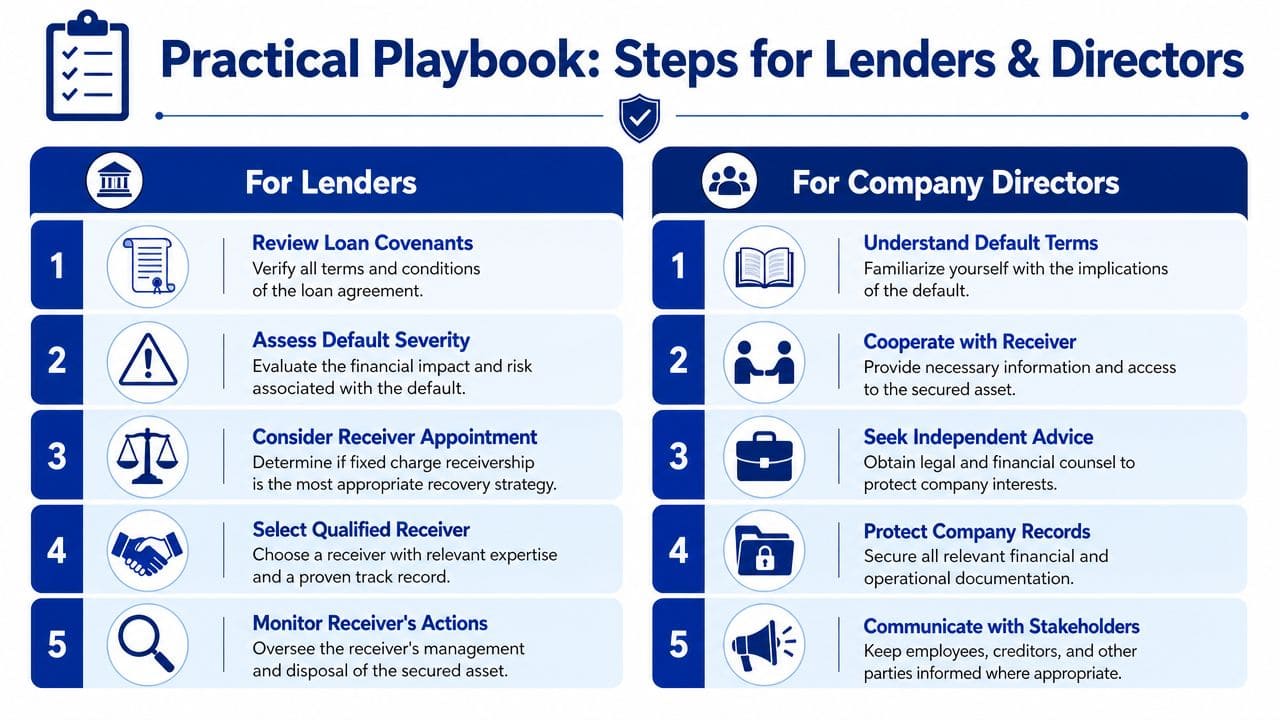
The biggest practical mistake in a looming fixed charge receivership is waiting for someone else to define the facts. Lenders need reliable recovery analysis before enforcing. Directors need a defensible understanding of the company's position before reacting.
DMH Stallard highlights a point that deserves more attention. The central issue is whether a receiver can preserve value fast enough to beat trading losses, dilapidations, or other enforcement costs. That often requires expert financial analysis, as discussed in DMH Stallard's review of fixed charge receiver or administrators.
For lenders
A lender should avoid treating appointment as a default button that always produces the best result.
- Review the charge documents carefully. The practical reach of the appointment may depend more on drafting than assumption.
- Test the current asset position. Confirm tenancy status, rent collection, arrears, insurance, title issues, and any signs of neglect or dissipation.
- Check whether the books can be trusted. If ledgers, bank activity, or occupancy data conflict, get independent financial analysis before moving.
- Compare enforcement routes. Fast action is attractive, but not if a wider process would protect more value.
- Prepare for challenge. Directors, junior creditors, or counterparties may dispute conduct, value, or communication if the process looks rushed.
For company directors
Directors don't lose their duties just because a lender is threatening enforcement. They need to act carefully and document decisions.
- Preserve records: Keep full accounting records, lease files, bank statements, and board papers intact.
- Stop informal transfers: Payments to connected parties, undocumented withdrawals, or selective creditor treatment can create serious problems.
- Get independent advice early: If solvency is doubtful, review the risks around trading whilst insolvent.
- Co-operate, but verify: A receiver may ask for information quickly. Provide it accurately, but keep your own audit trail.
- Assess the underlying cause of failure: If fraud, accounting manipulation, or a hidden liability caused the crisis, establish that before blame hardens into litigation.
A rushed enforcement can destroy value. A delayed response can do the same. The right move depends on evidence, not instinct.
The role of forensic accountant support in the checklist
This is the point where forensic accountant support, audit services, and business dispute support become practical rather than optional. A focused review can clarify whether the secured asset is still value-bearing, whether reported losses are genuine, and whether anyone has distorted the financial position before appointment.
Get Expert Clarity Your Next Steps with Lighthouse
The questions people ask at the end of a fixed charge receivership conversation are usually the same. How long will it take? Can a director challenge the appointment? Should the lender enforce now or wait? Has value already been lost through misconduct? The honest answer is that the legal framework gives structure, but the financial facts decide whether the process helps or harms recovery.
A receiver can be appointed quickly, but a quick appointment doesn't answer whether the records are reliable. A director can challenge aspects of the process, but challenge without evidence rarely gets far. A lender can enforce over property, but enforcement alone won't uncover hidden transfers, misstated rents, or manipulated accounts.
That is why independent forensic accounting services matter around fixed charge receivership. A skilled forensic accountant can investigate suspicious transactions, support a fraud investigation, perform targeted forensic audit work, quantify losses for insurance claims or litigation, and act as an expert witness accountant where disputes escalate. The same discipline also helps lenders and boards make calmer, better decisions before positions become entrenched.
If you're dealing with a distressed secured asset, don't rely on assumptions, partial records, or optimistic explanations. Get the numbers tested properly. Clear financial evidence often changes the legal and commercial strategy.
If you need a confidential view on fixed charge receivership, fraud, financial disputes, loss quantification, insurance claims, or litigation support, speak to Lighthouse Consultants. Their team provides forensic accounting services and wider forensic accountant support, audit services, fraud investigation services, and business dispute support for lenders, directors, law firms, and businesses facing difficult financial decisions.