One morning the bank asks a routine question about a payment. By lunchtime your finance team has found an invoice trail that doesn't make sense. By the afternoon someone is asking whether this is fraud, whether you need to freeze a transaction, and whether filing a report will make things worse.
That's the moment suspicious activity reporting stops being a compliance acronym and becomes a business crisis.
For owners, finance directors, trustees, and advisers, the immediate problem usually isn't legal theory. It's uncertainty. You don't yet know whether you're looking at sloppy bookkeeping, employee dishonesty, a customer issue, a wider money laundering concern, or the start of a painful business dispute. You do know that every hour of delay increases risk. Funds move. Records get altered. People start talking.
A good response is structured, fast, and calm. It starts with understanding when a concern has crossed the line from unusual to suspicious. It continues with a clear internal escalation, a well-written Suspicious Activity Report where required, and careful handling of evidence, communications, and operational decisions afterwards. In many cases, that same issue then turns into a fraud investigation, a loss quantification exercise, an insurance claim, or litigation that needs an expert witness accountant.
That's where sound forensic accounting matters. A forensic accountant helps turn fragmented concerns into a defensible chronology, an evidence-led narrative, and a practical action plan.
That Sinking Feeling Discovering a Financial Black Hole
It rarely starts with a dramatic confession. More often, a small inconsistency opens the door.
A supplier appears on the ledger that nobody in procurement recognises. A customer who has always paid from one account suddenly starts using a different route through an unfamiliar entity. An employee with long-standing authority pushes through an urgent payment with weak backup. Each detail, taken alone, looks explainable. Put together, they create that sinking feeling that something is badly wrong.
What that moment usually looks like
In practice, the first hours are messy. Senior people want answers before the facts are assembled. Staff speculate. Someone suggests “waiting until we know more”. Someone else wants to confront the individual immediately. Both reactions can damage the position.
The better approach is narrower and more disciplined:
- Secure the records: Preserve emails, invoices, payment instructions, bank material, approvals, and system logs.
- Limit discussion: Only those who need to know should know.
- Define the concern: Write down what was observed, when, by whom, and why it appears inconsistent.
- Pause unsafe action: If a transaction is still live, consider whether it can proceed safely.
Suspicion grows from observed facts. It doesn't require certainty, but it does require articulation.
Why businesses freeze at this point
Many firms hesitate because they fear getting it wrong. They worry about accusing a loyal employee, upsetting a valuable client, or creating disruption that later proves unnecessary. Those concerns are understandable. They're also why incidents often worsen before anyone takes formal action.
Suspicious activity reporting gives businesses a route out of that paralysis. It creates a formal mechanism for escalating concern when the facts justify suspicion. It also forces clearer thinking. What exactly happened? Who benefited? What funds moved? What doesn't fit the known commercial story?
This is also the stage where forensic accounting services can make a practical difference. A forensic accountant doesn't just look for bookkeeping errors. They test explanations, reconstruct transaction flows, identify missing evidence, and help management separate noise from genuine risk. That same work often supports a later forensic audit, insurance claim, disciplinary process, or court action if the matter develops into a wider financial dispute.
Your Legal Duty to Report Suspicion Not Proof
The most common hesitation is simple. “What if we're wrong?”
In the UK, that fear misunderstands the regime. The modern suspicious activity reporting framework is rooted in the Proceeds of Crime Act 2002, and it creates a route for escalating unusual activity where suspicion is based on observed facts rather than absolute proof, with the report explaining why the matter is suspicious, as the National Crime Agency guidance on Suspicious Activity Reports makes clear.

Suspicion is the trigger
That distinction matters. A SAR is not a verdict. It is not an accusation of guilt. It is an intelligence report and, in the UK framework, a control mechanism.
For regulated firms, the question isn't “can we prove criminality today?” The question is whether the known facts, looked at objectively and in context, create knowledge or suspicion that money laundering or terrorist financing may be involved. If they do, the issue belongs with the MLRO and may require reporting.
That's why internal escalation needs discipline. The MLRO has to review what is known, what remains uncertain, and whether the concern has crossed the reporting threshold. Firms dealing with repeated alerts, internal fraud concerns, or awkward client matters often need stronger procedures around this point. In practice, that's where specialist forensic accountant support for financial crime and compliance helps management document decisions properly.
Why delay creates risk
Inaction is rarely neutral. If a firm carries on with a suspect transaction, ignores a warning sign, or fails to preserve evidence, it can create legal and operational exposure that is far harder to unwind later.
A second practical point is volume. The NCA received 873,000 SARs in 2023/24, up from 872,000 in 2022/23, according to this discussion of SAR misconceptions and reporting pressure. That doesn't mean firms should file defensively. It does mean the process is normal, established, and part of routine risk management across the regulated sector.
Practical rule: Don't wait for certainty. Wait for facts strong enough to explain why you are suspicious.
Discipline lies in the explanation. If you can set out the subject, the activity, the dates, the transaction path, and the reasons the conduct does not make commercial sense, you are approaching the task correctly.
Recognising Red Flags for Fraud and Money Laundering
A lot of poor suspicious activity reporting starts with poor recognition. Teams know something feels wrong, but they can't define why. That leads either to over-reporting or to endless internal debate.
The better test is factual and commercial. What happened that doesn't fit the customer profile, the normal business pattern, or the documentary trail?
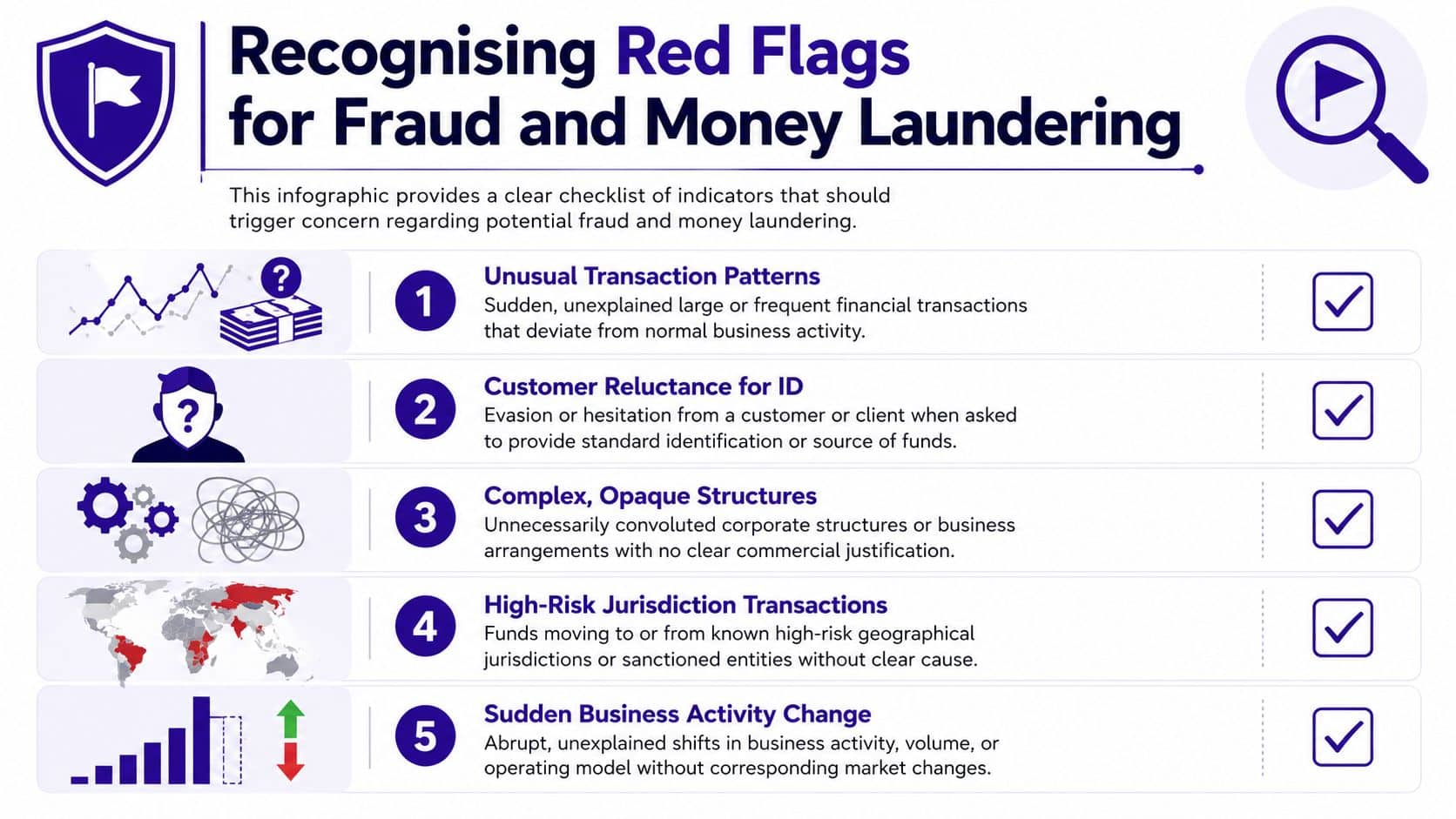
Red flags worth taking seriously
Some warning signs appear repeatedly in fraud investigations and AML reviews:
- Unexplained transaction shifts: Payments become larger, more frequent, more rushed, or routed differently without a clear commercial reason.
- Opaque counterparties: You struggle to identify the true customer, beneficial owner, introducer, or destination of funds.
- Documentation that almost works: Invoices, contracts, proof of delivery, or source-of-funds material exist, but key details don't align.
- Structures that create fog: Several entities, nominees, or offshore links appear without any obvious operational purpose.
- Behavioural pressure: Someone pushes for speed, secrecy, exception handling, or avoidance of standard checks.
A single red flag may not justify a report. Several together often do.
Unusual is not always suspicious
That distinction is where many firms struggle. A one-off large payment can be perfectly legitimate. A customer changing banks isn't automatically suspicious. A group restructure involving multiple entities may be ordinary.
What matters is whether the explanation stands up. Does the paperwork support the commercial story? Do the transaction dates, approvals, beneficiaries, and account details line up? Can the individual involved explain the activity consistently? If not, the concern moves beyond “odd” into something that may require a SAR and a fraud investigation.
A sensible way to reduce false positives is to document non-filing decisions as carefully as filing decisions. Teams that do this well usually have better thresholds and stronger audit trails. For firms reviewing their controls, a targeted checklist such as this guide to fraud risk assessment in the UK can help sharpen escalation criteria before the next incident lands on your desk.
Strong suspicious activity reporting begins before the form. It begins with a disciplined explanation of why the activity makes no commercial sense.
The UK SAR Process From Filing to NCA Response
Once suspicion is formed, the process needs to move in a controlled sequence. The UK system operates on an authorised disclosure basis. Regulated firms submit a report to the NCA when suspicion arises, and the framework treats that report as a control mechanism. The quality of the narrative and transaction chronology materially affects whether investigators can act efficiently, as set out by the FCA's overview of Suspicious Activity Reports.
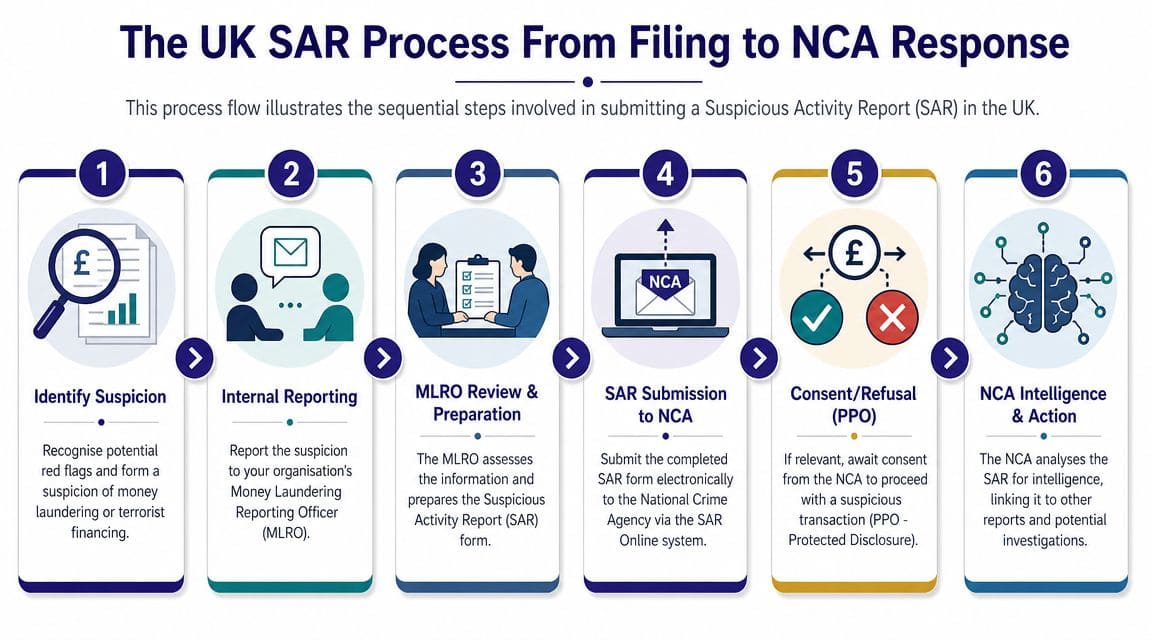
What a workable filing process looks like
For most firms, the sequence is straightforward even if the facts are not:
- Identify the concern internally and gather the immediate facts.
- Escalate to the MLRO or equivalent responsible person.
- Assess whether the suspicion threshold is met and whether a defence request is needed before dealing with property or a transaction.
- Prepare the narrative carefully. The report should identify who is involved, what happened, when it happened, how funds moved, and why the activity is suspicious.
- Submit electronically through the SAR Online system.
- Preserve records and manage the next operational step without improper disclosure.
The UK framework was operationalised through the SAR Online system, replacing older paper-based filing and enabling faster electronic reporting across the regulated sector. A key later milestone came in 2017, when the UK launched the Defence Against Money Laundering regime under POCA reforms, changing how firms handle transactions they suspect may involve criminal property, as summarised in this background note on SAR reporting systems and regime development.
For compliance professionals building a career in this area, it also helps to look at how firms define the MLRO role in practice. A current OpenFX compliance leadership role gives a useful snapshot of the blend of governance, escalation, and operational judgment employers expect.
A short explainer can help teams visualise the process in context.
What makes a SAR useful
The strongest reports are specific. They don't recite generic concerns or dump raw data into a text box. They tell a coherent story supported by chronology.
A weak narrative says the activity is “unusual”. A useful narrative explains that funds moved from A to B through C, on specific dates, in a pattern inconsistent with the customer profile, supported by contradictory documents and unexplained urgency. That gives the NCA something actionable.
After the SAR What to Do While Awaiting a Decision
Filing the SAR is not the finish line. It changes the legal and operational environment around the matter, and the period afterwards often causes the most internal mistakes.
The first issue is communication. Once a report has been made, people inside the business need to know only what is operationally necessary. Loose internal talk, a clumsy client query, or an ill-judged confrontation can create tipping-off concerns and damage any later investigation.
The immediate priorities
After submission, most businesses should focus on a short list of practical controls:
- Preserve evidence: Lock down accounting records, approvals, messages, onboarding files, contracts, and device data where relevant.
- Control internal knowledge: Limit awareness to those handling legal, compliance, finance, and operational decisions.
- Manage the transaction position: If the matter involves property or a transaction that may need a defence request, ensure nobody acts outside the agreed process.
- Document every step: Record what was known, what was done, who authorised it, and why.
That discipline matters because a SAR often marks the point where a compliance issue becomes a wider incident response problem.
The commercial reality after filing
Senior management usually wants to know three things quickly. How big is the exposure? Who was involved? Can we recover the loss or defend the business?
Those are forensic accounting questions as much as compliance questions. Once you move past the initial filing, the work often expands into tracing funds, reviewing counterparties, quantifying losses, and testing whether the business has suffered fraud, bribery, asset diversion, false invoicing, payroll manipulation, or collusion. If an insurer, regulator, lender, board, or claimant later asks for a clear financial analysis, you will need a proper evidential record rather than an improvised file of emails and screenshots.
Waiting for an external authority to “take over” is a common mistake. Businesses still have to manage the facts, preserve the evidence, and protect themselves.
It's also important to keep non-compliance risks in perspective. The UK framework treats the SAR as a control mechanism for intelligence generation and defence requests, not a finding of guilt. That means your internal process still needs independent judgment. Not every report leads to visible action, and not every suspicious fact pattern turns into a criminal case. Even so, the organisation must still decide whether to suspend staff, notify insurers, instruct solicitors, ring-fence funds, or start a formal internal investigation.
When the matter escalates
Some cases remain contained. Others trigger disciplinary action, litigation, insolvency issues, shareholder disputes, or a fight over loss and responsibility.
That's where early structure pays off. If your chronology is clean, your records are preserved, and your financial analysis is coherent, your options stay open. If not, every later step becomes slower, more expensive, and more vulnerable to challenge.
How Forensic Accountants Bolster Your SAR and Investigation
A SAR is only as good as the facts behind it and the narrative built from those facts. That's why forensic accounting is often the difference between a report that merely exists and one that effectively helps.
The NCA received over 901,000 Suspicious Activity Reports in the 2021-22 financial year, and with such volume the quality and clarity of the narrative are essential if law enforcement is to identify and act on the report, according to the NCA SARs Annual Report 2022.
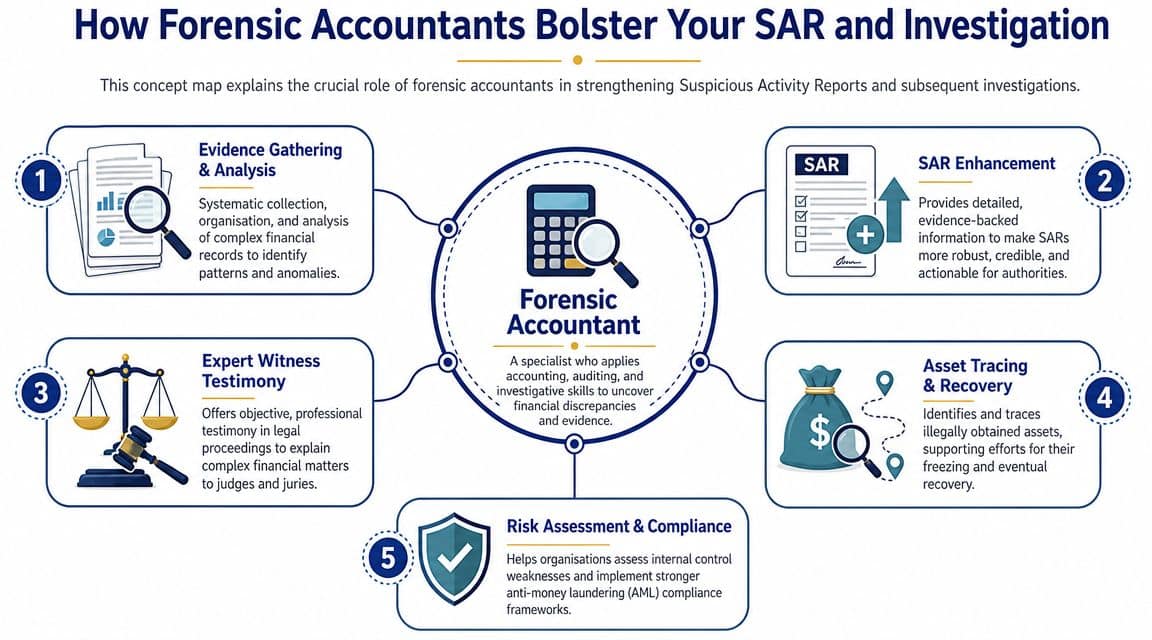
What a forensic accountant actually does
A forensic accountant brings structure to messy financial events. In suspicious activity reporting, that usually means:
| Task | Practical value |
|---|---|
| Transaction reconstruction | Shows how funds moved, in what order, and who benefited |
| Document testing | Compares invoices, contracts, bank entries, approvals, and source material for inconsistencies |
| Loss quantification | Measures exposure for claims, board reporting, settlement, or litigation |
| Asset tracing | Helps identify where money or value may have gone |
| Expert reporting | Produces analysis that can withstand challenge from solicitors, insurers, counterparties, and courts |
That work supports far more than the initial SAR. It also underpins forensic audit work, insurance submissions, shareholder and contract disputes, warranty claims, insolvency matters, and litigation support.
The value in difficult cases
In straightforward cases, an internal team may be able to assemble the facts and file well. In more complex matters, businesses usually struggle with chronology, data quality, and independence. They know something went wrong, but they can't show it clearly enough.
A forensic accountant closes that gap. They can examine ledgers, bank records, journal entries, supplier histories, payroll data, email trails, and management accounts in one joined-up review. If the issue later proceeds to court, an expert witness accountant can explain the financial evidence in a way judges and lawyers can use.
AI tools may help investigators draft faster, but governance still matters. Research on SAR generation found an agentic AI workflow could produce narratives that were about 70% complete on average and save investigators around 61% of the time in testing with a global fintech institution, according to this research on AI-assisted SAR generation. That's useful, but it still leaves a substantial human review burden. For teams reviewing technology options, it's worth also looking at broader discussions that discover AI tools for UK accounting firms, especially where privacy, auditability, and narrative quality are concerns.
For organisations that need hands-on help, forensic accounting services and this practical guide on forensic accounting for detecting fraud show how specialist support can assist with fraud investigation, evidence review, loss analysis, and dispute preparation. That sort of support becomes particularly valuable when the issue spans AML concerns, employee misconduct, insurance recovery, and litigation risk at the same time.
Good forensic accounting doesn't just find irregularities. It builds a financial story that others can test and rely on.
Building Your Defences with Expert Support
The best suspicious activity reporting process is the one you don't have to use often because the business identifies risk early, challenges weak explanations, and maintains proper controls.
That starts with basics done properly. Segregation of duties. Clear approval limits. Supplier and customer checks that aren't bypassed when someone shouts “urgent”. Regular review of journals, master file changes, and unusual payment patterns. A documented escalation route to the MLRO. Staff who know the difference between a routine anomaly and a concern that needs formal review.
Prevention is commercial, not just regulatory
Businesses sometimes treat AML, fraud risk, and dispute support as separate topics. In practice, they overlap. The same weak control that permits false invoicing can also obscure suspicious funds flows. The same missing records that frustrate a SAR can undermine an insurance claim. The same unclear chronology that weakens an internal investigation can damage a court case.
That's why businesses benefit from joining up forensic accounting, audit, fraud response, and dispute support rather than treating each issue in isolation. A forensic accountant can help strengthen controls before a problem surfaces and also respond once a loss, audit issue, or litigation threat appears.
When to bring in outside help
Bring in specialist support when the facts are unclear, the sums are material, senior staff may be involved, multiple jurisdictions or entities are in play, or the matter is likely to reach insurers, regulators, solicitors, or court.
At that point you need more than a compliance checklist. You need a reliable financial investigation, a defensible loss analysis, and reporting that stands up under scrutiny. That may include a forensic audit, a focused fraud investigation, business interruption or loss quantification work, or an expert witness accountant for contested proceedings.
If you need confidential help with suspicious activity reporting, forensic accounting, audit issues, financial disputes, or litigation support, review Lighthouse Consultants' forensic accounting, audit, and dispute support services and take advice before a difficult situation gets harder.
If you're facing suspected fraud, unexplained losses, a reporting decision, or the fallout from a SAR, contact Lighthouse Consultants for confidential support with forensic accounting, fraud investigation services, audit services, expert financial analysis, and business dispute support. A clear early review can help you preserve evidence, assess risk, quantify loss, and decide the right next step.