A dispute over value often starts with one innocent-looking line in the accounts.
A shareholder is exiting. A lender is testing covenants. An insurer is challenging a loss calculation. Two sets of advisers review the same business and produce very different answers because they start from different accounting treatments. At that point, the debate stops being technical. It becomes commercial, legal, and expensive.
That's where IFRS vs UK GAAP matters far more than many directors expect. The framework you use affects profit timing, asset values, disclosures, audit pressure, and how easily another party can challenge your numbers. For a forensic accountant, those aren't abstract accounting choices. They are the pressure points in a valuation dispute, a fraud investigation, a forensic audit, or expert witness work.
When Accounting Rules Fuel Financial Disputes
A business dispute accountant usually sees the problem after positions have hardened. The draft valuation is out. The claim schedule has been served. The board has split. Then someone notices that the earnings figure relies on an accounting treatment the other side rejects.
That happens often in shareholder exits and post-transaction disputes. One side may treat reported profit as a stable foundation for value. The other may argue that profit was flattered by policy choices, estimates, or a framework that gives management more room in key areas. Once that argument starts, the dispute widens beyond arithmetic. It pulls in directors' duties, covenant compliance, deal wording, and credibility.
Why the framework becomes evidence
Accounting standards shape the evidence base. They affect what sits in revenue, what remains in work in progress, whether costs hit the profit and loss account now or later, and how much disclosure a reader gets about judgement and uncertainty.
In practice, that means three things.
- Valuations move: A maintainable earnings calculation can change if reported profit timing changes.
- Claims move: Loss quantification in insurance or litigation can shift if revenue and cost recognition shift.
- Allegations gain traction: If a party can show aggressive policy selection, it may argue misstatement, unfair prejudice, or even dishonesty.
Practical rule: If a dispute turns on profit, cash generation, net assets, or covenant headroom, test the accounting framework before you debate value.
Many owners resist bringing in specialist support at this stage. They worry about cost, disruption, or advisers making a manageable disagreement more formal. That objection is understandable. It's also risky. A weak accounting analysis can leave management defending numbers it can't properly support.
A skilled forensic accountant support for disputes team doesn't just recalculate figures. It isolates which accounting choices drive the gap between parties. That narrows the argument. It also helps solicitors, boards, and valuers focus on the issues that matter in negotiation or court.
What doesn't work
Two mistakes appear repeatedly.
First, directors assume audited accounts end the argument. They don't. Audit doesn't eliminate disputes over judgement, policy selection, or whether accounts are the right basis for a specific legal or valuation question.
Second, parties argue from labels. They say “IFRS is stronger” or “UK GAAP is simpler” as if that settles anything. It doesn't. The core issue is how the chosen framework affects the specific transaction, period, and dispute wording in front of you.
IFRS vs UK GAAP Who Must Use Which Standard
Before debating which framework is better, you need to know which framework is available to your business under UK rules.
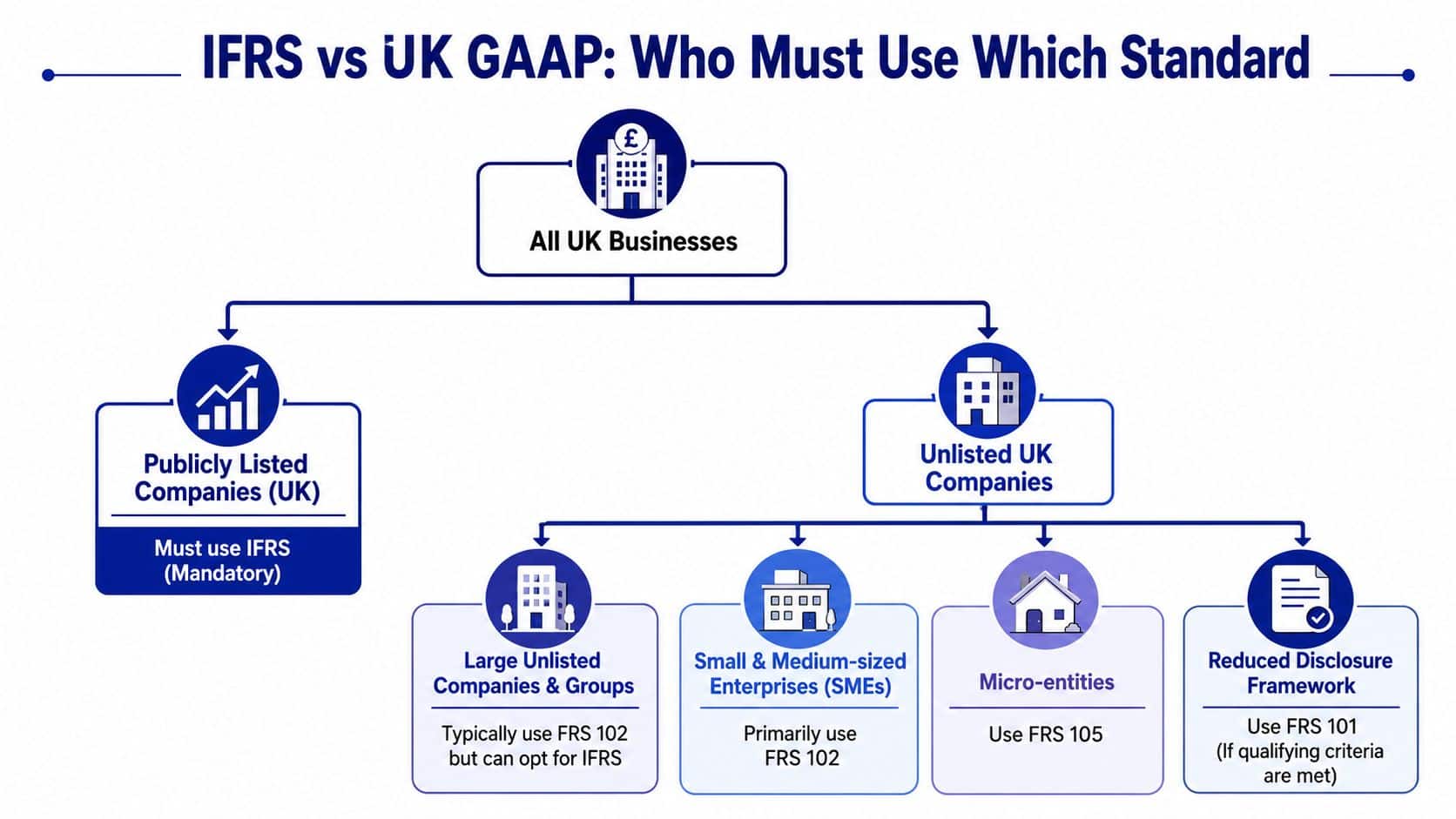
For UK companies, the key dividing line is regulatory status. Only groups with securities admitted to trading on a regulated market must prepare consolidated financial statements under full IFRS. Other UK groups and companies may choose either full IFRS or UK GAAP. In practice, UK GAAP is a set of six standards, with FRS 102 acting as the core standard for most entities, and the Financial Reporting Council built FRS 102 from IFRS for SMEs concepts, as outlined in this UK GAAP and IFRS regulatory overview.
The practical UK split
The result is a familiar split in the market.
Listed groups usually sit within full IFRS for consolidated reporting. Privately owned businesses and many SMEs more commonly operate within UK GAAP frameworks, often centred on FRS 102, with reduced-disclosure options available in some cases.
That split matters because it changes the reporting culture around the finance function. IFRS environments usually demand more systematised policy governance, tighter documentation of judgement, and greater readiness for scrutiny from investors, regulators, and transaction counterparties. UK GAAP environments can still be rigorous, but they often operate with more focus on statutory efficiency and owner-managed practicalities.
Why this matters beyond compliance
The choice is not merely administrative. It can affect how easy it is to explain the accounts to lenders, buyers, minority shareholders, and legal advisers.
A company considering acquisition, refinancing, or external investment should test whether its existing framework still fits the audience for its accounts. A framework that works perfectly well for statutory filing may create friction during due diligence or a dispute if readers expect different recognition logic or disclosure depth.
For firms that handle fee income, accruals, or complex work in progress, the accounting framework can also shape how revenue narratives land with counterparties. That issue is closely tied to revenue and income reporting standards in the UK, especially where legal, professional, and advisory businesses need defensible cut-off positions.
A good rule for directors is simple. If the accounts may be read by a hostile party, choose policies and evidence files as though they will be challenged.
Key Differences and Their Impact on Your Bottom Line
The technical debate around IFRS vs UK GAAP becomes commercially important when it changes earnings quality, covenant calculations, or deal metrics.
Early in any forensic accounting review, I want a short side-by-side map of the areas most likely to move reported performance. That prevents teams from getting lost in low-value technical points while key drivers sit in revenue, financing costs, leases, or acquisition accounting.
| Area | IFRS Treatment | UK GAAP (FRS 102) Treatment | Forensic Implication |
|---|---|---|---|
| Borrowing costs | Directly attributable borrowing costs for a qualifying asset must be capitalised | Borrowing costs may be capitalised or expensed | Profit, EBITDA presentation, and interest cover may differ materially |
| Revenue recognition | Control-based model under IFRS 15 | Risks-and-rewards approach | Profit timing and work-in-progress debates can intensify in long-cycle contracts |
| Policy flexibility | Often more prescriptive in high-risk areas | Can allow more policy choice in certain areas | Analysts must test consistency and motive behind policy selection |
| Disclosure profile | Often broader and more granular | Often more concise in practice | Opponents may have less disclosure to work from, but more room to question judgement |
Under full IFRS, directly attributable borrowing costs for a qualifying asset must be capitalised, and revenue recognition follows a control-based model under IFRS 15. Under FRS 102, borrowing costs may be either capitalised or expensed, and revenue follows a risks-and-rewards approach. That difference can materially change EBITDA, interest cover, and the timing of reported profit for UK entities on long-cycle projects, as described in this analysis of key IFRS and UK GAAP differences.
Revenue is often the first battleground
In disputes, revenue recognition usually attracts the earliest challenge because it drives headline performance.
Under a control-based model, the question is whether control of goods or services has transferred. Under a risks-and-rewards model, attention turns to a different threshold. In a clean, short trading cycle, the practical outcome may be similar. In staged projects, milestone billing, partial performance, or disputed delivery, the outcome may not be similar at all.
That matters in:
- Earn-out disputes, where one side says targets were missed and the other says revenue was deferred or accelerated wrongly.
- Business interruption claims, where turnover trends need reconstruction on a defensible basis.
- Fraud investigations, where premature revenue can mask trading weakness.
Borrowing costs can distort performance narratives
Borrowing cost treatment sounds niche until a lender, investor, or buyer relies on earnings metrics.
If one framework requires capitalisation and another permits expensing, the same underlying financing activity can produce different reported outcomes. That can alter apparent covenant headroom, project profitability, and trend analysis.
A business that looks comfortably profitable on one presentation may look more fragile once a forensic audit strips out the accounting effect and rebuilds underlying performance.
Other areas need judgement, not slogans
Leases, impairment, financial instruments, and business combinations also demand careful review. The exact issue in practice is rarely “which standard is better”. It is usually one of these:
- Was the chosen policy available under the framework used?
- Was it applied consistently?
- Was the judgement documented at the time?
- Did management benefit from the outcome?
That is why thorough financial analysis for UK entrepreneurs and directors matters before a transaction or dispute starts. Once the other side alleges selective accounting, the burden of explanation rises sharply.
Disclosure Audit and Tax Implications
The difference between IFRS and UK GAAP doesn't stop at recognition and measurement. It also changes what the business tells the market, how auditors challenge management, and where tax computations become awkward.
Disclosure can help you and hurt you
Broader disclosure can strengthen credibility. It can also hand an opponent a better roadmap.
Where disclosures around judgement, estimates, fair values, or financial instruments are fuller, readers can understand the accounting logic more easily. That's useful in financing rounds and transactions. Yet in litigation or a hostile shareholder setting, the same detail may expose assumptions, sensitivities, and internal inconsistencies.
A shorter disclosure set is not automatically safer. It may create room for a challenger to say management has not explained enough. The issue is whether the file behind the accounts supports the story the accounts tell.
Auditors don't just test numbers. They test whether management can evidence the judgements behind those numbers.
Audit pressure rises where judgement rises
Complex accounting usually increases audit focus. That doesn't mean the accounts are wrong. It means management must show its workings.
From a forensic accounting perspective, the highest-risk files often contain one of the following problems:
- Thin contemporaneous support: The board approved a position, but the technical memo is weak.
- Policy drift: The company changed practice over time without clear rationale.
- Optimistic estimates: Forecasts, recoverability assumptions, or stage-of-completion evidence were not refreshed properly.
- Weak handover: Finance staff changed, and no one preserved the reasoning behind earlier judgements.
That's why a strong audit trail matters whether you're preparing for statutory audit, a fraud investigation, or expert witness scrutiny.
Tax rarely follows accounting neatly
Directors often expect a clean bridge from accounting treatment to tax effect. In practice, that bridge can be messy.
A difference in recognition timing, capitalisation policy, or impairment treatment may create additional adjustments, deferred tax questions, or disputes about the correct period for relief. The technical answer depends on the item in question and the tax rules applied to it. The practical answer is simpler. If accounting policy choices affect reported profit materially, the tax consequences also need active review.
For owner-managed groups, problems often multiply. The finance team may focus on statutory compliance, while lenders, HMRC, buyers, or minority shareholders focus on the economic substance. A forensic accountant, forensic audit team, or business dispute accountant can help reconcile those perspectives before they become allegations.
A Forensic Accountant's View on Financial Disputes
A deal is agreed on headline earnings. Six months later, the buyer alleges those earnings were overstated because revenue was recognised too early under one framework, while the seller says the accounts were fully compliant. At that point, the argument is no longer about drafting the financial statements. It is about causation, evidence, and value.
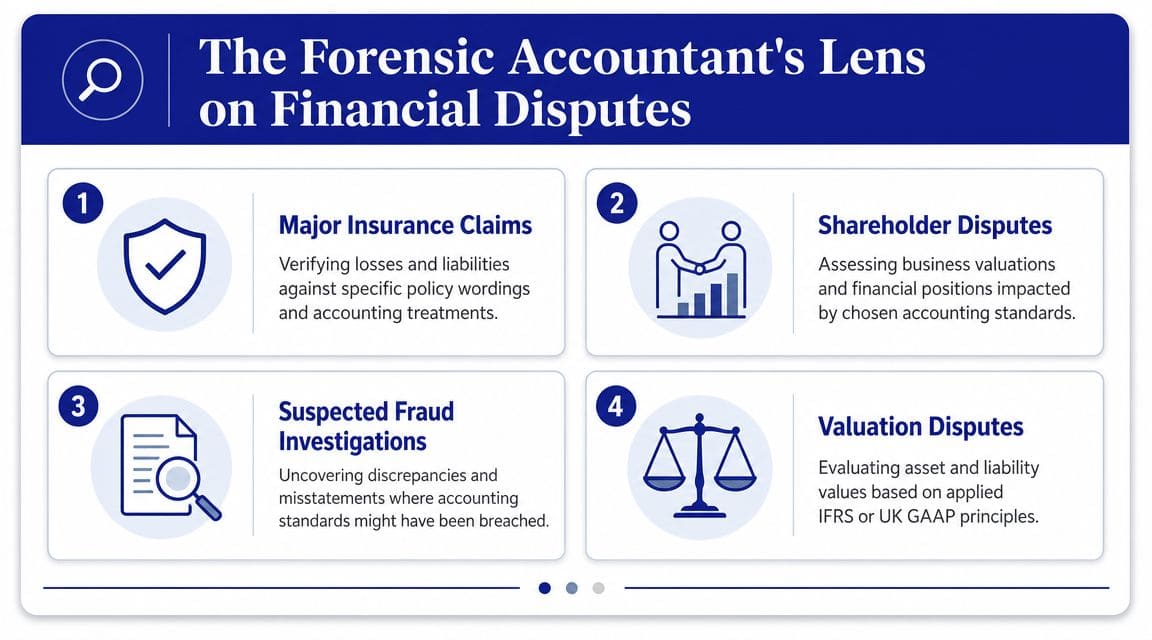
That is why IFRS versus UK GAAP matters in disputes. The accounting framework sets the ground rules for recognition, measurement, and disclosure, but in contentious matters I focus on a different question. Did the chosen treatment change the amount being claimed, defended, or negotiated, and can management prove why that treatment was used at the time?
For UK statutory reporting, the reporting split is well established. Listed groups preparing consolidated accounts use IFRS, while many private companies report under UK GAAP frameworks such as FRS 102 or FRS 101, as outlined in this explanation of the UK reporting split. In practice, that split often feeds straight into disputes because parties assume the numbers are comparable when the underlying rules, estimates, and disclosures are not.
Insurance claims and loss quantification
Business interruption work often turns on the baseline used to measure loss. If historic results were prepared under one recognition model and the claim is built on another, the analysis can drift quickly. Revenue may be pulled into the wrong period, margins may be distorted, and trend assumptions may stop reflecting how the business earned money before the event.
I see this regularly in delayed start-up, supplier failure, and contingent loss cases.
The accounting framework does not determine coverage. It does affect the reliability of the quantum. A weak link between the accounting records, operational data, and policy wording gives insurers room to challenge the claim, and sometimes rightly so.
Fraud investigations and manipulation risk
Fraud usually appears first as a pattern of judgement, not a confession. Early revenue recognition, selective capitalisation, deferred impairments, and optimistic fair value assumptions can all improve reported results without any obvious false document at the outset.
The forensic task is to separate a hard but supportable judgement from a careless error or a deliberate misstatement. That means tracing who made the call, what information they had, what pressure they were under, and whether the explanation changed after challenge. In court, in disciplinary proceedings, and in settlement discussions, that sequence often matters as much as the accounting entry itself.
The strongest forensic findings link accounting judgement to incentives, timing, and document history.
Valuation and shareholder conflict
Valuation disputes often start with a simple argument over maintainable earnings or net assets. They rarely stay simple. If IFRS or UK GAAP choices accelerated profit, delayed losses, or kept liabilities off the balance sheet for longer than the opposing party considers fair, the accounting treatment becomes part of the valuation evidence.
That has direct consequences in shareholder exits, post-acquisition disputes, divorce matters involving business interests, and earn-out claims. A small policy choice made years earlier can change EBITDA, distributable reserves, covenant compliance, or asset backing in ways that materially shift negotiating power.
In those cases, I do not stop at the final accounts. I examine board papers, audit files, management reporting, forecasts, post year-end evidence, and communications around the judgement. The central issue is often whether management applied the framework consistently and faithfully, not whether a standard gave them room to argue.
Managing a Transition Between Accounting Standards
Changing framework is a business project, not just an accounting memo. Teams that treat it as a narrow finance exercise usually discover late that systems, contracts, staff knowledge, and audit timing all need attention.
Start with impact, not mechanics
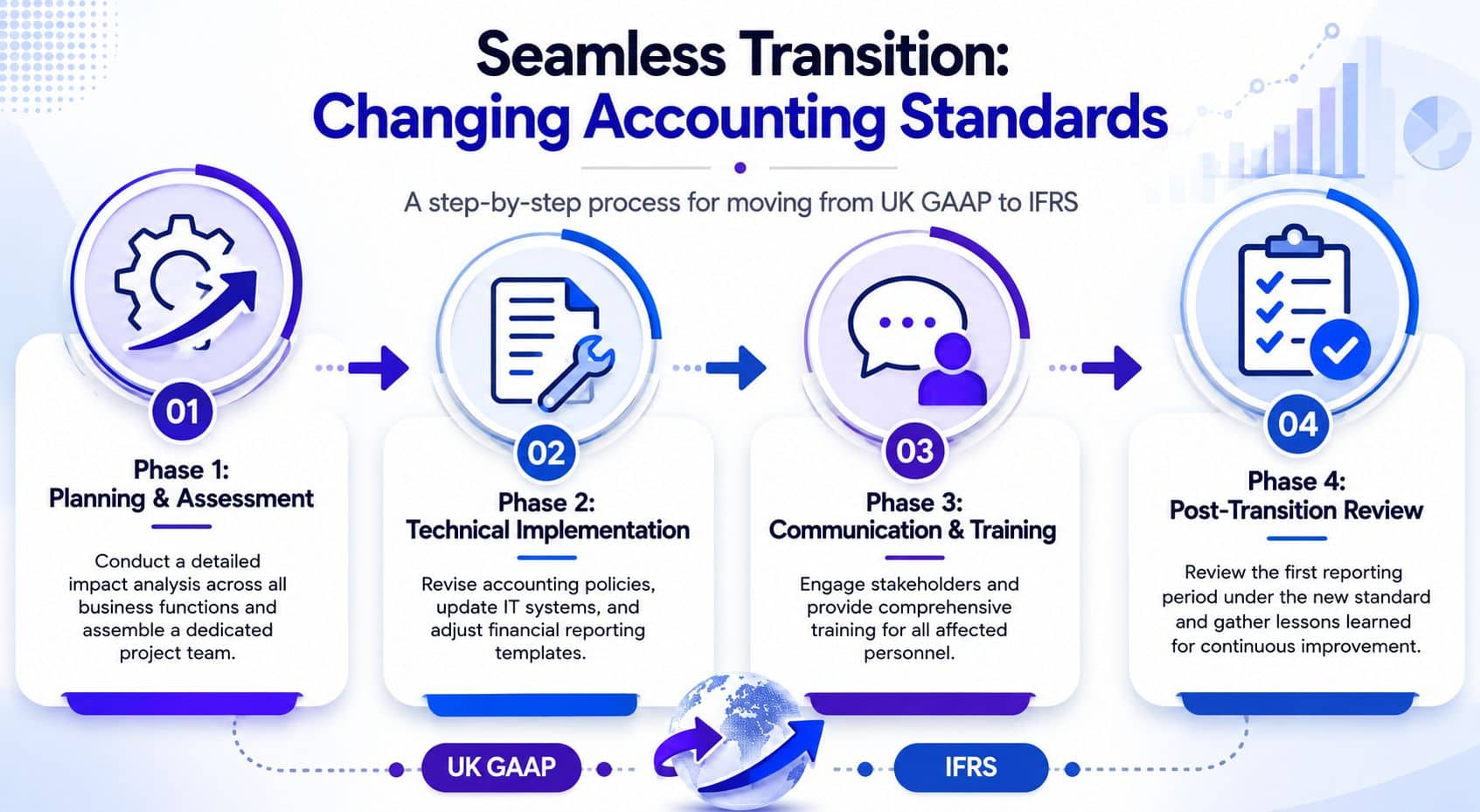
The first sensible step is a diagnostic review. Identify where the current framework and the target framework diverge for your business model. Not every difference matters. Focus on the lines that affect profit timing, asset values, covenants, tax, disclosures, and management incentives.
That review should cover more than the year-end accounts. It should also look at management reporting, budgeting, bonus arrangements, banking documents, earn-out terms, and any shareholder agreements that reference accounting numbers.
Build the transition like a controlled project
The strongest transitions usually include:
- A clear decision paper: Why is the change happening, and what business objective does it serve?
- A policy map: Which accounting areas need new policies, elections, or judgements?
- System readiness: Can your ledgers, reporting packs, and data capture support the new treatment?
- Audit engagement: Have you discussed the key judgement areas with auditors early enough?
- Training: Do finance staff, operational managers, and directors understand what will change?
Midway through the project, it helps to pressure-test the first draft outputs.
A dry run often exposes weak source data, inconsistent contract records, and reporting templates that no longer fit the accounting logic. That is much easier to fix before the first live reporting period than after the audit team has started challenging balances.
Common failure points
Most transition problems come from underestimating effort rather than misunderstanding the standards.
One business may fail to gather the right lease or contract data. Another may update statutory policies but leave management reporting on the old basis, which confuses directors and lenders. A third may brief the finance team but not the board, so key decisions are made using misunderstood metrics.
A forensic accountant can add value here by identifying where the transition could later become contentious. If the business expects a sale, claim, refinancing, or dispute, document the rationale for every material judgement during transition. That file may become important evidence later.
Protect Your Business with Expert Financial Analysis
A dispute rarely starts with a standard. It starts when a lender, buyer, insurer, minority shareholder, or regulator asks why the numbers moved and whether management chose the accounting that suited its position.
That is why IFRS versus UK GAAP needs board-level attention. The choice affects reported profit, net assets, distributable reserves, covenant headroom, deal pricing, and how easy it is to defend the accounts under pressure. In forensic work, I often find that the underlying weakness is not the policy itself. It is the lack of a clear, contemporaneous record showing why the policy was selected, what alternatives were considered, and who approved the judgement.
A disciplined review should answer a commercial question first. What could this accounting decision cost if it is challenged?
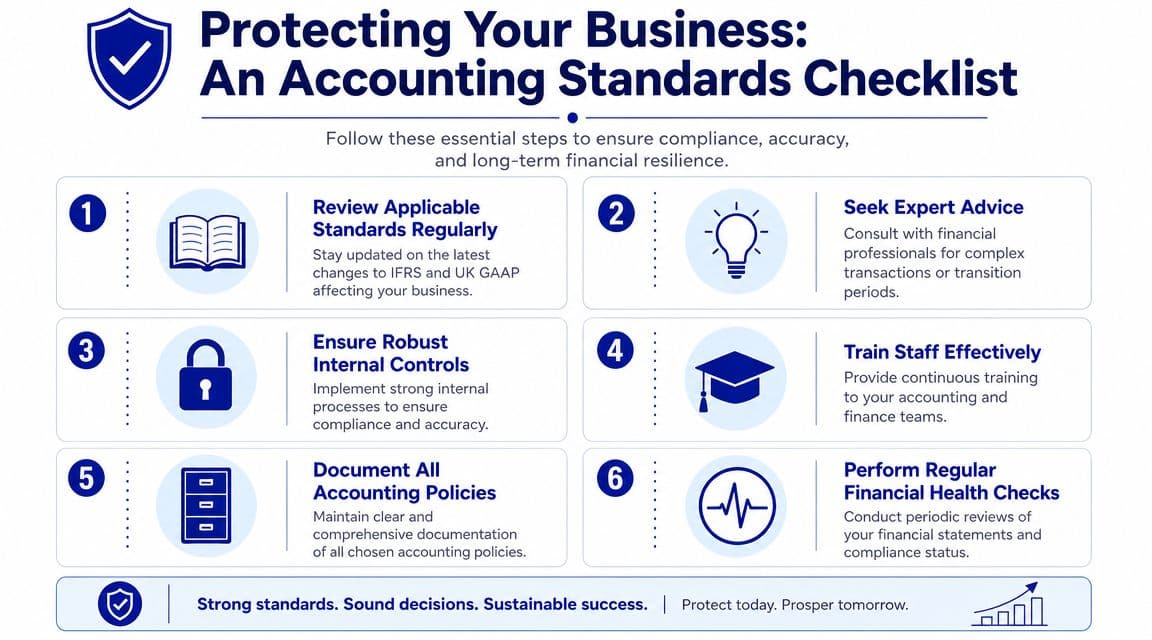
A practical checklist
- Confirm your framework: Identify which standard applies now, whether an election is available, and whether group reporting creates constraints.
- Pinpoint high-risk judgements: Revenue recognition, leases, impairment, deferred tax, business combinations, and financial instruments often drive the largest disagreements.
- Read the legal documents: Loan covenants, earn-outs, SPA completion accounts, shareholder agreements, insurance policies, and bonus schemes may use accounting terms that shift meaning under a different framework.
- Test the audit trail: Another party should be able to follow the judgement from source records to board approval without relying on verbal explanations.
- Separate reported earnings from maintainable earnings: A valuation dispute usually turns on sustainability, adjustments, and accounting distortions, not the headline profit figure.
- Assess internal capability: Decide early whether the finance team can support the judgement, document it properly, and defend it under audit or cross-examination.
When outside help changes the outcome
External support matters most where accounting treatment sits close to a live point of conflict. That includes a transaction, suspected manipulation, a post-acquisition argument, an unexplained fall in margin, an insurance claim, or a hardening disagreement with auditors.
The right specialist can test whether the numbers are merely technical or whether they create legal exposure.
- Fraud investigation: examining whether revenue, costs, stock, cash, or asset values have been misstated deliberately
- Independent forensic review: assessing contentious balances where stakeholders need more than the statutory audit process
- Loss quantification: calculating financial impact for litigation, insurance, contractual claims, or warranty disputes
- Expert support: preparing analysis that solicitors, funders, insurers, and the court can follow
- Shareholder and business disputes: analysing accounting records where value, profit allocation, or conduct is contested
Timing matters. Once draft accounts are circulated, tax returns filed, or a dispute letter sent, parties become invested in a position and the cost of changing course rises quickly.
If your business is facing a reporting dispute, suspected fraud, an insurance claim, a valuation disagreement, or pressure from auditors, speak to Lighthouse Consultants. They advise UK companies, law firms, insurers, and private clients on forensic accounting, fraud investigation, expert financial analysis, and wider business dispute support. If the figures may later be tested in negotiations, litigation, or valuation evidence, get the analysis reviewed before the position hardens.