A board pack lands on your desk and the numbers don't tie. Revenue looks clean on the face of it, but cash keeps lagging, the supplier dispute has turned legal, and the buyer wants to sign before the weekend. At that point, people usually realise they do not need another spreadsheet. They need corporate due diligence services that can separate a genuine commercial problem from a valuation trap, a disclosure issue, or a fraud pattern hiding inside tidy-looking accounts.
That same pressure shows up in claims, shareholder disputes, insolvency, bribery allegations, and acquisition work. The common thread is simple, the story on paper no longer matches the story in the bank account, the contracts, or the behaviour of the people running the business. Good diligence work does not just confirm what a seller, claimant, or management team says. It tests whether the evidence can survive scrutiny from a buyer, lender, insurer, regulator, or judge.
In the UK, that matters more than ever. London remains a busy deal centre, and due diligence now functions as a risk-control discipline, not a box-ticking exercise. Financial diligence still takes the largest share of work globally, at about 30 to 40% of due diligence engagements, with legal diligence at roughly 25 to 35% and operational diligence at 15 to 25% market research on due diligence workstreams. That mix reflects what directors worry about, quality of earnings, contingent liabilities, working capital, legal exposure, technology risk, and the people who have to deliver the plan after completion.
When the Numbers Stop Adding Up
The first warning sign is usually not a dramatic confession. It is a board meeting where the forecast stops matching trading reality, a customer dispute that starts to look like a contract claim, or an insurer who keeps asking for more support because the loss adjustment file feels thin. In acquisitions, it can be the moment the target's ledger looks polished but the cash trail tells a different story. By then, the issue is rarely just accounting. It has become a matter of evidence, timing, and credibility.
That is why corporate due diligence services sit so naturally beside forensic accounting. The same toolkit checks whether earnings are sustainable, whether liabilities are hidden, whether contracts support the stated revenue, and whether someone has massaged the numbers to get a deal across the line. In a dispute, that toolkit also quantifies the loss and traces where it went. In an acquisition, it shows what the buyer is really buying before the documents are signed.
Practical rule: when the explanation depends on trust alone, the file is not ready.
UK directors often ask whether they should wait for the full audit or ask internal finance to sort it out. That usually misses the point. A statutory audit looks back at historical statements. Internal audit tests controls. A forensic-style diligence review is different, it asks what the evidence says about the risk you face now, before completion, before settlement, or before a complaint turns into litigation.
The pressure points are familiar across sectors. Retail buyers worry about working capital and supplier concentration. Logistics groups worry about insurance claims and operational continuity. Mid-market firms worry about related-party transactions, cyber weaknesses, or people risk that never appears in the headline valuation. A good review catches those issues early enough to change price, change terms, or walk away.
This guide is UK-specific, practitioner-led, and written for the moment when the paper trail has started to wobble.
What Corporate Due Diligence Services Actually Are
Corporate due diligence services are independent, evidence-based reviews of a company's financial, commercial, operational, legal, technology, and human position. They are commissioned before a transaction, during a dispute, or after an unexplained loss. The point is not to admire the paperwork. It is to test whether the business behaves the way the documents claim it does.
In UK dealmaking, the process often begins with a buyer-to-seller request list, after which the seller or its counsel gathers the files and the buyer's counsel prepares a red-flag issues report that summarises legal issues, next steps, and follow-up requests Bloomberg Law on due diligence mechanics. That sequence matters because it shows diligence is not abstract. It is an ordered exchange of evidence, challenge, and response.
A practical UK lens also means using open-company records properly. Analyses of corporate due diligence work often combine open company data with other sources, then assess opportunities or risks linked to a particular company, including company register material and beneficial ownership data Global Data Barometer guidance on company due diligence. In plain terms, you are not relying on the target's preferred narrative. You are checking it against registries, filings, ownership evidence, and third-party data.
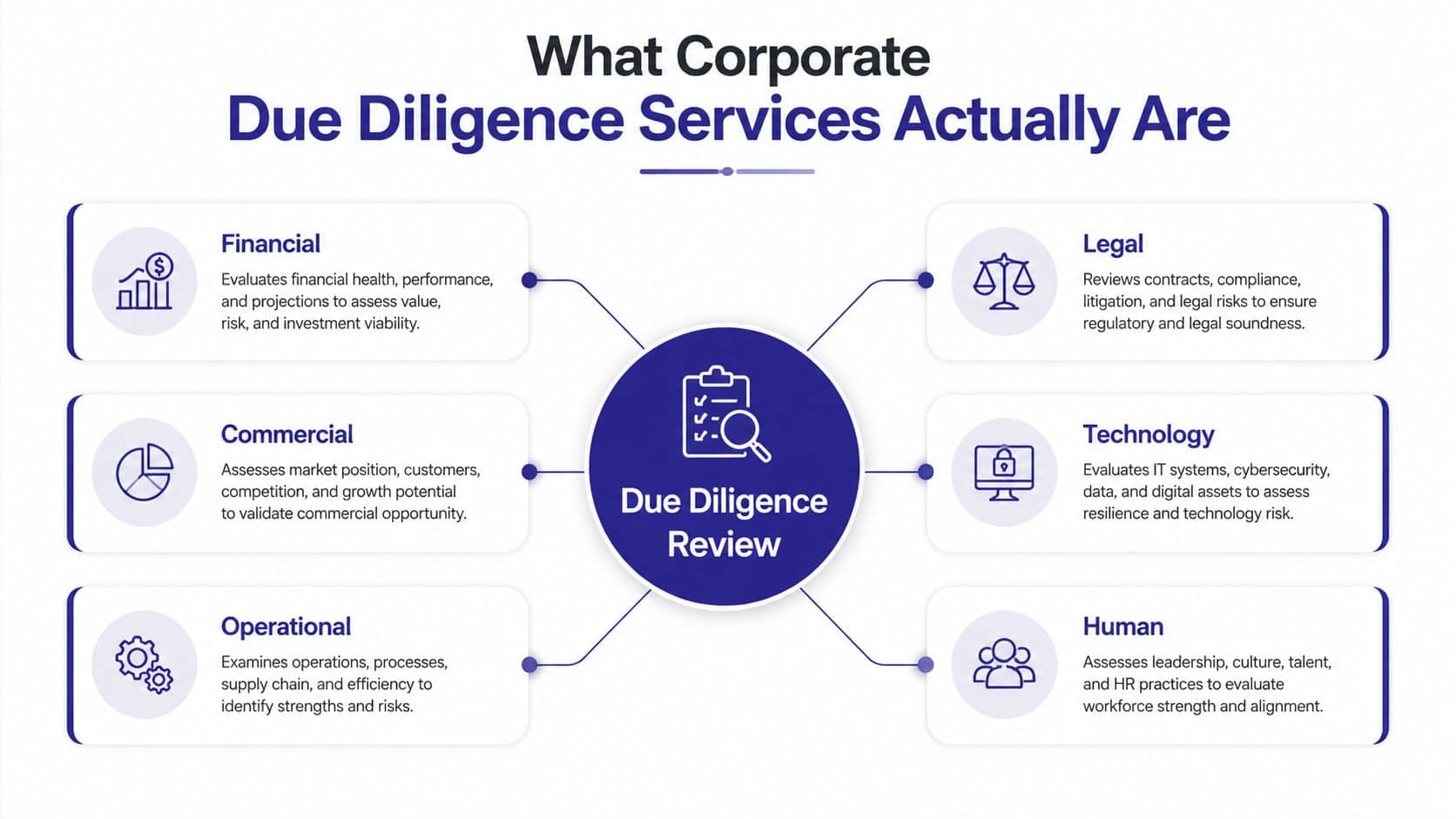
A useful way to think about it is this. Financial diligence asks whether earnings and cash flow are real. Commercial diligence asks whether the market case holds up. Operational diligence checks whether the business can deliver. Legal diligence screens the risk. Technology diligence tests the systems. Human diligence asks whether the people can carry the business forward.
If you want a short primer on the finance side of the process, the outsourced financial analysis guide is a helpful companion because it shows how external analysis can support a wider review without building a full internal team.
The right definition is simple. If the question is “can we trust this business, this claim, or this transaction”, due diligence is the evidence-led answer.
The Six Core Service Types Explained
A deal can look clean on the surface and still fail once you separate the six workstreams properly. I have seen boards focus on the headline earnings number, then miss the operational drag, the claims exposure, or the people risk sitting underneath it.
Financial due diligence
Financial due diligence answers the first question a buyer or lender asks, does the reported performance reflect the business's actual economics? Practitioners review quality of earnings, working capital, debt-like items, margins, customer concentration, and contingent liabilities. In the UK, this is often the front-end workstream that shapes price, structure, and warranty terms. If you want the finance side explained in more detail, the financial due diligence overview is a useful starting point.
Forensic due diligence
Forensic due diligence sits between acquisition work and dispute work. It looks for fraud, bribery, corruption, money laundering exposure, asset leakage, and unusual transaction patterns, then turns those findings into an evidence file that can support negotiation, disciplinary action, recovery, or litigation. That matters when the deal model looks acceptable but the behaviour underneath it does not fit.
A simple example: a company may report steady margins, yet the bank trail, approval trail, and supplier payments point to round-tripping or unexplained leakage. In that case, the forensic review is not just checking the box. It is building a file that can stand up if the matter becomes a claim, a recovery exercise, or a warranty dispute.
Practical rule: if the cash trail, ownership trail, and approval trail do not align, assume there is a problem until the evidence proves otherwise.
Operational due diligence
Operational due diligence asks whether the business can keep delivering after completion, after a loss event, or after a change in ownership. Analysts look at process resilience, supplier dependence, staffing structures, service continuity, and the bottlenecks that can slow or break integration. UK buyers in logistics, manufacturing, and services use it when the operating model matters as much as the accounts.
It also needs a human-capital lens. A business can pass a financial review and still fail if a handful of key managers carry the client relationships, the plant knowledge, or the day-to-day controls. Technology creates a similar blind spot. A legacy system, poor user access control, or weak logging can leave the acquirer with a business that is harder to run and harder to defend if something goes wrong, which is why cybersecurity tips from Technovation LLC belong in the same conversation.
Commercial due diligence
Commercial due diligence examines the target's business plan and projections rather than accepting them at face value. KPMG describes it as an objective enquiry used to critique and challenge commercial matters relating to a target entity, including its business plan and financial projections KPMG commercial due diligence guideline. That work matters when management optimism needs to be tested against market reality, customer behaviour, pricing pressure, and concentration risk.
In practice, a good commercial review often starts by stress-testing the assumptions behind revenue growth. If a forecast depends on three accounts renewing, one channel expanding, and pricing holding firm, the analysis should show what happens when one of those assumptions slips. That same technique also helps in disputes, where the issue is not whether a forecast was ambitious, but whether the loss claim or valuation case rests on assumptions that can be defended.
Legal and compliance due diligence
Legal and compliance work checks contracts, litigation, licences, regulatory exposure, tax filings, sanctions risk, and the rights that sit behind the value. EBSCO's due diligence summary points reviewers to revenues, profits, margins, liabilities, projections, contracts, partnership agreements, licence agreements, pending litigation, complaints, tax filings, government audits, and historical income tax liabilities EBSCO due diligence overview. That range is useful because it shows how wide the evidence base needs to be.
This workstream often decides whether a problem is a pricing issue, a closing issue, or a post-completion claim. A restrictive covenant, a missing consent, or a pending dispute can affect value just as much as a weak margin profile. It can also matter long after completion if the same document set is needed to prove who carried which risk, and from when.
ESG and responsible business diligence
ESG diligence focuses on environmental, social, and governance exposures that can affect value, financing, reputation, and supply chain access. In UK practice, it often sits alongside human rights, modern slavery, and supplier-code checks, especially where counterparties expect stronger disclosure and governance. It is not a branding exercise. It is a filter for risk, access, and continuity.
In a transaction, ESG findings can change how a buyer prices remediation, supply chain replacement, or disclosure risk. In a dispute, the same evidence can show whether a business failed to manage known issues or whether a third party's conduct drove the loss. That is why the better engagements do not treat ESG as a separate box to tick. They test whether it affects the value case, the claim case, or both.
The strongest reviews do not keep these workstreams in separate silos. They share evidence, follow the same ownership trail, and test the same weak points from different angles. A finance-led buyer may start with financial and legal due diligence. A claimant may put forensic and quantification work first. A board dealing with a messy situation often needs all six, because the same evidence can show the price risk, the fraud risk, and the recovery path at the same time.
How a UK Due Diligence Engagement Actually Runs
A focused UK engagement usually starts with a discovery call. That call should do three things fast, identify the problem, define the decision that needs to be made, and decide whether the work belongs in transaction, dispute, or quantification mode. If the matter is small and focused, the review can often run in two to six weeks. Full pre-acquisition diligence usually takes two to four months, depending on scope, access, and how cooperative the other side is market research on diligence timelines and costs.
After that, the adviser should issue a written action plan with fixed deliverables. That is the point where scope becomes real. If the target only opens a partial data room, or if a claim expands into multiple loss periods, the plan needs to be revised quickly and in writing so the client knows what changed and why.
The evidence request list comes next, then the data room. A disciplined team will ask for management accounts, contracts, ageing schedules, bank support, claims files, policy documents, system logs, and whatever else the problem requires. The fieldwork phase should include management interviews and analytical testing, because spreadsheets alone do not explain why the numbers moved. Good teams also test whether the response set feels complete or suspiciously tidy.
To help directors compare process design with their own internal expectations, the acquisition due diligence checklist is a practical reference point.
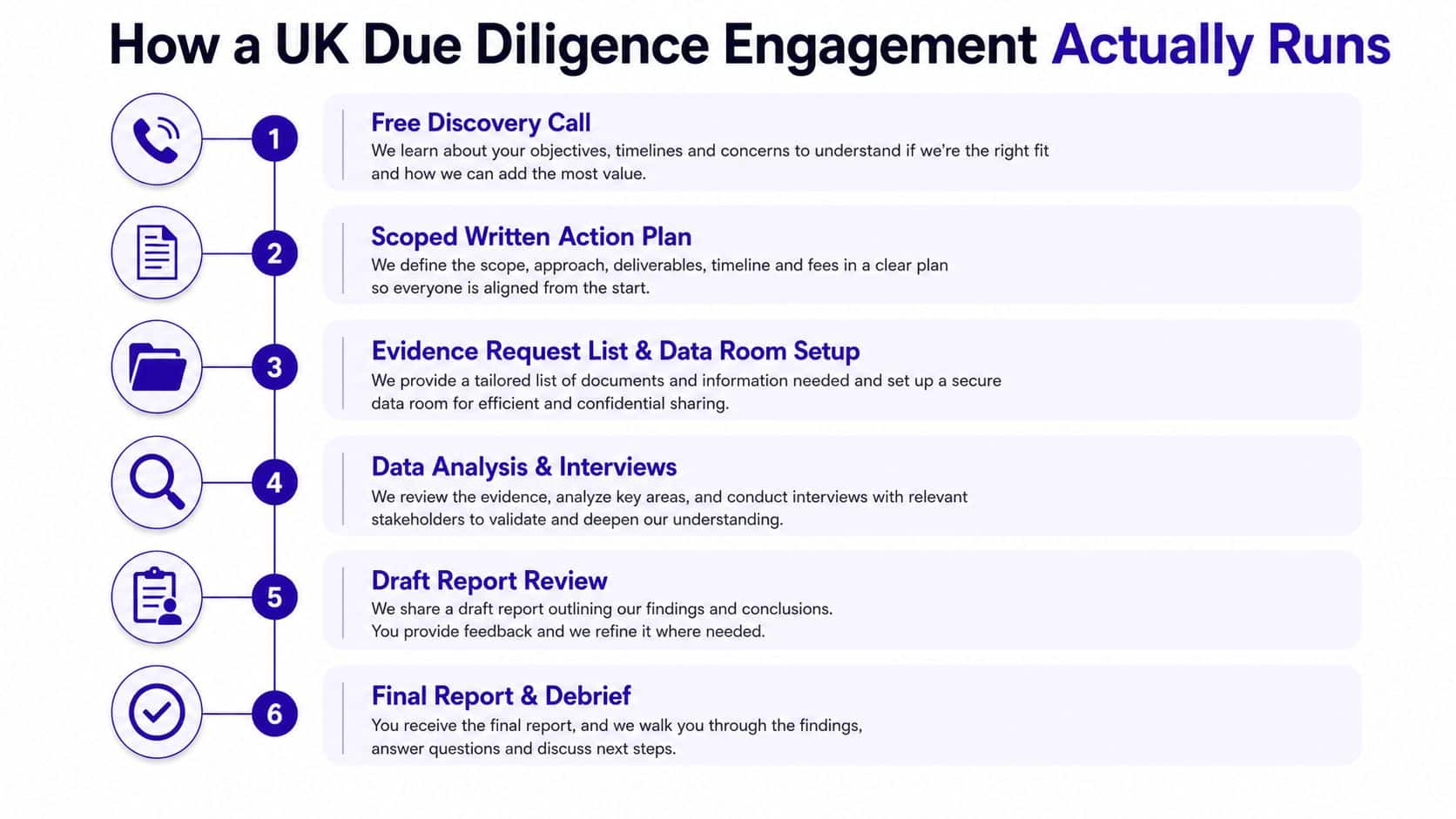
A strong engagement finishes with a red-flag issues report, then a final report and debrief. If the job is acquisition-led, the debrief may feed directly into price, warranties, indemnities, or completion conditions. If it is dispute-led, the report may be shaped for counsel, HR, insurers, or a regulator. If the scope changes, the adviser should say so plainly, show the incremental work, and avoid pretending the original brief still fits.
For deal situations with higher-risk investor materials, the Kons Law due diligence tips are a useful reminder that document completeness and source checking matter long before anyone signs.
Red Flags and Risk Indicators We Look For First
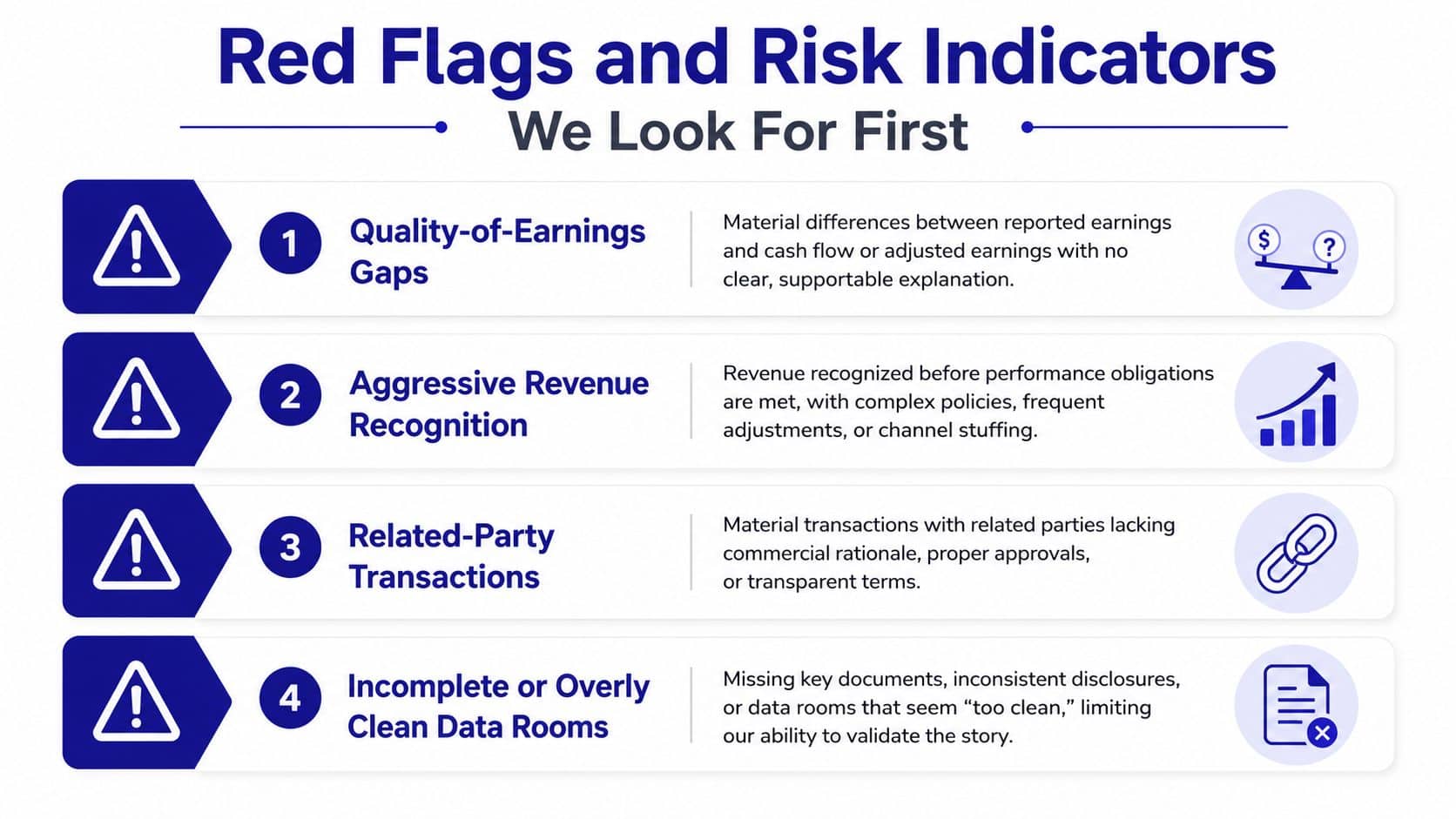
The first pass is about pattern recognition, not theatre. The issues that keep reappearing in UK files are rarely subtle once you know what to test. A diligence review should start with the areas that most often create valuation pain, regulatory exposure, or post-completion headaches.
Earnings quality and revenue recognition
If reported EBITDA looks strong but cash generation lags, the analyst needs to reconcile the bridge line by line. That means checking cut-off, accruals, deferred income, rebates, and whether revenue was pulled forward to flatter the period. It also means asking whether working capital and debtor days moved for commercial reasons or because recognition changed.
Related parties and unexplained flows
Related-party transactions are not automatically wrong, but they deserve daylight. A good review maps ownership, director links, shared service arrangements, and the flow of funds between connected entities. If invoices, intercompany balances, or supplier contracts do not support the transfers, the issue needs to be escalated, not softened.
Working capital and concentration risk
Big swings in working capital can point to seasonality, weak controls, or hidden pressure on the business model. Customer or supplier concentration can be just as dangerous, because one failed relationship can shift the economics of the whole target. The evidence that matters here includes ageing reports, renewal notices, order histories, and real contract terms, not management reassurance.
Technology, culture, and leadership
Weak cyber evidence, poor licence records, and unclear backup testing can create post-deal remediation cost very quickly. The same is true where leadership turnover is high, employee relations are strained, or the culture does not fit the buyer's operating model. These issues are often overlooked, yet they can decide whether the integration works at all. If you want a practical technology lens, the cybersecurity due diligence resource shows why architecture, access control, and resilience matter before completion.
Leadership quality is not a soft issue when the business depends on a handful of people. If those people leave, the valuation changes.
For a more hands-on security perspective, the cybersecurity tips from Technovation LLC are useful because they frame insider-risk indicators in a way that complements document review and interview testing.
The Human side deserves proper attention too. Industry guidance repeatedly notes that cultural, HR, and management-practice checks are often overlooked, even though integration failure can destroy value after completion overlooked due diligence areas discussion. In my experience, that is especially true in smaller and mid-market deals, where the numbers get most of the attention and the people risk gets the least.
What You Receive and How It Reads
A due diligence report should not read like a dump of everything reviewed. It should give a director a clear view of scope, findings, severity, and what to do next. For acquisition work, that usually means an executive summary, a findings section ranked by seriousness, supporting schedules, and practical recommendations.
A forensic investigation report is different. It needs a chain-of-evidence narrative that shows what was reviewed, what was found, how the conclusion was reached, and why the evidence is reliable enough for disciplinary, regulatory, or recovery use. An expert witness report goes a step further, because it has to satisfy courtroom standards and the discipline expected under CPR Part 35.
| Due Diligence Deliverables Compared | Primary Audience | Evidential Standard | Typical Use |
|---|---|---|---|
| Due Diligence Report | Buyer, lender, board, investor | Evidence-based commercial review | Acquisition, investment, funding, or signing decisions |
| Forensic Investigation Report | Directors, counsel, insurers, regulators | Chain of evidence and quantified findings | Fraud, disputes, loss investigations, disciplinary matters |
| Expert Witness Report | Court, tribunal, instructing lawyers | Independent opinion under expert rules | Litigation, valuation disputes, loss quantification |
That distinction matters because the wrong format weakens the message. A board wants a commercial answer in a clean document. Counsel wants a tested evidential trail. A court wants neutrality, method, and clarity. If the adviser blurs those roles, the work becomes harder to defend and less useful in negotiation.
Overcoming the Objections That Stop UK Firms From Acting
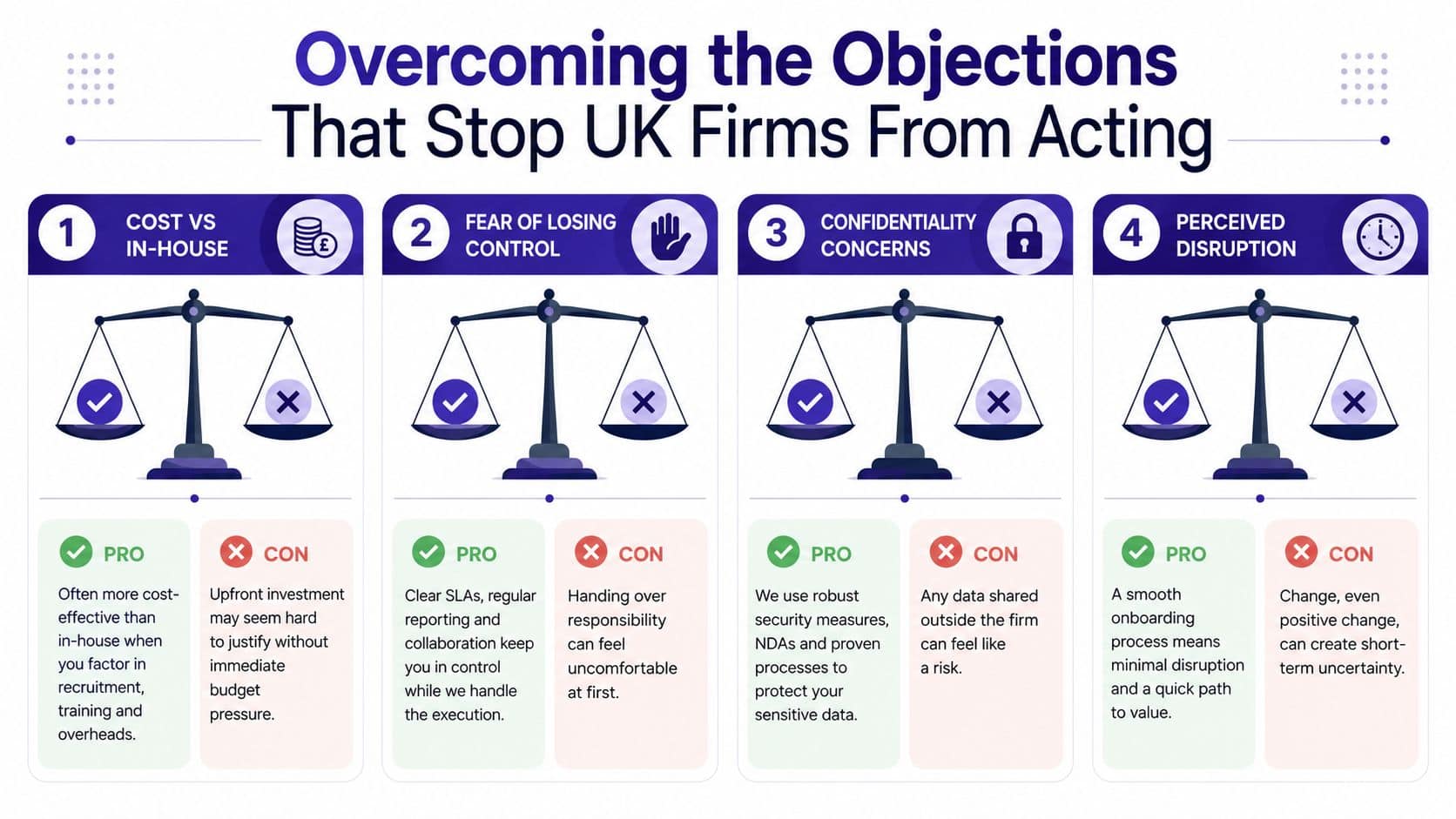
The first objection is cost. Fair enough, good diligence is not free, and the price is most obvious when the business wants speed. But the comparison is not fee versus no fee, it is fee versus the cost of overpaying, missing a liability, or funding a claim that collapses under challenge. Fixed-fee scoping helps because the client sees what is included before the work starts.
The second objection is control. Directors often worry that external advisers will take over the conversation, slow the deal, or make the issue feel bigger than it is. That only happens when the adviser works in a black box. Collaborative working sessions, clear milestones, and direct access to the right people keep the process tight without handing away control.
The third objection is confidentiality. Sensitive deal, claim, or fraud material needs careful handling, and sloppy email chains are not acceptable. Secure data-room protocols, restricted permissions, and disciplined issue logs are the basics. If the adviser cannot explain how information will be protected, they are not ready for serious work.
The fourth objection is credibility. Boards, lenders, insurers, and courts all ask, “Can we trust the person standing behind this work?” That is where chartered management accountant credentials, clear methodology, and director-level expert witness experience matter. A firm such as Lighthouse Consultants fits that model when the case needs forensic accounting, due diligence, and loss quantification in one place.
The strongest engagements do not pretend the objections are irrational. They answer them with scope discipline, evidence discipline, and reporting discipline. That is what makes the work usable when the stakes get real.
Choosing the Right UK Partner and What Happens Next
A good UK due diligence provider should tick a short list. Look for chartered credentials, sector experience, an expert-witness track record, the ability to handle multi-jurisdictional matters, transparent fees, and an engagement model that tells you exactly what happens after the first call. If the provider cannot explain scope, evidence handling, and reporting in plain English, keep looking.
For higher-profile or cross-border matters, collaboration matters too. Lighthouse Consultants works from London and can collaborate with Andersen Global on selected mandates where the matter needs wider reach. That is useful when the deal, dispute, or claim crosses borders and the evidence does too.
A retail buyer once came in worried about headline revenue and post-completion integration. The financial review found a supplier concentration risk that had not shown up in the seller's summary pack, and the buyer used that information to adjust the deal position before signing. In a separate logistics business interruption claim, forensic quantification turned an argument about loss into a supportable settlement position. The numbers did the talking because the evidence had been tested properly.
If your numbers do not reconcile, or the other side's story feels too neat, the next step is straightforward. Book the free discovery call, scope the issue properly, and decide whether you need acquisition diligence, forensic investigation, or quantified loss support before the problem gets bigger.
If you need corporate due diligence services for a deal, dispute, claim, or unexplained loss, Lighthouse Consultants can scope the evidence, test the numbers, and report what stands up. Visit Lighthouse Consultants to arrange a free discovery call and get a clear view of the risk before you commit.