You've found unexplained payments in the accounts, an insurer has rejected a business interruption claim, or two shareholders now disagree about what the company is worth. Perhaps a divorce, inheritance, insolvency, suspected money laundering, bribery allegation, investment dispute, or contract claim has turned financial records into evidence. The immediate questions are uncomfortable and practical: Can I afford an expert? Will the court listen? How long will it take?
A court expert witness can turn a mass of bank statements, ledgers, contracts, forecasts, and emails into a defensible opinion. Choose badly, and you may pay for a report that the court ignores, restricts, or attacks under cross-examination. Choose well, and a forensic accountant can isolate the dispute, quantify loss, test competing explanations, and give the judge something reliable to work with.
When a Financial Dispute Demands an Expert on Your Side
A director in Manchester discovers that a senior employee moved company money through connected businesses. At the same time, the company's insurer disputes the interruption period and says the claimed loss reflects poor trading rather than the insured event. The solicitor asks for records, but the records don't answer the central questions. How much money disappeared? What would the business have earned? Which transactions matter? Who can explain the numbers independently?
That's the point at which a court expert witness becomes more than an expensive adviser. A forensic expert helps separate evidence from suspicion and calculation from assertion. In a fraud matter, that may involve tracing funds and testing whether transactions had a legitimate commercial purpose. In a business interruption claim, it may involve reconstructing the counterfactual trading position without presenting an inflated claim.
The same need appears in a valuation dispute, a shareholder deadlock, an insolvency investigation, or a disagreement over contractual payments. Family lawyers may need an independent view of company value, income, hidden assets, or financial disclosure in divorce and inheritance matters. Criminal and regulatory work can involve bribery, corruption, money laundering, or disputed financial evidence.
Practical rule: If the dispute turns on a financial question that a judge cannot resolve from ordinary experience, obtain advice early. Don't wait until the report deadline forces rushed analysis.
The objection is usually cost. The greater risk is paying for litigation without proving the financial proposition that supports it. A tightly scoped expert can identify whether the claim justifies further work, which records matter, and where the opposing side's calculation fails. That early discipline often matters more than producing a long report.
What a Court Expert Witness Actually Does
A court expert witness gives an independent opinion on a technical issue outside ordinary judicial knowledge. In financial disputes, that specialist may analyse accounting records, value a business, quantify loss, assess cash flows, investigate transactions, or test whether a claimed figure follows from the underlying evidence.
The expert doesn't act as a second solicitor. The solicitor presents the legal case. The expert explains the financial reasoning that helps the court decide it.
The role changes by jurisdiction
In England and Wales civil proceedings, CPR Part 35 controls expert evidence. The court must permit the evidence, and the rules restrict it to what's reasonably required to resolve the proceedings. The judiciary's guidance on expert evidence describes an expert as someone qualified to give the court an opinion on an admissible matter requiring expertise. The framework keeps the evidence focused and independent.
Criminal proceedings have a different route. Crown Prosecution Service guidance explains that Section 30 of the Criminal Justice Act 1988 can make an expert's report admissible as evidence of fact and opinion, whether or not the expert attends court to give oral evidence. The guidance also warns that statistical conclusions need a sound statistical basis. A financial expert therefore needs more than a plausible spreadsheet. The report must show how reliable evidence supports the conclusion.
Family proceedings apply their own rules and guidance, with necessity and proportionality remaining central. This matters in financial remedies cases, where the parties may disagree about company interests, income, assets, or the value of a business.
A report can carry real evidential weight
The GMC guidance on expert evidence explains the criminal-law position that an expert report may be admissible even when the expert doesn't attend to give oral evidence. That doesn't make a weak report safe. Opposing counsel can still challenge its assumptions, records, methodology, and conclusions.
Even a solicitor managing public perception after a difficult case may need a specialist resource on law firm online reputation repair. Reputation management can't repair flawed evidence, but it can help address the commercial consequences after proceedings.
How Courts Decide If Your Expert Will Even Be Heard
The first question isn't whether an accountant can produce a report. It's whether the court needs that report at all.
Under CPR Part 35, expert evidence in civil proceedings requires the court's permission and must be “reasonably required to resolve the proceedings.” That phrase acts as the gatekeeper. A party can't commission a broad financial investigation because more analysis might be interesting or tactically useful.
Necessity comes before detail
A solicitor should identify the precise proposition that needs expert evidence. Is the issue the value of shares at a particular date? The amount of loss caused by a breach? The effect of an insured event on gross profit? The movement of funds through related entities?
Once the issue is clear, the expert should test whether the court can resolve it using ordinary documents, admissions, or factual witnesses. If the answer is yes, an expert may add cost without adding assistance. If the answer is no, the instruction should define the technical question narrowly.
The court may resist reports that:
- Repeat existing evidence: An expert shouldn't restate documents or witness evidence without providing specialist analysis.
- Cover every possible theory: A report should address the pleaded issues, not speculate across the entire business.
- Use unnecessary modelling: An overly complex model is not automatically a useful model.
- Ignore the value at stake: Proportionality applies to the work undertaken, not just the final conclusion.
Independence affects permission and weight
The Part 35 practice direction reinforces that expert evidence must represent the independent product of the expert. The client can explain the case and provide records. The client can't dictate the answer.
That distinction affects both permission and credibility. A report that appears designed to advocate for one side may receive less weight, even if the author has impressive qualifications. A court may also refuse, restrict, or penalise unnecessary expert work. A report that ignores proportionality can be refused, costs-reduced, or struck out.
If you're preparing witness evidence alongside expert analysis, make sure the factual account and financial opinion perform different jobs. Guidance on preparing a witness statement can help keep those roles separate.
Duty to the Court Beats Duty to the Client
An expert's overriding duty is to help the court on matters within the expert's expertise. That duty overrides any obligation to the instructing or paying party, as the Part 35 practice direction makes clear.
This isn't a ceremonial statement placed at the front of a report. It changes how the expert works. The expert must identify limitations, disclose material assumptions, correct errors, and reach an opinion that the evidence supports, even when that opinion damages the client's preferred case.
A defensible report shows its working
At minimum, the report should make the reasoning traceable. It should identify:
- The issues: What financial questions does the court need to answer?
- The instructions: What did the solicitor ask the expert to do?
- The assumptions: Which facts remain unproved, and how do they affect the calculation?
- The documents relied upon: Can another expert locate and test the source material?
- The methodology: Why does the selected approach fit the issue?
- The conclusions: What does the evidence support, and what remains uncertain?
- The statement of truth: Has the expert formally confirmed the obligations attached to the report?
The report should also explain the difference between fact and opinion. A bank statement may establish a payment. Whether that payment represents misappropriation, a loan, a dividend, or a legitimate supplier transaction may require analysis and, sometimes, further factual evidence.
Cross-examination exposes weak chains
Opposing counsel will test the route from records to conclusion. If the expert cannot reproduce a calculation, explain an adjustment, or identify a missing document, the opinion loses force quickly. A confident tone won't rescue an opaque spreadsheet.
The strongest report is not the one with the most pages. It's the one another competent expert can follow, challenge, and reproduce.
The expert must also be prepared to attend when required. That means the engagement needs enough time for working papers, review, corrections, and focused preparation for questions. Rushed drafting saves little if the report collapses in the witness box.
Single Joint Expert or Party-Appointed Expert
Many solicitors assume that each side appoints its own expert. That isn't a safe assumption in UK proceedings. Courts may prefer a single joint expert, particularly where one neutral opinion can resolve a defined technical question without duplicating cost.
A party-appointed expert gives one side greater control over the questions, evidence review, and timing. That control can help where the issues are complex or the parties need separate analyses. It also creates a direct target for the opposing side, which will scrutinise independence and instructions.
Match the model to the dispute
| Factor | Single Joint Expert | Party-Appointed Expert |
|---|---|---|
| Cost | Usually avoids duplicated analysis | Each side funds its own opinion |
| Control | Both parties agree the questions and instructions | One party controls its instructions |
| Independence | Often appears more neutral | Must demonstrate independence despite appointment |
| Speed | Can narrow issues efficiently | Separate reports may create further disagreement |
| Complexity | Works well for defined questions | Better suited to competing methodologies or broad disputes |
| Risk | One opinion may not address one party’s concerns | Conflicting reports can increase cost and delay |
The choice also has an administrative side. Revised expert witness guidance addresses prior authority, higher-rate experts, additional-party assessment time, and translated documents. Those details matter in family and civil matters because a court may scrutinise not only whether expert evidence was necessary, but also whether the requested work and fees were proportionate.
A single joint expert can't become an advocate for either side. A party-appointed expert can't become one either. The difference lies in the appointment structure, not the overriding duty.
Timelines and Costs You Can Plan Around
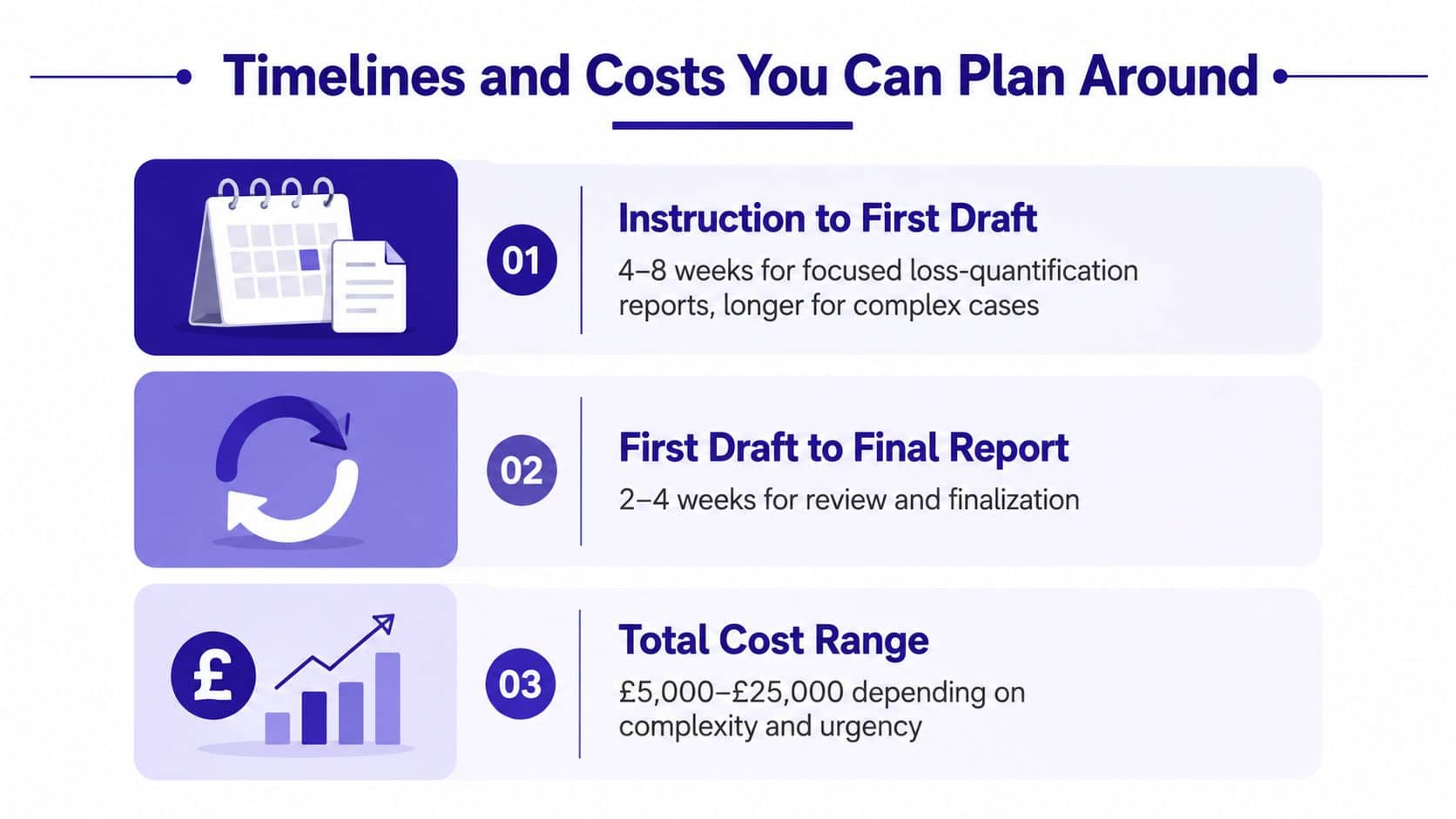
A focused UK loss-quantification report typically takes 4 to 8 weeks from instruction to first draft, with longer periods for complex fraud or records that need substantial reconstruction. That range depends on prompt access to documents, clear instructions, responsive solicitors, and a defined question. It isn't a promise that every matter fits the same programme.
After the first draft, allow time for factual corrections, solicitor review, challenge from the other side, and finalisation. Reply reports may follow exchanged reports, and experts may need to prepare a joint statement after discussing areas of agreement and disagreement. Civil procedure often requires that expert issues receive structured attention rather than remaining as two disconnected reports.
What drives the fee
A realistic budget needs more than an hourly rate. Fees rise with the volume and quality of records, the number of entities, missing data, transaction tracing, data analytics, valuation work, counsel-led conferences, expert meetings, and the urgency of the timetable.
A project may fall within a £5,000 to £25,000 range, depending on complexity and urgency. That range is reflected in the supplied project-planning material, but it shouldn't replace a written scope and staged estimate. Ask the expert to separate document review, analysis, drafting, meetings, and attendance.
The court can examine whether expert fees were reasonable and proportionate. The GOV.UK guidance on expert administration highlights issues such as higher-rate experts and time linked to additional parties. An under-scoped fee encourages shortcuts and unpleasant surprises. An over-scoped fee may face reduction at detailed assessment.
For practical budgeting, review guidance on expert witness fees before you approve an engagement. Require assumptions, exclusions, reporting stages, and approval points in writing.
Choosing the Right Expert and Asking the Right Questions
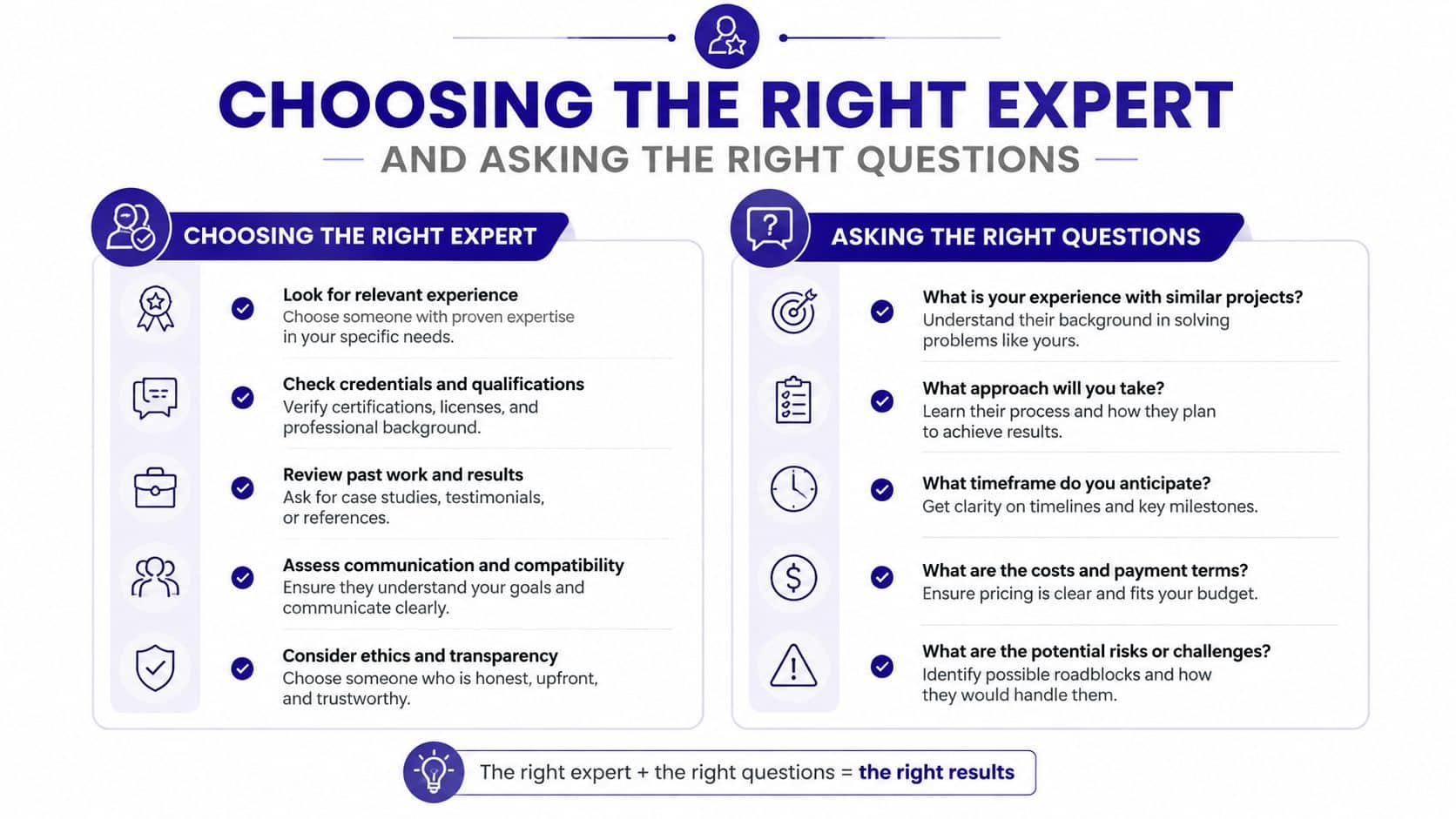
Interview the expert before instruction. A polished CV doesn't prove that the person can explain a disputed calculation to a judge, withstand cross-examination, or distinguish an accounting fact from an opinion.
Ask direct questions:
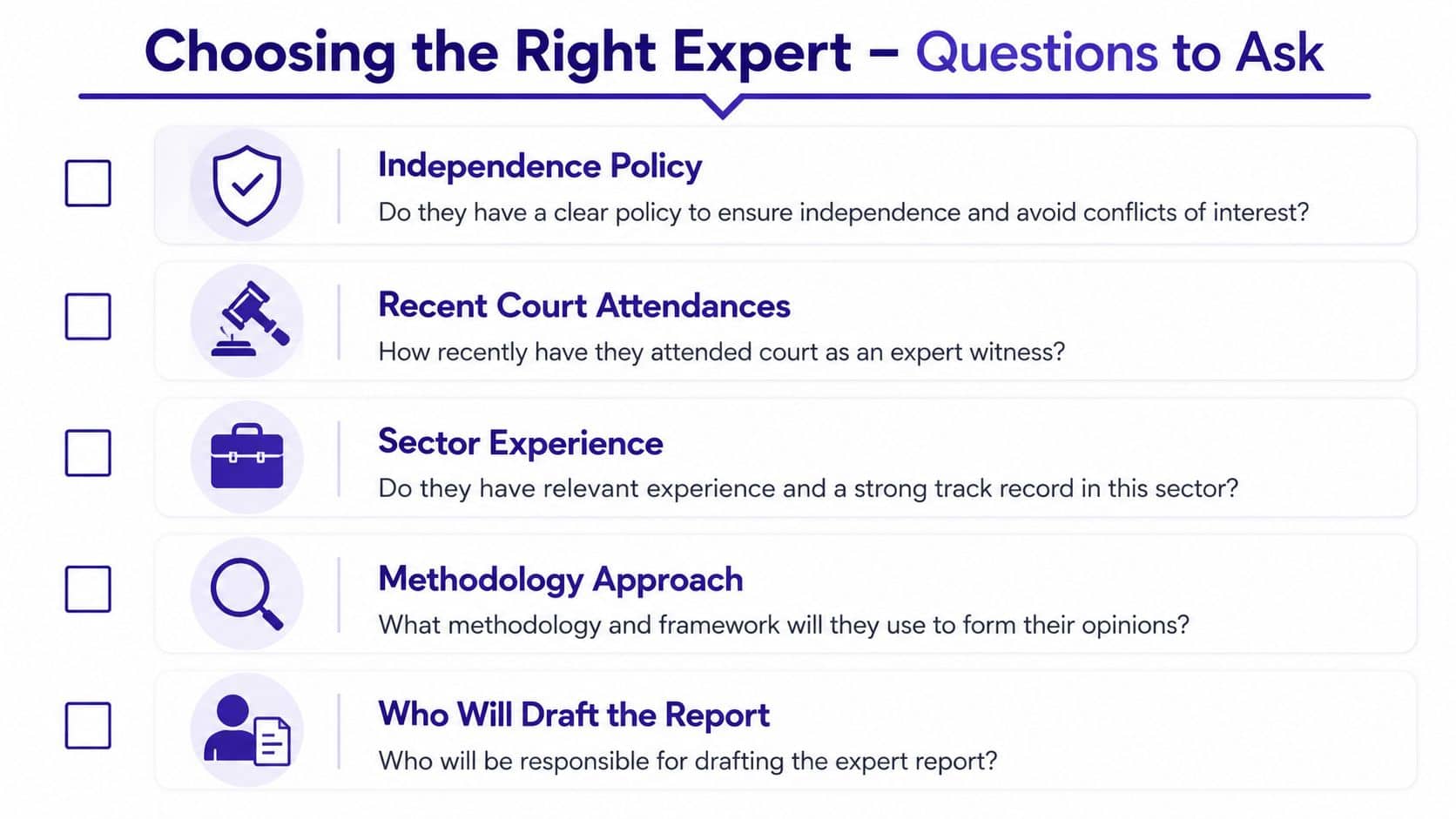
- Independence policy: How does the firm identify conflicts and manage pressure from an instructing solicitor?
- Court experience: Has the proposed expert attended recent hearings or faced cross-examination in a comparable role?
- Sector knowledge: Has the expert worked with the trading model, insurance wording, regulated environment, or transaction type in dispute?
- Methodology: What records will the expert need, what assumptions will apply, and how will the calculation remain reproducible?
- Authorship: Who will perform the analysis and draft the report? A senior reviewer must not just sign junior work.
- AI use: Has the expert used AI tools, and if so, what inputs, outputs, prompts, model settings, verification steps, and records will be preserved?
The last question now matters. A 2025 Bond Solon expert witness survey summary reported that 20% of surveyed experts had used AI, compared with 9.31% the year before. The same coverage discusses a High Court warning involving an AI-generated expert report. The lesson is simple: AI-assisted work requires disclosure, verification, and a clear explanation of its effect on the opinion.
Red flags: A guarantee of the outcome, a generic methodology, unexplained reliance on junior staff, or a fee that seems implausibly low should stop the instruction.
For financial disputes, a Chartered Management Accountant or chartered forensic accountant can offer the right combination of accounting control, commercial understanding, financial analysis, and communication. Credentials alone aren't enough. Combine them with relevant case experience, documented methodology, independence, and the ability to explain the work plainly. Use this guide to choosing a forensic accountant to structure the conversation.
Watch this short video for further context before appointing an expert.
Where Lighthouse Consultants Fits and How to Instruct Us
Most clients arrive with four objections. The cost feels uncertain. The solution is a scoped discovery process that identifies the question, records, assumptions, and stages before substantial work begins. Independence feels difficult when one side pays. The solution is a clear duty-to-the-court framework, conflict checks, disclosed instructions, and analysis that follows the evidence rather than the desired result.
Time creates pressure. A focused action plan can prioritise the records and calculations that matter first, instead of allowing an unfocused review to consume the timetable. Cross-examination creates doubt. A report built from authenticated records, transparent methodology, and organised working papers gives the solicitor a defensible basis for preparation.
Lighthouse Consultants is a London-based team of Chartered Management Accountants providing forensic accounting, expert witness, management consulting, and audit services. Its directors can act as expert witnesses, and the team can work as a single joint expert or shadow expert in forensic accounting litigation support. The engagement model includes free discovery, a scoped action plan, and results reporting.
The firm supports matters across retail, logistics, aviation, manufacturing, financial services, insurance, and public and not-for-profit organisations. Its work includes fraud, bribery, corruption, litigation and insurance claim quantification, due diligence, financial analysis, risk assessment, internal audit, and sustainability audit. Collaboration with Andersen Global on selected mandates supports cross-border and multi-jurisdictional work.

Before you instruct any firm, send a short chronology, the pleaded or proposed issues, the key financial records, and the timetable. Ask for a written scope, fee stages, assumptions, exclusions, proposed author, conflict position, and explanation of how the expert will handle missing data or AI-assisted work. That process protects the business owner, the solicitor, and the credibility of the evidence.
If you're dealing with fraud, valuation, business interruption, insolvency, divorce, inheritance, or another UK financial dispute, Lighthouse Consultants can provide a focused discovery discussion, scoped forensic analysis, and CMA-qualified expert witness support. Visit Lighthouse Consultants to discuss the matter and arrange a practical plan before costs and procedural deadlines begin to run.