You can get the key wrong before you've even signed the contract. A buyer walks into a coastal cottage purchase thinking the holiday home will cost the same stamp duty as a normal main residence, then the solicitor's bill lands and the SDLT number is brutally higher. That shock usually comes from one simple mistake, treating holiday home stamp duty as a cosmetic add-on instead of a price factor that changes deposit size, loan cover, and post-tax yield.
I've seen couples budget for the property price, the furnishings, and the legal fees, then discover they've left no room for the tax bill that arrives at completion. That's where buyers get squeezed. If you want a useful general primer before you commit, Global's property tax insights is a practical place to start, but the issue is that holiday-home tax needs to be modelled before you offer, not after.
The Holiday Home Tax Trap Most Buyers Miss
A buyer signs for a holiday cottage on the coast, assumes the tax will look like any other residential purchase, and then discovers the bill is built on a different set of rules. That surprise is common, and it is expensive. In England and Northern Ireland, a holiday home can fall into the higher-rate treatment once the buyer already owns another dwelling worth at least £40,000, so the tax cost needs to be treated as part of the purchase price from the start.
The bigger trap is classification. A property that feels like a holiday home to the buyer is not always treated that way for tax, and a building that looks like a simple retreat can be caught as a dwelling for SDLT purposes. That is where purchasers get caught out, because the liability is not driven by lifestyle plans, it is driven by legal status and ownership history.
The best example is a chalet or similar property that sits close to the edge of the rules. If it is treated as a dwelling, the surcharge can apply. If it falls outside that definition, the result can be very different. Buyers should get that question checked before exchange, not after the completion statement arrives.
Cross-border ownership adds another layer of risk. An owner who already holds residential property abroad can still trigger the higher-rate treatment here, because the UK rules focus on ownership of other dwellings, not on whether those homes are in England or Northern Ireland. That point is easy to miss, and it is one of the first things I check for clients who already own property outside the UK. For a plain-English overview before you get into the detail, Global's property tax insights is a useful starting point, but the main job is to model the tax on the exact ownership position before you commit.
Why this catches people out
Many buyers still treat stamp duty as a line in the solicitor's paperwork. That mindset causes avoidable problems. The SDLT bill changes how much cash you need on completion, what you can safely borrow, and how much value the holiday home really gives you after tax.
Practical rule: if the property is a second home in England or Northern Ireland, work on the higher-rate assumption until your solicitor confirms the position in writing.
The replacement-main-residence window is the other trap buyers ignore. If you are buying a new home and selling your old main residence, the surcharge can sometimes be reclaimed if the old home is sold within the allowed replacement period. That can save a buyer a large sum, but only if the timing is handled properly and the paperwork is right.
For buyers who want to compare the tax logic with investment-property thinking, surcharge on buy-to-let purchases is useful context. The same pressure applies, higher acquisition tax reduces flexibility at purchase. The mistake is to treat SDLT as an afterthought. On a holiday home, it belongs in the numbers before you make the offer.
How Stamp Duty on Holiday Homes Works in England and Northern Ireland
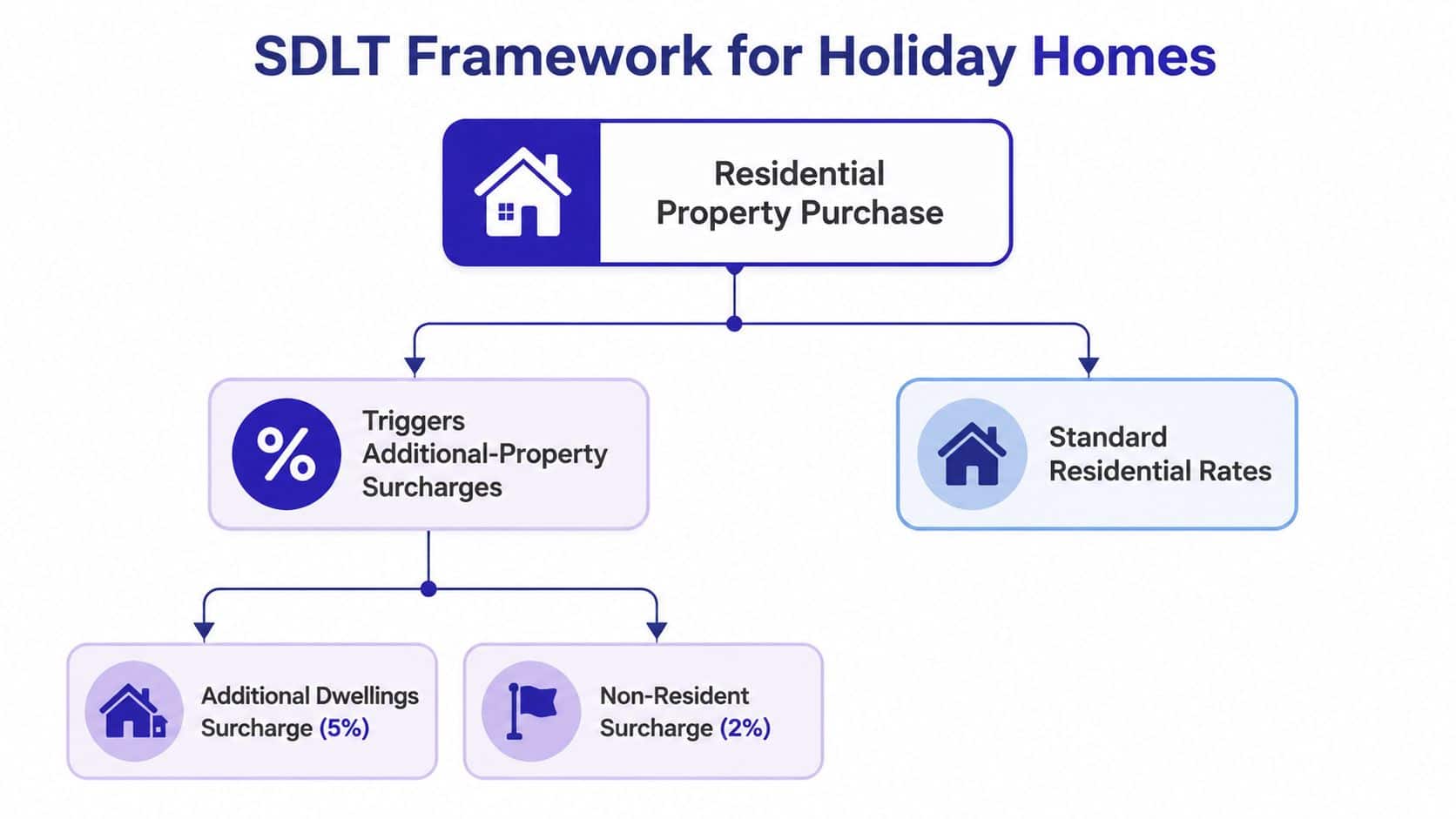
The clean way to understand stamp duty on holiday homes is to start with the base rule. In England and Northern Ireland, residential property normally falls into SDLT bands, but a holiday home usually gets pulled into the additional-property regime if the buyer already owns another dwelling worth at least £40,000. That means the higher-rate treatment sits on top of the ordinary residential bands rather than replacing them.
The rates after the April 2025 reset
From 1 April 2025, the residential nil-rate threshold in England and Northern Ireland fell from £250,000 to £125,000, and the holiday-home higher-rate bands moved to 5% up to £125,000, 7% from £125,001 to £250,000, 10% from £250,001 to £925,000, 15% from £925,001 to £1.5 million, and 17% above £1.5 million. That is the framework buyers face at completion, and it is why the bill escalates so quickly on a decent coastal property.
A simple way to read it is this. The first slice of price is taxed at one higher rate, the next slice at the next rate, and so on. The system is deliberately banded, not flat, because the tax rises as the price rises.
A worked mental model
Take a £300,000 holiday home. The first £125,000 sits in the 5% band, the next £125,000 sits in the 7% band, and the final £50,000 sits in the 10% band. You don't need to memorise the arithmetic yet, but you do need to accept the logic, once the additional-property rule bites, the holiday home is taxed on a steeper ladder than a main home.
For a concise external summary of the same ownership rules, the holiday home ownership tax guide is a useful companion. The next issue is that England and Northern Ireland are not the whole UK, and the devolved systems don't mirror this structure neatly.
The Additional Dwellings Surcharge and the Non-Resident Surcharge
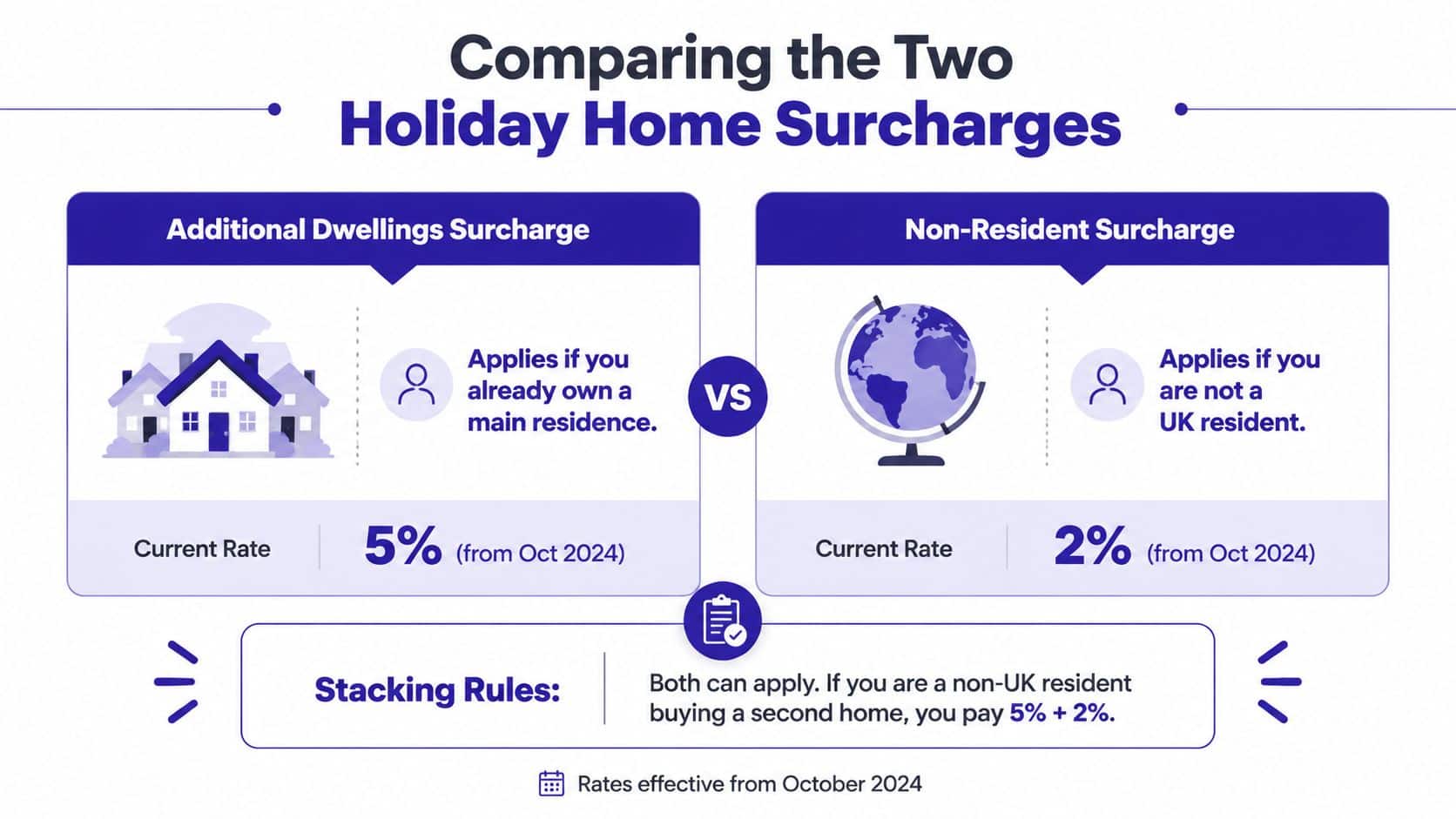
The trap is simple. Holiday-home buyers often face two separate charges, and they are not the same. The additional dwellings surcharge is the one that usually bites, and in England and Northern Ireland it sits at 5% on top of the residential bands from 31 October 2024. The non-resident surcharge is separate, and it applies where the buyer fails the SDLT residence test.
How they stack
A non-resident buyer who is also buying an extra home can face both charges at once. The purchase then picks up the standard SDLT bands, the 5% additional-property surcharge, and the 2% non-resident charge. The logic is similar to the surcharge on buy-to-let purchases, but the residency test adds a separate layer that many private clients overlook.
A UK resident buyer with no other property sits in a different position. That buyer usually pays standard residential SDLT, unless another rule changes the treatment. Company purchases also need separate review. A corporate buyer does not escape the higher-rate regime just because the property is for leisure rather than rental.
Where confusion usually starts
The residence test catches people out because it looks narrower than it is. If your position is unclear, the UK tax residence test guide should be checked before exchange, not after. Non-doms are not exempt simply because they are non-doms, and limited-company ownership can alter the charge even where the intended use looks straightforward.
The bigger mistake is treating ownership history as irrelevant. If you already own property abroad, or you are replacing a main residence, that can change the SDLT outcome, but only if the facts fit the rule exactly. Buyers who are selling their old home need to watch the replacement window closely, because that is one of the few routes that can remove the higher-rate charge.
Practical rule: check residency, ownership history, legal title, and any main-residence replacement position together. One missed fact can turn a normal-looking holiday purchase into a stacked-surcharge transaction.
How Scotland and Wales Treat Stamp Duty on Holiday Homes
England and Northern Ireland use SDLT, but Scotland and Wales run their own systems. In Scotland, the tax is Land and Buildings Transaction Tax and in Wales it is Land Transaction Tax, and both have additional-dwelling rules that catch holiday homes. You cannot assume the English figures carry over, because the bands and surcharge mechanics are different.
| Nation | Tax | Additional dwelling surcharge | Non-resident surcharge | Starting nil-rate band (2026) |
|---|---|---|---|---|
| England | SDLT | 5% | 2% in relevant cases | £125,000 |
| Northern Ireland | SDLT | 5% | 2% in relevant cases | £125,000 |
| Scotland | LBTT | Additional dwelling charge applies | Not separately set out in the same way | Not provided in the verified data |
| Wales | LTT | Additional dwelling charge applies | Not separately set out in the same way | Not provided in the verified data |
The practical difference
Scotland's structure is especially important because the residential adder is calculated on the full purchase in a way that differs from the slice-by-slice English model. Wales also applies its own surcharge framework, and companies can face higher rates there too. The point for buyers is blunt, you need the local regime, not a generic “UK holiday home tax” assumption.
The same legal classification trap matters in both devolved systems. A chalet, park home, or short-let unit does not magically become a dwelling just because an estate agent says “holiday home”. Main-residence replacement logic can also matter, but the procedural steps differ, so the sale and purchase should be reviewed before missives or contracts are locked in.
How advisers should think about it
If a client is buying in Scotland or Wales, I would not let them rely on an England-based calculator. The tax can move differently, and the consequences show up at completion, not six months later when the client realises the budget was wrong.
Worked Stamp Duty Calculations for a Holiday Home
A real calculation is where the tax trap stops being abstract. Take a higher purchase price and the banding starts to matter fast, especially if the buyer has already got other residential property in the background.

England
Use £550,000 as the purchase price and the arithmetic becomes harder to ignore. For a holiday home in England bought by someone who already owns a main residence, the SDLT due under the verified example is £52,500 under the second-home rules, compared with £17,500 for the same price as a main residence Essendon Tax. That gap is not a technical footnote. It is cash the buyer needs available before completion, and it is exactly why the purchase price must be modelled as a banded tax problem, not just a deposit problem.
The practical point is simple. Once the property price moves into a higher band, the surcharge hits each slice of consideration, so the bill rises faster than many buyers expect. A client who has only budgeted on the headline price can be short on funds on the day the solicitor asks for the tax money.
Scotland and Wales
Scotland and Wales need their own calculations because their systems do not mirror England's banding and surcharge mechanics. The right approach is to work through the local rules on the actual contract price, then test whether the property is caught as an additional dwelling in that jurisdiction.
Cross-border ownership makes this even messier. If the buyer already owns a home abroad, or already holds another residential property in the UK, that ownership history can change the result, even where the holiday home is meant to be a simple weekend purchase.
When the picture changes
Joint ownership, gifts, and company purchases create further pressure points. The ownership history of each buyer matters, the title structure matters, and the way the solicitor drafts the contract can change the analysis of who is treated as the buyer for tax purposes. A buyer replacing a main residence also needs to watch the replacement window, because that route can save real money if the old home is sold in time and the paperwork is handled properly.
Proper modelling pays for itself. It is the difference between a clean return and a costly mistake, and it is why mortgage lender data tools should be used to cross-check the facts before exchange, not after completion.
Is Your Holiday Home Actually a Dwelling for Tax
The biggest classification mistake is assuming every property marketed as a holiday home counts as a dwelling for SDLT. HMRC's manual draws a line between something that is suitable for use as a dwelling and something that is used as a dwelling, and that difference can decide whether the additional-dwellings surcharge bites at all. A chalet, park home, or short-let unit can sit in the grey area if its physical design and occupation pattern don't match an ordinary house.
For non-standard property, the details matter. HMRC looks at permanence of structure, sleeping arrangements, cooking and washing facilities, and how the property is occupied in practice. A unit that looks like leisure accommodation on paper may not be treated the same way as a conventional residential house.
Practical rule: don't let the marketing brochure decide the tax treatment. Let the structure, facilities, and use pattern decide it.
Buyers get burned by a too-simple answer. They hear “holiday home” and assume “second home surcharge”, but that shortcut can be wrong. In a borderline case, the legal classification should be checked before contracts are exchanged, because the wrong assumption can leave a buyer with either an unnecessary tax charge or an underpaid return.
If you are buying a park home or chalet, the mortgage lender data tools can help advisers cross-check facts that affect the transaction file, but the SDLT question still needs legal and tax review. The correct question is not “is it called a holiday home?”, it is “what is it, legally, for SDLT purposes?”
Reliefs and Planning Opportunities That Cut the Surcharge
The cleanest way to reduce the bill is to avoid assuming the surcharge is inevitable. The main-residence replacement rule can still protect a buyer who sells their old main home and buys a new one within the permitted window, even if they already own a holiday home. That nuance is often missed in consumer guides, and it matters because the buyer may not need to pay the additional-property surcharge at all if the new purchase replaces the main residence properly.
The reliefs that actually matter
Multiple dwellings relief can help when linked properties are bought together, because it averages the rate across the transaction rather than treating every part of the deal bluntly. First-time buyers' relief is worth knowing, but it does not stack with the additional-dwelling surcharge, so it is not a magic workaround for a second home.
A relief only helps if the facts support it. If the buyer's residence history, completion dates, and ownership trail are weak, HMRC will test the position.
Common objections, answered
Some buyers say the reliefs are too risky. They aren't risky if the file is clean and the evidence is solid. Others say HMRC will challenge everything, which is nonsense, HMRC challenges weak claims, not properly documented ones. The final objection is cost, but professional advice is usually cheaper than paying the wrong tax and trying to unwind it later.
The main point is this, reliefs are not for optimism, they're for disciplined planning. If the purchase has any mixed-purpose or mixed-ownership element, the surcharge question should be tested before exchange, not left to wishful thinking.
Practical Steps Before Exchange and How Lighthouse Consultants Helps
The buyers who avoid problems do a few things early and they do them in writing. They check the SDLT position before exchange, they confirm whether the property is a dwelling for tax purposes, they review residence history for every buyer on the title, and they keep a clean file that shows how the conclusion was reached. If the facts are borderline, that file becomes the defence later.
The checklist I'd use before completion
- Confirm ownership history early: Work out whether any buyer already owns another dwelling, including overseas property where relevant, because that fact drives the higher-rate analysis.
- Test the property classification: Ask what the building is, legally, not just what the brochure calls it, especially for chalets, park homes, and short-let units.
- Check the replacement rules: If the purchase is replacing a main residence, gather the sale contract, completion date, and any supporting evidence before exchange.
- Document the occupation facts: Keep details of use, layout, and facilities so the dwelling analysis can be defended if HMRC asks questions later.
- Plan the SDLT return deadline: The return has to be filed within 14 days of completion, so the solicitor needs the facts before completion, not after the move-in date.
- Retain a refund pack: If the surcharge is paid and later reclaimed under the replacement rules, keep the evidence together so the reclaim is not delayed.
The sale side matters too. Sellers often need to prove main-residence status to a buyer's solicitor, especially if the buyer is testing whether the surcharge applies. That is where weak records cause friction, and I've seen transactions stall because nobody could prove who lived where and when.
Where professional support earns its fee
If you want a defensible SDLT position, you need a team that can quantify the tax, test the facts, and write the position up clearly. Our UK property accountants work through the numbers, the ownership trail, and the documentary evidence so you are not left guessing on completion day.
That's the point of a disciplined review. We start with a free discovery call, scope the tax and evidence issues properly, and then give you a position that stands up to scrutiny, rather than a vague opinion that falls apart when the solicitor or HMRC asks for support. If the purchase is straightforward, you get reassurance. If it is messy, you get a clean path through the mess.
Lighthouse Consultants helps buyers, advisers, and solicitors turn a holiday-home SDLT question into a quantified, evidenced tax position. If you're buying, selling, or reviewing a holiday home purchase, visit Lighthouse Consultants and book a discovery call so the tax is checked before completion, not argued after it.