You usually don’t call a forensic accountant when things are calm. You call when the numbers no longer add up, when a shareholder starts asking awkward questions, when a divorce solicitor wants a clean valuation, or when a fraud claim, insurance dispute, or winding-up threat turns a routine company file into evidence. That’s where the Ltd vs PLC difference stops being theory and starts shaping risk, control, and exposure.
If you’re running a UK business, the structure on the certificate does more than decorate the letterhead. It decides who can own shares, how easily control shifts, how much you must publish, and how hard it is for outsiders to challenge your records. If you want a plain-English reminder of how limited companies fit into the wider business-structure decision, renn helps you decide is a useful starting point before you look at the more exposed PLC model.
| Requirement | Private Limited Company (Ltd) | Public Limited Company (PLC) |
|---|---|---|
| Share offers | Private only | Can offer shares to the public |
| Minimum share capital | No statutory minimum | £50,000 minimum share capital |
| Paid-up capital before trading | No statutory minimum | 25% of nominal capital must be paid up |
| Directors | One director can be enough | At least two directors required |
| Company secretary | Not required | Qualified company secretary required |
| Reporting burden | Lighter, especially for smaller firms | Heavier reporting and disclosure |
| Ownership profile | Closed, private ownership | Public fundraising and wider ownership possible |
If the company is already under scrutiny, you may also need to think about closure, liquidation, or formal dissolution. In that situation, the process described in this guide on dissolution of a limited company can become relevant fast, especially if there are unpaid claims or unresolved disputes.
When Company Structure Becomes the Problem
A director gets the call after a minority shareholder has instructed solicitors. The books are late, the management accounts do not tie, and one side says the other has been shifting money before a sale. At that point, nobody cares about abstract company-law points. They care about control, evidence, and whether the structure makes the dispute easier to prove or easier to hide.
That is where the Ltd PLC difference starts to matter in practice. A private company’s closed ownership can keep a dispute inside a small circle, but it also means the people in the business often control the only records that matter. If those records are incomplete, altered, or selectively shared, the disagreement turns forensic fast.
A PLC puts the business under a harder spotlight. Once shares can be offered to the public and governance becomes more formal, more people can ask questions and more of the financial picture sits in the open. UK government guidance on forming a public limited company makes the point plainly, a PLC is built for wider share ownership and stricter company requirements than an Ltd (UK government guidance on PLC formation).
Practical rule: if there is a dispute, do not start by asking whether the company is “successful”. Start by asking who controls the records, who can transfer ownership, and who has standing to challenge the numbers.
That structural gap also changes the job for advisers, lenders, and litigators. An ownership fight that looks tidy on paper can unravel once someone checks the share register, board minutes, dividend trail, and related-party payments. If the business is already heading toward closure, liquidation, or formal dissolution, the process set out in this guide on dissolution of a limited company can become relevant quickly, especially where unpaid claims or unresolved disputes are still live. Business owners should treat structure as a dispute-control issue before a disagreement becomes evidence preservation, document requests, and expert reports.
If you are already there, you need more than a company secretary or a general accountant. You need a clear view of what the structure permits, what it exposes, and what a court or insurer will ask for next. For a plain-English reminder of how limited companies sit in the wider structure decision before you compare the more exposed PLC model, renn helps you decide is a useful starting point.
Formation and Capital Requirements Compared
The formation gap between an Ltd and a PLC is not cosmetic. It sets the funding discipline from day one, and it changes how outside investors, creditors, and advisers assess the company’s readiness for public capital. UK guidance consistently says that a PLC must meet a minimum share capital threshold of £50,000, while an Ltd can be formed with more than zero share capital.
The key phrase is paid-up capital. In practical terms, it means money or value has been committed to the company’s share capital, not just promised on paper. For a PLC, the rule that 25% of the nominal share capital must be paid up before trading starts forces a real funding base before the business can operate as a public company. That is a different discipline from a private company, where founders often start with nominal capital and keep control tightly held. For businesses considering cross-border expansion, the single company form for 27 markets offers an alternative structural path.
A PLC also needs at least two directors and a qualified company secretary (OpenForest). An Ltd can usually run with one director and no company secretary. That difference matters because governance in a PLC is built for public scrutiny, not founder convenience. In a dispute, those extra formalities give investigators more records to test, and more points where poor control becomes visible.
Here is the plain comparison.
| Requirement | Private Limited Company (Ltd) | Public Limited Company (PLC) |
|---|---|---|
| Minimum share capital | No statutory minimum | £50,000 |
| Capital paid up before trading | No specific statutory minimum stated in the brief | 25% of nominal capital |
| Directors required | One director | Two directors |
| Company secretary | Not required | Qualified company secretary required |
| Ownership model | Private, closed group | Public fundraising possible |
| Best fit | Owner-managed businesses, SMEs | Companies needing broader capital access |
That is why most UK businesses stay private. One accounting source says there are over five million registered Ltd companies in the UK, compared with only around 100,000 PLCs, so Ltds outnumber PLCs by roughly 50 to 1 (Crunch). The market has already chosen the simpler structure for most owner-managed firms.
Bottom line: if you do not need public capital, do not pay for public-company machinery.
The classic mistake is treating PLC status like a prestige upgrade. It is a funding and governance decision. If the business does not need a public market, the extra formality usually brings more cost, more exposure, and more litigation surface than benefit.
Governance and Reporting Obligations in Practice
The reporting gap between an Ltd and a PLC becomes painful when a dispute starts. Private companies generally have more breathing room, with one UK business guide saying they have nine months to file annual accounts, while public companies have six months and must hold an annual general meeting (Red Flag Alert). That shorter timetable is not just administrative. It forces quicker closure, tighter process, and less room for sloppy finance.
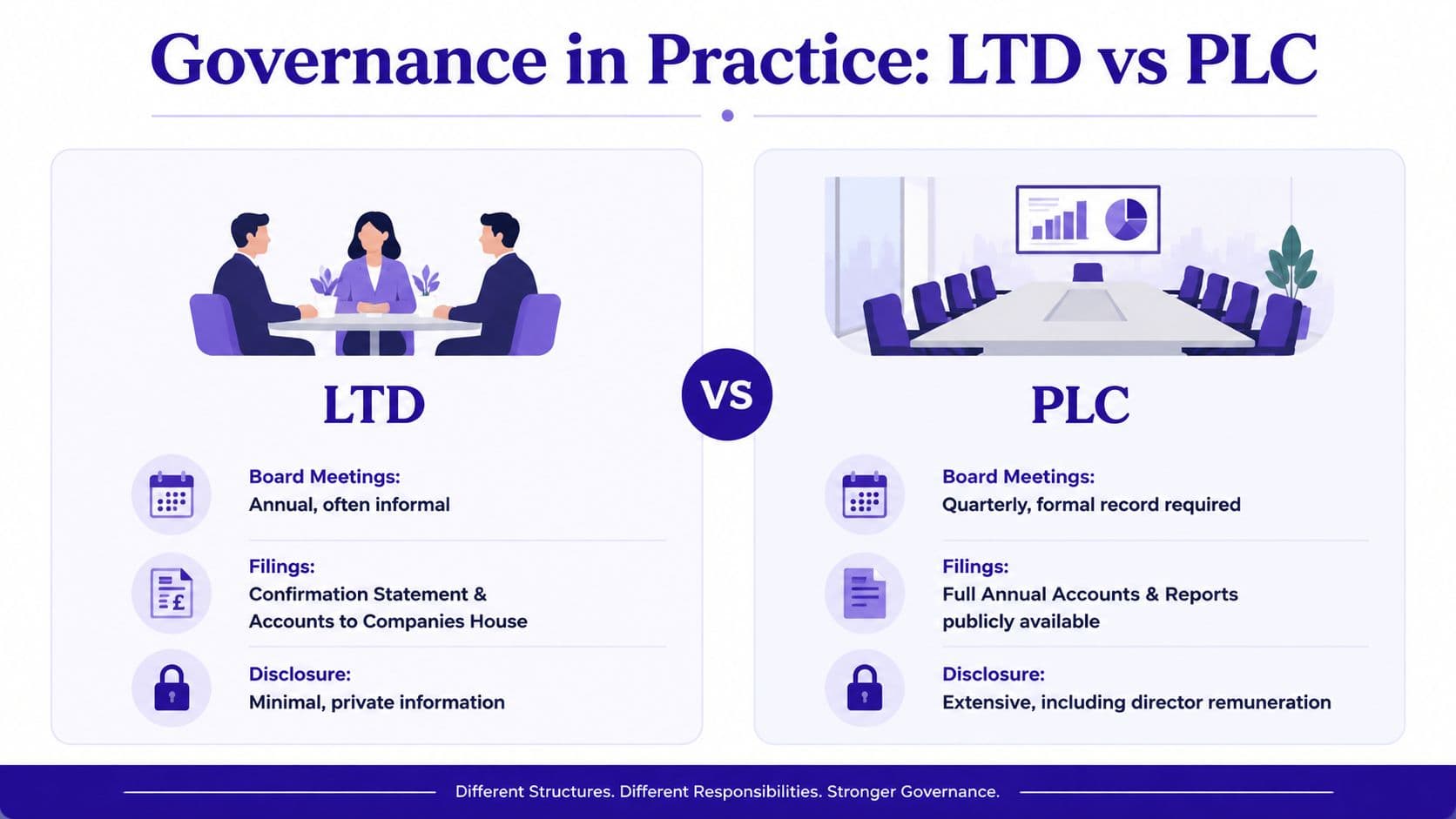
A PLC also has to carry a more formal control environment. The required qualified company secretary matters because public-company administration can’t rely on ad hoc founder habits. Public disclosure and published accounts mean board behaviour, year-end close, and shareholder communications all leave a more durable trail. That is useful when controls are strong, but it becomes a problem fast if the directors have been casual with approvals or bookkeeping.
The reporting burden is one reason PLCs face sharper scrutiny in investigations. Published financial statements invite comparison, questions, and challenge. If a shareholder alleges hidden dividends, related-party extraction, or misstated performance, the public-company framework gives them more angles of attack and more paper to test. By contrast, a small Ltd can move faster and keep more information private, which helps founders make decisions without a heavy administrative layer.
An internal governance framework is often the difference between a contained issue and a full-scale dispute. If you want a practical board-level view of what good control looks like, this UK guide to corporate governance frameworks is the right reference point.
A PLC should behave as though every material decision may later be read aloud in a dispute bundle.
That is not paranoia. It’s realism. The more formal the structure, the more disciplined the records need to be. If directors can’t produce clean minutes, reconciliations, and approval trails, the governance gap itself becomes evidence.
The Hidden Costs of PLC Status
PLC status carries prestige, but prestige doesn’t help when the process turns hostile. A public company must tolerate wider disclosure, and that makes its finances easier for shareholders, competitors, litigators, and sometimes counterparties to inspect. The structure invites capital, but it also invites challenge.
The first hidden cost is privacy. An Ltd lets founders keep ownership and financial detail inside a tighter circle. A PLC pushes much more into the public domain, and that matters when the business is negotiating a sale, defending a claim, or trying to keep sensitive commercial information away from competitors. The second hidden cost is stamina. Public-company compliance is not a one-off filing exercise, it’s a permanent operating load.
That load also changes dispute risk. In shareholder litigation, a PLC’s broader ownership base can create more voices, more factions, and more documents to test. In divorce proceedings, public disclosures can make it easier to identify the business’s shape, but also easier for one party to argue about value, control, and extractable wealth. In fraud work, the same visibility that helps transparency can also widen the trail that needs to be reviewed, which means more people, more records, and more points of failure.
The UK guidance already makes the structural logic plain. PLCs can offer shares to the public and face stricter capital, disclosure, and governance rules than Ltds (Sprintlaw’s UK overview). That is not a neutral change. It creates a business that is easier to fund, but also easier to scrutinise.
The wrong question is, “Should we become a PLC because it sounds bigger?” The right question is, “Can we carry the disclosure, control, and dispute burden without damaging the business?”
If the answer is no, stay private. A leaner Ltd usually gives you more room to manage cash, control ownership, and keep sensitive issues out of public view. That is especially important where there are family shareholders, thin margins, or a history of informal decision-making.
Share Transfers and Ownership Disputes
Share transfer rules are one of the sharpest dividing lines between the two structures. In an Ltd, shares are held and transferred privately within a closed group. In a PLC, shares can be freely bought and sold by the public (Tide). That single difference changes how control moves, how value is assessed, and how disputes get traced.
A closed ownership model can look simple until relations break down. Then every restriction, consent right, and historic transfer becomes relevant. If one shareholder says they were pushed out unfairly, or a spouse argues that a company interest was undervalued in divorce proceedings, the share-transfer rules and the paper trail around them become central evidence. For guidance on share issuance mechanics, this UK guide to the issuance of shares is worth reading alongside the company’s constitutional documents.
Forensic point: the easier a share can move, the harder it can be to track control after the fact.
That matters in fraud investigations too. A private company’s ownership trail is often narrower, but that doesn’t make it safer. It can concentrate the risk, because a small group may control both the records and the approvals. A PLC spreads the ownership base, which may improve liquidity, but it also creates more counterparties, more possible transaction paths, and a wider field of people who can dispute what happened.
Valuations become more technical as a result. A public market gives you a different reference point for price and ownership spread, but it also brings market behaviour into the analysis. In a private company, the fight is often about what the shares are worth in a controlled setting and who had the right to move them. In a PLC, the question broadens to liquidity, disclosure, and whether public trading changed the balance of power.
Insurance claims can be affected too. When business interruption losses depend on ownership, management control, or who was authorised to act, the structure changes the evidence set. The cleaner and more formal the transfer records, the easier it is to defend the claim. The sloppier they are, the more likely the insurer or the other side will challenge the numbers.
When to Convert and When to Call for Expert Help
Most Ltd companies should not convert to PLC just because the idea sounds more ambitious. Convert only when the business needs wider capital access, a more public ownership model, and the governance discipline that comes with it. If you do not need the public market, conversion usually adds friction rather than value.
Use this simple test.
- Public capital need: If the business needs to raise from a public shareholder base, PLC status may make sense. If funding will stay private, it probably doesn’t.
- Ownership spread: If the shareholder base is about to widen materially, the PLC model may fit. If the current group wants to stay tight and controlled, stay Ltd.
- Governance capacity: If the board can handle formal reporting, shareholder processes, and public disclosure without drifting, conversion is viable. If not, the structure will expose weaknesses.
- Dispute exposure: If the company is already fighting over ownership, value, or control, sort the records first. Don’t change structure to avoid a mess.
That same discipline applies when deciding whether to call in forensic help. Bring in specialists early if fraud, unexplained losses, dividend disputes, litigation, or an insurance claim are on the table. Early review stops people from overwriting evidence, misreading the accounts, or making damaging admissions in writing.
A firm such as Lighthouse Consultants can support that process with forensic accounting, management consulting, and audit services that quantify disputes, investigate irregularities, and produce independent reporting. Its model is simple, free discovery, a scoped action plan, then results reporting, so the board knows what happens next while it keeps the business moving.
You don’t need to wait until the case has become a tribunal file or a court bundle. If the structure feels wrong, the records look thin, or the dispute is already getting personal, act now. Certainty, quality, and care matter most when the figures are contested and the outcome is critical.
If your company structure is now part of a dispute, valuation, fraud concern, or governance review, speak to Lighthouse Consultants for a focused forensic assessment. They can help you test the records, quantify the exposure, and decide whether your Ltd should stay private or whether a deeper structural review is overdue.