The worst moment usually arrives subtly. A bookkeeper flags a strange supplier payment, a shareholder notices margins don't add up, or a solicitor asks for records that no one can quite reconcile. By then, trust is already bruised, deadlines are close, and the question isn't just who took the money or where the loss sits, it's how to prove the truth before the other side controls the story.
A forensic accountant near me search often begins in panic, but the right hire is rarely about postcode alone. It's about whether someone can preserve evidence, rebuild the numbers, and produce analysis that stands up in negotiations, arbitration, or court. In the UK, that matters even more because financial crime is a constant workload, with the government's 2024 fraud report estimating that fraud accounted for around 40% of all crime in England and Wales, while the Crime Survey for England and Wales recorded 4.1 million fraud incidents in the year ending March 2024 Forensic Ledger's summary of the 2024 UK fraud picture.
When Financial Chaos Demands an Expert Eye
A good forensic engagement starts where ordinary finance work stops. If a company's payroll doesn't reconcile, if a business interruption claim turns into a fight over hidden assumptions, or if a divorce, inheritance, or shareholder dispute has left everyone arguing from different spreadsheets, a general accountant usually can't carry the load. You need someone who can trace the money, test the story, and explain the result in plain English.

What usually brings people to the point of search
The common trigger isn't a dramatic confession. It's an unexplained gap, a set of invoices that feel off, or a dispute where one side has better records than the other. In practice, local forensic work often gets used for fraud investigations, loss quantification, hidden asset issues, and control reviews, because those are the cases where facts matter more than noise.
Practical rule: if the numbers already look messy, don't wait for them to get “clearer”. Preserve records first, then let the evidence guide the story.
That's also why cost worries need a sober answer. A forensic accountant isn't a routine overhead, and it can feel expensive when you're already under pressure. Yet a tightly scoped investigation can stop avoidable loss, narrow a dispute, and create a defensible basis for settlement. That's often cheaper than guessing, especially when the other side is already building its own version of events.
UK buyers should also think about context. The National Crime Agency treats economic crime as a major enforcement priority, which helps explain why forensic analysis, expert reporting, and dispute support have become routine parts of business and legal workflows. For owners, directors, insurers, and solicitors, the key question is whether the accountant can turn uncertainty into evidence quickly enough to matter.
Finding and Shortlisting Your Local Specialist
Typing forensic accountant near me into a search bar is a start, not a strategy. Proximity helps with meetings and evidence handling, but the stronger filter is fit. A fraud investigator, a litigation support specialist, an expert witness, and a loss-quantification expert do not always do the same job well.
Search where credibility already exists
Start with professional bodies, solicitor recommendations, and firms that already work inside dispute-heavy environments. In the UK, that usually means checking accounting memberships, looking at litigation experience, and asking who regularly briefs lawyers rather than just business owners. If a practice only sells itself as “we investigate fraud”, that's too thin for anything likely to end up in a hearing.
One useful way to separate noise from substance is to read a firm's guidance on how to choose a forensic accountant, then compare that against what they say in interviews and proposals. A practical reference point is how to choose a forensic accountant, because the best local providers should be able to explain their method without hiding behind jargon.
Match the expert to the problem
The query forensic accountant near me often masks a more precise need. You may need someone who can trace funds, someone who can support counsel, or someone who can give evidence as an expert witness. That distinction matters because courts and insurers expect a clear methodology, contemporaneous evidence handling, and quantified loss models rather than a vague promise to “look into it” JurisPro's forensic accounting category overview.
If you're working with a marketing or business development team, it also helps to recognise that local visibility matters. A firm may know the technical side but still lose enquiries if its online profile is poor, which is where a specialist resource such as digital marketing for UK accountants can be useful in understanding how credible practices present themselves online.
A shortlist should be narrow, relevant, and evidence-led. Three strong candidates beat ten vague ones every time.
Your Vetting Checklist and Key Interview Questions
Vetting matters because a weak appointment creates a second problem on top of the first. If the work has to be redone, your team loses time, your legal position weakens, and the costs climb. That's why you should test the accountant as hard as you test the evidence.
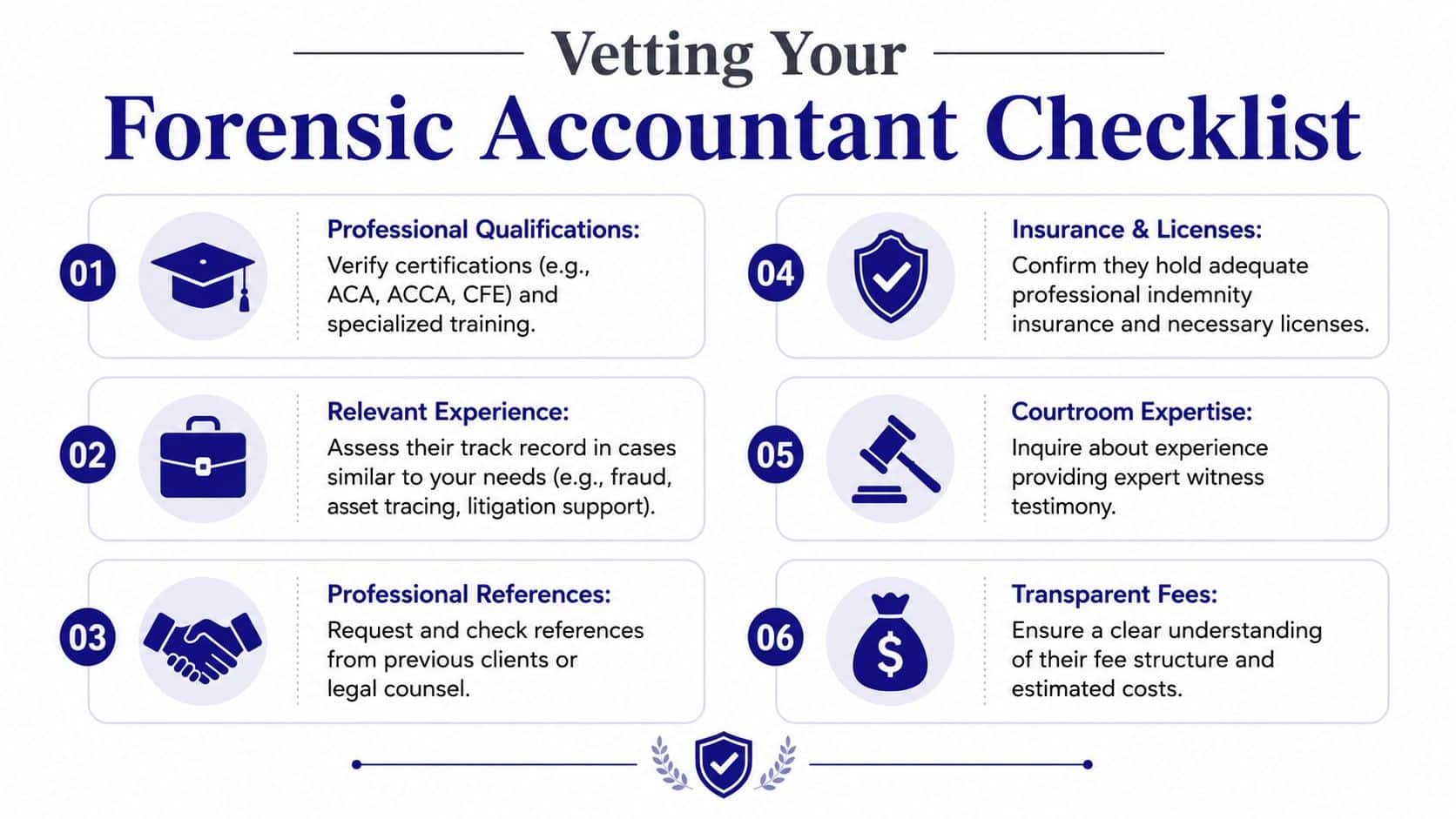
Credentials and legal familiarity
The UK forensic market has matured for decades. The Serious Fraud Office was created in 1988, and the framework has since expanded through the Bribery Act 2010 and the Economic Crime and Corporate Transparency Act 2023 truth behind numbers on UK forensic accounting history. If the accountant hasn't worked in that environment, they may understand bookkeeping but miss the legal rhythm of modern disputes.
Look for professional qualifications, specialist training, and experience in matters that touch UK fraud, bribery, corruption, and civil disputes. Ask how often they work with solicitors, what kinds of instructions they receive, and whether they've had reports tested in arbitration or court. A competent professional should answer calmly and specifically.
Questions that expose real capability
Use questions that force detail, not slogans.
- Relevant case experience: Can you describe a matter like mine, and what evidence mattered most?
- Method: How do you decide whether to test the full population rather than sample the records?
- Court resilience: What do you do to make sure your findings survive cross-examination?
- Independence: How do you manage conflicts if you've worked in my sector before?
- Deliverables: What will I receive, and when will I see it?
- Fees: What drives your price up, and what would count as scope creep?
The best interview answers sound measured, not theatrical. If someone promises certainty before they've seen the records, be cautious. If they can explain planning, evidence gathering, review, and reporting in plain terms, that's a better sign.
For a deeper list of interview points, forensic accounting interview questions can help you structure the conversation and avoid forgetting the awkward but necessary details.
Decoding Services Deliverables and Costs
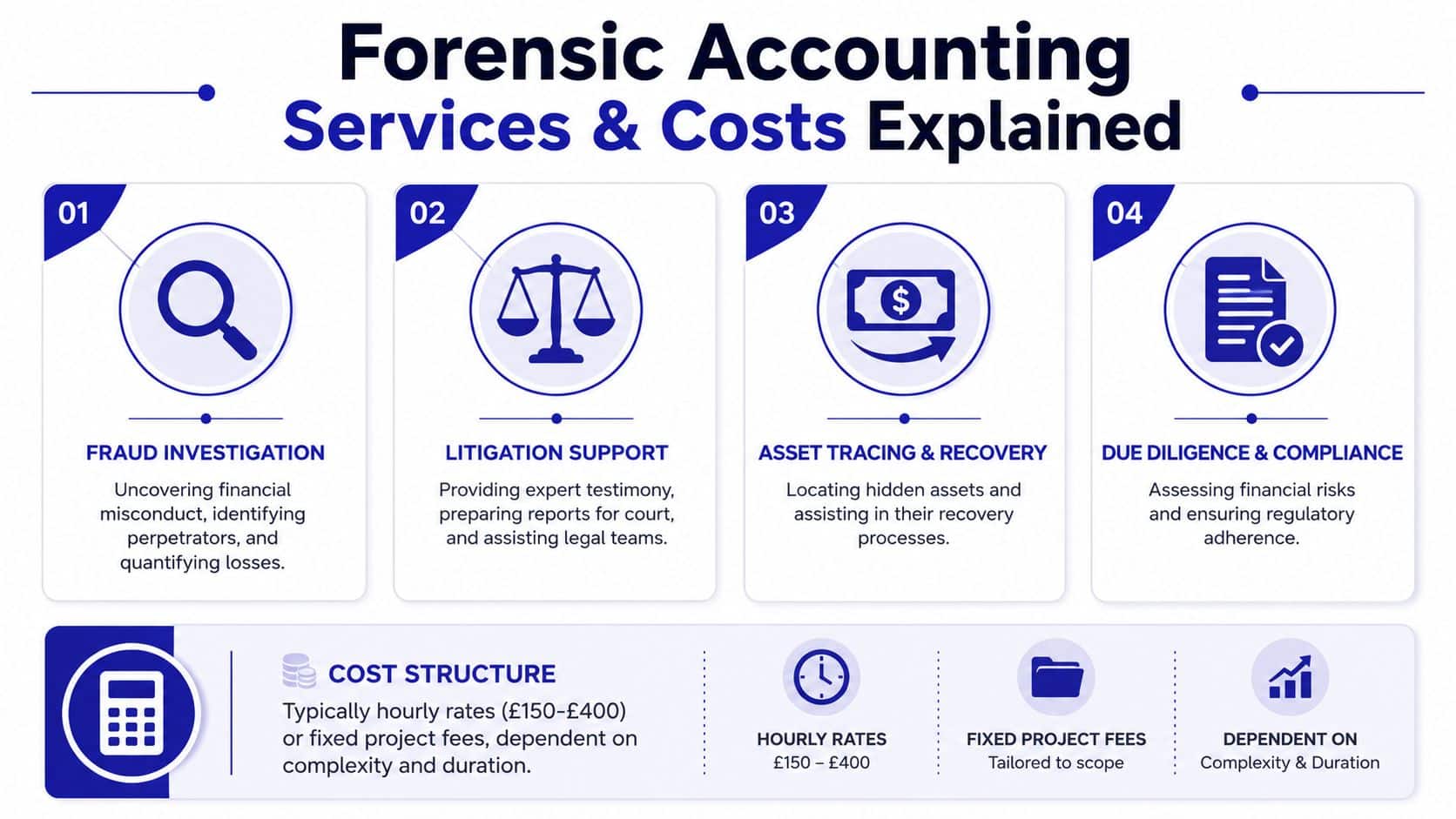
Most buyers don't just want a person, they want an outcome they can use. That might be a fraud investigation, asset tracing, litigation support, due diligence, or a valuation dispute. Each should produce a tangible deliverable, not a vague verbal update that disappears as soon as the call ends.
What you should expect to receive
A solid engagement usually produces a preliminary findings note, a fuller investigative summary, and, where needed, a court-admissible expert report. The report should explain what records were reviewed, what tests were run, what assumptions were used, and where the limits sit. If the matter is contentious, clarity matters as much as technical depth.
The workflow itself should be evidence-led. In UK-style forensic accounting engagements, the process usually runs from defining the allegation, to collecting and preserving records, to financial reconstruction and analytical testing, and finally to a client-facing report academic review of forensic accounting stages. In tracing misappropriation, full-population testing is often preferred over audit-style sampling because it can expose duplicate invoices, unusual timing, and outlier payees that a sample could miss.
How fees really behave
Independent industry guidance puts hourly forensic-accounting fees in the broad range of about $200 to $500+ per hour, with more complex matters reaching $50,000+ in total fees ACFE forensic accountant career guidance. That's not a UK tariff, but it is directionally consistent with higher-end London expert work, where seniority, credentials, and complexity all affect the final bill.
The budget danger is scope creep. If the instruction isn't tight, the review expands, the document set grows, and the cost rises faster than the value. A proper engagement letter should pin down the question, the records, the deadline, the reporting format, and any assumptions. If a firm won't define that clearly, you're not buying certainty, you're buying drift.
Forensic accounting services and processes should always map to those deliverables, because good process protects both the client and the final opinion.
The Engagement Process With Lighthouse Consultants
The strongest forensic engagements don't begin with a report, they begin with control. A stressed finance director, solicitor, or claims handler needs to know what happens first, what gets preserved, and how the work will stay focused. That's where a structured process matters more than a flashy pitch.
A process built for disputed records
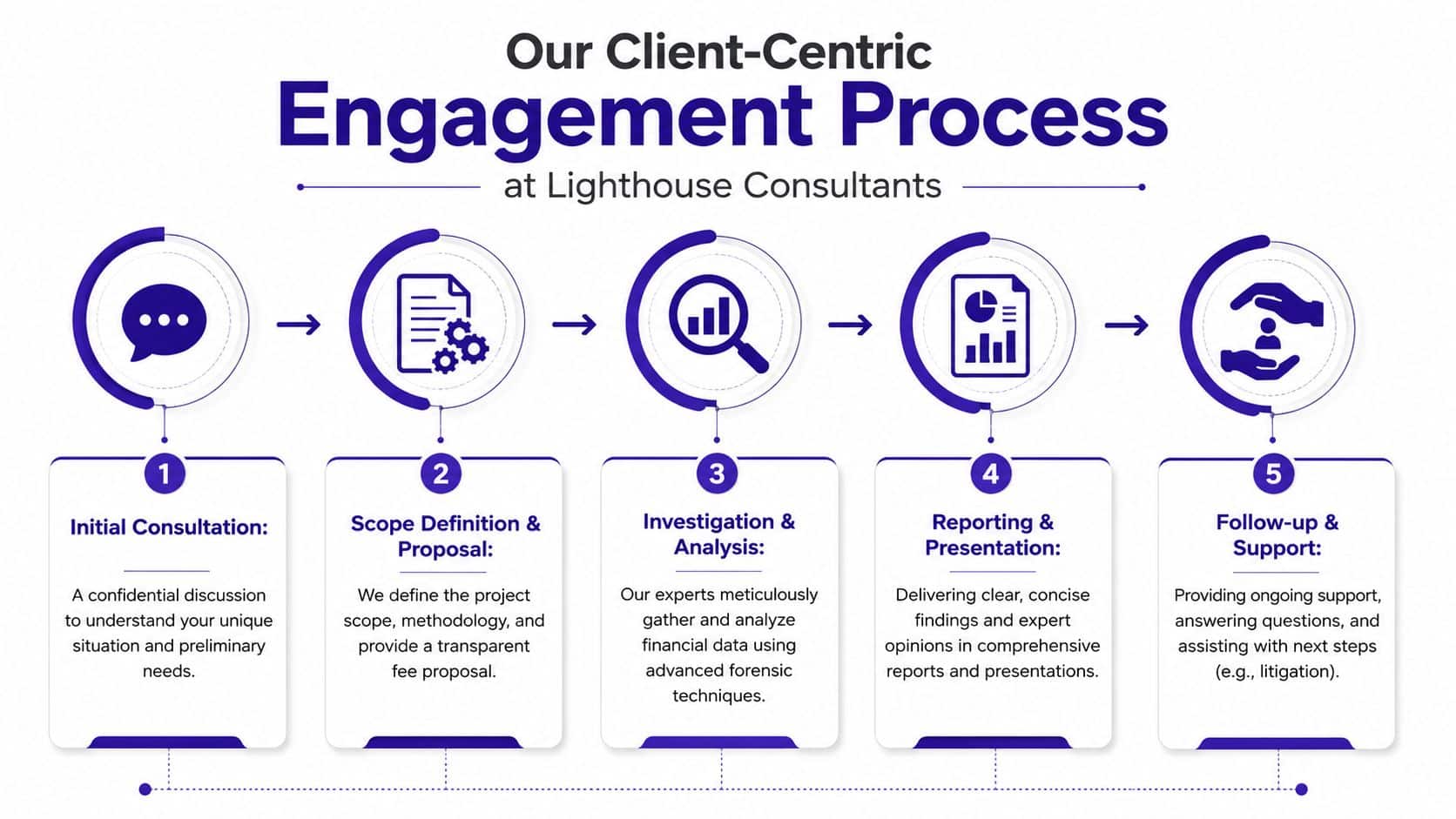
Lighthouse Consultants follows a straightforward path, starting with a confidential discovery call, then a scoped action plan, then reporting. That structure helps people move from chaos to clarity without committing to a full investigation before they understand the likely direction of travel. It also helps lawyers and business owners see where the work is heading before fees accumulate.
The technical side still has to be disciplined. Evidence is preserved first, the allegation is defined clearly, and analysis is run across the records that matter rather than around them. That's especially important in fraud and loss cases, where selective testing can miss the pattern that full-population review reveals.
What a good client experience feels like
A good forensic team keeps you informed without drowning you in jargon. You should know what has been reviewed, what remains outstanding, and what the likely next decision point is. If the matter moves toward negotiation or litigation, the same evidence trail should support the next stage rather than needing to be rebuilt.
Standout advantage: the client should never wonder whether the work is drifting. If the scope is clear, the route stays visible.
That approach fits the modern UK environment, where fraud, bribery, and corporate transparency issues can overlap quickly. It also works for insurers, boards, and legal teams who need analysis that is calm, independent, and ready for scrutiny. Lighthouse Consultants is one option for that kind of work, especially where the brief needs forensic accounting, loss quantification, or dispute support in one controlled process.
Your Next Step Towards Financial Clarity
If you're holding a file full of missing pieces, the right move isn't to keep guessing. It's to get the records preserved, the question narrowed, and the evidence reviewed by someone who does this work every day. That's how you turn a stressful dispute into a manageable assignment.
The best forensic accountant near me choice is the one that can show you a method, not just a claim. Ask how they investigate, what they deliver, how they price the work, and whether they've handled UK disputes that need clear, defensible reporting. If those answers feel vague, keep looking.
For business owners, solicitors, insurers, and directors, delay usually helps the wrong side. Records go missing, memories shift, and the cost of unpicking events rises. A confidential first call is the cleanest way to start, because it gives you an immediate sense of whether the problem is suitable for forensic analysis and what the next step should be.
A CTA for Lighthouse Consultants.