A clean audit can still leave you with a bad deal, a disputed loss figure, or a cash squeeze that makes no sense on paper. I see it most often when a finance director has tidy year-end accounts, yet working capital tightens, or when a buyer signs a transaction and then finds liabilities the audit never needed to flush out. In those moments, the issue isn't whether the books were prepared properly. The issue is whether they answer the right question.
That's where due diligence vs audit gets misunderstood. An audit tells you whether the historical accounts give a true and fair view. Financial due diligence asks something sharper, whether the business, the numbers, and the assumptions support the price, risk, and structure of a specific deal, claim, or dispute. UK businesses lose time and money when they use one process as a substitute for the other, because they are built for different decisions under different legal and commercial pressures.
| Dimension | Statutory Audit | Financial Due Diligence |
|---|---|---|
| Main question | Are the accounts materially correct and compliant? | Is the business worth the price, and what could change the deal? |
| Trigger | Annual reporting cycle | Acquisition, investment, lending, or another transaction |
| Output | Audit opinion | Deal-focused report and risk findings |
| Scope | Historical financial statements | Earnings quality, working capital, forecasts, debt, tax, and deal risks |
| User | Shareholders and other stakeholders | Buyer, investor, or lender |
If you're an SME owner, litigator, insurer, or lender, the practical question is simple. Which report will stand up in the room where the decision gets made, whether that is a board meeting, a data room review, a claim challenge, or a witness box? The answer depends on what you need to prove, not just what you need to read.
When the Books Look Right but Something Still Feels Wrong
A UK finance director once puts it plainly in a kickoff meeting, the accounts are signed off, the margin looks stable, and yet the business keeps leaning on the overdraft. That's not an audit failure. It's a category error. The audit did what it was meant to do, it tested whether the accounts were materially correct, but it was never designed to tell you whether the business model was still behaving in the real world.
That same confusion shows up in acquisitions. A buyer reviews a clean audit, assumes the target is straightforward, then discovers post-completion that the working capital profile, debt terms, or earnings quality doesn't support the price paid. The audit may have been fine. The deal still wasn't. UK market guidance draws this line clearly, an audit is a complement, not a substitute, for due diligence in an acquisition. It is common for the same company to be perfectly auditable and still require transaction-specific scrutiny. Understanding the differences between an audit and financial due diligence
Why the confusion costs real money
The problem gets expensive when people rely on the wrong work product in the wrong context. A claims handler may want a loss figure that can survive challenge. A solicitor may need evidence that holds up in dispute. A lender may need comfort on cash generation, not just compliance with reporting rules. An audit rarely answers those questions on its own.
Practical rule: if the question is “were the numbers prepared properly?”, audit helps. If the question is “can I rely on these numbers to make a commercial decision?”, due diligence is the better fit.
The UK distinction matters because company law gives audit its statutory footing, while due diligence is a transaction tool, not a compliance ritual. UK practice has long treated due diligence as a broader risk check on the target business, including earnings quality, working capital, debt terms, and future cash-flow reliability. That is exactly why a clean audit can still leave serious valuation or completion risk unresolved.
The situations that trigger the wrong instinct
Fraud suspicions often start with accounts that look neat but feel too smooth. Business interruption claims often need a loss model that goes beyond historical figures. Divorce, inheritance, insolvency, and shareholder disputes all tend to expose the same issue, the records may exist, but the key question is still unanswered. Once you separate historical assurance from transaction or dispute testing, the right workstream becomes much easier to choose.
What Each Process Actually Does in the UK
A statutory audit in the UK sits inside the Companies Act reporting framework. It is a regulated, independent review of annual financial statements, and its purpose is to support an opinion on whether those statements give a true and fair view. That's why it follows a standardised assurance process and why the reporting cycle is tied to a financial year rather than to a deal, claim, or dispute.
Financial due diligence works differently. It is commissioned by a buyer, investor, or lender, and it is customized for the decision in front of them. The question is not whether the accounts are compliant in a general sense. The question is whether the reported performance is sustainable, whether the assumptions make sense, and what hidden issues could affect price, structure, or post-completion performance. A UK government-hosted summary of Deloitte's evidence describes due diligence as an investigation “designed to assist a purchaser evaluate a target company”, and notes there is no formal opinion in the statutory audit sense. UK government summary of due diligence and reporting accountant work
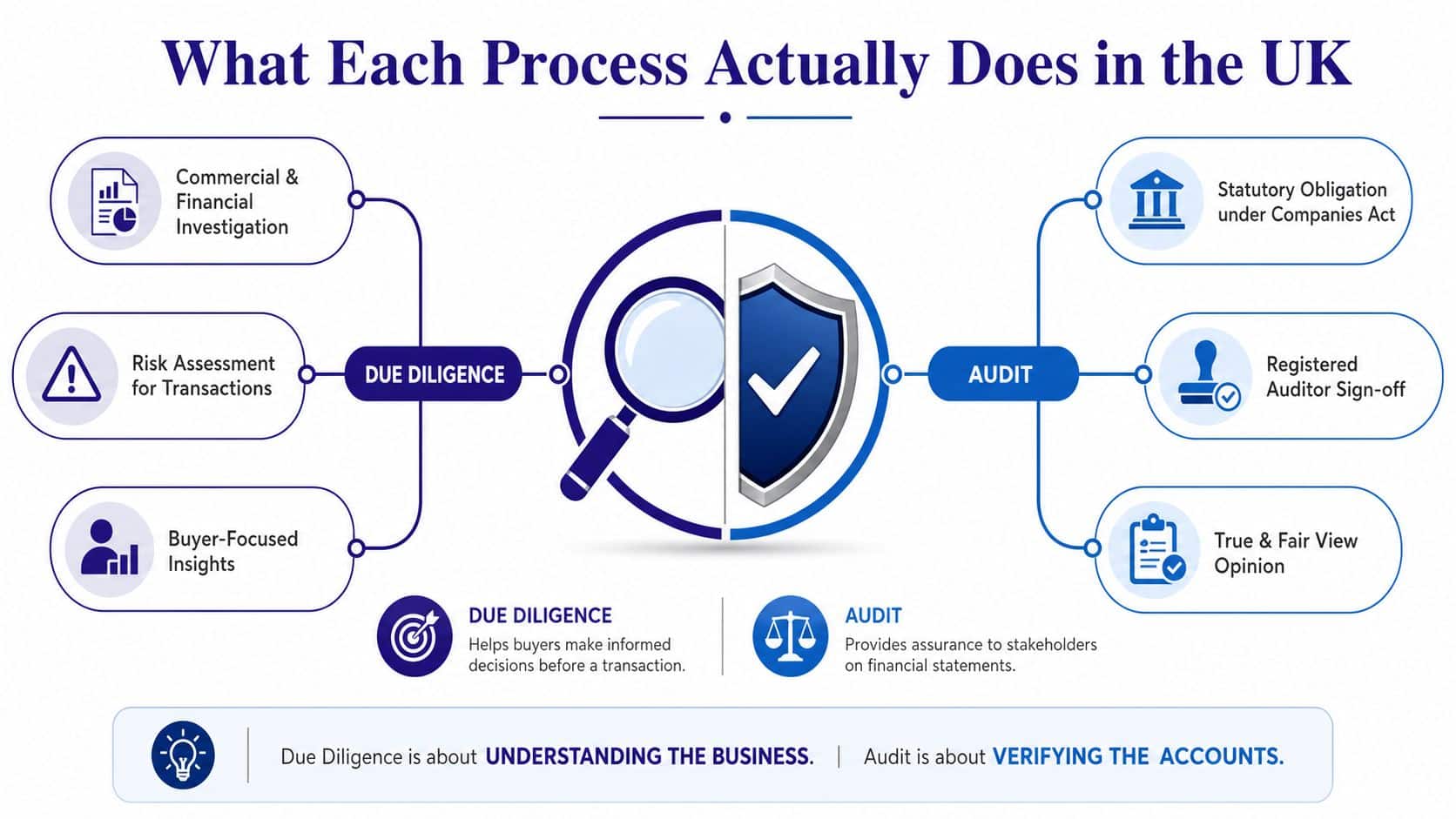
The UK version of due diligence is broader than most people think
In practice, due diligence can cover financial, commercial, legal, tax, operational, and ESG workstreams. Only financial due diligence is the direct counterpart to an audit, because it tests the quality and sustainability of earnings, working capital, forecast assumptions, key personnel, and accounting systems. That's the work you want before a private-equity bolt-on, a management buy-out, or a refinance where the lender cares about cash generation rather than just historical compliance.
For a simple internal explanation, I'd put it like this. Audit asks whether the annual accounts are reliable. Due diligence asks whether the business is investable on the terms proposed. If you need a plain-English explainer for colleagues, the overview at what is financial due diligence makes the transaction angle easier to separate from audit language.
Different people commission them for different reasons
Audit is a statutory checkpoint, so the company, its shareholders, and its regulator-facing obligations drive the work. Due diligence is buyer-led, lender-led, or investor-led, so the scope bends around the risk profile of the deal. That difference matters in a private company context, where disclosure is often thinner and the buyer cannot assume the accounts tell the whole story.
A useful way to frame it is this, audit gives confidence in reported history, due diligence tests whether history supports a commercial decision. If a director, solicitor, or claims handler cannot explain that difference clearly, they usually end up commissioning the wrong scope.
Side by Side on Scope Timing Evidence and Liability
| Dimension | Statutory Audit | Financial Due Diligence |
|---|---|---|
| Objective | True and fair view on annual accounts | Support a transaction decision |
| Trigger | Annual reporting requirement | Deal, investment, lending, or acquisition event |
| Frequency | Annual | Event-driven |
| Scope | Standardised and retrospective | Tailored and forward-looking |
| Evidence | Supports an assurance opinion | Supports negotiation, adjustment, and drafting |
| Deliverable | Audit report and opinion | Due diligence report, issues list, and recommendations |
| Liability | Shaped by audit regulation and statutory context | Usually contractual and engagement-specific |
| Main cost driver | Audit effort across a financial year | Depth of commercial, financial, and risk analysis |
The biggest practical difference is timing. Audit is annual and retrospective. Due diligence is event-driven and forward-looking. That alone changes what evidence matters, because a buyer wants to know whether earnings are sustainable, whether working capital needs have been normalised, and whether forecast assumptions are credible before completion. A statutory audit is not built to answer those questions.
Evidence does different jobs in each process
Audit evidence is assembled to support a binary professional opinion on the accounts. Due diligence evidence is assembled to inform negotiation, adjustment, warranty drafting, and sometimes whether the deal should proceed at all. That means the same ledger or management account can serve both processes, but it won't be interpreted the same way.
A buyer who wants a practical checklist can use a published due diligence checklist for FedEx TSP sellers as a reminder of how transaction work becomes more granular than audit work. The point isn't the branding, it's the structure, because due diligence needs transaction-specific questions, not just a general review of the books.
Liability follows the brief, not the label
Liability is another place where confusion bites. Audit liability sits inside the statutory and professional framework that governs audit work. Due diligence liability is generally set by the engagement terms, the scope of the ask, and the commercial purpose of the report. If the brief is too loose, the report will be too vague. If the brief is too narrow, the buyer won't get enough comfort to move.
The same numbers can lead to very different outputs. An audit may say the accounts are acceptable. Due diligence may say the business has a weak working capital profile, fragile forecasts, or earnings that depend on one key customer.
That's why the cleaner comparison is not “which is more detailed”. It is “which one answers the decision-maker's question”. Once you keep that fixed, the rest of the process design starts to make sense.
Practical Checklists and Sample Engagement Scopes
A finance director preparing for audit and a founder preparing for sale need different folders on the data room index. Some documents overlap, bank statements, nominal ledgers, contracts, and management accounts, but the purpose changes. Audit wants evidence to support the annual statements. Due diligence wants evidence to test the deal thesis and the risks behind it.
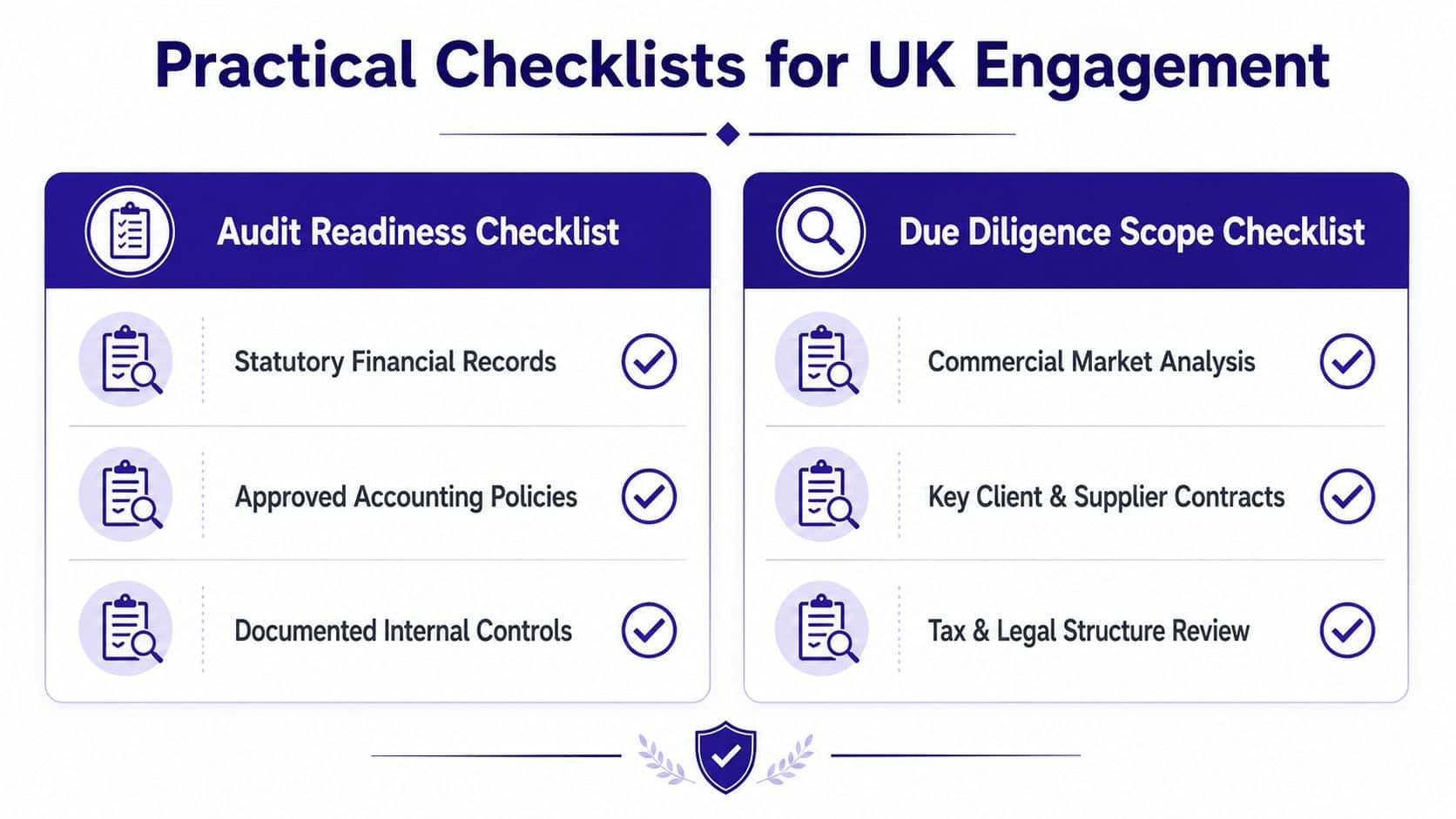
Audit readiness checklist
- Statutory financial records. Keep ledgers, reconciliations, prior-year comparatives, and year-end journals tidy.
- Approved accounting policies. Make sure the accounting basis matches the company's reporting framework and has board approval.
- Documented internal controls. Keep evidence of who approves payments, journals, and unusual adjustments.
- Contract and balance support. Retain major supplier, customer, lease, and debt documents that back up the figures.
For a team wanting a deeper view of control expectations, the internal control report overview is a useful reference point, especially where control weakness could affect the reliability of year-end numbers.
Due diligence scope checklist
- Commercial market analysis. Prepare a clear view of who buys, why they buy, and what drives margin.
- Key client and supplier contracts. Show concentration risk, renewal timing, pricing terms, and break clauses.
- Tax and legal structure review. Map intercompany balances, entity roles, and any structural issues that affect completion.
- Working capital schedules and forecast assumptions. Explain seasonality, one-offs, and why the forecast is believable.
- Management presentation pack. Align the story in the deck with what the numbers show.
A good due diligence scope reads like a decision paper, not a compliance certificate. If you need a model of how detailed an acquisition brief can get, the internal audit vs external audit comparison also helps directors see where independent assurance ends and operational testing begins.
Two sample scopes that sound very different
A mid-market acquisition scope usually asks for a review of sustainable earnings, normalised working capital, debt-like items, quality of revenue recognition, and forecast sensitivity. An annual statutory audit scope usually asks for a review of financial statement assertions, accounting policies, material estimates, and evidence that the accounts comply with the relevant framework. The first scope is built around price and protection. The second is built around compliance and opinion.
Practical insight: if the engagement letter sounds interchangeable, the scope is probably wrong.
That's why I encourage clients to think in terms of deliverable language. If you need a report that can support negotiations, warranty drafting, or completion mechanics, you need due diligence. If you need an annual opinion for stakeholders, you need an audit. If you need both, ask for each workstream to be scoped separately so one doesn't dilute the other.
Which One Your Situation Actually Requires
A trade sale by an SME usually needs financial and commercial due diligence, not just an audit. The trigger is the buyer's need to price risk properly, and the right expert is a transaction accountant or corporate finance team that can test earnings quality, working capital, and forecast reliability. A clean audit helps, but it does not remove deal risk. If the buyer is borrowing to fund the acquisition, the lender may also want its own view of cash generation and debt serviceability.
A compliance review under the Bribery Act or economic crime rules is different again. That calls for audit plus forensic-style procedures, not a one-off due diligence exercise. The reason is simple, compliance questions often need transaction tracing, control testing, and evidence preservation. A routine audit may surface control issues, but it will not usually be designed to trace suspected misconduct through documents, counterparties, and payments.
The fact pattern changes the expert you need
Litigation, shareholder disputes, divorce, inheritance, and insolvency cases often start with audited accounts, then move far beyond them. The work needed is usually forensic accounting, because the task is to quantify loss, trace movements, test assumptions, or present evidence that can stand in court. In those matters, the accounts are a starting point, not the answer. The same is true in business interruption claims, where the dispute usually sits in causation, quantification, and exclusions, not in whether the previous year-end audit was clean.
Investor, lender, or board-level acquisition checks usually sit between those two poles. They need financial due diligence, often with tax and legal streams alongside it, because the decision depends on how the deal behaves under stress. Internal control reviews, risk assessments, and sustainability audits belong to a separate internal audit workstream, not the statutory audit cycle. The work is operational and risk-based, so it belongs with people who understand controls, process design, and management action plans.
A short decision guide
- If you are buying, lending, or investing, commission due diligence.
- If you are signing annual accounts, commission a statutory audit where required.
- If you suspect fraud or need evidence for a dispute, bring in forensic accounting.
- If you need controls improved, use internal audit or risk review.
- If the issue crosses borders, pick a team that can coordinate specialist advisers without losing the thread.
For UK threshold questions around what needs auditing at all, the note on what are UK audit thresholds is worth reading before you assume a small company is automatically outside scope.
Overcoming Objections and Choosing the Right UK Partner
The first objection is always cost. Directors see a fee line and assume a lighter review will do. That instinct is understandable, but it often underprices the downside of discovering a problem after completion, after a claim is rejected, or after a dispute has hardened. A scoped discovery call and a clear action plan usually help separate essential work from nice-to-have analysis, which keeps the engagement proportionate.
The second objection is board time. Nobody wants a deal team trapped in meetings while the transaction clock keeps moving. The fix is a phased process with a tight request list, structured interviews, and reporting that lands in usable chunks rather than one overloaded draft at the end. Confidentiality is the third concern, especially in sale processes, and that is handled through proper NDA protocols, ring-fenced access, and a need-to-know approach to the data room.
What a structured engagement model changes
When findings are unwelcome, generic firms often retreat into cautious wording. That helps nobody. A better model produces phased reporting, clear issue grading, and output that can be reused in negotiation, governance meetings, or, where needed, expert witness work. That matters in contentious matters, because a report that can't be defended later is just an expensive memo.
A Chartered Management Accountancy team that combines forensic, consulting, and audit expertise under one roof can usually move faster between these use cases. Lighthouse Consultants in London operates that way, with forensic accounting, due diligence, internal audit, and audit services delivered in a way that can also support expert witness work when the matter escalates. On cross-border mandates, collaboration with international networks gives the team more reach without losing local control of the analysis.
My recommendation on the three decisions that matter
Use a statutory audit when the question is annual compliance and a true and fair view. Use due diligence when the question is whether to buy, lend, or invest. Use both when the business is entering a transaction and the accounts alone won't protect the decision-maker. Then brief the firm tightly, define the decision you need to make, and insist on a scope that matches that decision.
If you're facing a deal, dispute, claim, or control problem and want a London team that can separate the audit question from the due diligence question quickly, book a confidential discovery call with Lighthouse Consultants. A focused call is the fastest way to work out what needs testing, what can wait, and what the next step should be.
A CTA for Lighthouse Consultants.