Your solicitor is pushing a transaction over the line. Your finance team is focused on completion accounts. Management wants the deal signed before quarter end. Then someone mentions a past phishing incident, an outsourced IT provider with patchy documentation, or customer data sitting in systems nobody can map properly. At that point, the issue stops being “technical”. It becomes a valuation problem, a warranty problem, a fraud problem, and in the worst cases, a litigation problem.
That's where many boards get this wrong. They still treat cyber risk as an IT housekeeping matter. It isn't. If you acquire hidden cyber weaknesses, onboard an unsafe supplier, or walk into a dispute without quantifying digital control failures, you inherit financial exposure with legal consequences attached.
Some clients hesitate because they assume cybersecurity due diligence is expensive, slow, or too specialised to matter unless they're a large regulated business. That objection doesn't survive contact with reality. A short, disciplined investigation costs less than a bad acquisition, a mishandled breach, a failed insurance claim, or a shareholder argument over who approved a deal without understanding the risk. Forensic accountants and cyber specialists don't do the same job. The strongest outcomes come when technical findings get translated into loss, liability, and contract language that decision-makers can use.
The Unseen Risk That Derails Deals and Ruins Reputations
Friday afternoon. Heads of terms are agreed, advisers are lining up signatures, and everyone wants the transaction closed before month end. Then a late diligence question exposes an old breach, weak administrator controls, and customer data spread across systems nobody can map with confidence. At that point, cyber stops being an IT issue. It becomes a pricing issue, a warranty issue, a disclosure issue, and, if handled badly, a negligence issue.
A deal can look clean on paper and still carry hidden digital liabilities that damage value within weeks of completion. Integration slows, remediation costs arrive early, insurers ask hard questions, and management time disappears into incident response instead of execution. The board then asks the only question that matters. Why was this exposure not identified, priced, or contractually allocated before signing?
Why this keeps happening
Boards still allow cyber risk to be parked with the CIO or an outsourced provider. That is a mistake. If control failures can lead to fraud, business interruption, ransom demands, regulatory scrutiny, customer claims, or a lower exit multiple, the issue belongs with finance, legal, and the board.
The point is straightforward. A security weakness is only “technical” until it affects revenue, margin, cash, or liability.
Recent UK government findings show that cyber breaches and cyber crime remain common across businesses and charities, and that a meaningful share of incidents involve fraud as well as operational disruption. You do not need a large regulated group to suffer material loss. A smaller company with poor access control, weak logging, and unclear data ownership can still create a seven figure problem once legal fees, forensic work, customer notification, delayed billing, and management distraction are counted. If you want broader context on the pressure facing UK organisations, this overview of the rising tide of cyber threats is a useful starting point.
Cyber risk shows up in board minutes, disclosure letters, insurance claims, covenant discussions, and court bundles.
The objection I hear most often
“We've never had a major issue.”
That statement usually means one of three things. The business was fortunate. Incidents were contained without proper investigation. Or management never translated technical failures into financial exposure.
Those distinctions matter. A phishing incident that “caused no major harm” may still indicate weak payment controls, poor segregation of duties, or inadequate monitoring over privileged access. In a transaction or dispute, that is not background noise. It is evidence of control weakness with direct value implications. In regulated sectors, it also raises questions about governance and record keeping. For teams dealing with sector-specific obligations, this financial services compliance guide is relevant because cyber failures rarely sit apart from broader compliance failures.
What boards should do instead
Ask questions that produce numbers, responsibilities, and legal protections, not reassurance.
- What happened before? Identify prior incidents, near misses, fraud attempts, and unresolved audit findings. Check whether root cause was established and whether the fix was tested.
- What is the downside in pounds, not jargon? Quantify likely remediation spend, interruption loss, legal cost, possible ICO exposure, customer churn, and any hit to valuation or deferred consideration.
- Who pays if this goes wrong? Tie the findings to warranties, indemnities, price adjustment, escrow, insurance recoverability, supplier recourse, and post-completion obligations.
If management cannot answer those questions clearly, you do not have comfort. You have an uncosted liability.
What Cybersecurity Due Diligence Really Means
A board approves an acquisition on Friday. On Monday, outside counsel discovers the target cannot show who has access to customer data, whether backups work, or whether a key supplier can contain an incident. The issue is no longer technical. It is a price, warranty, indemnity, and disclosure problem.
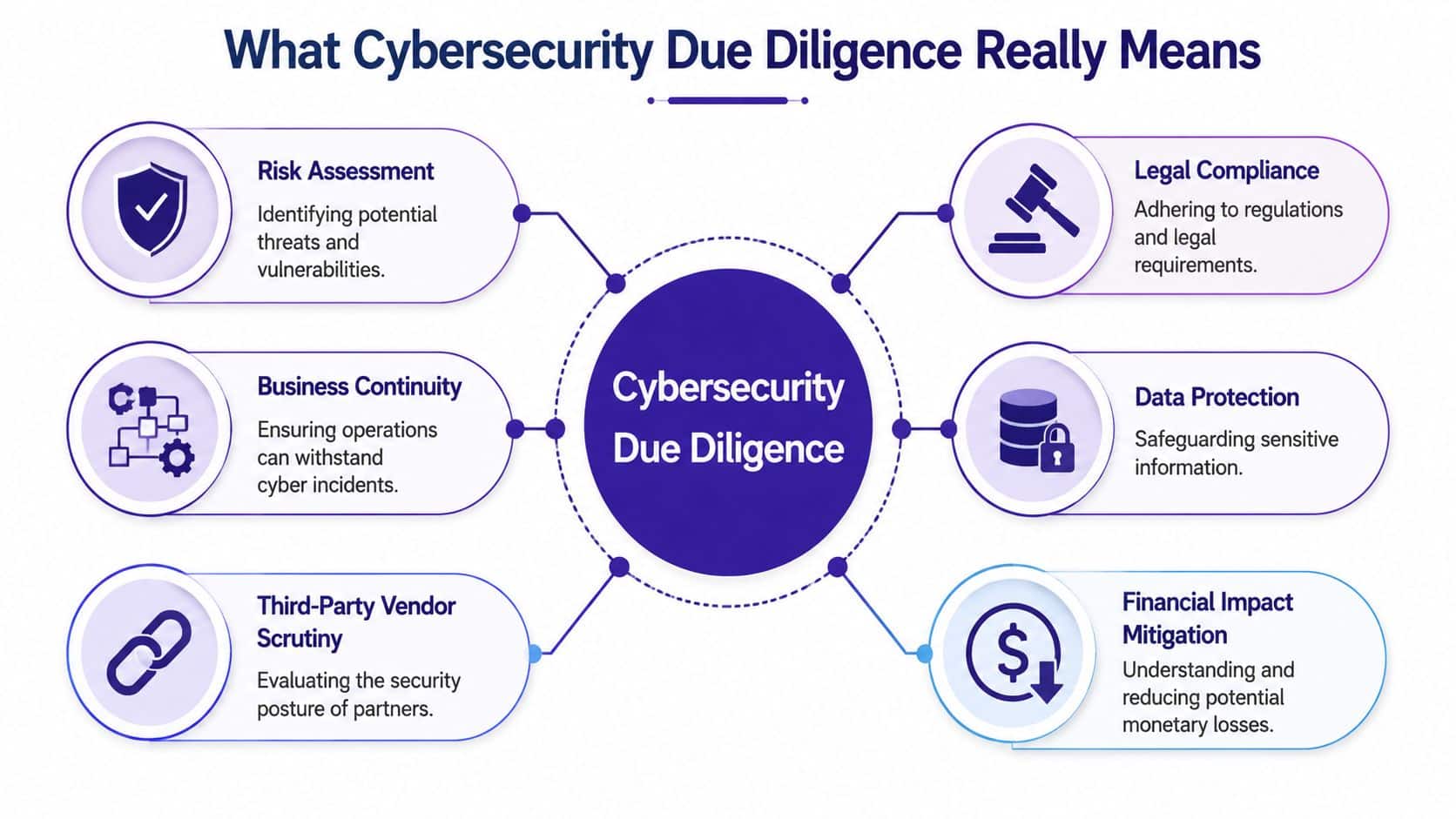
Cybersecurity due diligence works like a financial and legal investigation of digital exposure. Its purpose is to identify liabilities that can reduce value, trigger regulatory scrutiny, delay completion, or fuel post-deal disputes. A proper review tests whether the business can evidence control over data, systems, privileged access, incident response, supplier dependencies, and regulatory obligations.
It also tests whether management's statements stand up. If executives claim they have mature controls, the review should verify that claim against logs, incident records, access reviews, insurance terms, contractual commitments, and prior audit findings. If the evidence is thin, treat that as a governance failure with monetary consequences.
What it covers in practical terms
A sound review answers business questions, not just technical ones. What data would create liability if exposed. Which systems would stop revenue, operations, or client delivery if disrupted. Which third parties create concentration risk. Which security weaknesses contradict warranties, privacy notices, customer contracts, or insurance disclosures.
That is why this work belongs in the boardroom and the deal room, not just with IT.
Why it matters financially
Consultancy.uk's reporting on cyber risk in M&A due diligence points to a clear gap between how seriously acquirers view cyber risk and how inconsistently businesses assess it. The same reporting links weak basics such as poor authentication, limited staff training, and phishing exposure to material breach costs for UK enterprises. For a buyer, investor, lender, or litigation team, that shifts cyber review from a technical exercise to a valuation exercise.
The right question is simple. What will this weakness cost if it fails under ownership, regulatory scrutiny, or disclosure?
That cost can include incident response fees, business interruption, forensic review, legal advice, customer notification, contractual claims, increased insurance premiums, remediation projects, management distraction, and delayed integration. In regulated sectors, the exposure widens to governance, record-keeping, and supervisory issues. Teams dealing with those obligations should read this financial services compliance guide.
Practical rule: If management says, “our MSP handles that,” ask for the contract, service scope, reporting, exclusions, and evidence of testing.
What due diligence is there to decide
Cybersecurity due diligence is there to support a decision. Proceed on current terms. Cut price. Ring-fence the risk through escrow, indemnities, and warranty protection. Require remediation before completion. Or stop.
The boardroom definition
Use this definition. Cybersecurity due diligence is the process of identifying digital liabilities, testing whether management has disclosed them properly, and converting the findings into financial exposure and contractual protection.
Key Triggers for Performing Due Diligence
Most companies wait too long.
They investigate cyber risk after a scare, after a breach, or after a deal starts wobbling. By then, their advantage is lost. Costs rise. Tempers rise faster.
Mergers and acquisitions
An acquisition is the obvious trigger. You are inheriting systems, data, vendors, historic decisions, and unspoken weaknesses. The key financial question is simple. What liabilities are embedded in the target that the accounts and legal disclosures don't fully capture?
In that setting, cyber review should test whether management's representations can be relied on, whether remediation costs should affect price, and whether post-completion integration will expose fresh weaknesses. If the target can't evidence control maturity, the prudent response is to tighten contractual protection, not to “work it out later”.
Venture capital and private equity
Investors often focus on growth, retention, burn, and route to exit. Fair enough. But if a business can't defend its environment, its headline metrics may not survive the first serious incident. The key question isn't whether the company has a security policy somewhere. It's whether weak cyber governance can derail the investment thesis, delay exit, or trigger messy disputes with founders.
For early-stage software businesses, buyers and investors often want a benchmark for internal control readiness before formal diligence intensifies. A practical reference point is this guide for early-stage SaaS SOC 2, which helps non-technical decision-makers see where evidence usually breaks down.
Critical vendor onboarding
This trigger is underrated and often more immediate than a transaction. A new payroll processor, cloud provider, software integrator, or outsourced service partner can create direct exposure on day one.
SecurityBrief UK reports that only 38% of UK respondents could complete security due diligence for a new supplier within two weeks, while the same coverage notes that the UK Cyber Security and Resilience Bill 2025 introduces enhanced supply chain security measures, stricter penalties for non-compliance, and a compliance pressure point around 24-hour notification and 72-hour reporting obligations in the supply chain context, as discussed in this SecurityBrief UK report on supply chain cyber due diligence challenges.
That matters because supplier onboarding is where delay and overconfidence combine badly. A rushed onboarding creates risk. A slow onboarding can cripple operations. The answer is disciplined triage, not endless questionnaires.
Post-incident response
After an incident, due diligence serves a different purpose. You're no longer screening a future risk. You're establishing facts, quantifying impact, preserving evidence, and identifying whether the event reveals deeper control failures.
In that context, legal teams usually need answers to questions like these:
- Was this isolated or systemic
- Did management know, or should they have known
- What losses can be evidenced and recovered
- Did any supplier, employee, or former officer contribute to the failure
The behavioural problem nobody likes to admit
Many UK SMEs don't neglect cyber because they've never heard of it. They delay action because they assume they can deal with it later. The same SecurityBrief UK coverage notes research using UK Government survey data from 2018 to 2024 that identifies procrastination and overconfidence as the main reasons for underinvestment in cyber security among small businesses.
That's exactly why good due diligence needs an external, evidence-led process. Internal optimism is not a control.
The Five Pillars of a Thorough Investigation
A credible investigation needs structure. Without it, you get a pile of technical notes and no usable conclusion.
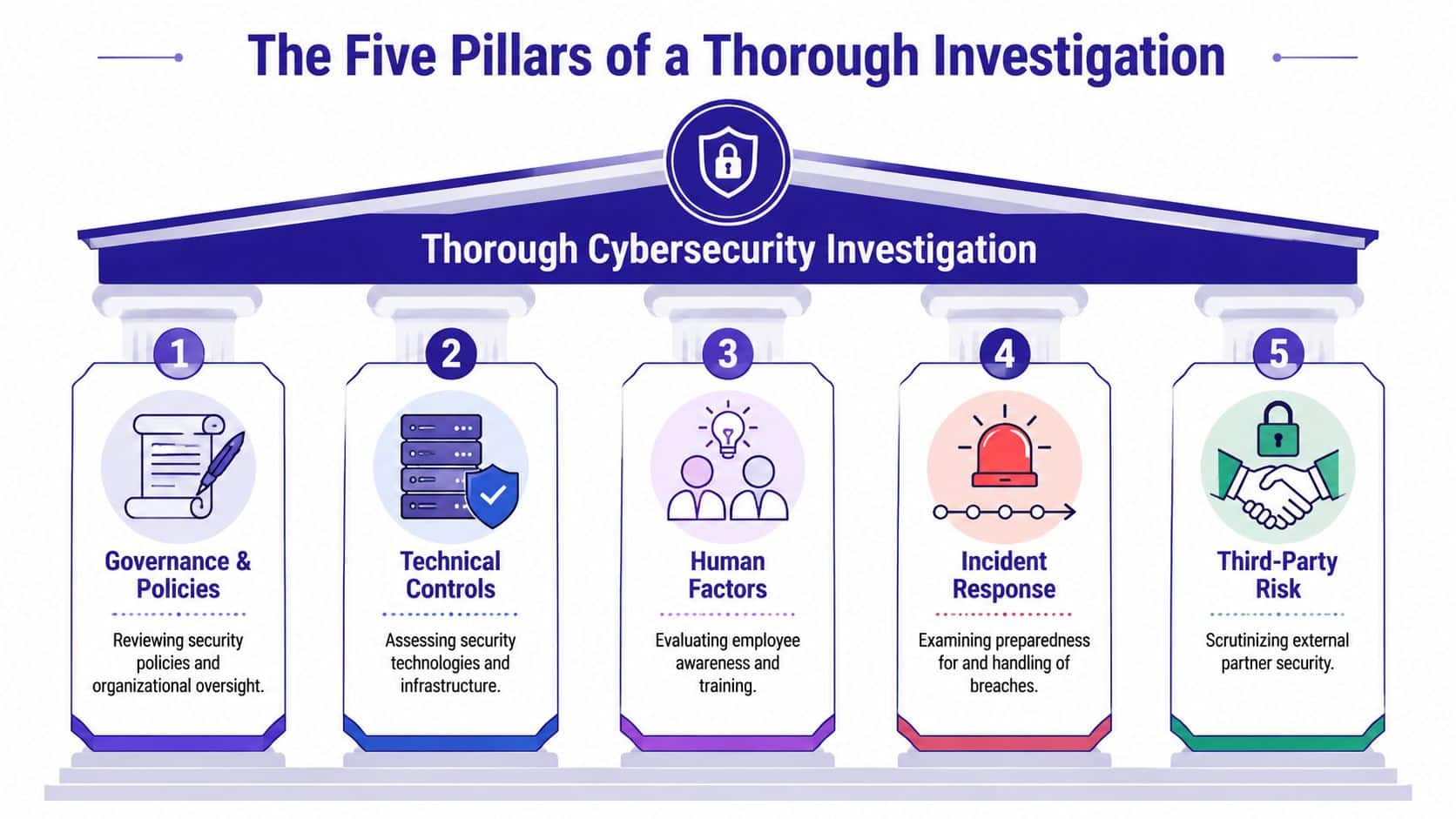
Governance and policies
Start with who owns the risk. Ask for board reporting packs, risk committee papers, incident logs, policy approvals, and evidence that decisions were escalated properly. Then test whether those documents reflect reality.
A strong file usually includes current policies, named accountable owners, and records showing that exceptions were approved rather than ignored. A weak file contains generic templates, stale approvals, and management statements that don't line up with actual practice.
Technical controls
Often, reviews become too narrow. Good work doesn't stop at a vulnerability scan. It examines whether the environment is sensibly configured, patched, segmented, monitored, and tested.
UK-based cybersecurity due diligence mandates require a granular data mapping audit that validates five critical attributes: the sensitivity of held data, its physical and logical location, classification levels, the presence of encryption at rest and in transit, and the mechanism for data deletion or consumer correction, according to CyPro's technical due diligence guidance. The same source states that failure to validate those controls directly correlates to 40% higher regulatory breach penalties under UK GDPR enforcement guidelines.
That point is vital. If the business can't map its data properly, nobody can estimate the exposure properly.
If the CISO cannot explain where critical data sits, how it is classified, and how it is deleted, don't treat that as a communication issue. Treat it as evidence of control weakness.
Human factors
Most breaches don't need genius from the attacker. They need a user who clicks, reuses credentials, or bypasses process because the business made the insecure route easier than the secure one.
Ask for training records, phishing response procedures, joiner-mover-leaver controls, and disciplinary evidence where policies were breached. Then compare that paper trail with actual access rights and user behaviour. The point isn't to produce a morality play about careless staff. It's to assess whether management designed a control environment that people can realistically follow.
Incident response and resilience
Policies alone aren't enough. You need to know whether the business can detect, contain, investigate, and recover from an incident without improvising under pressure.
Useful evidence includes prior incident reports, tabletop exercise records, ransomware playbooks, backup restoration evidence, insurer correspondence, and decision logs from earlier events. If the response plan exists but nobody has tested it, treat it with scepticism.
Third-party risk
Many firms have tighter internal controls than their suppliers. That still won't save them if a critical third party fails.
Review vendor risk classifications, onboarding records, contract clauses, security schedules, right-to-audit terms, penetration testing requirements, and remediation tracking. Also ask a blunt question. Which suppliers could stop revenue, expose regulated data, or trigger reportable disruption if they failed tomorrow?
CyPro's guidance also notes that a CISO's inability to articulate data mapping in real time is a primary red flag indicating a 35% higher probability of historical security policy failures and future vulnerability exposure in UK-targeted M&A. Boards should take that seriously.
A Practical Checklist and Scoring Framework
Most leadership teams don't need another glossy cyber presentation. They need a working triage tool.
Use a simple Red, Amber, Green framework at the outset. It won't replace a full investigation, but it will tell you where to press harder and where to stop taking comfort from vague assurances.
How to score it
- Green means documented, current, tested, and consistent with management's explanations.
- Amber means partial, outdated, untested, or dependent on a single person or supplier.
- Red means absent, contradicted by evidence, or clearly inadequate for the risk profile.
A sensible UK framework should also include external security ratings and real testing. BitSight notes that UK due diligence frameworks use a guided security rating threshold strategy, where targets falling below a pre-defined threshold, typically a rating score below 700, trigger contract language such as cyber security SLAs and mandatory remediation plans, while the absence of manual penetration testing increases the likelihood of undetected material data breaches by 55% in UK acquisition scenarios, according to BitSight's explanation of cyber security due diligence.
Cybersecurity Due Diligence High-Level Checklist
| Pillar | Check Item | Status (Green/Amber/Red) |
|---|---|---|
| Governance | Board receives regular cyber risk reporting with named ownership | |
| Governance | Policies are current, approved, and matched to actual operations | |
| Technical Controls | Critical systems use multi-factor authentication where appropriate | |
| Technical Controls | Manual penetration testing has been completed alongside automated scanning such as Nessus | |
| Data Protection | Data mapping identifies sensitivity, location, classification, encryption, and deletion method | |
| Human Factors | Staff training records and access controls align with user risk | |
| Incident Response | Incident response plan is documented, tested, and supported by evidence of restoration capability | |
| Third-Party Risk | Key vendors are tiered by criticality and subject to contractual security obligations | |
| Third-Party Risk | Security ratings are reviewed and weak vendors trigger remediation or stronger contract terms | |
| Legal and Contracts | Warranties, indemnities, notification duties, and audit rights cover cyber exposure |
What to do with the reds
A Red item should trigger immediate follow-up, not a note for “post-deal integration”. If a supplier or target looks weak externally, open-source intelligence and exposure monitoring can sharpen the picture. For teams assessing whether leaked credentials, exposed assets, or criminal marketplace references are in play, InsecureWeb's dark web monitoring guide offers a useful investigation lens.
You should also tie this checklist to transaction mechanics. This acquisition due diligence checklist is useful when you need cyber findings to sit alongside the wider financial and commercial diligence file.
What this checklist cannot do
It cannot quantify losses, test truthfulness in management responses, or draft the contractual fallout. It identifies smoke. It does not tell you how far the fire has spread. That requires deeper forensic review, legal analysis, and sometimes formal expert evidence.
Translating Red Flags into Financial Impact
A technical report without financial translation is half-finished work.
Boards don't decide on CVSS scores. They decide on price, warranties, indemnities, escrow, insurance, disclosure, and whether they can defend the decision later. That means every cyber red flag needs a commercial consequence attached to it.
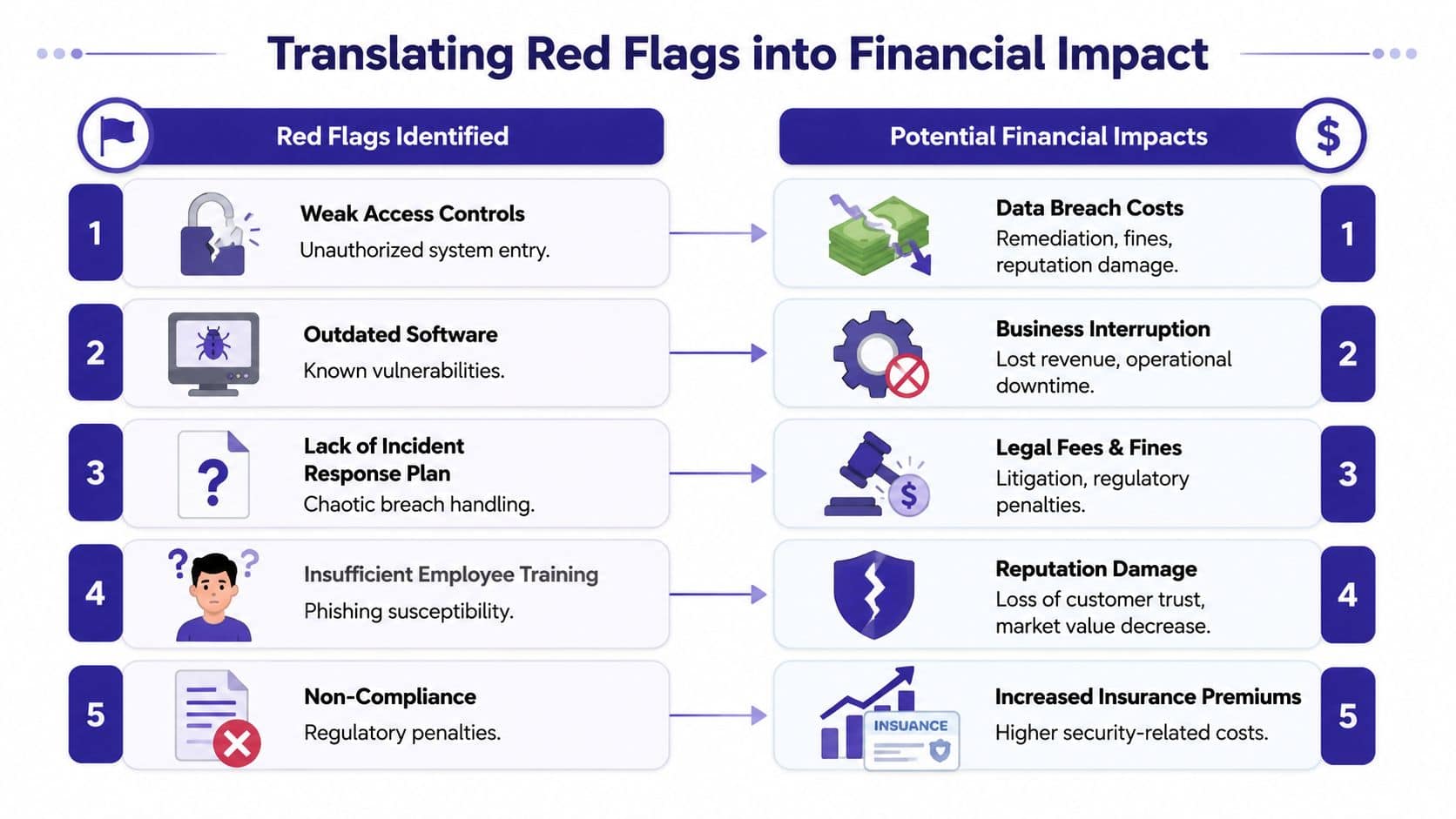
Red flag to consequence
Weak access controls
This raises the probability of unauthorised transactions, internal misuse, and broader compromise. Financially, that can mean remediation spend, revenue interruption, increased insurance friction, and a stronger case for escrow or retention.Poor data mapping
If management cannot identify where sensitive data sits, legal counsel cannot assess notification obligations properly. That drives uncertainty, and uncertainty depresses value. It also supports tighter warranties around data protection disclosures.Untested incident response
A plan that has never been exercised is a paper defence. In practice, weak response capability increases operational disruption and claim preparation complexity. If the business suffers downtime, proving and recovering losses becomes harder.
Here's a concise explanation of how cyber events can spill into trading losses and claims assessment. Review this guidance on cyber business interruption insurance if your concern is not just breach cost but disruption to operations and recoverability.
Where forensic accountants add value
Forensic accountants convert technical weaknesses into categories of loss and contractual risk. We ask questions such as:
- Remediation spend. What will containment, investigation, restoration, legal review, and customer communication cost?
- Business interruption. Which revenue streams or projects could stall, and how will loss be evidenced?
- Deal protection. Does the issue justify a price chip, a specific indemnity, a warranty qualifier, or funds held back at completion?
- Dispute exposure. If something goes wrong later, what evidence exists to show who knew what, and when?
Technical severity doesn't always equal financial severity. A modest-seeming control failure in a revenue-critical workflow can be far more expensive than a dramatic vulnerability in a non-core system.
The commercial point is simple. If you identify a cyber issue but fail to quantify it, the seller will minimise it, the insurer will scrutinise it, and the board will struggle to act decisively.
A short explainer may help some readers before they brief counsel or the board.
The negotiation effect
Once quantified, cyber findings stop being background noise. They become a powerful tool.
A buyer can seek a purchase price adjustment. A lender can impose conditions. Legal counsel can draft targeted warranties and disclosure obligations. If the risk is acute and poorly evidenced, walking away becomes a rational outcome, not an overreaction.
Your Next Steps in Protecting Your Interests
If you're reading this in the middle of a deal, supplier onboarding, insurance issue, or dispute, don't wait for perfect information. Start forcing clarity now.
For business owners and boards
Ask management for a direct statement of cyber exposure in business terms. Not a dashboard. Not a technical memo. A statement covering critical data, critical suppliers, historic incidents, response readiness, and likely financial consequences if controls fail.
Then test whether the evidence supports that statement. If it doesn't, you've found a governance issue.
For investors and lenders
Tie cyber review to value protection. Require evidence that the target can map data, manage third parties, and respond to incidents without improvisation. If weaknesses appear, push them into price, conditions precedent, or post-completion obligations.
For solicitors and litigators
Use cyber findings to sharpen disclosure requests, causation analysis, and damages strategy. In contentious matters, the technical issue rarely wins the case on its own. The winning position usually comes from proving financial impact, foreseeability, and failures in governance or reporting.
For insurers and claims teams
Focus early on evidence preservation, timelines, control history, and loss documentation. Cyber events often evolve into business interruption, fraud, and coverage disputes. Weak records make expensive problems worse.

The right response is disciplined and commercial. Identify the red flags. Quantify the exposure. Put the risk where it belongs contractually. Then decide with your eyes open.
If you need that work done properly, speak to Lighthouse Consultants. We help boards, business owners, law firms, insurers, and investors investigate cyber-related financial risk, quantify losses, support due diligence, and provide expert witness evidence where disputes follow. Start with a no-obligation discussion, get a clear scope, and move quickly before uncertainty turns into avoidable cost.