You notice the problem before you can prove it. Margins tighten, stock figures drift, a supplier invoice looks wrong, a manager disputes a dismissal, or an insurer starts pushing back on a business interruption claim. At that point, most retail owners aren't short of data. They're short of certainty.
That's where many businesses lose time and money. They rely on generic checklists, a quick stock review, or a year-end audit trail that was never built to answer hard questions about fraud, bribery, contract disputes, valuations, or loss quantification. By the time a legal adviser, insurer, lender, or shareholder asks for evidence, the business has assumptions instead of proof.
A proper risk assessment in retail business should do more than list hazards. It should uncover where money is leaking, who controls the process, what evidence exists, and how to quantify the loss in pounds. That's the difference between a compliance exercise and a forensic one.
The Unseen Threats to Your Retail Bottom Line
Retail owners usually spot the obvious threats first. Missing stock. Voided till transactions. Refund patterns that don't feel right. A supplier relationship that seems unusually protected by one employee. Yet the largest problems often sit behind ordinary accounting noise.
Existing retail risk content overwhelmingly focuses on physical theft, while advanced fraud vectors get less attention. UK government data indicates that the average loss for a small UK retailer from fraud is £15,000, but standard assessments often fail to separate genuine operational loss from fraud-induced loss. That gap matters when you need to support a claim, discipline a member of staff, or defend a dispute.
What standard reviews tend to miss
A routine risk checklist might ask whether you lock the stockroom and reconcile inventory. Useful, but incomplete. It often won't test for collusion between staff and suppliers, inflated credit notes, manipulated write-offs, bribery around procurement, or losses hidden inside “normal” wastage.
That matters because the financial story in retail rarely sits in one ledger line. It spreads across margins, discounts, returns, stock adjustments, payroll, and vendor accounts. If no one follows those links, the business treats fraud as error and carries the cost unnoticed.
Hidden loss is rarely hidden because it is sophisticated. It is hidden because no one measures it with the right question in mind.
Cyber risk belongs in the same conversation. Retailers that hold payment data, customer details, supplier banking information, and cloud-based stock records can't treat ransomware as an IT-only issue. The operational and evidential implications are commercial. For a concise look at current attack patterns, the Splash Access ransomware insights are a useful prompt for boards that still see cyber incidents as remote rather than operational.
Why a forensic lens changes the outcome
A forensic-led review asks different questions:
- What changed: Which transactions, margins, suppliers, users, or stores started behaving differently?
- Who benefited: Did a person, vendor, or connected party gain from the anomaly?
- What can be evidenced: Can the business support a disciplinary process, insurance claim, settlement discussion, or court case?
- How much is at stake: What is the provable loss, not just the suspected one?
If your concern sits around dishonest conduct rather than mere weak controls, it helps to understand the patterns first. The five main fraud risks in business provide a practical starting point for recognising where retail losses often begin.
Identifying Your Complete Retail Risk Universe
Most retail assessments fail at the first hurdle because they define risk too narrowly. If the whole exercise starts and ends with shoplifting, slips, and CCTV coverage, you'll miss the issues that usually create the hardest disputes.
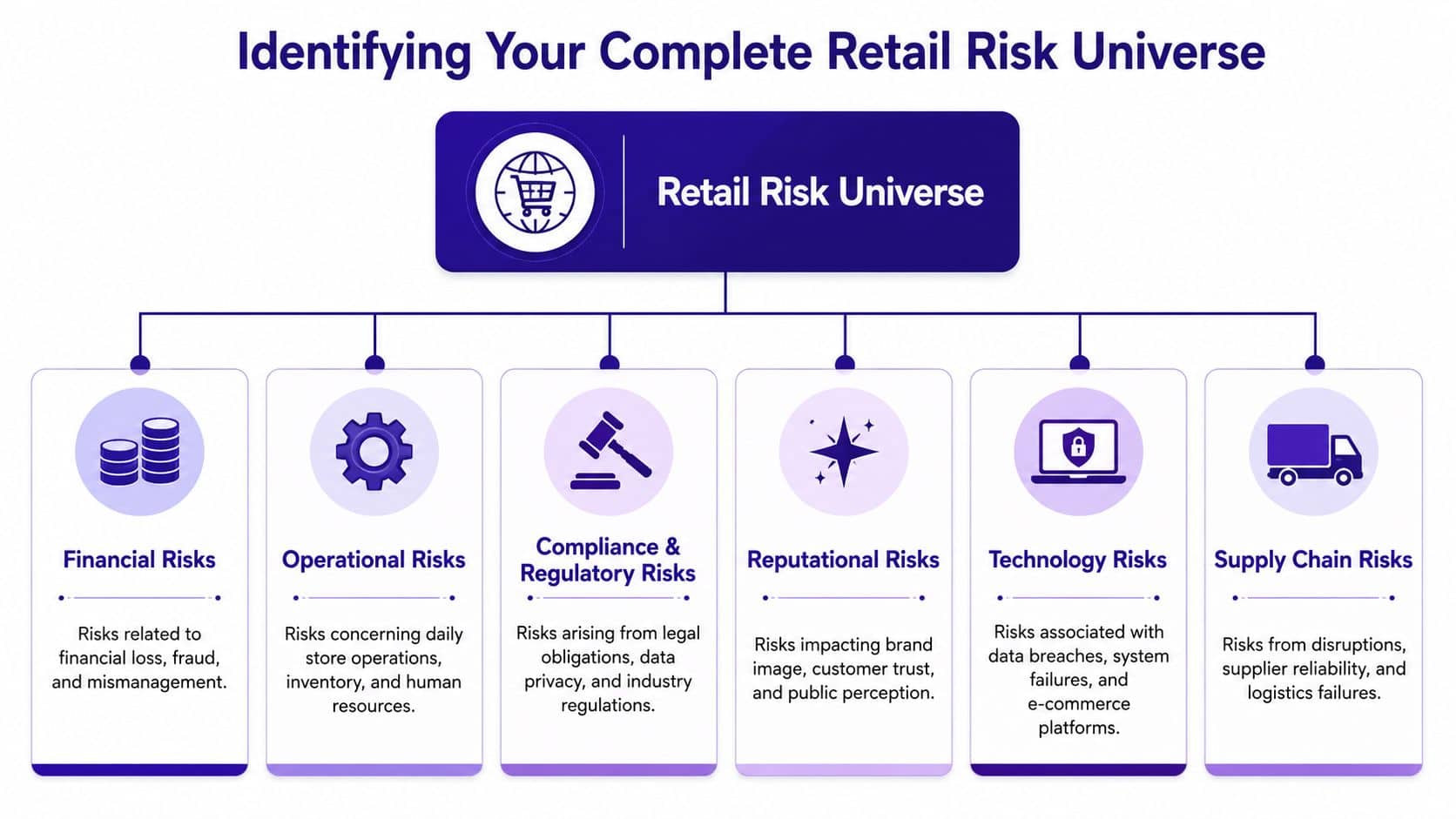
According to the UK Home Office, shoplifting and fraud accounted for approximately 34% of all reported crimes against businesses in the retail sector, and since the 2023 Fraud Act review mandated more rigorous controls, 68% of major UK retail chains have updated their risk assessment frameworks to include real-time data monitoring. Those figures underline a simple point. Retail risk isn't static, and your assessment shouldn't be either.
Six categories worth mapping properly
I prefer to map the full risk universe into six practical categories. That stops managers from forcing every issue into “stock loss” and helps leadership see where responsibility sits.
| Risk category | What it looks like in retail |
|---|---|
| Financial | Till manipulation, supplier overbilling, false credits, duplicate payments, margin distortion, unsupported expense claims |
| Operational | Weak stock handling, poor segregation of duties, inadequate cycle counts, unauthorised discounts, single-person control over critical processes |
| Compliance and regulatory | Poor audit trails, weak payment controls, data handling failures, inadequate policy enforcement |
| Reputational | Customer complaints linked to safety, poor returns handling, public allegations of unfair trading, social media fallout after an incident |
| Technology | Access control failures, weak user permissions, poor logging, compromised payment environments, unsupported systems |
| Supply chain | Vendor fraud, substitution, delivery discrepancies, corrupted procurement decisions, concentration risk with one supplier |
What this looks like on the ground
A finance risk isn't just “fraud”. It might be a phantom vendor set up with banking details controlled by an employee. An operational risk isn't just “human error”. It might be a store process that lets one person receive stock, approve write-offs, and adjust the ledger without review.
A compliance risk doesn't only sit with legal teams either. In retail, it often shows up in incomplete records. That becomes a major problem when an insurer asks how you calculated loss, or when a solicitor asks whether the business can support allegations of misconduct.
For premises-heavy businesses, practical physical controls still matter. A sensible review of access, alarms, and property obligations should sit alongside financial testing, and guidance on fire safety compliance for properties can help businesses align building-level duties with wider operational controls.
One warning sign that deserves attention
If each department keeps its own version of the truth, the assessment will fail before scoring begins. Retail businesses often hold stock data in one system, purchasing in another, incident logs in email, and HR concerns in a private file. That fragmentation hides patterns.
The cleanest frauds don't rely on brilliant deception. They rely on disconnected teams.
A useful exercise is to ask each function one question: “What losses do you see that nobody else records?” The answers usually reveal the actual risk universe faster than a template ever will.
Quantifying Risk with a Forensic Mindset
A risk list without quantification won't help much in the boardroom, a mediation, or a claim file. You need a method that turns concern into a measured exposure.
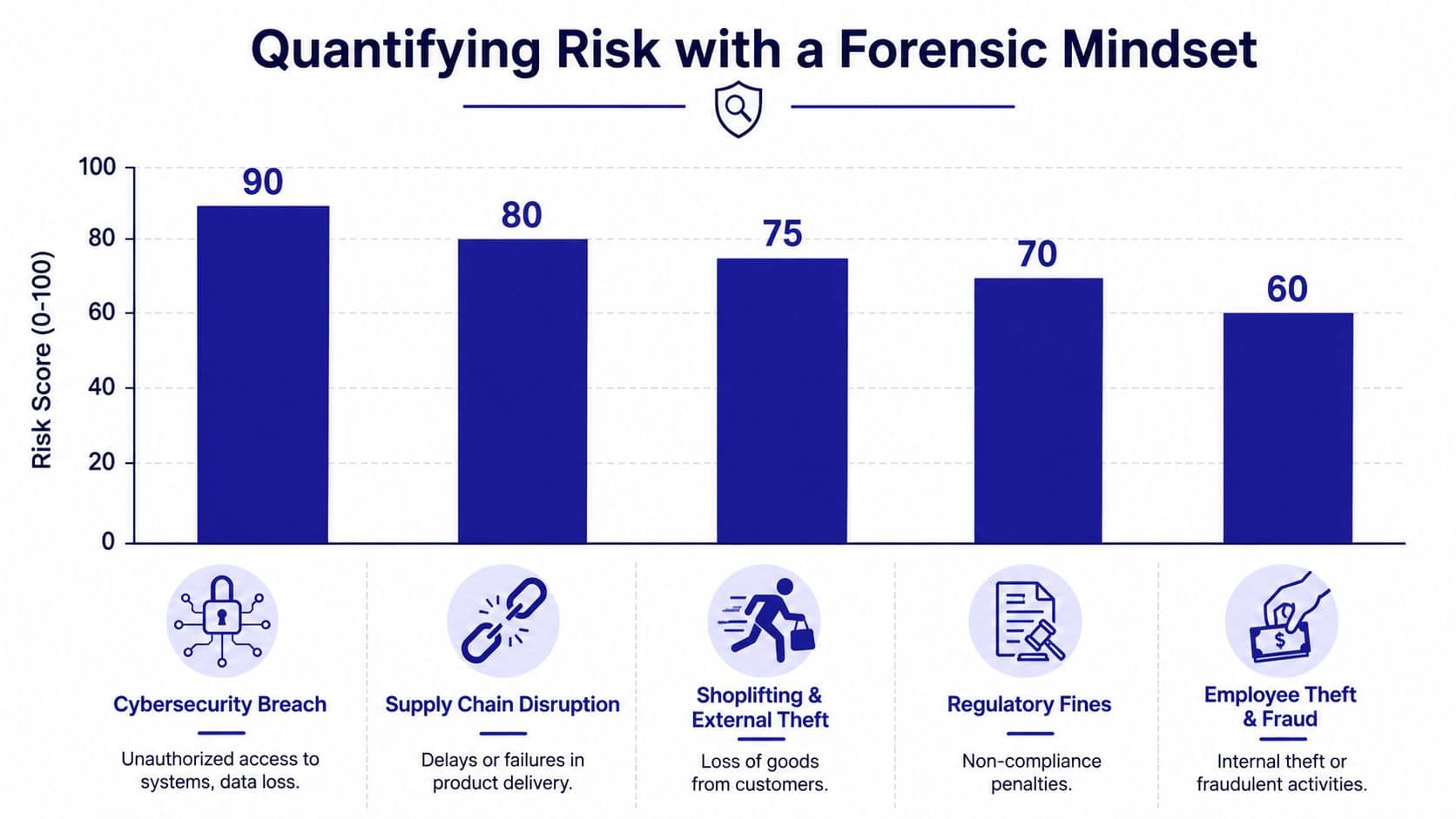
A rigorous UK retail risk assessment follows a four-stage quantitative framework that moves from threat identification to likelihood evaluation, impact measurement, and final prioritisation through a Risk Matrix. The same body of guidance notes that continuous real-time monitoring reduces incident costs by 35% in the post-pandemic retail sector when compared with periodic assessment alone. That's the practical case for building a live process rather than filing a yearly document.
The four stages that actually work
The process is straightforward, but the discipline matters.
Threat identification
Start with store audits, transaction testing, supplier review, user access checks, and incident history. Don't rely on brainstorming alone. Pull till exceptions, stock adjustments, credit notes, and vendor changes.Likelihood evaluation
Test whether the risk is theoretical or recurring. Look for frequency, failed controls, staff overrides, repeat suppliers, and timing patterns.Impact measurement
In impact measurement, a forensic mindset differs from a generic review. Measure the direct and indirect loss. Include stock, cash, margin, recovery cost, professional fees, and business interruption where relevant.Prioritisation
Use the risk matrix properly. Low sits at 1 to 4, medium at 5 to 9, and high at 10 to 15. The score matters less than the discipline behind it.
A practical way to score and quantify
Below is a simple way to keep the exercise commercial rather than academic.
| Question | What to test |
|---|---|
| How likely is it | Past incidents, frequency of exceptions, control failures, concentration of access |
| What is the cash effect | Direct financial loss, lost margin, rework, legal spend, claims exposure |
| Can we prove it | Documents, system logs, approvals, CCTV, email trails, supplier records |
| What happens if we do nothing | Escalation into dispute, repeated loss, insurance issues, weakened recovery options |
This video gives a useful visual frame for thinking about risk scoring in practice.
Don't stop at red, amber, green
Many retailers assign a colour and move on. That's the point where the value of the exercise collapses. If “supplier fraud” is marked high, leadership still needs to know whether the likely exposure sits in routine leakage or a dispute large enough to justify immediate legal advice.
For example, if you suspect a data-related incident, the financial impact won't sit only in IT remediation. It may involve business interruption, customer remediation, legal review, internal investigation, and delayed trading decisions. Likewise, if you suspect procurement corruption, the loss may sit in inflated prices over time rather than a single visible theft.
Practical rule: If you can't express the risk in pounds, you haven't finished assessing it.
The same applies to people risk. A suspected employee fraud issue isn't just an HR matter. If the evidence later supports dismissal, recovery action, or a defence to unfair allegations, your records need to show more than suspicion. They need a quantified trail. That's where techniques used to uncover hidden financial crimes become relevant, particularly when transactions have been disguised as ordinary business activity.
Real-time beats annual every time
Annual assessments have their place, but they often identify losses after they've repeated for months. A live model is better. Use exception reports, vendor change logs, stock variance reviews, user access checks, and recurring management review. The aim isn't more paperwork. It's earlier visibility.
Done well, the matrix becomes a decision tool. It tells leadership where to spend, what to monitor, and which issues require evidence strong enough for insurers, solicitors, or the court.
Why Most Retail Risk Assessments Fail
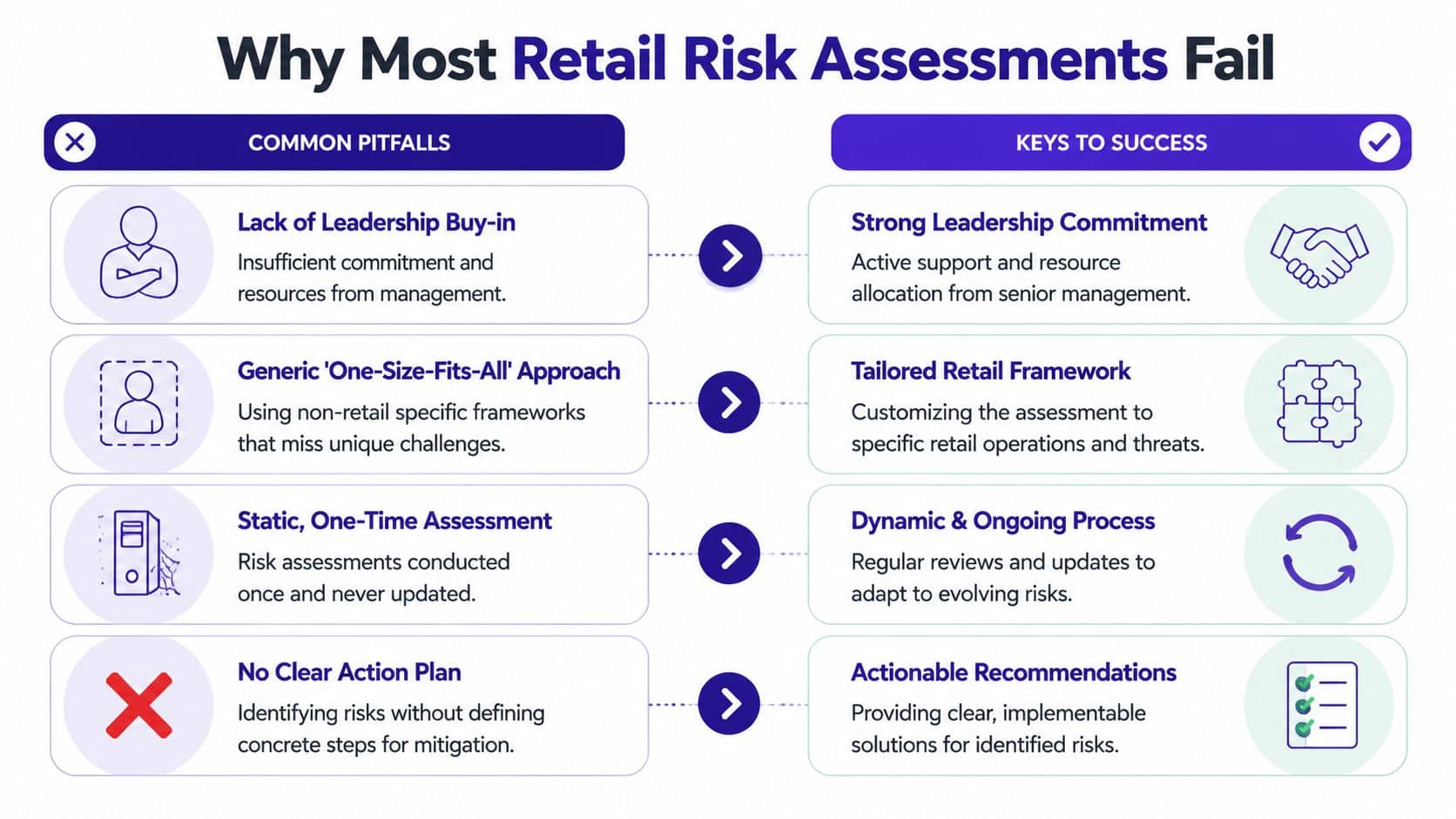
Most failed assessments don't fail because the business lacked intelligence. They fail because the process became performative. Someone downloaded a template, filled in broad categories, assigned a few colours, and moved on.
Benchmark data from the UK National Retail Security Survey reveals that 74% of retail businesses fail their first risk assessment due to assessment fatigue and incomplete data, and a siloed approach leads to a 45% higher rate of unmitigated operational risks when teams don't share information. Those are not drafting problems. They're operating model problems.
Four failure patterns I see repeatedly
The first is assessment fatigue. Staff are asked for the same information in slightly different formats, so they disengage. By the end, key details sit in side emails, local spreadsheets, or memory.
The second is incomplete data integration. Finance holds one set of records, operations another, and IT keeps logs nobody outside the system team reviews. The result looks tidy, but it isn't complete.
The third is one-size-fits-all design. A retail business with concessions, online channels, stock transfers, vendor rebates, and seasonal labour can't use the same framework as a small office-based firm and expect meaningful output.
The fourth is no action path. Risks are identified, but nobody decides who owns remediation, when the test will be repeated, or what evidence will show the issue is fixed.
What works better in practice
A good assessment has to earn cooperation. It should reduce uncertainty for store managers, finance teams, and directors, not create more of it.
- Use one evidence trail: Keep incident logs, transaction samples, stock variance reviews, and control testing in one working file.
- Set decision owners early: Assign responsibility for each major risk to a named person with authority to act.
- Build retail-specific testing: Review refunds, voids, markdowns, vendor onboarding, cycle counts, and user access. Don't rely on generic operational wording.
- Escalate specialist issues quickly: If the pattern suggests fraud, bribery, collusion, or loss likely to enter dispute, treat it as an evidential issue from day one.
A binder on a shelf doesn't reduce risk. Decisions, records, and follow-through do.
The objection I hear most often
Some leaders resist deeper analysis because they assume specialist review is disproportionate. That objection makes sense when the issue is minor. It does not make sense when the business may face an insurance dispute, disciplinary challenge, supplier claim, shareholder disagreement, or unexplained margin loss with no clear root cause.
At that stage, the cost of vague analysis is usually higher than the cost of proper investigation. Weak early work often leads to duplicate effort later, then emergency spending when legal, insurance, or insolvency pressure arrives.
Designing Controls and Presenting Your Case
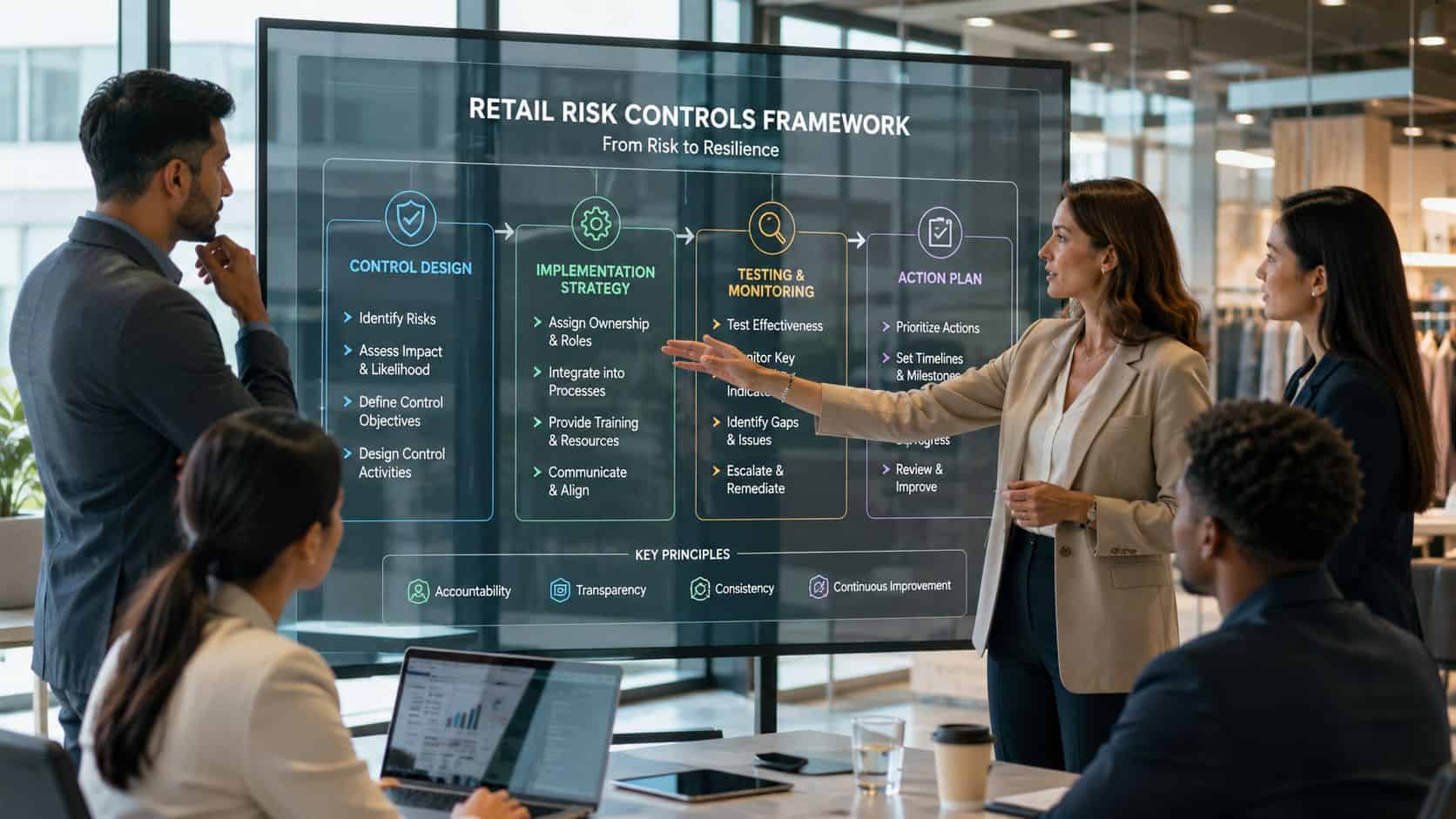
Once the risk is clear, the next job is control design. During this phase, many businesses either overreact with expensive blanket measures or underreact with vague policy language. Neither works.
A study by the UK Financial Ombudsman Service found that retailers who carried out thorough quarterly risk assessments reduced fraud-related losses by an average of 33% compared with those carrying out annual assessments only. The lesson isn't that more meetings solve the problem. The lesson is that disciplined review drives better intervention.
Match controls to the actual failure
If stock is disappearing from one site, don't begin with “improve security”. Begin with the mechanism of loss. Is it receipt fraud, till abuse, after-hours access, false markdowns, or weak transfer controls?
Controls should fit the pattern:
- For inventory leakage: Tight cycle counts, restricted access to high-value stock, review of stock adjustments, and exception testing around transfers and write-offs.
- For payment and supplier risks: Dual approval on vendor creation and bank detail changes, independent review of unusual credits, and periodic supplier legitimacy checks.
- For cyber and systems risk: Access reviews, log retention, stronger user permissions, and prompt investigation of override behaviour.
- For business interruption readiness: Clear records of turnover, gross profit assumptions, incident timelines, mitigation steps, and supporting source documents.
For retail businesses that also operate in hospitality, contractors and mixed-use environments, insurance alignment matters as much as controls. Reviewing specialist cover structures such as hospitality insurance for contractors can help directors understand whether their operational model and policy wording still match.
Present findings in business language
A board paper should not read like an audit worksheet. It should answer five direct questions.
| Leadership question | What your report should show |
|---|---|
| What is the issue | A clear description of the risk and how it arises |
| What is the evidence | Transaction samples, reconciliations, access logs, witness points, or supporting records |
| What is the likely financial exposure | Proven loss, estimated range, and areas where quantification remains incomplete |
| What should we do now | Immediate containment, medium-term controls, and any external support needed |
| What happens if we delay | Ongoing leakage, claim weakness, dispute escalation, or reputational exposure |
Build a case that can survive scrutiny
This is the point many internal reports miss. If the issue later reaches an insurer, opposing solicitor, regulator, or tribunal, your recommendations need to stand up to challenge. A weak note saying “risk appears high” won't help much. A paper showing transaction testing, quantified exposure, control failure points, and remediation costs will.
Where controls involve systems and digital monitoring, it helps to think beyond policy wording and into measurable oversight. Approaches to digital advanced controls are useful when manual supervision no longer matches the scale or complexity of the retail operation.
Good control design is specific. Good reporting makes that specificity impossible to ignore.
From Assessment to Advantage Securing Your Business
A retail risk assessment shouldn't end as a compliance file. Used properly, it becomes a commercial advantage. It sharpens decisions, protects cash, strengthens claims, and gives leadership a defensible basis for action when something goes wrong.
That matters in ordinary trading, but it matters even more when the issue moves into dispute. A margin leak might become a fraud investigation. A supplier concern might turn into a contract claim. A stock loss issue might expose bribery, collusion, or weak oversight by senior staff. A fire, cyber incident, or shutdown might become a contested business interruption claim where every assumption is tested.
The practical benefit of a forensic approach is certainty. You stop arguing from instinct and start working from evidence. You can quantify the probable loss, separate error from dishonesty, identify weak controls, and explain your position in language that insurers, solicitors, boards, and courts can assess.
Retail businesses that do this well do more than reduce downside. They make faster decisions, preserve stronger records, and avoid being cornered by uncertainty when pressure rises. That's the core value of a serious risk assessment in retail business. It gives you control before a loss becomes a crisis, and it gives you proof if that crisis becomes a dispute.
If your review uncovers suspected fraud, unexplained losses, bribery concerns, disputed valuations, shareholder tension, business interruption issues, or questions around insolvency and recovery, don't leave the matter at “further review required”. At that point, the business needs evidence, quantification, and an opinion that can withstand scrutiny.
If you need that level of clarity, speak with Lighthouse Consultants. Their London-based forensic accounting team helps businesses, law firms, insurers, and stakeholders investigate fraud, quantify losses, assess risk, support litigation, and resolve complex financial disputes with clear, independent analysis. A confidential discovery call is a sensible next step when the numbers don't add up and the consequences of getting it wrong are too high.