A solar project can start as a sensible board decision and end as a tax dispute.
That usually happens when the finance team hears that solar is “100% tax deductible”, books the spend, claims relief, and only later discovers that the asset classification, timing rules, or supporting evidence don't match the claim. Then the problem stops being about sustainability and starts becoming about cash flow, HMRC scrutiny, director time, and whether your adviser can defend the numbers.
That's where a forensic accountant becomes useful. Capital allowances on solar panels aren't just a compliance exercise. They affect valuations, covenant forecasts, audit queries, insurance positions, shareholder disagreements, and litigation support if a bad claim creates a wider business dispute. If you need the claim to stand up under challenge, you need more than a rough tax summary. You need a defensible financial position.
The Hidden Risks in Your Green Investment
A business owner approves a commercial solar installation. The pitch sounds straightforward. Lower energy dependence, a cleaner operating model, and tax relief to improve payback.
Months later, HMRC asks questions about the capital allowance claim.
The issue often isn't fraud. It's confusion. Someone treated the installation like ordinary plant, relied on a headline summary, or failed to separate qualifying costs from non-qualifying ones. A claim that looked routine then turns into a file review, an amended return, and awkward conversations with lenders, shareholders, or buyers who relied on the original figures.

Where businesses get caught out
Most problems start in one of four places:
- Asset classification errors that put solar expenditure into the wrong pool.
- Poor documentation where invoices, contracts, and completion evidence don't support the amount claimed.
- Overconfident forecasting where management assumes immediate relief and builds budgets around it.
- Transaction pressure during refinancing, sale, or due diligence when nobody wants to revisit prior tax treatment.
A practical site issue can also affect the wider evidence trail. For example, operational records about maintenance, output, and condition can matter when a dispute expands beyond tax into performance or value. Even a practical resource such as Sparkle Tech solar panel cleaning shows how owners increasingly track panel condition as part of preserving asset value and system performance.
Practical rule: A tax claim is only as strong as the documents and classifications underneath it.
This is why finance leaders often bring in specialist review before or after the claim. A targeted assessment can identify whether the claim is strong enough to survive challenge, or whether it needs correcting before the issue becomes expensive. In transaction settings, that overlaps with forensic due diligence, especially where buyers or lenders need confidence that historic tax positions won't become post-deal liabilities.
Why this matters beyond tax
A weak solar allowance claim rarely stays in the tax box. It can affect:
- Audit issues if the accounting and tax treatment diverge without explanation
- Business dispute accountant work when one shareholder says the business overstated returns
- Loss quantification if a failed project or adviser error leads to a negligence claim
- Expert witness accountant instructions if the matter reaches tribunal or court
That's the hidden risk. The relief is valuable, but only if the claim is accurate, evidenced, and defensible.
Understanding Capital Allowances for Solar Panels
Capital allowances on solar panels let a business deduct qualifying capital expenditure from taxable profits. That sounds simple. The complexity sits in which allowance applies, when it applies, and how the asset is classified.

The UK introduced a 100% First Year Allowance on solar panels as an incentive for renewable investment, and from 1 April 2012 for corporation tax and 6 April 2012 for income tax solar expenditure has been categorised as special rate expenditure, which places it in the special rate pool rather than the general pool. Businesses can also use the Annual Investment Allowance up to £1 million, and a business spending £20,000 on installation can deduct the full £20,000 from taxable profits if the expenditure qualifies under that route, as explained in Fit Solar's guide to solar capital allowances.
Why classification drives everything
Think of the allowances system as a motorway with separate lanes. If you enter the correct lane early, the journey is efficient. If you enter the wrong one, you may still reach the destination, but more slowly and with more risk.
Solar panels usually sit in the special rate lane. That matters because special rate treatment does not behave like standard main pool plant and machinery. If management assumes the wrong category, tax forecasts, project appraisals, and year-end provisions can all be distorted.
This is one of the points where forensic accountant support matters. A forensic review doesn't just ask whether relief is available. It asks whether the business can prove why that relief was chosen, whether the costs were analysed correctly, and whether the tax position aligns with contracts, invoices, asset registers, and financial statements.
The distinction many businesses miss
A short summary helps:
- Capital allowances are a tax deduction, not accounting depreciation.
- Solar panels are treated as special rate expenditure for capital allowance purposes.
- The route to relief can differ depending on the allowance used and the facts of the purchase.
- Documentation matters as much as eligibility when the claim is reviewed later.
A quick explainer can help if your team needs a visual overview before diving into the detail.
The businesses that handle this well usually do one thing early. They map the tax treatment to the transaction documents before the return is filed.
That discipline helps with tax compliance, but it also helps with forensic audit, internal review, and later dispute support if the project becomes contentious.
Which Solar Panel Tax Allowances Can Your Business Claim
The right answer depends on the size of the spend, the timing, and whether the asset fits the relevant conditions. Many owners hear one headline and assume one universal rule. In practice, you need to compare the available routes.
Capital allowances on solar panels in the UK require careful distinction between different allowance structures. Solar panels are classified as special rate expenditure and do not qualify for 100% Full Expensing, which applies only to main rate assets. Solar panels can qualify for a 50% First Year Allowance under the special rate pool classification, and the Annual Investment Allowance remains capped at £1 million per annum, as set out in ECECO Energy's explanation of solar capital allowances.
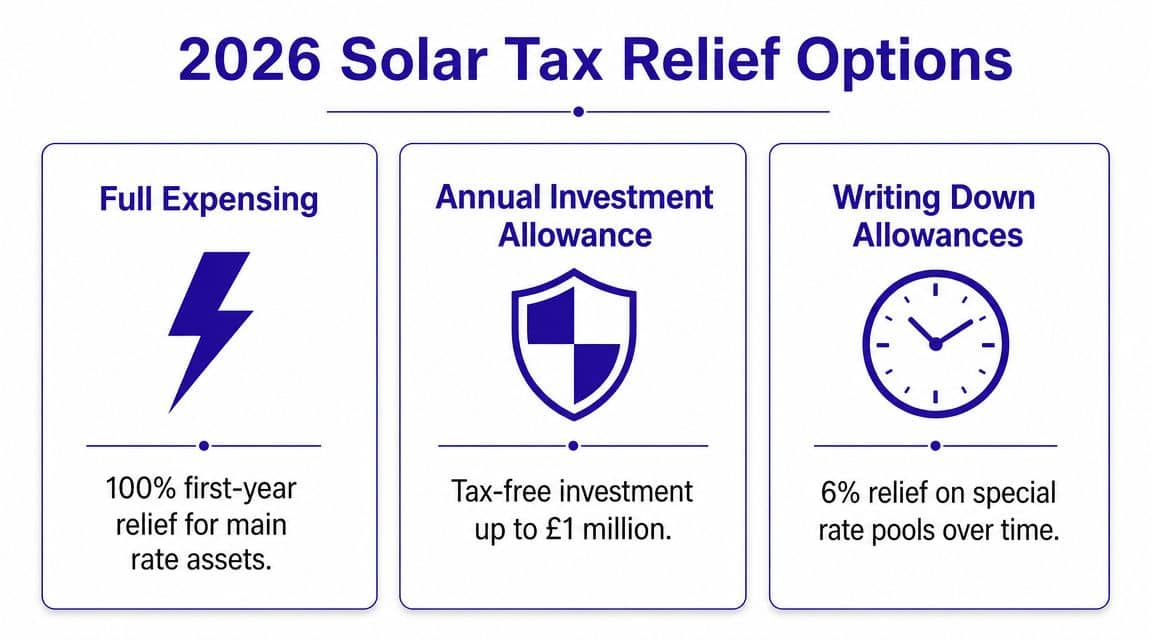
Comparison of UK Capital Allowances for Solar Panels 2026
| Allowance Type | Relief Rate | Annual Limit | Best For |
|---|---|---|---|
| Annual Investment Allowance | 100% | £1 million | Many SME projects where qualifying spend falls within the annual cap |
| Special rate First Year Allowance | 50% | Not stated here as an annual cap in the verified data | New and unused qualifying solar assets bought within the relevant date window |
| Writing Down Allowance in special rate pool | 6% | N/A | Spend not relieved upfront, or claims falling into the ongoing pool treatment |
What works in practice
For many owner-managed businesses, AIA is the cleanest route if the expenditure qualifies and sits within the annual cap. It gives immediate relief and keeps the modelling simpler.
The 50% special rate FYA becomes more relevant when the facts fit the date and asset-status conditions. It can help where expenditure goes beyond what the business wants to allocate to AIA, or where the wider capital programme requires a more strategic split across asset categories.
The 6% writing down allowance is the slower path. It often applies when upfront relief is unavailable or only partly available. That isn't wrong, but it can be a commercial shock if the board assumed a much faster tax recovery.
What does not work
A frequent mistake is treating solar like it qualifies for Full Expensing just because another renewable or plant purchase might. That shortcut causes problems.
Another weak approach is relying on overseas incentive summaries when planning a UK claim. International comparison can help management think about project economics, and a piece like this 2026 Florida solar savings guide can be useful for understanding how other markets frame solar incentives. It should not drive a UK corporation tax position.
Decision point: If the claim changes the board's cash-flow assumptions, review the classification before the return goes in, not after.
This is also where formal review under audit services or a tax-sensitive expenditure review can stop a future dispute. The numbers matter, but the legal classification matters more.
How to Calculate and Claim Your Allowances A Worked Example
A worked example is useful because most errors happen in translation. The business understands the broad rule but misapplies it in the return.
Take a UK limited company that spends £50,000 on a qualifying solar installation. If the expenditure qualifies for the Annual Investment Allowance, the company can deduct the full £50,000 from taxable profits in that year because AIA can give 100% relief on qualifying plant and machinery up to the £1 million annual cap. The position becomes more nuanced where the business is relying on the 50% special rate first-year allowance, which applies only to new and unused assets bought between 1 April 2021 and 31 March 2026, as explained in Oak Network's discussion of solar panel capital allowances.
Step by step treatment
Identify the expenditure
Start with the actual project cost that belongs in the capital allowances analysis. Don't assume every line on the supplier invoice qualifies in the same way.
Confirm the allowance route
If the expenditure fits AIA and the business has sufficient annual limit available, the company may claim the whole £50,000 in year one. If not, the business may need to consider the special rate first-year route or pool treatment.
Tie the claim to the accounting period
The tax team should make sure the expenditure falls into the intended period and that the company's return reflects the right date basis.
Prepare the evidence file
Keep contracts, invoices, board approvals, completion records, and payment support together. If HMRC asks questions later, a reconstructed file is always weaker than a contemporaneous one.
What the return process should include
The mechanics of the return are only part of the exercise. Good practice also includes an internal paper showing:
- Why the asset qualified
- Which allowance was chosen
- How the project costs were analysed
- Who reviewed the claim before filing
That sort of paper reduces friction with auditors and helps management explain the position to lenders, acquirers, or legal advisers.
For directors who want a stronger grip on the numbers before they approve a filing position, a broader guide to financial analysis for UK entrepreneurs is often useful. The same discipline applies here. Decision quality improves when the assumptions are written down and tested.
Where worked examples often go wrong
The biggest mistake isn't arithmetic. It's false certainty.
A business may have a £50,000 project and still get the claim wrong if it:
- Uses the wrong allowance label
- Ignores the new and unused condition where relevant
- Assumes one rule applies to phased installations
- Fails to separate tax planning from tax evidence
If your project includes multiple sites, staged spending, or mixed asset categories, the claim may need to be split rather than forced into one simple treatment.
Common Errors and Financial Red Flags
The most expensive solar claims usually fail for ordinary reasons. They weren't reviewed with enough scepticism.
Solar panels are classified as special rate expenditure under the Capital Allowances Act 2001, so they fall into a special rate pool rather than the main pool. The special rate pool operates at 6% annual writing-down allowance, compared with 18% for main pool assets. On a £500,000 solar investment, that means £30,000 in year one at 6%, compared with £90,000 if it had been treated as main pool expenditure at 18%, as outlined in Lockton's note on capital allowances and renewable energy transactions.
Red flags that deserve a second look
- Main pool treatment for solar when nobody has documented why.
- Cash-flow forecasts built on immediate relief even though the project facts don't support it.
- Grant and subsidy interactions that haven't been analysed properly.
- VAT assumptions copied from installer material instead of reviewed in the business's own context.
- Board papers that quote tax outcomes without attaching the supporting technical basis.
A claim can be technically available and still fail in practice if the business can't explain how it arrived at the amount.
Why these mistakes get costly fast
A slow recovery profile can create a real planning problem. If management priced the project on the assumption of rapid tax relief but the expenditure falls into the 6% special rate pool, the numbers in the investment appraisal may stop matching reality.
That has knock-on effects. A lender may ask why forecast cash cover changed. A buyer may challenge the quality of earnings. A shareholder may allege that management approved the project on a flawed basis. In more serious cases, the review can widen into a forensic audit, a fraud investigation, or a negligence claim against a former adviser if the file suggests careless or misleading advice.
What usually helps
The strongest corrective step is early independent review. That means checking the classification, recalculating the claim, and quantifying the effect on tax, cash flow, and any connected dispute. A business dispute accountant can then separate an honest mistake from a deeper control weakness.
If the project has already become contentious, don't let the file drift. Once positions harden, every missing document becomes more damaging.
Defending Your Claim The Role of Forensic Accounting
When HMRC opens a check, the conversation changes. This is no longer a routine compliance task. It becomes a matter of evidence, consistency, and how well the business can support the judgement calls behind the return.
The UK's April 2026 policy transition matters here. The 50% special rate allowance ends on 31 March 2026, while full expensing continues for qualifying new and unused plant in some contexts from April 2023. At the same time, market guidance notes that solar is usually special-rate expenditure under the Capital Allowances Act 2001. That makes classification evidence critical for cash-flow models, tax claims, covenant calculations, and post-transaction disputes, as discussed in TLT's note on full and partial expensing.
What a forensic accountant actually does
A forensic accountant doesn't just rerun the tax computation. The job is broader and more defensible.
It usually includes:
- Reviewing contracts and invoices to test what the expenditure really was
- Analysing the asset classification against the claim made
- Reconciling the tax treatment to statutory accounts, fixed asset registers, and management forecasts
- Quantifying any overclaim or underclaim if the return needs correction
- Preparing a clear evidence file that legal advisers, auditors, and HMRC can follow
That's why forensic accounting services sit naturally beside dispute support. A challenged capital allowances claim can feed into litigation, warranty disputes in an acquisition, professional negligence actions, or insurance-related loss analysis.
When the issue escalates
Sometimes the numbers are only one part of the dispute. The business may also need to show:
- that a previous adviser used the wrong methodology
- that directors relied on defective financial advice
- that a lender or buyer was given an inaccurate tax-adjusted forecast
- that losses flowed from the mistake
In those cases, the work moves closer to expert evidence. An expert witness accountant may be asked to explain the financial consequences, separate fact from assumption, and present an opinion that stands up under cross-examination.
For businesses already facing HMRC questions, a review of the HMRC compliance check process can help directors understand the likely document requests and pressure points before they respond.
One sensible way to respond
If the claim is material, treat it like a dispute file early. Preserve documents. Write down the reasoning. Recalculate the position if needed. Then decide whether you're defending the claim, correcting it, or quantifying loss against someone who got it wrong.
Secure Your Investment with Expert Financial Analysis
Capital allowances on solar panels can materially improve project economics. They can also create avoidable trouble when a business relies on headlines, installer summaries, or generic tax commentary instead of a proper technical review.
The usual objection is cost. Owners often ask whether specialist input is really necessary for what looks like a standard capital claim. In practice, the cost sits in the mistake. A weak filing position can lead to extra tax exposure, management distraction, delayed transactions, audit tension, and expensive dispute work later.
Why specialist review pays for itself in risk control
A disciplined review helps you do three things well:
- Claim accurately so the return reflects the right allowance and timing
- Defend the position if HMRC, auditors, lenders, or counterparties challenge it
- Quantify the impact if an adviser error, failed project, or contract dispute has already caused loss
That's where structured forensic accounting services are valuable. Firms such as Lighthouse Consultants' forensic accounting services can support claim validation, dispute analysis, expert reporting, and wider financial investigations where the tax issue is only one part of the problem.
The commercial view matters too
Solar decisions are rarely tax-only decisions. Boards also care about return on investment, resilience, and funding. A broader commercial perspective, like this Connect VPP guide to solar profitability, can be useful when management wants to compare tax relief with operating value and long-term project returns.
If your business is planning a claim, revisiting an old one, or already facing challenge, don't leave the matter half-analysed. The right answer isn't just the highest relief. It's the claim you can prove.
For wider support on disputes, investigations, audits, and financial analysis, the firm's general services page covers the broader areas where a forensic accountant, business dispute accountant, or expert witness accountant can assist.
If you need a forensic accountant to review capital allowances on solar panels, quantify risk, support an HMRC dispute, investigate a possible adviser error, or provide expert financial analysis for litigation, contact Lighthouse Consultants. Their team can assist with forensic accounting, forensic audit work, fraud investigation services, audit services, loss quantification, and business dispute support in UK matters where the numbers must stand up to scrutiny.