It’s a moment every business owner dreads. A plain brown envelope, marked with the HMRC logo, lands on your desk. That single sight can trigger a wave of anxiety, plunging you into fears of financial ruin. Suddenly, you’re facing disputes, potential fraud allegations, and legal battles. The threat of insolvency, acrimonious shareholder disputes, or even the fallout impacting a personal matter like divorce or inheritance feels terrifyingly real. Control feels like it’s slipping away, replaced by the fear of crippling penalties and damage to your reputation.
This is precisely where a forensic accountant steps in. We untangle the complex financial knots that tie up businesses and individuals, whether it’s a fight over business interruption insurance, complex valuations, or suspected money laundering.
The HMRC Brown Envelope Has Arrived: What Happens Now?
The shock is understandable. An official notice from HMRC isn’t just another letter; it’s the start of a process that can be gruelling and threaten to unravel years of hard work. The letter could be a simple request for information, a formal notice of investigation, or something far more serious. The uncertainty alone creates immense stress. You’re left wondering what triggered the enquiry and what comes next. Your first instinct might be to panic. Or worse, to ignore it and hope the problem goes away. This is the single most expensive mistake you can make.
Why You Cannot Afford to Wait
Ignoring an HMRC enquiry doesn’t make it disappear; it only makes it worse. The longer you delay, the greater the risk. First, HMRC works to strict deadlines. Miss one, and you can face automatic, and often substantial, financial penalties on top of any tax liability. Second, a prompt and cooperative response shows you’re taking the matter seriously. Delays can be seen as obstructive, setting a confrontational tone from the start. Finally, an unanswered query about a single tax year can quickly spiral into a full-blown investigation covering multiple years and different types of tax, significantly increasing the complexity and cost of resolving the issue.
Overcoming Objections: Why Expert Help is Crucial
Many business owners feel they must face this pressure alone. You might think your regular accountant can handle it, but an HMRC investigation is not business-as-usual compliance. It is a specialised, adversarial process that demands a different skill set—the skillset of a forensic accountant. Another common objection is the cost: “I can’t afford to hire specialists right now.” The truth is, you can’t afford not to. The cost of getting the right expert help is a fraction of the potential penalties, inflated tax demands, and long-term business damage that can result from a poorly handled investigation. Our forensic accounting services provide the strategic defence you need.

Common Triggers for HMRC Investigations
HMRC uses sophisticated software to flag anomalies, but some triggers are more common than others. Understanding these red flags can help you gauge your own risk profile in 2026.
| Risk Factor | Why It Attracts Scrutiny |
|---|---|
| Large, unexplained drop in profits | Suggests potential under-reporting of income or inflated expenses. |
| Consistently filing late | Seen as a sign of poor record-keeping or a disorganised business. |
| Significant discrepancies with industry averages | If your profit margins or expenses are far out of line with your sector, it raises questions. |
| Frequent errors or amendments | Indicates a lack of care or potential manipulation of figures. |
| Tips from informants | Disgruntled employees, ex-partners, or competitors can report suspected tax evasion. |
| Running a cash-based business | HMRC often suspects under-declaration of cash takings in sectors like hospitality and trades. |
While this is not an exhaustive list, these are the kinds of issues that frequently put a business on HMRC’s radar in the UK.
Turning Chaos into a Clear Strategy with Forensic Accounting
This is where a forensic accountant becomes your most critical asset. Unlike routine accounting, forensic accounting services are designed specifically for disputes and investigations. We don’t just check your books; we rebuild the financial story with the level of detail and rigour needed to stand up to legal and regulatory scrutiny. We act as your strategic defence, turning the chaos of an investigation into a clear, managed process. Our role is to take control of the financial detail, analyse the data, and quantify the true tax position—which is often much lower than HMRC’s initial, aggressive estimates.
You can learn more by reading our guide explaining the notice of intent meaning and how to respond effectively.
A forensic accountant is an independent financial detective. Our primary role is to provide an objective, evidence-based analysis that either confirms or challenges the claims being made. This independent verification is essential for negotiating from a position of strength and reaching a fair settlement.
We provide the certainty you need when everything feels uncertain. By engaging us, you aren’t just hiring an accountant. You are bringing in a specialist partner dedicated to protecting your interests. We manage the complex communications with HMRC for you and build a robust, evidence-led case on your behalf. Don’t let a brown envelope dictate your future.
What HMRC Really Means by “Tax Defaulter”
The phrase “tax defaulter” is enough to make any business owner’s blood run cold. It conjures images of public disgrace, financial ruin, and legal fights that can grind a UK business to a halt. However, it doesn’t just mean large-scale fraud. The definition covers a surprisingly broad spectrum of non-compliance, from genuine mistakes to the deliberate hiding of income. Faced with an HMRC inquiry, many business owners try to handle it themselves. They’re worried that hiring a specialist signals guilt or will come with an impossible price tag. This is almost always a mistake. A forensic accountant doesn’t signal guilt; they provide an independent, factual analysis that can prevent a difficult situation from spiralling out of control.
The Critical Line Between Error and Deliberate Action
When HMRC looks at your case, they focus on one thing: your behaviour. They treat an innocent mistake very differently from a deliberate attempt to pay less tax. The key is the level of care you took to get your tax affairs right.
- Reasonable Care: You made an honest effort to be accurate but still made a mistake.
- Careless: You failed to take reasonable care, and this led to an error.
- Deliberate: You knew a document was inaccurate when you submitted it, or you knowingly failed to declare income.
- Deliberate and Concealed: You deliberately submitted an inaccuracy and then took steps to hide what you’d done.
For any business, the prospect of being publicly named is a major fear. This is a severe measure reserved for the most serious cases. HMRC will only add your details to its “deliberate defaulters list” if you have received penalties for deliberate behaviour and the potential tax lost is over £25,000.
Your actions and intentions are put under a microscope. A forensic accounting investigation establishes the hard facts, building an evidence-based narrative that shows clearly whether an error was careless or intentional. This is vital when negotiating with HMRC.
The Power of Public Naming
The threat of being publicly named is one of HMRC’s most powerful deterrents. The deliberate defaulters programme, running since 2013, publicises the names and business details of those penalised for significant, deliberate tax evasion. This highlights HMRC’s increasingly aggressive stance, particularly towards high-net-worth individuals and business owners in the UK. Scrutiny can come from anywhere – public tips to HMRC surged to 76,000 in 2022-23. For businesses already in litigation, Lighthouse provides expert forensic accounting to quantify claims and deliver robust expert testimony. Our forensic accounting services give you the shield you need to gain clarity and control.
The Real Consequences of a Tax Default
Becoming an official tax defaulter in HMRC’s eyes can shatter the foundations you’ve spent years building. The anxiety isn’t just about the investigation; it’s about the financial and reputational storm that follows. You’re likely worried about how you’ll ever afford a mounting tax bill, let alone the specialist help needed to challenge it. You might dread your company’s name being dragged through the mud in the UK market, destroying trust with customers, suppliers, and lenders. A common thought is, “I can’t afford a forensic accountant right now.” The hard truth is, you can’t afford to wait. Our forensic accounting services are not an expense; they are a critical investment in damage control.
The Escalating Financial and Legal Stakes
The consequences of a tax default are a cascade of actions designed to recover tax and deter others. The longer a situation continues without expert intervention, the more severe the outcome. HMRC’s enforcement powers are formidable. For instance, penalties for deliberate action can hit 100% of the tax owed, and in cases involving offshore non-compliance, this can soar to 200%. For deliberate defaults where over £25,000 in tax is at stake, HMRC can publish your name, address, and business details. In the most serious cases of tax evasion, HMRC will not hesitate to pursue criminal charges, which can lead to prison sentences.
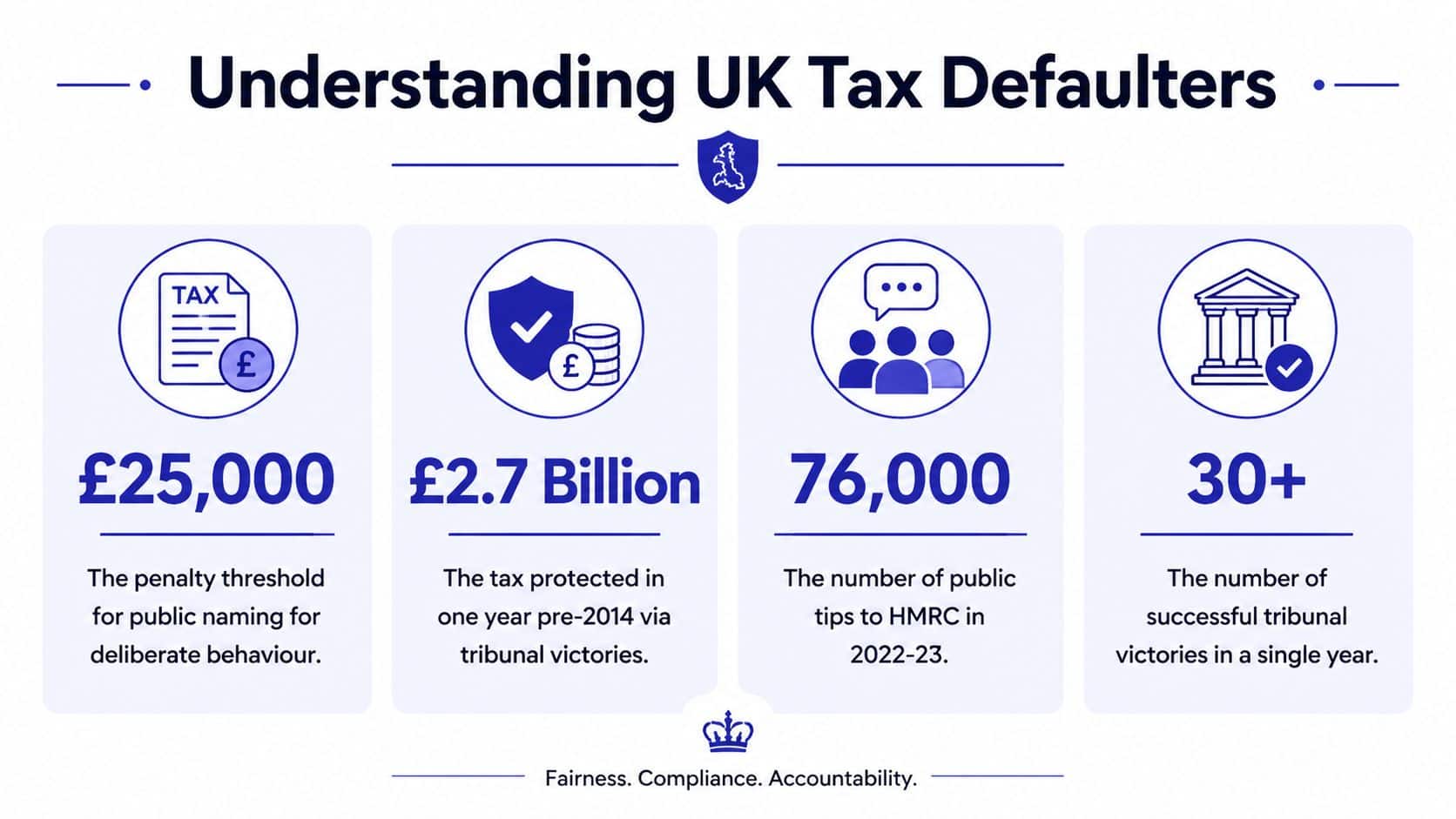
The figures show that HMRC has a wide array of powerful tools, from the threat of public naming to a strong track record in legal challenges. They are not afraid to use them.
When the Problem Spreads Beyond Your Business
The ripple effects of a tax default extend far beyond your direct relationship with HMRC. Directors can find themselves held personally liable. Lenders may call in loans or refuse future credit, triggering a sudden liquidity crisis. What’s more, these issues can intersect with other stringent regulations. It’s worth understanding the hidden triggers that can freeze funds overnight under the Proceeds of Crime Act. The numbers prove HMRC is not afraid to act. In 2021-22, they recorded 4,012 tax evasion cases, and in the last five years, over 15,000 individuals have faced investigation for tax offences, leading to thousands of prosecutions and total prison sentences of 2,700 years. This threat underlines the urgent need for a robust, expert-led defence from the very start.
How Forensic Accounting Protects Your Business
An HMRC investigation can feel overwhelming. What starts as a simple tax dispute can quickly spiral, touching on allegations of fraud, triggering shareholder arguments, or even threatening the company’s solvency. The stress can bleed into your personal life, complicating everything from family finances to director liabilities. You might think your regular accountant can handle it, or perhaps you’re worried about the cost. These are common reactions, but an HMRC investigation isn’t business as usual. It’s a legal and financial challenge. Think of your accountant as a trusted GP; for this, you need a surgical specialist. You need a forensic accountant.
Shifting from Defence to Offence with Forensic Accounting
A forensic accountant isn’t just there to check the numbers. They are your financial detective and strategic partner, building a vital shield against HMRC’s claims, which are often inflated. This is a meticulous, evidence-led process. First, we reconstruct your financials, even from messy or incomplete records, to establish a true and fair view. Next, we trace funds, clarifying their source and use to counter claims of hidden income or disallowed expenses. Finally, we compile our findings into a robust, court-ready report that tells an accurate financial story. This independent quantification of the true tax liability is your most powerful negotiating tool.

Containment and Resolution for Your UK Business
Our role is to contain the financial damage and create a clear path toward resolution for the business and everyone involved. While your regular accountant focuses on compliance, our forensic accounting services are designed for conflict. We are experienced in the complex issues that often run alongside tax investigations, like business interruption claims, valuations, and contract disputes. The pressure on UK businesses is immense. The UK’s tax gap was a staggering £39.8 billion in 2022-23. With HMRC managing an outstanding debt of £38 billion by March 2024, their pursuit of tax defaulters in the UK is becoming far more aggressive. Read more on the state of UK tax administration from TaxWatchUK.
A forensic accountant’s report transforms the conversation. Instead of arguing about opinions, we present an independent, verifiable set of facts. This forces HMRC to deal with the reality of your financial position, not their initial assumptions.
This structured, evidence-first approach protects the company and its directors, lenders, and insurers from the fallout. It provides the certainty needed to make crucial decisions and puts control back in your hands. Our expertise in litigation support is essential when the stakes are this high. You can explore a detailed overview of our forensic accounting services and processes to see exactly how we build your case. Don’t let an investigation dictate your company’s future.
Your Path to Resolution and Control
The dread that comes with a tax investigation, a major shareholder dispute, or an allegation of fraud can feel paralysing. Whether you’re facing litigation, insolvency, or even a contentious divorce, the financial and personal strain can make it seem impossible to find a way forward. It’s natural to hesitate. Many business owners and individuals worry that engaging a forensic accountant will be too expensive, or that it will only complicate matters. We designed our process to address these fears head-on. Our goal is to replace that anxiety with a sense of certainty, providing a clear, structured path that puts you back in command from the very first day.
Our Transparent Three-Step Engagement
We demystify the world of forensic accounting with a straightforward, three-step model. This approach ensures you have complete clarity at every stage, with no hidden costs or unwelcome surprises. We’re here to resolve the immediate crisis, whether that means dealing with tax defaulters UK issues or quantifying losses from business interruption. Our structured process unfolds in three distinct phases. First, it all begins with a no-obligation, confidential conversation where we listen. Second, we map out a detailed Action Plan with a realistic timeline and a fixed fee. Finally, we conduct a rigorous investigation and deliver our findings in a comprehensive, court-ready report.
Beyond tax investigations, businesses often face other critical situations that demand a clear route to resolution, such as understanding what to do after a data breach.
Your First Step Towards Certainty
This structured engagement provides the clarity needed to confront even the most complex financial disputes. Our forensic accounting services are not just about the numbers; they are about delivering a resolution. We arm you with the facts you need to challenge allegations, quantify damages, and negotiate from a position of undeniable strength.
Don’t let uncertainty dictate your next move. Our process is designed to bring order to chaos, giving you the expert support and objective evidence required to protect your interests and achieve the best possible outcome.
Taking that first step is often the most difficult, but it’s also the most important. Taking back control begins with a simple conversation. You don’t have to face this alone. Book your free, confidential discovery call with our experts today and take the decisive first step toward resolving this dispute with confidence. We are here to provide the certainty you need.