Cash is tightening. HMRC is pressing. Suppliers want payment sooner, not later. The bank wants current numbers, and the numbers you have don't fully explain why the business feels weaker every month.
That's where many directors get stuck. They assume the problem is turnover, margin pressure, or a temporary squeeze in working capital. Sometimes that's true. Often it isn't. In distressed companies, the visible problem is lack of cash, but the underlying cause may be poor controls, unreliable management information, stock leakage, payroll manipulation, unauthorised payments, a shareholder dispute, or reporting that has painted a healthier picture than reality justified.
A business in that position doesn't just need legal process. It needs diagnosis. Before anyone decides whether the answer is rescue, refinance, administration, a CVA, or liquidation, someone has to establish what's happened to the money, what the liabilities are, and whether the business can still be saved.
Introduction Beyond the Balance Sheet Crisis
A familiar pattern plays out in UK businesses under pressure. A director notices that creditor days are stretching, VAT or PAYE becomes harder to clear on time, and management accounts arrive late or no longer reconcile cleanly to the bank. Staff say sales are steady, yet cash keeps disappearing. The explanation given internally is usually simple: trading is tough, customers are paying slowly, costs have risen.
Sometimes that explanation is incomplete.

Distress often starts before insolvency becomes obvious
In practice, insolvency & restructuring work often begins long before a formal appointment. The first warning sign is usually confusion, not collapse. Directors sense that something is wrong but can't yet isolate it. They may have incomplete ledgers, disputed balances, unexplained withdrawals, or contract losses that haven't been quantified properly.
That matters because the wrong diagnosis leads to the wrong remedy. A company can enter a formal process without understanding whether value was lost through ordinary trading failure or through misconduct. If nobody investigates that distinction, creditors may recover less, directors may make decisions on flawed information, and viable rescue options may be missed.
For context on wider pressure in the market, the 2023 bankruptcy filing report gives a useful external read on how financial stress can build across the business environment.
Practical rule: When cash-flow pressure appears faster than trading performance would suggest, assume there may be a hidden driver until proven otherwise.
Why a forensic accountant matters early
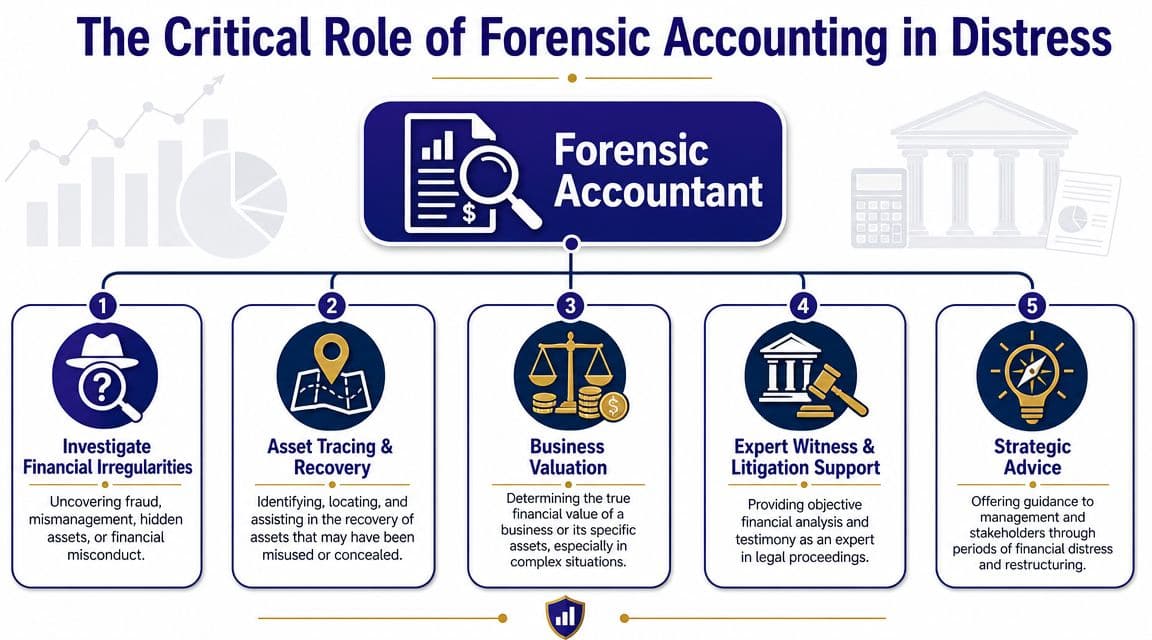
A forensic accountant doesn't replace a solicitor or insolvency practitioner. The role is different. Forensic accounting identifies what the accounts really show, what they fail to show, and what evidence supports or undermines the current narrative. That can include reviewing bank movements, journal entries, director loan accounts, stock records, debtor quality, supplier payments, and related-party transactions.
This is why forensic accounting services belong at the front end of distress, not only in litigation after the damage is done. If fraud, weak controls, or a financial dispute sits behind the pressure, directors need that established early. If the issue is a business with excessive debt but otherwise sound, the evidence should show that too.
A proper forensic review also helps answer the questions boards care about. Is this a solvency problem or a reporting problem? Is there a recoverable loss? Has someone diverted value? Can the business still support a rescue? Those answers shape every serious conversation that follows.
Insolvency vs Restructuring What UK Businesses Must Know
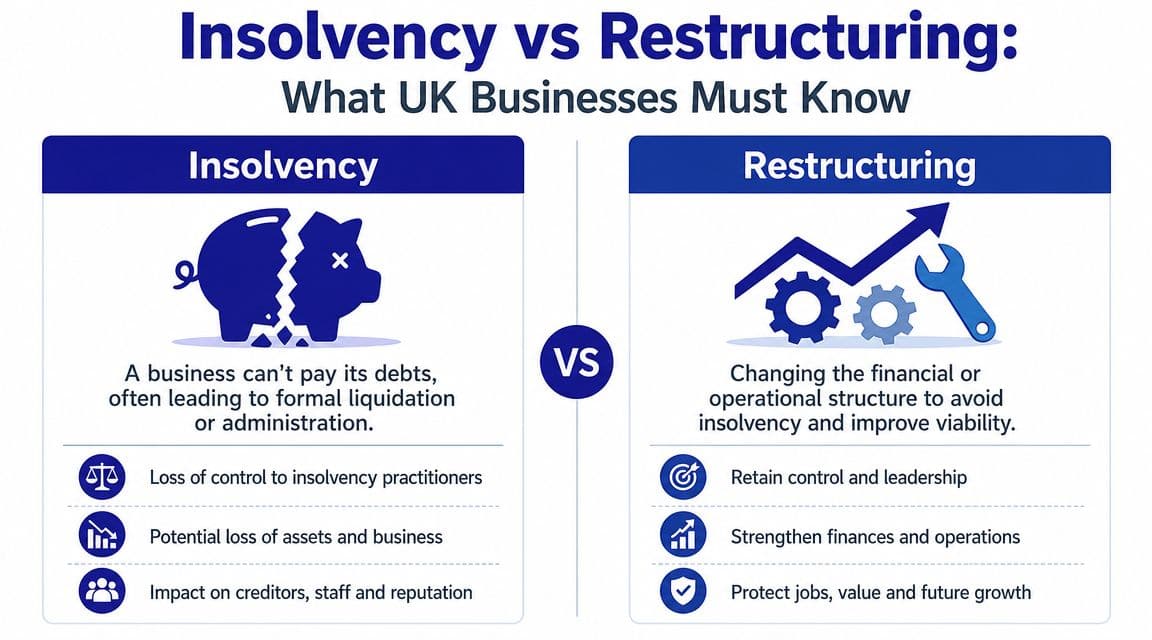
Most directors use the words interchangeably. They shouldn't. Insolvency and restructuring may overlap, but they are not the same thing.
A simple way to think about it is medical. Insolvency is the emergency response once the business can't meet its obligations and formal intervention may be unavoidable. Restructuring is the attempt to preserve the patient. It changes the financial or operational model so the business can keep trading and recover value.
Insolvency is about legal status and creditor pressure
A business is insolvent in practical terms when it can't pay debts as they fall due, or when liabilities outweigh assets on a realistic basis. Once that threshold is crossed, director decision-making changes. The focus can no longer be only on shareholders or growth plans. It has to include creditor interests, evidence, and defensible judgement.
That's why delay is dangerous. Directors often keep trading on optimism, assuming that one new contract, one refinance, or one tax arrangement will restore stability. Sometimes it does. But unsupported optimism is not a strategy. If management information is weak, the business can drift into deeper loss before anyone acknowledges it.
Restructuring is about preserving value
Restructuring tries to keep the business alive. It may involve revised repayment terms, operational downsizing, store closures, cost base reduction, asset sales, management change, covenant resets, or a formal compromise with creditors. The point is not merely to buy time. The point is to produce a business that can survive after the intervention ends.
This outside perspective from LemonAide on Navigating business insolvency challenges is useful because it captures the practical tension many owners face when deciding whether they are dealing with a temporary crisis or a more fundamental failure.
A short explainer can help frame the distinction in plain terms.
| Issue | Insolvency | Restructuring |
|---|---|---|
| Primary aim | Deal with unpayable debt and creditor claims | Restore viability and preserve going-concern value |
| Typical mood | Urgent, defensive, legally driven | Analytical, negotiated, commercially driven |
| Main question | What must happen now? | What can still be saved? |
| Evidence needed | True liabilities, recoveries, creditor position | Cash-flow forecast, operational viability, stakeholder support |
A restructure without reliable numbers is only a delay mechanism.
Key UK Procedures Administration CVA and Liquidation
A director gets the call from the bank on Monday, a winding-up threat on Tuesday, and by Wednesday someone has suggested administration, a CVA, and liquidation in the same conversation. At that point, technical labels are less important than understanding what each route protects, what it costs, and what evidence will support it.
The practical question is simple. Is there still a business worth saving once the actual numbers are stripped back to fact. In distressed cases, that answer is often clouded by poor reporting, hidden creditor pressure, unpaid taxes, weak stock controls, or outright irregularities. Procedure should follow diagnosis, not replace it.
Administration
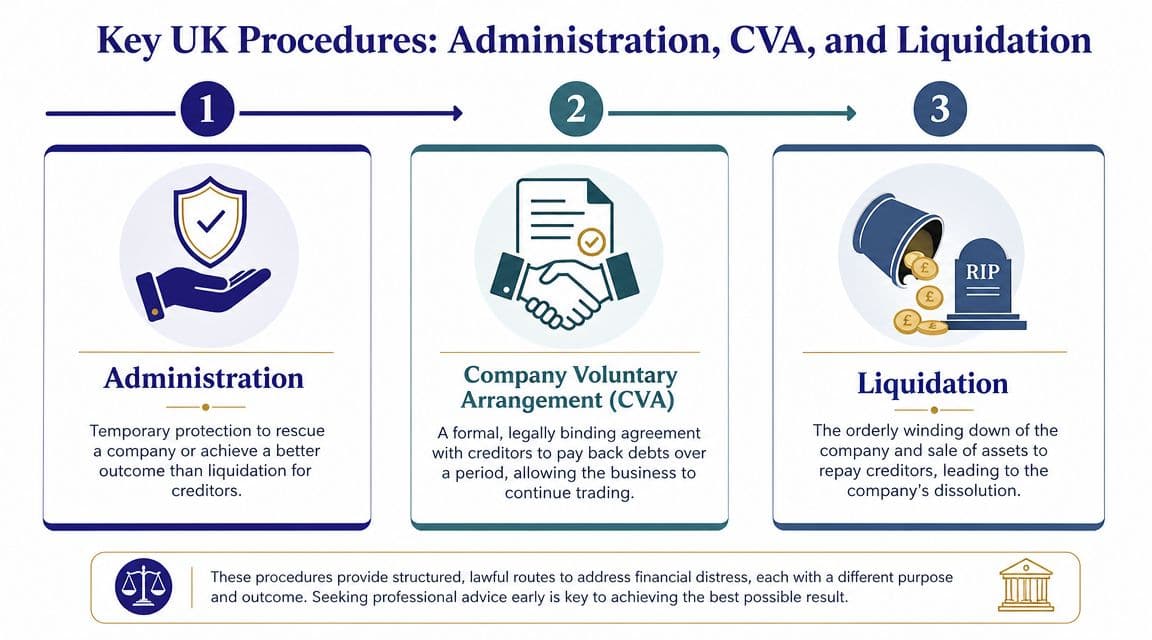
Administration is designed to create space. It pauses creditor pressure while an insolvency practitioner assesses whether the company can be rescued, sold, or at least dealt with in a way that produces a better result than a break-up sale.
Used well, administration stops value leaking out through panic. Staff may stay in place, customer contracts may be preserved, and a sale can be prepared on an orderly basis instead of under fire. Used badly, it becomes an expensive holding pattern for a business that had no viable future in the first place.
That is why I treat administration as evidence-led. Before recommending it, I want to know whether the cash generation is real, whether debtors are collectible, whether stock values stand up, and whether management accounts have masked the scale of the problem. If fraud, concealed liabilities, or weak controls sit underneath the distress, administration may still be the right process, but the recovery plan will look very different.
Company Voluntary Arrangement
A CVA allows a company to reach a binding compromise with unsecured creditors while it continues trading. It suits businesses that still have a workable core operation but need time and a realistic debt deal to survive.
Approval depends on creditor support. Forensic Risk notes in its overview of restructuring and insolvency that a CVA requires approval by 75% in value of voting unsecured creditors. In practice, that makes claim verification and creditor analysis far more than box-ticking. If a major landlord, supplier, or connected creditor is misclassified, the proposal can fail or face challenge.
A CVA stands or falls on credibility:
- Verified creditor claims: bad numbers produce bad voting outcomes.
- Clear creditor mapping: directors need to know who holds influence before terms are proposed.
- A trading model that works after the compromise: creditors will support pain if they can see a route to payment.
- Honest forecasting: inflated revenue and understated costs destroy support quickly.
What usually causes trouble is not the legal structure. It is weak underlying information. I have seen CVA proposals undermined by overstated stock, unrecorded HMRC arrears, side agreements with creditors, and branch performance figures that did not survive scrutiny. In those cases, the failed proposal is only the visible symptom.
For a practical comparison of outcomes and control issues, see this guide on the difference between liquidation and administration.
Liquidation
Liquidation ends the company's life and turns assets into recoveries for creditors. Sometimes that is a creditors' voluntary liquidation started by directors. Sometimes it is forced by creditors or the court.
It is often the right decision.
Where there is no credible route back to supported trading, liquidation can stop further losses and preserve what remains. It also creates a framework for investigating antecedent transactions, director conduct, asset dissipation, and accounting irregularities. If the business has been weakened by fraud or poor controls, liquidation may be the point at which recoveries finally become possible.
Commercial test: If reliable records, cash support, and stakeholder backing are absent, the least damaging option may be to stop trading early and investigate properly.
The Critical Role of Forensic Accounting in Distress
Most insolvency commentary focuses on process. The harder question is usually this: what caused the hole in the first place?
That question matters because some distressed companies are overextended. Others have suffered asset leakage, manipulated reporting, concealed liabilities, procurement abuse, payroll fraud, director misconduct, or a shareholder battle that has paralysed decision-making. If you don't identify the cause, you can't choose the right strategy.
Distress often hides a recoverable claim
The UK Insolvency Service reported 1,712 corporate insolvencies in March 2026, and also published 27 company director disqualifications in March 2026, including 11 for abuse of the Bounce Back Loan Scheme, as referenced in this discussion of restructuring and insolvency. That matters because misconduct is not a niche issue at the edges of insolvency & restructuring. It can be central to the story.
A forensic accountant examines whether the apparent decline in performance reflects normal commercial failure or value removed by people, weak systems, or false records. That distinction affects everything from recovery strategy to litigation support.
What forensic accounting actually does in a distressed business
A proper forensic exercise is evidence-led. It does not rely on suspicion alone, and it does not accept the ledger at face value.
Key areas usually include:
- Bank and cash analysis: tracing where funds went, who authorised them, and whether the payments match business purpose.
- Ledger integrity testing: checking journals, suspense accounts, write-offs, and manual overrides.
- Related-party review: identifying whether suppliers, customers, or loan arrangements were connected and improperly priced.
- Loss quantification: establishing what the business lost and what can be supported for negotiation, insurance claims, or proceedings.
- Solvency analysis: assessing whether the business was trading through a temporary squeeze or deeper insolvency.
This is why legal strategy on its own is often incomplete. A solicitor can advise on rights, duties, and process. An insolvency practitioner can guide formal routes. But if the accounts are unreliable, if there's suspected fraud, or if a dispute over value sits at the centre, the case needs forensic accounting services, a forensic audit, and sometimes a full fraud investigation before anyone can act with confidence.
The overlap with disputes and litigation
Distress rarely stays contained within finance. It spills into claims. Shareholders dispute who caused the problem. Lenders challenge information they were given. Insurers ask for proof of loss. Former directors deny responsibility. Creditors allege preferences or transactions at undervalue.
That is where expert witness accountant work and business dispute accountant support become critical. Financial evidence must stand up not only in internal meetings but also under challenge by lawyers, counterparties, insolvency office-holders, and the court.
For a practical explanation of this role, see this overview of how forensic accountants help.
In distressed matters, bad records create two losses. The first is financial. The second is evidential.
If the business has suffered fraud, a forensic review can support recovery pathways. If the problem is poor controls rather than dishonesty, the same work still matters because it separates error from misconduct and gives directors an objective basis for action.
Making the Right Call A Decision Framework for Directors
By the time most directors seek help, they already know the business is under strain. The main issue is deciding whether they are looking at a manageable restructuring, a formal insolvency process, or a business that first needs investigation.
For smaller companies, the need for speed is even greater. In Q1 2026, 90.4% of insolvency-related losses were in firms with fewer than 50 employees, and 82.1% were in firms with fewer than 10 employees, according to the UK Insolvency Service figures cited by White & Case in its commentary on financial restructuring and insolvency. Distress is overwhelmingly an SME problem, which means directors often have limited finance capacity and less margin for drift.
The questions that matter first
Start with the core business, not the legal label.
Is the underlying trade viable?
If the business strips out one-off shocks, disputed items, and exceptional leakage, can it still generate cash from normal operations?Are the numbers reliable enough to act on?
If bank reconciliations are overdue, stock is uncertain, or management accounts don't tie back, decisions are being made in the dark.Is there evidence of wrongdoing or value diversion?
Unusual supplier payments, director loan movements, duplicate payroll, or unexplained write-offs should never be treated as background noise.Can short-term trading be funded responsibly?
A rescue plan without working capital is just a document.
A practical triage view
| Signal | Likely implication | Immediate response |
|---|---|---|
| Creditor pressure rising but trade still sound | Restructuring may still be realistic | Build a live cash-flow model and verify liabilities |
| Accounts unclear or disputed | Investigation must come first | Commission forensic accounting support |
| Allegations between owners or directors | Business dispute risk is high | Secure records and isolate decision-making |
| No funding path and no operating turnaround | Formal insolvency may be unavoidable | Take insolvency advice quickly |
A director may also need specialist valuation input, especially where exits, shareholder claims, or asset realisations are being debated. For readers dealing with valuation standards in parallel disputes, this note on expert advice on RICS Red Book is a useful companion resource.
Don't confuse motion with progress
Directors under pressure often do too many things at once. They speak to a lender, negotiate with HMRC, ask for a sale process, and tell finance to produce revised accounts. None of that is wrong. But until someone establishes which numbers are dependable and which aren't, the board may only be increasing activity, not improving judgement.
If there is any concern about continuing to trade, this guidance on trading whilst insolvent is worth reviewing carefully.
The right call usually becomes obvious once the evidence is clean. Before that, every option looks half-plausible.
Engaging Lighthouse Consultants for a Clear Path Forward
Many businesses wait too long because they assume expert help will be disruptive, expensive, or geared only to litigation. That hesitation costs time. In a stressed environment, delayed action usually means weaker records, lower recoveries, and fewer realistic options.
According to the UK Insolvency Service, 2024 saw 23,872 company insolvencies in England and Wales, down from 2023 but still above pre-pandemic levels, as set out in the official insolvency statistics guidance. This is not a rare event affecting only large corporates. It is a sustained UK environment in which directors, lenders, insurers, and lawyers need clear financial evidence quickly.
What good support looks like
Strong advisory support should remove uncertainty, not add to it. In practice, that means a structured start, a defined scope, and reporting that decision-makers can use. The most effective engagements usually begin with a confidential discussion to identify the pressure point, whether that is suspected fraud, a solvency concern, a shareholder dispute, a loss claim, or unreliable reporting.
Then the work should narrow quickly into specific questions, such as:
- What happened to the cash
- Which liabilities are real, disputed, or overstated
- Whether there is a recoverable claim
- What evidence would withstand challenge
- Which route gives the best commercial outcome
Why this matters in insolvency & restructuring
Insolvency & restructuring decisions are often made under time pressure and with partial information. That is exactly when independent financial analysis matters most. A business may need forensic accounting, fraud investigation services, audit services, or an expert witness accountant. The form changes with the problem. The need for credible evidence does not.
For organisations facing pressure, forensic accounting services and broader business dispute support and audit services can provide the financial clarity needed to move from anxiety to action.
FAQs on Insolvency and Director Responsibilities
What should a director do first if insolvency is a possibility
Start by freezing poor decision-making, not the business. Directors should secure the books and records, get a current view of cash, creditors, tax arrears, borrowing, and contingent liabilities, and test whether the numbers can be trusted.
That last point matters more than many boards expect. I have seen businesses treated as simple cash-flow problems when the cause was weak controls, missing transactions, inflated stock, or payments that no one could properly explain. If the records are unreliable, any turnaround plan built on them is unreliable too.
Can a company keep trading while insolvent
Sometimes, yes. The question is whether continued trading protects or worsens creditor outcomes.
A defensible position usually depends on current forecasts, realistic funding, tight control over payments, and evidence that a rescue or sale has a genuine prospect of success. Directors should be able to show why trading continues, what assumptions support that decision, and what would cause them to stop. Hope is not enough. Clear records and disciplined monitoring are.
What is the point of a moratorium
A moratorium can give a company short-term protection from creditor action while management and advisers assess rescue options. Used properly, it creates time to stabilise the position, review funding, and decide whether a restructuring is credible.
It is not a remedy by itself. If forecasts are weak, liabilities are understated, or fraud and control failures have not been identified, the extra time can be wasted quickly. The value of a moratorium depends on the quality of the financial evidence underneath it.
When should fraud investigation sit alongside restructuring advice
Early, not after the restructuring plan is drafted.
Unexplained payments, related-party transactions, hidden liabilities, margin movements that do not make commercial sense, missing stock, and internal allegations all justify forensic review at the outset. In practice, that work often changes the case strategy. It may show that losses are recoverable, that reported profits were misstated, that a director conduct issue needs separate advice, or that the business is more viable than first assumed once false numbers are stripped out.
If your business is facing insolvency pressure, suspected fraud, a financial dispute, loss quantification issues, insurance claim challenges, or the need for independent expert analysis, contact Lighthouse Consultants. Their team provides forensic accountant support, forensic accounting, audit, fraud investigation, dispute support, and expert witness services for UK businesses, law firms, insurers, and stakeholders who need clear evidence and a credible path forward. A confidential discussion can help you identify the core problem, scope the right response, and regain control before value is lost further.