You notice a supplier payment that doesn't look right. Then you find a second one. The employee who processed both payments has worked beside you for years, knows your systems, and can explain every transaction. Meanwhile, cash flow tightens, colleagues stop speaking openly, and you're left wondering whether the problem involves fraud, a bookkeeping error, a dispute, or a much wider breakdown in control.
That uncertainty creates its own damage. It can affect financing, insurance claims, litigation, valuations, shareholder relationships, employment decisions, and even the viability of the business. Owners often hesitate to bring in a forensic accountant because they fear cost, disruption, or reputational harm. In practice, an early, properly managed review can protect evidence, establish facts, quantify loss, and give decision-makers a defensible route forward.
The Silent Crisis Hitting UK Businesses
A business owner discovers that payments have been leaving the company for months. The invoices look ordinary, the supplier exists, and the employee responsible has always appeared dependable. Only a detailed comparison of purchase orders, supplier bank details, approval records, and access logs reveals the pattern. The loss isn't just the money. Operations stall, managers question one another, and the owner must decide whether to investigate internally, contact insurers, suspend access, or notify the authorities.
That reaction is understandable. Trusted employees often hold the operational knowledge needed to conceal a scheme. They know which reports receive little scrutiny, which approvals happen automatically, and which unusual transactions they can explain as urgent. A single review of the ledger rarely exposes that behaviour. Investigators need to examine repeat activity, connected transactions, access rights, payment changes, and control failures.
Why early warning signs get ignored
Owners commonly dismiss the first signs as administration problems. A new supplier bank account looks like a routine update. Repeated overtime seems linked to a busy period. A former employee remains active in a system because someone hasn't completed the offboarding process. A manager approves transactions for a colleague because the team is short-staffed.
Those explanations may be legitimate. They may also conceal a pattern. The right response isn't to accuse someone based on a single anomaly, but to create a documented review process that tests the explanation against independent records.
Practical rule: Treat an anomaly as a question requiring evidence, not as proof of guilt or an issue to ignore.
Employee fraud can damage more than the balance sheet. It can interrupt deliveries, distort management accounts, trigger employment disputes, affect business interruption insurance claims, and undermine evidence in later litigation. If directors confront an employee too early, delete records, or allow systems to remain open, they can make recovery harder.
A proportionate response starts with preservation. Restrict unnecessary access, retain relevant emails and financial records, record who handled the data, and obtain advice before interviews or disciplinary action. The objective is to establish what happened, how long it continued, who benefited, and which controls allowed it to continue.
Understanding the UK Fraud Landscape
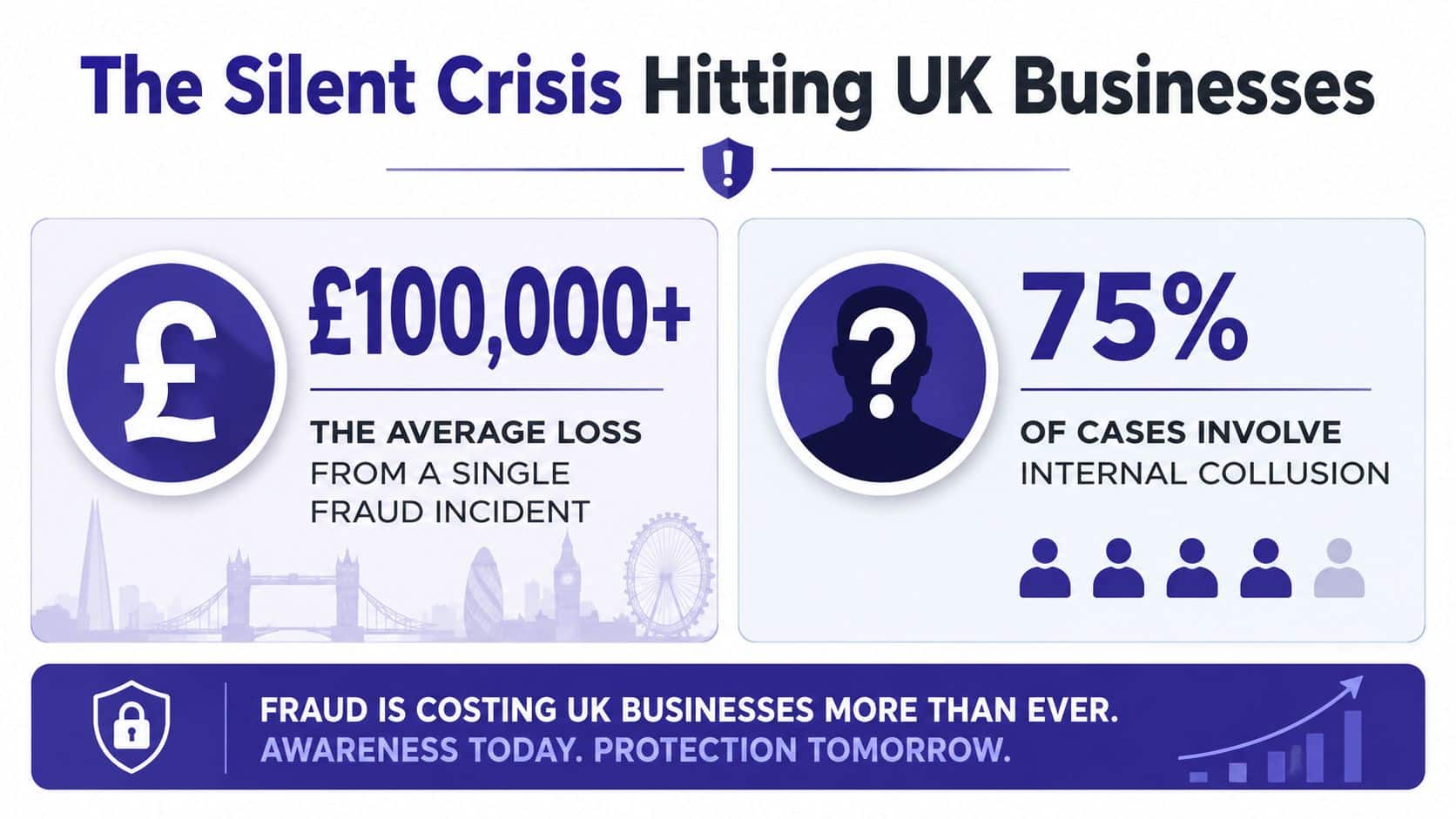
UK businesses face both frequent fraud reports and the risk of severe individual losses. The 2024 Economic Crime Survey found that 27% of businesses with employees, about 389,000 organisations, reported fraud during the previous 12 months. Victim businesses averaged 16 incidents each, producing an estimated 6.04 million fraud incidents.
The most common reported frauds included fake invoice fraud at 11% of businesses, mandate fraud at 7%, and investment fraud at 6%. Those categories point directly to practical controls. Businesses need reliable invoice verification, disciplined payment-change procedures, and clear separation between preparing, approving, and releasing payments.
Historical police data shows why a business shouldn't wait for a large loss before acting. City of London Police records obtained by RSM recorded 885 corporate employee-fraud incidents in 2022, compared with 806 in 2021. Reported losses reached £227,151,202 in 2022, compared with £46,034,952 in 2021, while the mean loss per incident was £256,668. These figures appear in RSM's reporting on employee fraud and the UK failure-to-prevent-fraud law.
Frequency doesn't tell the whole story
London accounted for 194 incidents, yet those incidents represented £198,677,127, or 87% of reported stolen funds, according to the same RSM source. That concentration shows why headline incident counts can mislead. A business might experience only one event and still face a material threat to cash flow, banking relationships, or solvency.
Earlier UK reporting identified more than £40 million in employee-fraud losses during 2016-17, with more than 800 incidents, also referenced by RSM. The pattern supports continuous monitoring rather than a once-a-year review.
For SMEs, that doesn't mean buying an expensive surveillance platform. It means ranking risk by payment value, system access, supplier concentration, payroll authority, and management override. A smaller firm may need a focused monthly exception review, a confidential reporting route, and independent quarterly control testing. The important point is consistency. Annual accounts can confirm what happened financially, but they rarely provide an early warning system.
Businesses dealing with fraud exposure, anti-money laundering obligations, or wider financial crime risks can also review financial crime and compliance support when designing a proportionate response.
Recognising Behavioural and Digital Red Flags
Employee fraud doesn't always look like someone stealing cash. It may begin with a shared password, an unexplained system login, or an employee who gives another person access to a restricted process. Cifas's 2026 workplace fraud research found that 13% of UK workers said they had sold company login details to a former colleague, or knew someone who had, during the previous 12 months. The same research found that 19% admitted to secretly juggling two competing jobs, and 13% said they or someone they knew had used fraudulent reference houses to cover employment gaps. These figures come from Cifas's workplace fraud trends research.
Behavioural indicators worth testing
The UK government's generic fraud indicator checklist for education providers identifies warning signs that apply well beyond education. These include:
- Lifestyle changes: Spending or possessions appear disproportionate to known income. That isn't proof of fraud, but it can justify a sensitive, evidence-led review.
- Financial or personal pressure: Gambling, alcohol, drugs, debt, or other personal problems may create vulnerability to misconduct.
- Conflicts of interest: An employee has an undisclosed relationship with a supplier, customer, contractor, or competing business.
- Unusual defensiveness: Someone resists routine review, refuses to take leave, or insists that only they can complete a process.
- Personal resentment: Disgruntlement, animosity, or professional jealousy can increase the risk of deliberate misconduct, particularly where the person controls valuable information or approvals.
Behavioural indicators need careful handling. Managers shouldn't investigate private lives informally or treat a personal difficulty as evidence. The proper response involves checking objective records and applying the same process consistently.
Digital signals reveal the operating pattern
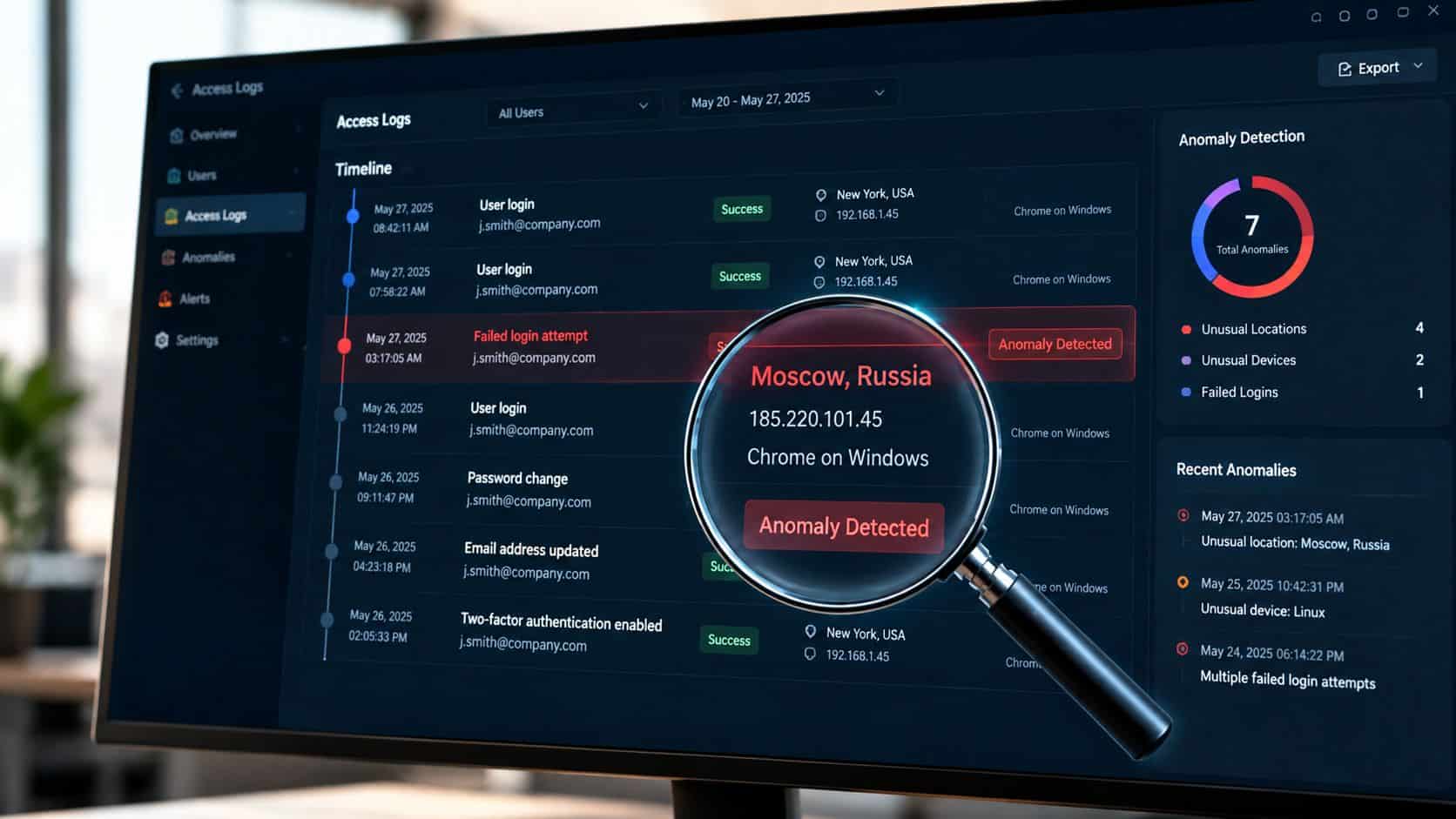
Review user activity for logins outside normal working patterns, access to systems unrelated to an employee's role, repeated failed authentication, sudden downloads, unusual exports, and changes made shortly before payments or records move. Compare access logs with approved duties, holidays, location information where lawfully available, and transaction timestamps.
Credential sharing makes attribution harder. A valid login may not identify the person who used it, so investigate device information, multi-factor authentication events, password resets, and the sequence of actions across systems. For organisations assessing automated data collection and the technical limits of access controls, Scrapfly's explanation of bypass DataDome provides useful context about how automated activity can interact with protective systems.
The practical answer is not blanket surveillance. It's role-based access, prompt offboarding, individual accounts, multi-factor authentication, and documented reviews of exceptional activity. A focused review of ghost employees and access risk is also available through ghost employee fraud support.
Implementing Proactive Detection Controls
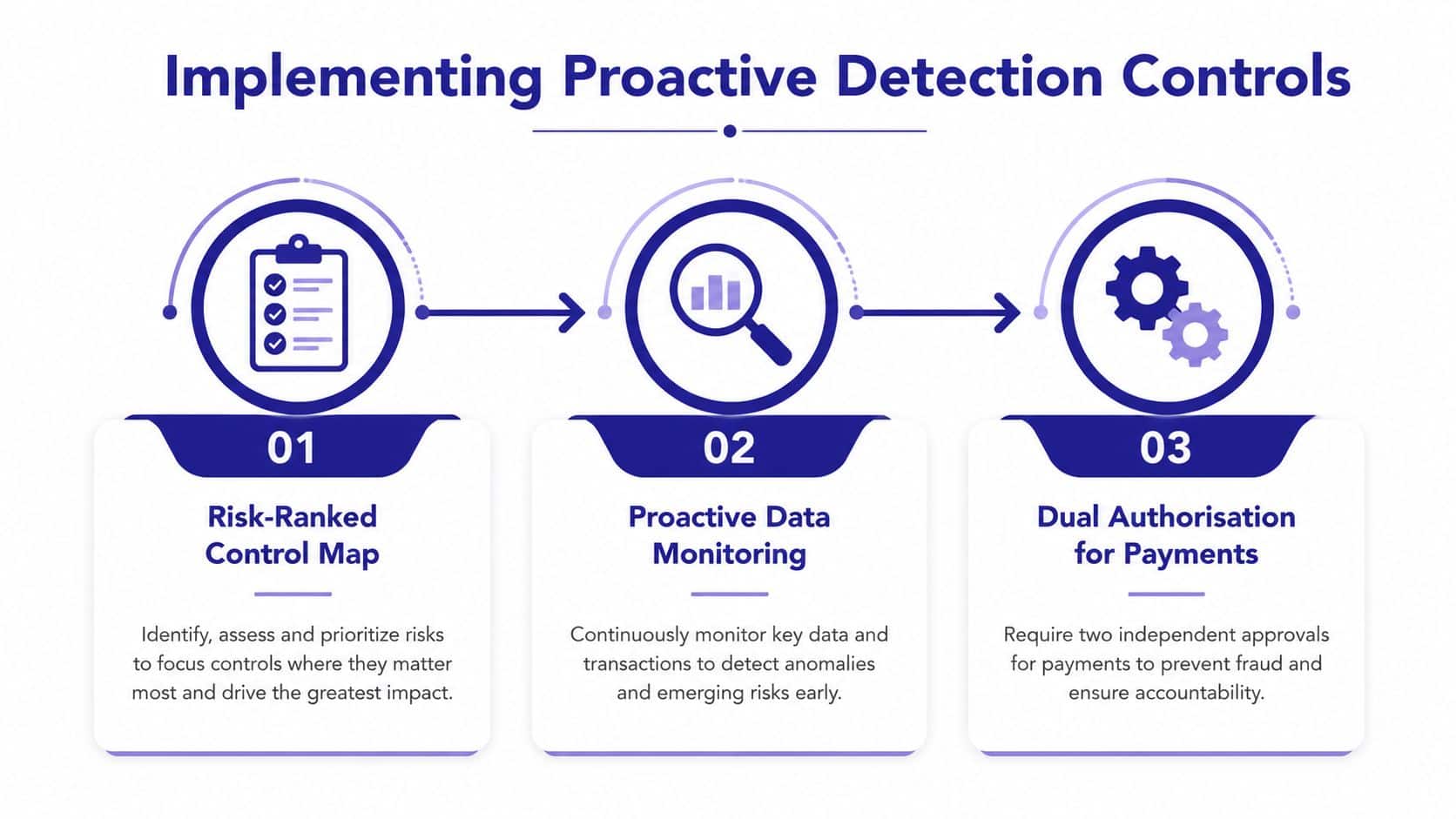
A detection programme works when someone owns it, tests it, and acts on its results. Start by mapping processes according to risk. Rank supplier payments, payroll changes, refunds, cash handling, procurement, customer credits, system administration, and journal entries according to value, access concentration, management override, and the ease with which one person could conceal activity.
The UK government's fraud guidance recommends understanding internal and external data, maintaining and improving internal controls, using due diligence and monitoring in recruitment and contracting, and deploying data analytics to identify anomalies. It also supports clear staff reporting routes and the recording of referrals and identified loss through an organised process.
Build a repeatable review cycle
Use a simple control calendar rather than an unmanageable list of promises:
- Risk-ranked control map: Identify who can create suppliers, amend bank details, approve invoices, release payments, amend payroll, and post journals. Record the second-person review expected for each high-risk action.
- Proactive data monitoring: Run exception reports for duplicate bank details, unusual payment timing, round-value invoices, split purchases, dormant suppliers becoming active, rapid changes to employee records, and transactions approved by users outside their normal role.
- Access-control review: Compare system permissions with current job responsibilities. Remove leavers promptly and investigate privileged access that lacks a documented business reason.
- Segregation-of-duties testing: Test whether one user can create, approve, and pay. If the organisation is small, a director or external adviser can perform the independent review.
- Confidential reporting: Provide a route that employees trust, explain how reports will be handled, and protect people who raise qualifying concerns.
The Northern Ireland Audit Office's internal fraud guidance states that controls should be proportionate to risk and regularly tested. Its central warning is direct: “trust is not a control”.
Use technology to support judgement
Analytics should prioritise cases for human review, not automatically label employees as dishonest. A useful alert includes the transaction, the relevant policy, the user's role, the comparison point, and the next evidence request. Security teams designing stronger account protection can use this practical guide to MFA and detection signals explained.
Schedule exception reporting, access reviews, segregation-of-duties checks, and hotline triage monthly or quarterly according to risk. Keep an audit trail of alerts, decisions, explanations, and follow-up action. A control that generates alerts but never receives a documented response creates activity, not protection.
For a structured implementation approach, review fraud detection programme support.
Overcoming Objections to Expert Intervention
“We can investigate this ourselves.” Sometimes an internal review can establish that a payment was duplicated or that a process failed. It becomes risky when the matter may involve an employee, a director, a supplier relationship, an insurer, law enforcement, or a future court claim.
An inexperienced investigation can overwrite metadata, circulate allegations too widely, contaminate witness evidence, or give a suspect time to delete records. It can also produce a loss figure that doesn't distinguish confirmed loss, prevented loss, consequential cost, and unsupported suspicion. Those weaknesses can affect disciplinary proceedings, civil recovery, insurance notifications, and settlement discussions.
Evidence matters more than confidence. A strong allegation without a reliable evidential trail is a weak position.
“The loss isn't large enough”
The amount discovered today may represent only the visible part of the scheme. Investigators need to test the relevant period, connected accounts, related suppliers, access histories, and control overrides before anyone can assess the true exposure. A forensic accountant can also determine whether the event affects working capital, covenant compliance, business interruption, or a shareholder dispute.
Professional help doesn't always mean a large, open-ended engagement. A sensible starting point can involve a defined scoping exercise, agreed data sources, preservation advice, and a decision point before wider work begins. That approach gives the board clarity while controlling disruption.
“We don't want to damage trust”
Ignoring credible concerns damages trust more severely than a fair investigation. UK whistleblowing protections cover workers who report suspected criminal offences such as fraud, provided the disclosure relies on information and the worker reasonably believes it's in the public interest. The UK government's whistleblowing information explains those protections and the need to distinguish information-based disclosure from a vague allegation.
Handle reports confidentially, avoid retaliation, and separate fact-finding from conclusions. An expert can help design interviews, preserve source material, quantify loss, and present findings neutrally. That structure protects the business and reduces the risk that managers treat an allegation as either proven or irrelevant before the evidence has been tested.
Securing Your Business with Lighthouse Consultants
A credible response combines three outcomes. First, you need to establish the facts. Secondly, you need to quantify the financial effect in a way that directors, insurers, solicitors, and courts can assess. Finally, you need to repair the control weakness that allowed the conduct to continue.
Lighthouse Consultants provides forensic accounting support for UK organisations investigating fraud, bribery, corruption, unexplained losses, and related disputes. Its Chartered Management Accountants analyse financial data and evidence for use in disciplinary hearings, negotiations, insurance claims, and court proceedings. The firm also quantifies litigation and business interruption claims, performs internal audits and risk assessments, and supports due diligence.
A structured engagement keeps decisions clear
The process begins with a free discovery call to understand the concern, urgency, stakeholders, and available evidence. A scoped action plan then defines the questions, data required, work stages, and reporting route. Results reporting gives decision-makers a clear account of the findings, limitations, quantified loss, and recommended control improvements.
That structure matters when the issue extends beyond employee misconduct. A fraud investigation may uncover a supplier dispute, a shareholder disagreement, an insolvency risk, an insurance notification issue, or a wider financial crime concern. Directors can also serve as expert witnesses where the assignment requires independent professional evidence.
Lighthouse has worked across retail, logistics, aviation, manufacturing, financial services, insurance, and public and not-for-profit sectors. Its stated values of certainty, quality, and care reflect a practical focus on accurate analysis, authenticated evidence, personalised support, and responsive communication.
Owners who need a broader view of business risks can also explore LegesGPT for business owners as a supplementary resource, while keeping formal investigations and evidential conclusions with appropriately qualified professionals.
Don't wait for a suspicious payment to become a crisis. Start by preserving records, reviewing access and payment controls, and documenting the concern, then obtain independent advice before confronting anyone or changing evidence. A controlled investigation can show what happened, quantify the loss, support recovery, and make repeat misconduct harder.
Lighthouse Consultants investigates employee fraud, preserves and analyses financial evidence, and quantifies losses for disciplinary, insurance, negotiation, and court purposes. Visit Lighthouse Consultants to arrange a free discovery call and discuss a scoped plan for your organisation.