You've found unexplained payments in the ledger, a shareholder is challenging the accounts, or an insurer is disputing a business interruption claim. Your solicitor asks for a forensic expert witness statement, and the first instinct is often to search for a template, copy the headings, and fill in the figures. That approach can create a polished document that still fails under scrutiny.
A UK expert report must do more than present persuasive financial analysis. It must comply with the procedural regime, distinguish evidence from opinion, reveal the limits of the work, and help the court understand how the conclusion follows from the material reviewed. The following forensic expert witness statement example focuses on those compliance points, because courts often discount reports for procedural weaknesses rather than poor arithmetic.
When Financial Disputes Demand an Expert Witness
A business owner may discover that a finance manager diverted funds through related suppliers. A shareholder may allege that profits were understated before a sale. An insurer may accept that an interruption occurred but dispute the financial loss flowing from it. In each situation, the parties usually have spreadsheets, bank records, management accounts, emails, contracts, and competing explanations.
The dispute changes character when the financial evidence must enter court. An internal report can use shorthand, rely on institutional knowledge, and leave assumptions unexplained. An expert report cannot safely do that. The court needs to know what the expert reviewed, what the documents establish, what someone told the expert, and which conclusions represent professional opinion.
The report becomes the financial map
In a fraud claim, the expert may need to trace funds, identify concealed transactions, and distinguish an accounting error from deliberate misappropriation. In a valuation dispute, the expert may need to explain the selected methodology and test alternative assumptions. In a divorce or inheritance matter, the analysis may involve asset tracing, ownership questions, or the reconstruction of incomplete records.
Business interruption claims create a different challenge. The expert must connect the insured event to the claimed loss while considering the policy wording, trading records, capacity constraints, seasonality, and other causes that may have affected performance. The Supreme Court's decision in the FCA business interruption test case confirmed that cover may apply to partial closure as well as full closure, that some mandatory closure orders need not be legally binding to trigger cover, and that valid claims shouldn't be reduced because the pandemic would have caused the loss anyway. Those legal conclusions make the quality of loss quantification particularly important, and the FCA summary of the Supreme Court judgment provides the relevant legal context.
The expert statement often becomes the court's clearest window into that analysis. It sets out the route from documents to findings, then from findings to opinion. If that route contains unexplained assumptions or missing disclosures, the opposing expert has an obvious line of attack.
Practical rule: A court-ready report should allow a reader who knows the dispute, but not the accounting file, to follow every material step in the reasoning.
Why a template alone won't protect the case
A generic template may include headings for qualifications, documents, methodology, and conclusions. It won't decide whether the expert has gone beyond their expertise, whether a management forecast counts as evidence or assumption, or whether delegated testing needs disclosure. It also won't ensure that the prescribed statement of truth uses the current wording.
Under the Civil Procedure Rules, a party can't call an expert or rely on an expert report without the court's permission. The Part 35 rules on expert evidence also require a report to include a statement of truth confirming which facts fall within the expert's own knowledge and that the opinions are the expert's true and complete professional opinions.
That means format is part of admissibility. A report can contain sound calculations and still lose weight, or become unusable, if it doesn't comply with the procedural framework. The rest of this guide shows how to build the document so its structure supports the evidence rather than creating a second dispute.
The Mandatory Structure Under UK Civil Procedure Rules
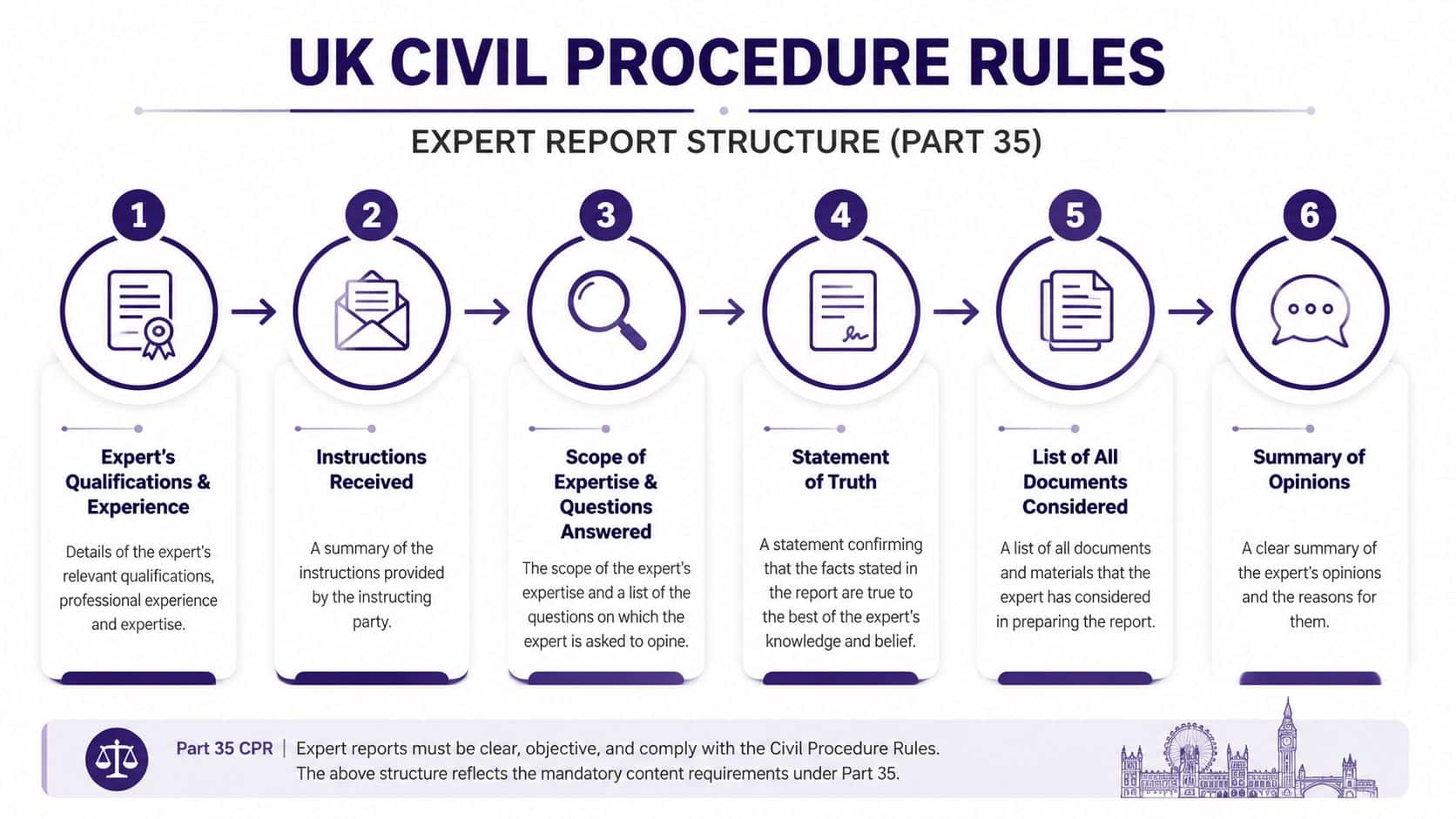
A forensic accounting report for a civil claim in England and Wales should follow a disciplined sequence. Part 35 and its Practice Direction provide the framework, while the guidance for experts in civil claims reinforces the need for a report addressed to the court, transparent instructions, disclosed material, and a clear separation between fact and opinion.
1. Identify the expert and define the scope
Start with the expert's name, professional qualifications, relevant experience, and current role. A forensic accountant shouldn't rely on a long curriculum vitae to establish expertise. The body of the report should explain why the expert is qualified to answer the specific questions in dispute.
State the instructions received and identify the issues addressed. If the instruction concerns the amount of loss, don't imply that the expert has determined liability unless that question falls within the assignment and the expert's expertise. A clear scope protects both the court and the expert from opinions that exceed the retainer.
2. List the evidence relied upon
The report should identify every material document, record, schedule, interview, inspection, test, or calculation relied upon. Use a document schedule with meaningful descriptions, not a vague reference to “the disclosure”.
Where the expert has relied on information supplied by management, say so. Where a third party performed testing or analysis, identify who performed it, what they did, and how the expert used the output. The UK government guidance on experts' legal obligations highlights the need to identify qualifications, instructions, material facts, tests, the people who performed them, the range of opinion, conclusions, qualifications, and the duty-to-court statement.
3. Separate facts, assumptions, and opinions
Many reports become vulnerable at this point. A factual finding might state that a bank statement records a payment. An assumption might state that the payment related to a particular supplier because supporting records were incomplete. An opinion might state that the transaction is consistent with a diversion of company funds.
Use labels and careful wording:
- Fact: “The bank statement records a payment of £X to the account identified as Supplier A.”
- Assumption: “For the purpose of the loss calculation, I have assumed that the payment related to the disputed contract.”
- Opinion: “In my opinion, the available records support the conclusion that the payment should be included in the quantified loss.”
The number in an example should be replaced with the actual evidence. Never turn an assumption into a fact by repeating it often enough.
4. Explain the methodology step by step
Describe how the expert moved from raw material to conclusion. For a fraud investigation, that may include transaction extraction, categorisation, reconciliation, source checking, and loss attribution. For a valuation, it may include the selected approach, the relevant financial information, adjustments, and sensitivity to assumptions.
The explanation must be sufficiently detailed for another expert to understand and test it. It shouldn't become a record dump. Courts need a reasoned analysis, not every working paper reproduced in the report.
5. State the range of opinion and conclusions
An expert must address material alternatives where a reasonable range of professional opinion exists. Explain the principal conclusion, the alternative, and the reason for preferring one approach. If the evidence doesn't permit a single precise answer, say so and quantify or describe the range supported by the material.
Follow with a concise summary of conclusions. The summary should answer the questions posed in the instructions, not introduce new opinions that appear for the first time at the end.
6. Include qualifications, limitations, and the statement of truth
State matters outside the expert's expertise, material gaps in the evidence, qualifications to the opinion, and facts that might undermine the conclusion. This isn't an admission of weakness. It shows the court where the opinion is reliable and where it depends on further evidence.
The report must end with the prescribed statement of truth. The Practice Direction states that an expert report should not exceed 20 pages unless the court orders otherwise, subject to the treatment of the CV and certain supporting material. That limit encourages issue-led drafting. A concise report makes the reasoning easier to inspect and gives the opposing party fewer opportunities to identify inconsistency.
Joint expert discussions also operate to a timetable. A statement arising from the discussion must be signed within 7 days of the meeting and served within 14 days of signing, under the Practice Direction to Part 35. A drafting workflow, such as the Voice Control Pro drafting workflow tool, can help organise dictated material, but it can't replace legal review or expert judgment. For the distinction between a civil witness statement and an expert report, see this UK witness statement guide.
Civil and criminal reports shouldn't be blended. Civil practice centres on Part 35 content, the range of opinion, proportionality, and the duty to the court. Criminal practice places stronger emphasis on disclosure, continuity of duties, and recording, retaining, and revealing material under the applicable criminal procedure rules. A forensic accountant must identify the regime before drafting.
Common Pitfalls That Get Forensic Reports Rejected
Courts don't need ornate prose. They need a report that complies with the rules and exposes the reasoning. The most damaging defects usually appear in ordinary drafting choices, such as presenting a client's explanation as established fact or describing analysis without naming the person who carried it out.
The 1 October 2020 change to the mandatory statement-of-truth wording strengthened the declaration framework. The current wording requires the expert to distinguish personal knowledge from other matters and confirm that the opinions are true and complete professional opinions. A false statement verified by a statement of truth can expose the maker to contempt proceedings, as reflected in related professional commentary on the current requirements.
A diagnostic comparison
| Element | Common Failure | Compliant Approach |
|---|---|---|
| Qualifications | Lists broad finance experience without linking it to the issue | Identifies relevant qualifications, experience, and the precise scope of expertise |
| Instructions | Describes the case generally and omits the questions answered | Records the material instructions and states which questions fall within the assignment |
| Evidence | Refers to “the documents” without a complete schedule | Lists the documents and other material relied upon with clear descriptions |
| Facts and assumptions | Treats management explanations as proven facts | Labels factual findings, assumptions, and opinions separately |
| Delegated work | Says “we performed testing” without identifying the analyst | Names who performed tests, explains their work, and states how the expert reviewed it |
| Methodology | Gives a conclusion without showing the calculation route | Explains the method, inputs, adjustments, and material limitations |
| Alternative views | Presents one answer as inevitable | Addresses a reasonable range of opinion and explains the preferred view |
| Duty to court | Uses a generic declaration or omits it | Includes the prescribed statement of truth and duty-to-court wording |
| Length | Exceeds the page limit without permission | Keeps the report issue-led and seeks directions where additional length is necessary |
A report can also fail through poor evidence handling. If the expert cannot show how a bank export, email chain, or accounting file reached the analysis, the opposing side may challenge reliability. Clear records of document handling and review support the evidence trail, as explained in this guide to maintaining a reliable chain of custody.
A statement of truth isn't a signature added after the accounting is finished. It changes the level of care required throughout the assignment.
The practical correction is to audit the report against the rules before serving it. Check every factual proposition, identify its source, mark every assumption, and test whether each opinion follows from the stated method. If another analyst performed part of the work, disclose that contribution rather than hiding it behind a firm name.
Annotated Forensic Expert Witness Statement Example
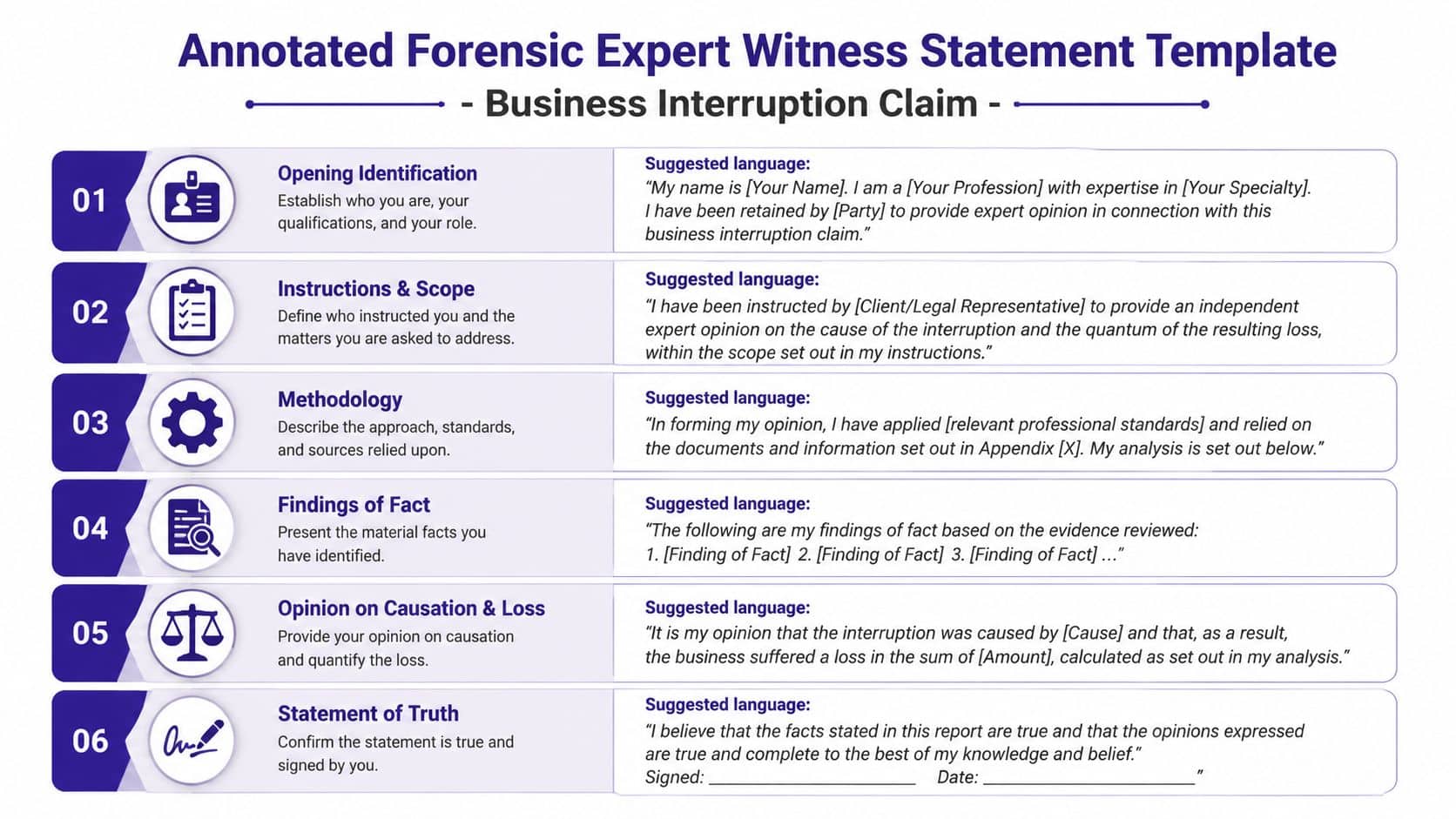
The following shortened model uses a hypothetical business interruption claim. It demonstrates structure and wording, not a substitute for the expert's own analysis or the court's directions.
Opening identification
1. Qualifications and appointment
I am [name], a Chartered Management Accountant and a director of [firm]. I have experience in forensic accounting, financial analysis, and the quantification of business interruption losses. I have been instructed by [solicitors] to address the financial issues identified below. I understand that my duty is to assist the court on matters within my expertise and that this duty overrides any obligation to the party instructing me.
Annotation: Address the report to the court, not to the instructing solicitor or client. Explain the relevant expertise rather than relying only on an attached CV. Don't imply independence through adjectives. Demonstrate it through the scope, method, and treatment of inconvenient evidence.
Instructions and scope
2. Instructions
I have been asked to assess the financial loss allegedly suffered by [insured] following [insured event]. I address the period identified in my instructions and consider whether the available financial records support the claimed revenue, saved costs, and resulting loss. I don't express an opinion on policy construction or legal liability.
Annotation: This wording prevents scope creep. If the legal team later asks for an opinion on policy interpretation, the expert should record the new instruction and confirm whether it falls within expertise.
Documents and evidence
3. Material considered
I have considered the policy schedule and wording, management accounts, sales records, bank statements, payroll records, customer orders, supplier invoices, correspondence, and the schedules provided by the parties. I have also considered information provided by [named individual] in response to questions dated [date]. The complete document list appears in Appendix A.
Annotation: Replace general categories with document identifiers in the filed report. If a third party performs data extraction or testing, add: “The data extraction was performed by [name and role]. I reviewed the extraction procedure and reconciled the resulting dataset to [specified source].”
Methodology
4. Method
I compared the insured's actual trading results with the performance that I consider reasonably supportable on the available evidence during the relevant period. I reviewed historical trading, confirmed orders, capacity information, variable costs, and other material factors. I treated management forecasts as assumptions requiring corroboration, not as established results. I performed the calculations shown in Appendix B and tested the effect of material alternative assumptions.
Annotation: The method should show the chain from evidence to calculation. Avoid claiming that a forecast would definitely have occurred. State what supports it and what limits it.
Findings and opinion
5. Findings of fact
The sales records show [factual finding]. The payroll records show [factual finding]. The correspondence records [factual finding].6. Opinion
On the assumptions stated above and having regard to the documents listed in Appendix A, it is my opinion that the evidence supports a loss within the range of [range]. My preferred conclusion is [conclusion], subject to [qualification]. If [alternative assumption] is adopted, the conclusion changes as set out in Appendix C.
Annotation: Keep findings and opinions visibly separate. State a range where the evidence supports one. Don't present a precise result if missing records or alternative trading explanations make precision artificial.
This short video can help professionals think about how report structure supports later testimony:
Statement of truth
7. Statement of truth
I confirm that I have made clear which facts and matters in this report are within my own knowledge and which are not. The opinions I have expressed represent my true and complete professional opinions on the matters to which they refer.
Annotation: Use the current prescribed wording required by the applicable rules and directions. The expert must check the final version against the court's requirements rather than copy an old online example.
Overcoming Objections to Hiring a Forensic Accounting Firm
Business owners often hesitate because they expect expert evidence to be expensive, slow, or disproportionate to the dispute. Solicitors may worry that an external accountant will produce a report that looks impressive but collapses during cross-examination. CFOs may also fear disruption while the expert requests records from already stretched finance teams.
Those concerns are legitimate. A sensible engagement addresses them before detailed work begins.

Cost and proportionality
The right starting point isn't an open-ended investigation. A structured model can begin with free discovery, followed by a scoped action plan and results reporting. That process lets the client identify the central question, the records needed, the likely workstreams, and the points that don't justify further expenditure.
A narrow instruction may be appropriate for a preliminary loss assessment. A wider mandate may be necessary where fraud indicators, related-party transactions, or incomplete books require investigation. The expert should explain the trade-off plainly. A cheaper report that ignores a material assumption can cost more once the other side exploits the omission.
Timing and coordination
Court timetables require active planning. Joint expert discussions create specific procedural milestones, with the resulting statement signed within 7 days of the meeting and served within 14 days of signing, under the Part 35 Practice Direction cited earlier. A forensic accountant should build review, partner sign-off, solicitor comments, and document reconciliation into the timetable rather than treating them as last-minute tasks.
Confidentiality also needs practical controls. Limit access to the relevant team, use secure transfer arrangements, maintain a document register, and agree who may receive draft analyses. These practical tips for client privacy are useful when several advisers and stakeholders handle sensitive financial material.
Fear of cross-examination
No responsible expert can promise that a report won't be challenged. The aim is to make the challenge useful rather than fatal. A report that discloses limitations, identifies assumptions, considers alternatives, and explains delegated work gives the expert a defensible basis for answering difficult questions.
Lighthouse Consultants is a London-based team of Chartered Management Accountants providing forensic accounting, management consulting, and audit services. Its directors can serve as expert witnesses, and its work covers sectors including retail, logistics, financial services, insurance, aviation, manufacturing, and public and not-for-profit organisations. Its approach to objections to hiring a forensic accountant describes how a scoped engagement can address concerns about cost, relevance, and disruption.
Your Next Steps for a Court-Ready Expert Statement
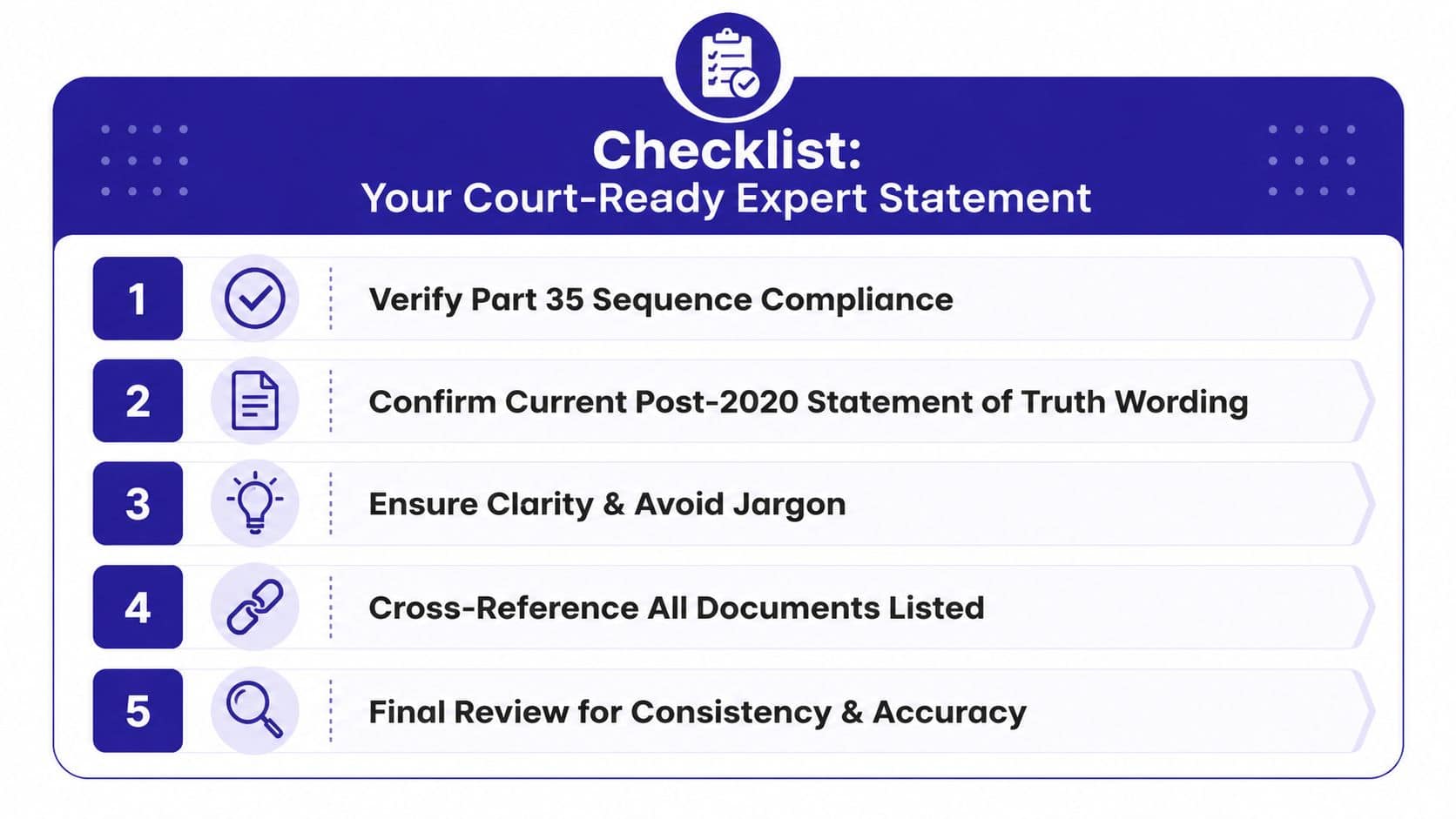
Before anyone serves a report, run a compliance review that is separate from the final proofreading exercise. Elegant language won't repair a missing declaration, an undisclosed analyst, or an opinion that exceeds the instructions.
Use this checklist:
- Confirm the procedural regime. Establish that the assignment concerns a civil claim under Part 35, or identify the separate criminal disclosure and continuity requirements.
- Check the sequence. Make sure the report identifies qualifications, instructions, scope, documents, facts, assumptions, methodology, findings, opinions, limitations, alternatives, conclusions, and the duty-to-court declaration.
- Verify the statement of truth. Confirm that the wording reflects the current post-2020 requirements and distinguishes matters within personal knowledge from other material.
- Review the page count. Check the report against the 20-page default limit, and obtain the court's permission if the case requires more.
- Test the evidence trail. Cross-reference every material conclusion to the listed documents, calculations, or disclosed information.
- Challenge the assumptions. Ask whether each assumption has support, whether an alternative is material, and whether the report explains the effect of adopting it.
- Check delegated work. Name anyone who performed tests or analysis, explain their role, and state how the expert reviewed and adopted the work.
- Read it as a judge would. Remove jargon, separate fact from opinion, and make the answer to each instructed question easy to locate.
The central lesson is simple. Compliance determines the report's usefulness before eloquence has any opportunity to persuade. A forensic accountant should draft for scrutiny from the first instruction, not add procedural safeguards after the calculations are complete.
Lighthouse Consultants can assess the dispute, define a proportionate forensic accounting scope, and prepare an expert report designed for scrutiny in negotiations, disciplinary hearings, and court. Its structured engagement model starts with discovery and a scoped action plan, while collaboration with Andersen Global on selected mandates supports multi-jurisdictional matters.
Arrange a free discovery call with Lighthouse Consultants to discuss your fraud, valuation, insolvency, shareholder, or business interruption dispute. Their forensic accountants can scope the evidence, identify compliance risks, and prepare a court-ready report that makes the financial reasoning clear.