A demand for every email, invoice, bank record and chat message can arrive before breakfast. One moment, you're running a business. The next, you're dealing with a disputed supplier, an HMRC enquiry, a fraud concern, an insurer questioning your loss calculation, or a solicitor asking whether a document still exists.
That pressure creates a dangerous instinct: ask IT to make a backup, export everything and send it over. A digital disclosure service requires a different mindset. The central question isn't which platform uploads files most quickly. It's whether your team can identify, preserve, interpret and explain the evidence in a way that withstands scrutiny.
For UK businesses, that distinction matters across commercial litigation, regulatory investigations, insurance subrogation, internal whistleblower reviews, money laundering concerns, insolvency, shareholder disputes and HMRC tax disclosures. The right process protects both the evidence and the credibility of the financial story built from it.
When the Inbox Becomes Evidence
It's Tuesday morning at a mid-market manufacturer in Hampshire. The managing director opens an email from the company's solicitor requesting all correspondence with a disputed supplier. Before the finance director can gather the purchase ledger, a separate HMRC notice asks for transactional data supporting a tax position.
The business has the information, but it sits across Microsoft 365 mailboxes, SharePoint folders, an ERP system, mobile phones and informal chat threads. Some employees have left. One director has deleted messages from a personal device. Nobody knows whether the finance team's spreadsheet contains the final figures or an earlier working version.
That situation brings people to a digital disclosure service for four recurring reasons:
- Commercial litigation: A supplier, customer, shareholder or former employee alleges breach, misrepresentation or financial loss.
- Regulatory investigation: A regulator, HMRC or another authority requests records and an explanation of the underlying transactions.
- Insurance subrogation: An insurer or recovery team needs to test whether a third party caused the insured loss and how much the business can properly claim.
- Internal fraud or whistleblower review: A tip points towards manipulated invoices, diverted funds, bribery, conflicts of interest or concealed transactions.
The inbox has become the modern paper trail. So have cloud drives, accounting exports, mobile messages, collaboration channels, audio files and metadata showing who created, changed or circulated a document.
The first response shapes the case
The first 72 hours often determine whether a business preserves useful evidence or creates avoidable uncertainty. That doesn't mean rushing into a huge collection. It means stopping routine deletion, identifying key custodians, securing relevant devices and recording what the business did.
A normal backup may preserve availability, but it doesn't necessarily preserve context, metadata or a defensible chain of custody. It also won't tell you which records matter to the disputed loss, which communications attract privilege, or whether two apparently different files are duplicates.
Practical rule: Treat a sudden data demand as an evidence event, not an IT ticket.
A focused evidence gathering process helps the business define the issue before it collects an uncontrolled mass of material. That discipline affects liability quantum, settlement posture and the reliability of any expert report.
What a Digital Disclosure Service Actually Is
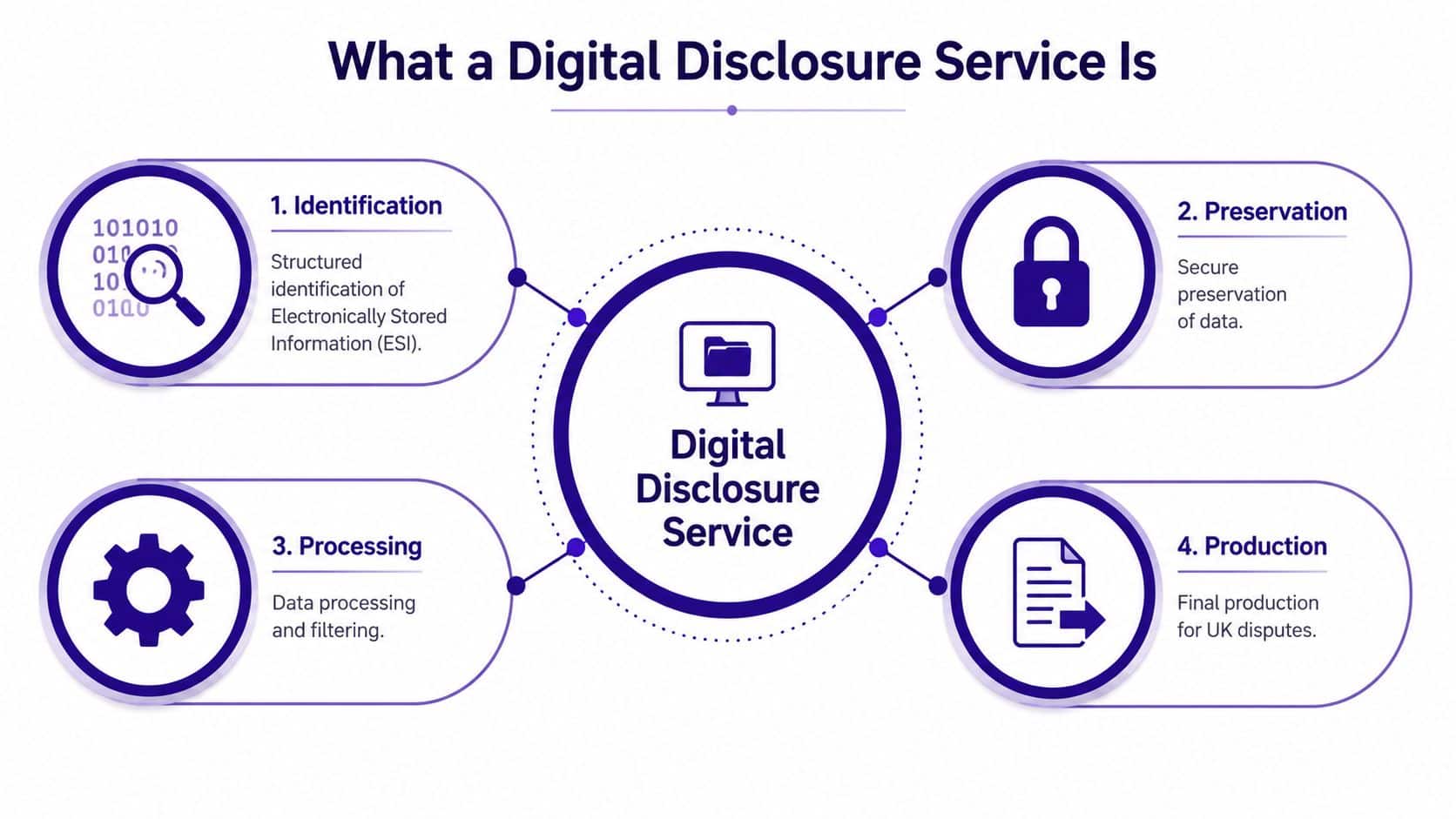
A digital disclosure service is the structured identification, preservation, processing, review and production of electronically stored information, often called ESI, for a dispute or investigation. The service turns dispersed digital records into an organised evidential set that lawyers, experts, insurers, regulators or the court can examine.
The phrase can cause confusion in the UK because HMRC also operates a Digital Disclosure Service, usually called HMRC's DDS. HMRC's service is a tax route for voluntarily disclosing underpaid liabilities, including income tax, capital gains tax, inheritance tax, corporation tax, National Insurance contributions and ATED. After HMRC acknowledges notification, its guidance generally gives the taxpayer 90 calendar days to submit the full disclosure and payment, as set out in HMRC's guide to making a disclosure.
That tax facility is not an e-discovery platform for litigation. A commercial digital disclosure service deals with the evidence that supports a legal, regulatory, insurance or forensic question.
The four practical stages
Identification maps the people, systems and date ranges likely to contain relevant material. That may include emails, accounting records, databases, mobile devices, messaging platforms, audio, spreadsheets and structured finance systems.
Preservation prevents relevant data from being altered, deleted or overwritten. A litigation hold should cover identified custodians and sources, while the collection plan should record how the business preserved the original material.
Processing prepares the data for review. It can involve de-duplication, email threading, optical character recognition, filtering and conversion into a reviewable format.
Production supplies the relevant material in an agreed format, with associated metadata, redactions and audit information. A professional team may also need to support questions about provenance and completeness.
The provider could be a specialist e-discovery vendor, a forensic accountancy firm with a disclosure team, or a law-firm managed service. Secure transmission also matters when teams exchange sensitive files, so professional teams may consult guidance on secure sending for professionals.
The key point remains simple. This is forensic risk work, not software rental. Platforms such as Relativity can process and display data, but they don't decide the financial relevance of a transaction, test a loss model or construct a coherent account of what happened. A defensible method under the relevant Civil Procedure Rules and practice directions matters more than the name on the login screen.
Inside the Process From Collection to Production
A sound workflow starts with the dispute or investigative question, not with a storage quota. The team identifies custodians, relevant systems, date ranges and search themes, then records the decisions in a way that counsel can explain if the opposing solicitor challenges scope.
Collection must preserve context
Forensic collection should capture the relevant source in a manner that preserves metadata and supports repeatability. In suitable cases, that means an imaged-bitstream copy, documented acquisition steps and hash values that help demonstrate whether collected material changed.
Processing then reduces noise without destroying meaning. Typical tasks include de-duplication, de-NISTing, email threading and OCR for scanned documents. Search strings can isolate terms linked to a supplier, bank account, project, employee or transaction, but searches require testing. A poorly chosen term can exclude relevant material or produce an unmanageable review set.
Reviewers assess relevance, responsiveness, privilege, confidentiality and possible significance. Redaction needs an audit trail, particularly where a document contains privileged legal advice, personal information or commercially sensitive material. Production may use Relativity load files, image PDF sets or another format agreed with the parties.
The table below shows where shortcuts usually fail.
| Stage | What Actually Happens | Common Shortcut | Risk if Challenged |
|---|---|---|---|
| Identification | Custodians and data sources are mapped against the issues | Collecting only the active mailbox | Relevant mobile, chat or archived evidence may remain undiscovered |
| Preservation | Original data and metadata are secured with documented handling | Asking staff to forward selected emails | The business may lose context, metadata and confidence in provenance |
| Processing | Data is filtered, de-duplicated, threaded and made searchable | Exporting folders without quality checks | Duplicates, broken threads and unreadable files increase review uncertainty |
| Review | Trained reviewers apply relevance, privilege and issue coding | Letting an unbriefed team search by instinct | Important financial or legal themes may be missed |
| Redaction | Sensitive or privileged content is removed and logged | Redacting without an audit record | The party may struggle to justify withheld material |
| Production | Relevant documents and metadata are delivered in an agreed format | Sending a shared-drive link | The receiving side may challenge completeness, usability or security |
Chain of custody is the connecting record
The chain-of-custody record should show who collected the data, when, from which source, using what method and where the copy went afterwards. It should also explain validation checks and any transformation during processing.
A practical chain of custody procedure gives the legal team something more useful than a collection of assurances. It gives them a chronological account that another practitioner can understand and test.
Teams handling a dispute can also use a discovery request guide for lawyers as a prompt when framing requests and assessing whether the proposed material matches the issues. The guide doesn't replace UK procedural advice, but it can help expose vague requests before they create unnecessary work.
Compliance and Evidential Standards in the UK
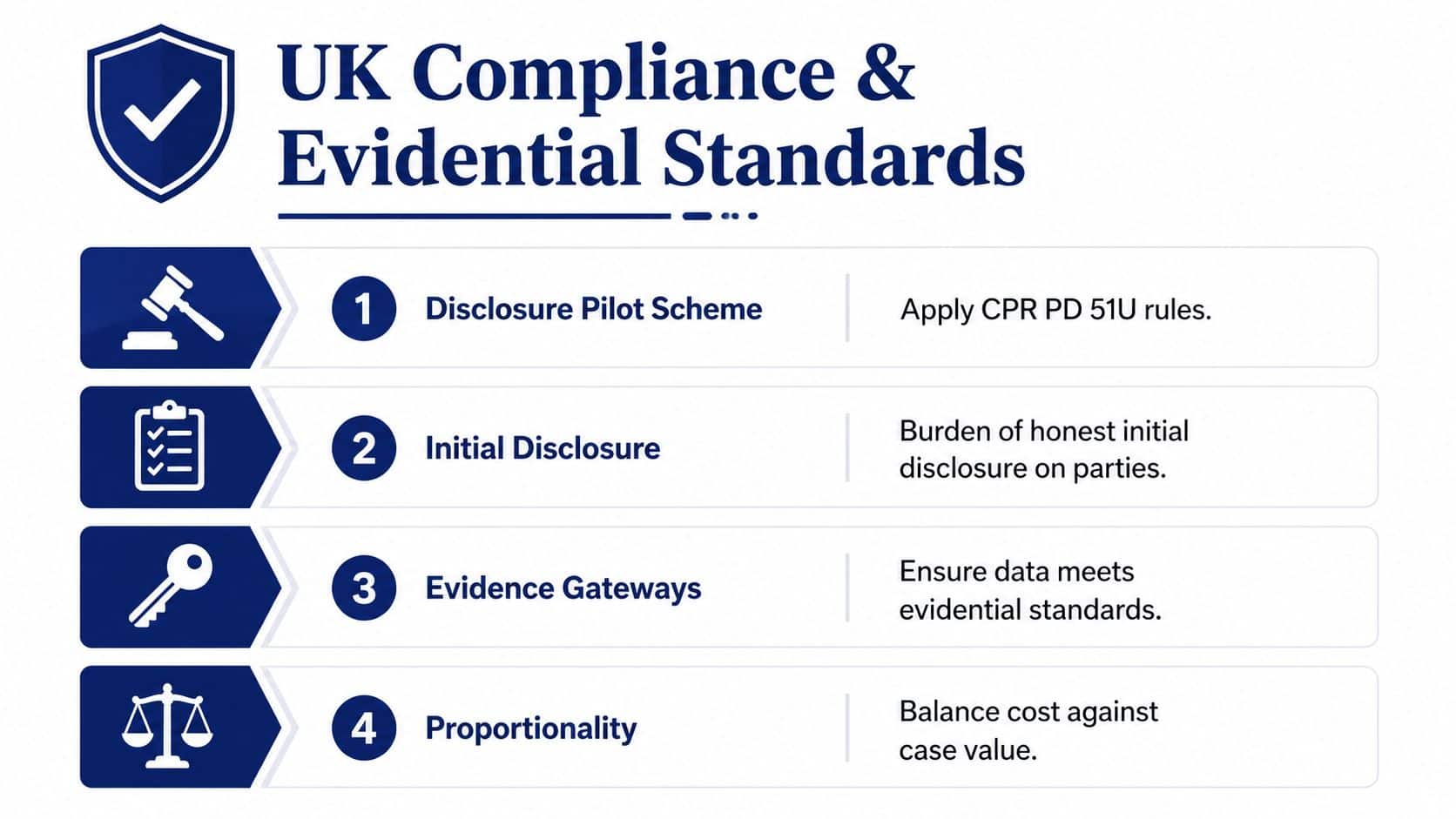
Raw data becomes usable evidence only when the business can explain how it found, preserved and handled the material. UK disclosure practice places emphasis on cooperation, proportionality and candour. A technically complete collection can still create problems if the parties can't explain its scope or if the process overlooks obvious sources.
The Disclosure Pilot Scheme, reflected in CPR Practice Direction 51U, places responsibility on parties to provide honest Initial Disclosure where the applicable rules require it. The Disclosure Review Document must describe the issues and proposed approach with enough precision to support meaningful discussion. Extended Disclosure models, including Models D, E and F, can require a more demanding approach to the identification and review of documents.
The Sedona Principles provide international guidance on electronic information management, but UK practitioners must apply them alongside the relevant English procedural framework. Proportionality remains practical rather than theoretical. The value, importance and complexity of the dispute should inform the scope, method and expense.
Privacy and privilege need decisions, not assumptions
Employee mailboxes often contain personal information. The organisation needs a lawful basis for processing, a legitimate interests assessment where appropriate, access controls and a retention approach that reflects the dispute. Data minimisation doesn't mean deleting potentially relevant material. It means defining a defensible scope and limiting access to what people need.
Litigation privilege also requires care. A document doesn't become privileged because a solicitor received it, and copying a lawyer into an email doesn't automatically protect the underlying business communication. The legal team should decide the privilege position, while the collection and review process should preserve the information needed to support that decision.
Evidence must be repeatable. If nobody can reconstruct the collection and handling steps, the platform cannot repair the weakness.
Hash values, acquisition notes and a documented chain of custody support forensic soundness in the sense associated with recognised digital evidence practice, including the principles reflected in ACPO guidance and ISO 27037. Teams should also consider data protection obligations and, where relevant, the transport compliance logging principles that illustrate why an auditable record matters when information passes through several hands.
For a short visual explanation of the legal context, this video provides an additional reference point.
A procedural error rarely becomes harmless because the business later purchases more software. Once a source disappears, a custodian's account changes or a redaction decision lacks a record, remediation becomes slower and less certain.
Cost, Effort and the Real Trade-Offs
Businesses often compare providers by storage or processing rates. That can obscure cost. Reviewer time, rework, late production, poor scoping and the financial analysis needed to understand the evidence usually drive the outcome.
The stakes can be material. UK Finance reported that criminals stole £629.3 million in the first half of 2025, alongside more than 2.09 million confirmed fraud cases, while banks prevented £870 million of unauthorised fraud, equivalent to 70p in every £1 attempted. Those figures come from UK Finance's fraud losses update. They don't predict the value of a particular claim, but they show why a low-cost evidence process can become expensive if it misses a diverted payment or fails to support recovery.
| Criterion | In-house | Outsourced | Hybrid |
|---|---|---|---|
| Upfront cost | Lower if existing staff and systems can manage the work | Clearer external fees, but scope and hosting need control | Shared cost, with specialist work targeted at the difficult stages |
| Speed to first review | Fast for a small, known dataset | Fast once instructions and access are complete | Often efficient when counsel sets priorities and the vendor processes promptly |
| Data sensitivity | Maximum internal control, subject to internal competence | Requires vendor due diligence, contracts and access controls | Sensitive interpretation stays close to the legal and finance team |
| Technical capability | Depends on internal tools and training | Specialist collection, processing and review capability | Specialist capability without outsourcing every decision |
| Residual risk | Missed sources, weak preservation and reviewer inconsistency | Loss of financial context or over-reliance on platform coding | Coordination risk if responsibilities aren't documented |
Why cheap collection can become costly
Per-gigabyte pricing can reward broad collection because the metric measures volume rather than usefulness. A narrow, forensic-led scope can produce a smaller review population, particularly when the team uses targeted searches, defensible deduplication and email threading.
The claimed saving must remain a hypothesis until the team tests the data. No responsible adviser should promise a fixed reduction without seeing the sources, search terms, document types and issues. The better commercial model links cost to a proportionate plan, clear decision points and disciplined review rather than raw volume.
A fully in-house approach may suit a small, contained matter with strong internal capability. A fully outsourced arrangement can work where the dataset is complex and the legal team needs specialist infrastructure. A hybrid model often gives the business a useful balance, provided the instructions define who owns collection, financial interpretation, privilege decisions, quality assurance and production.
Objections Addressed and When to Bring in a Forensic Accountant
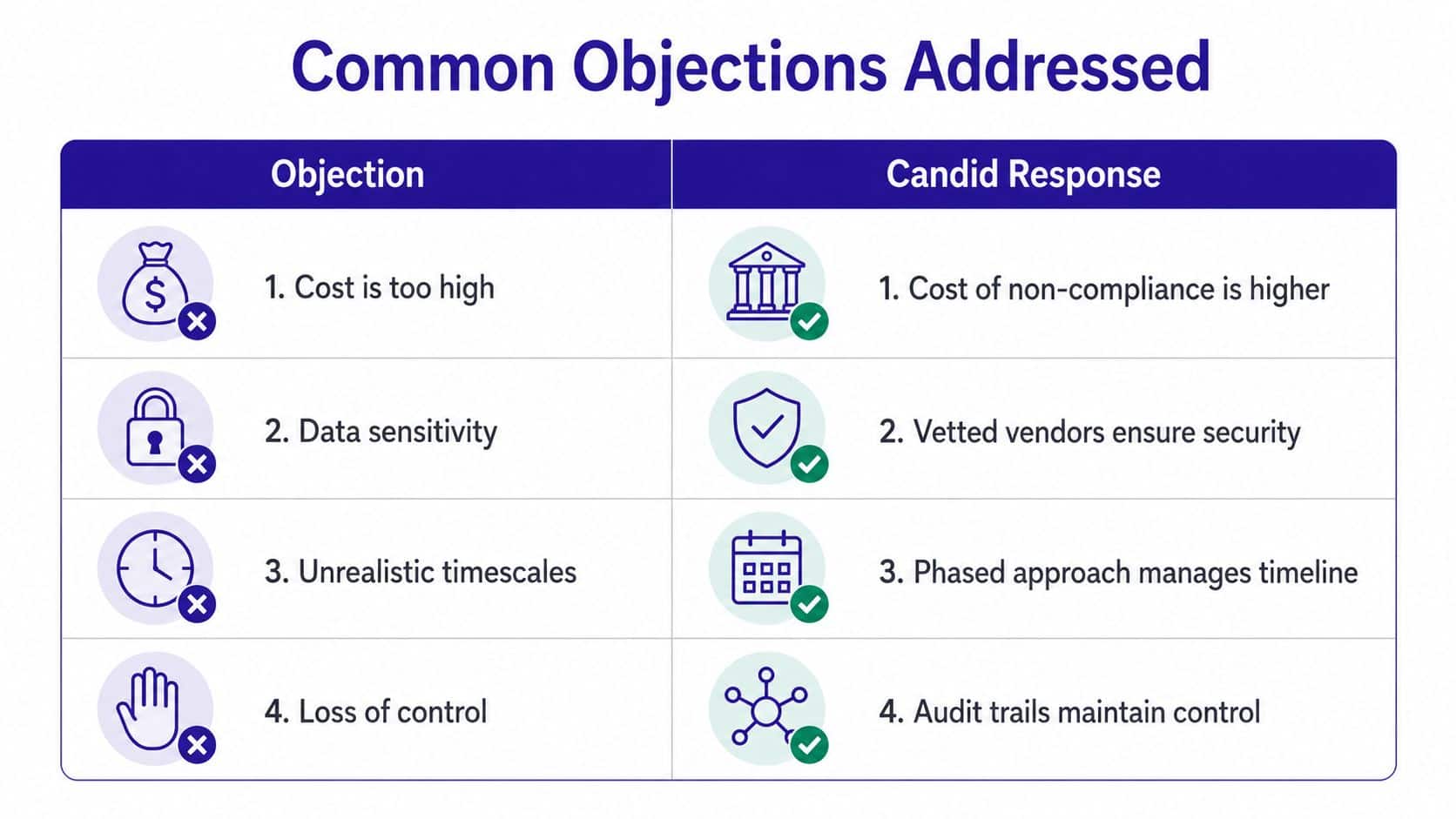
The common objections are reasonable. Digital disclosure can feel expensive, sensitive and disruptive, particularly when the business already faces legal fees, lost management time or an uncertain claim.
“The cost is too high.” It can be, if the team collects every mailbox without a question-led scope. It can also be false economy to rely on manual review when a fraud allegation, shareholder dispute or insurance claim turns on a small set of transactions. Start with the issues, likely custodians and relevant systems, then price the collection and review in phases.
“The data is too sensitive to leave the building.” Sometimes the business has regulatory, contractual or personal-data reasons to limit external access. That doesn't eliminate specialist support. It means the team should assess hosting location, access permissions, encryption, subcontractors, retention and deletion controls, then decide whether collection, processing or review can stay in-house.
“The timescale is unrealistic.” A rushed response may still need an immediate preservation step, followed by a staged collection and rolling production. The right answer depends on the court timetable, HMRC request, insurer's requirements and the availability of custodians. A phased plan gives decision-makers visibility without pretending that every file can receive a perfect review overnight.
“An outside vendor will take control away.” Control should sit in the instruction, decision log and approval process. Audit trails, issue coding, escalation rules and sign-off points allow the business and its advisers to retain oversight.
Where financial interpretation changes the result
A pure e-discovery provider can host, process, search and display documents. That doesn't mean it can trace funds, value lost profits, test an opponent's model or explain why a ledger movement supports one version of events rather than another.
A forensic accountant becomes particularly useful at these points:
- Pre-issue triage: Determine whether the financial records support a viable claim or defence before the parties incur unnecessary disclosure costs.
- Fraud and breach quantification: Reconcile ledgers, bank statements, invoices and communications to calculate loss and identify recoverable amounts.
- Cross-border asset tracing: Follow movements through connected entities, accounts and jurisdictions while separating evidence from inference.
- Second-opinion review: Test an opponent's assumptions, missing records and alternative explanations.
- Shareholder disputes: Analyse management information, distributions, valuations and conduct relevant to a claim under section 994 of the Companies Act 2006.
The practical value lies in connecting the documents to the financial narrative. Lighthouse Consultants provides forensic accounting, fraud investigation, financial analysis and expert reporting alongside disclosure support. Its digital forensic investigator service is relevant where the question extends beyond finding documents to understanding what the evidence means.
Best Practices and Your Next Step
The first response should give each decision-maker a clear job. An SME needs speed and cost control. A law firm needs defensibility and proportionality. An insurer needs loss visibility, causation and recovery options.
A practical 48-hour response
SMEs should preserve first. Stop routine deletion where relevant, identify key custodians, secure company laptops and phones, map Microsoft 365, SharePoint, finance systems and messaging channels, and appoint one person to coordinate instructions. Don't let employees conduct informal searches and overwrite the only useful record.
Law firms should define the issues. Review the claim or investigation scope, identify the ESI requirements, consider CPR PD 51U and, where applicable, Practice Direction 57AD, then set clear collection, privilege, review and production decisions. If bribery or corruption may involve a corporate failure to prevent under section 7 of the Bribery Act 2010, the legal and forensic teams should align the evidence plan with the control environment.
Insurers should establish loss visibility. Secure relevant communications, policy records, financial ledgers and operational data, then test causation, mitigation, quantum and recovery prospects. Business interruption disputes can involve difficult questions about the interaction between public support and insured losses. The Supreme Court's summary in the linked Gatwick Investment and Bath Racecourse cases records issues concerning Covid-19 business interruption losses and the effect of CJRS furlough payments on claims, matters not decided in the FCA test case. The Supreme Court case summary provides the UK reference point.
The quality of the narrative decides the value
A platform can process files, but it can't decide which transaction proves diversion, whether a valuation assumption holds, or how a disputed loss flows from conduct to financial impact. That requires review discipline, accounting analysis and a narrative that lawyers, insurers and the court can follow.
HMRC's tax route illustrates the same point from another angle. The Worldwide Disclosure Facility guidance requires specific identity and agent information at the outset for offshore-related liabilities. HMRC's process also expects the taxpayer to disclose undeclared tax, make an offer, pay what is owed and assist with follow-up information. The online form structures intake, but the quality and completeness of the underlying analysis still matters.
Digital verification is expanding across the wider public-sector compliance environment. The UK digital verification services register, updated in August 2026, lists 46 providers offering 64 certified services, including services for right to work, right to rent and DBS checks, as reported in the OFDIA annual report. That wider shift makes disciplined data handling more important, not less.
Lighthouse Consultants can help you scope a proportionate digital disclosure response, preserve and analyse financial evidence, quantify fraud, litigation or insurance losses, and prepare reporting that withstands scrutiny. Visit Lighthouse Consultants to arrange a focused scoping call, identify your critical data sources and agree the next practical step.