You don't usually spot a share premium problem when the money lands in the bank. You spot it later, when a director has already treated the cash like spare working capital, a lender wants comfort on the equity story, or a dispute solicitor asks why dividends were paid from a reserve that was never distributable in the first place. That's when the tidy fundraising narrative starts to crack.
I've seen this go wrong in proper boardrooms, not just messy start-up admin. A company raises equity, the balance looks healthier, and someone in the room assumes the excess can cover bonuses, salaries, or a short-term squeeze. Then an investor, HMRC, an insolvency practitioner, or a litigator asks for the ledger, the board minutes, and the reasoning behind the entry. The issue is no longer accounting style, it's legal treatment, governance, and evidence.
This guide is for directors, finance teams, investors, lenders, and lawyers who need the UK position clear and defensible. It focuses on shares at premium through a forensic lens, because risk is rarely the definition; it's the trail, the permissions, and the misstatement that follows.
When Shares at Premium Become a Problem Worth Solving
A founder rings finance at the end of a funding round and asks a simple question, can we use the new money to clear payroll strain and still pay a modest dividend later in the year? On the face of it, the bank balance says yes. The share premium account says something very different.
That mismatch is where trouble starts. In UK company law, amounts credited to share premium sit in a legally constrained reserve, not as free cash for routine spending. If directors rely on the bank balance alone, they can misread what the company can lawfully do and put themselves into a position that becomes awkward fast once an adviser, investor, or litigator reviews the paperwork.
Who needs to care
Directors need the answer before they approve distributions. CFOs need it when they brief the board. Investors need it when they compare the cap table to the valuation story. Lenders and lawyers need it when they test whether the equity narrative matches the books.
Practical rule: if the question sounds like “we've raised money, so can we spend it?”, the next document you need is the share issuance trail, not the cashflow forecast.
That is especially true in disputes. A share premium entry can look routine in the accounts, then become central evidence in a shareholder conflict, a refinancing, or a solvency challenge. The point of this article is to make the mechanics, the legal limits, and the forensic checks visible before they become an argument.
What Shares at Premium Actually Means
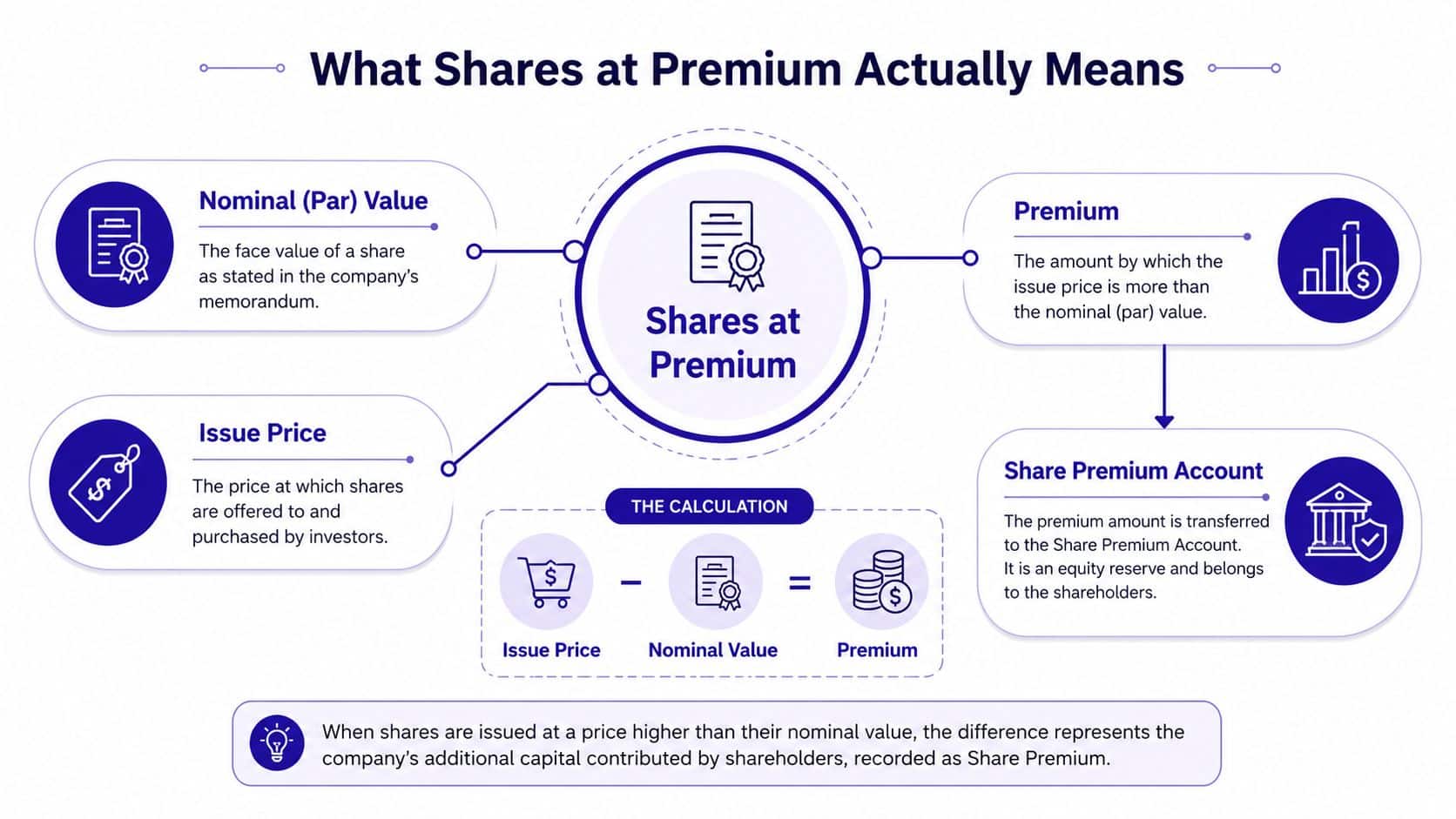
A share premium arises when a company issues shares above their nominal value, sometimes called par value. The nominal value is the face value set in the share structure. The issue price is what the investor pays. The gap between the two is the premium, and in a dispute that gap is one of the first figures I test against the allotment paperwork and cash trail.
The accounting split is straightforward once the terms are kept separate. The nominal portion goes to share capital. The excess goes to the share premium account, which sits inside equity but is not the same as retained earnings or distributable profits. UK guidance on the mechanics makes that distinction clear, and so does the basic legal treatment of the reserve LegalVision's explanation of share premiums.
A simple example shows why the distinction matters. If a company sells a share with a nominal value of £1 for £2.50, £1 goes into share capital and £1.50 goes into share premium. The premium is only the amount above nominal value, not the whole issue price. That matters because it drives the ledger entry and the later restrictions, and those are exactly the points a forensic review will check if the cap table and bank receipts do not line up.
The formula you use
The standard calculation is:
Share premium = (issue price per share − nominal value per share) × number of shares issued
That formula is where a lot of sloppy summaries fail. It shows how much of the fundraising round becomes share capital and how much lands in the share premium account. It also helps when a cap table looks odd and you need to test whether the issue price supports the paperwork, especially if you are checking for side agreements, sweetheart pricing, or a mismatch between the board minute and the money received.
For readers who also deal with subordinated funding or hybrid structures, mezzanine capital for broker training is a useful adjacent concept, because it shows how capital labels affect rights, controls, and later negotiations.
How the Premium Lands in the Accounts
The bookkeeping looks simple, which is why it is often posted badly. A UK limited company issues new shares above nominal value, the cash arrives, and the journal should split the receipt between share capital and share premium. The debit goes to bank, the nominal amount credits share capital, and the excess credits the share premium account.
That split is not cosmetic. It shows anyone reading the balance sheet how much of the funding is ordinary issued capital and how much is trapped in a separate reserve. Lenders care because it affects the quality of the equity support they think they are seeing. Auditors care because a wrong split can point to wider control weaknesses, especially where board approvals or statutory registers are weak.
A competent bookkeeper should show the issue clearly in the ledger and in the equity section of the balance sheet. The share premium account should sit apart from retained earnings, not hidden in a vague “other reserves” bucket that nobody can explain.
A practical example helps here. If shares are issued at a premium and the entry is posted only as share capital, the accounts overstate issued capital and understate the restricted reserve. That error matters in disputes, because a clean-looking balance sheet can still be wrong if the supporting papers do not match the entry.
What forensic reviewers check first
A forensic review starts with the source documents, not the trial balance. The first checks are the share allotment paperwork, the consideration received, and the exact date of issue against the entry posted. If the reserve was created but the cash never arrived, or the consideration was netted off against something not properly documented, the file needs attention fast.
A clean journal entry can still hide a bad transaction if the underlying authority is missing.
The accounting trail should also match the corporate trail. Board approval, the bank receipt, the allotment record, and the final equity presentation should all point to the same issue price and the same number of shares. For a practical UK issuing workflow, Lighthouse Consultants' guide to the issuance of shares is a useful reference point when you are checking whether the paperwork and the accounting tell the same story. If that trail breaks, due diligence gets harder, not easier.
Legal and Tax Treatment Under UK Law
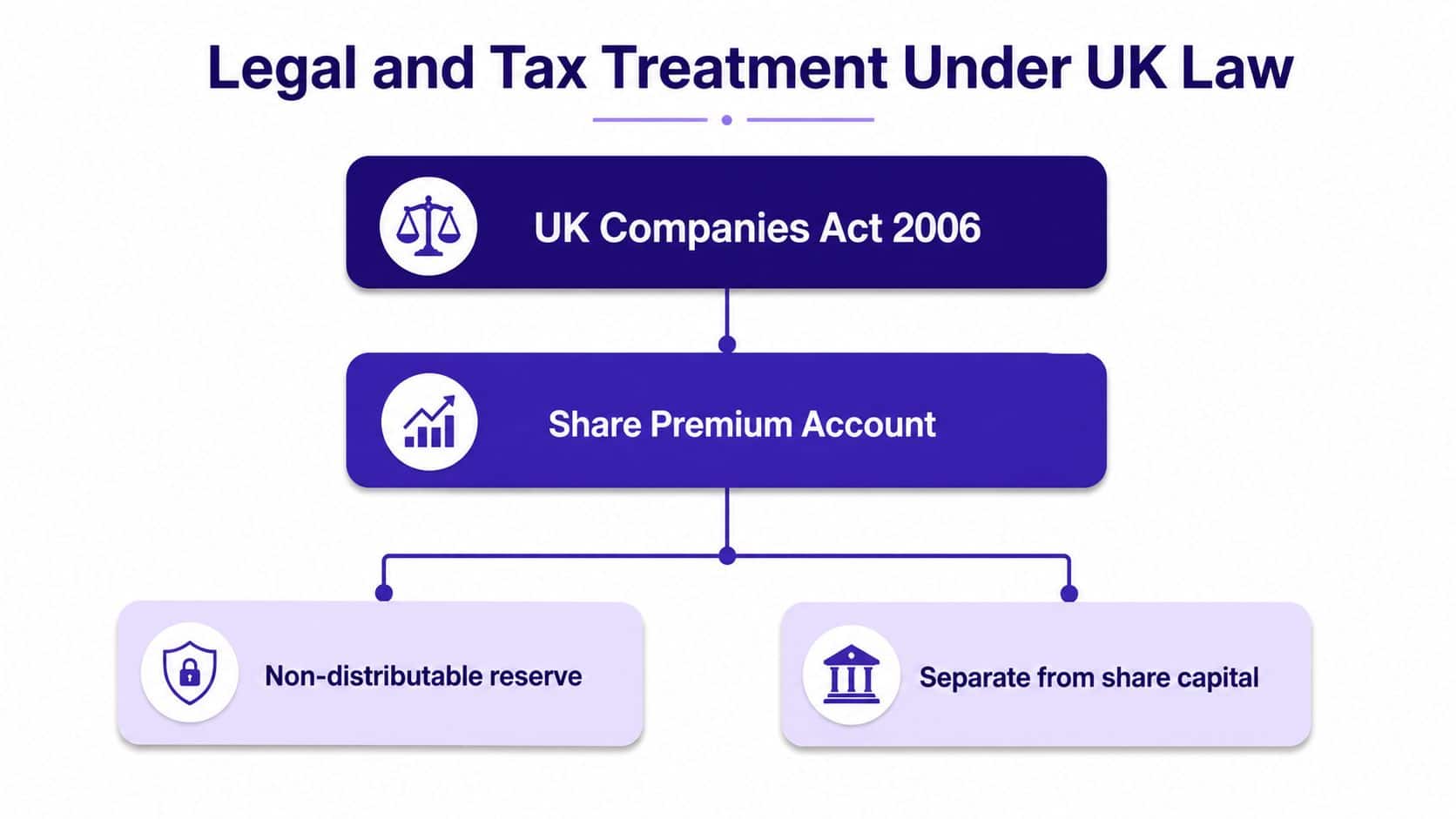
Under the Companies Act 2006, amounts credited to share premium form a non-distributable reserve. That means directors can't treat it like an ordinary pot of cash for dividends, salaries, or general overheads. UK-focused guidance from 1st Formations states this plainly, and it reflects the practical legal distinction that often gets missed in founder-led businesses 1st Formations on share premium.
The permitted uses are limited. The reserve can be applied to writing off share issue expenses, paying up bonus shares, and certain reorganisations or reductions of capital where the statutory route is followed. It is not there to plug a working-capital gap because the bank balance looks comfortable.
Why the history still matters
The UK treatment did not always look like this. The historical record shows a shift in 1948, when the Companies Act 1948, section 56, removed earlier flexibility after the Cohen Committee recommended tighter treatment of share capital. Historians also note a tax-avoidance loophole open from 1889 to 1973, which helped make share premiums a permanent feature of UK share issuance practice after about 1920 historical analysis of UK share premium treatment. That history explains why the modern rule is so cautious. The reserve exists to separate contributed capital from profits.
What tax teams usually ask
The tax point is more restrained than many directors assume. Share premium itself is not ordinary trading income for the issuing company. The practical issue is not corporation tax on the premium as if it were sales revenue, it's whether the legal form of the transaction matches the company records and any later movement through the reserve.
Audit trail check: if anyone proposes to “use” share premium, ask for the statutory route, the board resolution, and the exact accounting treatment before money moves.
The UK-specific question is never just “is it on the balance sheet?”. It's “is it distributable, and if not, who authorised the planned use?” That's where compliance risk starts.
Why Directors Issue Shares at a Premium
A premium price is usually chosen when directors want the share issue to reflect commercial value rather than only the nominal amount. It lets a company raise capital without issuing more shares than needed, which keeps the cap table under control and avoids handing out unnecessary equity on an early valuation. In practice, that matters once the business has moved beyond the first risk-heavy stage and the board needs the paperwork to match the actual pricing decision.
It also leaves an audit trail. A premium shows that the company and its investors have attached value to the business above nominal share capital, which can support later discussions with lenders, buyers, and new investors. Forensic review starts here, because the issue price tells you more than the headline valuation, it shows whether the transaction was priced for substance or dressed up after the fact.
The trade-off is straightforward. A higher premium can help preserve ownership proportions, but it can also create trouble later if the round documents are thin, the valuation basis cannot be supported, or the company later needs to work through distributions and reserves. Directors often treat premium as a financing detail, yet it is part of the legal and accounting structure of the raise, so the board should set it with the same care as the headline terms.
For a broader market view on funding structures, browse capital raising insights is a useful reference point, especially when comparing how different capital forms affect negotiation posture and investor expectations.
Where premium helps, and where it complicates life
Premium helps when the valuation is credible, the cap table is clean, and the directors want a clear split between contributed capital and the excess above nominal value. That split can matter in a dispute, because it gives accountants and solicitors a documented route back to the original bargain. It also helps when later diligence teams want to see that the issue was priced with intent, not improvised to fill a funding gap.
It complicates life when people use it to make weak pricing look respectable, or when they assume the reserve can be moved around like free cash. That is a common forensic concern. Once share premium has been created, the records need to show exactly how it arose, who approved it, and what the company believed it could do with it under the rules. If the paperwork is loose, the reserve becomes a point of challenge rather than a comfort.
Premium is not a way to dodge dilution, and it is not a substitute for valuation work. It is the legal and accounting expression of issuing shares above nominal value.
If you need the mechanics of the issuance process itself, the UK guide to the issuance of shares is the right companion reading before anyone signs off the round. The commercial question is whether the premium supports the fundraising story or creates avoidable friction for the next diligence review.
Red Flags and Common Pitfalls
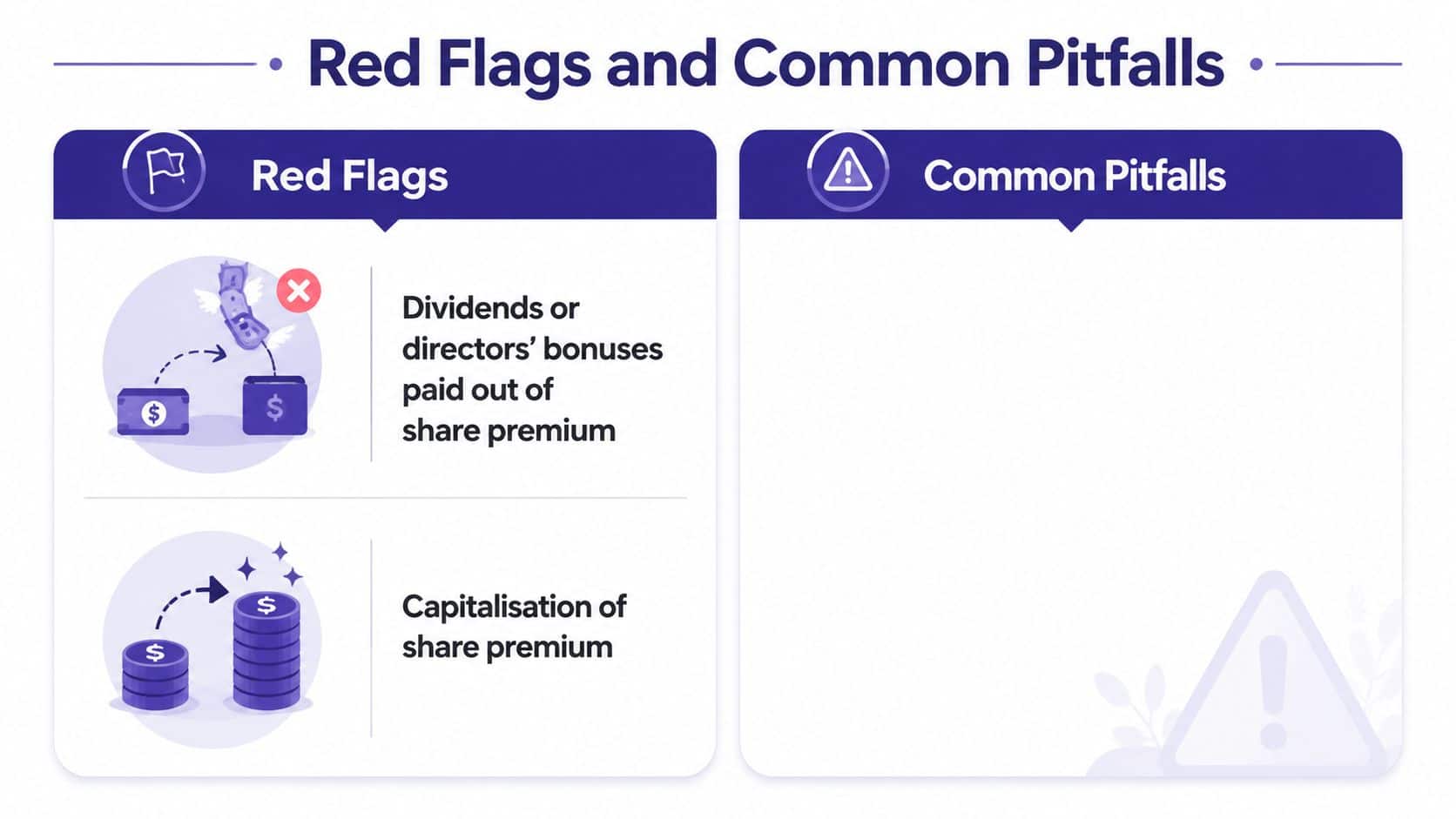
The most common abuse pattern is painfully ordinary. A company records share premium, then someone treats that reserve as a convenient source for dividends, bonuses, or short-term spending. The accounts may still look tidy at a glance, but the legal position is wrong, and that becomes obvious once an insolvency practitioner or a shareholder's solicitor asks why the payment left an apparently non-distributable reserve.
Another red flag is capitalisation gymnastics. Directors or advisers sometimes try to dress up existing balances in a way that makes the premium look larger or more useful than it really is. Related-party transactions can make this worse, especially where a premium is inflated to shift value between connected parties without a clean commercial basis.
The forensic markers that matter
A forensic accountant usually looks for the same pressure points first.
- Dividends or directors' bonuses from premium: that is the quickest sign the reserve is being treated as spendable cash.
- Capitalisation moves that inflate reserves: if the reserve appears to grow without a clear, documented share issue, the paperwork needs to be tested hard.
- Related-party premium pricing: where the issue price looks detached from the commercial reality, the transaction may need a valuation challenge.
- Share-for-share structures that hide disposals: these can change the economic story while making the accounts look cleaner than the underlying deal really is.
A representative dispute often starts with a routine fundraising round and ends in insolvency proceedings. One side says the premium supported the business. The other side says the company used it to fund improper distributions and misled creditors. Once that argument starts, the board minutes and bank trail matter more than the narrative.
Due Diligence Checklist for Investors, Lenders and Litigators
A proper review starts with documents, not assumptions. If the company says the premium is clean, the file should prove it.
Request these records
- Share issuance ledger: confirm how many shares were issued, at what price, and on what date.
- Board minutes: check that directors approved the issue and understood the premium treatment.
- Share premium account reconciliation: tie the movement in the reserve to the share issue and later permitted uses.
- Bank statements at the date of issue: verify that the consideration arrived.
- Valuation reports or pricing papers: test whether the premium aligns with the commercial story.
Run these tests
- Premium per share versus market evidence: ask whether the issue price looks rational against the round's facts.
- Age of the reserve: older reserves can carry historical baggage that modern summaries miss.
- Movements since issue: trace whether the reserve was used only for permitted purposes.
- Authority trail: confirm the statutory steps and board approvals line up with the accounting entries.
For a deeper framework on how professional reviewers organise this work, financial due diligence guidance is a useful companion before the next meeting with management.
If you want to benchmark the investor side of the discussion, browse UK investor profiles can help frame how different backers think about capital structure, diligence depth, and governance.
Who focuses on what
Investors usually want confidence that the premium supports the valuation story. Lenders care whether the equity base is real and properly recorded. Litigators and forensic accountants press hardest on source, authority, and use, because those are the points that hold up or collapse under scrutiny.
When to Bring in a Forensic Accountant and What Happens Next
Bring in a specialist when the reserve looks misused, when a sale or refinancing depends on a clean equity story, or when a dispute has already started and everyone is fighting over what the premium meant. Those are the moments when a neutral analysis pays for itself, because the issue is no longer bookkeeping, it's evidence.
The best time to ask for help is before the transaction closes or the letter before action lands. That way, the company can test the trail, fix the documentation, and avoid building a weak position into the record. Where matters do escalate, the same analysis can support expert evidence in court, which is why the independence of the work matters so much forensic accounting in the UK and litigation support.
Lighthouse Consultants works through a structured process, starting with a free discovery conversation, moving to a scoped action plan, and finishing with independent reporting that directors, advisers, and courts can rely on. If you're dealing with a share premium question in the UK, start that conversation early and bring the paperwork with you.
If you need a clear view on whether your shares at premium treatment is clean, defensible, and ready for scrutiny, Lighthouse Consultants can review the records, test the accounting trail, and support you through dispute, diligence, or court-facing work. Visit Lighthouse Consultants to start a confidential discovery conversation with a London-based forensic accounting team.