The case usually goes wrong before anyone gets near a witness box. A finance director spots unexplained payments, a solicitor receives a half-baked bundle from a departing partner, or an insurer asks for records that no one can quite explain. By the time people call for help, the damage isn't just financial, it's evidential.
That's the problem with evidence gathering in corporate disputes, fraud, insolvency, divorce, inheritance fights, shareholder disputes, and insurance claims. Many think the hard part is finding the truth. In practice, the hard part is preserving it in a form a judge, regulator, or expert can still rely on later. The wrong first move can contaminate records, destroy metadata, or leave a chain of custody gap that opposing counsel will hammer in cross-examination.
When Financial Evidence Disappears Before You Can Act
A managing director rings in a panic because the monthly numbers don't tie, a bookkeeper has resigned, and a shared mailbox suddenly looks emptier than it should. That's the point where instinct takes over, and instinct often makes things worse. People start opening laptops, forwarding emails, and asking the suspected employee to “just explain what happened”, all before anyone has preserved the original material.

The first 48 hours matter because digital and paper evidence don't wait around politely. Volatile data can disappear, shared folders can be altered, and a single well-meaning IT reset can overwrite material that would have answered the whole dispute. UK public-sector guidance from the Centre for Governance and Scrutiny stresses that evidence should be relevant, proportionate, accurate, and reliable because weak provenance reduces the weight a decision-maker can place on it, and that principle holds in private disputes too. CfGS practice guidance on gathering and evaluating evidence
Practical rule: if you've got a live device, preserve before you investigate. Curious browsing destroys cases.
A common mistake is to treat the suspect device like an ordinary office computer. Someone clicks through emails, checks browser history, or exports files to a desktop folder, then asks why the other side is challenging authenticity. Another mistake is confrontation too early. Once a suspect knows the concern, records may be deleted, moved, encrypted, or normalised before anyone has taken a defensible copy.
The market also rewards speed in a very unhelpful way. Directors want answers fast, lawyers want a usable bundle, and insurers want a claim position. Yet speed without discipline creates evidence that looks busy but won't survive scrutiny. If the first capture isn't controlled, every later finding sits on top of a weak base.
For matters where timing is critical, many teams bring in specialist support early. In urgent cases, a structured response matters more than heroic effort after the fact, and that's where speed in forensic accounting becomes a practical issue rather than a slogan.
Building a Defensible Evidence Collection Workflow
The safest workflow starts with a clear objective, not with a pile of documents. Define what you're trying to prove or disprove, then identify the sources that can support that point. That sounds obvious, but in real disputes people often collect everything except the records that matter.
Start with the order of volatility
Live systems need attention before static files. If a device is powered on, capture the screen, RAM, running processes, and network state first, because later actions can overwrite or destroy live evidence. That principle is well established in digital-forensic practice, and it's why powering down a machine without thinking can delete the most valuable artefacts. Cellebrite's guidance on digital evidence collection sets out the logic clearly.
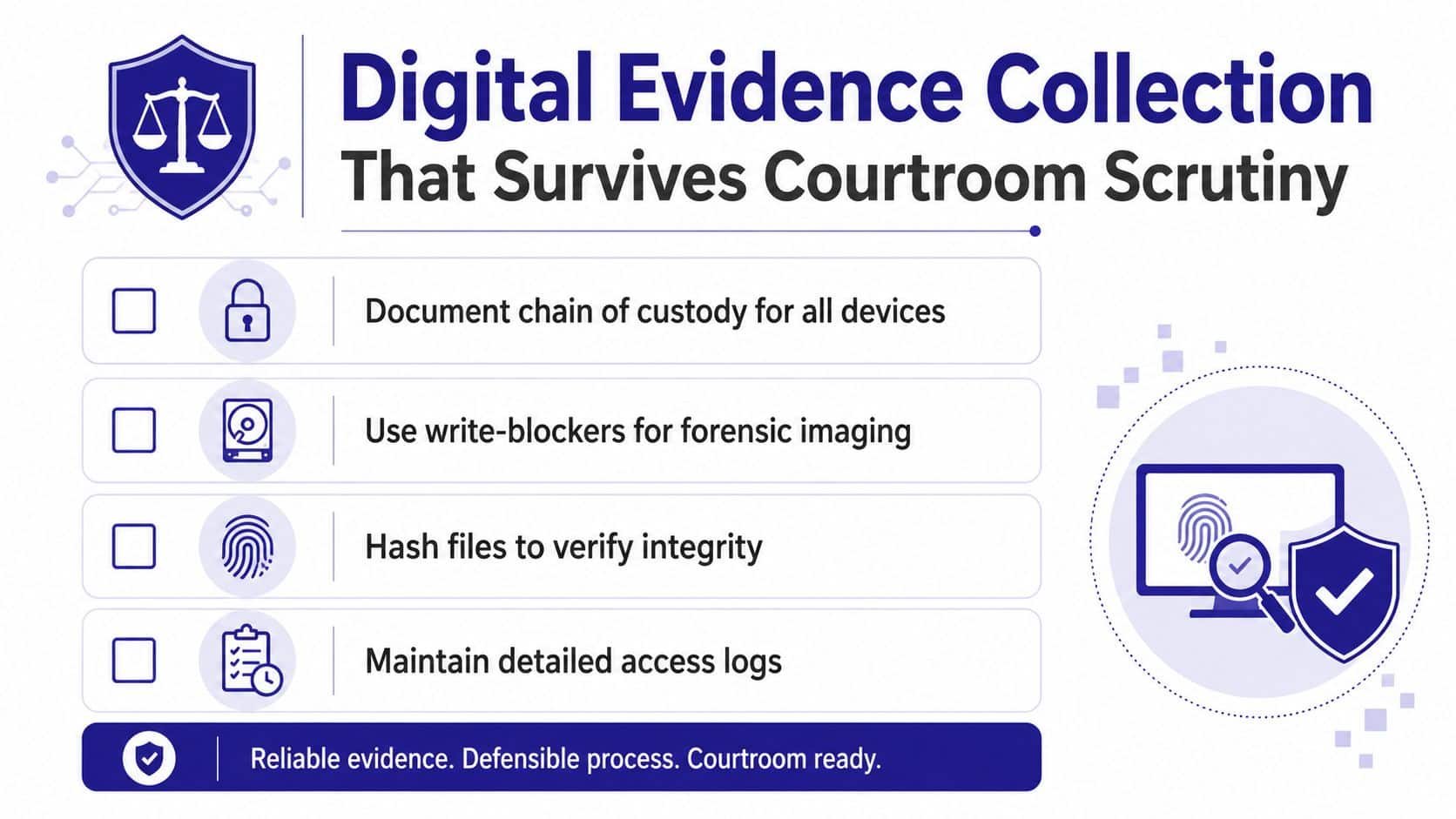
Once the volatile material is secured, move to the less fragile records. Use bit-for-bit imaging for storage media, keep originals untouched, and document every handoff. If you're collecting mobile evidence, isolate the device from networks immediately, and if you're handling storage media, use a hardware write blocker so you're not writing back to the source.
A defensible collection is boring. It's repetitive, time-stamped, labelled, and easy to explain.
Build the record as you collect it
Photograph each item before it moves. Time-stamp it. Give it a unique label. Log who handled it, when, where it was stored, and what happened at each transfer. Courts and regulators test whether evidence was altered, selectively collected, or passed around without control, so the log has to read like a continuous story, not a reconstruction after the event.
When records are missing or delayed, resist the urge to fill the gap with guesswork. Collect background records early, ask third parties for original source material, and note the absence plainly. In practice, that means recording what you asked for, who held it, when they said it was unavailable, and whether any alternative source can corroborate the same fact pattern.
Use the environment, not just the files
Storage discipline matters too. If you need a secure room or a controlled evidence area, physical layout affects integrity, especially when multiple teams handle material. A useful operational reference is the Material Handling USA design guide, which shows how storage discipline supports controlled access and traceability.
A simple working checklist helps:
- Define the objective first: State the allegation, loss issue, or dispute point in one sentence.
- Map the sources: List devices, mailboxes, ledgers, contracts, and third-party records.
- Preserve live data early: Capture volatile information before static files.
- Protect originality: Keep source material untouched and document any copies made.
- Log every handoff: Record who had it, when, and for what purpose.
- Note missing material: Don't pretend a gap doesn't exist, document it.
Digital Evidence Collection That Survives Courtroom Scrutiny
Digital evidence usually decides the argument, but it only helps if the other side can trust it. The problem isn't just retrieval. It's whether the material still carries the metadata, provenance, and continuity needed to prove authenticity.
Metadata is the difference between useful and vulnerable
Creation dates, modification timestamps, access logs, and file paths often do more work than the document itself. They help show whether a file was created when someone says it was, whether it was edited later, and whether it was opened by someone else. If IT staff export, copy, or save over the original in the wrong way, those clues can disappear or become unreliable.
That's why working on originals is a bad habit. Bit-for-bit forensic imaging preserves the source exactly as found, which makes reproduction and review possible later. If you're analysing visual material, first-hand capture matters too. Preserve the original file, record location data where relevant, and take multiple angles so the image can be tested rather than merely admired. UK-oriented visual-evidence guidance stresses that point because authenticity is usually the first target in a challenge.
Cloud, messaging, and ephemeral platforms need fast handling
Modern investigations rarely stop at a laptop. Email sits in the cloud, chats disappear, and location-linked information can vanish as soon as a device syncs or an app refreshes. The practical answer is immediate isolation, disciplined collection, and a clear decision about what can be captured live before it evaporates.
For teams dealing with cloud-heavy investigations, specialist digital expertise helps. Why you need a digital forensic investigator is a useful internal starting point because the technical question is rarely just “what's there?”. It's “can you prove it wasn't changed on the way out?”.
The courtroom test is simple. Can another expert reproduce what you did, using the same source material, and reach the same conclusion? If the answer is no, the evidence may still be interesting, but it's not strong.
A recent UK cyber breach survey found that 50% of businesses and 32% of charities experienced a cyber breach or attack in the last 12 months, which is one reason digital traces now show up in far more investigations than they used to. UK cyber breach survey reference in visual-evidence guidance That means logs, screenshots, device data, and account records need the same discipline that people once reserved for bank statements and paper files.
If your collection process can't explain why one file was preserved and another wasn't, opposing counsel will use that gap. The better question is whether the collection method can stand up to a hostile review months later, when nobody remembers the original urgency and every inconsistency looks deliberate.
For teams facing awkward collection issues, overcome common forensic hurdles is a useful reminder that technical friction is normal, but sloppiness isn't.
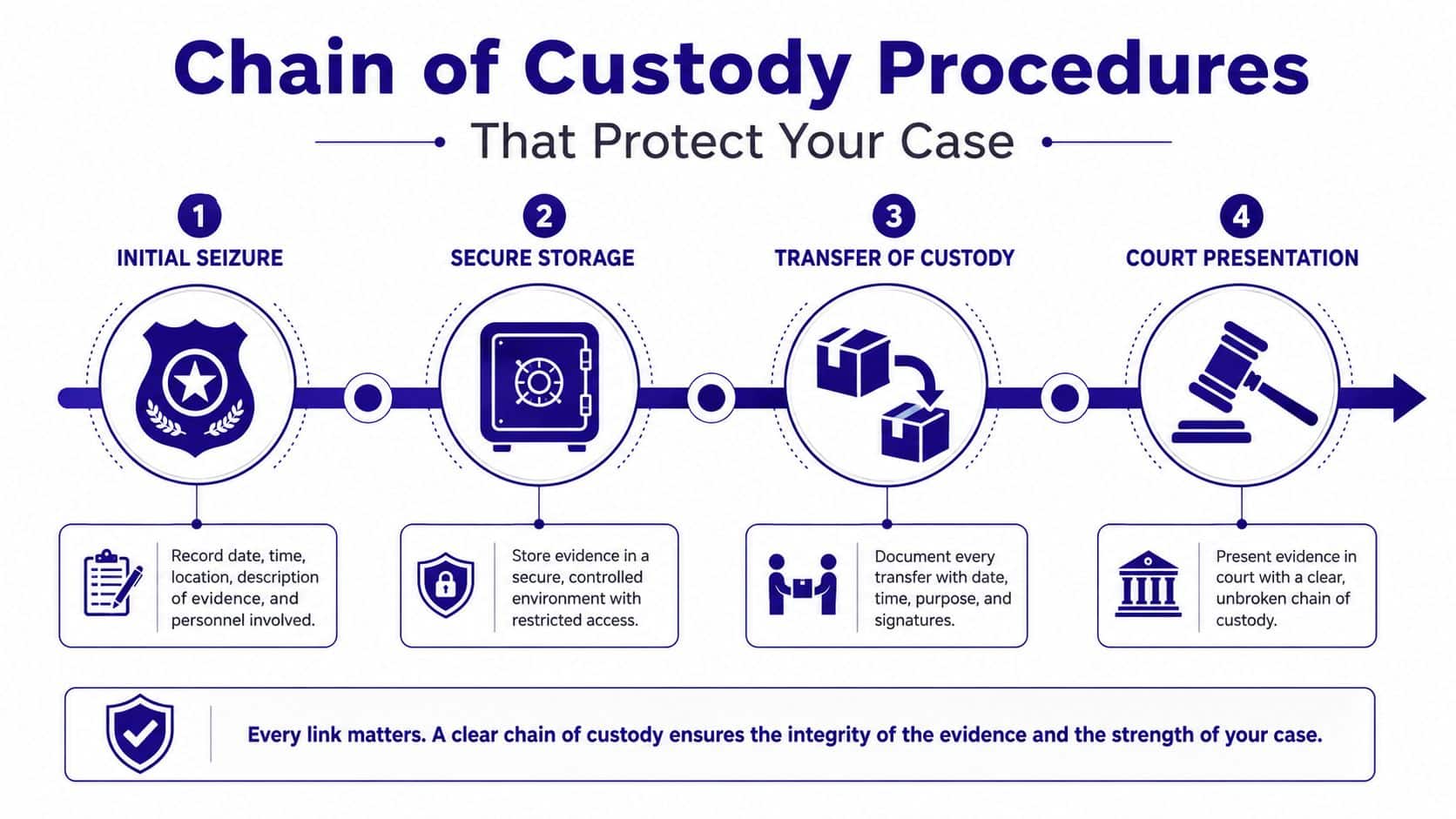
Chain of Custody Procedures That Protect Your Case
A broken chain of custody is one of the fastest ways to weaken otherwise solid evidence. If you can't show who held the material, when they held it, where it was stored, and what controls applied, the other side will argue that the item might have been altered, switched, or selectively presented.
Treat the log as a living record
A defensible chain of custody document starts the moment evidence is identified. It should record the item description, date and time collected, collector's name, unique identifier, storage location, and access restrictions. Every later movement needs the same treatment. That includes transfers between solicitors, forensic accountants, IT staff, and expert witnesses.
Undocumented transfers cause the biggest problems. So do shared drives with no access log and mixed evidence folders where nobody can say who uploaded what. In cross-examination, that kind of gap is easy to expose because it looks like loss of control, even if no one acted improperly.
Use a consistent custody structure
A simple format works well across physical, digital, and financial records:
| Item | What to record |
|---|---|
| Physical document | Date, time, who seized it, where it was found, storage location |
| Digital media | Device identifier, imaging method, hash or verification reference, transfer log |
| Financial record | Source system, export date, file name, recipient, retention location |
That table is basic on purpose. Simple logs are easier to keep accurate, and accuracy matters more than presentation polish. If several professionals handle the same bundle, each transfer should have a clear handoff note and a named custodian.
One internal resource that fits this theme is UK document authentication services, because authentication and custody often overlap in real cases. If the document's origin is shaky, the custody trail has to do more work, not less.
Opposing counsel doesn't need to prove the evidence is false. They only need to show the trail is incomplete.
The best practice is to keep one master log and avoid parallel versions. Multiple spreadsheets, emailed updates, and informal notes create contradictions that can be mined later. A clean, uninterrupted record gives the judge or tribunal something stable to rely on when the evidence itself is contested.
Overcoming Objections to Forensic Accounting Support
Cost is usually the first objection, but it's the wrong place to start. The question is what happens when a case turns on records that weren't preserved properly, losses weren't quantified cleanly, or the evidence bundle can't survive challenge. In that scenario, cheap becomes expensive very quickly.
Time is the second objection. Directors and solicitors worry that bringing in a forensic accountant will slow everything down, yet structured engagements usually speed matters up because they narrow the dispute. Instead of arguing over every file, parties can focus on the transactions, records, and assumptions that move the outcome.
Where DIY evidence gathering breaks down
In fraud cases, people often collect partial bank statements, screenshots, and email chains, then assume the narrative will speak for itself. It won't, because the evidence still has to connect conduct to intent. UK fraud law, as discussed in legal evidence commentary, turns on proving dishonest conduct and the required mental element, not just showing that money went missing. Stanford Encyclopedia of Philosophy on evidence and legal reasoning
Shareholder disputes and divorce cases create a different trap. One side may control the records, and the other side may only see selected extracts. That's when a forensic accountant can test completeness, reconstruct missing sequences, and identify where the paper trail stops being credible. In business interruption claims and insolvency work, the same discipline helps separate genuine operational damage from unsupported assumptions.
The hidden cost sits in the failed outcome
Poorly gathered evidence can lead to rejected claims, delayed settlements, and avoidable regulatory pain. It can also create a wider credibility problem, because once a tribunal sees sloppy handling in one area, it starts looking harder at everything else. That's especially dangerous where documents, emails, and financial records all point in slightly different directions.
Practical rule: if the evidence won't explain itself to a sceptical third party, it's not ready.
For businesses, the disruptive part is often not the expert's work. It's the internal uncertainty that comes from trying to do the job without a clear method. A structured engagement gives staff a process to follow, gives lawyers a defensible record, and gives decision-makers something they can use rather than just review.
In short, the question isn't whether forensic support costs something. It's whether you can afford to proceed with evidence that won't stand up when it matters.
How Lighthouse Consultants Strengthen Your Evidence Position
Lighthouse Consultants brings a structured model to the exact problems that weaken corporate evidence. The firm's process starts with a free discovery conversation, then moves to a scoped action plan, then to results reporting that can be used in negotiations, disciplinary hearings, and court. That sequence matters because it forces the evidence plan to fit the dispute, rather than forcing the dispute to fit whatever records happen to be available.
The practical value sits in the detail. In fraud investigation, bribery and corruption matters, litigation and insurance claim quantification, due diligence, and expert witness work, the firm's job is to gather financial evidence, test it, and present it in a way that can be checked. That aligns with what fails most often in the field, weak provenance, missing context, and unsupported assumptions.
Experience across retail, logistics, aviation, manufacturing, financial services, insurance, and the public sector matters because evidence problems change by environment. A ledger issue in a manufacturer doesn't look like a disclosure issue in a financial services file, and neither looks like a claim quantum dispute in insurance. A team that has handled those settings before is less likely to miss where the records usually break down.
The cross-border element matters too. Where records sit in more than one jurisdiction, collaboration with Andersen Global can help manage the evidential load without treating every country as if it runs the same way. That's a real issue in multi-party disputes, especially when emails, contracts, and financial statements travel faster than the people who control them.
The point isn't to decorate a case with expert language. It's to make the evidence testable, traceable, and usable. Lighthouse Consultants does that by tying collection method, financial analysis, and reporting discipline together, which is exactly what courts and regulators tend to reward.
If you're dealing with missing records, disputed transactions, or digital evidence that could be challenged, Lighthouse Consultants can help you structure the collection, preserve the trail, and quantify the issue clearly. Visit Lighthouse Consultants to start a free discovery conversation and get a defensible evidence plan in place before the case hardens against you.