You're probably dealing with this already. A supplier misses delivery, a subcontractor turns out to be insolvent, payroll records don't match the contract, or an insurer asks for proof you took reasonable steps before a loss hit. Then the actual cost arrives. Not the missed shipment. The dispute, the frozen cash flow, the fraud investigation, the legal fees, the management time, and the uncomfortable question from your board or solicitor: why didn't anyone spot this earlier?
Most businesses still treat supply chain due diligence like a procurement formality. That's a mistake. In practice, it's a financial control issue, a fraud prevention issue, an insurance issue, and, if matters escalate, a litigation evidence issue. If your process can't show who you contracted with, who performed the work, who paid the workforce, and what you did when risks appeared, you don't have due diligence. You have paperwork.
The Hidden Risks That Could Ruin Your Business
A supply chain failure rarely stays in the supply chain. It spills into unpaid invoices, disputed contracts, regulatory scrutiny, delayed projects, and insurance rows over whether your controls were adequate. If forced labour, bribery, sham subcontracting, or supplier fraud enters your operation, you'll feel it in margin erosion first and courtroom risk second.
The UK figures should stop any owner or finance director from being casual about this. The value of fraud cases heard in UK courts surged by 151%, rising from £444.7 million in 2021 to £1.12 billion in 2022 according to the KPMG UK Fraud Barometer. That doesn't mean every supplier issue becomes a fraud claim. It means the financial consequences of unchecked misconduct are severe and very real.

The excuses that leave businesses exposed
Business owners usually give one of three reasons for weak checks.
- It's too expensive: That logic fails the moment a supplier collapses mid-contract or a claim lands on your desk. The cost of targeted verification is small compared with a frozen project, withheld payments, or legal disclosure.
- We trust our partners: Trust isn't evidence. Good suppliers should welcome verification because it distinguishes them from weak or dishonest operators.
- We're too small to be a target: Smaller firms often have fewer controls, less segregation of duties, and less visibility below direct suppliers. That makes them easier to exploit, not safer.
Practical rule: If a supplier relationship matters enough to affect revenue, delivery, compliance, or reputation, it matters enough to verify.
Why a checklist won't save you
A static questionnaire won't help much after the fact. In disputes, people ask for dated records, source documents, approvals, payment trails, and evidence of action taken when warning signs appeared. If your concern includes cyber exposure as well as operational risk, this wider cybersecurity due diligence approach is worth reviewing alongside supplier checks.
The businesses that cope best aren't the ones with the longest policy manuals. They're the ones that can prove what they checked, when they checked it, what they found, and what they did next.
Navigating the UK Legal and Regulatory Maze
UK supply chain due diligence has moved far beyond box-ticking. Regulators, investors, counterparties, and courts increasingly expect an active process. That means identifying risk, acting on it, reviewing outcomes, and keeping records that stand up under pressure.
A useful indicator of that shift sits in corporate practice itself. In the UK, supplier selection and monitoring based on human rights criteria rose from 41% of companies in 2010 to over 82% by 2023, reflecting a major change in corporate accountability, as set out in evidence submitted to the UK Parliament. Businesses are no longer expected to merely publish broad statements. They're expected to know what sits behind them.
What matters in practical terms
You don't need a legal lecture. You need a working view of what the UK environment demands in real life.
| Area | What it means for your business |
|---|---|
| Modern slavery risk | You need credible processes to detect labour abuse, hidden intermediaries, and exploitative subcontracting. |
| Bribery and corruption exposure | You need to understand who you're paying, why they're in the chain, and whether commissions, facilitation, or unusual structures hide misconduct. |
| Environmental due diligence | You need traceability and evidence where commodities or sourcing practices create deforestation or similar risks. |
| Reporting and governance | You need internal ownership, escalation routes, and records that show decisions weren't arbitrary. |
The UK position is getting broader, not narrower
The due diligence net is widening. The UK Government has announced plans for new mandatory rules requiring businesses to ensure supply chains do not contribute to illegal deforestation, with a consultation scheduled to launch in 2026, covering commodities such as soy, palm oil, cocoa, and rubber, as reported by ESG Today on the UK's planned deforestation due diligence rules. That matters because it confirms a direction of travel. Human rights, environmental compliance, and commercial resilience are converging.
Some sectors feel this more sharply than others. Transport, logistics, warehousing, manufacturing, and labour-intensive contracting all face layered risk because complex subcontracting makes accountability harder. If you operate vehicles or rely on transport providers, the practical discipline in these 2026 transport operator regulations is relevant because operator compliance failures often sit alongside broader supplier control failures.
The legal question is rarely “did you have a policy?” It's usually “what did you actually do when risk became visible?”
For businesses also wrestling with formal sustainability disclosure duties, the Corporate Sustainability Reporting Directive overview helps connect supply chain controls with reporting obligations.
What a sensible UK response looks like
A strong response has four features:
- Board-level ownership: Someone senior must own the risk.
- Risk-based depth: High-risk suppliers need more than onboarding forms.
- Escalation: Red flags must trigger action, not archive storage.
- Documented review: Your file must show an ongoing process, not a one-off exercise.
That's the maze simplified. The rules aren't asking for perfection. They're asking for evidence of reasonable, active control.
Building Your Practical Risk Assessment Framework
Most UK guidance starts where your visibility is best and your danger may be lowest. It focuses on Tier 1. That's understandable, but it's not enough. Existing UK guidance overwhelmingly focuses on Tier 1 suppliers, leaving SMEs with no actionable framework beyond Tier 2, where 60–70% of modern slavery and bribery incidents originate in the UK retail and logistics sectors, according to the UK practical guide on transparency in supply chains.
That gap matters because losses usually come from what sits one or two steps away from your direct contract. The hidden labour provider. The umbrella company no one checked. The raw material source with poor traceability. The transport subcontractor using someone else's workforce.
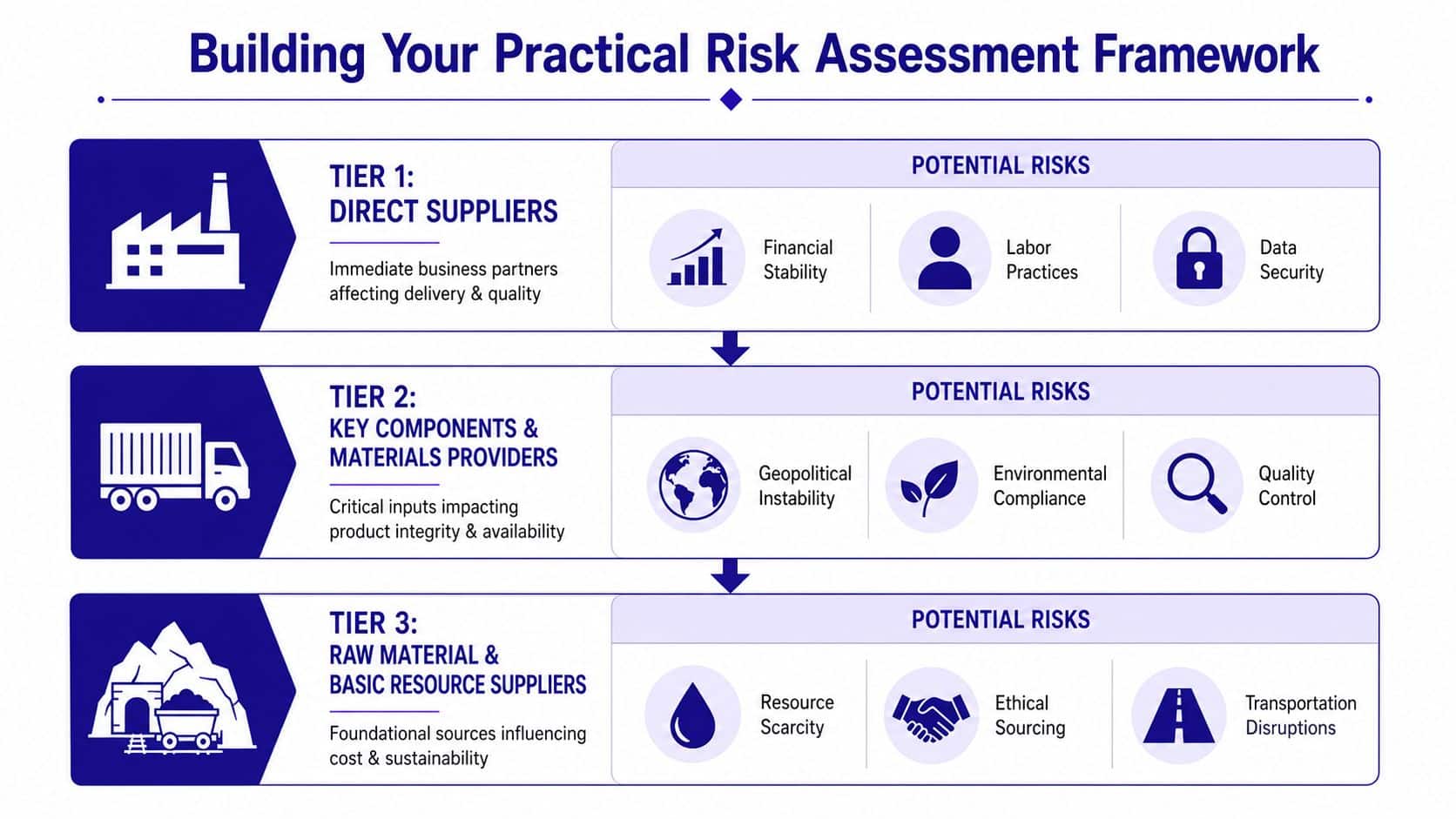
Identify the whole chain, not just the contract name
Start by mapping three layers.
- Tier 1 direct suppliers: The businesses you contract with and pay directly.
- Tier 2 key inputs and subcontractors: The firms supplying labour, components, transport, packaging, processing, or specialist services into your Tier 1 provider.
- Tier 3 source-level providers: Raw material producers, labour pools, and upstream operators that affect continuity, ethics, and traceability.
If you can't name those layers, you can't assess them. Ask each direct supplier to disclose who they rely on for labour, transport, manufacturing steps, and critical materials. Then test the answer where risk is highest.
Assess where the financial pain would land first
Not every supplier deserves the same attention. Rank them by business consequence.
A simple working model is below.
| Risk lens | Questions to ask |
|---|---|
| Revenue exposure | If this supplier fails, do you miss delivery, lose customers, or breach contract? |
| Cash exposure | Have you prepaid, extended credit, or concentrated spend? |
| Fraud exposure | Are ownership, directors, payment instructions, or subcontracting arrangements unusual? |
| Legal exposure | Could labour, bribery, or environmental issues create reporting, claim, or litigation problems? |
| Evidence exposure | Could you prove reasonable care if this relationship is challenged? |
Prioritise red flags that signal hidden weakness
Don't overcomplicate this. Focus on the warning signs that commonly precede loss.
- A supplier resists disclosing subcontractors.
- The legal entity on the contract doesn't match the one invoicing.
- Payment flows move through intermediaries with no clear operational role.
- Directors have a history of failed entities or rapid company turnover.
- Labour-intensive work appears unusually cheap without a credible explanation.
- Records exist, but they don't reconcile.
Map the chain until you reach the point where risk becomes material. Then verify the weak points with evidence, not reassurance.
Build a proportionate framework
A mid-market business doesn't need a giant compliance machine. It needs discipline. Use a traffic-light system if you like, but make each rating mean something operational.
- Low risk: Basic credential checks, contract review, and periodic refresh.
- Medium risk: Deeper ownership review, invoice testing, site or video verification, and review of labour arrangements.
- High risk: Enhanced checks, live testing, source document review, and senior sign-off before continuing the relationship.
The point of supply chain due diligence isn't to inspect every corner equally. It's to find where a relatively small failure could become a large financial problem.
Vetting Suppliers Beyond the Self-Assessment
Self-Assessment Questionnaires have their place. They gather declarations quickly and force suppliers to answer standard questions. But they're weak evidence on their own. Anyone can tick a box saying labour standards are sound, subcontractors are approved, and payroll is compliant. The hard part is proving those statements match reality.
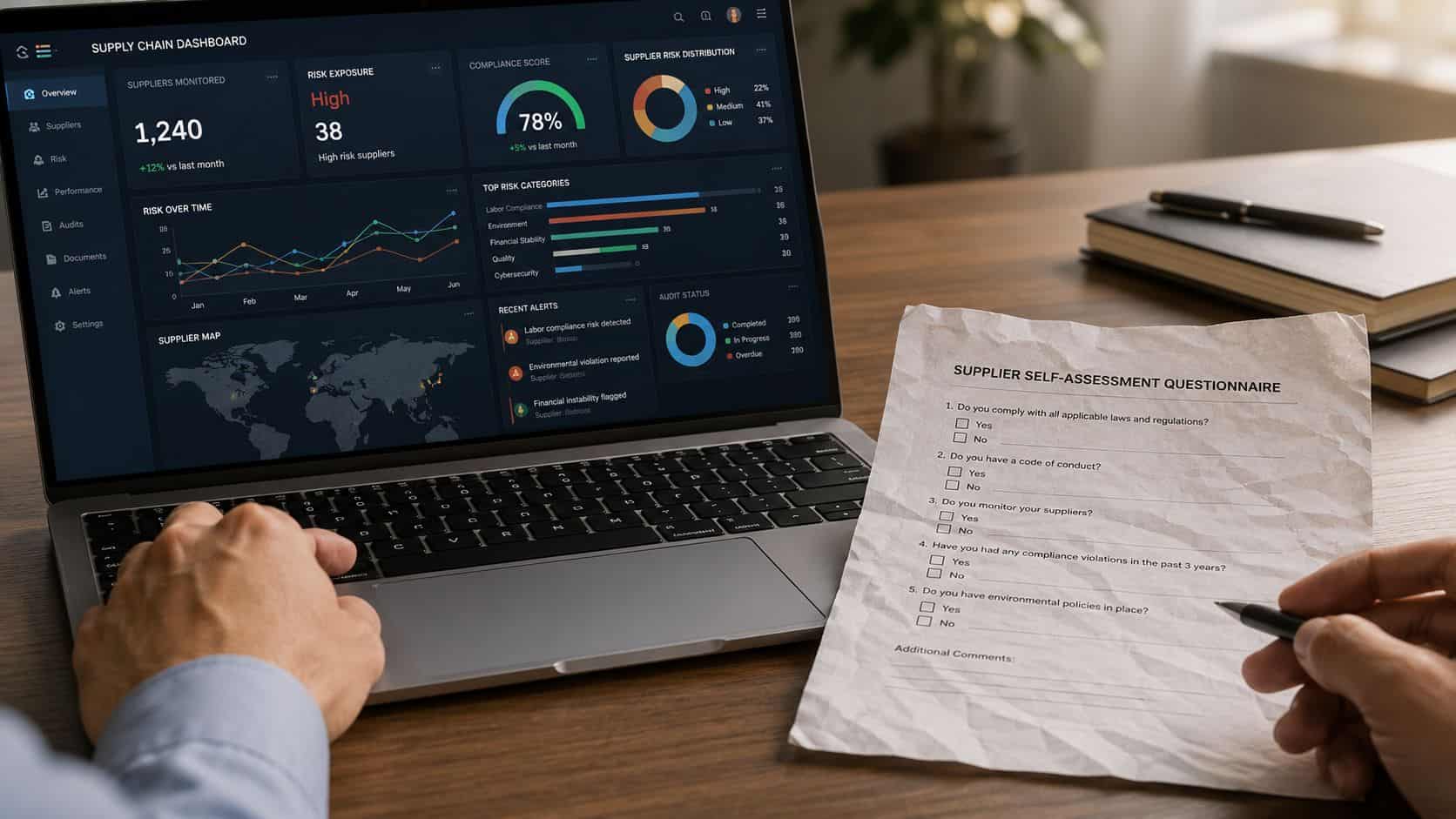
The UK's labour assurance guidance is blunt on this point. The GfC12 protocol mandates that firms must actively verify “who pays the workforce” against contractual terms and demand copies of payslips as primary evidence. Failure to perform those checks is a predominant cause of assurance failures in UK labour supply chains, as stated in the UK Government's recommended GfC12 approach to assurance.
What to verify before you rely on any answer
A better vetting process checks claims against records.
- Business identity: Confirm the legal entity, registration details, VAT status, trading name, and invoicing entity all match.
- Control and ownership: Review directors and related entities. Repeated failures, circular appointments, or opaque links deserve attention.
- Who pays the workforce: Match contract wording to payroll reality. Ask for payslips and payroll statements where labour risk exists.
- Use of intermediaries: Identify every intermediary between your contract and the individual doing the work.
- Consistency of documents: Check whether contracts, purchase orders, timesheets, invoices, and payment records tell the same story.
Questions that expose weak suppliers quickly
When I review supplier files, I look for evasive answers more than polished ones. Ask questions that force specificity.
| Question | Why it matters |
|---|---|
| Who actually employs or pays the workers? | It tests whether hidden labour intermediaries exist. |
| Which entity invoices us, and why? | It exposes mismatches between legal and trading structures. |
| Which subcontractors touch our contract? | It reveals chain length and control gaps. |
| Can you provide sample payroll evidence? | It distinguishes claims from proof. |
If a supplier says the information is confidential, narrow the request and ask again. Confidentiality isn't a licence to avoid validation.
Logistics firms need extra scepticism
Transport and logistics chains often involve subcontracting by necessity, which is exactly why control slips. For operator-side context, these Haulier.AI insights for UK logistics are useful because they reflect the operational realities that can complicate supplier verification.
A short explainer can also help teams visualise why declarations alone aren't enough:
A supplier who cannot show you who does the work, who pays the workers, and which entity stands behind the invoice is not ready for reliance.
What to stop doing
Stop treating completion rates as success. A fully completed questionnaire may still be worthless if no one tested the answers.
Stop accepting screenshots and unsigned documents where original records should exist.
Stop assuming your direct supplier controls the chain beneath it. Many don't. Some never did.
Conducting Audits That Generate Defensible Evidence
An audit should help you do two things. Reduce risk now, and defend your position later. If it can't do both, redesign it.
Too many supplier audits amount to document collection. Policies, certificates, declarations, and a few neatly labelled PDFs. That may satisfy an internal file review, but it often collapses under challenge. Insurers, solicitors, counterparties, and courts want to know whether your audit tested operational reality.
Static reviews versus tested evidence
The difference matters. The UK National Protective Security Authority says due diligence should include “tabletop and live exercises” to test supplier measures under pressure, and that approach increases detection of latent vulnerabilities by 65% compared to static document reviews alone, according to the NPSA supply chain guidance for practitioners.
That principle applies well beyond security. If a supplier says it can isolate a compromised system, maintain payroll continuity, replace labour lawfully, or continue delivery through disruption, test the claim.
What defensible evidence actually looks like
A useful audit file contains records that can be traced, authenticated, and reconciled.
- Contracts that match operations: The legal terms should reflect who performs the work and who gets paid.
- Authentic payroll evidence: Payslips, payroll statements, and matching records where labour assurance is relevant.
- Invoice and payment trails: Payments should flow to the contracted entity unless there's a documented and justified exception.
- Interview notes: Record who said what, when, and in what capacity.
- Exception logs: Note discrepancies, your follow-up, and the final resolution.
On-site, remote, and hybrid audits
Each method has value. None should be used blindly.
| Audit type | Best use | Main weakness |
|---|---|---|
| Remote review | Fast document screening and preliminary triage | Easier for suppliers to curate what you see |
| On-site visit | Observing operations, verifying workforce presence, testing controls in context | Higher cost and scheduling burden |
| Hybrid audit | Best balance for most mid-market businesses | Requires disciplined planning to avoid gaps |
A good hybrid audit usually starts remotely, identifies contradictions, and then uses on-site work to test the critical points.
Build the file as if a dispute is coming
That sounds severe, but it's the right discipline. Ask yourself whether an outsider could follow your reasoning from start to finish.
- What risk did you identify?
- What evidence did you request?
- What did the evidence show?
- What inconsistency did you find?
- What action did you take?
- Who approved the outcome?
If that chain breaks, your defence weakens. If you want a benchmark for a more structured review process, this supply chain audit resource is a sensible reference point.
Courts and insurers don't reward effort alone. They respond to records that show a rational process and reliable evidence.
Don't close an audit just because the paperwork looks tidy
Neat files can hide serious issues. Test controls where failure would hurt most. Confirm business continuity claims. Reconcile payroll evidence with the contract. Check whether the invoicing entity is the one performing. Repeat reviews after incidents or material changes.
That's how audits become useful. They stop being administrative exercises and start becoming financial protection.
From Reporting to Remediation When to Engage Experts
Most supply chain advice stops too early. It tells you how to identify risk and produce a report. Fine. But reports don't recover losses, settle claims, or win disputes. Action does.
The biggest gap in UK guidance is financial quantification. Recent 2025 ESG risk analysis found that 45% of UK supply chain disputes involve unvalidated ESG claims, yet no UK source links due diligence gaps to specific financial loss quantification methods used by insurers and litigators, as noted in the UK Government publication on applying supply chain due diligence principles. That leaves many businesses with compliance language but no damages model.
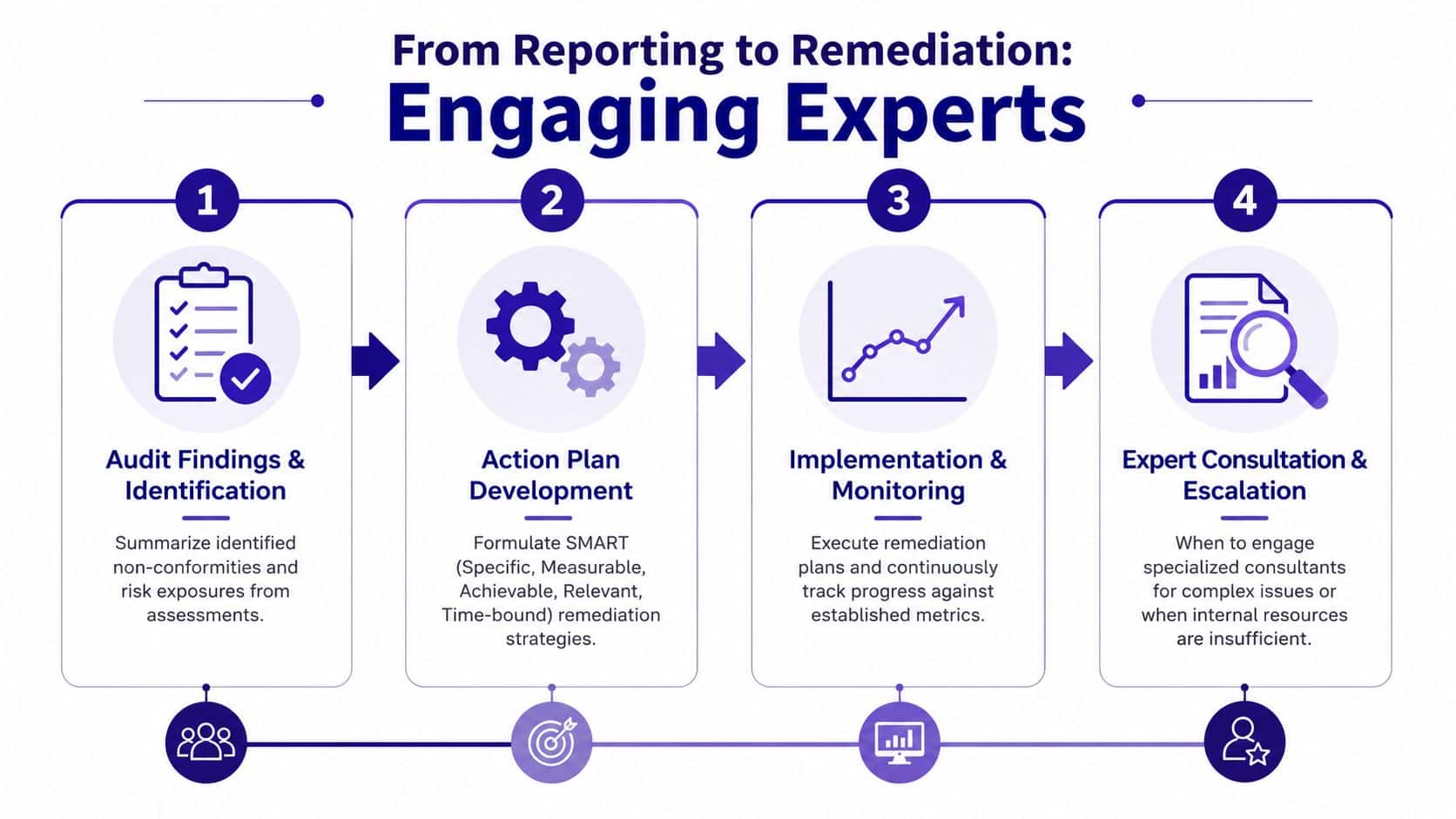
Turn findings into decisions
A sensible remediation path usually follows four moves.
- Contain the risk: Pause onboarding, suspend spend, ringfence affected contracts, or change approval levels.
- Correct the failure: Replace the supplier, remove hidden intermediaries, amend contractual controls, or require verified remediation.
- Quantify the impact: Calculate overpayments, delay costs, wasted management time, stock losses, or business interruption effects.
- Prepare for challenge: Keep the evidential trail organised for insurers, solicitors, regulators, or the other side in a dispute.
When internal teams should stop handling it alone
There's a point where finance, procurement, and compliance need specialist support. Usually that point arrives when one of the following appears:
| Trigger | Why expert input matters |
|---|---|
| Unexplained payment discrepancies | You may need transaction tracing and loss quantification. |
| Suspected sham subcontracting or hidden labour chains | You need evidence that links contracts, payroll, and actual operations. |
| Business interruption or insurance claim pressure | You need a robust calculation of financial loss and causation. |
| Bribery, fraud, or corruption indicators | You need independent investigation and clear reporting. |
| Litigation or expert witness exposure | You need work product built to survive scrutiny, not just internal review. |
What good expert support changes
It changes the quality of proof. That's the issue.
A procurement-led review may identify a concern. A forensic approach traces the financial consequences, reconciles source documents, tests alternative explanations, and quantifies the loss in a form a solicitor, insurer, or court can use.
It also changes timing. Early expert involvement often prevents bad assumptions from hardening into bad positions. If you wait until pleadings, mediation, or insurer challenge, your options narrow.
If the issue could affect a claim value, settlement position, or legal defence, treat it as an evidence exercise from day one.
The UK market for this work exists for a reason. The UK forensic accounting services industry is valued at £2.5 billion in 2026 according to IBISWorld's UK forensic accounting services industry report. Demand rises because commercial disputes keep colliding with messy facts, incomplete records, and contested losses.
If your supply chain due diligence would struggle to stand up in front of an insurer, regulator, opponent, or judge, fix it before the crisis lands. Lighthouse Consultants helps UK businesses, law firms, insurers, and boards investigate supplier risk, quantify loss, build defensible evidence trails, and present clear forensic analysis that holds up under scrutiny. Click through if you want a practical conversation about where your current controls would fail and how to strengthen them fast.