When a dispute turns financial, people usually lose control before they lose the argument. The numbers stop making sense. Key documents sit in six different systems. One side says profits collapsed because of a breach. The other says the business was already failing. A family case turns bitter because nobody agrees what a company is worth. A fraud issue lands on a director's desk and suddenly every payment, approval, and missing invoice matters.
That's when expert witness testimony stops being an abstract legal term and starts becoming practical protection. In UK disputes, courts don't need noise. They need a clear, independent explanation of what happened financially, what can be proved, and what the loss is.
Many clients hesitate at that point. They worry an expert will be expensive, slow things down, or take over the case. Those are fair concerns. A good forensic accounting expert should do the opposite. They should narrow the issues, test the evidence properly, and give your legal team something solid to work with.
Navigating Financial Chaos in Legal Disputes
A business owner discovers unexplained payments leaving the company. A shareholder falls out with the board and claims money has been diverted. An insurer asks for detailed support for a business interruption claim, but the records are incomplete and the pressure is rising. In each situation, the problem isn't only the event itself. It's the financial confusion that follows.
That confusion creates risk fast. People make decisions before they've pinned down the facts. Lawyers receive partial ledgers, inconsistent management accounts, and explanations that change each week. Internal teams often know the business well, but they're too close to the dispute to present an independent view that will carry weight.
What financial disorder looks like in practice
In live matters, the pattern is familiar:
- Records don't reconcile: bank statements, invoices, payroll records, and accounting entries tell different stories.
- Losses are asserted too early: someone puts forward a claim value before the underlying assumptions have been tested.
- Key facts get buried: the most important issue might be hidden inside a director's loan account, a stock adjustment, or a change in margins.
- Time pressure distorts judgment: disclosure deadlines and hearings don't wait for a business to get organised.
That's why a structured financial investigation matters. Instead of arguing from instinct, you move to evidence. Instead of reacting to allegations, you build a quantified position. Our work in handling financial disputes often starts there, with untangling the records before anyone can sensibly negotiate or testify.
Financial disputes rarely fail because there are no numbers. They fail because nobody has turned the numbers into evidence.
Why early clarity changes the case
A well-run expert exercise gives people room to think again. Once the transactions have been traced and the assumptions made explicit, weak arguments tend to shrink. Some claims settle. Others sharpen into the issues that call for a judge's attention.
That matters across fraud, insolvency, divorce, inheritance disputes, contract claims, shareholder actions, and investment matters. Different legal routes. Same commercial reality. If the financial picture remains confused, the case remains vulnerable.
Is an Expert Witness Worth the Investment
Most clients ask the same question in different words. Is this really worth paying for?
It's a sensible challenge. By the time expert witness testimony is being discussed, you may already be paying solicitors, counsel, insurers, investigators, or management time inside the business. Adding a forensic accounting expert can feel like one more cost in a process that already seems expensive and technical.
Cost objection versus case risk
The better question is usually this. What does it cost to run a financial case without dependable quantification?
Without an expert, parties often argue around estimates, rough schedules, and internal views that don't hold up under scrutiny. That drives more correspondence, more disagreement over disclosure, and more room for the other side to attack your numbers. An expert doesn't guarantee the result you want, but they do reduce avoidable uncertainty.
Here's where the fee objection often eases. A credible expert can help your team:
- Separate strong points from weak ones: that avoids spending legal time defending positions that won't survive challenge.
- Frame settlement properly: when both sides understand the financial logic, negotiations become more grounded.
- Avoid false confidence: a realistic assessment early on is cheaper than discovering flaws close to trial.
- Support recovery: in claims work, thorough quantification can make the difference between a persuasive case and an under-evidenced one.
Clients also worry about hidden incentives. In criminal matters, that concern is directly addressed by the Crown Prosecution Service. As set out in the CPS guidance on expert evidence and the 2023 Criminal Practice Directions, experts must disclose any fee arrangement where payment depends on the case outcome. That rule is there to expose credibility issues and protect the integrity of the evidence.
Complexity objection versus clarity
The second objection is control. Clients sometimes fear that once an expert is instructed, the matter becomes more complex and less manageable. That usually happens only when the scope is poorly defined.
A disciplined expert engagement should make the case easier to run, not harder. The work needs a clear question, a clear document list, and a clear timetable. If you want a practical overview of where forensic accounting adds value, our note on the benefits of using a forensic accountant sets out the common pressure points.
Practical rule: If an expert can't explain the scope, assumptions, and likely output in plain English, the engagement is already drifting.
The right expert is not a necessary evil. They're a strategic filter. They help you stop spending money on confusion.
Understanding Your Expert's Duty to the Court
Many clients assume an expert is another advocate for their side. In UK litigation, that's wrong, and it's good news for you.
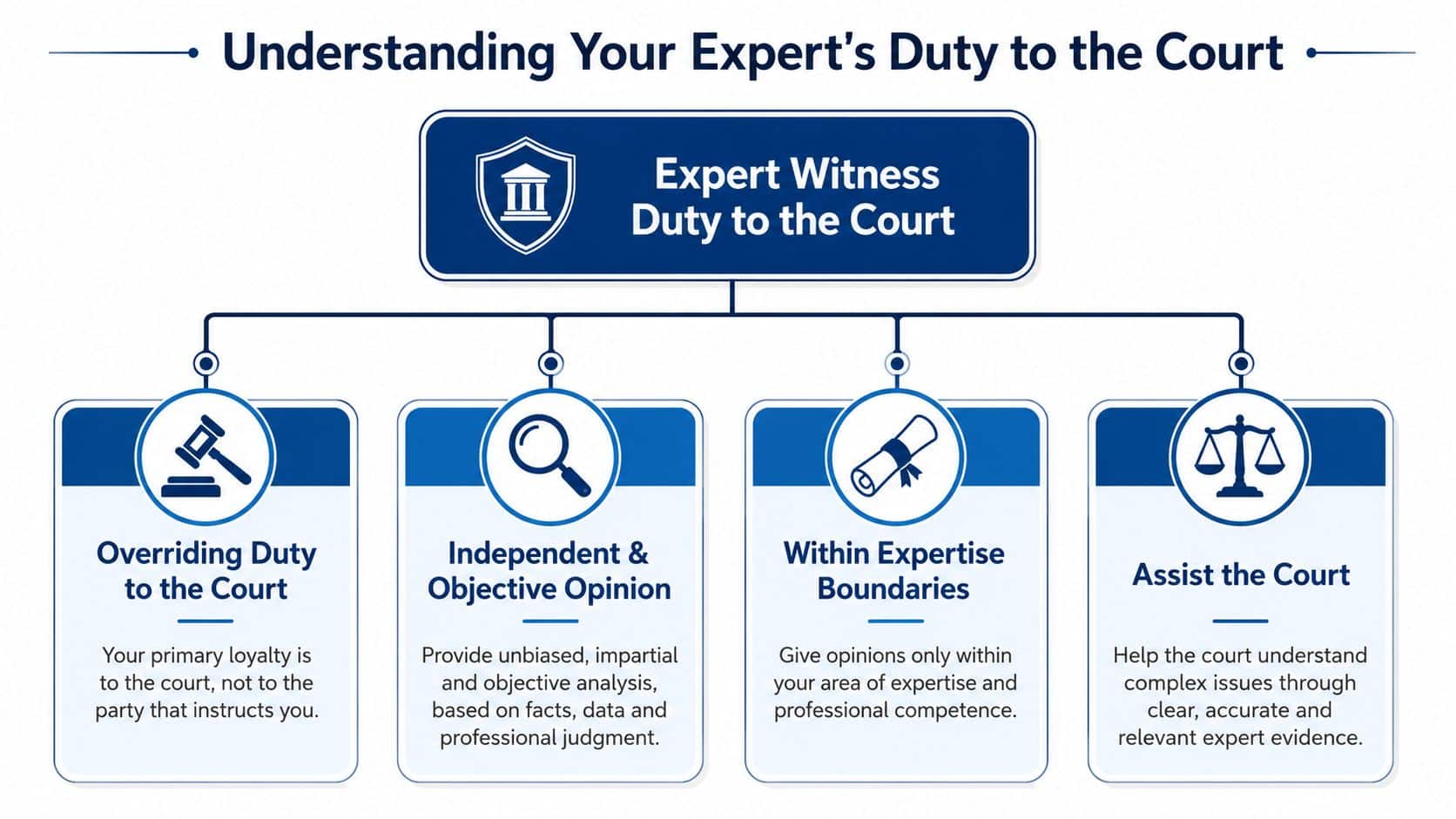
Under CPR Part 35, a forensic accounting expert witness owes an overriding duty to the court. That means the opinion must be independent, must state the facts and assumptions relied on, and must not leave out material facts that detract from the conclusion. A useful summary appears in this guide to forensic accounting and expert witness duties under CPR Part 35.
Why independence helps your case
Think of the expert as closer to a referee than a striker. Your solicitor advances your case. Your barrister argues it. The expert's role is different. They help the court understand financial issues that sit outside ordinary knowledge.
That principle has deep roots in English law. In Folkes v. Chadd in 1782, the courts established that scientific opinion may be given by people working within their own science, on matters outside the experience of a judge or jury. A later development under Section 30 of the Criminal Justice Act 1988 made expert reports admissible as evidence of fact and opinion even where the expert does not attend for oral evidence. The legal history is outlined in this review of expert evidence in English law.
The standard is higher than many clients realise
The duty to the court isn't a soft principle. It carries consequences. In 2011, the UK Supreme Court ruled, by five to two, that experts are not immune from negligence suits. That shifted the position significantly. If an expert acts negligently, they can face personal liability.
For clients, that should be reassuring. It means expert witness testimony must rest on sound methods, relevant validation, and properly reasoned conclusions. It also means a serious expert won't stretch beyond their expertise just to support a client's preferred theory.
A competent expert should also be able to tell you where their role starts and stops. If you want a practical look at the route into this work, our page on how to become expert witness is useful because it highlights the professional discipline the role demands.
An expert who tells you only what you want to hear usually becomes a problem long before trial.
The Forensic Accountant's Journey from Investigation to Report
The process feels less daunting when you break it down. Good expert witness testimony doesn't appear in one dramatic burst. It is built, checked, challenged, and documented step by step.
A forensic accountant normally starts by defining the dispute properly. Is the issue hidden profits, diverted funds, lost earnings, business interruption, solvency, valuation, or transaction tracing? If that question remains vague, the report will drift and costs will follow.
From raw records to usable evidence
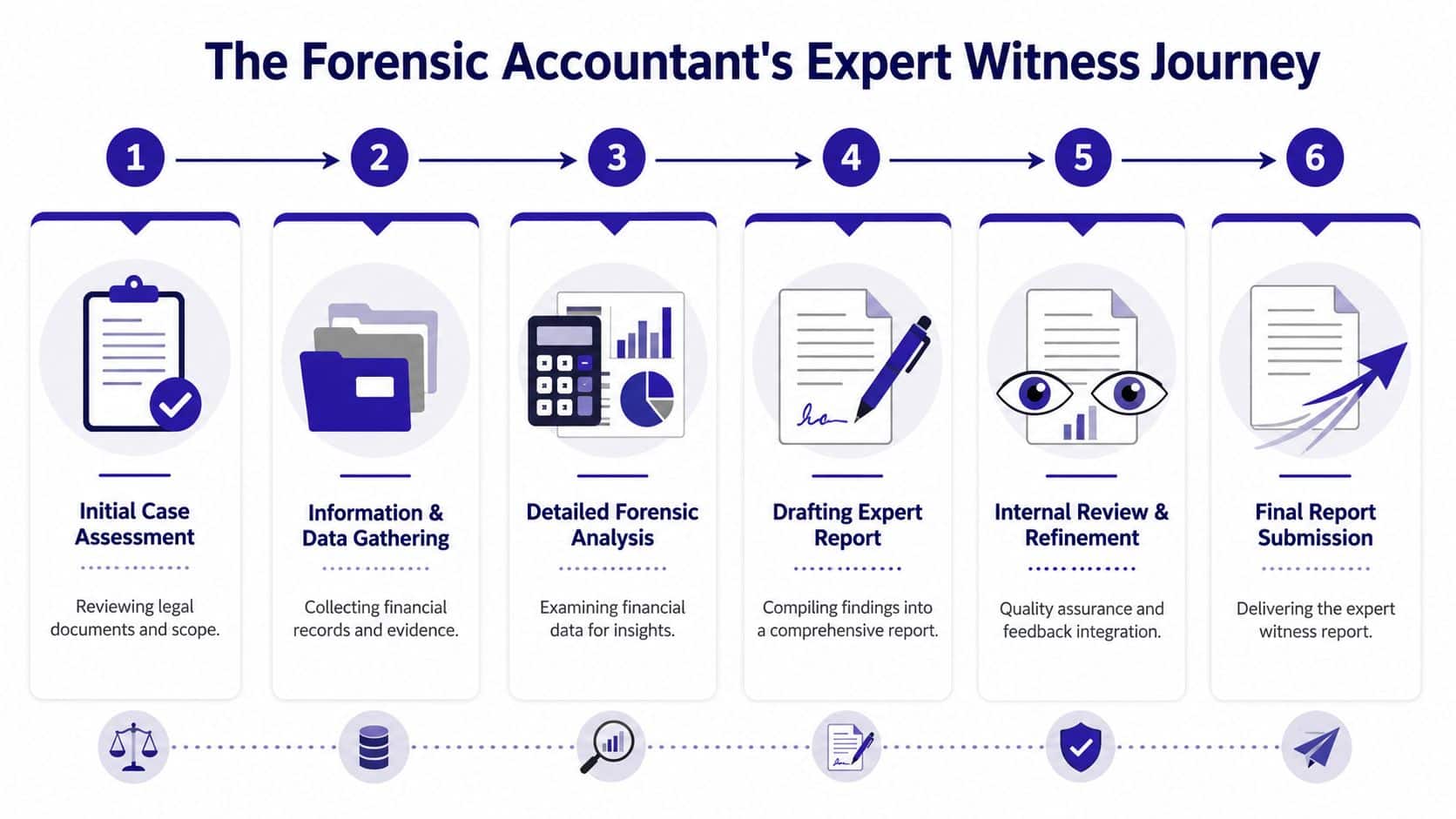
Once scope is fixed, the work usually moves through a sequence like this:
Initial case assessment
The expert reviews pleadings, instructions, key allegations, and the available financial material.Information gathering
This can include ledgers, bank statements, VAT data, payroll records, contracts, invoices, management accounts, emails, and source documents.Forensic analysis
The numbers are tested against the documents. Transactions are traced. Assumptions are checked. Gaps are identified and followed up.Quantification
If the case involves loss, the expert calculates it using a method that can be explained and defended.
For document-heavy matters, practical workflow matters as much as accounting judgment. Tools and structured review methods can make a real difference to how quickly teams identify key records, especially where disclosure arrives in mixed formats. A useful example of the operational side is this article on a 2026 data extraction workflow, which shows why organised document handling matters before analysis even begins.
A short explainer may also help if you want to see how this work is discussed visually in practice.
What the report must do
The final report isn't just a summary of opinion. It is the formal product the court and the parties will examine closely.
A UK forensic accounting expert report must comply with Part 35 of the Civil Procedure Rules, including a signed Statement of Truth, and non-compliance can lead to the report being excluded from evidence, as explained in this note on forensic accounting expert witness reports and CPR Part 35.
That requirement changes how the report is written. It must show the reasoning, not just the answer.
- Facts and assumptions: the reader should see exactly what the opinion depends on.
- Methodology: the calculation approach must be identifiable and capable of challenge.
- Conclusions: the report must state them clearly, without hiding uncertainty or overreaching.
- Statement of Truth: this is what turns the report into a court-compliant piece of evidence rather than a consultancy memo.
Preparing for the Witness Box and Cross-Examination
The hearing room exposes every shortcut. If records were incomplete, if assumptions were left vague, or if the expert adopted a position they can't defend calmly, cross-examination will find it.
That's why preparation starts long before anyone steps into the witness box. Clients and legal teams help most when they give the expert complete information early, including awkward documents. Holding back a bad email, an unhelpful set of accounts, or a contradictory schedule usually makes things worse later.
What helps before the hearing
A few habits improve the quality of expert witness testimony considerably:
- Give the full record: don't curate the file so heavily that the expert sees only favourable material.
- Flag pressure points early: if there's a weak margin trend, a disputed adjustment, or missing source data, raise it at the start.
- Keep one chronology: disputes become harder when dates differ across witness statements, schedules, and instructions.
- Test language for a non-accountant audience: judges and lawyers need clear explanations, not internal finance shorthand.
Experts also contribute before trial by helping solicitors identify what really matters in the numbers. That can support without-prejudice discussions and narrow the issues for hearing. In some cases, a report strong enough to withstand scrutiny helps bring the other side to the table.
What good testimony looks like
In oral evidence, the strongest experts are rarely the most theatrical. They're the clearest. They answer the question asked. They stay within the report. They concede points that should be conceded and defend the points that matter.
In cross-examination, confidence comes from having done the work properly, not from sounding forceful.
A well-prepared expert translates accounting into ordinary language. They explain why a cash flow pattern matters, why a loss model includes some assumptions but rejects others, and where the limits of the evidence sit. That balance matters. Courts tend to trust experts who show judgment, not partisanship.
Clients often worry that cross-examination is designed to destroy the expert. It isn't always. Often, it is designed to expose carelessness, bias, or unsupported opinion. If the underlying work is sound, the expert usually doesn't need a clever performance. They need discipline.
How to Select a Credible Forensic Accounting Expert
A case can look financially strong at first glance, then weaken once the expert starts writing. I have seen that happen when an expert was chosen because they sounded confident, quoted a lower fee, or seemed willing to support a preferred outcome before the records were even reviewed.
Selection matters because the expert does more than calculate loss. They shape how the financial issues are framed, which documents get attention, how assumptions are tested, and whether the opinion holds together under pressure. A cheaper instruction can become expensive if the report has to be repaired, replaced, or defended against obvious criticism.
Start with fit, not profile
A credible forensic accounting expert should fit the dispute, not just the label. General accounting experience is not enough if the case turns on profit extraction, business valuation, tracing of funds, shareholder conduct, or business interruption loss. The right expert will have worked on the same type of question before and will know where the weak points usually sit.
That includes procedural fit as well. Some accountants are good investigators but poor expert witnesses. Others write neatly but struggle once challenged on assumptions, source records, or alternative explanations. You need both.
What to check before you instruct
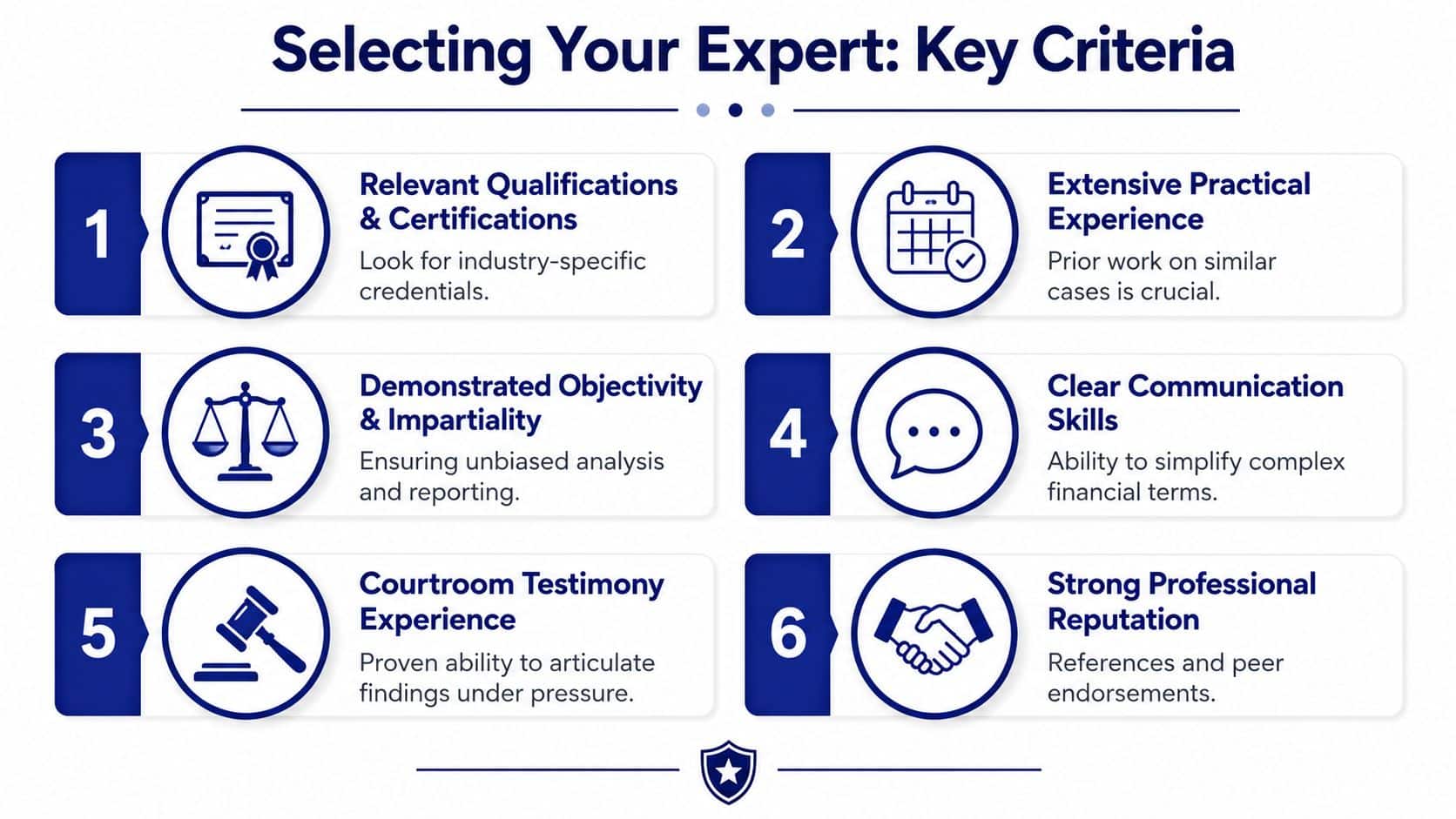
Use a short, practical test:
| Criterion | What to check |
|---|---|
| Relevant qualifications | Are they properly qualified for the specific financial issue in dispute? |
| Comparable case experience | Have they handled cases involving the same kind of loss, fraud pattern, valuation question, or accounting irregularity? |
| Expert report experience | Do they produce reports for court use, not advisory papers repackaged as evidence? |
| Independence | Will they give the same opinion if parts of your case are weaker than expected? |
| Communication | Can they explain their reasoning in plain English to lawyers, clients, and the court? |
| Oral evidence readiness | Can they answer difficult questions directly without becoming defensive or evasive? |
Cost sits behind all of this. Clients often ask whether a senior expert is worth the extra spend. In many disputes, yes. The real comparison is not one fee quote against another. It is the cost of getting a clear, defensible opinion early against the cost of delay, weak analysis, and a report that invites attack.
Red flags that should slow the instruction down
Several warning signs appear early.
- They reach conclusions before seeing the records. That suggests advocacy, not expert analysis.
- They promise to support your case. An expert's job is to give an independent opinion, even when that opinion is inconvenient.
- They stay vague about method. If they cannot explain how they will quantify loss or test assumptions, the report is likely to be vulnerable later.
- They speak far beyond their actual experience. A forensic accountant may be highly capable in fraud work and still be the wrong person for a valuation dispute.
- They minimise the time needed. Good expert work takes document review, analysis, iteration, and discussion with solicitors. Very fast often means very thin.
One sensible option in the market is Lighthouse Consultants, a London-based team of Chartered Management Accountants that investigates fraud, quantifies claims, and provides directors who can serve as expert witnesses. The practical value is straightforward: disciplined financial analysis, court-focused reporting, and experience across disputes involving business interruption, shareholder issues, unexplained losses, and other contested financial questions.
A good selection meeting should leave you with more clarity, not just more confidence. The expert should be able to explain scope, likely pressure points, documents needed, timing, and where the opinion may be limited by the evidence available.
Ask the proposed expert what could damage their opinion. A credible answer usually includes missing records, disputed assumptions, gaps in chronology, and alternative interpretations they would need to test.
Control is another common concern. Instructing an expert does not mean handing the case over. It means bringing in a specialist who can test the numbers properly, define what can be proved, and help the legal team avoid weak positions before they harden into strategy. That usually gives clients more control, not less.
The right appointment is usually measured and careful. They ask precise questions, set boundaries around the instruction, and resist overstating the evidence. That is the kind of expert courts tend to trust, and the kind of expert clients are relieved they chose early.
Gain Certainty and Clarity with Lighthouse
When finances are tangled up in litigation, delay has a cost. So does guesswork. The longer parties argue without a clear independent analysis, the harder it becomes to separate real loss from assertion, evidence from assumption, and strategy from wishful thinking.
That's why expert witness testimony matters. Done properly, it brings order to disputed accounts, supports negotiation, and gives the court a grounded explanation of complex financial issues. It also protects you from weak assumptions, poor quantification, and the false economy of running a case on incomplete analysis.
What clients usually need most
Individuals don't need more drama. They need three things:
- Clarity: what happened financially, what can be proved, and what remains uncertain.
- Structure: a disciplined process for gathering records, analysing them, and presenting conclusions.
- Credibility: an opinion that can withstand scrutiny from the other side and the court.
That's where a careful forensic accounting approach makes the difference. The aim isn't to create complexity. It's to cut through it.

If you're dealing with fraud, a shareholder dispute, a business interruption claim, insolvency concerns, divorce, inheritance issues, or an unexplained financial loss, don't leave the numbers to sort themselves out. They won't. You need a method, a report that stands up, and an expert who understands both finance and the demands of UK litigation.
If you need an independent view on a financial dispute, fraud issue, claim quantification, or potential expert witness testimony, contact Lighthouse Consultants for a confidential, no-obligation discussion.