A crisis usually starts with one ugly email, one missing payment, one whistleblower complaint, or one insurer query you can't answer cleanly. A supplier fails. A finance manager has been moving money. A contract breaks at the worst possible point in your trading cycle. Revenue drops, costs rise, and every decision suddenly carries legal consequences.
That's when many businesses make the same mistake. They treat mitigation of loss as a dry legal phrase for the solicitors to deal with later. In practice, it starts on day one. The choices you make in the first hours and weeks can decide how much cash you preserve, how much you can recover, and how credible your claim looks when the other side, an insurer, or the court takes it apart.
Business owners often hesitate before bringing in a forensic accountant. They worry about cost, duplication with legal advisers, or whether their internal finance team can manage it. Those concerns are understandable. But in serious disputes, fraud matters, business interruption insurance claims, shareholder disputes, insolvency issues, divorce finance disputes, inheritance disputes, valuations, money laundering concerns, and contract litigation, the actual risk isn't the fee. It's making undocumented, financially weak decisions that later reduce recovery.
The Moment a Financial Crisis Hits Your Business
The call usually comes at the wrong time. Your operations director says a key supplier has stopped delivering. Your bank asks questions about unusual transactions. Your solicitor forwards a letter alleging breach. Meanwhile payroll, stock, customer commitments, and lender pressure keep moving.
Most directors react in one of two ways. They either freeze and wait for legal advice, or they lurch into action without a record of why they chose one step over another. Both responses create problems. Delay can increase the loss. Panic can create a trail of inconsistent decisions that the other side later calls unreasonable.
Where the pressure builds first
A financial crisis rarely stays in one lane. One problem spreads into several:
- Cash flow pressure: delayed deliveries, replacement costs, or frozen funds tighten working capital.
- Evidence risk: emails vanish, systems change, and staff start “tidying up” records before anyone has preserved them.
- Claim risk: insurers, counterparties, and defendants start asking whether you could have limited the damage.
- Management distraction: senior people spend time firefighting instead of running the business.
Forensic accounting matters here because mitigation isn't only about measuring what went wrong after the event. It's about controlling the financial consequences while the event is still unfolding.
Practical rule: The first objective is not to build the perfect claim. It's to stop avoidable loss getting worse.
The path back to control
If a member of staff has diverted funds, you need more than suspicion. You need to secure data, isolate affected accounts, trace transactions, and decide whether immediate spend on containment is proportionate. If a major contract has collapsed, you need to test alternatives, compare replacement costs, and record the commercial rationale for every move. If a business interruption insurance claim is coming, you need contemporaneous figures that separate the original event from later operational noise.
That's why mitigation of loss works best as an active management process. A forensic accountant helps turn chaos into a financial sequence: what happened, what loss followed, what you did to reduce it, what benefit those actions produced, and what remains recoverable. That sequence becomes central in fraud investigations, litigation support, expert witness work, valuations, and insurance disputes across the UK.
Understanding The UK Standard for Mitigating Loss
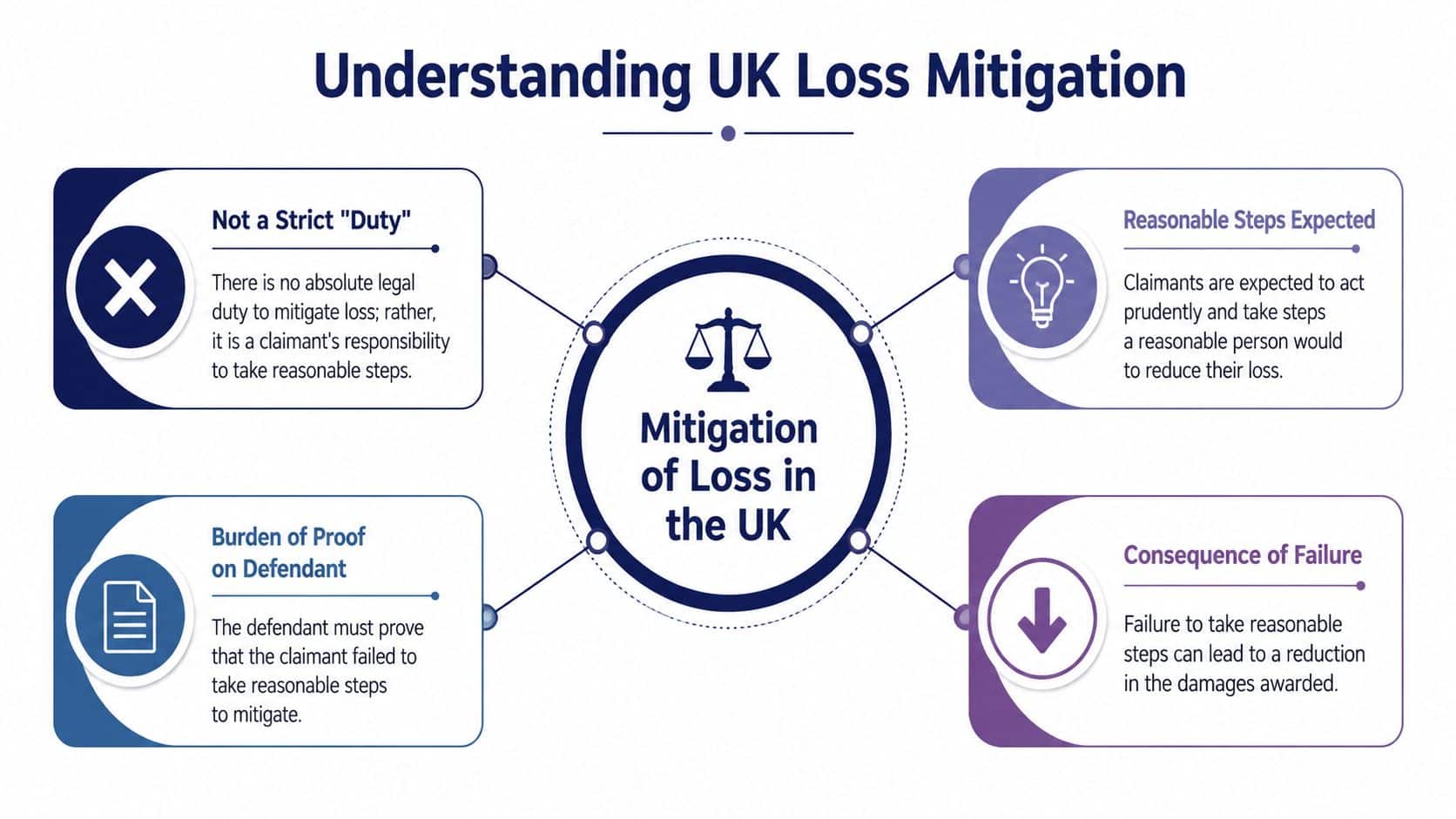
The legal starting point catches many people out. In England and Wales, mitigation isn't a strict positive duty in the everyday sense. The court doesn't order an innocent party to behave heroically. Instead, it limits recovery to losses that were not reasonably avoidable.
Farrer & Co puts the point clearly in its discussion of English contract law. “There is no positive obligation on the party who suffers a loss to do anything”. The legal consequence is different. “The innocent party cannot recover for any loss which was reasonably avoidable”. That is the core rule under the Farrer & Co analysis of mitigation and recoverable damages.
Think of a leaking pipe, not a courtroom slogan
If a pipe starts leaking in your premises and you can turn off the valve, the law won't let you ignore it and then claim for every bit of resulting damage. The point isn't that you owed the defendant a favour. The point is that the law won't compensate avoidable loss.
That matters in commercial disputes because courts ask a practical question. What would a reasonable business have done in the same position? They don't expect perfection. They do expect sensible commercial behaviour, especially where options were available at the time decisions had to be made.
How damages are assessed in practice
The standard is reasonableness, not hindsight perfection. CMS Law summarises the principle this way: “Mitigation is not a duty but an assumption; damages are calculated on the assumption that the innocent party has taken reasonable steps.” That assumption matters in quantum analysis and in any counterfactual analysis of what loss would have happened anyway.
A defendant bears the burden of proving failure to mitigate. If they discharge that burden, the claimant cannot recover the part of the loss that could reasonably have been avoided. In practice, courts often compare the actual outcome with a notional reasonable response and then discount the claim accordingly.
A simple illustration appears in the materials discussed by Hallellis. A boat owner who could have fixed a bung promptly recovered only £10 for the bung and labour, not the full £1000 value of the boat, because allowing the loss to escalate was not reasonable.
Mitigation of loss is a shield against over-recovery, not a sword that creates extra compensation.
Practical Steps You Can Take to Mitigate Loss
When trouble starts, don't ask abstract questions first. Ask what stops the immediate bleed, what preserves evidence, and what creates a reliable record of your reasoning. That approach helps in contract disputes, insurance claims, fraud investigations, professional negligence matters, and shareholder disputes.
In a contract breach
If a supplier defaults or a buyer walks away, act commercially and document it as you go.
- Search the market quickly: obtain replacement quotes, alternative terms, and revised delivery windows.
- Record cost differences: keep the failed contract price next to the replacement price and note why you chose that option.
- Preserve internal deliberations: board notes, procurement emails, and operational impact summaries often become key evidence.
- Avoid overbuying: replacing the entire failed arrangement when only part was urgent can create an avoidable loss argument.
A useful legal illustration appears in the CMS Law discussion of mitigation and alternative supply costs. In that UK case example, a buyer mitigated by sourcing alternative goods at a 15% higher cost, and the court awarded the 15% difference rather than the full contract price.
In a fraud or financial misconduct matter
The first instinct is often to confront the suspect. Usually, that's a mistake. Secure the evidence before you alert anyone who may delete, alter, or explain away records.
- Lock down systems that hold accounting data, banking records, and messaging trails.
- Stop further leakage by reviewing payment controls, user access, supplier master files, and approval pathways.
- Separate suspicion from proof by tracing transactions and reconciling them to underlying records.
- Quantify the working loss so directors can decide what containment spend is proportionate.
In a business interruption or insurance context
Insurers usually want to see that the business tried to reduce operational fallout.
| Situation | Immediate mitigation step | Evidence to keep |
|---|---|---|
| Premises disruption | Use temporary premises or remote delivery | rental records, logistics costs, management approval |
| Supplier failure | Source substitute inputs | quotations, purchase orders, margin impact |
| Staff disruption | Reallocate labour or outsource critical tasks | timesheets, contractor invoices, internal decisions |
Fast action helps. Documented fast action helps far more.
Small, sensible steps often work better than dramatic ones. Courts and insurers look for a rational chain of decisions, not gestures made for appearance.
Why a Forensic Accountant is Your Best Investment
A common objection sounds sensible on the surface. “My solicitor can deal with this.” Another is, “My finance team already knows the numbers.” Both statements can be true, but neither removes the need for forensic accounting when the dispute turns on causation, quantification, tracing, or expert evidence.

What a forensic accountant actually adds
Solicitors build legal arguments. A forensic accountant builds and tests the financial story behind them. That means identifying what loss flows from the event, what part was avoidable, what mitigation steps reduced damage, and what benefits must be credited back.
Your internal finance team has another problem. They are often witnesses to the business process, not independent experts. They know budgets, systems, and reporting lines. But they may not be used to tracing concealed transactions, building litigation-ready schedules, or defending methodology under cross-examination.
The UK market shows why this specialism exists at scale. The IBISWorld profile of UK forensic accounting services states that the industry comprises 1,332 businesses and has an estimated market size of £2.5 billion in 2026, with projected growth at a 3.9% CAGR between 2020 and 2026. That isn't a niche built on theory. It reflects practical demand in disputes, fraud, and regulated investigations.
The cost objection usually misses the real calculation
Fees matter, of course. But so does the value at risk. Verified UK pricing indicates that investigations can range from £2,000 to £5,000 for basic work, £10,000 to £50,000 for corporate fraud cases, and over £50,000 for complex financial disputes, as described in the Countify overview of forensic accounting costs and case types.
That sounds significant until you compare it with what poor mitigation records can do to a claim. An unproven loss, a muddled chronology, or unexplained benefits received can cost far more than the expert fee ever would.
One practical option is an evidence-first forensic accounting approach for fraud and disputes, where the work starts with scoping, data preservation, and loss pathways before moving into formal reporting.
A short overview helps show how this thinking applies in live matters.
When professional support becomes indispensable
Bring in a forensic accountant early when:
- Transactions look manipulated: journal entries, supplier changes, or bank movements don't reconcile cleanly.
- The claim involves interruption or lost profit: these cases often turn on assumptions, counterfactual trading, and causation.
- You expect challenge: from insurers, opposing experts, regulators, minority shareholders, or insolvency officeholders.
- You need independence: boards, lenders, and courts give more weight to objective analysis than internal assertion.
Proving Your Mitigation Efforts The Evidence You Need
Many claims fail in the gap between action and proof. The business did something sensible, but nobody preserved the reasoning, the alternatives considered, or the financial effect. By the time proceedings start, staff have moved on, inboxes have changed, and memory has improved in unhelpful ways.
A forensic accountant closes that gap by turning activity into evidence. That means linking each mitigation step to a dated decision, a measurable cost, and an identifiable reduction in loss. Without that chain, the other side can say the decision was unnecessary, excessive, or unrelated.
What belongs in a proper mitigation file
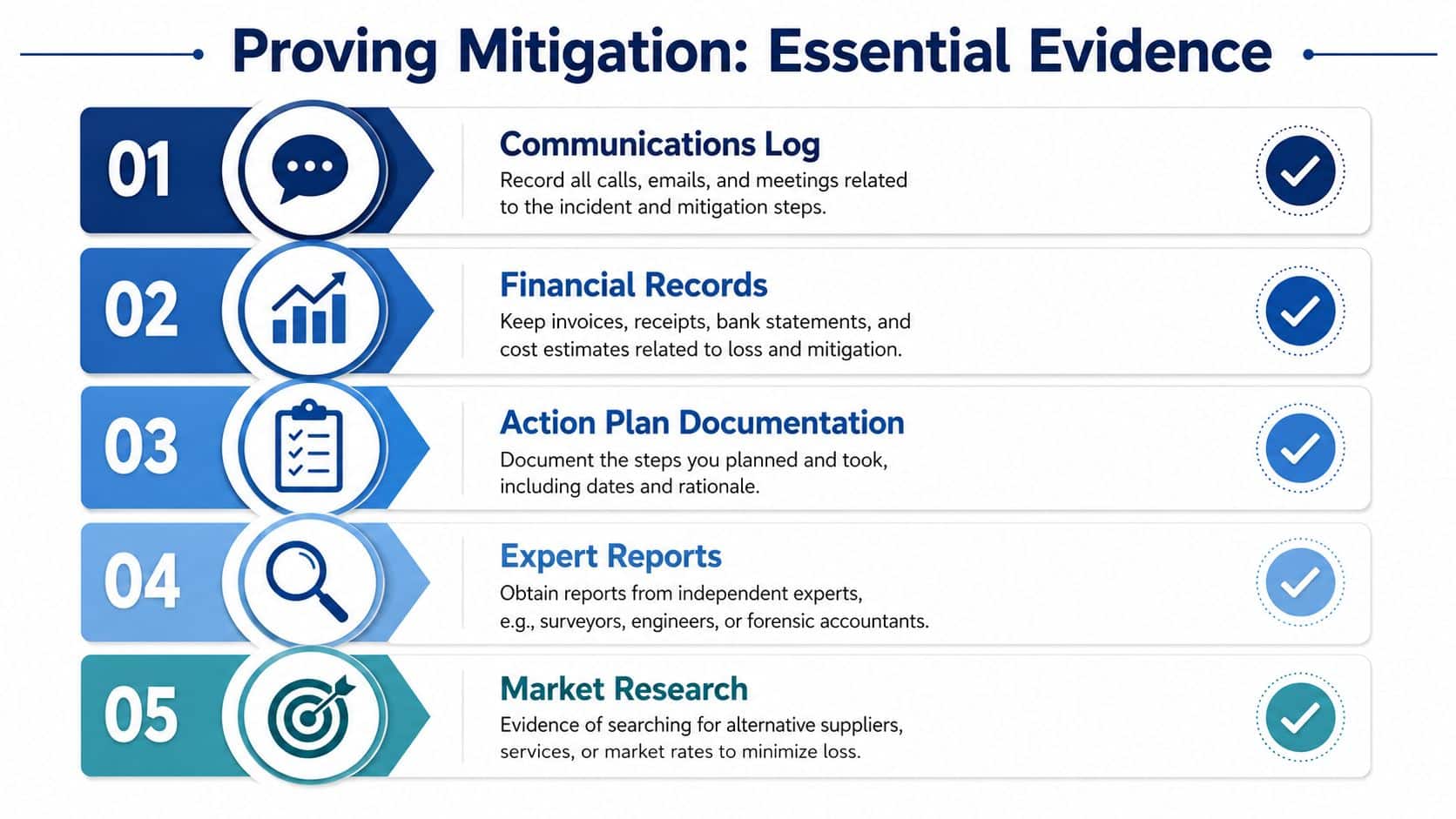
Keep the documents that explain both the event and the response:
- Communications records: emails, call notes, meeting minutes, and messages that show timing and rationale.
- Financial support: invoices, receipts, revised forecasts, bank entries, payroll effects, and margin analysis.
- Decision logs: who approved what, when, and why one option was chosen over another.
- Market evidence: alternative supplier quotes, replacement contractor terms, and benchmark pricing.
- Expert input: surveyor, engineer, IT forensic, or forensic accountant material where specialist judgement shaped the response.
Why methodology matters
In contested quantification, the numbers must do more than add up. They must survive scrutiny. Verified data on UK forensic accounting litigation states that experts may need to demonstrate a 90% confidence interval in damage measurement, often by cross-referencing corrected revenue figures against other business data, so the claim stands up in hearings and court. That's one reason rigorous modelling and reconciliation matter in proving loss in business interruption insurance claims.
Build the file as if someone hostile will read it line by line. Because eventually they will.
A good mitigation file also captures benefits received. If your response generated insurance proceeds, resale value, or savings, those items may need to be credited in the damages analysis. Trying to hide them is self-defeating. It damages credibility and usually fails once disclosure begins.
Mitigation in Action Case Studies and Your Checklist
The easiest way to understand mitigation of loss is to look at what worked and what failed.
A sensible response that preserved recovery
A buyer loses a key supply contract at a critical point in the trading cycle. Management immediately seeks replacement stock, compares available terms, and keeps a clear record of price differences, urgency, and customer commitments. The replacement costs more, but the business limits wider disruption and can show why the spend was commercially necessary.
That pattern aligns with the earlier UK case example where the buyer sourced alternatives at a higher price and recovered the differential because the response was reasonable. The strength of that position came from conduct, timing, and evidence working together.
An avoidable failure that damaged the claim
Contrast that with the claimant who lets a manageable problem become a major one. The legal materials discussed earlier include the well-known boat example, where failing to deal promptly with a simple fix destroyed value and drastically reduced recovery. Courts don't reward passivity when a straightforward step would have contained the loss.
The same issue appears with expensive mitigation. Businesses sometimes spend aggressively after fraud or breach and assume the other side will reimburse it all. That's risky. UK courts reject extraordinary or disproportionate mitigation costs, and the LexisNexis guidance on mitigation and reasonable costs notes a 2024 UK Bar Council report finding that 52% of SMEs lost part of their claim because they failed to prove mitigation costs were reasonable under the British Westinghouse test.
Your working checklist in a live dispute
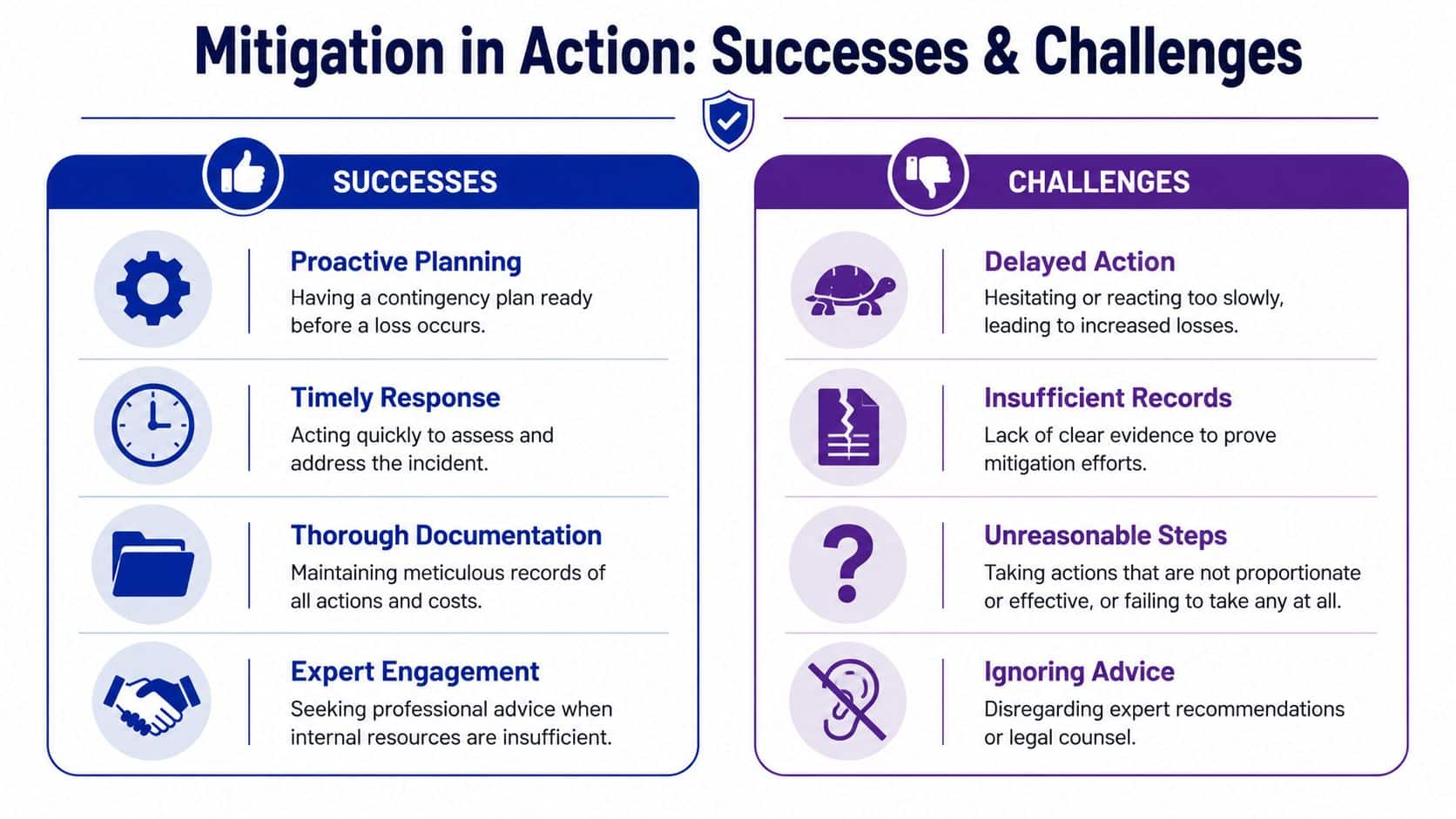
Use this when the issue is fresh:
- Stop the immediate leak: halt suspicious payments, preserve systems, secure stock, or source temporary supply.
- Appoint decision-makers: one commercial lead, one legal lead, one finance lead. Too many voices create inconsistent records.
- Document options considered: not just what you did, but what alternatives you rejected and why.
- Track every incremental cost: separate normal trading costs from event-driven mitigation costs.
- Record benefits received: credits, insurance recoveries, salvage, resale, or operational savings.
- Get specialist input early: especially where fraud, loss of profit, business interruption, valuation disputes, or complex causation issues arise.
- Review proportionality: ask whether the spend is justified by the loss it is preventing.
- Preserve board-level reasoning: contemporaneous approval often becomes critical later.
Reasonable but costly mitigation can still succeed. The key is evidence of commercial logic, urgency, and proportionality at the time the decision was made.
Take Control of Your Financial Recovery
You can't always stop a supplier collapse, an internal fraud, a contract breach, or a business interruption event. You can control your response. That response shapes cash preservation, legal recovery, insurer engagement, and the credibility of every figure you later put forward.
Mitigation of loss works when businesses act early, keep decisions grounded in evidence, and treat quantification as part of the response rather than an afterthought. The legal test focuses on reasonableness. In practice, that means prompt action, measured spending, clear records, and financial analysis that ties each step to a reduction in loss.
That's where many claims are won or weakened. Not in the headline allegation, but in the detail. Why this supplier? Why this spend? Why this timeline? Why does this number represent unavoidable loss rather than operational drift, overreaction, or hindsight reconstruction?
If you're facing fraud, litigation, business interruption, shareholder conflict, insolvency pressure, valuation issues, or any dispute where a forensic accountant can help, the priority is simple. Stabilise the position, preserve the evidence, and build a defensible financial narrative before the other side defines it for you.
If you need a confidential discussion about mitigation of loss, fraud, litigation support, business interruption insurance claims, or loss quantification, contact Lighthouse Consultants. A focused early review can help you preserve evidence, assess reasonable mitigation steps, and present a claim that stands up under scrutiny.