The letter usually lands on an ordinary day. You open it between meetings, or after dealing with payroll, or just before heading home. Then everything narrows. HMRC wants records, explanations, and time. What looked like a tax query suddenly threatens cash flow, director relationships, banking confidence, and your ability to run the business without constant distraction.
For many owners, the tax issue isn't the only fear. A serious investigation can trigger shareholder arguments, lender pressure, employment disputes, delayed transactions, insolvency concerns, and hard conversations at home. If your finances are already under strain, the stress spreads fast.
A lot of businesses hesitate before bringing in a forensic accountant. They worry it will look dramatic, upset their existing accountant, or increase cost. In practice, the bigger risk is letting a specialist problem drift. A tax fraud investigation is an evidence problem, a chronology problem, and often a credibility problem. Those are exactly the areas where forensic accounting earns its place.
The job isn't to create panic. It's to establish facts, preserve records, explain anomalies properly, and separate a manageable tax dispute from conduct that could invite allegations of fraud or even money laundering. That distinction matters more than most guides admit.
The Unwelcome Letter That Changes Everything
A director receives a brown envelope from HMRC on a Thursday morning. By lunchtime, the finance team is pulling ledgers, the managing director is asking who knew what, and a business that looked stable the day before now feels exposed from every angle.
That reaction is common because a tax fraud investigation doesn't stay neatly inside the accounts department. It spills into reputation, decision-making, and trust. Partners start second-guessing old transactions. Staff notice tension. A spouse asks whether the family home is at risk. If investors or lenders are already cautious, the timing can be brutal.
In the UK, this isn't a remote possibility. In 2021 to 2022, the estimated UK tax gap was £36 billion, with criminal tax evasion accounting for £5.4 billion, and HMRC recorded 4,012 formal tax evasion cases according to this summary of HMRC tax evasion statistics. That tells you two things. HMRC sees the problem as large, and businesses do get pulled into formal scrutiny.
Why the first few days feel so chaotic
Many individuals are unsure whether the letter signals a routine challenge, a civil fraud route, or the start of something more serious. That uncertainty creates mistakes. Directors reply too quickly, send incomplete records, talk loosely in internal emails, or rely on memory where documents should lead.
Common early problems include:
- Rushed explanations that try to sound helpful but create inconsistencies later.
- Poor document control when teams start forwarding files across personal inboxes and chat threads.
- Internal blame-shifting between directors, finance staff, advisers, and former employees.
- Silence from leadership that leaves staff guessing and increases anxiety.
The first response sets the tone. Calm beats speed, and evidence beats reassurance.
A tax fraud investigation also feels personal in a way an ordinary tax enquiry often doesn't. People read accusation into every sentence. Sometimes that instinct is right. Sometimes it isn't. Either way, you need a clear-eyed read of what HMRC is asking, what it already appears to know, and what exposure sits behind each document request.
The objection most directors raise first
Many owners think, “If I've done nothing wrong, I can just explain it.” Sometimes you can. But HMRC won't decide a case on confidence or indignation. It will look at records, inconsistencies, transaction trails, and whether your explanation fits the financial evidence.
That's why early specialist support matters. A practical guide to investigation by HMRC can help you understand the terrain, but understanding isn't the same as preparing a defensible response. The businesses that cope best are usually the ones that stop improvising early.
Understanding Your HMRC Tax Fraud Investigation
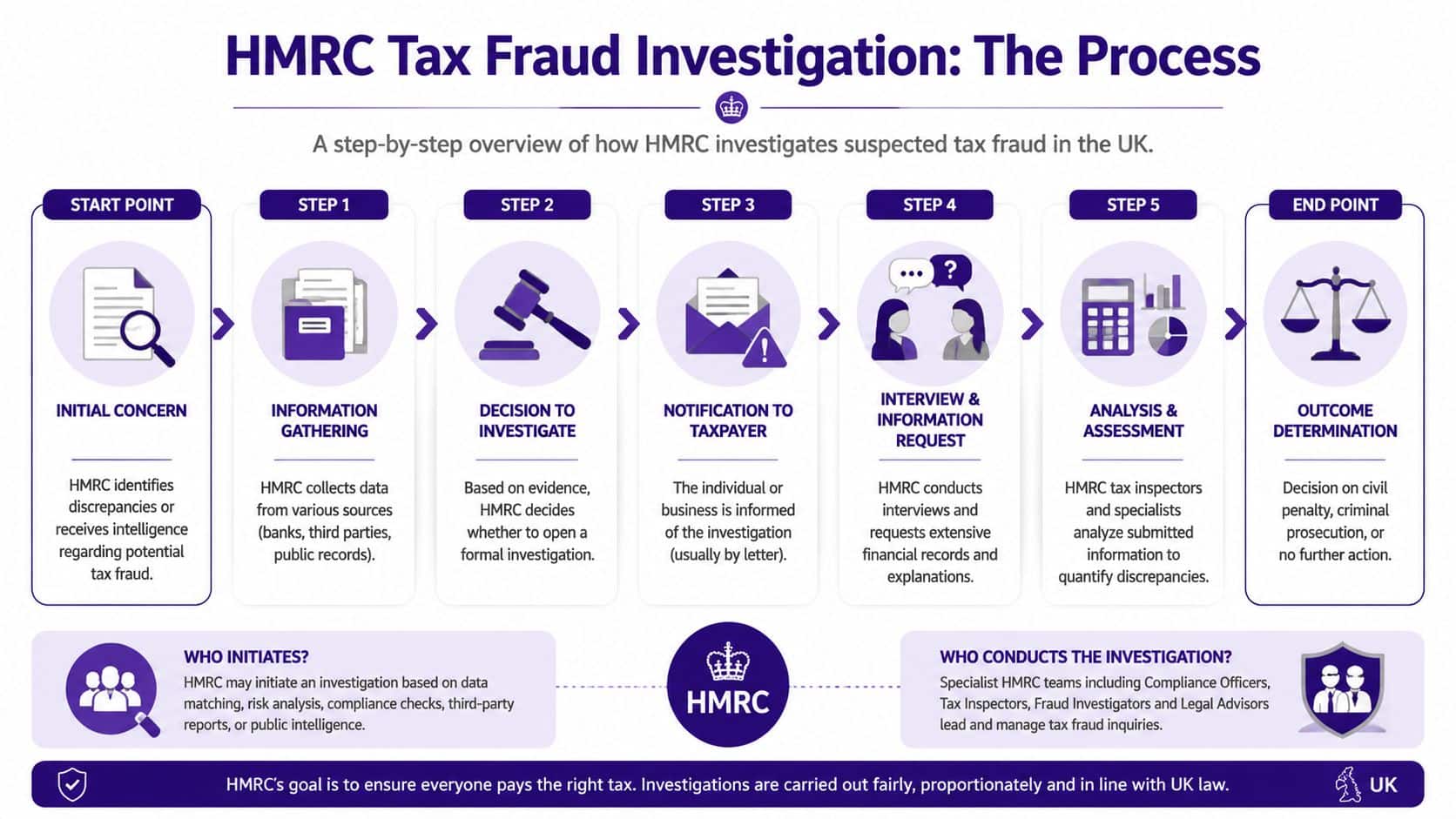
An HMRC tax fraud investigation is not the same as a normal compliance check. The key difference is intent. HMRC is no longer only asking whether the numbers are wrong. It may be asking whether someone acted fraudulently, concealed facts, or structured transactions to hide taxable income.
That distinction affects how you should respond. A routine accounting answer might not be enough if the underlying concern is alleged deception.
Who is usually involved
The specialist unit you'll hear about most often is the Fraud Investigation Service, often shortened to FIS. This team handles more serious cases, especially where HMRC suspects deliberate behaviour or needs to build a case from multiple data sources rather than a single return.
HMRC also uses technology aggressively. It has invested approximately £30 million in a specialised data mining tool that cross-references property ownership, financial transactions, and other datasets to identify inconsistencies in tax returns, as described in this overview of HMRC's data-led tax evasion detection approach. That means the old assumption that one isolated discrepancy will go unnoticed is unsafe.
What tends to trigger scrutiny
Triggers vary, but the patterns are familiar. HMRC may see a mismatch between declared income and asset ownership. It may compare returns against bank data, property records, or third-party information. It may receive intelligence from someone inside or close to the business. It may also notice unusual cash movement, inconsistent VAT positions, or unexplained director benefits.
What matters is this. HMRC rarely relies on one datapoint alone in a serious case. It builds a picture.
A sensible working approach is to ask four questions immediately:
- What conduct appears to concern HMRC
- What period is under review
- What documents will tell the story accurately
- Who inside the business should control the response
What HMRC is trying to establish
At a practical level, investigators usually want to test whether transactions were genuine, whether income was fully reported, and whether records support the explanation now being offered. They also look at who authorised entries, who benefited, and whether there's a pattern rather than a mistake.
Practical rule: treat every explanation as something that may later be tested against bank statements, invoices, messages, and third-party evidence.
A tax fraud investigation becomes easier to manage once you stop seeing it as a vague threat and start seeing it as a set of provable issues. Your task is to identify those issues before HMRC defines them for you in the worst possible way.
Why Your Regular Accountant May Not Be Enough
Your existing accountant may know the business well. That matters. They may have prepared returns, dealt with year-end work, and helped you through ordinary HMRC correspondence. None of that automatically makes them the right person to handle a tax fraud investigation.
The difference isn't loyalty or intelligence. It's function.
Compliance work and forensic work are different jobs
A general accountant usually focuses on preparation, reporting, and compliance. A forensic accountant works in disputes, investigations, and challenged fact patterns. The mindset changes. Instead of asking, “What should the accounts look like?” the forensic accountant asks, “What happened, how do we prove it, what's missing, and how will this stand up under scrutiny?”
That's why forensic accounting sits as a specialist field in its own right. The UK Forensic Accounting Services industry comprises 1,332 businesses and is projected to generate £2.5 billion in revenue by 2026, with fraud investigation as the largest service segment, according to IBISWorld's UK forensic accounting industry profile. This isn't an add-on service. It's a separate discipline.
Where the wrong approach causes damage
A well-meaning regular accountant can still create problems in an adversarial matter. Common examples include:
- Assuming cooperation alone will solve it when the chronology requires rebuilding first.
- Explaining transactions from memory rather than anchoring every point to source evidence.
- Treating inconsistencies as bookkeeping noise when HMRC may frame them as deliberate concealment.
- Missing litigation risk because the focus stays on tax computation rather than evidential exposure.
A forensic accountant doesn't replace legal advice, and doesn't replace your existing accountant's business knowledge. Instead, the specialist works alongside them where the facts are contested and the consequences are severe.
The practical test
Ask yourself which of these better matches your current problem.
| Situation | Likely lead adviser |
|---|---|
| Year-end accounts, returns, routine queries | Regular accountant |
| Allegations, disputed records, hidden income concerns, asset tracing | Forensic accountant |
If the issue could end up being argued to HMRC, lawyers, insurers, shareholders, or a court, treat it as forensic from the start.
That isn't overreaction. It's matching the adviser to the risk.
The Forensic Accountant's Critical Role
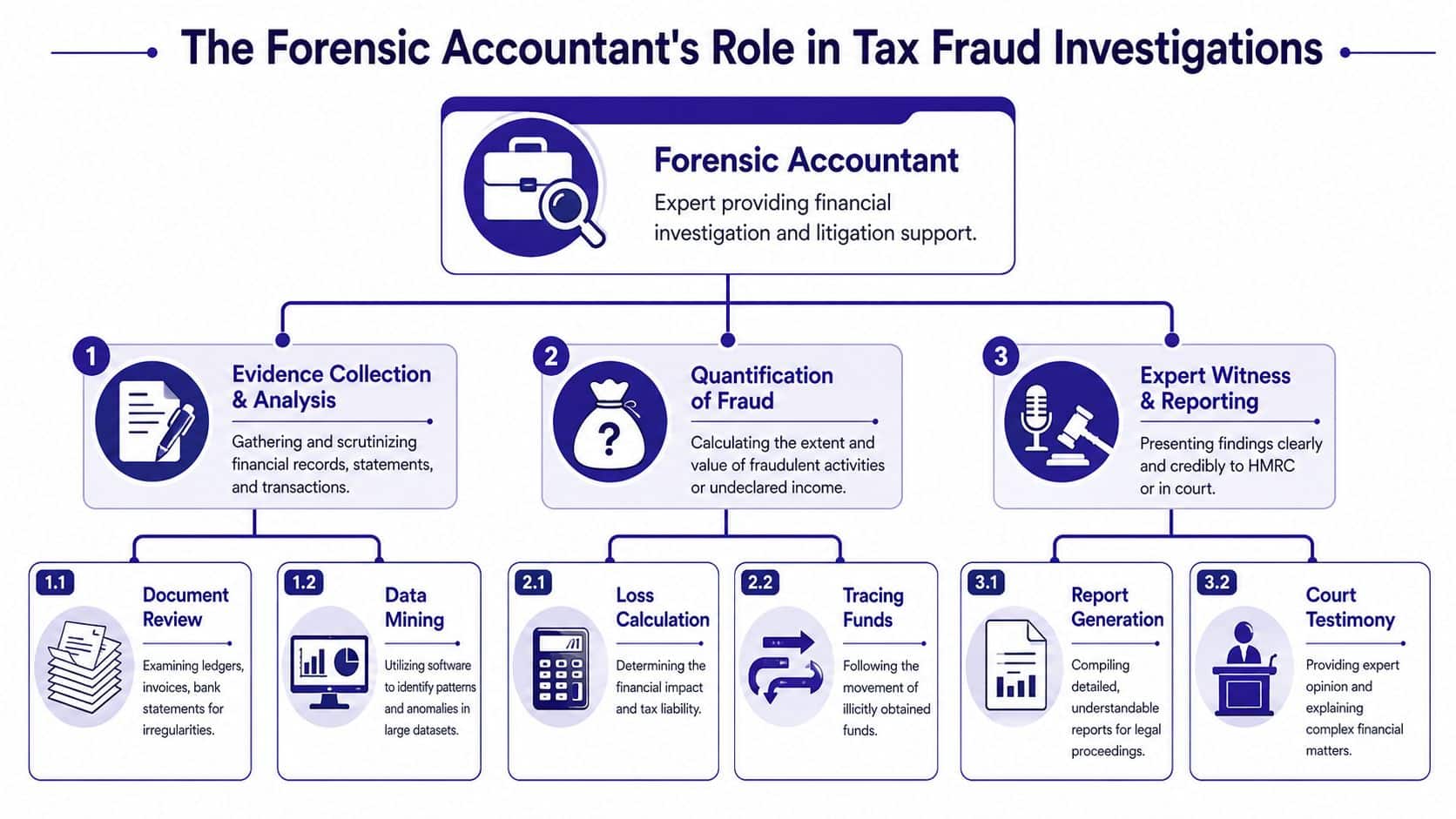
A forensic accountant doesn't just defend a number. They reconstruct the financial story. In a tax fraud investigation, that means identifying what happened, testing whether the records support it, and separating innocent error from conduct that points somewhere darker.
That last point matters. Some cases start as tax questions and widen because the money trail suggests something else.
Looking beyond the return
Research discussed in UCL Discovery's work on tax fraud and money laundering links confirms that UK tax fraud investigations often act as a gateway to uncovering complex money laundering schemes. In practice, that means a director who thinks the issue is undeclared income may suddenly face questions about beneficial ownership, circular payments, third-party accounts, or asset movements under the Proceeds of Crime Act 2002.
That's where forensic accounting becomes indispensable. The work goes beyond tax schedules.
What the work actually looks like
A strong forensic accountant will usually do several things at once:
- Rebuild the chronology by matching transactions, approvals, contracts, and communications to specific dates.
- Trace funds across accounts, entities, and counterparties to see whether the commercial explanation holds.
- Test documentation quality by identifying missing invoices, altered records, duplicate entries, or unsupported journal movements.
- Quantify exposure so you know whether the dispute concerns timing, accuracy, omission, or alleged deception.
- Prepare reports that a solicitor, barrister, HMRC officer, or judge can follow without guesswork.
This is also where technology helps. In document-heavy cases, legal teams often need support with streamlining legal document review so they can identify relevant contracts, correspondence, and inconsistencies faster. Used properly, that kind of tool can reduce noise and help everyone focus on the records that matter.
The value isn't only defensive
A forensic accountant can also tell you when the case is worse than you thought. That may sound uncomfortable, but it's far better to learn that in a controlled review than during an interview or after a disclosure request exposes a gap.
Useful outputs from a forensic accounting review often include:
| Area | Why it matters |
|---|---|
| Transaction mapping | Shows whether money movement matches the business explanation |
| Source document testing | Exposes weak evidence before HMRC does |
| Related-party analysis | Identifies hidden connections and conflicts |
| Loss or liability quantification | Supports negotiation and strategy |
Sometimes the right conclusion is that the issue is narrower than feared. Sometimes it isn't. Either way, clarity gives you options. A grounded explanation of what a forensic accountant in the UK actually does when money goes missing is useful because the skill set sits squarely in evidence, analysis, and independent reporting rather than ordinary bookkeeping.
A good forensic review doesn't just answer HMRC's questions. It shows which questions are coming next.
Navigating the Investigation Process Step by Step
Once the letter arrives, structure matters. Businesses struggle most when everyone reacts at once and nobody controls the flow of information. A tax fraud investigation becomes more manageable when you break it into stages and assign responsibility clearly.
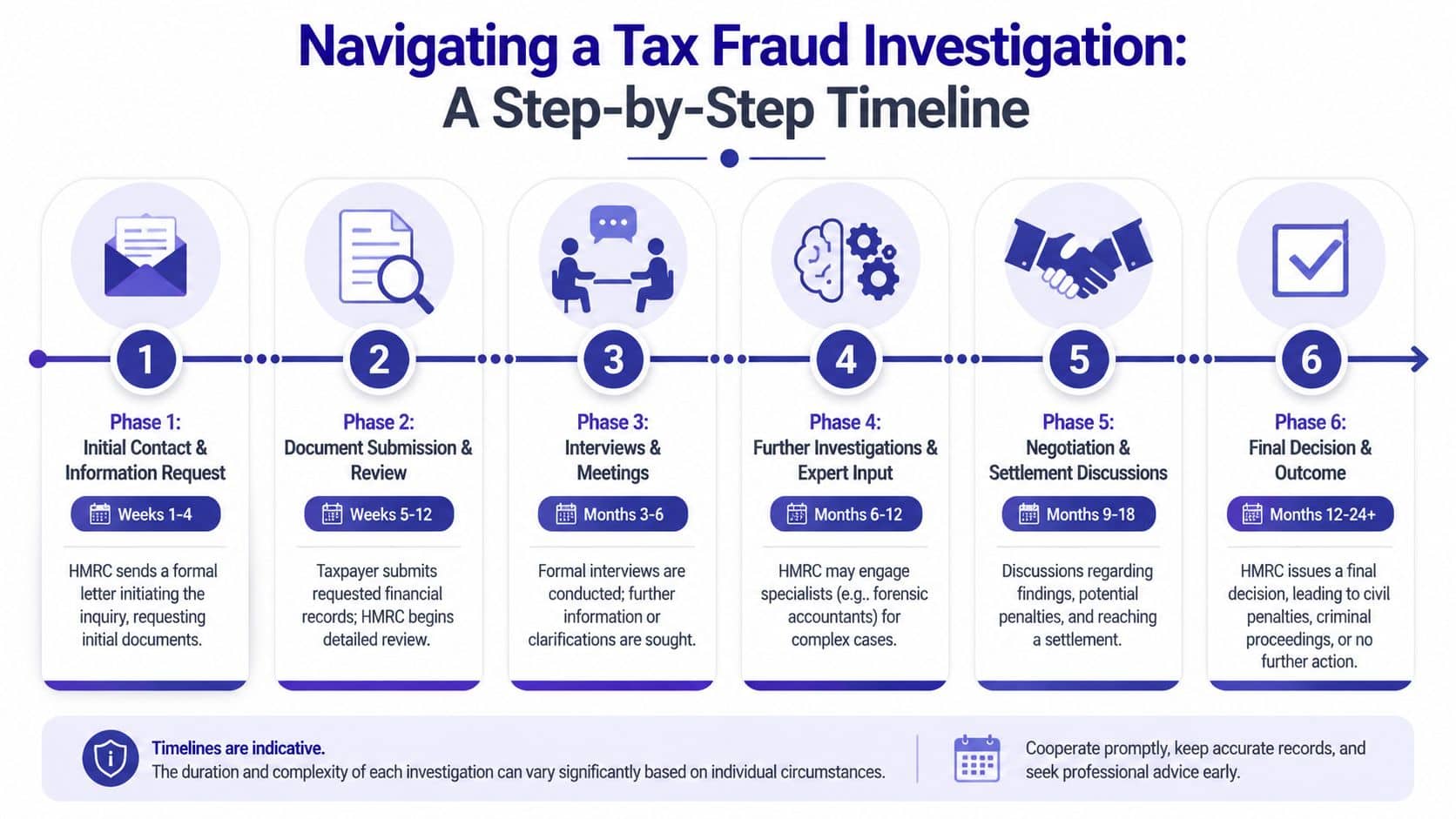
This timeline helps most directors stay grounded.
Phase one and two
The first stage is usually initial contact and document requests. Read the letter carefully. Identify the tax periods, entities, and named individuals involved. Then freeze informal commentary. Staff shouldn't start speculating in emails or messaging apps.
Next comes document collection and review. During this stage, many cases improve or deteriorate.
Start with a controlled evidence set:
- Core financial records such as bank statements, ledgers, VAT workings, payroll data, and sales records.
- Underlying commercial documents including contracts, invoices, loan agreements, and board approvals.
- Digital records such as accounting exports, email chains, and access logs where relevant.
- A chronology that ties key transactions to real business events.
Before any submission leaves the business, someone should test it for completeness and internal consistency.
Phase three and four
Interviews and meetings often follow. Preparation matters more than confidence. The right answer is the accurate answer, not the quick answer. If you don't know, say so and refer back to records.
Here's a sensible interview discipline:
- Review the likely themes in advance.
- Separate confirmed facts from assumptions.
- Avoid volunteering extra theories.
- Correct errors promptly if you realise one has been made.
Later, HMRC may widen its work and bring in specialist input. That's often the point at which hidden issues appear. Related entities, unexplained transfers, and inconsistent narratives tend to surface here, especially where the paperwork was assembled hastily at the start.
A short explainer can also help your internal team understand the pace and pressure of this stage:
Phase five and six
Negotiation and settlement discussions usually depend on evidence quality, credibility, and whether the facts support a civil resolution or something more serious. In this context, quantified analysis can make a major difference. You need to know which points are contestable, which should be conceded, and which require fuller explanation.
The final phase is the outcome. That may involve closure, a civil settlement, or escalation. The best preparation throughout the process is consistent:
- Keep one response team so messages don't drift.
- Preserve originals and track what has been disclosed.
- Record decisions about why certain explanations or concessions were made.
- Coordinate advisers so legal strategy and financial analysis align.
Slow the process down internally, even if HMRC's timetable feels aggressive. Accuracy saves more trouble than speed.
Potential Outcomes and Financial Penalties
Not every tax fraud investigation ends in prosecution. Many do not. But every serious case carries financial and strategic consequences, and directors need a realistic view of both.
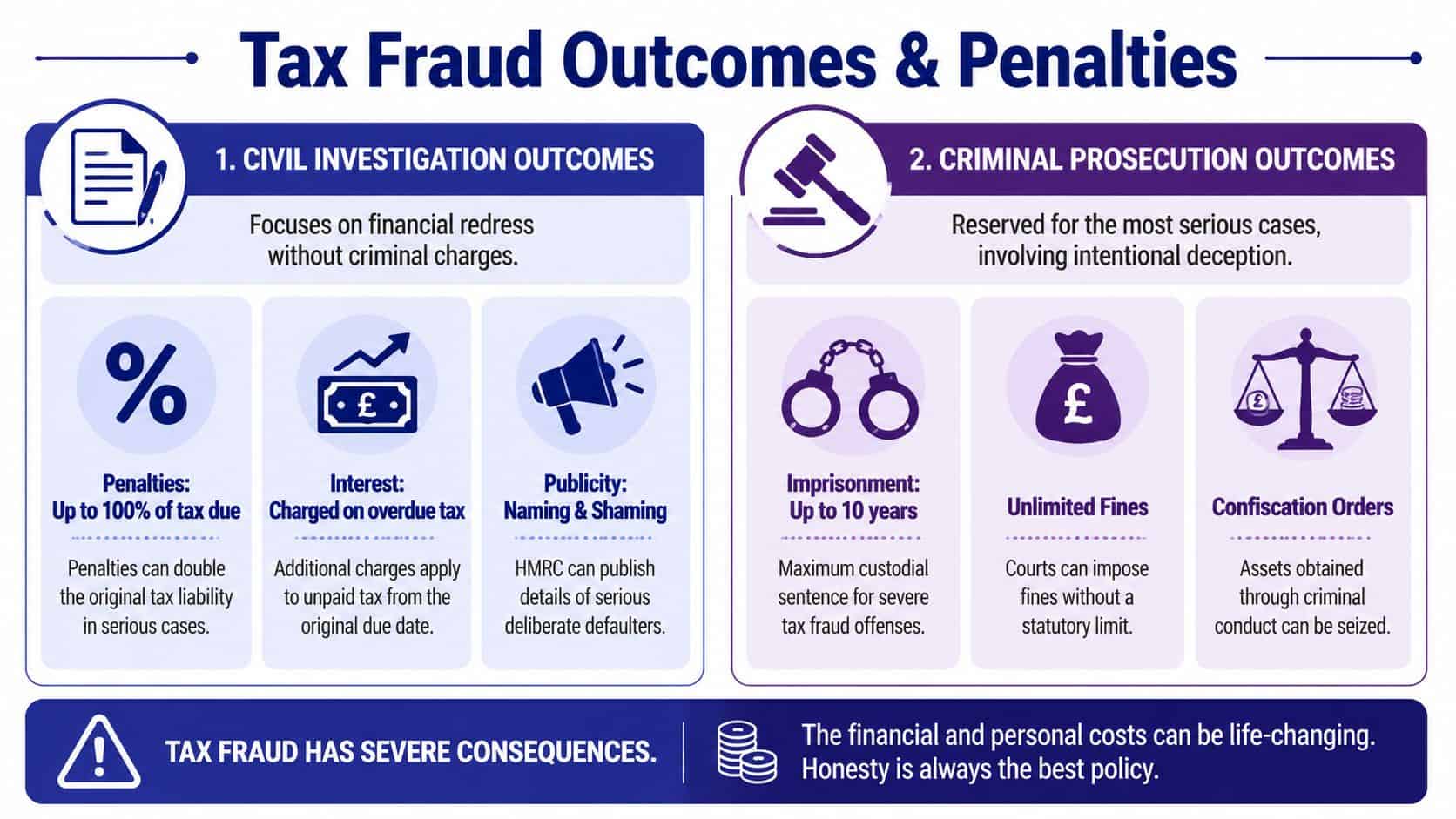
The first distinction is between civil action and criminal prosecution. Civil action usually focuses on disclosure, recovery, penalties, and future compliance. Criminal prosecution aims at conviction and punishment. The conduct may overlap, but the route and pressure points differ.
The civil side of the risk
HMRC's civil powers are formidable. Under its civil powers, financial penalties can reach up to 200% of the tax due, as set out in HMRC's briefing on its approach to tax fraud. Those penalties sit alongside tax recovery and can be accompanied by other sanctions such as publication of evaders' details and director disqualification in appropriate cases.
That means a civil outcome can still be severe. Businesses sometimes relax too early because they hear “civil” and think “administrative”. In reality, a civil fraud route can be financially punishing and commercially disruptive.
What directors often overlook
The practical burden goes beyond the headline liability. You may need to deal with:
- Cash flow strain from tax, penalties, professional fees, and management time.
- Banking and funding issues if lenders lose confidence or ask fresh questions.
- Corporate governance fallout including board tensions and investor scrutiny.
- Reputational harm if customers, suppliers, or counterparties hear about the matter.
Criminal outcomes sit at the more serious end, and they bring different exposure. The key point for most businesses is not to assume the absence of an arrest means the risk is minor. Financial penalties and restrictive consequences can still bite hard.
Early quantification changes negotiations. If you don't know the likely tax exposure, you can't judge whether a proposed settlement is proportionate.
A forensic accountant helps here by testing HMRC's numbers, identifying weak assumptions, and presenting alternative calculations where the evidence supports them. The point isn't to argue everything. It's to contest what is unsound and resolve what can't be defended.
Prevention and Engaging an Expert Firm
The strongest response to a tax fraud investigation starts before the next one ever arises. Good prevention doesn't rely on a policy sitting unread in a shared folder. It depends on records, oversight, and challenge.
Most businesses need tighter discipline in a few predictable areas.
Controls that reduce avoidable risk
Focus on practical controls first:
- Director oversight of unusual transactions so high-risk payments, related-party dealings, and off-pattern journals get challenged early.
- Clear evidence for revenue and expenses with contracts, invoices, and approvals stored together rather than across personal devices.
- Regular internal review of VAT treatment, payroll issues, cash handling, and director accounts.
- Separation of duties wherever possible, especially around payments, adjustments, and supplier onboarding.
If you're preserving evidence during a live matter, it also helps to use secure workflows that protect sensitive documents and reduce the chance of accidental sharing or altered files. Confidentiality and integrity matter as much as availability.
When to bring in specialist help
Don't wait until interviews are scheduled or relationships inside the business have already fractured. Bring in specialist support when any of these happen:
| Sign | Why it matters |
|---|---|
| HMRC suggests deliberate behaviour | The matter may no longer be routine |
| Records are incomplete or inconsistent | You need reconstruction, not just submission |
| Multiple entities or personal accounts are involved | The money trail may be wider than expected |
| Directors disagree on the facts | Independence becomes essential |
A specialist firm can help organise evidence, quantify exposure, support legal teams, and distinguish a contained tax issue from wider financial crime risk. That's particularly useful where fraud, bribery concerns, hidden assets, or shareholder tensions sit in the background. For businesses reviewing their wider control environment, this guide to fraud prevention strategies for businesses in the UK is a sensible starting point.
Where a matter needs independent forensic accounting, reporting, and litigation support, Lighthouse Consultants provides those services through structured scoping, financial analysis, and reporting designed for disputes and investigations. The value of that kind of engagement is straightforward. It gives the business a defensible fact base while management keeps running operations.
The earlier you establish control over documents, chronology, and financial analysis, the more room you have to influence the outcome.
If HMRC has contacted you, or you've found transactions that don't make sense, speak to Lighthouse Consultants for a confidential first discussion. A focused forensic accounting review can clarify the facts, reduce avoidable mistakes, and help you move from anxiety to an informed plan.