A domicile dispute rarely starts with the word domicile. It usually starts with a shock. A family member dies and the estate includes property abroad. A divorce turns hostile and one side says the other never really left the UK. A shareholder falls out with the board. An HMRC enquiry opens historic questions about where someone's real home was. Suddenly, ordinary life details become legal evidence.
That's where many people lose control. They assume residence, passport, or time spent abroad settles the point. It doesn't. In practice, what is a domicile becomes one of the most expensive questions in inheritance, divorce, succession and cross-border disputes, because it turns on law, facts and intention all at once. When that issue is contested, lawyers need more than argument. They need evidence that stands up.
The Multi-Million Pound Question You Never Knew to Ask
A client may spend years building wealth overseas, buying a family home in another country, moving business interests across borders, and assuming the structure is clear. Then a death, gift, divorce or challenge to an estate changes the position overnight. The legal fight often turns on a point they never focused on when life was calm. Where was their domicile?
For high-net-worth families, that single question can affect succession, inheritance exposure, family litigation, and the credibility of years of tax and legal planning. It also appears in disputes that don't look like “tax cases” at first glance. I've seen the same pattern in contentious probate, divorce, insolvency-related investigations and wider financial disputes. The legal label sounds academic. The consequences are not.
Why this catches people out
Individuals often think in practical terms. They ask where they live, where they work, where they hold a passport, or where they pay for daily life. Courts look wider. They examine whether those facts support a deeper conclusion about permanent attachment to a jurisdiction.
That difference is exactly why forensic accountants get pulled into these matters. We don't decide the law, but we test whether the story matches the records. We analyse bank activity, property ownership, business interests, travel behaviour, patterns of spending, document trails and family arrangements. If someone says, “England was no longer my home,” the financial history must support that.
Practical rule: If your domicile matters to your estate, divorce, trust position or historic tax analysis, don't rely on memory or broad assumptions. Build the evidence before the dispute hardens.
Why objections to expert help often fail
Some clients initially think this is “one for the lawyers” or believe their documents already speak for themselves. That approach often breaks down. Domicile disputes rarely hinge on one clean certificate. They turn on contradictions. A person may say they relocated permanently, yet keep their main wealth, family centre, testamentary planning and strategic decisions tied elsewhere.
A forensic accountant helps by turning a life history into an evidence-led chronology. That reduces guesswork. It also gives solicitors and counsel a firmer platform when the other side starts picking apart intent, timing and credibility.
Domicile Versus Residence The Critical Distinction
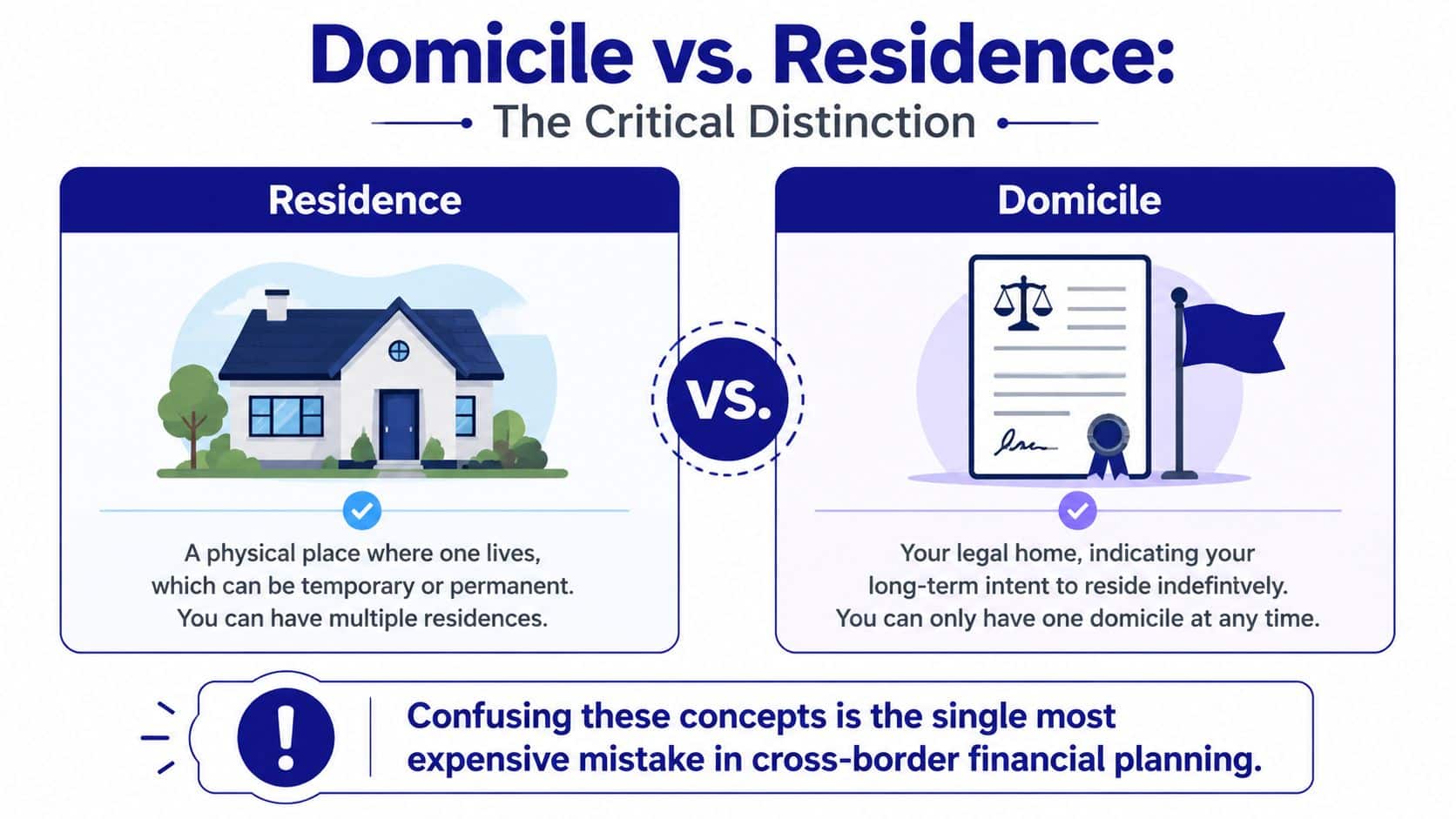
The costliest mistake in cross-border planning is confusing domicile with residence. They are not interchangeable. You may have several residences over time, and in some cases more than one practical residence in a year. You can only have one domicile at any time.
Residence is usually the easier fact. It asks where you live physically. Domicile is more demanding. It asks where your legal home is in the deeper sense, the place you ultimately belong and intend to treat as permanent or indefinite.
A practical way to think about it
Residence is the house you occupy. Domicile is the jurisdiction that the law treats as your enduring home. A person can spend substantial time outside the UK and still retain a UK domicile. Equally, a foreign passport doesn't automatically establish a foreign domicile.
That distinction matters because clients often organise their affairs around the visible facts of movement. Flights, rentals and work locations are important, but they don't complete the picture. A forensic accountant treats residence as one strand of evidence and domicile as the conclusion that has to be supported by the full record.
If you're sorting out cross-border immigration logistics alongside tax and legal planning, operational help such as find residence permit appointment support can be useful. It helps with the practical side of relocation, but legal domicile still needs its own analysis.
Where residence still matters
Residence remains vital in UK tax work. If you need to separate tax residence from common law domicile, the UK tax residence test guide is the right starting point. It addresses a different question from domicile, and mixing the two usually creates avoidable confusion.
Here's a short visual explanation before going further.
Residence tells you where someone is. Domicile asks where the law says they ultimately belong.
The Three Types of Domicile That Define Your Status
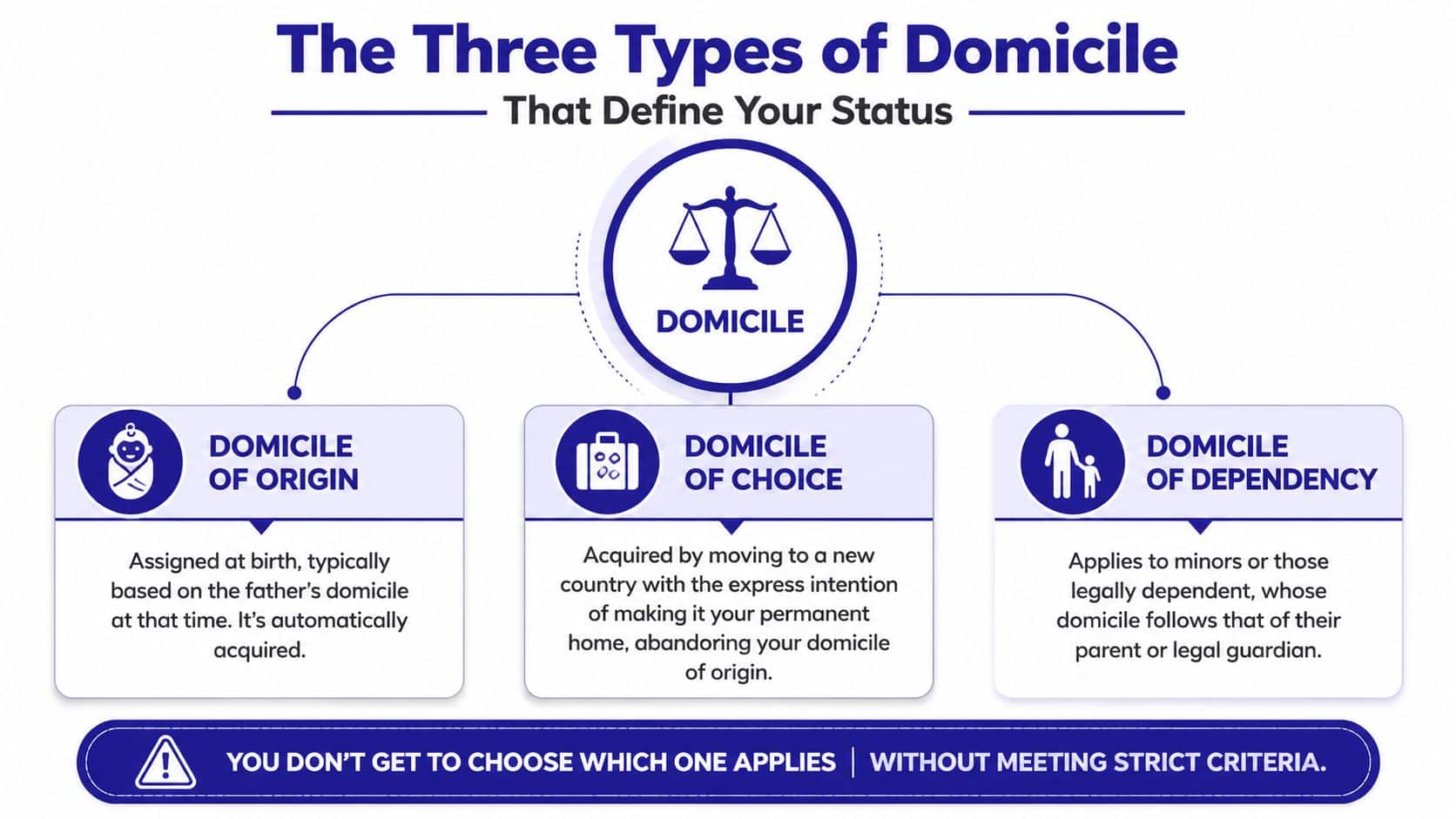
English law doesn't let people pick a domicile label that suits the moment. It applies established categories. In live disputes, that classification usually frames the entire case from day one.
Domicile of origin
This is the starting point. Under English common law, every individual acquires a domicile of origin at birth defined by their father's domicile at the time of birth, or if born out of wedlock, by their mother's domicile. This domicile of origin persists unless the individual acquires a domicile of choice, which requires two concurrent conditions: (1) establishing chief residence in a territory different from the domicile of origin, and (2) forming the subjective intention to reside there permanently or indefinitely. Absent a new domicile of choice, the domicile of origin revives automatically, as set out in Withers' guide to the UK's domicile regime.
In practice, this is why old assumptions die hard. A person may leave the UK decades earlier and still struggle to prove that they displaced their domicile of origin.
Domicile of choice
A domicile of choice is possible, but it is evidence-heavy. The move alone won't do it. Nor will a statement of intention written years later when a dispute has already started. Courts want to see both residence in the new territory and a real intention to remain there permanently or indefinitely.
That creates tension in many high-net-worth cases. Clients often preserve flexibility by design. They keep several homes, move between jurisdictions, and avoid committing too strongly in writing. Commercially, that may be sensible. Legally, it can make proving a domicile of choice harder.
Domicile of dependence
This category usually concerns those whose status follows another person legally, typically minors. It matters in family wealth structures and in succession disputes where historic family facts shape the later analysis.
A forensic accountant often starts with a timeline like this:
- Birth and family position: What was the parent's domicile at the relevant time?
- Later relocation: Where did chief residence move, if it moved at all?
- Objective conduct: Did the person's actions support permanent attachment elsewhere?
- Reversion risk: If the later position fell away, did the domicile of origin revive?
That final point catches many people. Domicile of origin is persistent. If a supposed domicile of choice collapses, the law doesn't leave a vacuum.
The Evidence Trail That Defines Your Domicile
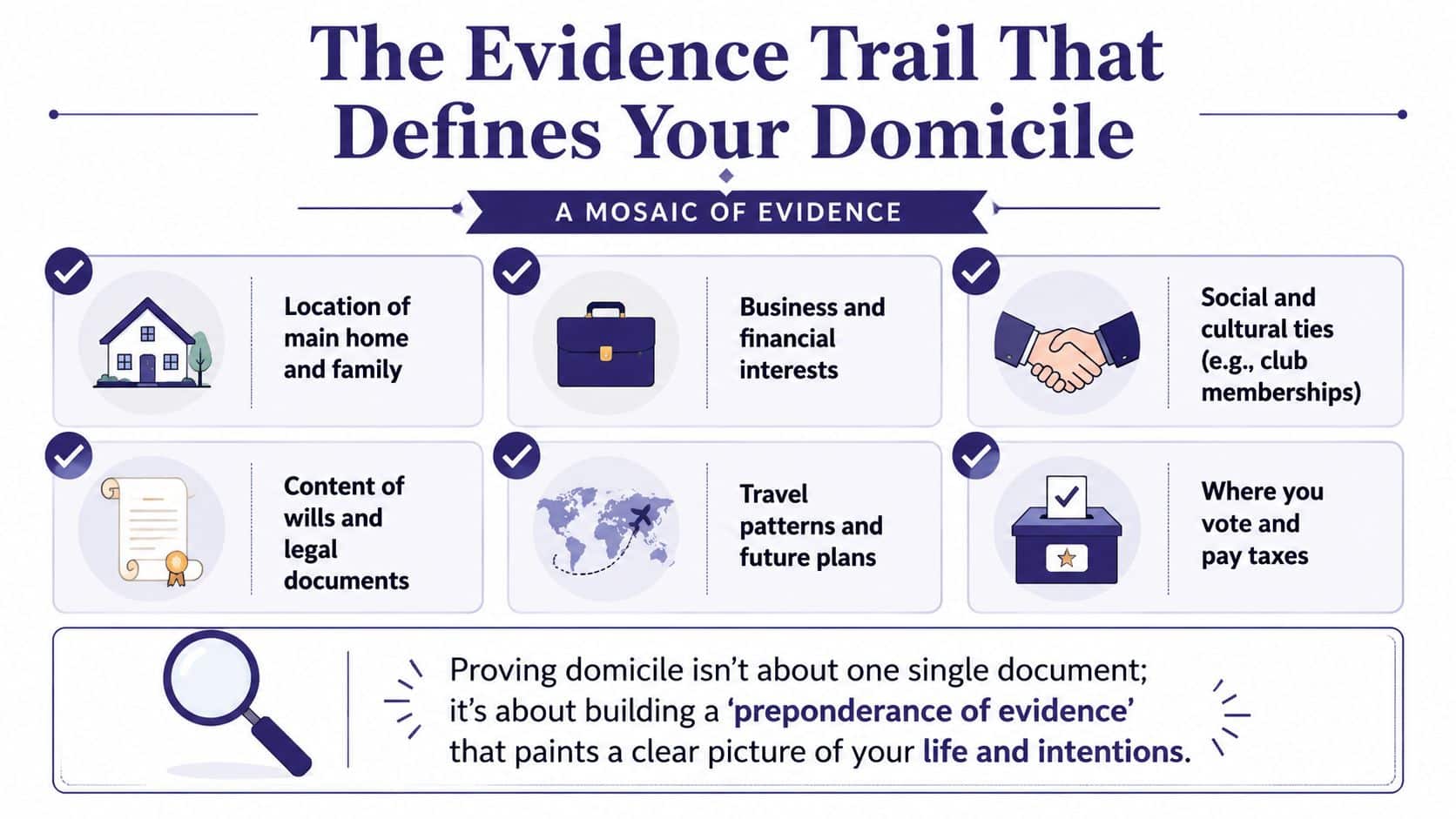
Domicile is rarely proved by one dramatic document. It is usually proved, or undermined, by a pattern. Courts and advisers assemble a mosaic of facts and test whether those facts point consistently in one direction.
That's why these matters fit naturally within forensic accounting. The exercise is investigative. It requires chronology, document control, financial analysis and the discipline to separate assertion from evidence.
What we actually test
A domicile review usually starts with ordinary records. Then it widens. We look at where major assets sit, how money moves, which jurisdiction anchors family life, and whether legal documents align with the story being told.
Typical evidence includes:
- Main home and family centre: Where is the principal home? Where does the spouse or partner live? Where were children educated?
- Financial footprint: Which banks are used most actively? Where are investment decisions made? Which country hosts the person's material business interests?
- Social attachment: Club memberships, cultural affiliations, regular charitable activity and community ties can support or weaken a claimed long-term home.
- Legal documents: Wills, powers of attorney and trust papers often reveal more than witnesses expect.
- Travel and future plans: A travel schedule matters, but so do one-way commitments such as disposal of homes, retirement planning or burial intentions.
- Civic connection: Voting records and tax positions don't decide domicile alone, but they help test consistency.
Why this has become more technical
The volume of financial evidence is much greater than it used to be. UK courts increasingly rely on expert forensic accountants to quantify damages from breach of contract or tort, value assets and liabilities for insolvency proceedings, and support divorce valuations in family courts, as data volumes have exploded since the Millennium, demanding advanced skills in transaction tracing and net-worth analysis, as noted by Chambers.
That same skill set applies in domicile disputes. We reconcile records across years and jurisdictions. We identify gaps. We test whether someone's claimed intentions are reflected in spending behaviour, ownership structures and documentary decisions.
A strong domicile case reads like one coherent life story. A weak one reads like a set of explanations added later.
What doesn't work
Clients sometimes arrive with a neat folder and a simple proposition: “I've lived abroad for years, so I'm clearly domiciled abroad.” That isn't enough. Another common mistake is overreliance on a single headline fact, such as a residence card, passport, villa purchase or foreign will.
What works is consistency. The records must show that the person didn't just spend time somewhere else. They reoriented the centre of their life and intended that move to last.
The Financial Consequences When Domicile Is Disputed
Domicile disputes become expensive because they don't stay theoretical for long. They feed directly into inheritance exposure, estate planning, succession fights, divorce strategy and historic tax analysis. Once the issue is live, every inconsistency can carry a financial cost.
Historic UK tax risk
Until 6 April 2025, the UK tax system applied a deemed domicile rule. Any individual UK tax resident for more than 15 out of the previous 20 tax years was automatically treated as UK domiciled for all tax purposes. This 15/20 rule meant that after 15 years, a foreign-domiciled person lost their non-dom status and became taxed on their worldwide income and gains.
That rule shaped years of planning for internationally mobile individuals. It also created a hard edge in long-term residence cases. A person could regard themselves as foreign-domiciled under common law, yet still face tax treatment that followed the deemed domicile rules.
Inheritance and private disputes
Domicile also matters outside tax planning. In probate and succession disputes, parties often argue over whether worldwide assets should be viewed through a UK lens or a foreign one. In divorce, domicile can influence forum arguments, the treatment of asset histories and the documentary narrative around where the family was centred.
If your concern is specifically estate exposure, clear advice on inheritance tax should sit alongside any domicile review. One without the other leaves a gap.
Why the money at risk often escalates
A domicile dispute usually arrives alongside another pressure point:
| Dispute type | Why domicile matters |
|---|---|
| Inheritance dispute | It can affect the scope of estate exposure and the law tied to succession questions |
| Divorce | It can shape arguments about home, intention, jurisdiction and the treatment of family wealth |
| Shareholder or family business conflict | It can affect credibility, disclosure and the location of controlling interests |
| Historic tax enquiry | It can reopen years of assumptions about worldwide income, gains or estate positioning |
The mistake I see most often is delay. People assume they can tidy the evidence later if a challenge comes. By then, the chronology is muddy, records are scattered, and key decisions appear self-serving.
How Our Forensic Accountants Provide Certainty in Domicile Cases
When domicile is contested, the party with the clearer evidence usually controls the case. That's why forensic accounting matters here. The job isn't to produce more paper. The job is to build an evidence-led account that a solicitor can use, counsel can argue, and a court can trust.
What a forensic accountant adds
A forensic accountant approaches domicile as an investigation. We gather financial records, legal documents, travel history, ownership data and family context. Then we compare declared intentions with actual conduct.
That matters because people often say one thing and organise their affairs another way. A statement that someone meant to settle abroad permanently carries little weight if the banking, property, governance and succession records still point back to the UK.
The wider profession reflects that demand. The UK forensic accounting services industry comprises 1,332 businesses in 2025 and is projected to reach a market size of £2.5 billion in 2026, growing at a compound annual rate of 3.9% between 2020 and 2025, according to IBISWorld's UK forensic accounting services data.
The process that works in practice
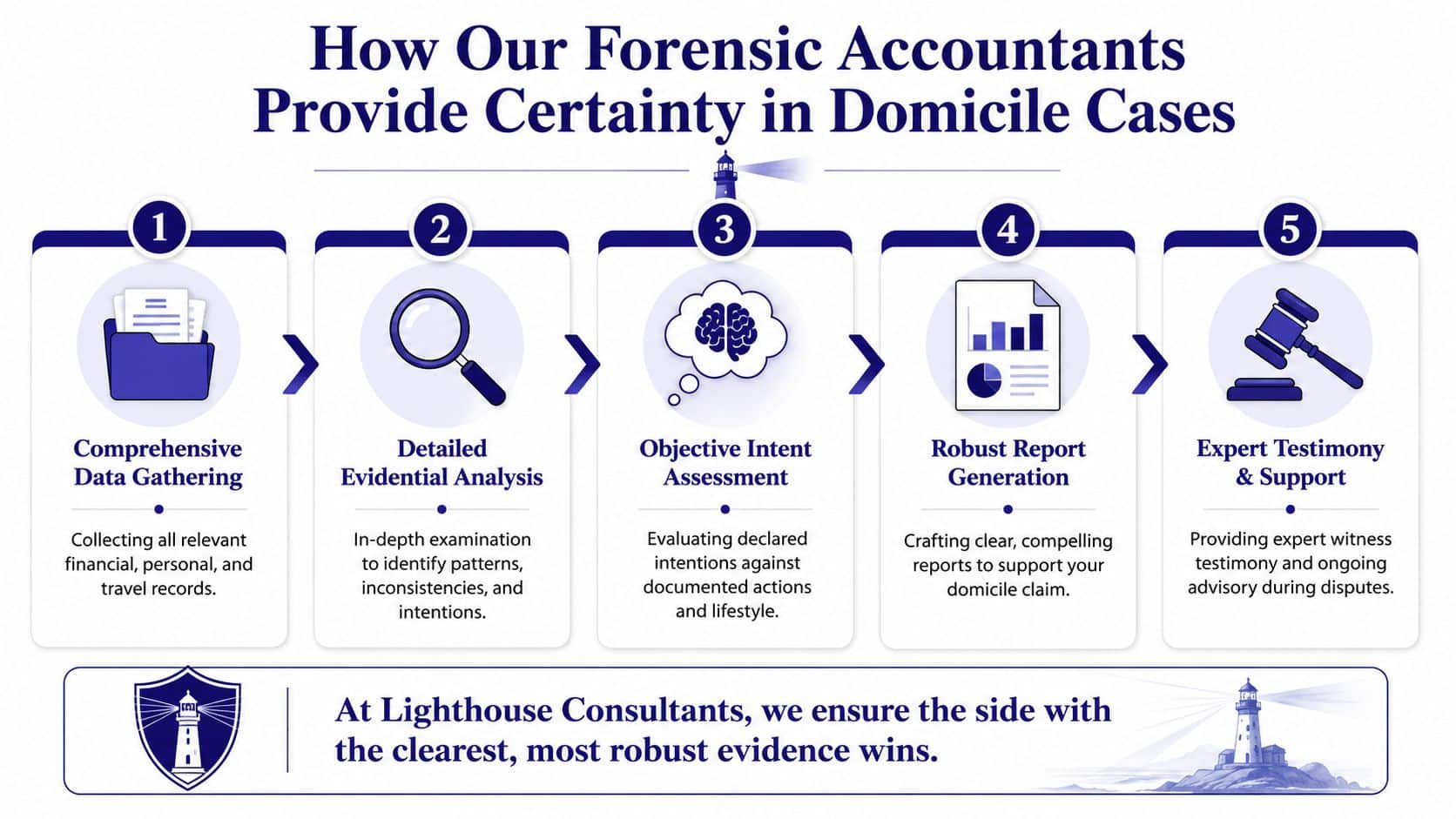
A thorough domicile investigation normally follows five linked stages:
Evidence gathering first
We collect financial, personal and travel records before opinions harden.Chronology before conclusion
We build a disciplined timeline. That exposes inconsistencies quickly.Intent tested against conduct
We compare what was said in letters, forms and witness statements with what happened.Clear reporting
The findings need to be usable. Lawyers don't need a data dump. They need a coherent evidential narrative.Support under challenge
If the matter proceeds to negotiation or court, the analysis must withstand scrutiny.
For readers dealing with relocation or cross-border property moves, broader planning context can also help. Someone exploring overseas ownership may want to review Portugal tax benefits for property buyers alongside legal advice, while recognising that property ownership alone never settles domicile.
Why an evidence-first approach matters
The right forensic work often narrows the dispute before trial. Weak arguments fall away once the documents are organised properly. Stronger arguments become clearer and more persuasive. For parties already in fraud, divorce, probate or shareholder litigation, that clarity is valuable.
For a closer look at this method in contentious matters, the forensic accounting services evidence-first approach shows how financial investigation supports difficult disputes more generally.
The best forensic reports don't simply state a conclusion. They show how each conclusion is earned.
Frequently Asked Questions About Domicile Investigations
Does domicile still matter after the 2025 UK tax changes
Yes. As of 6 April 2025, the concept of domicile was replaced for UK tax purposes by a new system based on tax residence, abolishing deemed domicile and the remittance basis. The new foreign income and gains regime now applies, meaning domicile is no longer a relevant connecting factor for determining UK tax liability from the 2025/26 tax year onwards, though it remains critical for non-tax matters like succession.
That doesn't make old domicile questions disappear. Historic tax positions, probate disputes, trust structures and succession arguments can still require detailed analysis of what someone's domicile was at the relevant time.
When should you instruct a forensic accountant
Earlier than one might think. Bring one in when any of the following appears:
- A will, gift or estate is likely to be challenged
- A divorce or family dispute turns on where the home was
- HMRC asks questions about historic status
- The documentary story looks inconsistent across countries
- There are substantial overseas assets or family business interests
Delay usually increases cost and weakens recollection. It also gives the other side time to frame the narrative first.
What's the difference between the lawyer's role and the forensic accountant's role
The lawyer handles legal analysis, privilege, pleadings, negotiation and advocacy. The forensic accountant handles the financial investigation, chronology, record testing and evidential reconstruction that support those legal arguments.
That division matters in asset-heavy family disputes. If you want a non-UK example of how forensic accounting supports contested marital finances, Florida divorce asset division insights provide a useful comparative perspective on the investigative role, even though UK legal rules differ.
Can I prove domicile with one decisive document
Usually not. A domicile case is rarely won by a single certificate, tax return or property deed. Courts look for a body of evidence that points in one direction. If the records are mixed, the analysis has to explain why.
What is the practical takeaway
If you're asking what is a domicile, the useful answer is this: it is your legal home for some of the most important questions in wealth, succession and dispute work. It is harder to change than often assumed, and much harder to prove than typically expected.
If domicile is already affecting an inheritance issue, divorce, shareholder dispute, fraud review or historic tax question, speak to Lighthouse Consultants. Their London forensic accountants build evidence-led analyses that help lawyers and clients move from assumption to certainty.