A lot of owners reach for business tax planning only when the pressure becomes obvious. Cash feels tight despite decent sales. The bookkeeping lags behind reality. One director wants larger drawings, another wants to conserve cash, and nobody fully trusts the year-end numbers. Then tax becomes the visible problem, even when the deeper issue is weak financial control.
That's where many businesses get trapped. They ask how to reduce tax, when the more urgent question is whether the accounts, records, and decision-making can stand up to HMRC scrutiny, a lender's questions, or a shareholder dispute. Good tax planning reduces liabilities legally. Better tax planning also exposes leaks, unsupported claims, messy related-party transactions, and timing decisions that damage cash flow.
A forensic accountant often enters the picture after something has already gone wrong. In practice, the same forensic discipline can help much earlier. If your records are organised, your claims are supported, and your decisions are documented, your tax position becomes stronger and your business becomes harder to destabilise.
When Business Growth Feels More Like Financial Chaos
A familiar pattern shows up in growing SMEs. Revenue improves, headcount increases, software subscriptions multiply, and the founder still approves too much personally. The business looks busy and successful from the outside. Inside, finance starts to fray.
One month the VAT bill feels larger than expected. Another month PAYE lands before a major customer pays. Then the year-end conversation begins and someone asks whether the company has claimed everything it should. At that point, tax planning often becomes a salvage exercise.
Tax stress usually signals a wider control problem
When owners say they feel behind on tax, they rarely mean tax alone. They often mean:
- Records don't reconcile cleanly: Sales, payroll, VAT, and bank movements don't align quickly enough to support confident filing.
- Cash flow tells a different story from profit: The accounts show success, but the bank balance keeps creating anxiety.
- Unusual transactions are accumulating: Director's loans, intercompany transfers, personal spending through the business, or rushed year-end journals start clouding the picture.
- Disputes are easier to trigger: If numbers aren't trusted, shareholder disagreements and supplier claims become harder to resolve.
That matters because weak tax planning doesn't just cost money. It also weakens your position if HMRC asks questions, if an employee has manipulated payments, or if another stakeholder challenges the accounts.
A business that can't explain its numbers quickly usually can't defend them cheaply.
What owners often get wrong
Many businesses still treat tax as a once-a-year compliance task. That approach fails when the company is changing quickly. Growth introduces complexity. Complexity needs systems, not just a year-end tidy-up.
What works better is a disciplined monthly and quarterly review that looks beyond tax saved today. It asks whether margins make sense, whether expenses are classified properly, whether loan accounts are drifting, and whether the reported profit matches operational reality.
A forensic mindset helps here. It looks for inconsistencies, not just allowances. If a tax review reveals unexplained write-offs, duplicate suppliers, odd payroll patterns, or unsupported claims, those aren't merely accounting issues. They are risk signals.
Why this changes the conversation
Once tax planning is viewed as part of financial control, owners make better decisions. They stop chasing every deduction blindly and start asking whether the business can evidence its position. That shift protects cash, improves resilience, and reduces the chance of ugly surprises later.
Understanding Your Core UK Tax Obligations
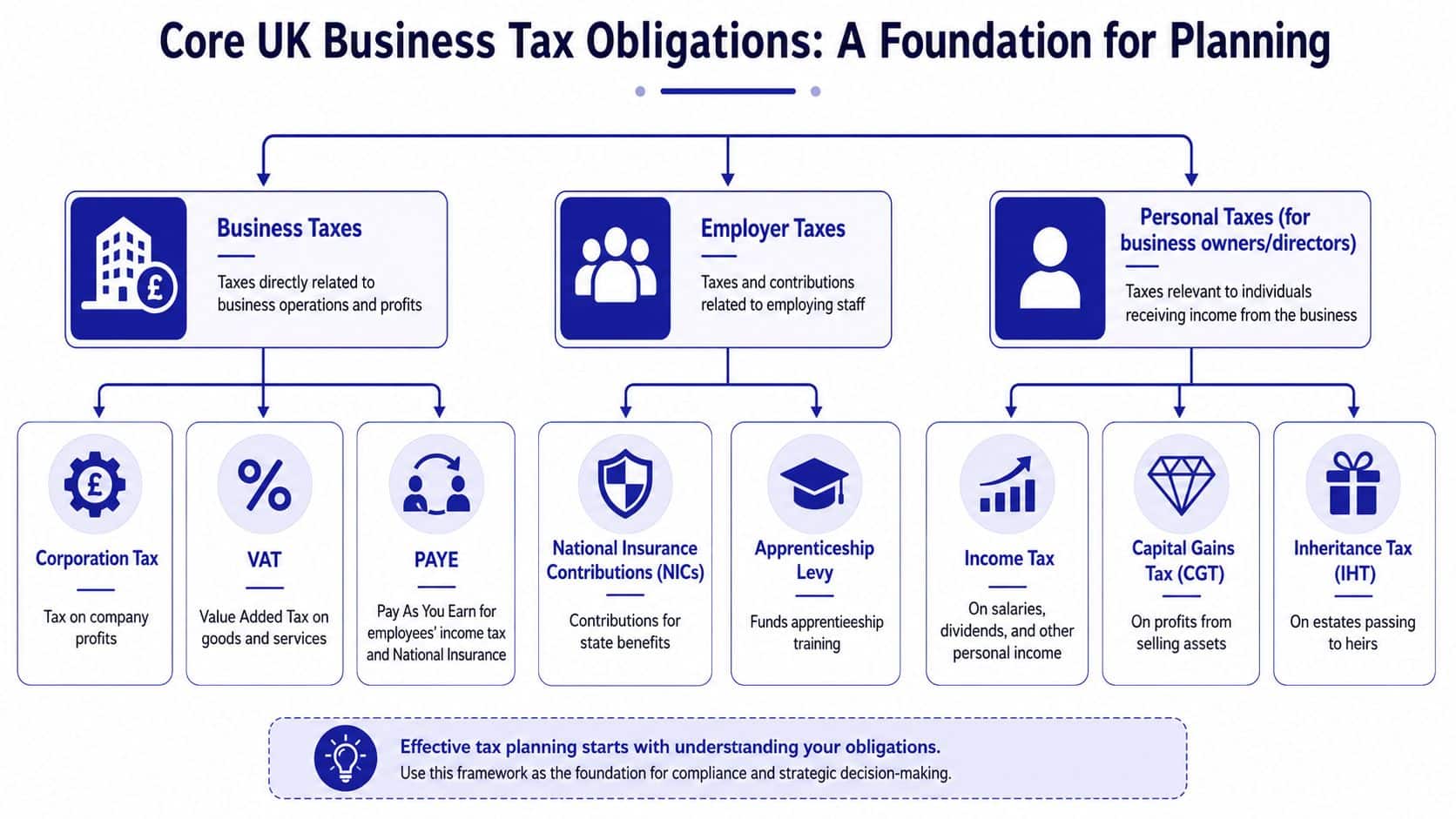
If you run a UK company, tax planning starts with the taxes that hit cash flow most often and attract the fastest consequences when ignored. For most SMEs, that means Corporation Tax, VAT, and PAYE, plus related employer obligations.
Corporation Tax needs active planning now
The old habit of assuming a flat Corporation Tax rate no longer works. In the UK, the main rate increased from 19% to 25% on 1 April 2023, but only profits above £250,000 are charged at the full rate. Companies with profits of £50,000 or less continue to pay the 19% small profits rate, and marginal relief applies between those thresholds, as outlined in this UK tax planning summary.
That changes day-to-day planning. A business near those thresholds needs to think carefully about timing, expense recognition, profit extraction, and structure. A few decisions taken too late can move profits into a less favourable position.
For smaller companies, this is one reason a proper small business taxation review is useful before the year closes, not after it.
VAT and PAYE are operational taxes
Corporation Tax is often discussed most, but VAT and PAYE usually create the sharper operational pain because they affect recurring cash obligations.
A practical way to separate them is below:
| Tax area | What catches businesses out | What good planning looks like |
|---|---|---|
| VAT | Late reconciliations, misclassified sales, poor treatment of mixed supplies | Clean coding, regular return reviews, timely invoice capture |
| PAYE | Payroll errors, benefits not handled properly, poor leaver/joiner processing | Monthly payroll controls, director pay review, year-round payroll discipline |
| Corporation Tax | Last-minute adjustments and unsupported expense claims | Forecasting profits early, timing decisions deliberately, evidence for major claims |
Owners also need to think personally
Tax planning for the company and tax planning for the owner aren't the same thing. Salary, dividends, benefits, loan accounts, and asset disposals all affect the wider picture. A company can make a technically valid decision that creates personal tax inefficiency or documentation risk for directors.
Practical rule: If a transaction only makes sense in the final week before year-end, check whether it's commercial first and tax-efficient second.
That discipline matters because HMRC expects the records to support the filing position. A clean structure and a clear paper trail usually matter more than clever last-minute adjustments.
Strategic Tax Reduction Beyond Basic Deductions
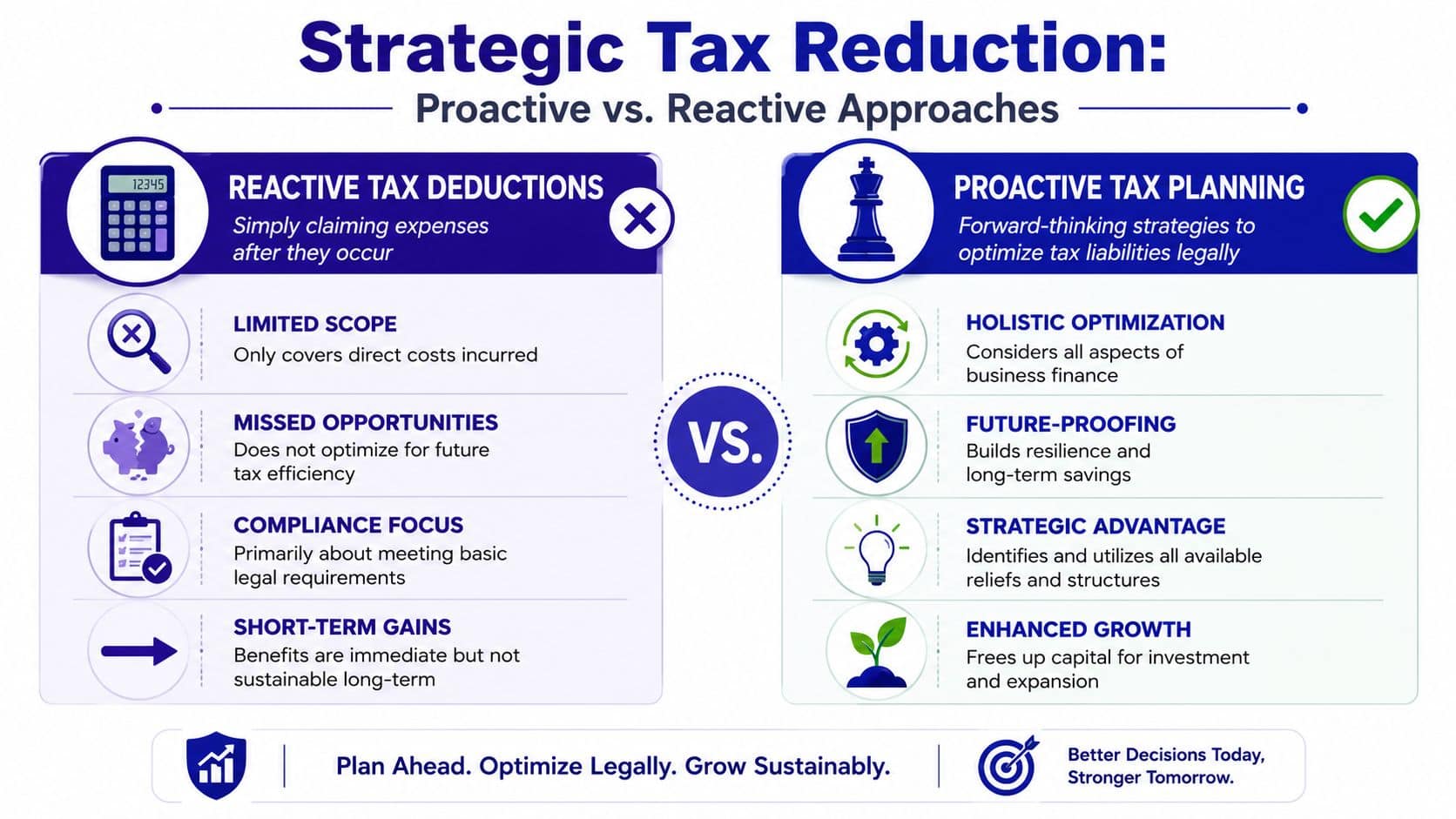
Claiming allowable expenses is necessary. It isn't strategy. Real business tax planning asks better questions. Should you hold activity in one entity or separate it? Should a purchase happen now or later? Should directors extract profits immediately or leave cash in the company? Those decisions affect tax, but they also affect resilience.
A reactive approach usually starts with receipts. A strategic approach starts with forecasts.
Structure, timing, and remuneration
Three planning levers matter repeatedly in owner-managed businesses:
- Entity structure: Separate trades, property, or risk-heavy activity where that supports clarity, control, and commercial sense.
- Timing of income and expenditure: Don't let year-end panic dictate when you invoice, invest, or incur major costs.
- Director remuneration: Salary, dividends, pension contributions, and benefits need to be reviewed together, not in isolation.
These aren't abstract tax ideas. They determine whether a profitable year leaves the business stronger or more exposed.
Capital investment is no longer a simple tax win
HMRC's April 2025 guidance confirms that full expensing remains a central capital-allowances tool for companies investing in qualifying main-rate plant and machinery. At the same time, the 25% corporation tax main rate and 19% small profits rate keep timing and profit-smoothing highly relevant. But there's an important catch. Average annual interest paid by private non-financial corporations rose from about £28 billion in 2021 to roughly £84 billion in 2024, according to this discussion of small business tax strategies and current conditions.
That changes the usual advice. Buying an asset for the tax relief may still be sensible. Financing that asset aggressively may not be.
Here's the practical decision test:
| Decision | Usually works when | Usually fails when |
|---|---|---|
| Use full expensing | The asset is genuinely needed, cash flow can absorb the outlay, and the business will use it productively | The purchase is rushed, underused, or funded in a way that strains working capital |
| Defer a purchase | The tax saving is secondary to preserving liquidity and avoiding expensive borrowing | Delay blocks operations or leads to worse commercial outcomes |
| Smooth profits deliberately | Forecasting is reliable and expenses are commercially timed | Management relies on forced year-end spending with weak documentation |
The point isn't to avoid investment. It's to stop treating tax relief as free money. Relief reduces tax. It doesn't remove financing pressure, integration risk, or the cost of buying the wrong asset at the wrong time.
A short explainer on planning choices helps frame that distinction:
What usually works in practice
Owners get better outcomes when they review tax alongside operating forecasts, debt commitments, and capital needs. They get worse outcomes when they ask only one question: “Can I deduct this?”
Leave enough room for tax planning to serve the business, not distort it.
That means resisting vanity purchases near year-end, documenting commercial rationale for significant expenditure, and reviewing remuneration and extraction before drawings become habitual rather than planned.
When Tax Planning Meets Forensic Accounting
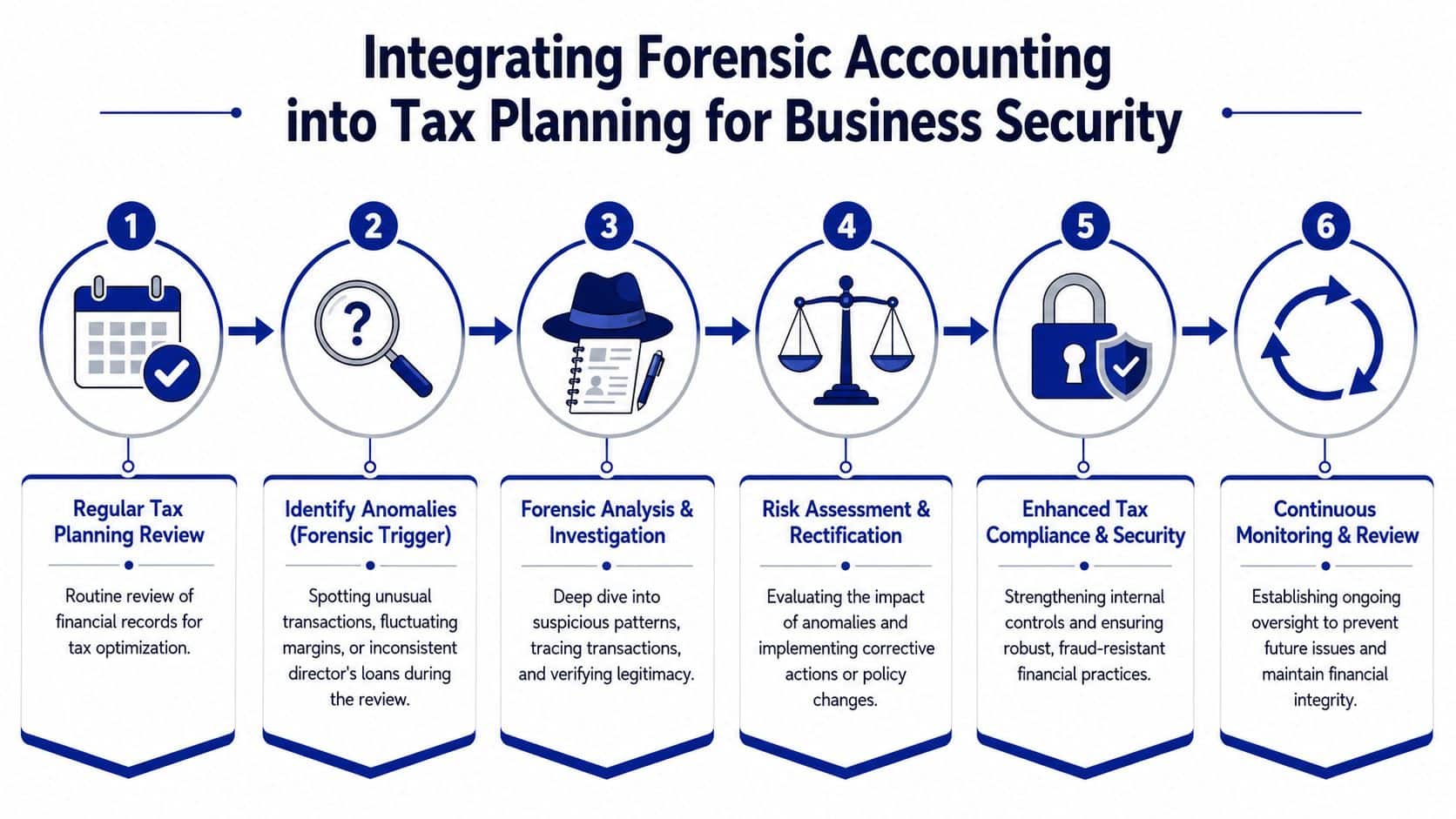
Tax planning becomes far more effective when someone tests the numbers as if they may later be challenged. That's the practical overlap with forensic accounting. A forensic accountant doesn't just ask whether a claim can be made. They ask whether the evidence, records, and transaction trail would survive scrutiny from HMRC, a court, an insurer, or a hostile counterparty.
R&D relief shows the risk clearly
In the UK, research and development tax relief remains valuable. In the 2021 to 2022 tax year, around 63,260 claims resulted in about £7.4 billion of relief. HMRC also reported that claim numbers fell while the amount claimed rose, showing a move toward fewer, larger claims, according to these HMRC business tax statistics.
That pattern matters because larger claims draw more attention. If projects are described loosely, staff time is not evidenced properly, subcontractor treatment is unclear, or technical narratives were written to fit a tax outcome rather than reality, the relief can become a liability.
What a forensic review adds
A standard tax review may focus on eligibility. A forensic review adds evidence testing.
That means checking:
- Project classification: Does the work meet the criteria claimed?
- Cost tracing: Can wages, subcontractor costs, consumables, or software be tied to the project credibly?
- Board and management records: Do internal documents support the timeline and purpose of the work?
- Consistency: Do the tax narrative, accounts, payroll records, and commercial activity tell the same story?
This approach is useful well beyond R&D. It also helps with director's loan issues, suspicious journals, unexplained margin shifts, and claims that may later feed into litigation or insurance recovery.
For businesses that want a plain-language overview of red flags and controls, this essential fraud prevention guide is a useful primer on where forensic accounting fits.
Where specialist support becomes necessary
Some businesses can tighten their own controls with better monthly discipline. Others need external review because the potential consequences are more significant. That's especially true when tax planning sits close to disputed transactions, suspected fraud, hidden losses, or documentation gaps that already worry management.
In those cases, an adviser with both tax and investigative discipline is usually more useful than a compliance-only preparer. Lighthouse offers this kind of combined review through its tax advisory partnership support, where the work can cover planning, documentation quality, and risk exposure in the same engagement.
A defensible tax position is built long before anyone asks you to defend it.
Staying Compliant and Managing HMRC Risk
Many owners avoid proactive tax planning because they think planning increases the chance of enquiry. In reality, weak systems are often the bigger problem. If the records are inconsistent, the bookkeeping lags, and the rationale for claims is unclear, even ordinary tax positions become harder to support.
HMRC estimated the UK's tax gap reached £46.8 billion in 2023/24, with small businesses responsible for 60% of the total. The same discussion notes that a 2025 Sage report found 71% of small-business decision-makers said rising costs were affecting finance decisions. That wider picture is captured in this analysis of business tax planning pressures on SMEs.
Why SMEs get into difficulty
Most small and mid-sized companies don't drift into risk because they are trying to be aggressive. They drift because finance capacity is thin. One person handles bookkeeping, payroll support, supplier payments, and management reporting. When that happens, tax compliance becomes a systems issue.
The pressure points are usually familiar:
- Bookkeeping falls behind: Returns are prepared from incomplete data.
- VAT, PAYE, and Corporation Tax are treated separately: Nobody checks whether the same underlying records support all three.
- Directors override process: Personal urgency takes priority over documented controls.
- Evidence is assembled after the event: That's when inconsistencies appear.
Good compliance is operational, not cosmetic
If you want to reduce HMRC risk, focus less on appearances and more on repeatable control. Strong compliance often looks boring. Monthly reconciliations happen on time. Payroll changes are approved. VAT coding is reviewed. Major claims have supporting files. Director transactions are recorded clearly.
A useful non-tax starting point is understanding the broader discipline of regulatory control. This vital regulatory compliance info gives a practical overview of how compliance frameworks support day-to-day operations, not just inspections.
When to bring in expert help
External help makes sense when the business has one of these features:
| Situation | Why specialist input helps |
|---|---|
| You've received HMRC correspondence | Early handling can shape the response, scope, and evidence gathered |
| Your records are incomplete or inconsistent | Reconstruction and reconciliation need disciplined review |
| You're making significant claims or adjustments | Documentation must be built to withstand challenge |
| There's a parallel fraud, dispute, or shareholder issue | Tax questions may overlap with wider financial investigation |
If HMRC has already opened questions, a practical reference point is this guide to investigation by HMRC. The value of expert support isn't optics. It's preparation, record quality, and coherent explanation.
Your Actionable Business Tax Planning Checklist
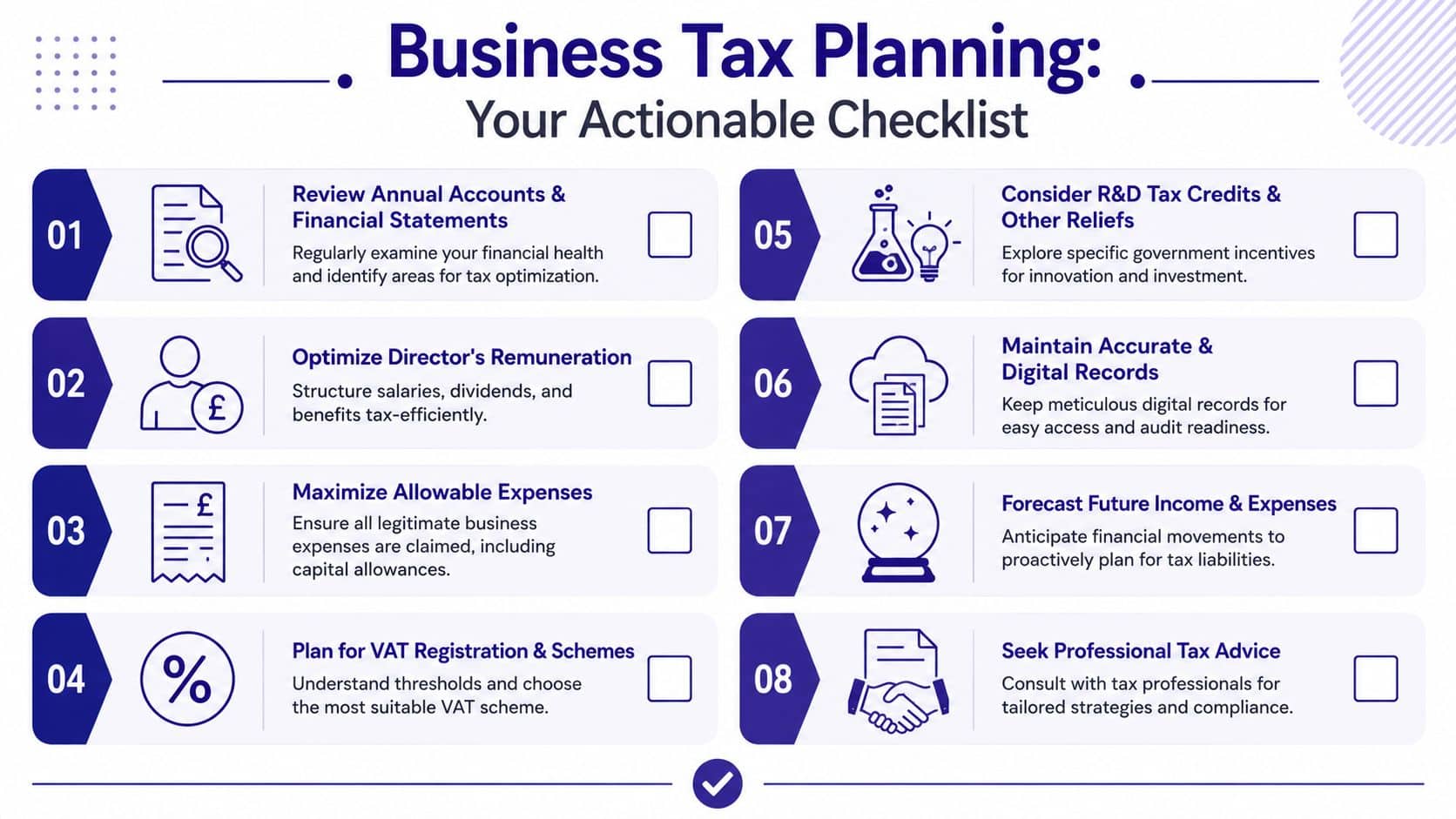
Good business tax planning runs through the year. It doesn't begin at filing deadline. Use this checklist to test whether your process is proactive or merely reactive.
A practical checklist you can use now
- Review your annual accounts with intent: Don't just sign them off. Check margin changes, unusual journals, director balances, and expense classifications.
- Forecast before year-end: Estimate profit, tax exposure, and cash needs early enough to make real decisions.
- Reconcile key balances quarterly: VAT control, PAYE, bank, debtor, creditor, and director's loan accounts should not wait for year-end.
- Document major decisions: If you buy assets, change remuneration, or make a relief claim, record the commercial reason at the time.
- Pressure-test high-value claims: R&D and other significant reliefs need evidence, not optimism.
- Keep personal and business transactions separate: Mixing them creates avoidable tax and evidential problems.
- Review systems, not just deductions: Ask whether your finance process can produce reliable support quickly.
- Escalate early when something feels wrong: Unexplained losses, irregular supplier patterns, and unsupported postings need investigation, not wishful thinking.
One simple test
If HMRC, a lender, or a shareholder asked for support tomorrow, could your business produce a clear file that explains what happened and why? If the answer is no, your planning needs more than a better spreadsheet.
Secure Your Business with Expert Financial Guidance
Tax planning is often described as a way to save money. That's true, but it's incomplete. Proper business tax planning also protects working capital, sharpens decision-making, and gives you a cleaner financial story when someone external starts asking questions.
That matters more in businesses dealing with rapid growth, unexplained losses, internal suspicion, or pressure from investors and lenders. In those situations, the cost of weak documentation and poor control can easily exceed the tax at stake. A sound process puts the company in a stronger position whether the challenge comes from HMRC, a dispute, or a due diligence review.
If you're comparing advisers or specialist support, directories can help you find qualified consultants with relevant expertise. The key is to choose someone who can address tax, evidence, and financial risk together, rather than treating them as separate problems.
Tax should never be the only lens. The stronger approach is to ask whether your records are reliable, your claims are supportable, and your financial position can withstand scrutiny.
If you want a confidential review of your tax exposure, financial controls, or potential dispute risks, contact Lighthouse Consultants. A focused conversation can quickly show whether the issue is tax efficiency, weak systems, or something deeper that needs forensic attention.