A lot of people search for forensic jobs near me when they're really trying to solve a more urgent question. They've found a gap in the numbers, they don't trust a partner, a claim has turned contentious, or a solicitor has asked for evidence that stands up under challenge. The job search is real. So is the underlying problem.
That's why forensic accounting matters so much in the UK market. It doesn't sit in the world of television crime drama. It sits where money goes missing, records don't reconcile, directors disagree, insurers demand proof, and courts want clear financial logic. If you're entering the field, you need to understand that. If you're hiring, you need someone who can turn financial confusion into evidence.
The Financial Chaos That Demands an Expert
The usual starting point isn't curiosity. It's damage.
A business owner sees stable sales but weaker cash flow. A finance team discovers duplicate payments, unexplained journals, or supplier relationships that don't feel right. A shareholder falls out with another shareholder and suddenly every ledger line becomes contested territory. In family matters, inheritance disputes and divorce proceedings can expose years of unclear ownership, informal transfers, and assets that were never properly understood. In insolvency, the questions get sharper. What happened, when did it happen, who knew, and what's recoverable?
A standard accountant can help keep books in order. A forensic accountant is brought in when the books themselves have become evidence.
Where the pressure comes from
The hardest part for most organisations isn't the first suspicion. It's the period after that, when nobody knows whether the issue is a control failure, a deliberate fraud, a contract breach, a valuation dispute, or a claim that needs quantifying. Delay makes that worse. People keep working around the problem, emails multiply, positions harden, and legal costs rise.
Practical rule: If the matter may end up in a disciplinary process, negotiation, insurance claim, or court bundle, treat the financial records as evidence from day one.
That changes how you work. You preserve underlying records. You trace transactions rather than relying on summaries. You document assumptions. You separate fact from interpretation. You test whether a loss is real, overstated, duplicated, or incapable of proof.
Why businesses hesitate and why that backfires
Many businesses resist bringing in a specialist because they think the issue is still “internal” or “probably explainable”. Sometimes it is. Even then, an independent review can settle the matter fast and stop unnecessary escalation.
The bigger mistake is assuming that specialist work only adds cost. In reality, the absence of rigorous financial analysis can cost far more. Weak evidence undermines fraud recovery. Poor loss calculations damage business interruption claims. In shareholder and contract disputes, unclear quantification weakens settlement positions. In money laundering concerns or bribery issues, inadequate investigation can create regulatory and reputational consequences that outlast the original event.
A strong forensic accountant doesn't just find errors. They create order where the numbers have become contested.
The work that actually matters
In practice, this field touches a wide range of high-stakes problems:
- Fraud investigations involving payroll abuse, expense manipulation, procurement issues, or management override.
- Litigation support where solicitors need schedules of loss, rebuttal analysis, or expert-ready financial reasoning.
- Business interruption and insurance claims that need disciplined quantification instead of broad estimates.
- Valuations and disputes involving shareholder exits, post-acquisition disagreements, or director conflicts.
- Insolvency and tracing work where records must be reconstructed and challenged transactions examined.
- Family and inheritance matters where the actual economic position is obscured by informal arrangements.
For anyone considering a career, that's the attraction. The work has consequences. For any business or law firm facing one of these issues, that's also the reason to instruct carefully. You're not buying spreadsheet capacity. You're buying financial clarity that can withstand scrutiny.
Navigating the UK Forensic Career Landscape
Searches for forensic jobs near me often return a messy mix of police posts, laboratory roles, cyber vacancies, and commercial investigations. That confuses candidates and clients alike.
In the UK, one of the biggest hidden segments in that search is forensic accounting and fraud investigation. That matters because fraud isn't a niche issue. The ONS reported 5.8 million fraud incidents in England and Wales in the year ending September 2024, which points to persistent demand for financial investigation skills in business, legal, and advisory settings, as noted in this labour market discussion of forensic accounting demand.
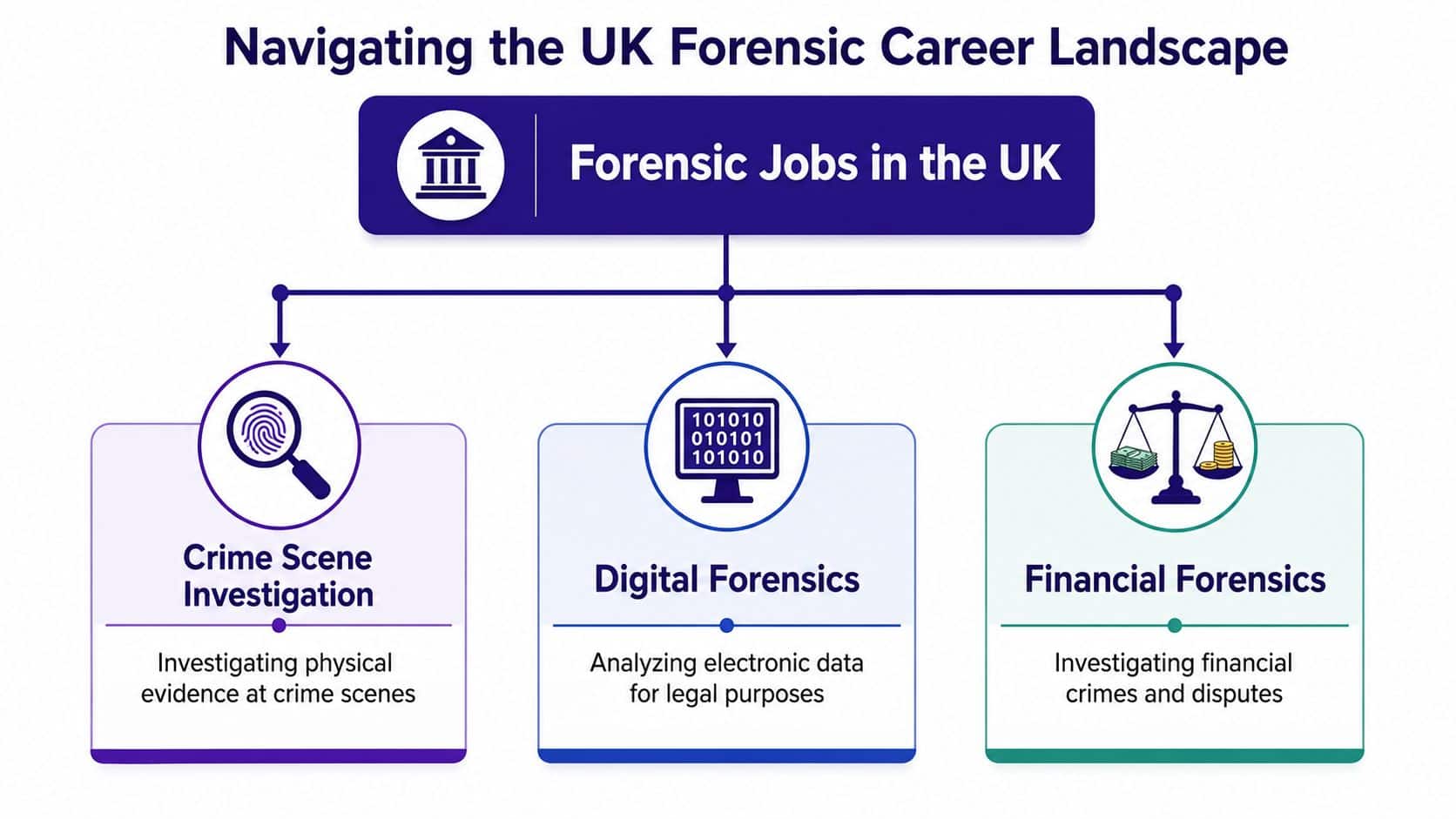
Three different career tracks
When you filter the search results properly, most roles fall into three broad groups.
| Track | Main focus | Typical setting |
|---|---|---|
| Crime scene | Physical evidence collection and scene handling | Police, labs, public bodies |
| Digital forensics | Devices, data extraction, cyber investigation | Police, specialist firms, cyber teams |
| Financial forensics | Fraud, disputes, losses, valuations, tracing | Accountancy firms, consultancies, law-linked work |
If your strengths sit in accounts, audit, disputes, insolvency, or commercial analysis, the third track is usually the right one.
What financial forensics looks like in real life
Financial forensics is less about dramatic discovery and more about disciplined reconstruction. You review ledgers, bank records, contracts, emails, management accounts, claims support, and transaction trails. You identify inconsistencies, quantify losses, test assumptions, and explain your findings in plain English.
That's why many people looking for “forensic jobs” are better suited to the commercial route than to a lab or police pathway. A useful starting point is this guide to roles and careers for a forensic accountant, which maps the profession more clearly than generic vacancy pages.
The best early career move is usually not “any forensic role”. It's the role family that matches how you already think and work.
Where to look in the UK
The obvious employers include large accountancy firms, specialist forensic boutiques, insolvency practices, and teams that work closely with litigators, insurers, and investigators. Some roles lean heavily into expert witness support. Others focus on fraud reviews, due diligence, or disputes.
Pay research varies by firm, city, and qualification path, so broad claims don't help much. What does help is comparing your route against wider benchmarks and progression expectations. This career strategy with UK salary data is useful for sense-checking market context before you evaluate specific forensic accounting opportunities.
For clients, the lesson is similar. Don't assume every “forensic” provider does the same work. The right adviser for a seized device isn't always the right adviser for a loss of profits claim or a shareholder dispute.
The Skills That Uncover Financial Truth
Good forensic accountants don't merely read numbers. They test whether the numbers deserve to be believed.
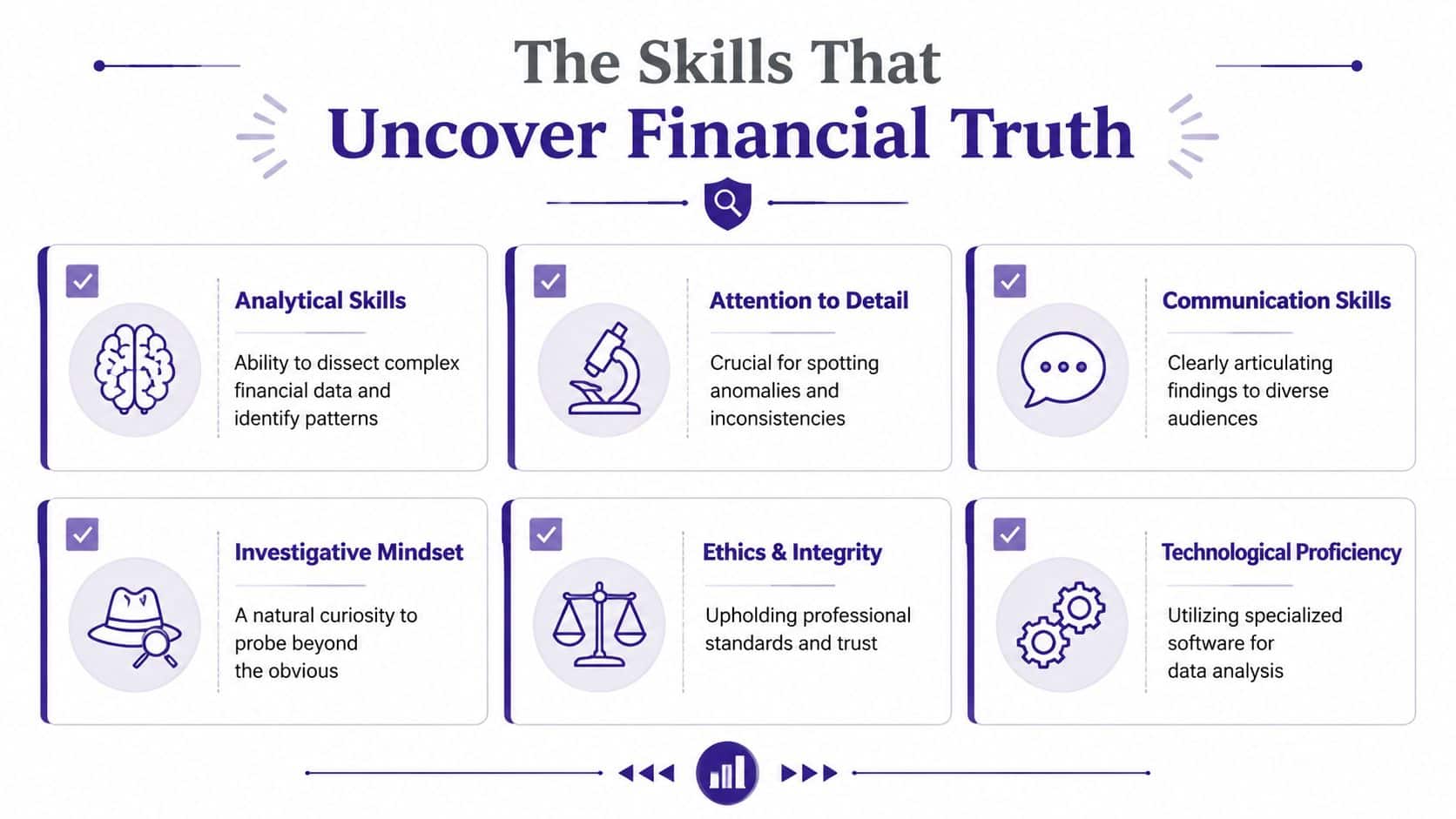
That distinction matters. A candidate can be technically strong in bookkeeping, audit, or FP&A and still struggle in forensic work if they can't question assumptions, trace evidence, and write clearly under pressure. The role demands a blend of finance, investigation, judgement, and communication.
The wider forensic evidence market gives a rough sense of the discipline's durability. The U.S. Bureau of Labor Statistics estimates 20,700 jobs for forensic science technicians, with 13% projected growth from 2024 to 2034, plus a median annual wage of $67,440 and around 2,900 openings per year over the decade. It's not UK-specific, but it does offer a useful benchmark for the scale and sustained demand attached to forensic evidence work in adjacent markets, as shown in the forensic science technician occupational outlook.
Technical skill is only the entry ticket
In forensic accounting, the technical foundation usually includes:
- Financial statement analysis to spot inconsistencies between reported performance and economic reality.
- Ledger and transaction testing to trace entries back to source documents and bank activity.
- Loss quantification for disputes, insurance matters, and contract breaches.
- Asset tracing where funds, ownership, or beneficial interests are in question.
- Data analysis tools such as Excel at an advanced level, plus practical familiarity with larger data sets and reconciliations.
Those skills matter because clients don't need abstract intelligence. They need a coherent answer to a precise question.
The soft skills clients actually feel
Clients and solicitors notice soft skills immediately. They notice whether you listen properly, whether you stay neutral, and whether your report makes sense without a decoder ring. That's why this broader piece on insights on soft skills for HR teams is relevant even in a technical field. The softer elements often determine whether strong analysis becomes persuasive evidence.
The most valuable soft skills in forensic accounting are different from the usual interview clichés:
| Skill | Why it matters in practice |
|---|---|
| Professional scepticism | Stops you accepting management explanations too quickly |
| Structured thinking | Helps you separate fact, assumption, and opinion |
| Clear writing | Allows non-accountants to understand a complex issue |
| Interview discipline | Keeps witness and client conversations useful and admissible |
| Composure | Matters when allegations are serious and deadlines are tight |
Qualifications and credibility
Most firms in the UK expect a solid accountancy route such as ACA or ACCA, or strong equivalent experience in audit, insolvency, restructuring, or disputes. Specialist forensic development builds on that base.
This overview of forensic accountant education and skills is a practical reference for candidates trying to judge whether they're ready to move from finance work into investigative work.
Strong forensic professionals don't rush to conclusions. They build them, document them, and defend them.
For clients, that's the standard to expect. If an accountant can't explain method, assumptions, and evidence trail clearly, they may not be the right person for a contested matter.
Finding Local Opportunities Beyond Job Boards
The best forensic accounting opportunities rarely come from typing forensic jobs near me into a job board and firing off twenty applications. That approach gives you volume, not direction.
The smarter move is to search by role family first. That matters because forensic work splits into distinct tracks, and weakly validated methods can produce unreliable conclusions. In practical terms, candidates should target roles that emphasise documented procedures, auditability, and court-admissible reporting rather than vague “investigative” flair, as discussed in this piece on pitfalls in forensic science methods and validation.

Who actually creates the work
If you want local opportunities, follow the instruction chain. Forensic accountants are often brought in by:
- Litigation solicitors handling commercial, insolvency, family, and shareholder disputes
- Insurers and brokers needing quantified loss analysis
- Insolvency practitioners examining conduct, recoveries, and transaction history
- Boards and CFOs dealing with suspected internal fraud or control failure
- Investors and lenders who need independent financial review
This matters for job seekers because relationships shape hiring. A boutique with strong legal and insurer relationships may offer better case exposure than a larger team where junior staff remain narrowly siloed.
Direct approaches work better than generic applications
A good speculative approach is specific. Don't write, “I'm interested in forensic roles at your firm.” Write that you've worked on reconciliations, claims review, audit files, insolvency casework, fraud indicators, or complex Excel analysis, and explain how that background supports evidence-led assignments.
A useful way to frame your search is to study a specialist forensic accounting firm near you and map the types of problems they solve. That tells you far more than a generic vacancy listing. You'll see whether the firm leans into expert witness work, fraud matters, business interruption claims, or broader dispute support.
For clients, this is also a practical filter. If a firm can clearly explain what kinds of disputes and investigations it handles, that's usually a good sign. If its service description stays vague, the engagement may become vague too.
Look beyond the vacancy page
Some of the best openings appear only after a conversation, referral, or targeted introduction.
Before you reach out, it helps to see how practitioners discuss the field and its demands:
A practical local search method looks like this:
- Map your radius around London, your region, or major legal and commercial centres.
- List specialist firms rather than relying only on Indeed or LinkedIn.
- Identify referrers such as law firms, insolvency practices, and insurance contacts.
- Send a precise introduction tied to the firm's actual case profile.
- Follow up with substance, not repetition. Offer a relevant writing sample, case summary, or explanation of transferable work.
That same method helps buyers of forensic services. The strongest provider often isn't the loudest one online. It's the one whose work aligns with your exact dispute.
Winning the Role with a Value-Driven Approach
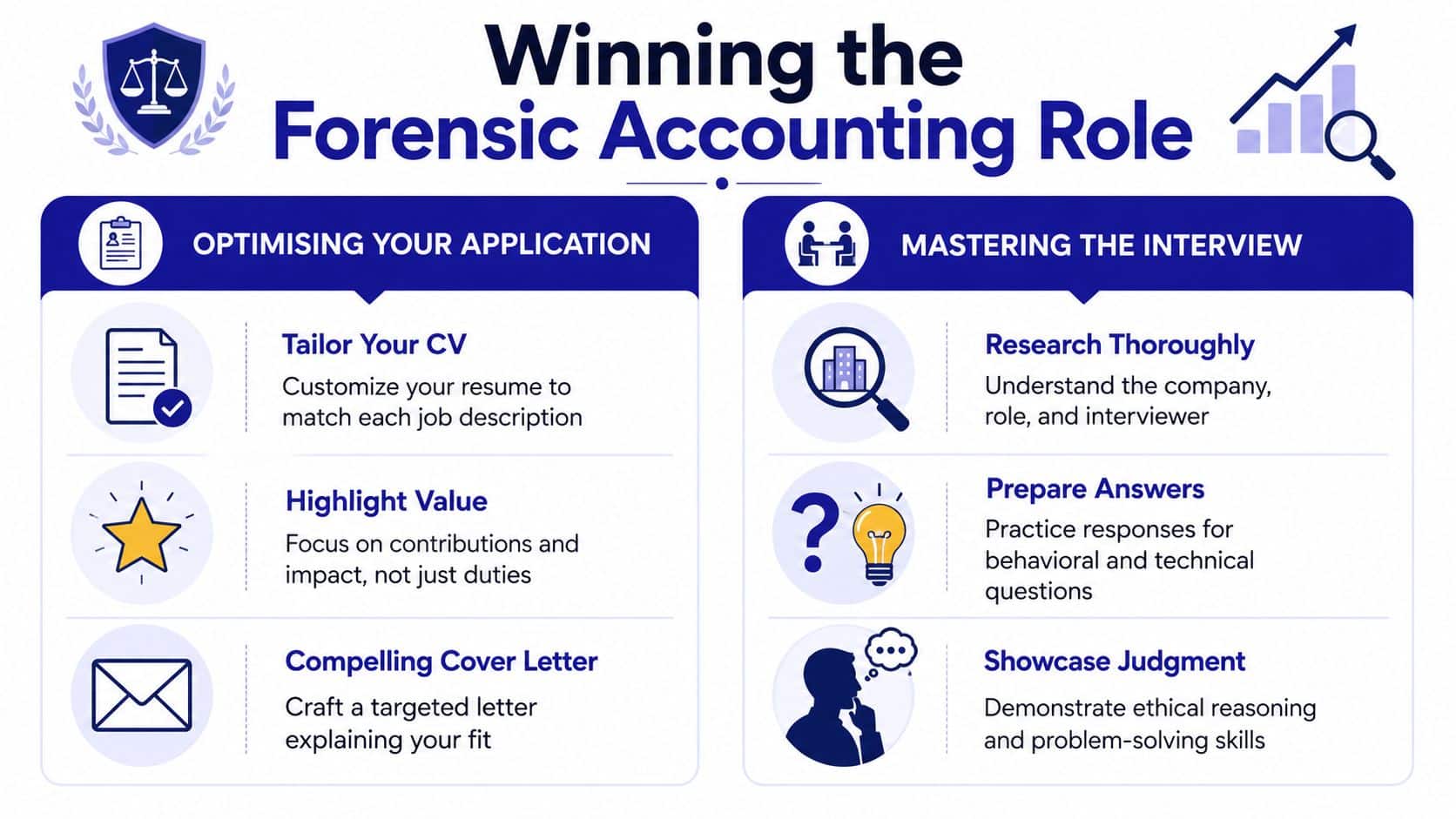
A weak application describes duties. A strong one describes judgement.
That's especially true in forensic accounting because hiring managers aren't only asking, “Can this person analyse data?” They're asking whether you can handle ambiguity, preserve integrity, and communicate findings when the stakes are uncomfortable. The field is demanding. A systematic review of forensic science jobs found that workload, time pressure, and detail-intensive work increase burnout risk, with structured stress-management and organisational support recommended as best practice. In practical hiring terms, the strongest applicants show methodical case handling, chain-of-custody discipline, and resilience under deadline pressure, as discussed in this systematic review on wellbeing in forensic science work.
What your CV must prove
Your CV should show evidence of thought, not just activity. If you've worked in audit, don't stop at “prepared working papers”. Show that you identified anomalies, reconciled conflicting records, tested evidence, or explained difficult findings to clients. If you've worked in industry, frame examples around controls, investigations, disputed balances, forecasting gaps, or unusual transaction flows.
Use concrete wording such as:
- Investigated unreconciled balances across supplier and bank records
- Supported claims analysis with underlying document review
- Prepared schedules used in legal or disciplinary contexts
- Tested transaction populations for anomalies and exceptions
- Explained findings to directors, lawyers, or non-financial stakeholders
That language signals value. It tells the employer how you think.
How to answer interview questions properly
In interviews, firms often ask scenario questions because they want to see your process. Don't leap to the conclusion. Start with scope, evidence, preservation, and method.
A good answer to a suspected fraud question usually covers these points:
| Interview theme | Strong angle |
|---|---|
| First response | Secure records and limit further loss |
| Evidence review | Trace transactions to source documentation |
| Independence | Avoid assumptions and document each step |
| Reporting | Separate findings, indicators, and unresolved issues |
| Commercial awareness | Consider business continuity as well as proof |
“I'd begin by preserving records, understanding the allegation, and defining the question that actually needs answering.”
That kind of answer reassures both employers and potential clients. It shows you won't produce noise when they need clarity.
What often loses the role
Candidates usually fail for one of three reasons. They speak too generally. They confuse confidence with certainty. Or they underplay communication, even though reports and meetings are where the work earns trust.
For clients reading this, that hiring logic doubles as a selection tool. The right forensic accountant won't make dramatic claims in a first conversation. They'll ask better questions, define the issues tightly, and explain what can and cannot be proved from the available material.
Your Partner for Certainty Quality and Care
A search for forensic jobs near me can lead to a worthwhile career. It can also reveal something more important. Businesses, law firms, insurers, boards, and families need financial specialists who can investigate properly when the facts are disputed and the money matters.
That's the centre of forensic accounting. It combines technical rigour with commercial judgement. It demands care with evidence, discipline in method, and clarity in reporting. The work serves a purpose beyond employment. It helps organisations respond to fraud, quantify loss, resolve disputes, challenge weak claims, and make informed decisions under pressure.
For aspiring professionals, that means choosing substance over glamour. The best training comes from environments where evidence standards matter, where reports are scrutinised, and where senior people can explain not only what they concluded but why. For clients, the same principle applies. The right adviser won't only produce schedules and spreadsheets. They'll help you understand the problem, preserve the evidence, and build a position you can defend.
When financial uncertainty threatens a business, speed alone isn't enough. You need accuracy. You need independence. You need analysis that's strong enough for negotiations, insurers, regulators, or court. That's why the difference between ordinary accounting support and forensic accounting is so important. One records events. The other reconstructs, tests, and explains them.
If you're considering a move into this field, build the skills that make your work reliable under challenge. If you're facing fraud, a dispute, a business interruption claim, an inheritance issue, or unexplained financial loss, choose a team that treats every figure as evidence and every conclusion as something that may have to stand up to scrutiny.
If you need that level of support, Lighthouse Consultants provides forensic accounting, expert analysis, and independent financial investigation for disputes, fraud matters, claims, and complex business issues. Their team helps clients move from uncertainty to evidence-based action with certainty, quality, and care.