A lot of small business tax trouble starts with a letter that looks routine.
One VAT query lands on the desk. The records aren't tidy. A few invoices are missing. Someone can't explain why a payment went through the director's personal card, or why payroll doesn't quite match the ledger. Then the issue widens. What began as tax administration turns into questions about controls, evidence, shareholder conduct, and whether the books can be trusted at all.
That's where taxation for small business stops being a narrow compliance topic and starts becoming a forensic one. In practice, weak tax management often exposes deeper commercial problems. It can reveal internal fraud, undeclared drawings, disputed expenses, poor governance, or a finance function that's been patched together for too long. In the UK, that matters to almost every employer because SMEs account for 99.9% of all businesses, or about 5.5 million firms according to UK small business tax data.
Business owners often assume the primary risk is the tax bill. It usually isn't. The bigger risk is losing the ability to prove what happened, defend your position, and keep control of the narrative once HMRC, a lender, an investor, or an opposing shareholder starts asking questions.
When a Tax Letter Becomes a Business Crisis
The dangerous moment isn't always a dawn raid or a fraud allegation. More often, it's an ordinary brown envelope.
A business owner receives an HMRC query about VAT. At first glance, it looks manageable. Then the questions become specific. HMRC asks for sales records, purchase invoices, bank support, payroll detail, and explanations for transactions that don't fit the pattern of the trade. The business can't pull the file together quickly because the records sit across email inboxes, spreadsheets, cloud folders, and the bookkeeper's desktop.
The tax issue is rarely the only issue
At that point, the problem changes shape. The owner isn't just dealing with output tax or an input claim anymore. They're dealing with whether the company can prove its own accounts.
That can trigger pressure in several directions at once:
- Operational strain: Staff stop normal work to gather records and answer questions.
- Cash pressure: The business may hold back decisions because it doesn't know the likely tax exposure.
- Relationship damage: Shareholders and directors start asking who approved what.
- Control concerns: Mixed spending, missing invoices, and unexplained adjustments raise wider suspicions.
Practical rule: If a tax query touches records, payroll, expenses, or director funding, treat it as a control review, not just a filing issue.
Owners often wait too long before getting organised. That's a mistake. If you're already dealing with questions from HMRC, it helps to understand how to navigate an HMRC tax check before you respond piecemeal. It also helps to get a clearer picture of what a formal HMRC compliance check can involve when the inquiry starts expanding beyond the original point.
Why this escalates so fast
Tax records sit at the centre of the business. They connect sales, purchasing, payroll, dividends, expenses, and cash movements. If one part doesn't reconcile, HMRC may start asking whether the problem is an isolated error or evidence of something systemic.
From a forensic perspective, that distinction matters. A one-off bookkeeping mistake can usually be corrected. A pattern of unsupported transactions is different. It may suggest weak authorisation, undocumented loans, suppressed income, personal expenditure through the company, or an internal dispute that has already started to affect the books.
A tax enquiry often reveals what management has tolerated for years.
That's why taxation for small business needs more than deadline management. It needs evidence that stands up under challenge. Without that, even a routine letter can become a business crisis.
Understanding Your Core UK Tax Obligations
A business can look profitable, pay suppliers on time, and still carry tax exposures that later surface in a dispute, shareholder argument, or fraud review. I see that pattern often. The tax problem is rarely limited to tax. It usually points to weak controls over profit reporting, payroll, and cash extraction.
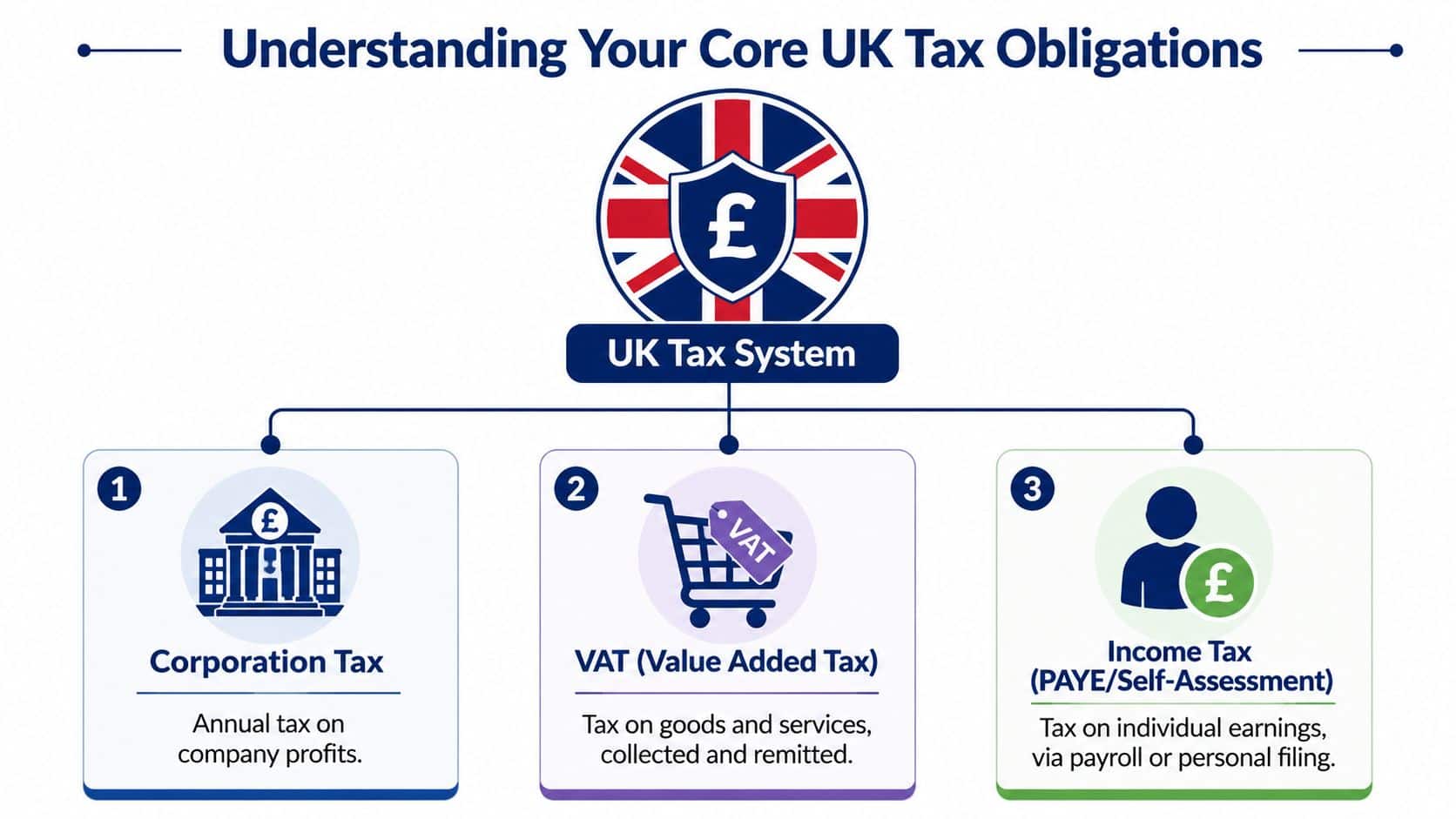
For UK companies, the core obligations usually sit in three places: Corporation Tax, VAT, and PAYE or self-assessment obligations linked to earnings. Each one is tested differently. Each one relies on a separate record trail. If those trails conflict, the issue is no longer just whether the return was filed correctly. It becomes a question of whether the books can be trusted.
Corporation Tax affects far more than the year-end bill
For incorporated businesses, the rate structure changed materially from 1 April 2023. HMRC confirms that the main rate is 25%, the small profits rate is 19% for profits up to £50,000, and marginal relief may apply between £50,000 and £250,000, as set out in HMRC's guidance on Corporation Tax rates and thresholds.
That matters because owner-managed companies often make commercial decisions first and ask tax questions later. Salary, dividends, capital purchases, repairs, entertaining, and director-funded costs do not all receive the same tax treatment. The practical risk is simple. If management accounts show one story and the tax computation requires another, someone must be able to explain the difference with records that stand up to scrutiny.
I treat Corporation Tax as a credibility test as much as a profit tax.
VAT exposes weak monitoring quickly
VAT catches growing businesses when turnover is rising but no one is checking the rolling registration position properly. Registration is triggered by taxable turnover, not by whether the owner feels ready. Once the threshold is crossed, delay can create backdated liabilities, interest exposure, and difficult conversations with customers if prices were quoted without VAT in mind.
If you need to check that threshold point carefully, this guide on when VAT registration becomes necessary for a growing business sets out the practical starting point.
From a forensic angle, VAT failures also matter because they often reveal broader weaknesses. Missing invoices, inconsistent sales records, and unexplained gaps between bankings and returns do not stay confined to one tax. They can feed allegations of suppressed income, poor stock control, or internal misappropriation.
PAYE errors damage trust fast
Payroll is where tax compliance meets employment law, benefits reporting, and director conduct. If wages, bonuses, expense reimbursements, benefits in kind, or ad hoc director payments are processed badly, the consequences spread quickly. HMRC may question deductions. Employees may challenge what they were told. In more serious cases, the records become relevant in insolvency work, matrimonial disputes, or shareholder litigation.
Owners sometimes treat director drawings as an informal cash valve. That is risky. If the entries are not clearly classified between salary, dividends, expenses, and loan account movements, the books can start to suggest something very different from what management intended. For practical ideas on reducing tax efficiently without losing control of the records, see Umbrella Company's expert tax tips.
A simple way to frame the three core taxes is this:
| Tax area | What it tests | What usually goes wrong |
|---|---|---|
| Corporation Tax | Whether profits and deductions are stated correctly | Owners rely on management accounts that do not reflect tax adjustments |
| VAT | Whether taxable turnover and invoice evidence support returns | Registration is delayed, or input claims lack support |
| PAYE | Whether payroll records match reality | Directors mix wages, expenses, and drawings |
The practical point is not just that these taxes create liabilities. They create evidence. If the Corporation Tax return, VAT returns, payroll records, statutory accounts, and bank activity line up, the business is far easier to defend. If they do not, a routine compliance issue can become a fraud question, a director dispute, or a litigation problem.
Proactive Tax Planning and Available Reliefs
Good tax planning doesn't mean forcing artificial schemes or chasing fashionable ideas. It means making commercial decisions with the tax consequences understood in advance.
That matters most where the tax system creates sharp changes in outcome. One clear example is Corporation Tax planning for small companies. From 1 April 2023 the main rate is 25%, while profits up to £50,000 are taxed at 19%, with marginal relief between £50,000 and £250,000, and that sharp effective-rate increase in the marginal band requires careful planning, as noted in this explanation of Corporation Tax rate changes and marginal relief.
Planning works when it starts before the year end
Many owners review tax after the year has finished. By then, most useful decisions have already been made. The stronger approach is to model profit, extraction, and expenditure before the year closes.
That usually means looking at questions like these:
- Profit timing: Should income or deductible expenditure fall into this period or the next, where the facts support that treatment?
- Owner extraction: Is the current salary and dividend mix still sensible for the company's actual results?
- Capital spend: Would planned investment be better made before or after the year end?
- Evidence quality: Can the business support the tax treatment with proper records?
The best tax planning is often quiet. It happens in forecasting, documentation, and timing, not in aggressive last-minute adjustments.
Reliefs only help if the records can support them
Owners often focus on the relief itself and ignore the proof behind it. That's backwards. A relief is only valuable if the business can defend the claim.
In practice, the most useful tax planning discussions often involve:
- Capital allowances and investment decisions
- Business disposals and owner exits
- Structuring expenditure so the records support the claim
- Preventing taxable profit from being distorted by weak bookkeeping
If you want a practical owner-manager perspective on reducing tax within a limited company structure, Umbrella Company's expert tax tips can help frame the right questions. Where the issue moves into exit planning, share disposals, or disputes over value, specialist capital gains tax advice becomes more important because the tax treatment and the underlying commercial facts need to align.
What doesn't work
Several habits cause avoidable damage:
- Treating the accountant as a historian: If advisers only see the numbers after the year ends, they can report them, but they may not be able to improve them.
- Buying assets with no paper trail: If the invoice, date, or business purpose is unclear, the claim becomes harder to defend.
- Mixing personal and business motives: The tax answer weakens quickly when the transaction lacks a clean commercial rationale.
Tax planning should strengthen the business, not merely reduce a line on a return. When it's done properly, it improves cash control, supports investment decisions, and lowers the chance of a future dispute over what the company did.
The Hidden Costs of Disorganised Recordkeeping
Owners often say bookkeeping is admin. That's too narrow. Bookkeeping is evidence.
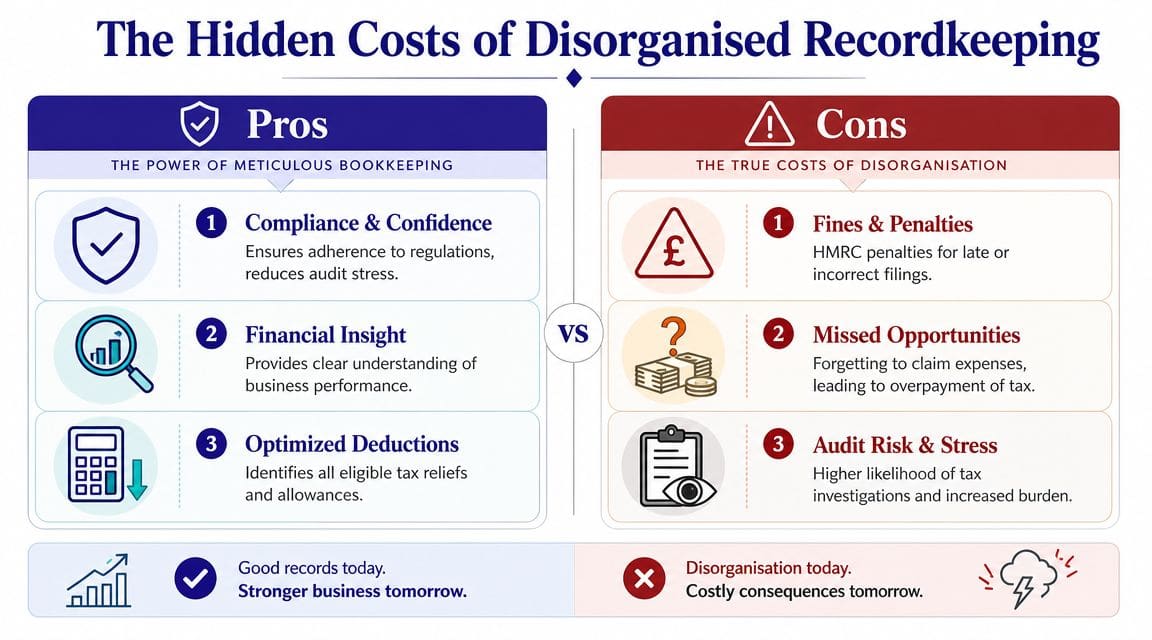
When records are disorganised, the business pays twice. First, it loses time trying to reconstruct what happened. Second, it loses credibility when the reconstruction doesn't hold together. HMRC's administrative burden estimates show that tax rules and filing obligations impose real time and cost pressures on smaller firms, and that for many SMEs the main pain is the compliance workload and risk of error rather than the headline tax rate, as discussed in this review of tax compliance burden on smaller firms.
Messy books create expensive blind spots
A disorganised ledger doesn't just make the accountant's job harder. It creates blind spots where losses, errors, and misconduct can sit unnoticed.
Typical examples include:
- Expense claims with no underlying support
- Sales adjustments that no one can explain months later
- Payroll journals posted without reconciliation
- Director spending coded vaguely to avoid scrutiny
- Supplier balances that hide duplicate or irregular payments
These issues matter because they don't stay in the tax file. They affect lending applications, due diligence, valuations, shareholder confidence, and dispute resolution.
Good records protect far more than the tax return
A tidy finance function gives management options. It lets the owner answer questions quickly, prove the position taken, and challenge inaccuracies before they become formal disputes.
The contrast is stark:
| Recordkeeping standard | Likely outcome |
|---|---|
| Supported, reconciled, and reviewed | Faster responses, stronger claims, clearer management decisions |
| Scattered, incomplete, and inconsistent | Delays, disputed numbers, greater stress, and weaker defences |
A short explanation of why records matter in practice may help here.
Why owners resist fixing it
The usual objections are familiar. “We're too busy.” “The bookkeeper knows where everything is.” “We've never had a problem before.” None of those answers survives scrutiny once an enquiry starts.
Field note: If only one person understands the records, the business doesn't have a finance system. It has a dependency.
What works instead is disciplined routine. Reconcile regularly. Keep invoices where the ledger can point to them. Separate personal and business transactions. Review unusual entries while the facts are still fresh. That isn't over-engineering. It's basic defence.
In taxation for small business, proper recordkeeping isn't a back-office luxury. It's what allows the company to claim what it's entitled to, reject what it doesn't owe, and show that management is in control.
Common Compliance Risks and Forensic Red Flags
The tax problem that worries me most usually isn't the obvious underpayment. It's the pattern of behaviour underneath it.
UK guidance increasingly links recordkeeping, VAT checks, payroll, and expense substantiation to penalties and disputes, and weak controls can turn a tax query into a broader financial-control problem, especially where HMRC uses data matching and errors or under-reporting remain significant risks, as outlined in this background on small business taxation compliance risks.
Director's loans and mixed spending
A poorly managed director's loan account is one of the clearest warning signs in an owner-managed business. It often signals that the boundary between company money and personal money has broken down.
That doesn't always mean dishonesty. Sometimes it means haste, weak bookkeeping, or an owner who treats the company bank account as an extension of their wallet. But in forensic work, the explanation matters less than the consequence. Once the records become muddled, it becomes harder to establish whether a payment was salary, dividend, loan, reimbursement, or personal expenditure.
Expenses that don't survive inspection
Expense claims should tell a clean story. What was bought, who approved it, why it served the business, and where the supporting evidence sits.
Red flags include:
- Vague coding: “general expenses” becomes a dumping ground
- No clear business purpose: the paperwork shows what was spent but not why
- Missing VAT support: claims rely on card statements rather than proper invoice evidence
- Repeated round-sum claims: the pattern suggests estimation rather than substantiation
These issues often surface in disputes because they damage trust. A shareholder who sees unexplained expense patterns may conclude that management reporting can't be relied on more generally.
Weak expense controls don't just create tax exposure. They weaken every later argument about governance.
Payroll and cash anomalies
Payroll irregularities create a different type of concern. If wages, reimbursements, and director payments don't align, the business may struggle to prove who was paid, on what basis, and with what tax treatment.
Cash-heavy businesses face a related problem. If the books don't reconcile cleanly to takings, deposits, and till records, a tax question can quickly become an allegation that the reported trading position is incomplete.
Three practical forensic tests often help identify whether a compliance issue is isolated or structural:
Consistency test
Do the ledger, bank records, payroll reports, and tax filings tell the same story?Document trail test
Can management produce the underlying support promptly and in full?Control test
Was the transaction approved, reviewed, and recorded through a process, or did someone post it after the event?
If those tests fail repeatedly, the business doesn't just have a tax problem. It has a governance problem.
Your Proactive Defence Checklists for Tax Health
The safest way to handle tax risk is to reduce surprise. That means reviewing the records before HMRC, a buyer, or a hostile shareholder does.
HMRC has estimated a persistent VAT gap of around 5.3% of theoretical VAT liability, equal to about £9.5 billion in the 2022 to 23 tax year, partly driven by small business non-compliance and recordkeeping errors, according to this summary of VAT gap and compliance pressure. That figure matters because it explains why VAT accuracy, evidence quality, and record discipline continue to draw scrutiny.
Year-end checklist
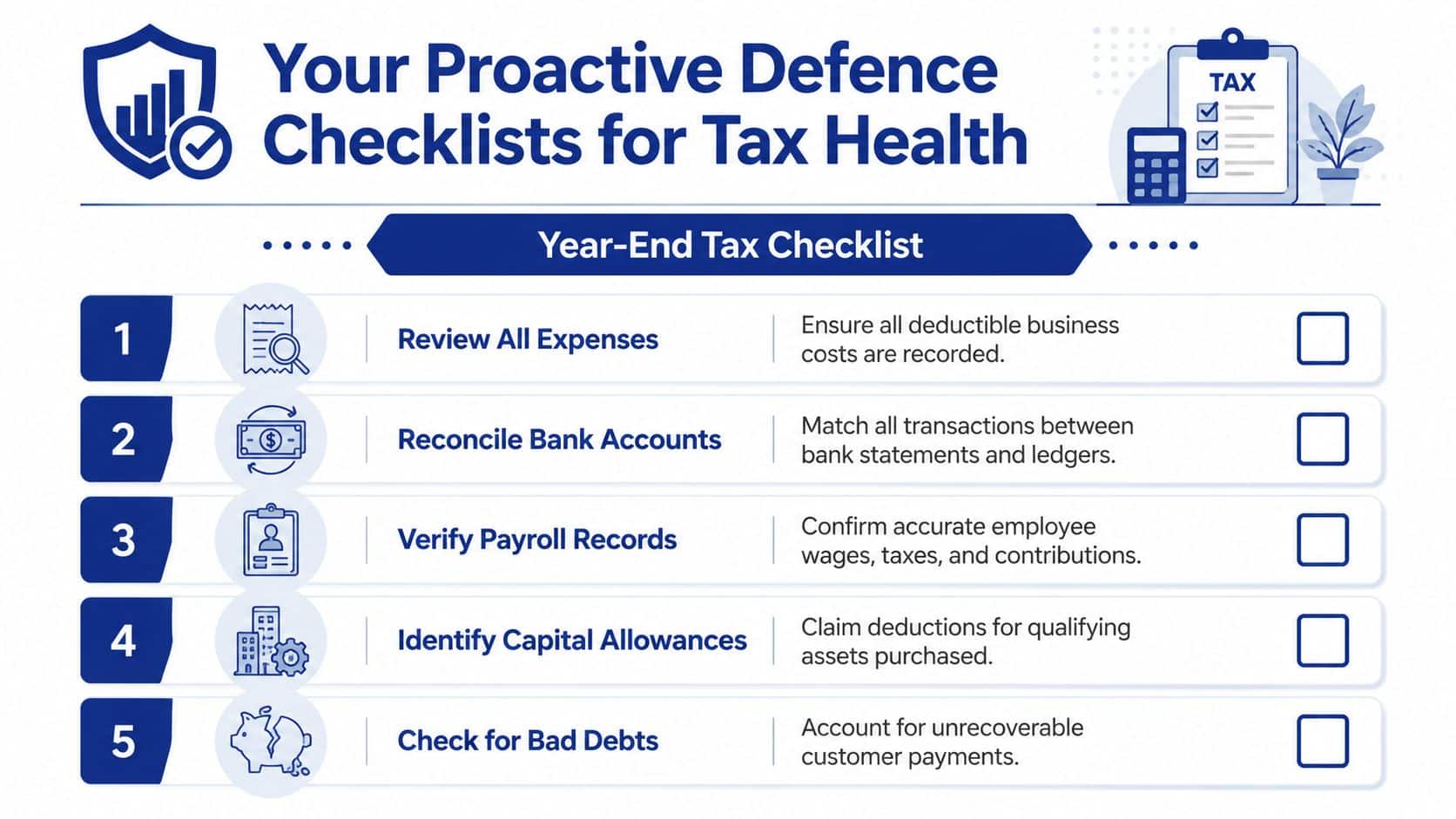
Use a year-end review to close gaps while the evidence still exists.
- Review all expenses: Check that each material claim has support, business purpose, and correct coding.
- Reconcile bank accounts: Make sure ledger balances, bank statements, and suspense items all agree.
- Verify payroll records: Confirm wages, reimbursements, benefits, and director payments are reflected consistently.
- Identify capital items: Separate routine expenses from asset purchases and keep the invoice file complete.
- Check doubtful and bad debts: Make sure the records reflect commercial reality, not wishful thinking.
If you want a practical companion resource for internal preparation, Smart Receipts' 2026 tax checklist is a useful prompt list for gathering source documents before filing season becomes frantic.
HMRC response checklist
A tax letter doesn't require panic. It does require discipline.
Confirm exactly what HMRC is asking
Don't answer the question you wish had been asked. Answer the actual one.Freeze ad hoc explanations
Staff shouldn't speculate by email or phone. Gather records first.Create a document pack
Pull bank support, invoices, payroll records, board approvals, and contracts into one controlled file.Map the chronology
If the issue spans several periods, build a timeline of what happened and who authorised it.Escalate early when sensitive areas appear
Director loans, related-party transactions, payroll anomalies, and inconsistent VAT treatment all justify closer review.
The quality of your first organised response often shapes the tone of the entire enquiry.
Internal control checklist
This final checklist is less about filing and more about defence.
| Control area | What to check now |
|---|---|
| Directors | Loans, reimbursements, dividends, and personal spend through company accounts |
| Sales | Completeness of invoicing, credit notes, and VAT treatment |
| Purchases | Supplier legitimacy, invoice support, and approval trail |
| Payroll | Accuracy of classifications, timing, and consistency with books |
| Records | Whether a third party could follow the evidence without oral explanation |
Tax health improves when the business can prove its story quickly. That's the standard to aim for.
Engaging Specialists When a Tax Matter Needs Forensic Investigation
A business owner receives what looks like a routine tax query on Monday. By Friday, the issue has widened into missing support for payments, inconsistent payroll treatment, and questions about whether money left the business for valid commercial reasons. At that point, the problem is no longer just about filing accuracy. It is about evidence, control failure, and who may later challenge the account your business gives.
Routine compliance accountants deal with returns, reconciliations, and year-end reporting. A forensic specialist deals with disputed facts. That distinction matters when a tax issue starts overlapping with suspected fraud, shareholder conflict, unexplained losses, weak governance, or potential litigation. The work shifts from preparing figures to testing them, tracing transactions, preserving evidence, and quantifying exposure in a form HMRC, solicitors, insurers, lenders, or the court can examine.

When specialist input becomes the sensible choice
The warning signs are usually practical, not theoretical:
- A tax enquiry starts exposing signs of fraud or misappropriation
- Shareholders or directors dispute the reliability of the accounts
- A lender, insurer, or investor asks for independent financial analysis
- Management cannot explain fund movements with a clear audit trail
- The matter is likely to enter formal dispute resolution or legal proceedings
In those situations, the wrong response is to keep treating the issue as a bookkeeping tidy-up. Poor tax compliance often sits alongside wider control weaknesses. I have seen VAT errors uncover diverted receipts, payroll anomalies lead to employment status disputes, and director loan questions open up arguments about personal benefit, solvency, and fiduciary conduct. HMRC penalties may be the first cost. They are rarely the last.
What useful specialist support looks like
You need a defined scope, independent analysis, and reporting that works outside the finance function. That can include tracing payments, testing whether expenses were legitimate, reviewing payroll irregularities, analysing director current accounts, identifying gaps in source records, quantifying losses, and preparing evidence for solicitors or counsel.
Firms like our own, Lighthouse Consultants, provide forensic accounting, investigation, risk review, and expert support where tax problems overlap with disputes and complex financial issues. The practical point is not the firm name. It is recognising when the risk has changed. Once facts may be contested, independent financial analysis becomes part of the business's defence against fraud allegations, civil claims, insurance disputes, and regulatory scrutiny.
Delay creates avoidable damage. Records are lost, inboxes get deleted, staff leave, and informal explanations harden into positions that are difficult to defend. Early forensic review helps preserve evidence, narrow the points in dispute, and separate error from misconduct before the matter becomes more expensive to resolve.