You're often at your most exposed when everything looks routine.
The contract is signed. The overseas buyer is ready. Your solicitors have the papers. Then someone on the other side says the document isn't properly authenticated for their jurisdiction. Completion stalls. Funds sit in limbo. A court refuses to rely on an exhibit. A bank won't open the account. An insurer questions the provenance of a record you thought was straightforward.
That's when people realise document authentication services aren't clerical admin. They're part of risk control.
I see this problem from the sharp end. In disputes, fraud reviews, insolvency matters, shareholder rows, inheritance fights, insurance claims, and cross-border asset tracing, weak paperwork doesn't just irritate people. It weakens evidence, delays recoveries, and gives an advantage to the other side. If a document needs recognition abroad, getting the process wrong can cost far more than the fee to get it right.
When a Simple Signature Is Not Enough
A signed document can still fail at the exact moment you need it most.
A UK company sends a board resolution to support a foreign subsidiary setup. The directors signed it properly. The signatures are genuine. The content is fine. Yet the overseas registrar rejects it because the document hasn't gone through the right authentication route for that country. The company loses momentum, misses a banking window, and starts renegotiating deadlines it should never have touched.
The same pattern appears in disputes. A shareholder claims control of an overseas asset. A legal team assembles what looks like a strong bundle. Then the foreign court or authority asks for proof that the signature and seal on a UK public document are authentic. Without that official step, the evidence can lose force very quickly.
Where the damage starts
The commercial loss rarely comes from the piece of paper itself. It comes from what the paper was supposed to enable.
- Completion risk: A deal doesn't close because overseas counsel won't accept the document pack.
- Litigation risk: Evidence arrives in the wrong form, so the other side attacks admissibility or reliability.
- Banking risk: An overseas bank won't onboard the company or release instructions.
- Fraud risk: A copied seal, unclear signer authority, or weak handover process creates doubt about authenticity.
A document that cannot survive scrutiny abroad is often worth less than the information written on it.
Many businesses make a bad assumption. They think authentication proves the contents are true. It doesn't. It supports official recognition of the signature, seal, or status of the document for use in another country. That distinction matters in every contested matter.
Why identity concerns sit alongside authentication
Some failures start even earlier, with the wrong person, the wrong document, or the wrong intermediary. If you're dealing with a remote counterparty, suspicious instructions, or inconsistent contact details, basic identity checking matters before anyone sends originals into a cross-border process. For that kind of early warning work, PeopleFinder's catfish identity guide is a useful practical read.
Businesses don't usually call for document authentication services because they enjoy formalities. They call when delay is expensive, challenge is likely, and someone needs the paperwork to hold up under pressure.
Understanding Document Authentication Apostille vs Legalisation
Most confusion comes from one basic error. People treat apostille and legalisation as if they mean the same thing.
They don't.
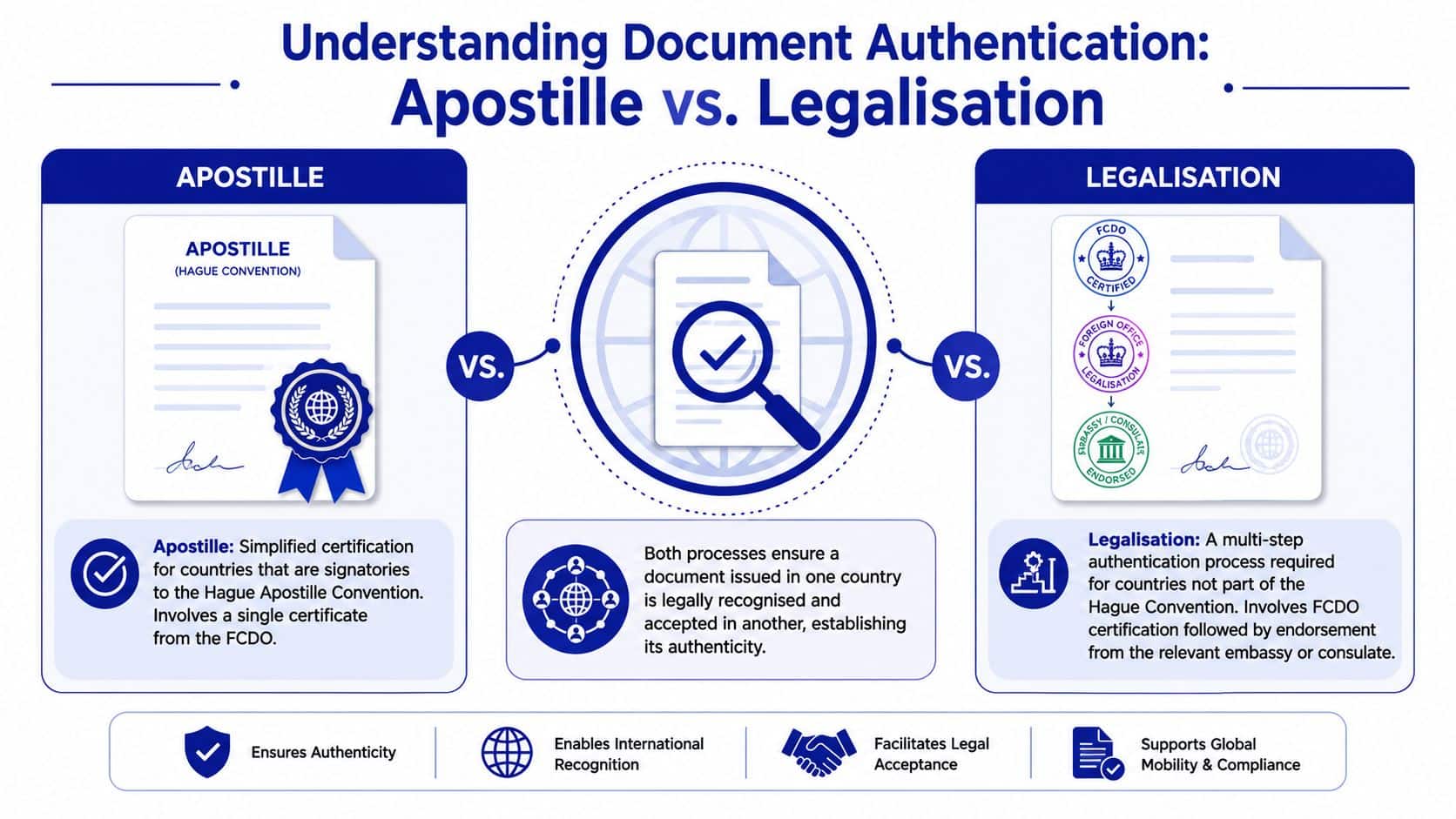
For UK documents, the key distinction is whether the destination country accepts the Hague Apostille system or requires further embassy involvement. The UK framework rests on the Apostille Convention (1961), and the Foreign, Commonwealth & Development Office is the authority that issues apostilles for UK public documents. For countries outside that system, you usually need embassy legalisation instead, which adds further steps and risk points, as outlined in guidance on authenticating documents for international use.
Apostille in plain English
Think of an apostille as the document equivalent of a recognised international pass.
If your destination country accepts the Hague framework, the UK document can often move forward with a single recognised certificate from the FCDO. That's the simpler route. Simpler does not mean casual, though. The underlying document still has to be in the right form, and the signatory or issuing authority still has to satisfy the relevant requirements.
Typical examples include corporate records, powers of attorney, certificates of incorporation, and public documents needed abroad for routine business use.
Legalisation for non-Hague countries
If the receiving country sits outside the Hague Apostille system, an apostille alone may not be enough.
You may need further certification or endorsement through the relevant embassy or consulate after the UK stage. That's where timetables become less predictable and document handling becomes more sensitive. Every added handoff creates another opportunity for rejection, mismatch, or delay.
Practical rule: Ask the destination country question first, not last. It decides the route.
A common business mistake is preparing the document beautifully, arranging signatures, and only then checking whether the receiving authority needs apostille or full legalisation. By then, the matter is already running late.
To see the distinction visually, this short explainer helps:
What UK businesses should decide first
Before you send anything, answer these questions:
- Which country will receive the document?
- Is that country using the Hague Apostille route or a legalisation route?
- What type of document is it?
- Does it need notarisation or solicitor certification before FCDO submission?
- Will the receiving bank, court, authority, or counterparty impose its own format requirements?
Shortcuts here are expensive. The right route is not a technical nicety. It's what makes the document usable overseas.
When Authentication Becomes Non-Negotiable for Your Business
This isn't a niche process for rare edge cases. It sits inside everyday international business.
The scale tells you that clearly. More than 11 million electronic apostilles were issued worldwide between 2016 and 2020, with annual issuance projected to reach around 5.1 million by 2024, according to InCorp's overview of apostille demand. That volume matters because it shows authentication now operates as infrastructure, not ceremony.
Four situations where failure hurts fast
Litigation and dispute work
If you're relying on documents across borders, the question is never just “is it signed?” The question is whether the receiving forum will recognise it in the form presented. In a shareholder dispute, contract claim, or asset recovery exercise, that difference can shape the advantage from the start.
Due diligence and investment checks
Investors, lenders, and acquirers need confidence that company records, authorities, and official filings are real and acceptable in the target jurisdiction. If you're already thinking about verification discipline, Lighthouse's guide to customer due diligence is a sensible companion read because weak onboarding and weak document controls often travel together.
Fraud investigations
When funds move through multiple entities and jurisdictions, investigators need a clean evidential trail. A document that hasn't been authenticated correctly may still hold information value, but its legal and practical usefulness can weaken under challenge.
Cross-border trading and operations
These are not exotic scenarios. They include:
- Overseas bank account opening
- Foreign subsidiary formation
- Use of powers of attorney abroad
- Submission of company documents to overseas authorities
- International contract support packs
Why business leaders underestimate the risk
Many executives assume the lawyers will sort it out at the end. Sometimes they do. Sometimes the issue sits with company secretarial work, finance, compliance, or external agents until the final week. That's how avoidable bottlenecks start.
A failed authentication process doesn't merely delay paper. It can postpone revenue recognition, defer funding access, interrupt deal sequencing, and complicate evidence preparation. Those are financial consequences, not admin inconveniences.
| Business event | What authentication protects |
|---|---|
| Overseas entity setup | Acceptance of UK corporate records abroad |
| Cross-border dispute | Credibility and usability of key documents |
| Banking and finance onboarding | Recognition of authority, identity, and status |
| Fraud and asset tracing | Integrity of documents moving between jurisdictions |
The right time to deal with authentication is when the transaction or dispute plan is first mapped, not when someone asks for it at the eleventh hour.
Navigating the Authentication Chain of Custody
Most clients don't object to authentication itself. They object to uncertainty.
They don't know who should certify what, who should hold the original, when the FCDO enters the process, or whether the document can safely pass through agents and couriers without creating evidential problems. Those concerns are sensible. The answer is a disciplined chain of custody.
The usual workflow
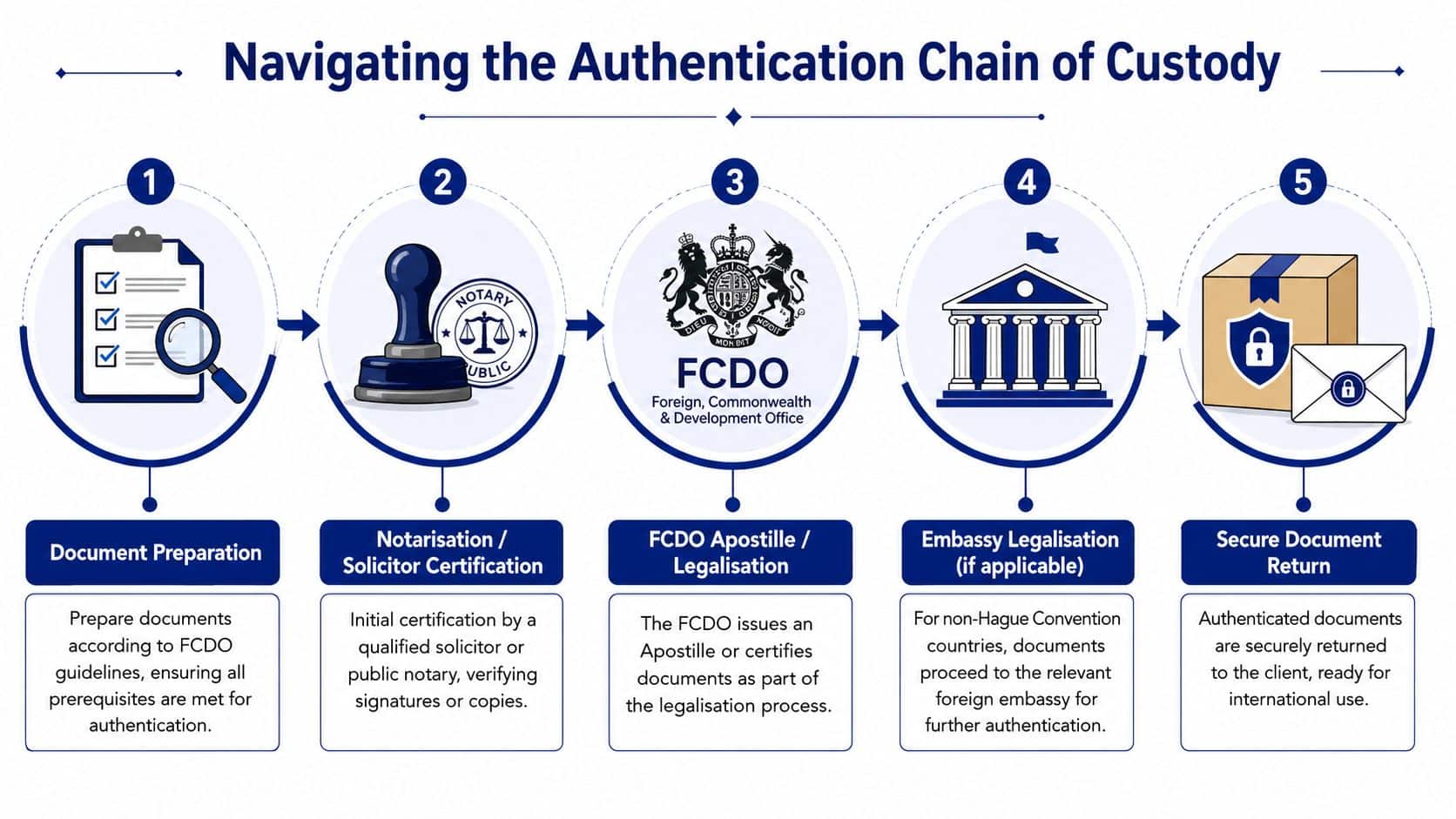
The route varies by document and destination, but the working sequence usually looks like this:
-
Review the destination requirement
Confirm whether the receiving country needs an apostille or further legalisation. -
Prepare the underlying document properly
Public documents, certified copies, affidavits, powers of attorney, and corporate papers may each need different treatment. -
Arrange the right first certification
That may involve a solicitor or a notary, depending on the document and the receiving authority's expectations. -
Submit for FCDO processing
This is the official UK stage for apostille issuance or the UK leg of a broader legalisation route. -
Proceed to embassy legalisation if required
Non-Hague destinations often need this further step. -
Return and store securely
Originals and certified packs should move back through a controlled handover.
Where businesses go wrong
A major source of confusion is the split between apostille for Hague countries and legalisation for non-Hague countries. Get that wrong and delays follow, because the route, signatory requirements, and destination rules change by country, as noted in guidance on apostilles and document authentication services.
That's why internal teams should stop treating all overseas document requests as identical.
- Wrong signatory: The person who signed may not be acceptable for the next stage.
- Wrong document form: A plain copy may be rejected where a notarised copy is expected.
- Wrong country assumption: The legal route may be different from what a generic online guide suggests.
- Wrong timing: Embassies and counterparties don't adjust their deadlines because you discovered the requirements late.
If a court timetable, deal completion date, or regulatory filing depends on the document, build the authentication path into the project plan from day one.
Chain of custody is not just a legal phrase
In contentious matters, the journey of the document matters almost as much as the document itself.
If originals move between finance staff, external agents, translators, couriers, and overseas recipients with no clean audit trail, you create opportunities for challenge. That risk matters in disputes, but it also matters in commercial due diligence. Questions often arise about who held the original, whether a scan was substituted, whether a seal was copied, and whether the final document used abroad is the same one that began the process.
For matters likely to face scrutiny, a structured evidence approach helps. Lighthouse's perspective on documentation in dispute resolution is relevant here because document control and evidential credibility are inseparable.
A tighter operating discipline
Use a simple internal protocol:
- Nominate one owner: One person should control versions, handovers, and status updates.
- Log every transfer: Record who held the document, when, and for what purpose.
- Keep copies intelligently: Retain scans of each stage, but don't confuse working copies with originals.
- Verify before dispatch: Check names, dates, company details, and destination requirements before anything leaves your office.
Clients often think the difficult part is obtaining the stamp. It isn't. The difficult part is preserving confidence in the document from start to finish.
Choosing the Right Authentication Partner
Choosing on price alone is a mistake.
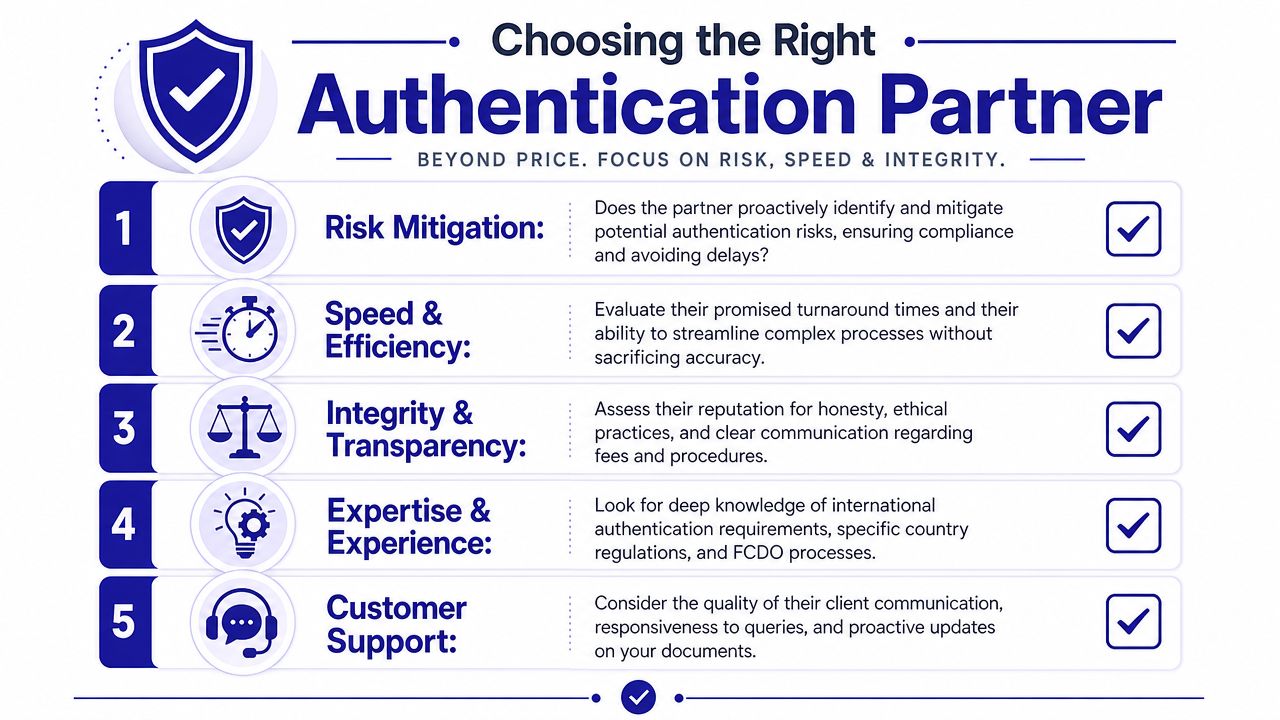
If a provider handles your papers as if they were ordinary admin, you're paying for appearance, not protection. In high-stakes matters, the key question isn't “what's the cheapest route?” It's “who reduces the chance of rejection, delay, challenge, or evidential damage?”
The fraud backdrop makes that point hard to ignore. UK Finance reported 2.6 million fraud offences in the year to September 2024, with losses of £1.17 billion, a reminder that document integrity and control over intermediaries matter far more than most generic service pages admit, as discussed in this overview of apostille and fraud-related handling risks.
What to look for
A credible provider should answer practical questions directly.
| What to check | Why it matters |
|---|---|
| Knowledge of both apostille and legalisation routes | Some matters fail because the provider only understands the simpler path |
| Secure handling process | Originals need controlled movement and clear accountability |
| Clear communication | You need to know what stage the document has reached and what remains outstanding |
| Experience with legal and forensic use cases | Court, dispute, and due diligence matters require more than courier efficiency |
| Transparent fees and scope | Hidden extras usually appear when the route was poorly diagnosed at the start |
Red flags that should stop you
Some warning signs are obvious once you know what to ask.
- Vague answers about destination country rules: That usually means guesswork.
- No explanation of custody controls: That suggests they don't understand evidential risk.
- Promises detached from document type: Turnaround depends on route, authority, and form. Blanket assurances are unreliable.
- Casual attitude to originals: That is unacceptable where legal rights or transaction value depend on the paper.
Cheap handling becomes expensive the moment a document is rejected after contracts are exchanged or proceedings are underway.
The right mindset
Treat document authentication services as part of your risk management framework.
The best partner doesn't merely “process” a form. They stress-test the route, confirm the underlying document is fit for purpose, protect the handoff trail, and flag issues early enough for you to act. That is what saves time in real life.
Lighthouse Consultants Your Partner for Certainty and Clarity
In critical situations, administrative competence isn't enough. You need forensic discipline.
Lighthouse Consultants approaches document-heavy matters the way experienced financial investigators and expert witnesses should. The team understands what happens when records are challenged in disputes, when fraud concerns distort trust, and when weak documentation slows litigation, due diligence, or claims work. That matters because authenticated documents only help if the surrounding handling stands up to scrutiny.
Why this matters in practice
A forensic mindset changes the quality of the process.
Instead of treating authentication as a stamp-chasing exercise, Lighthouse looks at document provenance, handover control, evidential resilience, and the commercial deadline attached to the paperwork. That approach fits law firms, SMEs, insurers, investors, and business owners who can't afford preventable errors.
Those working with solicitors on complex matters can also see why firms value this rigour in Lighthouse's page on why law firms trust Lighthouse Consultants.
What clients actually need
They need clarity. They need someone to say which route applies, what must be done first, where the risk sits, and how to avoid losing time.
They also need empathy. Individuals dealing with document authentication are already under pressure from a transaction, a dispute, a regulatory deadline, or a suspected fraud issue. They don't need jargon. They need certainty, quality, and care.
If your document is central to a claim, a deal, a recovery, or a defence, it deserves the same discipline you'd expect from any evidence that may later be tested.
Frequently Asked Questions About Document Authentication
Timing is usually the first concern, and rightly so. Authentication processes can become critical path items. A useful benchmark comes from the United States, where the Department of State charges $20 per document and advises mailed requests can take five weeks, with faster options for urgent travel cases, according to the U.S. Department of State authentication guidance. UK timelines differ, but the lesson is universal. Start early.
Common Authentication FAQs
| Question | Answer |
|---|---|
| Do I always need an apostille? | No. Some destination countries require apostille, while others require fuller legalisation through an embassy or consulate. |
| Does authentication prove the contents are true? | No. It supports official recognition of the document's signature, seal, or issuing status, not the truth of every statement inside it. |
| Can I leave this until the deal is nearly done? | You shouldn't. Authentication often affects the critical path, especially if multiple authorities are involved. |
| Are copied or scanned documents enough? | Sometimes for working purposes, but many formal uses still depend on originals or properly certified copies. |
| Why does chain of custody matter? | Because weak handling creates openings for challenge, especially in disputes, due diligence, and fraud-sensitive matters. |
If you're dealing with overseas transactions, disputed evidence, fraud concerns, or time-sensitive legal paperwork, Lighthouse Consultants can help you handle document authentication with the rigour it deserves. Get clear advice early, protect the chain of custody, and make sure your documents are accepted correctly the first time.