A fund report lands in your inbox on a Friday afternoon. The valuation has held up. The commentary sounds calm. Yet your instincts say something is wrong.
Perhaps the manager keeps deferring basic questions. Perhaps the assets are hard to price, the legal structure spans several entities, or the investor letter explains movement in broad phrases but never shows the working. By the time most investors, lawyers, trustees, or business owners ask for help, the problem isn't just poor performance. It's uncertainty. They can't tell whether they're facing ordinary investment risk, weak controls, a suitability failure, a reporting breach, or conduct that deserves formal investigation.
That's where an alternative investment fund becomes dangerous. It can hold legitimate, complex strategies. It can also hide conflicts, weak governance, inflated values, and difficult recovery routes behind technical language and slow-moving administration. In the UK, those risks are sharper because structure, authorisation, marketing permissions, investor eligibility, valuation practice, and tax treatment all matter at once. If one piece is wrong, the whole investment thesis can unravel.
The High-Stakes World of Alternative Investments
A valuation pack arrives late on a Friday. The headline number is unchanged, the commentary is measured, and the manager assures investors that nothing material has shifted. By Monday, counsel is asking for support for the NAV, an investor wants to see the side letters, and the administrator is suddenly “still compiling” key records. That is how many AIF disputes begin in practice. Not with fraud in plain sight, but with missing evidence, delayed answers, and a structure that becomes harder to understand the moment someone asks precise questions.

Where clients usually get trapped
Clients are rarely caught out by the investment theme alone. They get caught out by the combination of illiquid assets, layered entities, delegated functions, and reporting that sounds clear until you ask for the underlying calculations. Private equity, real estate, private credit, hedge strategies, and fund-of-funds structures can all be legitimate. They can also conceal stale pricing, inconsistent allocations, undisclosed conflicts, and terms that work very differently under stress than they did in the pitch.
The warning signs tend to appear in familiar places:
- Valuation support is thin or heavily judgement-based, with little independent challenge.
- Information rights look stronger on paper than in use, especially once performance weakens or redemptions are delayed.
- Liquidity terms do not match the assets, even though investor reporting presents a stable picture.
- Fees, carried interest, or expense allocations become hard to follow, particularly across parallel vehicles or side arrangements.
- Suitability is questioned after the event, when the investor finally sees how much depended on assumptions they were never shown.
For property-heavy strategies, investors often benefit from understanding the mechanics of underlying asset analysis before they ever review a fund pack. Tools and frameworks used in software for real estate investors can help people ask sharper questions about assumptions, cash flow quality, and sensitivity before those assumptions are buried inside a fund-level NAV.
Complexity is manageable. Complexity with weak evidence is where losses, disputes, and recovery problems start.
Why these vehicles matter in serious disputes
Alternative assets now sit at the centre of many contentious instructions, involving family offices, owner-managed businesses, trustees, charities, and professional advisers who expected institutional standards but did not receive them. The sums involved are often large, but the harder problem is evidential. Once records are incomplete, pricing inputs are inconsistent, or decision-making sits across several service providers, it becomes difficult to establish whether the issue is poor judgement, poor governance, breach of mandate, misstatement, or something more serious.
That distinction matters in the UK. A weak valuation process can become a regulatory issue. A side-letter concession can become a disclosure issue. A gated redemption can become a causation and loss issue. By the time positions harden, standard accounting support is often too narrow. The work usually requires forensic testing of transaction flows, fund documents, valuation papers, investor communications, and what each party knew at the time.
That is the high-stakes reality of alternative investments. Returns may be attractive, but when controls are weak, visibility is limited, and exits are restricted, uncertainty becomes the first loss.
What Is an Alternative Investment Fund in the UK
A client often arrives with a term sheet that looks straightforward. The fund is described as private credit, real assets, or special situations, and the assumption is that the label tells you what you need to know. In the UK, it does not. An alternative investment fund is a legal and regulatory classification, and that classification affects marketing rights, governance, disclosure, and the remedies available if something goes wrong.
Many summaries reduce an AIF to anything outside a mainstream retail fund. That definition is too broad to help an investor, adviser, or manager assess risk. The key question is whether the vehicle falls within the UK AIF regime, who is responsible for managing it in substance, and how it is being offered into the market.
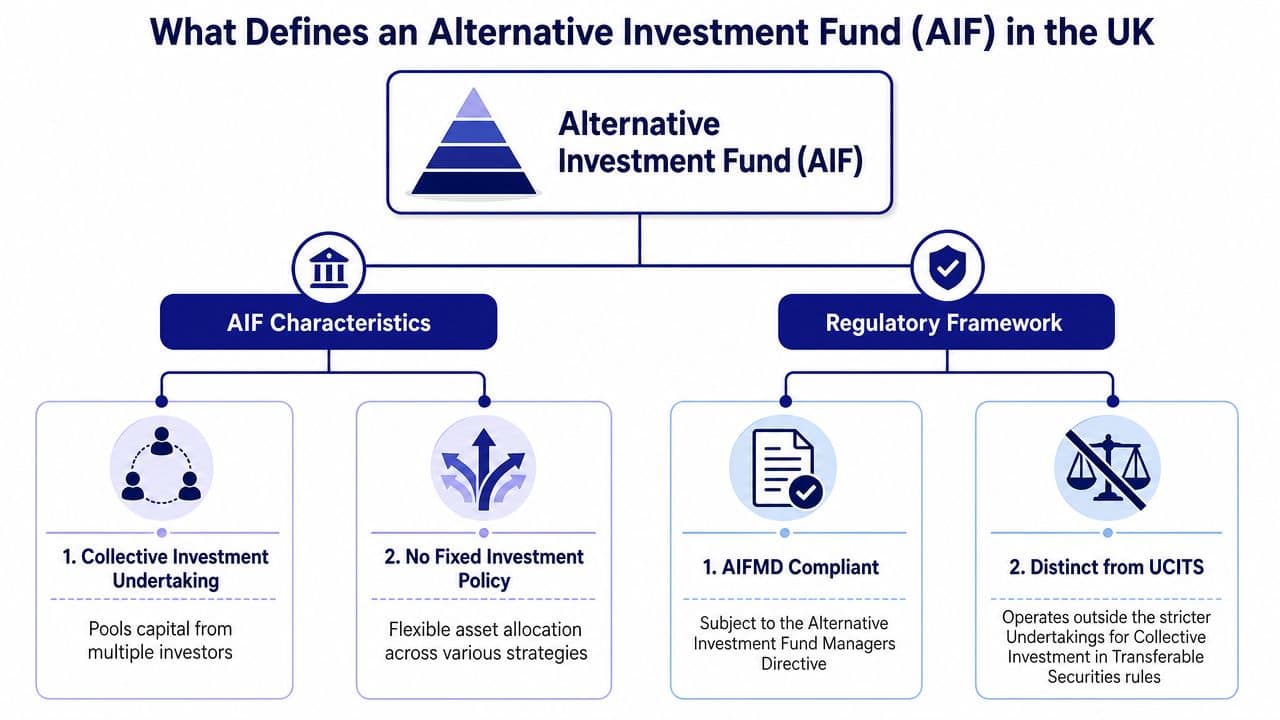
The UK questions that actually matter
Since 2020, the UK has run its own regime outside the EU framework, while preserving much of the AIFMD architecture. That creates a practical problem I see regularly. A structure may look familiar on paper but sit under a different set of marketing rules, reporting obligations, and supervisory expectations depending on whether it is a UK fund, a UK-managed overseas vehicle, or a non-UK fund being shown to British investors.
The size of the alternatives market is not the point here. The classification risk is.
A practical review usually starts with three questions:
- Is the fund authorised in the way the investor assumes it is?
- Who is the AIFM or equivalent decision-maker in substance, not just on paper?
- Is the marketing route into the UK available for this investor category?
Those points sound technical until a dispute starts. Then they become central. Investor rights, disclosure standards, and the scope for complaint or recovery often turn on the answers.
Here's a useful visual overview before you go deeper:
Structure first, branding second
Brochure language comes last in a proper review. Terms such as “private markets”, “real assets”, “opportunity fund”, and “special situations” can describe very different legal arrangements. What matters is the underlying vehicle, the manager, any delegated decision-maker, the administrator or depositary where relevant, the investor base, and the route used to distribute the product in the UK.
That is usually where hidden problems appear. I have seen investors assume they were dealing with an FCA-supervised structure when key functions sat offshore. I have seen managers rely on marketing exemptions that did not fit the investor category being approached. I have also seen disputes become harder to resolve because the documents described one governance model while actual decision-making sat elsewhere.
A short working table helps.
| UK issue | Why it matters |
|---|---|
| FCA-authorised or not | Affects oversight expectations and investor assumptions |
| UK AIFM-managed or overseas-managed | Changes reporting, governance, and accountability routes |
| Marketed under a UK private placement route | Affects whether promotion to the intended investor base is lawful |
| Investor category | Determines whether suitability and eligibility concerns may arise |
| Tax reporting profile | Can affect the real return far more than the headline strategy |
Practical rule: If you can't map the structure on one page, you probably don't understand the risk you're taking.
The distinction matters even more as alternatives move into more accessible wrappers. Funds are now being packaged in ways that look simpler to buy, hold, and explain. That does not reduce the underlying legal or valuation risk. It often shifts the risk to classification, suitability, and disclosure, especially where new channels or technologies are involved. The same caution applies to adjacent models such as RWA tokenization development, where easier access can mask difficult questions about ownership, control, pricing, and regulatory treatment.
Common AIF Structures and High-Risk Strategies
The label “alternative investment fund” covers radically different risk engines. Two funds can sit under the same broad umbrella and behave nothing alike in stress.
That's why I focus less on the sales category and more on what drives gains, losses, lock-ups, and disputes. Is the manager relying on operational improvement in private companies? Asset sales? Refinancing? Rental cash flows? Trading spreads? Derivatives? Borrowing? If you can't identify the return engine, you can't assess the failure points.
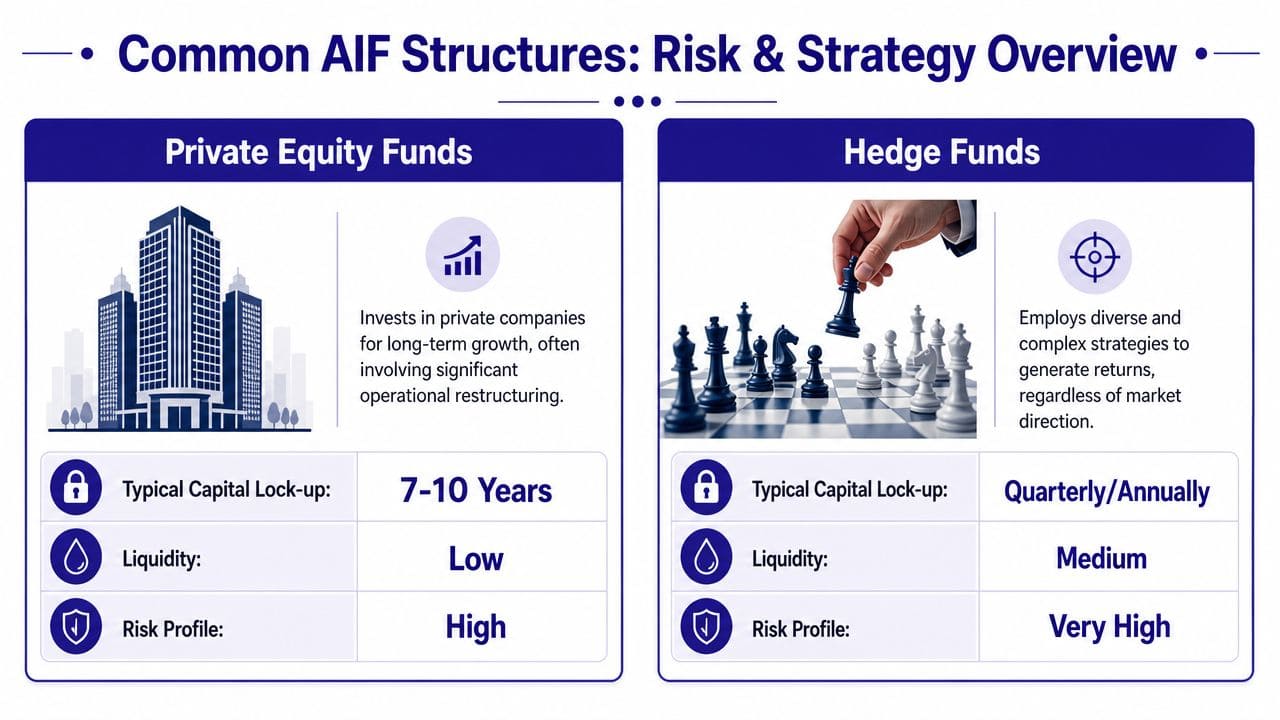
The main structures investors run into
The EU market provides a useful benchmark for the UK because of the overlap in investor expectations, service providers, and cross-border activity. ESMA reported that EU Alternative Investment Funds reached €5.8 trillion in net asset value in 2018, based on 30,357 AIFs, representing nearly 40% of the total EU fund industry. In that market, Funds of Funds accounted for 14%, Real Estate Funds 12%, and both Hedge Funds and Private Equity Funds 6% each, according to ESMA's report on the value of EU alternative investment funds.
Those categories matter because each produces a different pattern of conflict:
- Private equity funds often create disputes around valuation timing, portfolio company assumptions, follow-on funding, and whether the manager has drifted from the original thesis.
- Real estate funds tend to expose concentration risk, refinancing pressure, tenancy weakness, development delays, and valuation lag.
- Funds of funds add another layer of opacity. You inherit underlying manager risk and an extra layer of reporting complexity.
- Hedge funds can look liquid on paper while still carrying material strategy and amplification risk.
Leverage changes everything
Hedge-fund-style exposure deserves particular caution because magnified exposure can transform a modest market move into a major NAV event. ESMA reported adjusted exposure multiples of around 330% of NAV for hedge funds overall, with CTAs at a median 640%, macro at 435%, and relative value at 230%, as detailed in ESMA's AIF statistical report.
That doesn't mean every strategy that employs borrowed capital is reckless. It means investors must stop reading returns as if they came from simple asset appreciation. Financing structure, derivatives, collateral terms, and margin calls may be doing much of the work.
A quick comparison is often more useful than another paragraph.
| Structure | Typical dispute trigger | What often gets missed |
|---|---|---|
| Private equity | Exit value falls short of reported carrying value | Follow-on cash needs and manager discretion |
| Real estate | Redemption pressure meets illiquid assets | Reliance on appraisal-based values |
| Funds of funds | Investors can't trace underlying exposure | Layered fees and delayed transparency |
| Hedge funds | Losses accelerate unexpectedly | Embedded leverage and derivative complexity |
The mistake I see most often is treating the strategy name as the risk analysis. It isn't. The structure tells you where to investigate.
The Hidden Dangers of Valuation and NAV Calculation
Many investors speak about NAV as if it were a hard, objective fact. In alternative funds, it often isn't. It's a judgement-laden estimate built on models, assumptions, comparables, forecasts, and manager-selected inputs.
That doesn't make NAV meaningless. It does mean you should ask how it was produced, who challenged it, and what would happen if the assumptions were stressed. In private equity, property, private credit, and bespoke instruments, the reported number may be less a market price and more a defended position.
Why reported value can differ from realisable value
A fund can report a stable NAV while the underlying position is weakening. That happens when managers use stale comparables, optimistic cash flow forecasts, unsupported discount rates, or assumptions that ignore worsening liquidity. The most obvious warning sign is consistency that looks too neat when the assets themselves are difficult to sell or finance.
In disputes, I often separate valuation into three layers:
- Methodology. Was the chosen approach suitable for the asset?
- Inputs. Were assumptions independently supportable?
- Governance. Who reviewed, challenged, and approved the numbers?
Where discounted cash flow models are used, small changes in growth assumptions, discount rates, or timing can shift value materially. That's why a disciplined grasp of discounted cash flow for valuations matters when reviewing a fund holding that has no ready market quote.
A valuation can be technically neat and still economically misleading.
The forensic questions that expose weak NAVs
When a valuation starts to look fragile, I'd ask for the working papers, not the summary. You want to see whether management used transaction evidence, how recent it was, what marketability or control assumptions were built in, and whether contradictory evidence was brushed aside.
A useful challenge list includes:
- Was the price anchored to an actual transaction or only to an internal model?
- Did the valuer adjust for illiquidity, delays, covenant stress, or refinancing risk?
- Were fees or carried interest influenced by the valuation outcome?
- Did the board or oversight function record meaningful challenge, or sign off?
The damage emerges when investors try to redeem, refinance, litigate, or settle. A paper NAV can survive for months. A contested real-world sale exposes what the asset was worth.
Due Diligence Red Flags for Managers and Investors
Most failed due diligence wasn't really due diligence. It was document collection.
People review the presentation, note the pedigree of the principals, glance at prior performance, and move on. That approach misses the operational weaknesses that later drive losses and legal arguments. The CFA Institute's guidance is much closer to reality. It says monitoring alternative investments must go beyond benchmark comparison and include key person risk, alignment of interests, style drift, risk controls, client turnover, and service providers, because managers are often difficult to replace, as described in the CFA Institute refresher on asset allocation to alternative investments.
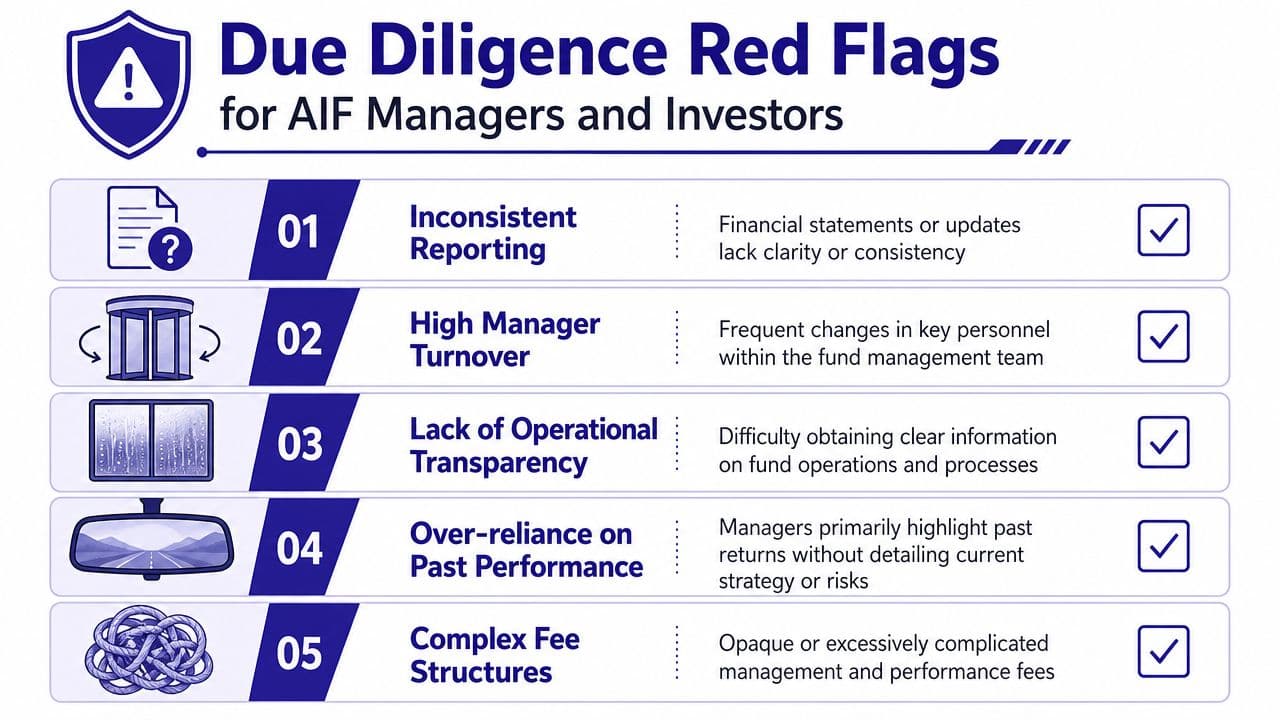
The red flags worth taking seriously
Some warning signs are obvious. Others only look serious in hindsight. I'd be wary when several of these appear together:
- Key person dependency. The strategy appears institutional, but actual decision-making sits with one individual.
- Style drift. The manager starts buying assets or using techniques outside the original mandate.
- Service provider churn. Auditors, administrators, or other key providers keep changing without a convincing operational explanation.
- Opaque reporting. Investor letters explain outcomes but avoid the assumptions behind them.
- Misaligned economics. Fee structures reward asset retention or valuation uplift more than disciplined exits.
A sharper process usually starts with financial due diligence that tests evidence rather than accepting narrative.
What proper diligence looks like
I prefer due diligence that feels slightly uncomfortable to the manager. Not hostile. Just probing enough to reveal whether the operation can withstand challenge.
Ask for examples, reconciliations, and exceptions. Ask how often valuation judgments were revised. Ask what happened in adverse periods. Ask who can override a model, suspend dealing, approve side letters, or waive limits. Then compare the answers across documents and calls.
Good due diligence doesn't try to predict every loss. It tries to identify whether a loss will be explained honestly and controlled competently.
If the manager resists basic transparency, investors often tell themselves that exclusivity explains the secrecy. Sometimes it does. Sometimes it covers weak governance.
Navigating UK Regulatory and Compliance Minefields
A UK alternative investment fund can look compliant from a distance and still create serious problems up close. That's because regulated status is not a blanket guarantee. You still need to know what obligations apply, who holds them, and whether the actual operating model matches the legal one.
The core UK framework inherited much from the European AIFMD regime after Brexit, but the UK now operates its own rulebook. For managers, that means valuation, risk management, reporting, governance, and marketing obligations must be handled under domestic requirements. For investors, it means you shouldn't rely on a broad statement such as “AIFMD compliant” without asking what that means in the specific structure you're reviewing.
Where compliance breaks in practice
Most failures don't begin with a dramatic breach notice. They start in ordinary operational shortcuts.
A manager may outsource key processes but fail to challenge them properly. Marketing teams may speak too broadly about who can invest. Valuation committees may become rubber-stamping exercises. Distribution into the UK may proceed on assumptions about professional client status that were never documented carefully enough. When pressure arrives, those weak points become disclosure problems, FCA concerns, investor complaints, or litigation points.
I'd focus on four compliance pressure areas:
| Pressure area | Why it causes disputes |
|---|---|
| Marketing permissions | Investors may later argue the product was not lawfully promoted to them |
| Valuation governance | Weak challenge procedures undermine reported NAV credibility |
| Risk management separation | Conflicts arise if risk oversight lacks real independence |
| Investor disclosure | Incomplete or unclear reporting fuels misrepresentation arguments |
Why “regulated” doesn't end the enquiry
Managers sometimes object that deeper review is expensive. Investors make the same mistake from the opposite side. They assume regulation removes the need for intrusive diligence. Neither position survives contact with a serious dispute.
Regulation provides a framework. It does not inspect every assumption in real time. It does not guarantee that every marketing statement was suitable, every valuation was sound, or every investor fully understood the lock-up, borrowed capital, or tax consequences. In the UK market, one of the most overlooked questions remains whether the fund is authorised, marketable, and tax-efficient for the investor in front of you.
That's why the practical question is rarely “is this fund regulated?” It's “which rules apply here, what do they cover, and where are the gaps?”
When to Engage Forensic Accounting Experts Like Lighthouse
By the time clients call a forensic accountant, they usually wish they'd done it earlier.
The right time isn't only after suspected fraud. It's any point where you need independent financial analysis that can survive challenge. That may be before investing, during a live dispute, in a redemption conflict, after a suspicious valuation movement, during insolvency risk, or when legal advisers need damages quantified in a form a court can understand.
The moments when specialist help changes the outcome
A conventional accountant can prepare accounts and explain historic figures. That's not the same as dissecting a disputed fund structure. In AIF matters, specialist work often includes tracing funds through layered entities, testing valuation assumptions, reviewing side letters, reconciling fee calculations, identifying control failures, and quantifying loss on a legally defensible basis.
Morgan Stanley has noted the wider move towards more accessible alternative structures, which makes regulatory and suitability checks more important, not less. Investors must ask not only what the product is, but whether they can lawfully buy it and what hidden risks sit behind the wrapper, as discussed in Morgan Stanley's piece on key themes in alternatives.
If that question has already become contentious, a forensic team can help establish what happened and what it cost. One option for that work is forensic accounting services in the UK, where the focus is evidence, quantification, and reports that stand up in negotiations or proceedings.
What works and what doesn't
What works is early intervention, clean document preservation, and a clear scope. You identify the issues, secure the records, test the valuations, and align legal and financial strategy before positions harden.
What doesn't work is waiting for the annual audit to solve an investor dispute. Audits serve a different purpose. Nor does it help to threaten proceedings before anyone has established the numbers properly. Weak quantification gives the other side room to dismiss the complaint as noise.
If you're considering an alternative investment fund, or you're already inside one and something doesn't add up, certainty has value. The longer uncertainty lasts, the more expensive it usually becomes.
If you're facing doubts over a fund valuation, investor reporting, suspected mismanagement, or a dispute that needs hard financial evidence, speak with Lighthouse Consultants. Their London team investigates complex financial issues, quantifies loss, and delivers independent analysis that helps investors, lawyers, and business owners make defensible decisions with confidence.