A copied brand rarely shows up as a tidy legal issue. It lands as a commercial mess.
A customer forwards a screenshot. Your sales team notices a lookalike listing on a marketplace. A distributor asks whether you've launched a cheaper line under a slightly altered name. At that point, the first question isn't abstract. It's brutally practical. What has this cost us, and what can we recover?
That is where many trademark disputes stall. Business owners understand the brand harm immediately, but they don't yet have a financial case. Without one, solicitors can argue liability while the numbers remain soft, disputed, or too weak to drive settlement. In the UK, that gap matters because the economics of the claim often shape the litigation strategy just as much as the legal merits.
The Moment You Realise Your Brand Has Been Stolen
The first days after discovering infringement are usually chaotic. Management wants the use stopped. Sales teams want answers for confused customers. Finance wants to know whether the problem is material. Legal wants evidence preserved before records disappear.
For an SME, the pressure is sharper because the budget is finite. One industry review estimates that trademark litigation in the UK averages £100,000 to £500,000 per case (patentpc.com). That figure explains why a dispute cannot be treated as a matter of principle alone. You have to weigh likely recovery against the cost of proving it.
What businesses usually fear first
Most clients I speak to don't begin by asking for a legal lecture. They ask practical questions:
- Lost sales: Did customers buy from the other side instead of us?
- Brand dilution: Has the infringer made our mark less distinctive or less trusted?
- Distributor disruption: Have legitimate channels pulled back because the market is confused?
- Proof: Can we show the court a clean financial story rather than suspicion and frustration?
Those fears are legitimate. So is the instinct to hesitate before spending more money on experts and lawyers.
Practical rule: The cost of inaction can exceed the cost of early analysis, especially when infringement spreads through online listings, resellers, and copied creative assets.
A lot of businesses also need a quick grounding in the basics before deciding whether to fight, settle, or monitor. If you need that primer, this guide to understanding trademark infringement risks is a useful starting point.
Why the numbers matter immediately
Anger doesn't win trademark cases. Evidence does.
If you're the claimant, you need to know whether the infringement caused measurable loss, whether the infringer made meaningful profit, and whether the available records support one remedy better than another. If you're the defendant, you need the same analysis for the opposite reason. You need to test whether the claim is overstated, duplicated, or economically irrational.
That work should start early. A dispute becomes harder and more expensive when nobody has pinned down the financial reality.
Understanding Your Financial Remedies in the UK
The UK does not approach trademark infringement damages as a fixed-penalty exercise. The system is primarily compensatory. That sounds technical, but the commercial point is simple. The court looks for evidence of real financial impact rather than plugging facts into a standard tariff.
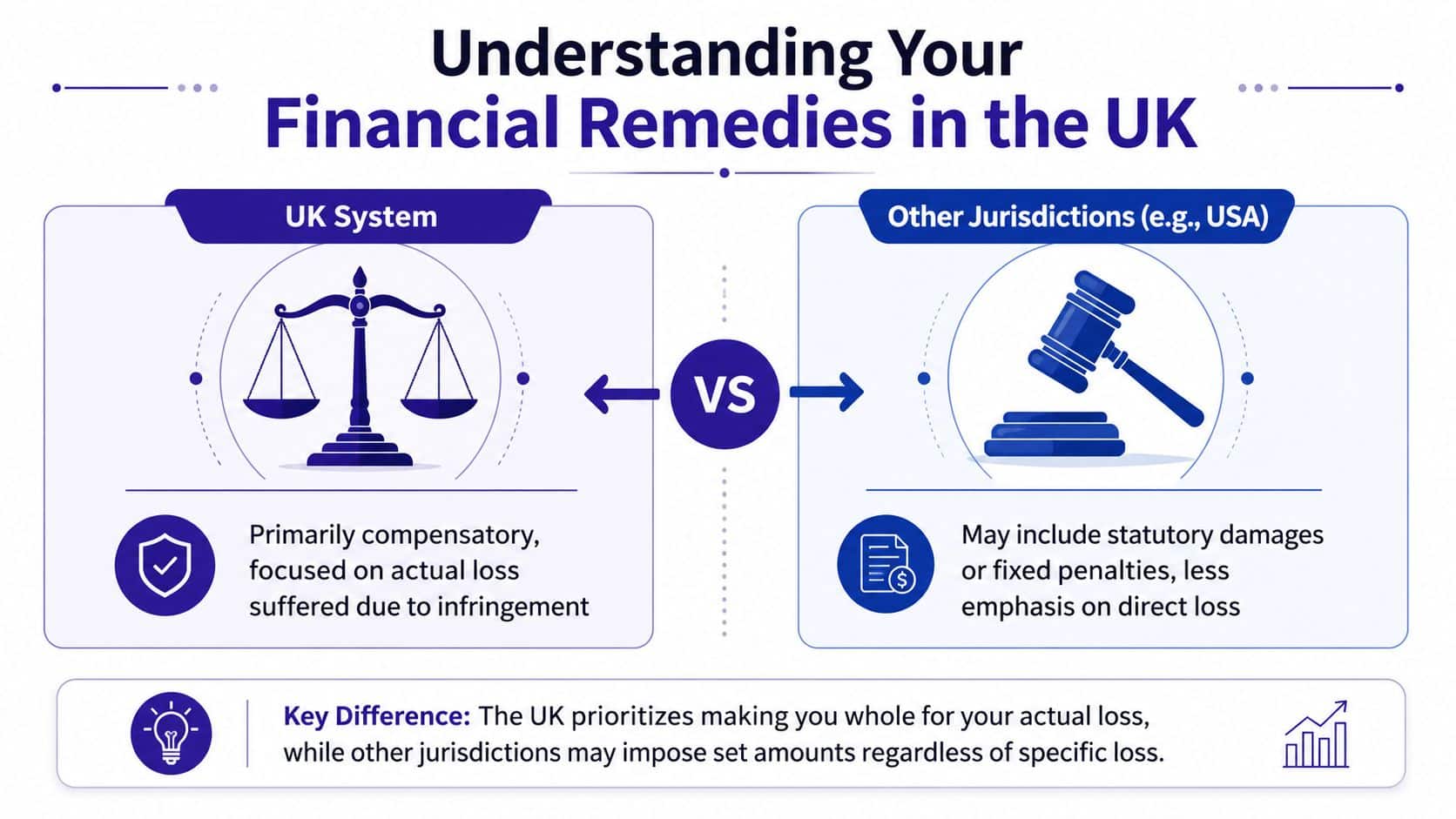
According to Hunton's overview of trademark damages, the court can award damages for the proprietor's loss, an account of profits, or additional damages for flagrant infringement. The technical distinction matters because compensating the rights holder and stripping the infringer's gain are different exercises, and the calculation must avoid double recovery.
Damages for your loss
Think of damages as the money needed to put the claimant, so far as money can, into the position they would likely have been in without the infringement.
That can include several different heads of loss, depending on the facts:
- Diverted sales: customers who would likely have bought from you
- Price erosion: pressure to discount because the market has been distorted
- Corrective spend: money needed to repair confusion or market perception
- Reasonable royalty style assessment: a licensing-based measure where direct loss is hard to prove
This route suits claimants who can show a credible link between the infringement and their own commercial harm.
Account of profits
An account of profits asks a different question. It focuses on what the infringer gained, not what the claimant lost.
That remedy can be attractive where the claimant's own loss is hard to measure, but the infringer's sales are visible and substantial. It also becomes central where the claimant wants to strip out unjust enrichment rather than argue over every diverted sale.
Recovering from your own empty pocket and taking the other side's gains are not the same exercise. Choosing the wrong one can shrink the value of an otherwise strong case.
A related point often gets missed in online brand disputes and adjacent IP claims. Businesses that ignore licensing discipline in one area often do the same elsewhere. This summary of font licensing lawsuits is a useful reminder that sloppy asset use can trigger expensive claims well beyond trademarks.
For a broader litigation context, this practical guide to UK court disputes helps frame how remedies sit within the wider court process.
Quantifying Your Claim A Step-by-Step Approach
Calculating damages moves from theory to practical challenges. In the UK, there's no widely accessible, standardised damages formula for SMEs, particularly where infringement is online or records are incomplete (Klemchuk on trademark infringement damages). That is why businesses often know they have a problem but still can't place a defensible value on it.
A proper damages model should be structured, documented, and capable of surviving challenge.
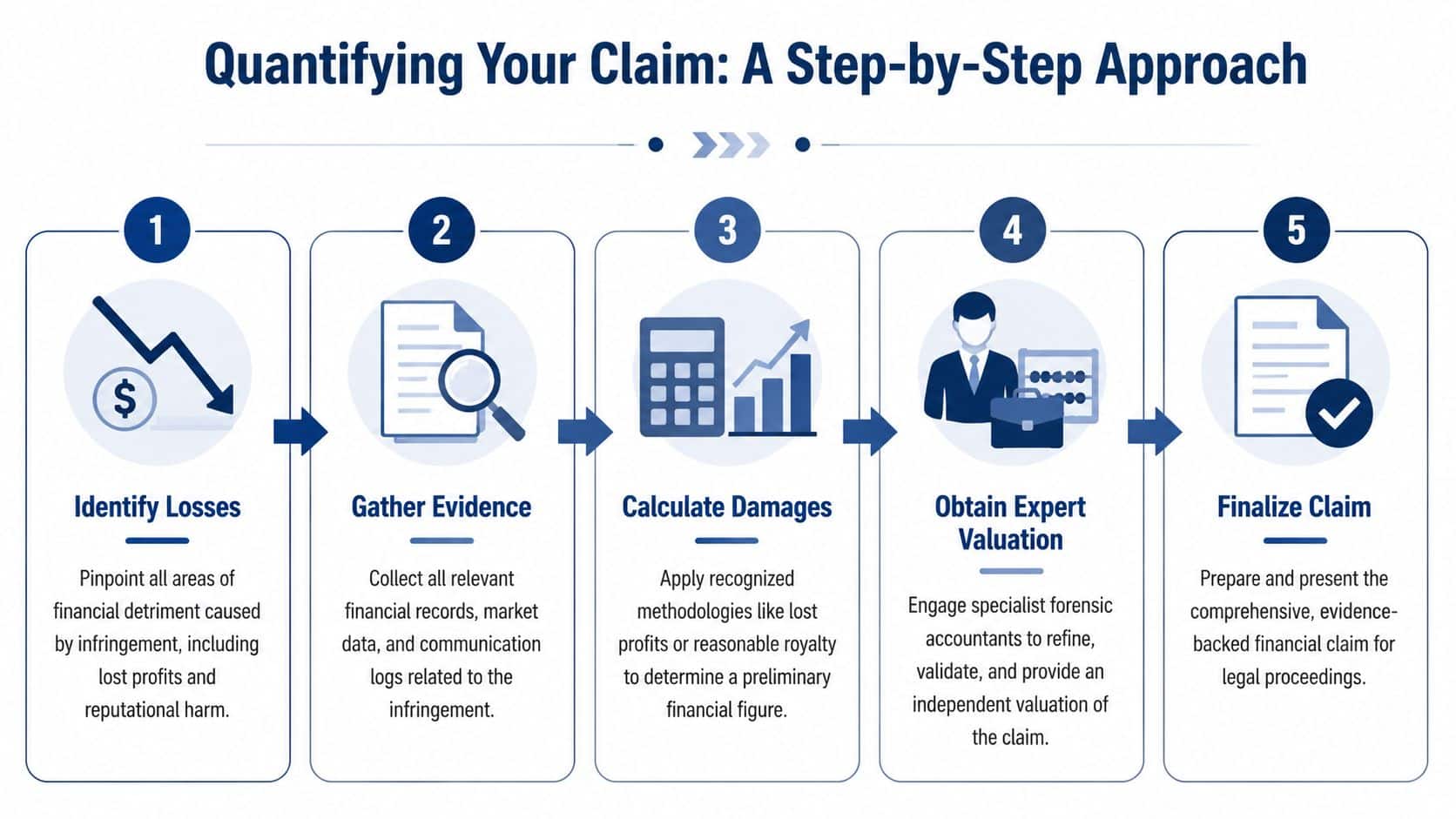
Step 1 Identify the period and commercial mechanism
Start with the trading story, not the spreadsheet.
When did the infringement start. Which products, channels, territories, or search terms did it affect. Did the copied mark target the same customer group or only overlap partly. Was the issue a marketplace listing, packaging imitation, paid search activity, or parallel online selling.
Those questions shape causation. Without them, the model becomes a broad complaint instead of a financial analysis.
Step 2 Build the damages model
For a claimant's loss analysis, I usually test several routes in parallel rather than forcing one theory too early.
Lost profits
This is often the clearest measure when you can show likely diversion.
The mechanics usually include:
- Establish baseline trading using historical sales and margin data.
- Compare the infringement period against prior periods and surrounding trends.
- Adjust for legitimate market factors such as seasonality, product mix, channel changes, or supply constraints.
- Estimate the sales likely diverted by the infringement.
- Apply the appropriate margin, not just revenue, to reach loss.
Reasonable royalty style approach
Sometimes the claimant cannot prove enough diverted sales, especially where the infringement is short-lived or online. In those cases, a royalty-style analysis can provide an alternative lens. The question becomes what a willing licensee would have paid for legitimate use of the mark in the relevant circumstances.
That method still needs evidence. It is not a shortcut for weak thinking.
For businesses dealing with wider profit attribution issues, this note on return of earnings calculation gives useful context on how financial returns are analysed in contentious settings.
A short explainer may help if you want a visual walkthrough of claim-building in practice:
Step 3 Build the account of profits model
This exercise starts from the defendant's turnover attributable to the infringement, then works down to net profit.
That sounds simple. It usually isn't.
The main disputes tend to sit around:
- Attribution: which sales arose from the infringing use
- Apportionment: whether only part of the profit is linked to the mark rather than other business factors
- Cost deductions: which costs are legitimate, direct, and properly evidenced
- Overheads: whether general business expenses should reduce the disgorgement figure
Defendants often claim the infringement produced little or no profit. Sometimes that is correct. Sometimes it relies on aggressive cost loading, weak records, or an attempt to attribute profitable sales to everything except the copied brand signal.
Step 4 Compare the outcomes before choosing a route
Below is a simplified illustration. It is not a legal formula. It shows why remedy choice matters.
| Metric | Damages (Claimant's Loss) | Account of Profits (Infringer's Gain) |
|---|---|---|
| Infringing sales considered | £100,000 | £100,000 |
| Less direct costs | Not the starting point | Deducted if properly attributable |
| Claim focus | Claimant's lost margin, price erosion, or royalty-style value | Defendant's net profit from infringing use |
| Core dispute | Causation and quantum of loss | Attribution and allowable deductions |
| Likely outcome driver | Strength of claimant's trading data | Quality of defendant's accounting records |
A persuasive valuation does not try to prove everything. It proves the right thing, with records that match the chosen remedy.
The Evidence You Cannot Afford to Ignore
A neat model with weak evidence collapses quickly. Courts do not award trademark infringement damages because a claimant feels wronged. They award them when the evidence supports a reliable financial conclusion.
That is why evidence quality usually matters more than mathematical elegance.
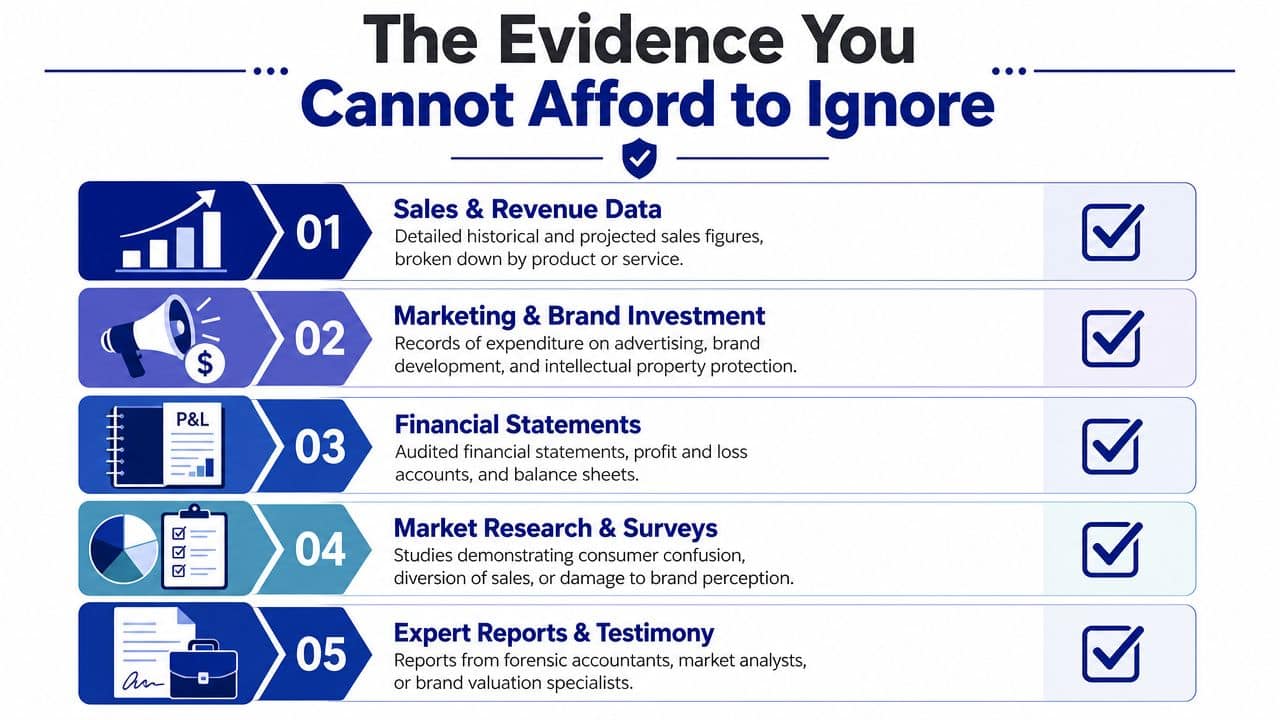
The claimant's core file
The strongest claimant files are organised around chronology, causation, and proof.
At minimum, that usually means:
- Sales ledgers and management accounts: broken down by product, customer, and period
- Margin data: so the claim measures profit impact rather than just turnover movement
- Marketing and brand investment records: to show the commercial strength of the mark and the cost of building it
- Customer communications: complaints, confusion reports, distributor queries, and cancelled orders
- Internal documents: forecasts, pricing papers, and board updates created before litigation strategy influenced the record
Those documents help separate a real loss case from a speculative one.
The defendant's weak spot
Defendants often underestimate how much their own records matter. If they argue low profit, they need clean support for that position.
That usually includes purchase records, channel sales data, platform statements, cost schedules, stock movement, and documents showing how the allegedly infringing activity sat within the broader business. If the records are incomplete, inconsistent, or reconstructed late, the credibility of the “minimal profit” argument weakens.
Weak evidence doesn't become strong because it sits inside a large spreadsheet.
Online infringement needs extra care
Online cases create a distinct evidence problem. Listings change, screenshots vanish, seller identities shift, and platform data can be patchy. That means the collection process has to start early.
A disciplined evidence pack often includes:
- Captured listings and product pages
- Dates of use across platforms
- Marketplace transaction records
- Advertising screenshots
- Web analytics and referral data
- Correspondence with platforms or resellers
The party that documents the online trail first usually has the clearer story later.
Common Pitfalls and Strong Defences
A common claimant assumption is that infringement automatically leads to a large monetary award. It doesn't.
A common defendant assumption is that saying “we made no profit” ends the damages discussion. That doesn't work either.
According to Freshfields' slide deck on damages in trademark infringement cases, UK trademark remedies are not the same as US remedies. There is no equivalent automatic statutory-damages regime, and outcomes remain highly fact-specific, with the burden of proof often decisive.
Where claimants go wrong
Some claimants overreach. They present every sales dip as infringement-driven, even where other commercial factors plainly existed.
Others choose a remedy before seeing the evidence. That can be expensive. If your own sales records are weak but the defendant's profit trail is stronger, a claimant-loss theory may be the wrong battlefield.
Frequent claimant errors include:
- Assuming liability proves quantum
- Using revenue instead of lost profit
- Ignoring alternative causes of decline
- Double counting the same harm under different labels
- Treating corrective advertising as automatic rather than evidenced
Where defendants misjudge the risk
Defendants often rely on one of three themes. Minimal profit. No confusion. Limited duration.
Each can be powerful, but none is a silver bullet.
A minimal-profit defence only works if the accounting is credible and the deductions are properly tied to the infringing activity. A no-confusion argument may reduce the claimant's damages theory, but it does not erase every possible monetary route. A short infringement period may narrow exposure, yet a concentrated online campaign can still create a meaningful dispute.
The real contest
The decisive issue is usually narrower than parties expect. It is not whether infringement feels serious. It is whether the chosen remedy can be proved with enough precision to justify a substantial award.
That is why good cases sometimes settle modestly, and apparently modest cases sometimes settle well. The side with the better evidential story usually has the stronger commercial advantage.
How a Forensic Accountant Builds Your Financial Case
Solicitors lead the legal strategy. They should. But trademark infringement damages often rise or fall on financial questions that sit outside legal argument.
A forensic accountant's role is to turn contested commercial history into a coherent damages analysis that the court can use.
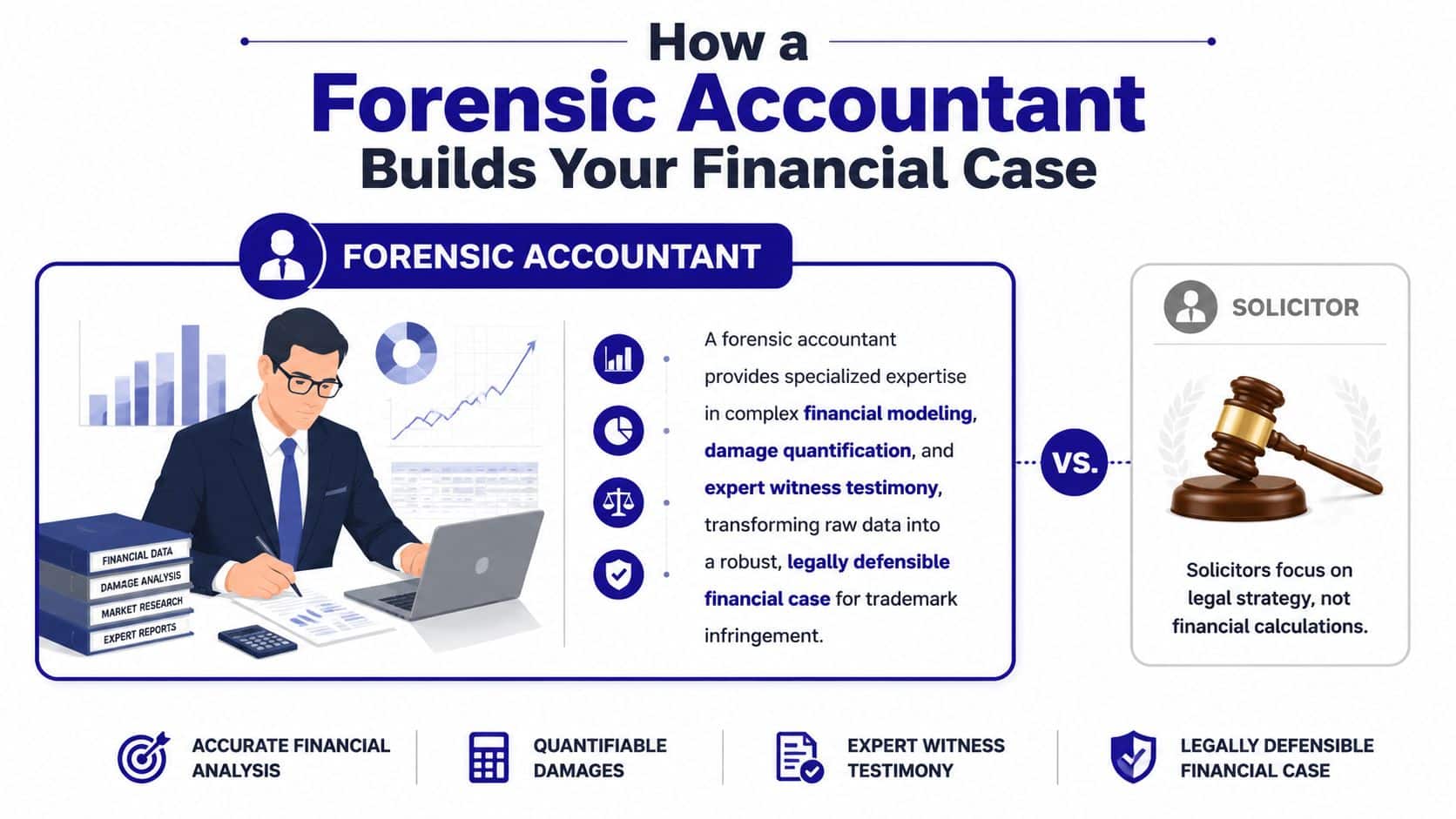
The job is wider than calculation
The work starts with investigation. Which transactions matter. Which documents can be trusted. Which periods should be compared. Which market events were genuine drivers and which were litigation talking points added later.
From there, the forensic exercise usually involves:
- Reconstructing the trading narrative from source records
- Testing causation between infringement and financial effect
- Building alternative models rather than relying on one fragile theory
- Identifying overstatement or understatement in the opposing case
- Presenting conclusions clearly for solicitors, clients, and the court
That matters on both sides of a dispute. Claimants need rigorous quantification. Defendants need disciplined challenge.
Parallel modelling matters
The court may award lost profits, an account of profits, or an uplift where conduct is flagrant. As noted by Arapacke on trademark infringement damages, forensic experts therefore need to model lost profits, infringer profit disgorgement, and any uplift for aggravated conduct in parallel so legal teams can test which remedy is most favourable.
That parallel analysis often changes the shape of negotiations. A claimant may begin focused on its own loss, then realise the defendant's profit model is cleaner and stronger. A defendant may insist its margin was tiny, then discover that its records do not support the deductions it wants to take.
The most useful expert report is not the most aggressive one. It is the one that survives challenge and still looks credible at trial.
Expert evidence has to be readable
Judges do not want performative complexity. They want a disciplined explanation of what happened, how it was measured, and where the uncertainties sit.
That means a strong expert report should do three things well:
- Explain the assumptions openly
- Tie every important conclusion to source material
- Show the court how competing figures were tested and why one is more reliable
If you want insight into that courtroom role, this guide on how to become an expert witness is useful background on what expert independence and reporting discipline involve.
Your Next Steps in a Trademark Dispute
A trademark dispute feels legal at the start, but it becomes financial very quickly. The practical questions decide the pressure points. What can be proved. Which remedy fits the evidence. Whether the likely recovery justifies the cost and risk of the fight.
That applies whether you are bringing the claim or defending one.
If you are the claimant, preserve records immediately and test the numbers before you lock yourself into a remedy. If you are the defendant, don't rely on broad denials. Review the accounting, the attribution of sales, and the logic behind your cost deductions before those positions harden into formal evidence.
It also helps to look beyond the narrow dispute and tighten your wider IP controls, especially online. For businesses reviewing brand misuse, takedowns, and digital asset exposure, this resource on protecting your online content is a useful companion.
Uncertainty is expensive. Early financial analysis gives you options. Late analysis usually leaves you reacting to the other side's story.
If you're facing a trademark dispute and need a clear view of the financial exposure or recoverable loss, Lighthouse Consultants can help. Their London-based forensic accounting team works with businesses, solicitors, and litigators to quantify claims, test opposing numbers, prepare expert reports, and build evidence-led cases that stand up in negotiation and court. A confidential, no-obligation discovery call is the fastest way to understand where you stand and what to do next.