An investment exits well. Cash comes in. Then the profit allocation statement lands on your desk and the manager's share looks far larger than you expected. You read the agreement, but the language around waterfalls, hurdles, catch-ups and clawbacks doesn't answer the practical question. Was this calculated correctly?
That's where disputes start. In my experience, people rarely come looking for help because they want a definition of carry. They come because they suspect a misallocation, an aggressive interpretation of the fund documents, a valuation issue, or a reporting trail that doesn't hold together under scrutiny. Business owners, investors and lawyers often sense that something is wrong, but they can't yet prove whether it is an innocent spreadsheet error, a flawed model, or a more serious issue that calls for a forensic accountant, a forensic audit, or a full fraud investigation.
The term people usually search for is what is carry interest. The key issue is what happens when carry becomes contentious. That's where forensic accounting, litigation support and expert financial analysis matter.
When Investment Profits Raise More Questions Than Answers
The trouble usually starts after a successful exit, not a failed one. Cash is distributed, the manager takes carry, and no one objects until someone compares the payment notice to the fund documents and asks a harder question. Does this allocation follow the agreement, the capital accounts, and the underlying cash movements?
That question can turn a routine reporting exercise into a dispute with real financial exposure. I have seen matters begin with a single line item that looked slightly too high and end with a full reconstruction of years of distributions, expenses, valuation assumptions, and side-letter terms. By the time the issue surfaces, the parties are often arguing about much more than a definition. They are arguing about entitlement, control, and whether someone has been overpaid.
Clients often hesitate at this stage. Business owners worry that a review will be expensive. Lawyers know the clauses are technical and heavily negotiated. Investors may suspect an error but lack the records needed to prove it.
Delay usually makes the problem worse.
Once carry has been paid out, recovery becomes harder. Files are missing, spreadsheet logic is poorly documented, and the individuals who built the model may no longer be involved. A dispute that could have been resolved by recalculating the waterfall early can turn into a claim about breach of contract, misrepresentation, or, in more serious cases, fraud.
Carried interest also creates confusion because the terminology sounds settled while the economics are often highly sensitive to drafting choices. Small differences in wording around realised proceeds, return hurdles, catch-up provisions, escrow, or clawback mechanics can shift large sums between investors and managers. For readers comparing structures, understanding private equity promotes helps show how performance-based profit shares can look straightforward at headline level but become contentious in practice.
A forensic accountant's role is practical. We trace the money, rebuild the calculation, test the assumptions against the signed documents, and identify where the numbers stopped matching the deal. That work often answers the question the parties care about. Was this a drafting issue, a spreadsheet mistake, an aggressive interpretation, or a deliberate misstatement?
The highest-risk cases usually involve one or more of these problems:
- Waterfall mechanics applied incorrectly: distributions are calculated in the wrong order or against the wrong pool of proceeds.
- Capital accounts that do not reconcile: the reported investor position does not match subscriptions, returns, fees, and prior allocations.
- Valuation pressure: unrealised gains are presented in a way that influences expectations around future carry.
- Expense misallocation: fund costs, broken-deal fees, or affiliate charges are loaded into the model in a way that distorts profit share.
- Clawback exposure: carry is paid early, but later losses or adjustments show the manager received more than the agreement permits.
- Weak audit trail: polished reports exist, but the working papers needed to verify them do not.
These are not abstract technicalities. They are the kinds of issues that drive settlement demands, expert reports, regulatory concerns, and recovery actions. When the numbers are disputed, clarity comes from reconstruction and evidence, not assumptions.
Demystifying Carried Interest
A dispute over carry usually starts with a simple claim. The manager says the fund cleared the performance threshold and a profit share is due. The investors or their advisers ask for the workings and find that the answer depends on definitions buried in the partnership agreement, treatment of fees, timing of exits, and whether profits are realised. At that point, "carry" stops being a glossary term and becomes a live financial issue.
Carried interest, often shortened to carry, is the share of investment profits allocated to the fund manager or general partner under the fund documents. It sits alongside the annual management fee, but it serves a different purpose. The fee pays for running the fund. Carry rewards performance, usually by giving the manager a contractual share of profits once the agreed conditions for distributions have been met.
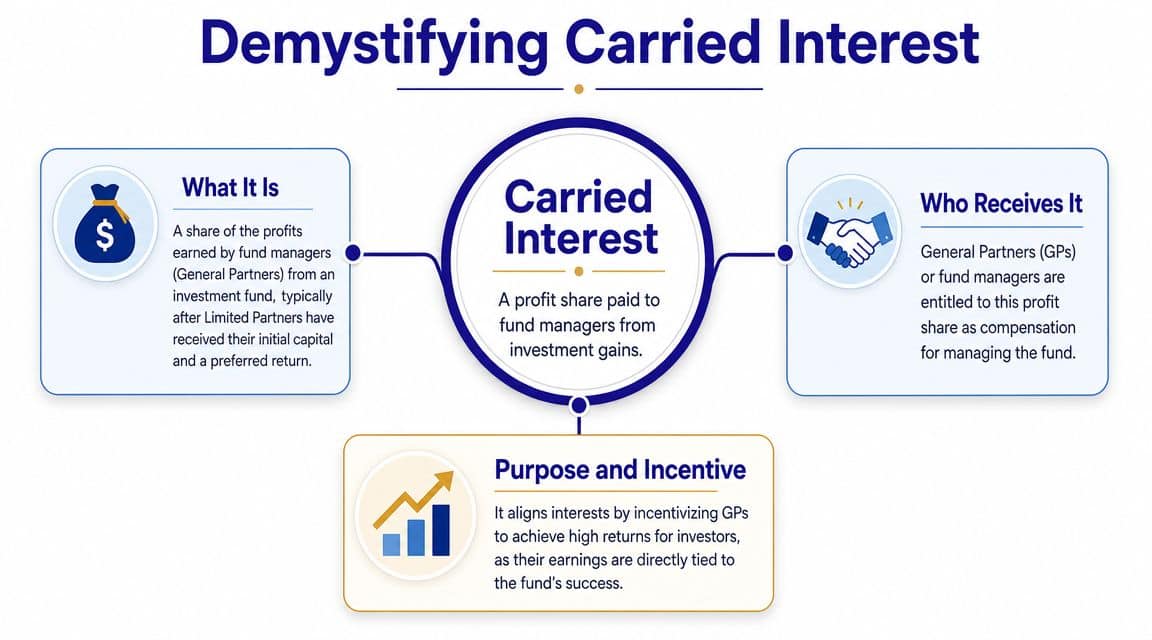
Carry is a profit-sharing right, not a free-standing entitlement
That distinction matters in disputes. Managers do not earn carry because an investment appears successful on paper. They earn it only if the governing documents say the required conditions have been satisfied. In practice, that means the question is rarely just "what is carry interest?" It is "what profits count, when do they count, and who had the right to calculate them?"
Those points drive real exposure. A manager may treat unrealised appreciation as support for an expected carry position. Investors may insist that only realised proceeds should affect distributions. Fees, broken-deal costs, foreign exchange movements, and fund-level adjustments can all change the profit pool. Small changes in classification can move large sums between the investors and the carry recipients.
Why carry exists, and why it so often becomes contentious
Carry is designed to align incentives. Investors want the manager to increase value and exit investments at the right time. Managers want the same outcome because their upside is tied to profits, not just to assets under management.
The commercial logic is sound. The execution is where problems arise.
From a forensic accounting perspective, carry attracts disputes because it combines technical drafting with large financial incentives. If the agreement is imprecise, the model is poorly controlled, or the inputs are manipulated, the carry calculation becomes vulnerable to error and challenge. I see that in cases involving side letters, amended waterfall terms, stale valuations, and spreadsheets that no longer match the signed documents.
For readers comparing structures across private markets, this guide to understanding private equity promotes is a useful companion because promote arrangements raise many of the same issues around incentive compensation, allocation methodology, and the risk of overpayment.
Carry works well when the legal terms, capital records, and distribution calculations agree. When they do not, the dispute is rarely about terminology. It is about entitlement, evidence, and whether the money was allocated correctly.
How Carry is Calculated Waterfalls Hurdles and Catch-Ups
The calculation sits inside the distribution waterfall. That is the contractual sequence that tells everyone who gets paid first, when the manager starts to share in profits, and what happens if the final fund outcome differs from early expectations.
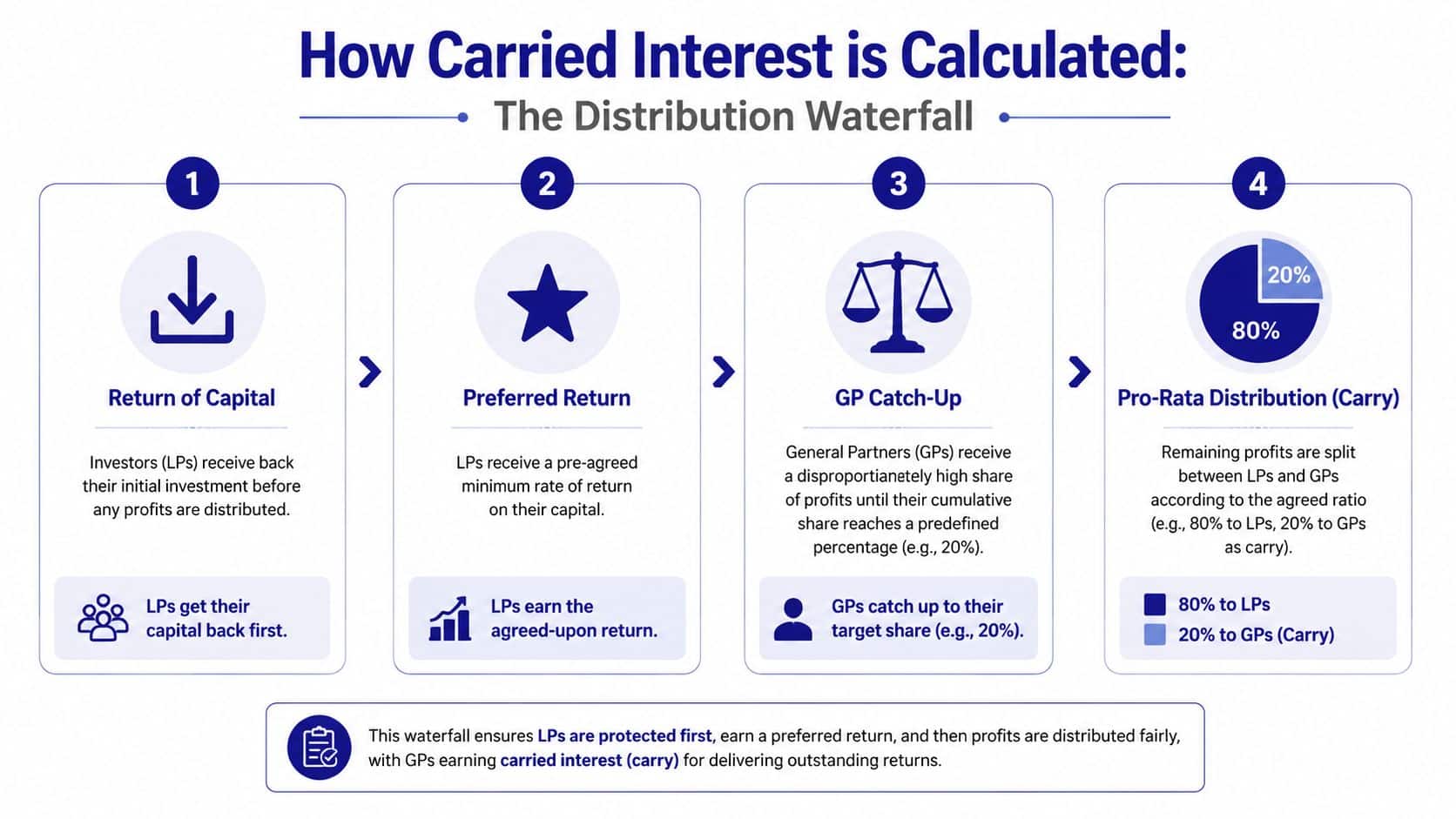
The key moving parts
Most carry disputes turn on a small number of mechanisms:
- Return of capital: Investors usually recover their contributed capital first.
- Preferred return or hurdle: Investors may have to receive a minimum return before the manager shares in profits.
- Catch-up: Once the hurdle is met, the manager may receive a larger portion of subsequent distributions until the agreed sharing ratio is restored.
- Residual split: Remaining profits are then divided between investors and the manager under the agreed economics.
Those words sound straightforward. They aren't. Minor wording changes can alter timing, entitlement and recovery rights.
American and European waterfalls
The biggest practical distinction is whether the waterfall is deal-by-deal or whole-fund. Industry guidance notes that this has real financial consequences. In a deal-by-deal, or American, waterfall, carry can be earned before final fund performance is known. That can create overpayment and recovery disputes. Clawback provisions are often needed at the end if the hurdle is ultimately missed, as explained in Carta's carried interest guidance.
That difference matters in disputes because timing changes advantage. If the manager has already received carry from early exits, later losses may leave investors arguing for repayment.
A short comparison helps:
| Structure | When carry may be paid | Main risk |
|---|---|---|
| American waterfall | Earlier, on successful deals | Overpayment risk and later clawback disputes |
| European waterfall | Later, by reference to whole-fund outcome | Fewer early overpayment issues, but still scope for interpretation disputes |
Here's a plain-language explainer before going further:
Why forensic accountants get pulled in
In contentious matters, the dispute usually isn't “what is a waterfall?” It's whether the actual spreadsheet model reflects the contract. A business dispute accountant will test:
- whether capital accounts were updated correctly
- whether fees and expenses were deducted in line with the documents
- whether hurdle calculations used the right dates and amounts
- whether catch-up provisions were modelled correctly
- whether any clawback exposure has been recognised properly
A carry model can look mathematically polished and still be contractually wrong.
That is why forensic accounting evidence often becomes central in negotiations, arbitration and court.
Worked Examples of Carried Interest Calculations
Worked examples help, but they need one warning. Actual fund documents contain detail that changes the result. Definitions of capital, expenses, recycling provisions, escrow arrangements and tax allocations can all alter the final answer.
Example one with a whole-fund waterfall
Start with a simple position. Investors have received back all contributed capital. The agreement says they must also receive the preferred return before the manager takes carry. Once that hurdle has been met, the remaining distributable profit is split using the carry terms in the agreement.
If the fund documents use the common market approach noted earlier, the manager's carry may be calculated by applying the agreed profit share to the profits remaining after the prior waterfall steps have been satisfied. In a straightforward whole-fund structure, the practical review questions are:
- Have all investor contributions been returned first?
- Has the hurdle been tested against the correct dates and amounts?
- Were fund-level expenses deducted in line with the agreement?
- Was the carry percentage applied only to the right profit pool?
A forensic audit often adds value. It checks not only the arithmetic but also whether the numbers fed into the model are reliable.
Example two with early wins and later losses
Now take a more contentious pattern. Early deals exit profitably and the manager receives carry under a deal-by-deal waterfall. Later deals underperform. By the end of the fund, the total economics suggest the earlier carry may have been too high.
The forensic questions become harder:
- Was the earlier payment permitted on the wording used?
- Does the agreement include a workable clawback?
- Is there escrow or some other protection for investors?
- Are tax effects or partner-level allocations relevant to the recovery amount?
Here, many spreadsheet models break down. They may calculate interim distributions well enough, but they do not maintain a detailed audit trail of later adjustments, contingent liabilities and repayment obligations.
Expert view: In a carry dispute, the model matters less than the assumptions driving it. If the assumptions are wrong, the spreadsheet only scales the error.
Valuation also matters. If the fund used aggressive assumptions in support of performance reporting, those assumptions may affect expectations around carry even where no final distribution has yet occurred. In some disputes, discounted cash flow work becomes relevant to test whether an asset valuation was reasonable. A practical primer on that sits in this guide to discounted cash flow for valuations.
What usually goes wrong
In live matters, the error pattern is often one of these:
| Problem | Why it matters in carry |
|---|---|
| Misread definitions | The wrong profit base gets used |
| Timing mistakes | Hurdles and return calculations change |
| Expense misallocation | Investor and manager shares distort |
| Weak records | Repayment claims become harder to prove |
That's why lawyers often ask a forensic accountant to build an independent model from the ground up rather than trying to patch an unreliable one.
UK Tax and Accounting Treatment of Carried Interest
A dispute over carry often changes shape once tax and accounting records are pulled. What looked like a straightforward profit share can turn into a fight about character, timing, partner allocations, and whether prior entries can be trusted at all.
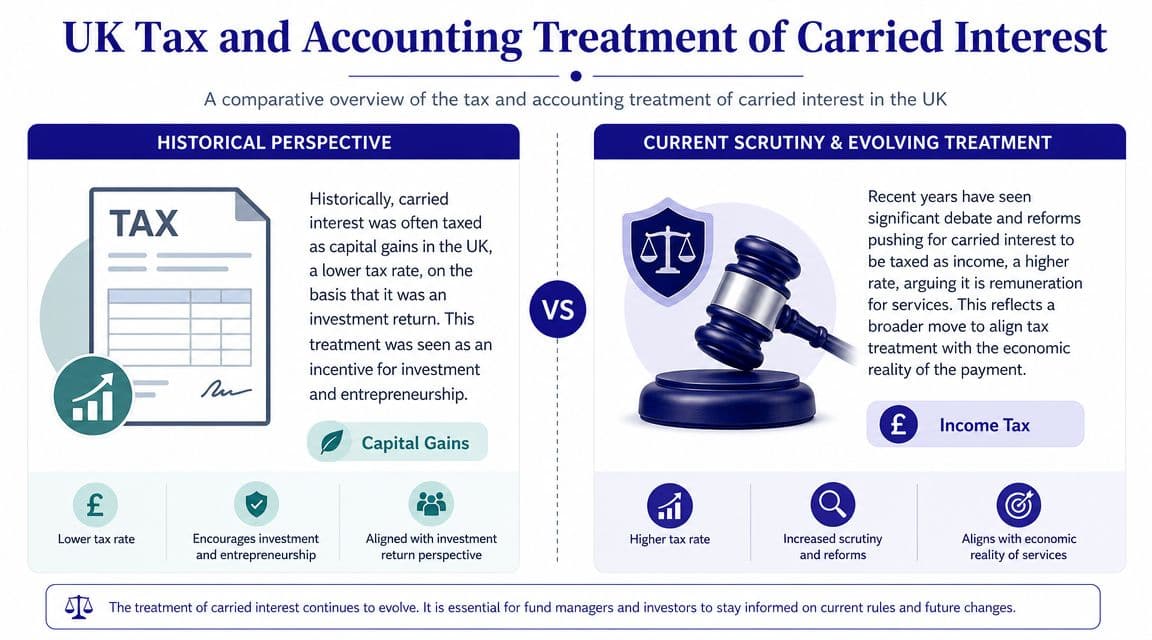
In the UK, carried interest receives close scrutiny because the tax outcome can differ sharply depending on the facts, the fund structure, and the statutory rules applied. For fund managers, that affects net returns. For investors, boards, and counterparties, it affects whether the numbers in distribution schedules and accounts reflect legal reality or an optimistic assumption that may not survive review.
That distinction matters in contentious matters. If carry has been treated as capital in forecasts, internal reporting, or negotiations, and HMRC or an opposing party argues for a different treatment, the financial consequences can spread well beyond the tax liability itself. I often see the fallout in warranty disputes, exits, matrimonial proceedings, and shareholder litigation where one side relied on carry figures that were never tested properly.
Why tax treatment creates dispute risk
The public debate usually focuses on whether carry should be taxed more like capital gains or more like income. In practice, the forensic problem is more specific. Which amounts qualify, when they arise, who is entitled to them, and whether the supporting records match the tax position being claimed.
Those questions become harder when the fund has multiple vehicles, side letters, deferred awards, or recycling provisions. A tax analysis built on incomplete ledgers or inconsistent allocation schedules is vulnerable from the outset. If the underlying accounting is wrong, the tax file may formalise the error.
Where the character of returns is under review, specialist input on related reliefs and classifications is often needed. A useful starting point is this guide to capital gains tax advice.
The accounting treatment is often where the trouble starts
Carry is not just a tax issue. It is also an accounting control issue. Teams need clear records for accrued entitlements, realised and unrealised components, clawback exposure, and partner-level allocations. They also need to document judgement calls, especially where valuations or contingencies affect whether carry should be recognised, deferred, or revised.
Poor accounting treatment creates three recurring problems. Reported entitlements get overstated. Clawback exposure gets understated. Historic entries become difficult to reconstruct once relationships break down or an investigation begins.
That is why legal disputes over carry often expand into document review, ledger testing, and transaction tracing. Counsel may ask one question about entitlement and end up needing evidence on journal entries, management accounts, working papers, and who approved changes to the model. For finance teams reviewing process design and reporting discipline, these practical accounting models for CEF leaders give useful context for how fund accounting frameworks handle complexity.
From a forensic accounting perspective, the key test is simple. Can the firm show, from source records to final allocation, how each carry figure was derived and why the tax treatment attached to it is defensible. If the answer is no, the risk is not abstract. It is the risk of reassessment, repayment claims, expert disagreement, and in some cases allegations that the figures were shaped to support a preferred outcome rather than the underlying facts.
Forensic Accounting Red Flags and Dispute Resolution
When carry becomes contentious, the warning signs usually appear in the documents, the model or the reporting trail. A forensic accountant looks for all three.
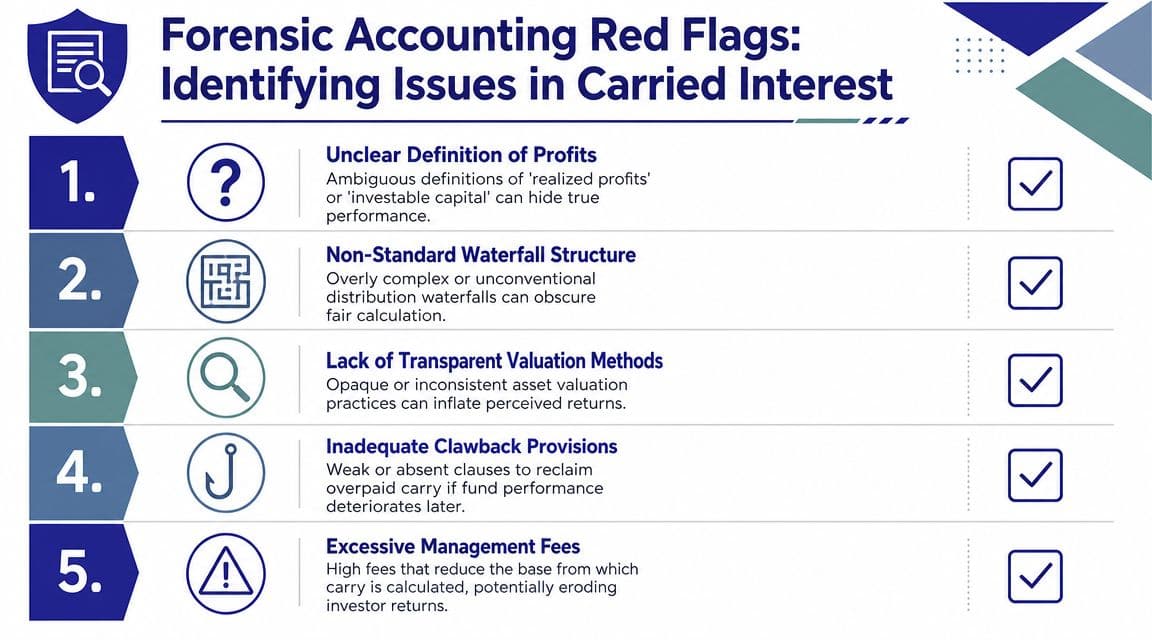
Red flags that deserve immediate review
- Unclear profit definitions: If “profits”, “realised proceeds” or “distributable cash” are defined loosely, parties can reach very different answers from the same underlying transactions.
- Unusual waterfall drafting: Complexity isn't always wrong, but non-standard drafting often increases interpretation risk.
- Thin valuation support: If asset values underpin internal carry expectations, weak valuation evidence can distort negotiations and reporting.
- Weak clawback language: A right to recover overpaid carry is less useful if the mechanics are vague.
- Mismatch between reports and ledgers: Summary reports may conceal inconsistent treatment of fees, expenses or timing.
When the issue may point to fraud
Not every carry dispute involves dishonesty. Many arise from poor drafting or bad modelling. But some cases do raise broader concerns about concealment, conflicts of interest, side arrangements or manipulated reporting.
In those cases, the work moves beyond calculation and into fraud investigation. That may include tracing beneficial ownership, testing whether disclosures were complete, reviewing altered spreadsheets, and analysing whether supporting evidence was created after the fact. For a broader legal perspective on how manipulated reporting can support misconduct, this article on how to uncover investment fraud schemes is a useful external read.
If a carry model changes repeatedly and no one can explain why, the issue may be control failure. It may also be something more serious.
How disputes get resolved
Resolution usually follows one of four paths:
- Private negotiation based on an independent recalculation.
- Expert determination where the contract allows a specialist to decide accounting issues.
- Litigation or arbitration supported by an expert witness accountant.
- Regulatory or internal investigation if reporting or conduct raises wider concerns.
The right approach depends on the documents, the amount at stake and the quality of the evidence. For many parties, the sensible first step is a targeted review. This overview of challenges in forensic accounting shows why these matters often need a structured, evidence-led approach rather than a quick spreadsheet sense-check.
Achieve Certainty with Expert Financial Analysis
Carry can work well as an incentive. It can also trigger expensive disputes, flawed valuations, tax complications and difficult recovery actions. By the time parties ask “what is carry interest?” in a live dispute, the primary need is usually independent evidence that can survive negotiation, cross-examination and regulatory scrutiny.
That is where good forensic work earns its place. A proper review can test the agreement against the model, verify the inputs, trace the cash, quantify any overpayment, and identify whether the issue is contractual, accounting-related or potentially fraudulent. The same skills also help in adjacent matters such as insurance claims, audit issues, shareholder disputes, insolvency questions and loss quantification.
If you are an investor, a business owner, or a solicitor handling a private funds dispute, don't rely on assumptions because the reporting pack looks polished. Carry calculations often sit on layers of judgement. Those layers need testing.
Independent forensic accounting services can provide that clarity. So can a focused forensic audit, a customized fraud investigation, or support from an expert witness accountant where proceedings have already started.
If you need clear, independent financial analysis on carried interest, investment disputes, fraud concerns, loss quantification or litigation support, Lighthouse Consultants can help. Their London team provides forensic accounting services, expert financial investigation, audit support and wider business dispute support for companies, investors, law firms and insurers across the UK. Contact Lighthouse Consultants for a confidential discussion if you need a forensic accountant to test the numbers, challenge assumptions and produce evidence you can act on.