When HMRC opens an enquiry into your affairs, individuals don’t typically think first about legal theory. They think about their mortgage, their business, their reputation, and whether one bad decision has now become a criminal file. That reaction is normal. Tax fraud allegations put pressure on every part of life at once.
The important point is that tax fraud sentencing in the UK isn’t a black box. Courts follow a structured approach. Outcomes turn on how the conduct is characterised, how the alleged tax loss is quantified, what records exist, and what mitigation can be proved properly. That’s where strong forensic accounting, a disciplined fraud investigation, and clear expert analysis can make a real difference.
The Letter from HMRC A Financial Nightmare Begins
It usually starts with a brown envelope, a formal request, or an invitation to answer questions that feel far wider than the issue you thought existed. A director who claimed expenses loosely during a difficult trading period. A sole trader whose returns don’t reconcile neatly with bankings. A finance lead who signed off figures prepared by someone else and now faces scrutiny for them.
Once that letter arrives, the fear escalates quickly. People assume HMRC has already reached a conclusion. They also assume every inconsistency will be treated as dishonesty. In practice, an enquiry, a civil investigation, and a criminal case sit on very different tracks. Early decisions matter, especially what documents you preserve, what explanations you give, and whether anyone independent has tested the figures before they harden into an allegation.

What people get wrong in the first week
The first mistake is silence without strategy. The second is over-explaining before the records are reviewed. The third is treating a tax issue as purely an accounting problem when it may already carry criminal risk.
A calm first response usually includes:
- Record preservation: keep bank statements, ledgers, invoices, emails, VAT workings, payroll records, and draft returns.
- Chronology building: identify who prepared what, who approved it, and when concerns first arose.
- Scope testing: work out whether the issue is an error, carelessness, deliberate understatement, or something HMRC may frame as evasion.
- Professional coordination: accountants, solicitors, and where needed a forensic accountant should work from one agreed factual narrative.
Practical rule: your first objective isn’t to argue. It’s to stop the facts becoming muddled.
If you’re trying to understand the process from the start, this guide to an HMRC investigation is a useful primer. For readers who have encountered US terminology in online searches, a short explanation of notice of deficiency options can also help clarify why tax procedure differs so much across jurisdictions.
Why early financial analysis matters
By the time a client reaches a solicitor, the numbers are often already carrying assumptions. Estimated undeclared income, duplicated transactions, gross figures used where net treatment matters, or missing context around intercompany flows can all distort the picture. A forensic accountant starts by testing the evidence trail, not by accepting the schedule at face value.
That shift matters because sentencing later depends heavily on the court’s view of the conduct and the loss. If those foundations are wrong, everything built on them becomes harder to correct.
UK Tax Evasion and Fraud The Legal Reality
People often use “tax fraud”, “tax evasion”, and “getting tax wrong” as if they mean the same thing. They don’t. In the UK, the legal position turns on intent, conduct, and the surrounding evidence. Honest mistake, poor record-keeping, aggressive tax planning, and deliberate concealment sit in very different places.
Tax avoidance uses the law to reduce tax liability, even if HMRC dislikes the outcome. Tax evasion involves deliberate steps to defeat tax that is properly due. Fraud allegations can arise under the Fraud Act 2006 and under tax-specific legislation such as the Taxes Management Act 1970, depending on what is said to have happened and how it was carried out.
Conduct that commonly leads to allegations
The pattern varies, but certain themes recur in practice:
- Understated income: cash receipts omitted from returns, diverted payments, or incomplete sales recording.
- Inflated deductions: personal expenditure treated as business cost, unsupported expenses, or duplicate claims.
- VAT manipulation: false input tax claims, suppressed output tax, or contrived invoicing.
- False documents: altered invoices, fabricated records, or misleading explanations given to HMRC.
- Concealment structures: arrangements designed to hide ownership, beneficial control, or taxable receipts.
A forensic accountant in this setting doesn’t decide guilt. The job is to identify what the records can prove, what they can’t, and where the narrative has drifted beyond the underlying documents.
The line between poor compliance and fraud
Courts look closely at whether the behaviour was deliberate. That sounds obvious, but it’s where many cases turn. Sloppy books may support a civil penalty. Deliberate falsification, repeated concealment, or knowingly false returns create a much more serious position.
The strongest defence work often begins with a disciplined review of intent. Who knew? Who benefited? Who created or changed the records?
For finance teams that want a clearer grounding in day-to-day compliance expectations, professional tax compliance training can help frame what “reasonable care” should look like operationally. If you need a wider picture of exposure, the risks set out in this guide on tax evasion in the UK give a practical overview.
Why definitions matter commercially
A criminal allegation doesn’t just threaten liberty. It can disrupt lending, M&A activity, insurance recoveries, shareholder confidence, and director appointments. That’s why businesses need the facts analysed quickly and independently. In many matters, the live issue isn’t only whether tax is due. It’s whether the evidence supports dishonesty at all.
How UK Courts Determine Tax Fraud Sentences
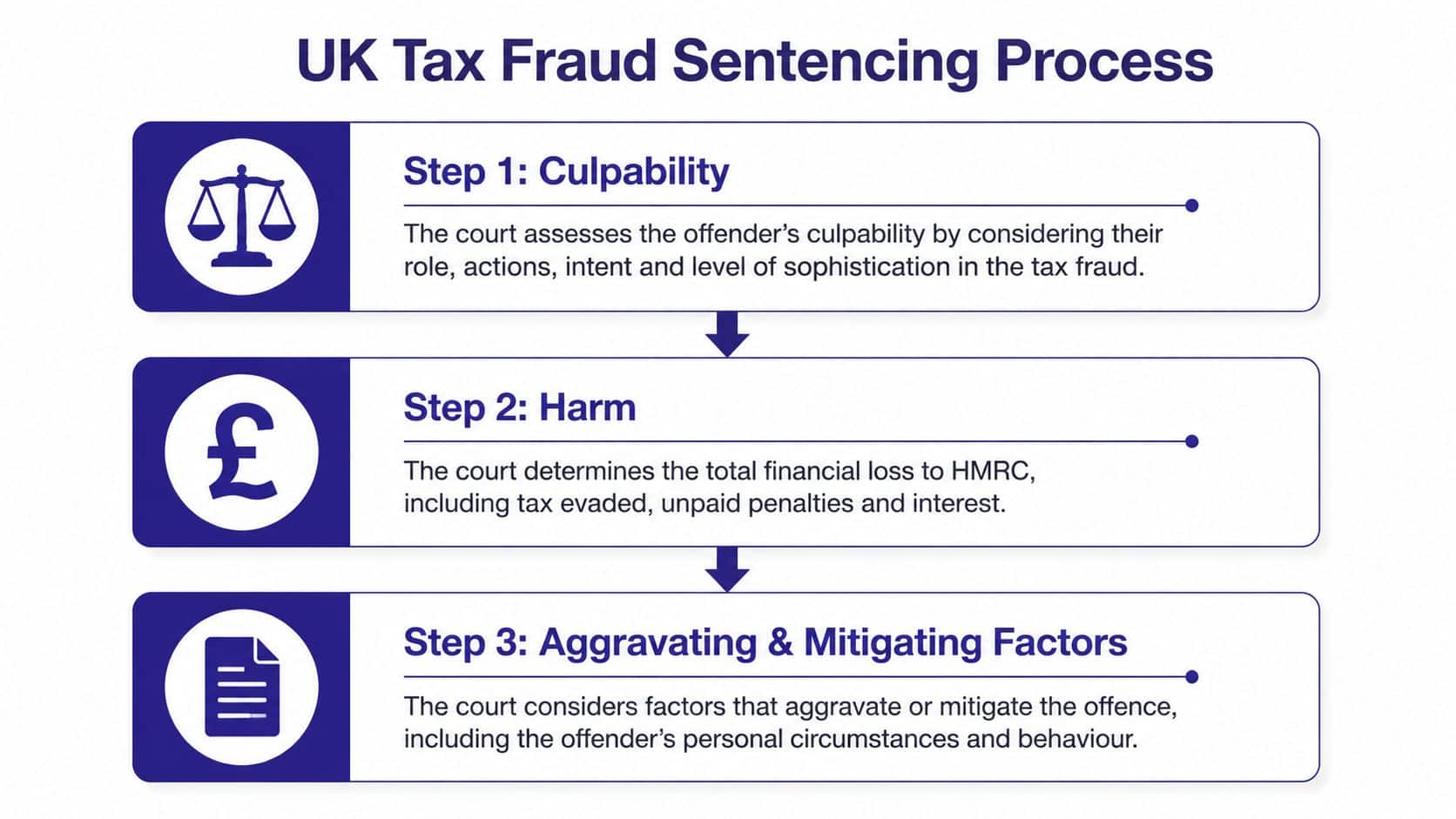
Courts don’t sentence tax fraud by instinct. They use the Sentencing Council’s framework, which assesses culpability and harm, then adjusts for other relevant features. That structure is what makes early financial and evidential work so important.
Culpability and harm drive the starting point
Culpability asks how blameworthy the conduct was. Deliberate evasion using false documents, layered transactions, or other elaborate concealment places a defendant in a more serious category than a short-lived or less organised offence.
Harm focuses on the financial loss to HMRC. In tax cases, the number matters enormously because it helps place the offence into the guideline matrix.
The Sentencing Council states that for high culpability offences involving deliberate evasion with elaborate concealment, combined with high harm where the tax loss exceeds £500,000, the starting point is 4 years’ custody with a range of 3 to 7 years under the guideline framework for fraud offences, as outlined by the Sentencing Council.
The matrix in working terms
A court usually works through the issue in this order:
| Stage | What the court asks | Why it matters |
|---|---|---|
| Culpability | Was the conduct planned, sustained, deceptive, or sophisticated? | This sets the seriousness of the offending behaviour. |
| Harm | What tax loss can be properly attributed? | This places the case within the relevant harm bracket. |
| Adjustment | Are there aggravating or mitigating features? | This moves the sentence up or down from the starting point. |
A forensic accounting exercise often has the greatest impact at the harm stage, but it can also affect culpability. For example, records may show disorganisation rather than sophistication, or demonstrate that a defendant followed instructions rather than directing the scheme.
What courts need from the numbers
Judges don’t need a spreadsheet dump. They need a figure they can trust, with assumptions exposed and documents cross-referenced. That means schedules tied back to bank statements, tax returns, invoices, journals, and source records. It also means separating tax lost from amounts merely suspected.
Working principle: if the loss figure is overstated, the sentencing bracket may be overstated with it.
This is why a forensic audit matters in tax fraud sentencing. It gives the court a tested financial basis for sentence, rather than a broad accusation wrapped in arithmetic.
Aggravating and Mitigating Factors That Change Everything
The starting point isn’t the finish line. Two people with similar alleged tax losses can receive very different outcomes because the court looks beyond the headline figure. In practice, careful preparation can change the shape of the case.
What pushes a sentence up
Certain features make a judge more likely to move upwards within the range. A director who abused a position of trust is in a worse position than someone acting under close instruction. A prolonged scheme is worse than a short one. False paperwork hurts more than confusion caused by weak systems.
Regional practice also matters. Ministry of Justice material indicates that London Crown Courts impose 28% longer average custodial terms in these cases, and under the Proceeds of Crime Act 2002, 92% of convictions trigger confiscation orders, which can materially increase the practical penalty if sums aren’t paid, as reflected in the criminal justice system statistics.
That second point often catches defendants by surprise. Sentencing doesn’t end with the prison term or suspended sentence analysis. Confiscation can become the next major battleground.
What genuinely helps
Mitigation isn’t theatre. Courts want evidence of it. The strongest points usually include some combination of these:
- Early cooperation: not confusion, not selective disclosure. Structured, documented cooperation.
- Reliable repayment evidence: what has been repaid, what can be repaid, and from what source.
- Clean prior history: relevant where the court is considering whether the conduct is out of character.
- Personal and business context: health, caring duties, collapse risk to employees, or pressures don’t excuse fraud, but they can matter.
- Proof of role: whether the defendant led, followed, or failed to challenge others.
What doesn’t work
Judges hear familiar explanations every day. “I meant to sort it out later.” “The bookkeeper handled it.” “There was no victim because HMRC would have got paid eventually.” Those points rarely help unless they are backed by documentary reality.
A better approach is disciplined and candid. If the records show undeclared liabilities, address them. If the loss figure is wrong, prove why. If systems failed, demonstrate exactly how, who had access, and what controls were absent.
Repayment, cooperation, and credible financial reconstruction carry far more weight than general assertions of regret.
Forensic accounting services add value. A forensic accountant can trace funds, isolate personal benefit, test whether entries were fabricated or merely unsupported, and quantify what mitigation is available. In many tax fraud sentencing matters, the difference between a vague plea in mitigation and a document-backed one is substantial.
How Forensic Accountants Provide a Strategic Advantage
A tax fraud case is rarely won on rhetoric. It turns on records, reconciliations, transaction trails, source documents, and whether anyone has presented the financial story in a way the court can rely on. That’s the practical advantage a forensic accountant brings.

Rebuilding the financial narrative
HMRC may allege a loss figure that becomes the centre of the sentencing case. Sometimes that figure is solid. Sometimes it rests on estimates, assumptions, omitted offsets, or records that were never tested independently.
A forensic accountant starts with the ledger detail and works outward. The exercise may involve bank analysis, invoice testing, VAT reconstruction, payroll review, director loan scrutiny, and matching declared figures against third-party evidence. In disputes over altered paperwork, tools for identifying document changes using CatchDiff can also help compare versions cleanly where the timing and content of amendments matter.
The goal isn’t to produce complexity. It’s to reduce complexity into evidence the court can use.
Where expert input changes the outcome
Strong forensic accounting can influence several pressure points at once:
- Loss quantification: proving the tax loss is lower than alleged, or that part of it cannot be attributed safely.
- Culpability analysis: showing the conduct lacked sophistication or that the defendant had a limited role.
- Benefit tracing: identifying whether there was personal enrichment, corporate use, or no extractive benefit at all.
- Mitigation support: documenting repayment capacity, asset position, and practical restitution proposals.
- Litigation support: preparing schedules and reports that stand up under cross-examination.
An expert witness accountant also helps solicitors translate accounting issues into legally useful evidence. Courts don’t reward volume. They reward clarity and reliability.
For a broader explanation of when this support becomes decisive, this guide on why to use a forensic accountant is worth reading.
Why presentation matters as much as analysis
Even correct numbers can fail if they’re presented badly. Judges and counsel need a trail they can follow. That means assumptions stated openly, disputed items flagged precisely, and supporting material organised so someone outside the finance function can test it.
A short discussion of how this work fits into live disputes can help here:
The best forensic accounting reports do three things at once. They quantify the issue, explain the mechanism, and expose the limits of the available evidence. That combination often gives legal teams room to negotiate from a stronger position.
Real-World Examples The Impact of Expert Analysis
Theory matters. Outcomes matter more. In tax fraud sentencing, the most useful examples usually involve repayment, better quantification, and a cleaner account of the defendant’s actual role.
Repayment can transform the court’s view
The benchmark case R v Smith [2017] EWCA Crim 456 is a strong illustration. In that case, a £750k VAT fraud matter saw the guideline range fall from 5 years’ custody to an 18-month suspended sentence because the defendant made a £400k repayment before sentencing, as recorded in the Bailii report of the case.
That doesn’t mean repayment solves every case. It does show that courts can treat concrete financial remediation as a serious mitigating factor when it is real, documented, and timely.
A promise to repay is weak mitigation. Verified repayment is different.
A typical SME scenario
A common mid-market pattern involves a business owner facing an HMRC allegation built from incomplete books, director drawings, and unexplained deposits. On first reading, the schedule may look like deliberate suppression of income. Once the records are reconstructed properly, some items turn out to be loan movements, duplicated receipts, or accounting misposts rather than hidden taxable profits.
That kind of forensic accounting work won’t erase genuine wrongdoing where it exists. What it can do is stop the court sentencing on an inflated or distorted basis. It can also separate poor control from calculated deceit, which is often critical to culpability.
A boardroom dispute with criminal overtones
Another pattern appears in internal disputes. A finance director leaves under a cloud. The company reports suspected tax irregularities. Emails are selective, systems access was shared, and control failures pre-date the individual’s appointment. Here, a forensic accountant may trace authorisation routes, compare draft and filed returns, and map who changed what and when.
That analysis can support several possibilities. It may confirm personal responsibility. It may also show a narrower role, no personal extraction, or a business process failure dressed up as a simple fraud narrative. In tax fraud sentencing, those distinctions can affect both the legal strategy and the final outcome.
Take Control Contact Lighthouse Consultants Today
If HMRC is asking questions, waiting rarely improves the position. Records disappear. Staff memories harden into assumptions. Informal explanations get repeated as if they were facts. By the time sentencing becomes the focus, the case may already be carrying avoidable damage.
That’s why early expert input matters. A strong forensic accountant doesn’t just produce schedules. They test the alleged loss, review the evidence trail, evaluate the complexity of the conduct, support fraud investigation work, and help legal teams present mitigation in a disciplined way. The same skills also support related problems, including insurance claims, shareholder disputes, internal audit concerns, loss quantification, and litigation support.
The right support is wider than one case type
Businesses and individuals facing tax allegations often have parallel problems. They may need:
- Forensic accounting services: to quantify tax exposure, trace funds, and review books independently.
- Fraud investigation services: to examine false documents, internal collusion, or unexplained transactions.
- Expert witness accountant input: for court-ready reporting and credible oral evidence.
- Business dispute support: where tax issues overlap with director disputes, insolvency concerns, or regulatory scrutiny.
- Audit services: to identify control failings and strengthen governance after the immediate crisis.
That combination matters because tax fraud allegations rarely sit in isolation. They affect banking relationships, insurers, counterparties, and often the future of the business itself.

Why clients act early
The commercial benefit of moving early is simple. You gain time to reconstruct records properly, consider repayment strategy, coordinate accountants and solicitors, and present evidence before assumptions become entrenched. That can improve negotiations, sharpen mitigation, and reduce the risk of the court relying on broad-brush figures.
Lighthouse Consultants provides forensic accounting services and wider expert financial analysis services for clients dealing with tax disputes, fraud investigation, audit issues, litigation support, and complex business conflicts. If you need forensic accountant support, a forensic audit, or a business dispute accountant with expert witness capability, the sensible step is to take advice now, while there is still room to shape the evidence.
If you’re facing an HMRC enquiry, suspected tax fraud, a financial dispute, or need independent expert analysis, contact Lighthouse Consultants for a confidential discussion about forensic accounting, fraud investigation, audit services, litigation support, and business dispute support. Thank you for contacting us.