A strange payment lands in the ledger. Then another. A supplier invoice doesn’t match the purchase order. Someone in finance says it’s probably a timing issue. Legal wants facts. The board wants reassurance. Meanwhile, nobody wants to alert the wrong person, suspend the wrong account, or destroy evidence by “looking into it” badly.
That’s the point where financial crime stops being a compliance topic and becomes a business crisis.
For many UK firms, the fca financial crime guide only gets serious attention after something has already gone wrong. By then, the problem is rarely confined to one transaction. It spills into contracts, insurance notifications, staff conduct, shareholder pressure, customer complaints, and sometimes litigation. If the business is FCA-supervised, the stakes rise again. You’re no longer asking only what happened. You’re asking whether your systems, controls, and reporting decisions will stand up to scrutiny.
A forensic accounting approach helps because it imposes order quickly. It identifies what moved, who approved it, what records exist, what the losses look like, and whether the issue points to fraud, money laundering, sanctions exposure, or a control failure. That matters just as much to a worried owner-manager as it does to solicitors preparing for disclosure or insurers assessing a loss.
Navigating the Aftershock of Financial Crime
A Tuesday evening discovery often starts the same way. A finance director spots an unusual transfer, or a lawyer reviewing disclosure notices a pattern in client account movements that no one can explain cleanly. The numbers may be modest at first. The concern isn’t.

The first mistake is often panic dressed up as action. Staff start emailing each other. Someone downloads records without preserving a chain of custody. A manager confronts the suspected employee too early. A director delays escalation because they hope it’s an accounting error that will disappear by month-end.
That instinct is understandable. It’s also risky.
What people usually fear first
The immediate fear is rarely the regulation itself. It’s the practical fallout.
- Cash disruption: Can the business still trade if accounts are reviewed or payments are paused?
- Reputational damage: What happens if customers, lenders, or counterparties hear about this before the facts are clear?
- Legal exposure: Will an internal error become a negligence claim, shareholder dispute, or employment issue?
- Regulatory consequences: If the firm is supervised, was there a reporting duty, and has the window already started to narrow?
Practical rule: In the first hours, protect evidence before you form conclusions.
The FCA framework matters here because it gives structure when emotions are running ahead of judgment. The guide doesn’t remove the stress, but it helps firms separate suspicion from proof, control weakness from criminal conduct, and remediation from delay. In a live incident, that discipline is often the difference between a contained issue and a worsening one.
Why forensic accounting changes the situation
A forensic accountant doesn’t arrive to produce jargon or tidy slides. The work is more basic and more valuable than that. Trace the money. Reconcile the records. Test whether the explanation fits the documents. Quantify the exposure. Preserve the evidence in a form that legal advisers, insurers, auditors, and regulators can use.
That’s also why firms under pressure often need a proper incident structure, not just ad hoc calls between finance and compliance. A formal crisis management consulting response helps leaders decide who knows what, who investigates, what gets documented, and when external notifications become necessary.
What Is the FCA Financial Crime Guide
The fca financial crime guide is the FCA’s practical handbook on the systems and controls regulated firms should have to reduce financial crime risk. It sits alongside legal and regulatory obligations rather than replacing them. In practice, firms use it to judge whether their arrangements are proportionate, coherent, and evidence-based.
It matters because the FCA doesn’t assess financial crime controls in the abstract. It looks at how a real firm identifies risk, documents decisions, monitors transactions, escalates concerns, and fixes weaknesses. The guide is where that practical expectation becomes visible.
Why it matters in day-to-day work
A lot of business owners assume the guide is relevant only to major banks. That’s the wrong lens. The core idea is risk-based control, which applies across different sizes and business models. The question isn’t whether your firm looks like a large institution. The question is whether your controls fit your actual exposure.
That means asking ordinary but important questions:
- Who are your customers and intermediaries?
- Where does your money move?
- Which jurisdictions, products, and counterparties create sanctions or laundering risk?
- Can you evidence why your controls are suitable for those risks?
The guide is especially important when a firm has grown quickly, added a new product line, expanded into cross-border activity, or started relying on more automated monitoring. Those are exactly the points where policy documents often drift away from operational reality.
The November 2024 update changed the practical focus
The guide didn’t stand still. The FCA updated it through Policy Statement PS24/17 on 29 November 2024, with changes covering sanctions, proliferation financing, transaction monitoring, cryptoassets, and the interaction with Consumer Duty, as outlined in TLT’s summary of the FCA updates.
That matters for two reasons. First, it confirms that firms can’t treat financial crime compliance as a static manual drafted years ago. Second, it pushes firms to think more carefully about how controls work in practice, especially where monitoring tools, customer treatment, and sanctions screening overlap.
The firms that struggle most are usually not the ones with no documents. They’re the ones with documents that don’t match what staff actually do.
How a practitioner reads the guide
A forensic accountant reads the guide differently from a policy drafter. The question isn’t only “do we have a control?” It’s “can we prove the control operated, and did it work when tested by a messy real event?”
That approach usually exposes three uncomfortable truths:
| Issue | What firms say | What the records often show |
|---|---|---|
| Risk assessments | “We’ve covered that risk.” | The assessment is generic and detached from actual business lines |
| Monitoring | “Our system flags unusual transactions.” | Staff close alerts mechanically or without documented rationale |
| Governance | “Senior management has oversight.” | Minutes record approval, but not challenge, follow-up, or remediation |
That’s why many firms need more than a compliance refresh. They need a documented, defensible review of systems and controls grounded in transaction evidence. For firms dealing with that pressure, a focused financial crime and compliance review is often the point where the guide becomes usable rather than theoretical.
Common FCA Enforcement Issues and Costly Pitfalls
Most firms don’t fall into trouble because they lacked a policy title. They fall into trouble because the policy said one thing and the records, alerts, approvals, or customer files showed another.
The enforcement mood has become harder to ignore. In the FCA’s 2024 to 2025 reporting period, it opened 965 new financial crime supervision cases, a 15% increase on the previous year, and financial crime fines rose over 500% to £180.1 million, as summarised in Clifford Chance’s review of the FCA annual report. Those figures matter because they show a regulator spending more time in this space and collecting far more when firms get it wrong.
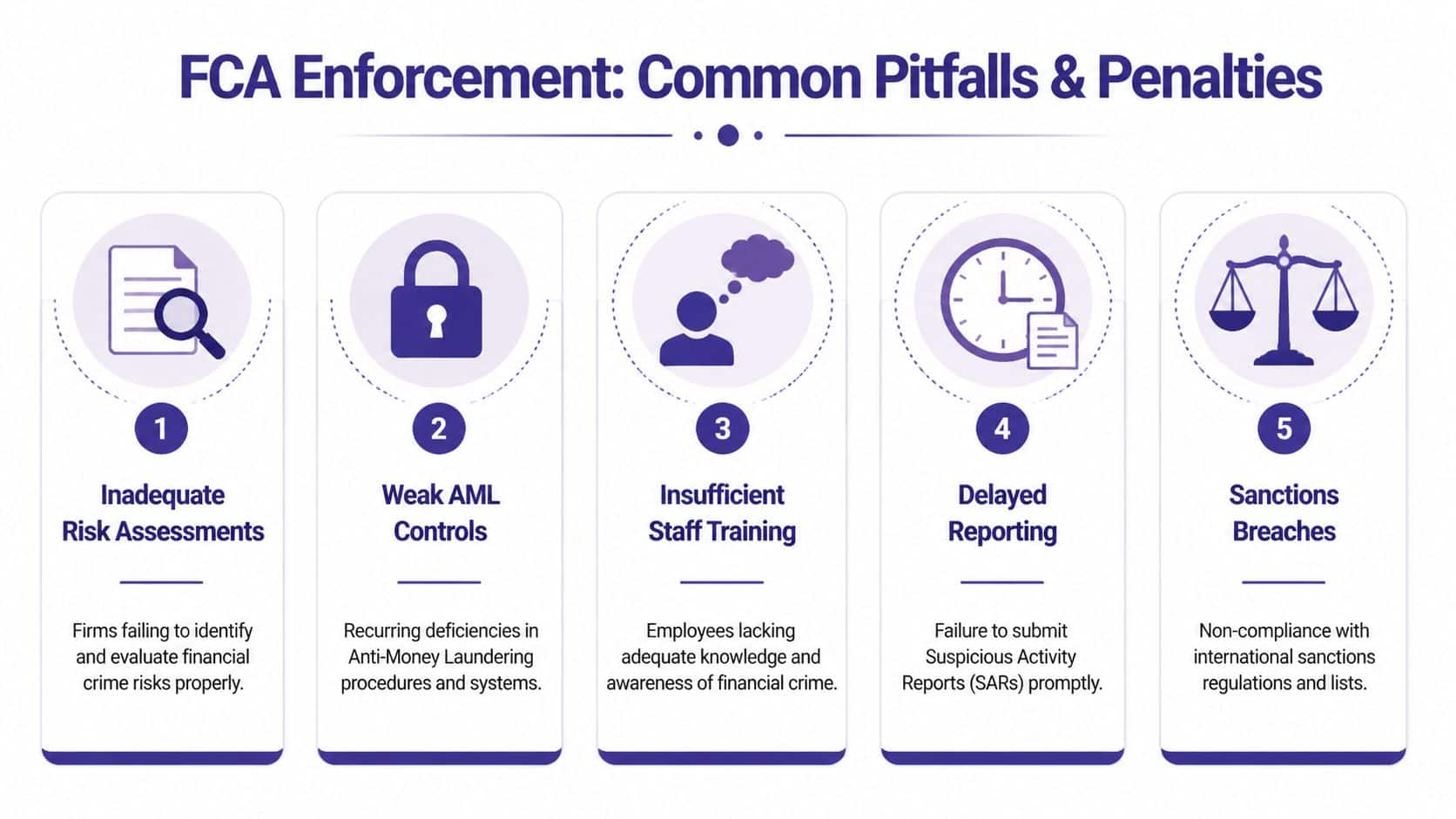
Where firms usually go wrong
Some failures are technical. Most are structural.
- Risk assessments that read well but don’t bite: They list categories of risk but don’t connect those risks to products, customer types, payment routes, or real control owners.
- AML controls that create noise instead of insight: A monitoring tool can produce alerts all day long. If analysts clear them without quality review, the system becomes theatre.
- Weak training in live roles: Staff know the annual module exists but can’t recognise suspicious behaviour in the transactions they handle.
- Late or poor escalation: Concerns sit with line managers too long, often because no one wants to be the person who raises the wrong alarm.
- Sanctions controls that stop at screening: Screening names is only part of the job. Firms also need escalation routes, recordkeeping, and evidence that decisions were reviewed properly.
The forensic accountant’s view of these failures
A forensic review often shows that the true weakness sits behind the visible breach.
For example, an “inadequate risk assessment” usually means the business failed to map how money, authority, and information flow across teams. A “monitoring failure” often turns out to be a governance problem, such as no documented threshold rationale, no feedback loop from investigations to rules, or no challenge when alert volumes become meaningless.
A control isn’t strong because it exists. It’s strong because it can survive a hostile review of the evidence.
That distinction matters in disputes. If a board later asks whether management acted reasonably, or if solicitors need to plead loss, the record must show what the firm knew, when it knew it, what it tested, and why it made each decision.
Pitfalls that cost more than the fine
The direct penalty gets attention. The hidden costs often hurt longer.
| Pitfall | Immediate consequence | Longer-term effect |
|---|---|---|
| Generic risk framework | Regulatory challenge | Rework across policies, onboarding, monitoring, and governance |
| Poor alert handling | Missed suspicious activity | Harder internal investigations and weaker disclosure position |
| Weak documentation | Inability to justify decisions | Greater exposure in litigation, audits, and skilled review work |
| Delayed reporting | Escalated regulatory risk | Board friction and reputational strain |
| Unclear ownership | Slow remediation | Repeated failures across business units |
A forensic accountant looks for these links because enforcement issues rarely stay in the compliance silo. They spill into insurance recoveries, shareholder allegations, employment disputes, deal due diligence, and expert evidence. Once that happens, the quality of your financial records and chronology matters just as much as the original control failure.
Strengthening Your Defences with a Risk-Based Approach
The strongest response to the fca financial crime guide isn’t a thicker manual. It’s a control environment that reflects how your firm trades, pays, onboards, and escalates.

That starts with a serious firm-wide risk assessment. Not a generic template. Not a board paper assembled the night before approval. A real assessment built from customer profiles, services offered, transaction routes, jurisdictions touched, third-party dependencies, and known control weaknesses.
The pressure is greater for smaller firms because capability and exposure rarely scale neatly together. The FCA’s updated focus on proliferation financing has sharpened that. Many SMEs still struggle to implement those requirements, even though UK SMEs make up over 99% of businesses, report 43% of fraud incidents, and invest 30% less in compliance technology than larger firms, according to IQEQ’s discussion of the FCA proposals.
Build the assessment from evidence
A usable assessment usually needs five ingredients.
-
Business model mapping
List what the firm does, not what the old policy says it does. Include products, services, customer channels, counterparties, payment methods, and any non-standard routes. -
Transaction reality testing
Pull sample transactions from higher-risk areas and test the journey end to end. Which checks were supposed to fire. Which ones did. Which approvals were manual. -
Control ownership
Name the people who operate each control. If no one clearly owns a step, the control is weaker than it appears. -
Escalation logic
Decide what turns an issue into a compliance event, a legal issue, or an investigation. Firms often have policies but no operational threshold. -
Residual risk judgement
Don’t stop at inherent risk. Document what remains after controls are applied, and why that level is acceptable or not.
Field note: If a control can’t be evidenced from system logs, reviewed files, or minutes, assume you’ll struggle to prove it worked.
Think like an investigator, not a form-filler
A forensic mindset improves compliance because it asks awkward questions early.
- What would a dishonest insider exploit here?
- Could a third party use our process to mask the true source or destination of funds?
- If this transaction later appeared in a disclosure bundle, would the rationale make sense to an outsider?
- If the control failed today, how quickly would we know?
That approach is especially useful in mid-market businesses where teams are lean and people wear several hats. One person may handle onboarding, payment release, and exception management. That may be efficient commercially, but it creates concentration risk.
Operational resilience matters too. Security and compliance don’t sit in separate worlds any more. A sensible review of access controls, audit logs, and collaboration platforms can support both fraud prevention and defensible investigations. In some firms, strengthening Microsoft 365 security risk management is part of making sure key financial evidence, user activity, and approvals are protected and reviewable.
Turn findings into control changes
A risk assessment only matters if it changes behaviour. The best remediation plans are simple enough to operate and specific enough to test.
| Control area | Weak version | Stronger version |
|---|---|---|
| Customer due diligence | One-size-fits-all checklist | Risk-tiered onboarding with documented exceptions |
| Transaction monitoring | Static rules with large alert backlogs | Calibrated scenarios with review quality checks |
| Governance | Committee receives summary papers | Committee challenges assumptions and tracks actions |
| Recordkeeping | Evidence spread across inboxes | Central, retained, reviewable files and logs |
A practical video can help teams align around what “risk-based” means in real operations before the documents are revised.
For firms that want to test whether their controls would stand up under pressure, a structured fraud risk assessment checklist for UK businesses can be a useful starting point. The value isn’t the checklist itself. It’s the discipline of forcing assumptions into evidence.
Responding to Suspicion Investigation and Reporting
Once suspicion arises, speed matters. So does restraint. Many firms damage their position by rushing into interviews, making accusations, or circulating untested theories before the facts are stabilised.
A sound response is controlled, confidential, and documented. That is where forensic accounting becomes operational rather than advisory. Someone needs to trace transactions, secure underlying records, identify connected parties, reconcile inconsistencies, and quantify exposure in a way others can rely on.

The first decisions shape the whole matter
When a red flag appears, the initial questions should be practical.
- What exactly triggered concern? An alert, a whistleblowing report, a reconciliation break, an external complaint, or a legal request?
- What records must be preserved immediately? Ledger entries, invoices, emails, chat logs, approval trails, bank support, and access logs.
- Who needs to know now? Usually fewer people than management first assumes.
- What should pause pending review? Payments, account access, customer contact, or document destruction routines.
A clean chronology is vital. In contentious matters, people later remember events in a way that protects their own decision-making. Contemporaneous notes and transaction evidence matter far more than retrospective confidence.
What a good internal investigation looks like
A good investigation is narrow at first, then expands only where the evidence justifies it.
| Investigation stage | Good practice | Poor practice |
|---|---|---|
| Triage | Define allegation and preserve evidence | Start broad interviews before records are secured |
| Analysis | Trace funds and reconcile source records | Rely on verbal explanations |
| Governance | Restrict access and log decisions | Share updates informally across teams |
| Reporting | Separate facts, assumptions, and conclusions | Blend suspicion with accusation |
Get the records before you get the story. Stories change. Ledgers, emails, and approvals usually don’t.
Forensic accountants add value here because they can quantify as well as investigate. If the issue affects cash loss, false invoicing, commission leakage, business interruption, or disputed balances, decision-makers need numbers they can trust. Solicitors also need schedules and narratives that can survive disclosure and challenge.
Reporting and information sharing need care
The reporting side often worries firms most. A Suspicious Activity Report should be grounded in facts, chronology, and a clear explanation of why the activity appears suspicious. Vague suspicion with weak records helps no one.
The legal environment has also changed. The Economic Crime and Corporate Transparency Act 2023 introduced new provisions for firm-to-firm information sharing. At the same time, there’s still concern about how liability operates in practice. That gap matters, especially because 62% of UK boards report insufficient controls for emerging hybrid cyber-financial threats, as discussed in Clifford Chance’s note on the updated guide and information sharing.
That means firms should be careful before sharing intelligence for the sole reason that a new gateway exists. The key questions are narrower:
- Is the sharing lawful in this situation?
- Is the data accurate and proportionate?
- Is there a proper audit trail of what was shared, why, and with whom?
- Does the firm’s Consumer Duty and confidentiality analysis align with the decision?
Poorly controlled information sharing can create a second problem on top of the first one. In practice, disciplined recordkeeping and a defensible rationale matter just as much as the decision to share.
Applying the FCA Guide in Your Sector
The fca financial crime guide uses broad principles. Real businesses face sector-specific pressure. The right controls for an insurance intermediary won’t look the same as the right controls for a law firm handling client money or a trading business dealing with cross-border suppliers.
SMEs and mid-market trading businesses
A mid-market importer in the Midlands discovers that one overseas supplier has changed bank details twice in a short period. The payments team accepted the changes because the amounts were consistent with past orders and the emails looked routine. Later, the finance director notices odd routing and weak support for beneficial ownership.
The issue here isn’t only invoice fraud. It may also raise wider questions about sanctions exposure, source of funds, and whether the firm’s supplier due diligence reflects its geographic risk. In this specific area, many SMEs struggle with the guide’s newer proliferation financing expectations. They know they need a risk assessment, but they don’t know how much depth is proportionate or what evidence a regulator would expect to see.
A forensic accountant helps by doing three things in sequence. First, reconstruct the payment path and verify documentation. Second, identify whether the weakness sits in onboarding, change control, or approval. Third, quantify direct and indirect exposure for management, insurers, or legal advisers.
Sector risk is rarely abstract. It sits inside the ordinary process your team stopped questioning months ago.
Law firms and litigation practices
A law firm may not think of itself as a high-risk financial business. Yet client accounts, property transactions, settlement flows, and corporate structures create obvious vulnerability if controls are rushed or delegated carelessly.
Consider a dispute practice receiving funds tied to a fast-moving settlement. The matter partner is under pressure. The accounts team sees unusual urgency from the client’s side and incomplete information about the underlying source of funds. Nobody wants to hold up completion. That’s precisely when the guide becomes practical.
The useful question isn’t “do we have an AML policy?” It’s “did the file show proper challenge, escalation, and documentation when the transaction became awkward?” In later negligence claims, regulatory scrutiny, or partner disputes, that distinction becomes decisive.
Forensic accounting support in this setting often extends beyond compliance. It may include tracing diverted funds, analysing fee irregularities, quantifying losses, reviewing client account patterns, or preparing expert evidence for court.
Insurers and claims handlers
Insurers face a different problem. They often see financial crime risk through claims behaviour rather than onboarding or payments operations. A business interruption claim may contain inflated revenue assumptions, inconsistent stock figures, or records that don’t reconcile cleanly with management accounts.
That’s not always fraud. Sometimes it’s poor bookkeeping under pressure. Sometimes it isn’t.
The forensic value lies in separating exaggeration, error, and deliberate manipulation. If a claims handler pays too quickly without testing the financial evidence, they may fund a false narrative. If they reject too aggressively without proper quantification, they may invite dispute and cost.
A careful review usually looks at:
- Revenue integrity: Do sales records align with VAT submissions, bankings, and stock movement?
- Cost behaviour: Are claimed savings and fixed costs consistent with historic management accounts?
- Document authenticity: Do metadata, sequencing, and ledger extracts support the timeline presented?
- Causation: Did the claimed event cause the loss, or was the business already underperforming?
Financial services and crypto-adjacent firms
Some firms now face risk around digital assets, crypto-related flows, or counterparties using decentralised systems. The guide’s cryptoasset references make that impossible to dismiss as niche.
Where a business is building products in that environment, technical design choices can affect compliance exposure later. In those cases, management should understand the operational model, wallet flows, screening limitations, and governance before launch. For teams exploring that side of the market, reviewing how a DEX development company UK structures platform capabilities can help frame the operational questions that compliance and forensic reviewers then need to test.
The point isn’t to outsource judgement to technology. It’s to make sure legal, compliance, finance, and product teams are looking at the same transaction reality.
Boards, investors, and transaction work
Sector application also matters before disputes begin. During acquisitions, fundraising, or strategic partnerships, weak financial crime controls can distort valuation and create ugly surprises after completion.
Boards often ask whether the target “has AML covered”. That question is too soft. A sharper review asks:
| Due diligence question | Why it matters |
|---|---|
| Does the target’s risk assessment reflect current business activity | Old documentation can hide post-growth weaknesses |
| Are high-risk customers and counterparties evidenced properly | Missing files can become inherited liability |
| Do monitoring and escalation records show challenge | A silent backlog is a warning sign |
| Are historical incidents quantified and remediated | Unknown exposure affects price, warranties, and indemnities |
That’s where forensic accounting intersects with disputes, valuations, and deal protection. The same skills used to investigate fraud also help buyers, lenders, and boards test whether a target’s controls are real, whether loss exists, and whether management’s assurances deserve reliance.
From Compliance Burden to Business Protection
Most firms approach the fca financial crime guide with reluctance. That reaction makes sense. The language is technical, the obligations feel heavy, and the consequences of error can seem out of proportion to the size of the business.
But the guide becomes more useful when you stop treating it as a compliance burden and start treating it as a protection tool.
Good financial crime controls protect more than regulatory standing. They protect cash, evidence, insurability, deal value, and credibility in disputes. They also make investigations faster and cheaper because the records are cleaner, the ownership lines are clearer, and the chronology already exists.
The most common objection to bringing in forensic accounting support is cost. That objection usually disappears once a matter starts to spread. A poorly handled incident can affect payment flows, litigation posture, insurance recovery, staff relations, and board confidence all at once. By then, the expensive option is improvisation.
A disciplined forensic review helps in three ways:
- It clarifies the facts when internal teams are guessing.
- It quantifies the exposure when stakeholders need numbers, not impressions.
- It supports defensible decisions when regulators, counterparties, or courts later ask what the firm did and why.
That turns compliance into something more commercially useful. It becomes evidence-backed risk management. In a difficult market, that isn’t bureaucracy. It’s resilience.
If you’re dealing with suspicious transactions, fraud concerns, weak controls, or a regulatory issue that’s starting to spill into disputes or litigation, Lighthouse Consultants can help bring order quickly. Their London team provides forensic accounting, fraud investigation, loss quantification, due diligence, expert reporting, and financial analysis that stands up to scrutiny. If you need a clear view of what happened, what it cost, and what to do next, speak to Lighthouse Consultants.
Tags: forensic accountant, forensic accounting