The letter lands on your desk, or worse, at your home. It carries the HMRC crest, formal language, and a demand for records, explanations, and deadlines. Your mind jumps straight to the worst outcome. Not just penalties, but your company, your name, your bank, your family, and whether prison for tax evasion UK is suddenly a real possibility.
That reaction is normal. It’s also dangerous if it pushes you into improvising.
Directors often make the same early mistakes. They reply too quickly, they trust that their routine accountant can handle a criminal-risk matter, or they assume HMRC must be wrong so the issue will fade away. It won’t. When HMRC starts asking questions about dishonesty, the case stops being a standard tax problem. It becomes an evidence problem.
That changes everything.
That Sinking Feeling When an HMRC Investigation Notice Arrives
It starts with a brown envelope, a recorded delivery, or a message forwarded from your finance team with the subject line no director wants to see. HMRC wants records. HMRC wants answers. HMRC has set a deadline. At that point, the actual risk is not the letter itself. It is what you do in the next 48 hours.
By then, the pressure is already inside the business. Cash flow is tight. Historic returns no longer look clean. A supplier arrangement you waved through now needs explaining. Payroll entries, VAT treatment, director drawings, and bookkeeping adjustments all start to matter at once. If HMRC is testing for dishonesty, this is no longer a routine compliance problem. It is a fact pattern that can be used to build a criminal case.
That is why the first response matters so much.
Why this hits directors so hard
HMRC does not just review figures. It reviews behaviour. Who knew what. Who signed what. Who benefited. Who ignored warnings. Who told staff to post entries a certain way. For a director, those questions are personal because they go straight to intent, and intent is where prison risk begins.
Early mistakes are common. Replying too quickly. Letting a general accountant handle a matter with criminal exposure. Trying to tidy records before understanding what HMRC has already seen. Sending a defensive explanation that fills gaps in HMRC’s case instead of closing them.
Practical rule: Freeze the facts before you explain them. Preserve emails, ledgers, VAT workings, payroll files, bank statements, draft accounts, messages with advisers, and internal timelines. Then get the case reviewed by someone who understands how HMRC argues dishonesty.
That point is often missed. HMRC still has to prove deliberate wrongdoing. Suspicion is not enough. Poor records, pressure on cash, and inconsistent explanations can help HMRC shape a narrative, but they do not by themselves prove dishonesty. A forensic accountant’s job is to test that narrative against the underlying transactions, the chronology, and the actual decision-making inside the business.
The first questions that actually matter
If you are searching prison for tax evasion UK, you are asking the wrong question too early. Start here instead:
- What allegation is HMRC really making? Carelessness, deliberate behaviour, or organised fraud require different responses.
- What documents support HMRC’s version of events, and what documents weaken it? Your memory is secondary. The record comes first.
- Which people touched the transactions in issue? That includes bookkeepers, payroll staff, outsourced finance teams, and other directors.
- What evidence could be read as dishonest, even if there is an innocent explanation? That is the pressure point.
- Has the case already moved beyond a civil enquiry into potential criminal territory? You need to know that before answering a single substantive question.
Sometimes the problem is not only the tax issue. It is the way HMRC officers are handling the process, the requests, or the conduct of the enquiry. In that situation, you may need to make a formal complaint to HMRC about process or conduct while you protect the underlying case.
Do not guess. Do not rush. Get control of the facts before HMRC turns confusion into dishonesty.
Tax Avoidance vs Evasion Where Legality Ends and Prison Risk Begins
Most directors confuse tax avoidance and tax evasion when pressure hits. HMRC doesn’t. Neither will a court.
Tax avoidance uses legal structures, reliefs, or planning to reduce tax. It may be challenged. It may fail. It may trigger enquiry and dispute. But failed planning is not automatically criminal.
Tax evasion is different. It involves deliberate dishonesty. That usually means hiding income, creating false records, suppressing sales, inflating deductions, disguising beneficial ownership, or using fake invoices to reduce tax that should have been paid.
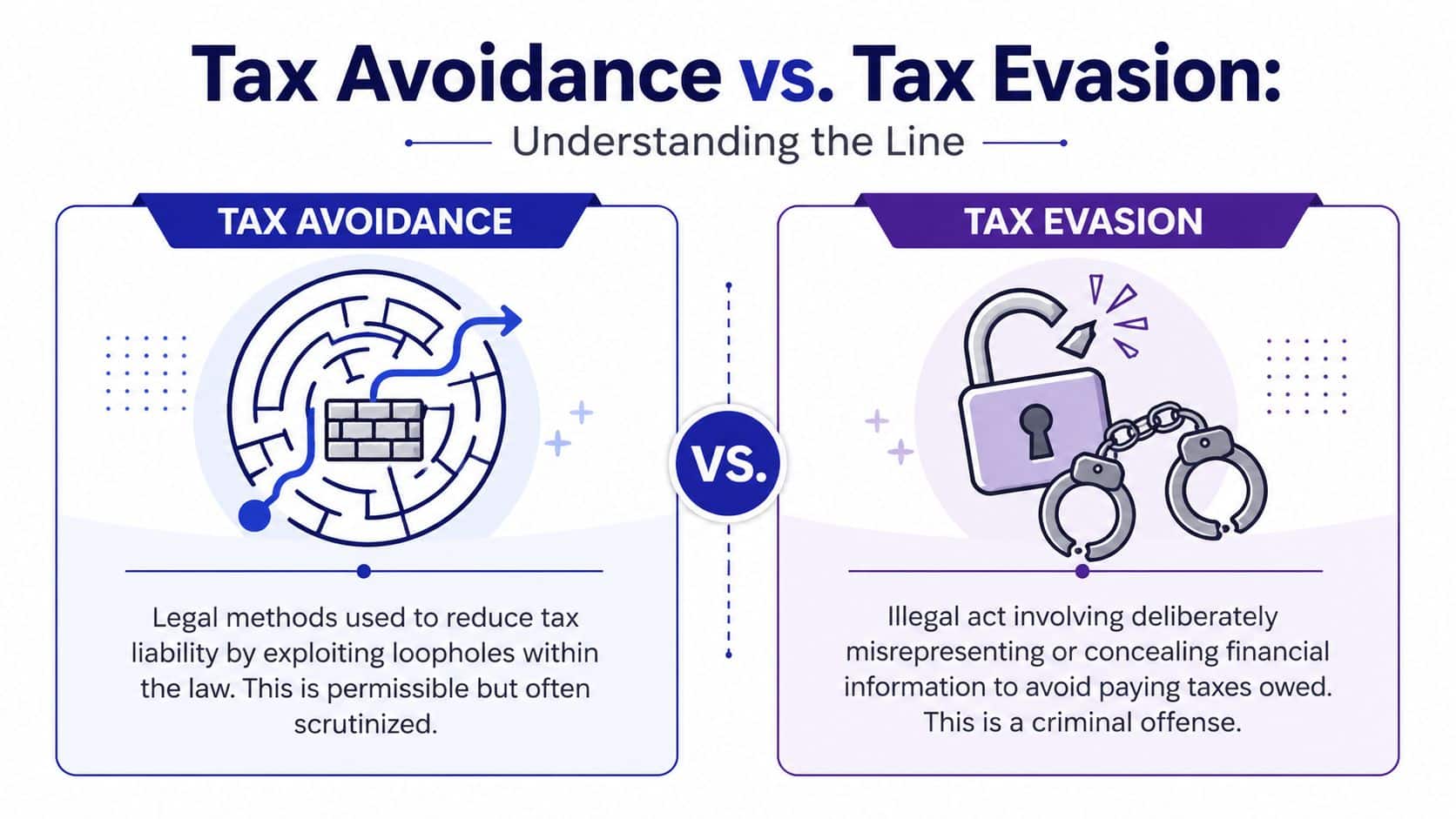
A simple way to think about it
Avoidance follows the route on the map, even if it takes an aggressive turn.
Evasion redraws the map after the journey and lies about where you’ve been.
That’s why the word dishonesty matters so much. HMRC doesn’t send people to prison because their records were messy. Prison risk starts when HMRC believes the mess was engineered to mislead.
The line that matters in practice
Use this comparison when you assess your own position:
| Issue | Tax avoidance | Tax evasion |
|---|---|---|
| Legal status | Within the law unless successfully challenged | Criminal if dishonesty is proved |
| Typical behaviour | Planning, structuring, use of reliefs | Concealment, falsification, omission |
| Core dispute | Interpretation of rules | Intent and truthfulness |
| Main risk | Extra tax, interest, penalties, litigation | Criminal investigation, confiscation, prison risk |
That middle column often collapses under scrutiny. A director says, “My adviser told me this worked.” Fine, but what did you do with the books? Did you disclose the arrangement? Did the invoices reflect reality? Did payroll entries match actual payments? That’s where legal planning ends and criminal exposure begins.
If HMRC can’t prove deliberate dishonesty, the criminal case weakens fast. If your records suggest concealment, the opposite happens.
Why forensic analysis matters at this stage
A forensic accountant doesn’t start with labels. They start with evidence. They trace transactions, test invoice chains, reconcile bankings to declared turnover, review journal patterns, and compare explanations against contemporaneous records. That work matters because businesses often sit in a grey zone between incompetence and intent.
A bad bookkeeping system can create a false appearance of fraud. It can also hide real fraud. You need someone trained to tell the difference.
That’s the practical answer to the search for prison for tax evasion UK. Before anyone talks confidently about jail, they need to answer a narrower question. Can HMRC prove that you acted fraudulently, personally, and knowingly?
Inside an HMRC Criminal Investigation From COP9 to Crown Court
The route from enquiry to prosecution isn’t random. HMRC usually follows a pattern, and directors who understand that pattern make better decisions earlier.

Historically, HMRC has been selective about criminal tax work. Over a decade, it initiated 3,665 criminal prosecutions for tax crimes, which was 23 times lower than the 85,745 prosecutions for benefits crimes, despite tax fraud’s financial impact being nine times larger, according to TaxWatch UK’s review of tax crime versus benefits crime. The point is clear. HMRC doesn’t criminally pursue everything. It tends to reserve that route for cases it sees as serious, deliberate, and worth making an example of.
The civil fraud route and COP9
Some cases begin with Code of Practice 9, often called COP9. This is a civil fraud investigation, but don’t underestimate it. HMRC uses COP9 when it suspects tax fraud and offers the Contractual Disclosure Facility.
That offer creates a sharp decision point. If you admit deliberate conduct fully and properly within the required process, you may avoid criminal prosecution for the disclosed fraud. If you reject it, or if HMRC thinks your disclosure is incomplete or dishonest, the danger rises.
Directors get this wrong when they treat COP9 as a form-filling exercise. It isn’t. It is a strategic decision with criminal implications.
What usually happens next
An HMRC matter often moves through stages like these:
Initial contact or notice
HMRC asks questions, requests records, or signals suspected irregularities.Assessment of your explanation
Investigators test whether your account fits the documents.Disclosure pressure
They push for fuller records, access to digital systems, explanations of transactions, and supporting evidence.Escalation or containment
If the evidence points toward deliberate fraud, the case can intensify. If the facts support error, confusion, or weak controls instead, the matter may stay civil.
When cases become openly criminal
The most serious matters may bypass the softer civil path. In those situations, HMRC can investigate criminally from the outset. That can involve interviews under caution, search warrants, seizure of computers and records, and coordinated action with other authorities.
The practical consequence is simple. Once a case is treated as criminal, every statement matters more, every inconsistency hurts more, and every missing document looks worse.
A useful overview of investigative pressure points appears in this video:
Where directors lose control
They lose it when they assume cooperation means answering everything instantly. Proper cooperation isn’t uncontrolled talking. It’s disciplined disclosure.
Use this as a working checklist:
- Secure the evidence first: Lock down accounting software access, email trails, bank statements, VAT workings, and payroll records.
- Build a chronology: Dates matter. HMRC will compare what happened, when it happened, and who approved it.
- Separate fact from explanation: “I didn’t know” is an explanation. System logs, signatures, and transaction trails are facts.
- Coordinate legal and financial response: Criminal tax work crosses both. A fragmented defence usually fails.
Early accuracy beats early optimism.
From interviews to court
If the case continues toward prosecution, the focus shifts from disclosure to proof. HMRC and prosecutors will try to show dishonest conduct through records, behaviour, and inconsistencies. Crown Court cases often turn on whether the documents support a deliberate scheme or a flawed business process.
That’s why the middle period matters so much. Between the first notice and any charging decision, there’s a window where evidence can still be organised, explained, tested, and challenged. That window closes fast.
The Deciding Factors When Does HMRC Push for Prison Time
The question is not whether HMRC is angry. The question is whether HMRC believes it can prove dishonesty against a specific person.
That is the point many directors miss. Prison does not follow from a messy set of books or a large tax assessment on its own. Custody risk rises when investigators can turn the records into a simple allegation of deliberate cheating, then tie that allegation to decisions you made, approved, benefited from, or ignored.
The legal ceiling is higher than it used to be. Legislative changes in the Finance Bill 2023-24 increased the maximum prison sentence for serious tax fraud from 7 years to 14 years, across taxes and duties administered by HMRC, as set out in the government’s policy paper on doubling the maximum prison term for the most egregious examples of tax fraud. That matters for one reason. It gives prosecutors and judges more room to treat a serious evasion case as criminal conduct deserving a long sentence.
What makes HMRC push for custody
HMRC does not need a dramatic headline. It needs a believable dishonest narrative supported by documents, conduct, and motive.
Clear signs of deliberate conduct
False invoices, suppressed sales, hidden bank accounts, sham suppliers, payroll fraud, and disguised remuneration arrangements all support the same allegation. This was not an accident. The more the paperwork looks designed to mislead, the easier it is for HMRC to argue intent.
Duration and repetition
A single bad quarter can be explained. A pattern repeated across VAT periods, payroll runs, or accounting years is much harder to defend. Repetition suggests planning. Planning is what pushes a case closer to prosecution.
Personal control
Directors face the sharpest risk when approval trails, banking authority, emails, or management accounts place them near the decisions in question. Seniority does not prove guilt, but it gives HMRC a target. If you controlled the process, signed off the numbers, or took the cash benefit, the dishonesty case becomes more straightforward.
Conduct after the issue surfaces
Many cases turn here. Deleting messages, creating replacement records, shifting blame to junior staff, or giving changing explanations can do more damage than the original error. By contrast, preserved records and a consistent evidence-based account can weaken the claim that there was a deliberate fraud.
The real test is whether dishonesty can be challenged
Directors often fixate on the tax loss figure. That is a mistake. I have seen lower-value cases become criminal because the evidence of deceit looked strong, and higher-value disputes stay civil because the intent case was weak.
That is why the key fight is not only about calculations. It is about interpretation. Were the transactions engineered to cheat HMRC, or do the records show a badly run business, poor controls, reliance on others, or a genuine misunderstanding that spiralled into a serious compliance failure? That distinction decides whether HMRC can justify prison risk.
| Factor | Higher prison risk | Better position |
|---|---|---|
| Records | Fabricated, altered, selectively missing | Preserved, traceable, consistent |
| Intent evidence | Emails or steps showing concealment | Documents showing confusion, poor systems, reliance on advice |
| Behaviour | Obstruction, panic edits, shifting stories | Controlled cooperation, accurate disclosure |
| Director role | Approval, benefit, authority over finances | Limited involvement supported by hard evidence |
| Pattern | Repeated conduct over time | Isolated issue with a credible explanation |
HMRC pushes for prison when it can present dishonesty as a clear story with a clear person at the centre of it.
A public example shows the point. In cases where courts see sustained evasion, personal benefit, and records that support deliberate conduct, custodial sentences follow. The lesson for a director is simple. If HMRC can make your actions look intentional, the case becomes dangerous fast.
Prison is only one part of the threat. Financial restraint often arrives earlier. If investigators believe assets represent criminal benefit, Proceeds of Crime Act risks can freeze funds overnight. That can cripple trading before any trial takes place.
Good case preparation now depends on disciplined evidence handling, transaction analysis, and document review. Many legal teams now support that process with leading legal technology innovations, but technology does not replace judgment. Someone still has to examine the records and dismantle the dishonesty allegation line by line.
My advice is blunt. Stop asking only, “How much tax is in dispute?” Ask, “What evidence lets HMRC say this was dishonest, and how do we break that argument?” That is the question that changes outcomes.
Building Your Defence How a Forensic Accountant Can Protect You
Your regular accountant may be competent, diligent, and loyal. They still may be the wrong person for this job.
A routine accountant prepares accounts, manages compliance, and helps the business run. A forensic accountant investigates allegations, reconstructs transactions, analyses disputed intent, and prepares evidence that can survive hostile scrutiny. Those are not the same skillset.

The issue most directors miss
An important nuance in tax evasion cases is the distinction between corporate director liability and personal prison risk. Prison requires proof of deliberate, personal dishonesty, not mere innocent participation in a flawed scheme. That’s why forensic audits matter. They can distinguish mismanagement or error from deliberate fraud, which is central to negotiating civil penalties over criminal charges, as explained in this discussion of UK tax evasion penalties and the role of forensic audits.
That point is bigger than it sounds. Many directors are surrounded by outsourced bookkeepers, payroll staff, tax advisers, finance managers, and software systems. The existence of a bad tax outcome does not automatically prove that the director acted with fraudulent intent. But you need evidence to show that. Assertions won’t do it.
What a forensic accountant actually does
A proper defence is built from the ledger upward. A forensic accountant will usually test the case in several directions at once.
- Transaction reconstruction: Rebuild what happened from bank entries, invoices, journals, contracts, VAT returns, payroll reports, and communications.
- Narrative testing: Compare HMRC’s theory with the documents. If the theory doesn’t fit the timing, authority chain, or money trail, that matters.
- Quantification: Establish the actual exposure. HMRC’s early view may be too high, too broad, or based on assumptions that don’t survive review.
- Responsibility mapping: Identify who knew what, who approved what, and whether the records really support personal dishonesty.
Why this changes outcomes
Cases turn on credibility. If HMRC says you engineered a scheme, someone must test whether the data supports that allegation. If journal entries were posted by another employee, if invoices reflect supplier failures rather than fabricated trading, or if undeclared receipts were later corrected within a broader pattern of poor controls, the legal significance changes.
That work isn’t glamorous. It’s painstaking. It often involves downloading ledgers, reconciling incomplete records, comparing source documents, tracing funds through multiple accounts, reviewing email authority chains, and isolating where the facts diverge from the accusation.
The right financial analysis doesn’t excuse wrongdoing. It stops HMRC from overstating it.
Common objections and the blunt answer
Directors hesitate for familiar reasons. Most of them are expensive mistakes.
| Objection | Reality |
|---|---|
| “My accountant can deal with HMRC.” | Routine tax correspondence is not the same as defending a dishonesty case. |
| “I’ll wait and see how serious it gets.” | Delay gives HMRC time to frame the facts first. |
| “A specialist will cost too much.” | Criminal exposure, confiscation risk, disqualification pressure, and reputational damage cost more. |
| “I’ve done nothing wrong, so evidence will speak for itself.” | Evidence doesn’t organise or explain itself. Someone has to build the case around it. |
The practical value in contested cases
Forensic accountants also help legal teams work faster and more accurately. They can narrow disputed periods, identify weak assumptions, isolate key transaction chains, and prepare schedules that are usable in interviews, negotiation, and court.
In more complex disputes, lawyers increasingly combine that financial work with digital case management and document review. If you want a useful overview of leading legal technology innovations, that area is worth understanding because large tax disputes often produce huge volumes of records and timelines.
Why specialist independence matters
A forensic accountant should be prepared to say what helps you and what hurts you. That independence gives the analysis weight. It also makes settlement more realistic because HMRC and legal teams respond better to disciplined, evidence-based work than to advocacy dressed up as accounting.
If you’re weighing whether specialist support is justified, this is the core question. Do you need someone to maintain the books, or do you need someone to investigate the facts and challenge an allegation of dishonesty? If it’s the second, the reasons to use a forensic accountant become obvious very quickly.
Avoiding the Worst Mitigating Factors and Settling with HMRC
Once HMRC is looking at possible dishonesty, your behaviour after first contact can either reduce the damage or deepen it. There’s no middle ground for long.
The strongest mitigation usually comes from disciplined cooperation. That doesn’t mean careless openness. It means accurate disclosure, document preservation, realistic admissions where necessary, and a clear payment strategy if tax is due.

What helps in real life
You can improve your position by doing a few things well and doing them early.
- Stop document drift: Don’t let records disappear into personal inboxes, old laptops, or forgotten cloud folders.
- Correct the factual record: If HMRC is working from wrong assumptions, challenge them with evidence, not indignation.
- Show the money position accurately: If tax is due, quantify it properly and address payment.
- Demonstrate responsible conduct now: Governance improvements made during the enquiry can support a more credible civil outcome.
Civil settlement is often the target
Many directors hear the phrase prison for tax evasion UK and assume every serious case ends in court. That’s wrong. In many matters, the practical objective is to steer the case toward a civil settlement instead of criminal prosecution.
That usually means agreeing the tax position, interest, and a penalty. The quality of your disclosure and cooperation matters a lot. So does whether HMRC believes you are finally telling the truth.
One nuance matters here. For deliberate cases, financial penalties can still be severe. The background material provided for this article notes that penalties can reach up to 200% of the tax due in some circumstances, and that first-time or minor matters often end in fines rather than prison. The lesson is straightforward. Avoiding custody does not mean escaping serious pain.
A civil settlement is not a soft outcome. It’s often the best available commercial outcome.
What not to do
Directors sabotage mitigation when they:
Edit history after contact from HMRC
Late-created documents and rewritten explanations can destroy credibility.Blame junior staff for everything
If your approval, signatures, or benefit appear in the records, that tactic usually backfires.Promise payment figures without analysis
Anxious overpayment is still a mistake. Get the numbers right.Treat remorse as theatre
HMRC responds to conduct, records, and practical correction, not rehearsed language.
The sensible path
The best negotiated outcomes usually come from a joined-up approach. Legal advisers deal with rights, process, and exposure. Forensic accountants deal with numbers, chronology, evidence integrity, and quantification. Directors deal with one thing only. Making sure the business doesn’t keep creating fresh problems while the old one is under investigation.
Take Control of Your Financial Future Today
An HMRC fraud investigation can wreck judgment before it wrecks finances. That’s why so many directors make avoidable mistakes in the first week. They talk too much, review too little, and underestimate how quickly a tax issue can become a dishonesty case.
You don’t need false comfort. You need a plan.
The key question behind prison for tax evasion UK isn’t whether HMRC can sound threatening. It can. The key question is whether the evidence proves deliberate personal dishonesty, whether the tax has been quantified properly, and whether the case can be steered toward a civil outcome before prosecutors shape the narrative for you.
That is where specialist forensic accounting earns its place. Not as a bolt-on service. As a core part of the defence.
A forensic accountant can reconstruct what happened, test HMRC’s assumptions, isolate weak links in the allegation, and distinguish bad controls from criminal intent. That work gives your legal team something solid to fight with. It also gives you a clearer view of your real exposure, which is far better than making decisions in a fog of panic.
If you’re under pressure now, act like a director. Secure the records. Stop informal explanations. Build the timeline. Get specialist help before HMRC’s version of events hardens into the accepted one.
Delay is expensive. Precision is protective.
If you’re facing HMRC scrutiny and need clear, independent financial analysis, speak to Lighthouse Consultants. Their team handles forensic accountant and forensic accounting matters involving fraud, disputes, tax-risk evidence, quantification, and expert reporting, helping directors and business owners regain control during critical periods.
Tags: forensic accountant, forensic accounting