You may already be in the danger zone without realising it.
A founder splits time between London, Dubai, and New York. A non-resident director flies in for board meetings. A family keeps a UK property “just in case”. Then HMRC asks a simple question. How many days were you in the UK, and what ties did you keep?
That question often drives a much larger problem. The statutory residence test looks mechanical at first glance, but disputes rarely turn on broad intentions. They turn on evidence, sequencing, and detail. In forensic accounting work, I’ve seen residence arguments become central to tax enquiries, shareholder disputes, divorce-related asset tracing, fraud matters involving relocated directors, and litigation where one side needs a defensible chronology of movement, work, and personal connection.
Business owners often think the issue is only personal tax. It isn’t. Residence status can affect the tax treatment of worldwide income and gains, influence how historic returns are reviewed, and complicate due diligence when a buyer or investor examines management conduct and offshore structures. Where the facts are messy, a forensic accountant doesn’t just “do the tax”. We reconstruct travel, test documents, challenge assumptions, and quantify exposure in a way that can stand up under scrutiny.
The Million-Pound Mistake That Starts with a Single Day
A client leaves the UK on 5 April believing the timing is clean. Months later, HMRC asks for the travel record, diary, accommodation details, and evidence of work performed in the UK. One extra day, one overlooked tie, or one assumption about available accommodation can change the answer for the entire tax year.

That is how seven-figure disputes begin. The statutory residence test is structured, but the financial exposure can be severe when the underlying facts are wrong. In practice, the fight is rarely about what the law says in broad terms. The fight is about proof. Which days counted, which ties existed, when they arose, and whether the record supports the position taken on the return.
Where business owners usually go wrong
Business owners often treat residence as a commercial judgement supported by rough day counts. That approach fails under scrutiny. The UK rules have applied a formal statutory framework since 6 April 2013 under Finance Act 2013. The sequence matters. The facts matter more.
The expensive mistakes are usually small. A late-night arrival that creates a UK day. A property that remained available after the taxpayer assumed it was out of the picture. Work done in the UK that was dismissed as incidental. Family presence that strengthens a tie analysis far more than expected. In forensic accounting work, those details are not side issues. They are often the points that decide the case.
Advisers can miss them as well. Personal tax, payroll, immigration, and corporate reporting are often handled separately, with no single person testing the full chronology. Cross-border businesses therefore use specialist tax, visa, and immigration experts where staff mobility, director travel, and tax exposure overlap.
Residence disputes usually start with ordinary records and bad assumptions, not dramatic facts.
Why the stakes escalate fast
If HMRC concludes that the residence position is wrong, the issue can spread well beyond a revised day count. Worldwide income and gains may come into charge. Earlier returns may need to be revisited. Offshore structures, remittances, directorship activity, and disclosure failures may all come under review. At that stage, the case stops being a technical filing point and becomes an evidence exercise with real financial consequences.
The practical burden is heavy. Someone has to rebuild the timeline from passports, boarding records, calendars, phone data, card transactions, meeting papers, tenancy documents, and family movements. Someone then has to quantify the tax effect of each competing version of events in a form that will stand up in correspondence, negotiation, or litigation.
If HMRC has already opened the door, a broader review of what an HMRC investigation can involve is often the sensible next step.
Why a DIY Approach to the Statutory Residence Test Invites Disaster
A spreadsheet helps. It doesn’t decide the case.
Many people approach the statutory residence test as though it were only a counting exercise. Count the days, stay under a number, and move on. That works until your facts stop being clean. They almost always do. Flights get diverted. Family arrangements change. A spare room becomes “available accommodation”. Directors answer emails from London and create UK work days without thinking about it.
The weak points in self-assessment
DIY assessments usually fail in the grey areas. The rules are structured, but their application depends on evidence. That distinction matters. You might believe a stay in the UK should be ignored because events were outside your control. HMRC may still reject that if your documentation is thin.
That risk isn’t theoretical. A 2025 Saffery report highlighted rising disputes, with HMRC rejecting 65% of exceptional circumstances claims in audits involving Middle East expatriates, often because the taxpayer couldn’t prove the event was uncontrollable. The same report noted a 40% success rate for claims supported by third-party affidavits, compared with 10% for self-declarations, as discussed in Farrer & Co’s review of the statutory residence test.
Practical rule: if a residence position depends on memory, it’s already weaker than you think.
Why general accounting support often isn't enough
A competent accountant may prepare returns accurately based on information given. That’s not the same as a forensic review. Forensic accounting work asks different questions.
- What the person did: We test diaries against travel confirmations, messages, card records, and meeting papers.
- What was available to them: Accommodation and home issues often turn on access, continuity, and use, not just ownership.
- What can be evidenced independently: HMRC pays close attention to records created at the time, not later explanations.
That difference becomes critical in disputes. A residence position may look fine in summary, yet collapse when someone maps it against dates and documents.
The objection I hear most often
The common objection is simple. “I know where I was.”
That’s often true at a high level and still useless in an enquiry. HMRC won’t decide the matter by asking whether your account feels plausible. They’ll look for consistency. Did your passport, boarding records, tenancy documents, board minutes, and work trail all tell the same story? Did you apply the statutory residence test in the right order? Did you distinguish a home issue from an accommodation tie issue? Did you preserve evidence before relationships soured or systems deleted records?
Forensic accounting adds value because residence disputes are evidence disputes. The tax rules matter, but the file matters more.
The SRT Framework Part 1 The Automatic Tests
A residence dispute often turns on an early mistake. Someone assumes the sufficient ties test will decide the year, skips the automatic tests, and builds the whole position on the wrong framework. By the time that error surfaces, the tax return has been filed, the evidence trail is incomplete, and the cost of correction is far higher than the cost of getting the sequence right at the start.
The statutory residence test works in a fixed order. The automatic overseas tests come first. If they do not settle the position, you move to the automatic UK tests. Only then do you consider sufficient ties. In forensic work, that order matters because it determines what facts need proving and which arguments are irrelevant.
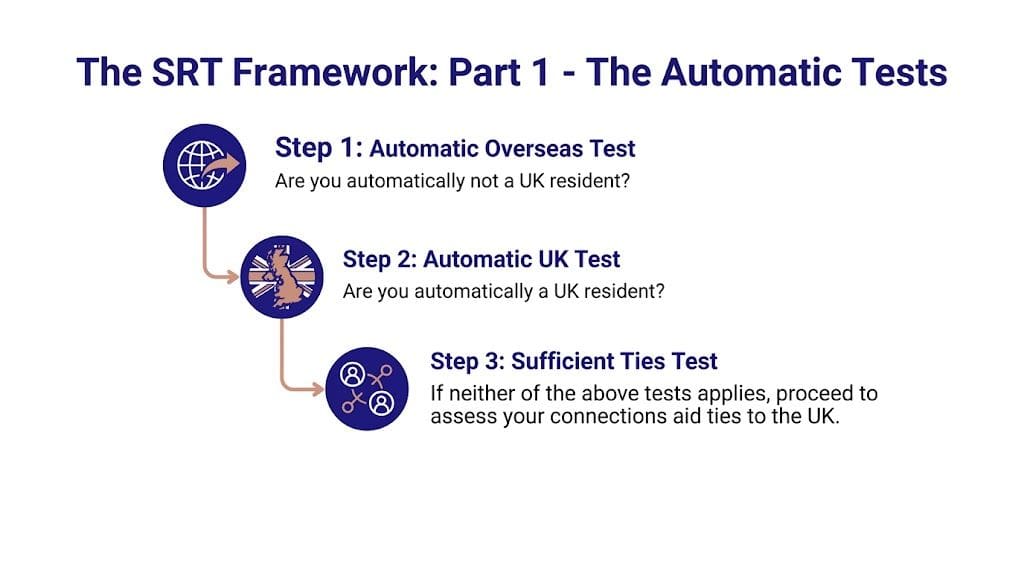
Automatic overseas tests
The automatic overseas tests can produce a clean non-resident answer. Broadly, they look at prior residence history, UK day counts, and whether full-time overseas work has been maintained within the limits set by the legislation.
Business owners and internationally mobile directors often get into trouble. They describe themselves as living abroad, and in commercial terms that may be true. The tax analysis is narrower and less forgiving. A small number of extra UK days, or a pattern of UK work activity that was never tracked properly, can knock out an automatic overseas result.
Full-time overseas work is a frequent pressure point. On paper, the position may look strong. In the documents, it can look very different. Board meetings held in London, investor calls taken from a UK flat, or a short run of transaction meetings can create UK workdays that were never counted at the time. In an enquiry, those details are not minor. They are often the reason a non-residence claim fails.
Automatic UK tests
If no automatic overseas test applies, the next question is whether the person is automatically UK resident. The best-known rule is the day-count threshold for substantial UK presence. That tends to be the least disputed because it is easy to state and, if records are good, usually easy to verify.
The harder cases sit in the home and work tests. A UK home can trigger residence where availability, use, and the position of any overseas home satisfy the statutory conditions. Clients often focus on ownership. That is not the right starting point. The practical questions are who could use the property, from when, on what terms, and whether the pattern of occupation can be proved from contemporaneous records.
The full-time UK work test creates similar problems. Titles and contracts help, but they do not settle the issue. The key question is what work was done, where it was done, and over what period. In disputes, I have found that calendars, email metadata, access logs, and meeting packs often carry more weight than tidy retrospective summaries.
What I test first in a forensic review
The first pass is usually a chronology exercise tied to documents, not a discussion about intention. The file needs to show a coherent pattern that survives challenge.
A reliable review usually starts with:
- Day counting: UK presence is usually counted by reference to where the person was at midnight, so travel timing matters.
- Workdays: A UK workday can arise from substantive activity carried out in the UK, not just formal attendance at an office.
- Home analysis: Availability, continuity of access, and actual use often matter more than legal ownership.
- Exceptional circumstances: Days may sometimes be disregarded, but only if the facts and evidence meet the statutory conditions.
If an automatic test decides the year, the analysis should stop there. Pushing on to ties without first settling the automatic position creates confusion and, in disputed cases, weakens credibility.
The practical trade-off
Clients often want commercial flexibility. They keep a UK property for convenience, retain directorships, and continue regular visits because the business needs them. That may be sensible from an operational perspective. It also reduces tolerance for error.
The reverse problem appears as well. Some individuals cut obvious UK presence but leave behind a work trail that still points back to the UK, or they assume a property does not matter because it was rarely used. HMRC does not test residence by asking what the individual meant to achieve. It tests residence by applying the statutory conditions to facts that can be evidenced.
From a forensic accounting perspective, the automatic tests are more than a technical first step. They are the point where a manageable compliance exercise can become a quantification exercise involving additional tax, interest, penalties, amended returns, and, in serious cases, formal dispute work. That is why the early review has to be exact.
The SRT Framework Part 2 The Sufficient Ties Test
A disputed residence case often turns on a detail that looked harmless at the time. One extra overnight stay. A spare room kept available. A board meeting treated as too minor to count. Once the automatic tests do not settle the year, the sufficient ties test is where those details start producing real tax exposure.
The question is not complicated in outline. It is exacting in application. You look at the individual’s UK day count and then measure that against the statutory ties that apply to them. You also have to place the person in the right category. Someone leaving the UK is tested more harshly than someone arriving for the first time, and misclassifying that status can distort the whole conclusion.
The five ties are family, accommodation, work, the 90-day tie, and the country tie, as noted earlier. In practice, the ties are less about labels and more about proof. In enquiries and tribunal work, I see the same pattern repeatedly. The client thought the risk sat in the day count. HMRC examined the ties.
The five ties in practical terms
Family tie. This sounds straightforward until family life has been split across jurisdictions. Spouses may live apart for work. Children may remain in the UK for school while a parent relocates. The legal relationship matters, but the lived arrangement during the tax year often matters more.
Accommodation tie. This is one of the most heavily disputed areas because clients tend to ask who owned the property. The rule asks whether accommodation was available and used in the way the legislation requires. A retained flat, a family home, or even regular access to someone else’s property can become relevant.
Work tie. This catches internationally mobile directors and founders with surprising frequency. Short periods of UK activity can matter. From a forensic accounting perspective, this tie is rarely tested by asking what the individual remembers months later. It is tested against diaries, meeting invites, call logs, expense claims, travel bookings, draft papers, and email traffic.
90-day tie. Historic UK presence can narrow the room for manoeuvre in later years. Clients who spent substantial time here before departure often underestimate how much that earlier pattern still affects the current analysis.
Country tie. For leavers, this is often where fragmented travel creates trouble. If the UK ends up being the country where the individual spent the greatest number of days, the conclusion can shift quickly, especially where no other jurisdiction shows a clear centre of day-to-day life.
Thresholds that change the result
The day-count thresholds are a working tool, not a substitute for analysis. They only help once each tie has been correctly identified and the person has been correctly treated as a leaver or an arriver.
| Number of UK Ties | Days in UK to Become Resident (Leavers) | Days in UK to Become Resident (Arrivers) |
|---|---|---|
| 1 | More than 120 days | More than 120 days |
| 2 | More than 90 days | More than 90 days |
| 3 | More than 45 days | More than 45 days |
| 4 | More than 15 days | More than 45 days |
| 5 | More than 15 days | Not applicable |
That table is where many mistakes begin.
Used properly, it helps frame risk. Used casually, it gives false comfort because each threshold depends on definitions that are narrower than clients expect and more fact-sensitive than advisers sometimes assume. In a dispute, the argument is often not about the arithmetic. It is about whether a tie existed at all, on what evidence, and for which part of the year.
What usually causes arguments
Three areas produce a disproportionate number of residence disputes.
- Accommodation: whether the property was available, for how long, and on what terms
- Work: whether the UK activity crossed the statutory line often enough to create the tie
- Country tie: whether fragmented travel records have been counted accurately across all jurisdictions
A one-day error can matter. So can a one-document error. If a client says a London flat was unavailable, but messages, access records, or overnight stays point the other way, the tie analysis can change. If a director says no UK work was done, but signed minutes and same-day follow-up emails place substantive activity in the UK, that position becomes difficult to defend.
Residence disputes often turn on the difference between occasional convenience and legally relevant availability.
How a forensic review differs from a quick tax review
A standard compliance review often starts with a checklist. A forensic review starts with evidence and asks whether the checklist answer survives contact with documents.
I would want to test travel records against passport stamps, flight confirmations, phone location data where available, calendar entries, company records, and family movements. I would also examine whether the narrative makes commercial sense. If someone claims to have stepped back from UK work, do the board packs and governance trail show the opposite? If they say accommodation was not available, do utility usage, deliveries, or visitor patterns suggest continuing access?
That difference matters because SRT disputes are rarely confined to residence status. Once residence changes, the case usually becomes a quantification exercise involving additional tax, interest, penalties, amended returns, and sometimes expert evidence on loss, timing, and source of funds. The sufficient ties test is therefore not just a technical middle step. It is often the point where a manageable filing issue turns into a high-value tax dispute.
The Statutory Residence Test in Action Worked Examples
Theory matters less than application. These worked examples show where business reality collides with the statutory residence test.

Amelia leaves for Singapore but keeps too much behind
Amelia is a British executive who takes a senior role in Singapore. She assumes the move ends UK residence. She leaves the UK, starts working abroad, and cuts back her UK travel.
The problem sits in the detail. Her spouse remains in the UK for part of the year while children finish schooling. She keeps access to the family property. She returns for strategy meetings and spends enough time in the UK that her day count no longer gives easy comfort.
In a forensic review, the first question isn’t whether she “moved”. It’s whether she met an automatic overseas test. If not, she becomes a leaver for sufficient ties purposes, and the remaining family, accommodation, work, and historic UK presence may create a much harsher outcome than she expected. The commercial move abroad may be genuine and still fail to produce the tax result she assumed.
Ben arrives in London to build a UK operation
Ben is a US tech founder launching a London subsidiary. He doesn’t think of himself as UK-based. His home, family, and main business interests remain outside the UK.
Yet he spends repeated stretches in London, uses a serviced apartment that becomes a familiar base, and works intensively while here. He isn’t a leaver. He is an arriver. That helps, but it doesn’t remove the need for analysis.
For Ben, I’d examine whether he triggered an automatic UK test through a home or full-time UK work pattern. If not, I’d assess whether his accommodation and work created enough ties for the days he spent in the UK. The result can surprise arrivers because they often focus on their “real home” overseas and underweight what repeated UK business presence looks like on paper.
Chloe attends board meetings and thinks that is low risk
Chloe is a non-resident director of a UK company. She flies in for board meetings and signs documents while visiting. She assumes that because she lives elsewhere and owns no UK property, the risk is small.
Sometimes it is. Sometimes it isn’t.
The work tie is the immediate issue. Director activity creates evidence. Board agendas, signatures, governance packs, and hotel stays are all capable of showing UK workdays. If Chloe also stays regularly at a family property or another available address in the UK, the analysis gets tighter. The mistake many directors make is treating each UK visit as isolated when HMRC will look at the full tax year and supporting records.
What these examples have in common
Each case turns on sequence, records, and proof rather than broad self-description.
A good forensic accounting review would usually build:
- A full movement chronology: Entries, exits, midnights, and travel purpose.
- A tie matrix: Family, accommodation, work, historic day count, and country position.
- An evidence file: Contracts, diaries, board materials, property records, and third-party documentation.
- A risk memo: The likely filing position, weaker points, and where an enquiry would focus.
That process is useful long before any dispute starts. It can also be used retrospectively when lawyers need to quantify exposure or challenge an allegation about residence made in litigation, insolvency matters, or shareholder conflict.
From Test Results to Tax Returns Record-Keeping and Consequences
A residence conclusion only starts the actual work. Once a person is resident, or claims not to be, that position has to be carried through the tax return, matched to the facts, and supported by records that can survive HMRC scrutiny years later.
The financial exposure can be severe. A residence error can pull worldwide income and gains into charge, reopen earlier filings, trigger penalties and interest, and create a valuation exercise if assets were sold or income was received while the wrong status was being used. In disputes, I often find that the tax issue is only part of the problem. The same factual errors can affect shareholder claims, divorce disclosure, insolvency recoveries, and allegations about where control was really exercised.
The consequences also extend beyond annual income tax. As noted earlier, the residence analysis now feeds into wider UK tax exposure, including inheritance tax risk for long-term residents. That raises the stakes for families with offshore structures, trusts, or non-UK assets.
Why records decide the case
HMRC does not accept a residence position because it sounds plausible. It tests the filing position against objective evidence, and weak records are often what turn a technical issue into an enquiry.
Forensic review is useful here because the task is evidential before it is argumentative. The job is to reconcile travel, accommodation, work activity, banking, corporate records, and third-party documents into one timeline that can be checked. Small inconsistencies matter. A meeting minute, a hotel invoice, or a phone location record can undermine a claimed day count, and once confidence in the chronology falls away, the rest of the return comes under pressure.
Records worth keeping
A defensible file usually includes:
- Travel records: flight bookings, boarding passes, passport scans, rail tickets, and calendar entries
- Accommodation records: tenancy agreements, booking confirmations, check-in data, and evidence of actual use
- Work records: diaries, board packs, email traffic, meeting notes, expense claims, and documents showing where duties were performed
- Personal context: medical material, visa paperwork, school records, and third-party confirmations where they explain presence in or absence from the UK
- Tax support: the day-count working papers, tie analysis, draft computations, and the rationale for the filing position taken
Contemporaneous evidence carries far more weight than a witness statement produced after an enquiry starts.
Corporate and dispute implications
Residence disputes rarely stay inside the tax file. A buyer may question whether historic filings were correct. A co-shareholder may argue that a director was operating from the UK despite saying otherwise. An insurer or litigation opponent may use the same records to challenge credibility on a different issue.
That is why residence work often overlaps with UK offshore tax compliance issues. Once HMRC starts asking where someone lived, worked, and controlled assets, the review can widen quickly into offshore income, reporting failures, remittances, and the accuracy of earlier returns. Where planning also touches international structuring, the wider position under new non dom status UK rules may need to be considered alongside the SRT analysis.
The practical point is simple. Record-keeping is not admin. It is part of the defence.
Secure Your Certainty with Expert Forensic Accounting
If you’ve read this and feel less certain than when you started, that’s a sensible reaction. The statutory residence test is structured, but real lives are untidy. Cross-border founders, directors, and high-net-worth individuals rarely fit neat templates.
That matters most when the issue is already live. An HMRC enquiry, threatened litigation, divorce proceedings, insolvency work, or due diligence exercise can turn residence into a contested fact. At that stage, broad tax advice is not enough. You need a documented position supported by chronology, independent evidence, and financial quantification that can withstand scrutiny.
When specialist support makes the difference
Forensic accounting support becomes especially valuable where you need to:
- Reconstruct history: Establish day counts, ties, and work patterns from incomplete records.
- Quantify exposure: Assess the likely tax effect of a challenged residence position.
- Support lawyers: Provide schedules, chronologies, and independent analysis for negotiations or court.
- Prepare for HMRC: Build an evidence-backed response rather than rely on assertion.
Residence risk also sits alongside wider rule changes affecting internationally mobile individuals. If your planning touches domicile reform and global structuring, it helps to understand the broader context around new non dom status UK rules, especially where residence analysis feeds into wider wealth planning decisions.
What robust forensic accounting looks like
Strong work in this area is disciplined. It tests records, identifies contradictions, and distinguishes what can be proved from what is merely believed. It also translates technical tax facts into the language a tribunal, investigator, insurer, or litigation team can use.
That is why businesses and legal teams often need more than a compliance answer. They need independent financial analysis, formal reporting, and, in some cases, expert evidence. If that is your position, it is worth understanding why you need a forensic accountant before the issue hardens into a dispute.
The key point is simple. Residence certainty is rarely achieved by guesswork. It comes from evidence, method, and challenge.
If your residence position affects tax exposure, a live dispute, or a cross-border business structure, speak to Lighthouse Consultants. Their forensic accounting team can help reconstruct the facts, quantify the financial risk, and produce an independent analysis that stands up in HMRC discussions, negotiations, and court. Tags: forensic accountant, forensic accounting