A clean external audit opinion can create false comfort.
The board sees signed accounts. The lender sees compliance. Yet the CFO still feels the strain in cash flow, margin, and working capital. Stock turns look wrong. Supplier spend creeps up. Refunds, write-offs, or overtime costs keep appearing in places no one expected.
That tension sits at the heart of internal audit vs external audit. One gives outside stakeholders assurance over the financial statements. The other helps management and the board test whether the business is operating as it should.
For companies dealing with unexplained losses, weak controls, disputes, or suspected misconduct, that distinction matters even more. It often marks the line between a year-end check and a proper financial investigation. It also explains why forensic accountant input becomes critical when audit findings point to something more serious than routine error.
When Your Numbers Don't Add Up
The difficult cases rarely begin with a dramatic fraud allegation.
They usually begin with a quieter pattern. Revenue holds up, but profit slips. Bank balances feel weaker than the P&L suggests. A division keeps missing forecast despite steady demand. The annual audit completes without major qualification, but management still knows the picture doesn't fit.

Why a clean opinion may not answer the underlying problem
An external audit answers a specific question. It asks whether the financial statements present the company’s position fairly under the relevant reporting framework. That matters. Investors, lenders, HMRC, and shareholders need that assurance.
But it doesn’t tell you why margin fell in one branch, whether approval controls work in procurement, or whether one manager has been bypassing policy for months.
That’s where leaders get stuck. They assume “audited” means “under control”. It doesn’t.
A statutory audit can confirm the accounts without uncovering the operational leak that is draining cash.
In practice, many warning signs sit below materiality for the external audit but remain highly material for management. Duplicate suppliers, poorly controlled credit notes, manipulated expenses, unauthorised journals, and stock adjustments can all erode performance long before they trigger a year-end dispute.
The warning signs usually sit in raw records
When finance teams start testing anomalies properly, they often need to rebuild a reliable transaction trail from inconsistent exports, scanned PDFs, and multiple banking formats. In those situations, a tool like a secure bank statement converter can help standardise source data before deeper review.
That step sounds minor. It isn’t.
Forensic accounting work often turns on whether the team can compare like with like across accounts, entities, and periods. If the raw bank and ledger data aren’t usable, the investigation slows immediately.
What management often misses
Boards usually ask the wrong first question. They ask, “Did the external auditors miss this?” Often, that’s not the right test.
A better set of questions is:
- What was the audit trying to conclude: Financial statement fairness, or control effectiveness?
- Where did the anomaly arise: In reported balances, operational workflow, or conduct?
- Who needed the answer: Shareholders and regulators, or management and legal counsel?
- What’s at risk now: Reporting accuracy, cash loss, fraud exposure, or litigation?
Those questions separate irritation from significant risk. They also determine whether you need an internal audit, a focused control review, or a forensic accountant to preserve evidence and quantify loss.
Internal vs External Audit An Overview
Two audit functions with different jobs
External audit is an independent examination of financial statements by a third party. Its core audience sits outside the day-to-day business. Think shareholders, lenders, regulators, tax authorities, and other stakeholders who rely on the accounts.
Internal audit serves the organisation itself. It reviews risk management, controls, governance, and operational effectiveness so that management and the board can improve how the business runs.
Those functions can overlap in information, but they don't share the same purpose.
If you want a concise primer on the wider regulatory context outside the UK, A Guide to Audit in UAE is a useful comparison because it shows how audit obligations and expectations shift by jurisdiction.
What each audit is designed to deliver
A straightforward way to understand internal audit vs external audit is to focus on the end user.
| Audit type | Main user | Core question | Typical output |
|---|---|---|---|
| Internal audit | Management, board, audit committee | Are our controls, processes, and risk responses working? | Findings, recommendations, remediation actions |
| External audit | Shareholders and external stakeholders | Can users rely on these financial statements? | Independent audit opinion |
Internal audit is flexible. It can review payroll controls, procurement approvals, revenue recognition workflow, cyber governance, third-party risk, or claims handling. A company can shape it around its actual risk profile.
External audit is narrower by design. It follows professional standards and focuses on financial reporting assurance.
Why the distinction matters in practice
A CFO usually feels the difference first.
If the concern is statutory compliance, lender requirements, or annual accounts, external audit is the right tool. If the concern is hidden loss, weak segregation of duties, fraud indicators, or a process that no one trusts, internal audit is usually more useful.
That’s why businesses that want a practical definition often start with a plain-language overview such as https://lighthc.london/what-is-internal-audit/.
Internal audit asks how the business is being run. External audit asks whether the accounts can be relied on.
Legal counsel also sees this split clearly. External audit may identify misstatement risk. Internal audit may reveal the control breakdown behind it. Forensic accounting then becomes relevant if the matter develops into a fraud investigation, shareholder dispute, an insurance claim, or litigation support exercise.
Comparing Audit Functions A Detailed Breakdown
The confusion around internal audit vs external audit usually comes from treating them as substitutes. They aren't. They solve different problems, report to different audiences, and create value in different ways.
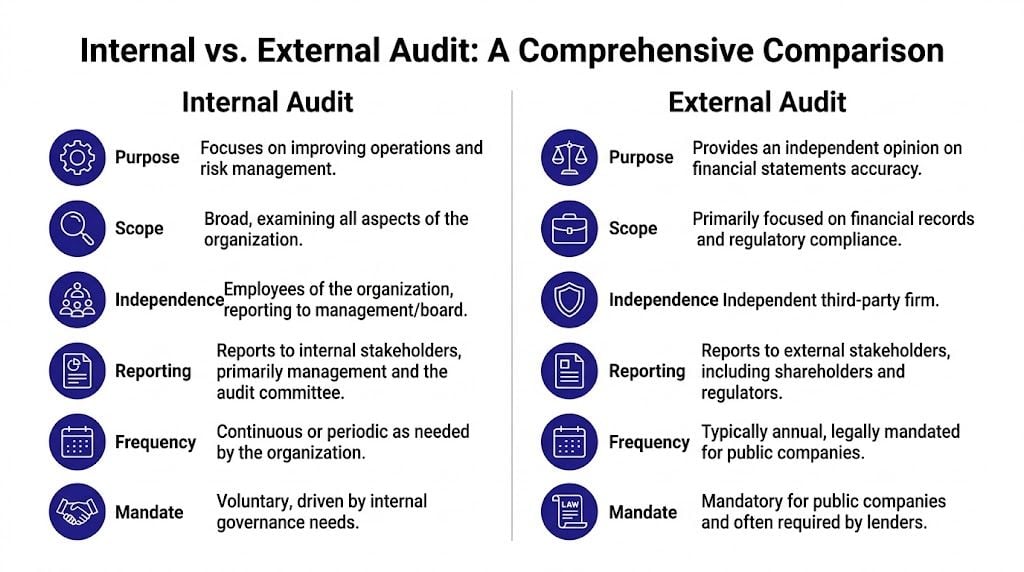
Internal Audit vs External Audit Key Differentiators
| Criterion | Internal Audit | External Audit |
|---|---|---|
| Purpose | Improve controls, governance, and operational performance | Provide independent assurance on financial statements |
| Main audience | Management, board, audit committee | Shareholders, lenders, regulators, other external stakeholders |
| Scope | Broad and risk-based | Focused on financial reporting and related controls |
| Timing | Ongoing or periodic through the year | Usually annual |
| Reporting line | Ideally to the audit committee or board for independence | To shareholders or those charged with governance |
| Legal position in the UK | Voluntary for most private sector entities | Required for companies exceeding statutory thresholds |
| Fraud focus | Can proactively test fraud risks, behaviour, and control gaps | Considers fraud risk as part of financial statement audit, but not as a full investigation |
| Typical outcome | Action plan and remediation | Audit opinion |
A broader walk-through of audit structure and process can be found at https://lighthc.london/the-anatomy-of-an-audit/.
Statutory trigger versus management choice
In the UK, external audits are mandated by the Companies Act 2006 for companies exceeding two of three thresholds: turnover of £10.2 million, balance sheet total of £5.1 million, or average 50 employees, according to MindBridge’s summary of the statutory position and audit alignment data.
Internal audit works differently. Most private sector businesses choose it because they want sharper visibility over risk, performance, and control.
That distinction changes behaviour. A mandatory audit often becomes a timetable exercise. A well-run internal audit becomes a management tool.
Scope is where the key difference appears
External auditors concentrate on balances, disclosures, assertions, and the evidence needed to support the accounts. Their work is necessarily disciplined and bounded.
Internal auditors can go where the risk sits. They can test vendor onboarding, purchasing authority, payroll amendments, inventory write-downs, expense approvals, system access, delegated authority, and post-acquisition integration controls.
That broader scope is why internal audit often surfaces issues that don't yet distort the financial statements enough to dominate the external audit, but still create serious commercial damage.
Practical rule: If your concern starts with “why is this happening?”, you’re usually outside the normal centre of an external audit.
Independence is not the same in each model
People often assume internal audit is less independent because it sits inside the business. That can happen. It usually happens when the function reports too closely to management, gets pulled into operational decision-making, or audits areas it helped design.
The better structure is clear reporting to the audit committee or board, plus a sharply defined mandate.
The same MindBridge summary notes that reliance on high-quality internal audit work reduced substantive testing by up to 25% and lowered external audit fees by 15 to 20%, but only when internal auditors showed strong independence and competence. The same source also notes that poor internal controls were a factor in 22% of audit deficiencies identified by the FRC in 2022 to 2023, which underlines how costly weak control testing can become in assurance terms.
Those figures matter for CFOs because they turn independence from a governance slogan into a cost issue.
Method matters more than many boards realise
External audit often works backwards from the reporting date. It tests evidence, applies materiality, evaluates estimates, and forms an opinion on the accounts.
Internal audit should work forwards from risk. It asks what could go wrong, where controls could fail, who could override them, how quickly the issue would be detected, and whether the business would respond properly.
That difference is especially important in forensic contexts.
A business that suspects expense manipulation, procurement collusion, side agreements, or cash diversion needs more than year-end sampling. It needs transaction mapping, behavioural indicators, policy testing, and escalation triggers. Internal audit can do that early. Forensic accounting takes it further when the facts suggest deliberate misconduct.
Reporting and action are different disciplines
External audit reports are formal, standardised, and directed to outside users. They serve trust in the accounts.
Internal audit reports should drive action. They need to state the root cause, identify the owner, define remediation, and set timing. Weak internal audit reports often describe findings without changing behaviour.
The strongest reports answer four practical questions:
- What failed: The control, process, or governance point
- Why it failed: Design gap, override, lack of monitoring, or poor segregation
- What exposure follows: Financial loss, compliance risk, dispute risk, or fraud opportunity
- Who fixes it: Named owner with a timetable
Where forensic accounting fits into the comparison
Internal audit and external audit are assurance functions. A forensic accountant serves a different role.
A forensic accountant follows disputed transactions, reconstructs records, tests intent indicators, quantifies losses, and prepares work that may need to stand up in negotiations, disciplinary action, arbitration, or court.
That’s why internal audit often acts as an early-warning mechanism. It can flag the symptoms. It usually won’t finish the evidential job.
Beyond Compliance The Strategic Value of Internal Audit
The usual objection is simple. If internal audit isn’t mandatory, why pay for it?
The short answer is that voluntary doesn’t mean optional in risk terms. It means management has to decide whether it wants visibility before the problem becomes public, expensive, or litigious.

The cost argument usually ignores the underlying exposure
A business rarely suffers from “lack of audit” in the abstract. It suffers from unchecked access rights, weak approval thresholds, poor stock controls, unmanaged third-party risk, or inconsistent evidence.
Internal audit addresses those conditions before they mature into fraud losses, failed transactions, covenant pressure, regulatory issues, or difficult insurance claims.
That’s become more relevant as boards face broader risk agendas. According to Linford & Co’s summary of UK audit trends, the UK’s 2025 Corporate Governance Code updates increased pressure even on non-FTSE firms to strengthen internal controls. The same summary states that 70% of firms outsource internal audit due to skills shortages, and that specialist teams provide 40% better risk coverage.
For many mid-market businesses, that’s the practical answer to the “why now?” question.
Outsourced internal audit can improve objectivity
An in-house team knows the business well. That helps with context.
But closeness can also soften challenge. Teams become familiar with legacy workarounds, personalities, and local habits. They may know where the weaknesses are but struggle to escalate them sharply.
An outsourced model can remove that friction. It also gives the board access to specialist skills in controls, cyber risk, investigations support, due diligence, and forensic review without building a full permanent team.
One option in that market is Lighthouse Consultants, which provides outsourced internal audit alongside forensic accounting and risk assessment for businesses dealing with control concerns, disputes, and unexplained losses.
Cyber and sustainability risks have changed the value equation
Internal audit used to be framed as a finance-side discipline. That’s too narrow now.
The same Linford & Co summary notes that cyber incidents in the UK mid-market have risen substantially, and that integrated internal and external audits can reduce breach costs significantly. Yet the same source says only a minority of SMEs have fully adopted that integrated model.
That gap matters because external audit generally captures the financial impact after the event. Internal audit can test preparedness before the event.
Boards that rely on the annual external audit to assess cyber resilience are asking the wrong team the wrong question.
What works and what doesn't
What works:
- Targeted audit plans: Focus on the areas where loss, misconduct, or disruption would hurt most.
- Board-level reporting: Keep findings independent from the managers who own the process.
- Control testing with evidence: Don’t accept policy as proof.
- Escalation routes into legal and forensic review: Move quickly when anomalies suggest intent.
What doesn’t:
- Generic annual plans: They produce reports no one uses.
- Operational ownership by the audit team: That weakens objectivity.
- Findings without remediation owners: Issues stay open.
- Treating internal audit as a training exercise: High-risk businesses need sharper capability than that.
Where Audits End and Forensic Investigations Begin
An audit can tell you that something is wrong. It usually can’t tell you everything you need to prove.
That’s the dividing line between assurance and investigation.

Audit findings are often the first red flag
Internal audit may notice unusual payment runs, altered supplier details, inventory variances, credit note abuse, or journals posted outside normal approval channels. External audit may identify a material inconsistency, unexplained adjustment, or control weakness affecting the accounts.
Those are warning points, not conclusions.
A forensic accountant takes the next step. That means tracing transactions in detail, preserving evidence, reviewing supporting records, testing whether conduct was accidental or deliberate, and quantifying the resulting loss.
For a fuller distinction between these disciplines, https://lighthc.london/forensic-accounting-service-vs-traditional-audits/ is a useful reference point.
What forensic accounting does that audit usually doesn't
Audit asks whether evidence supports a conclusion within a defined assurance scope.
Forensic accounting asks different questions:
- Who benefited: Follow the flow of funds, assets, or contractual advantage.
- How was the scheme executed: Identify override points, false documentation, collusion, or concealment.
- What is the loss: Quantify direct loss, consequential effects, or disputed amounts.
- Will the analysis withstand challenge: Prepare work suitable for lawyers, insurers, tribunals, or court.
That shift matters a great deal in live disputes. Once a matter may lead to dismissal, recovery action, shareholder claims, bribery allegations, insurance recovery, or expert evidence, the standard of investigation has to rise.
Audit tests assurance. Forensic accounting tests facts, intent, causation, and quantum.
The hand-off needs discipline
Companies often waste critical time after the first red flag. Management starts informal interviews. IT data get overwritten. Finance staff try to “check a few entries” without preserving the trail. Documents are downloaded, edited, or circulated too widely.
That can damage evidence.
A disciplined hand-off usually includes:
- Protect records early so ledgers, emails, bank data, and system logs remain intact.
- Limit internal discussion until the facts are clearer.
- Define the allegation carefully so the investigation remains proportionate.
- Separate remediation from investigation because fixing a control doesn’t prove what happened before.
- Coordinate legal, HR, and finance inputs where employment, reporting, or recovery issues may arise.
Why CFOs and legal counsel should care
Forensic accounting becomes especially important where the financial issue won’t stay inside finance.
That includes warranty disputes, post-acquisition claims, business interruption losses, bribery concerns, director misconduct allegations, diverted revenue, procurement fraud, and expert witness matters. In those cases, the business needs more than a recommendation. It needs evidence, chronology, and credible quantification.
That’s why audits should sit inside a broader risk framework. Internal audit identifies weak points. External audit supports confidence in reporting. Forensic accounting deals with the contested facts when the stakes rise.
Putting Audits into Practice Real-World Use Cases
The practical question isn’t whether one audit type is “better”. It’s which tool fits the risk in front of you.
SME with unexplained supplier spend
A growing SME notices that gross margin has been tightening for several quarters. The external audit completes on time and the accounts are filed. Nothing dramatic appears in the opinion.
Management still isn’t satisfied. Purchasing costs don’t reconcile with expected volume, and one site repeatedly uses emergency buying procedures.
A focused internal audit of procurement would usually test supplier setup, approval chains, changes to bank details, tender exceptions, duplicate invoices, and patterns of purchase splitting below approval thresholds. If that review finds suspicious behaviour, a forensic accountant would then step in to trace payments, connect related entities, and quantify potential loss for recovery action.
The external audit was not wrong. It just had a different objective.
Mid-market business preparing for a transaction
A mid-market company enters acquisition discussions. Financial statements are audited, but the buyer’s diligence team asks harder questions. How reliable are revenue cut-off controls? Who approves rebates? Are stock adjustments reviewed independently? Are customer concentration risks properly monitored?
Outsourced internal audit often adds significant value here. It can test high-risk processes before diligence intensifies, identify documents the buyer will expect, and expose control weaknesses that could affect valuation discussions.
In transaction settings, internal audit can also reduce friction between management and advisers because it turns assumptions into tested evidence. Forensic accountant support may be needed if diligence reveals unusual historic adjustments, disputed earn-out calculations, or signs that reported performance was supported by weak controls.
Law firm managing a commercial dispute
A law firm instructed in a shareholder or post-deal dispute often starts with an incomplete financial picture. The client may have audited accounts, management reports, and a stack of allegations, but no quantified narrative.
Audit materials help frame the issues. Internal audit work can show where controls were weak or where policies were bypassed. External audit documents may highlight judgment areas, corrections, or discussions with management. None of that alone proves the claim.
A forensic accountant then turns those fragments into a usable case theory. That means building a chronology, reconciling records, testing causation, and quantifying loss in a form solicitors and counsel can deploy.
Many disputes either strengthen or collapse at this point. Without disciplined financial analysis, allegations stay broad. With it, the legal team can focus on recoverability, breach, and quantum.
Insurers and claims handlers validating loss
Claims professionals often need to move quickly on incomplete records. A policyholder reports disruption, reduced trading, increased costs, or a suspected dishonesty event. The initial question is whether the records can support the claim.
Internal audit work may help by showing whether the insured had functioning controls before the event and how records were maintained. External audit history may provide comfort over the baseline financial statements. Forensic accounting then does the heavy lifting where the claim turns on causation, period loss, mitigation, saved expenses, or suspicious transactions.
That combination matters because claims rarely fail only on arithmetic. They fail on evidence quality, inconsistent assumptions, and poor linkage between event and loss.
A practical lesson across all four scenarios
The pattern is consistent.
- External audit helps establish credibility in the reported numbers.
- Internal audit helps identify where systems, controls, or governance are weak.
- Forensic accounting turns anomalies into evidence and quantified conclusions.
Businesses that understand that sequence respond faster. They also avoid a common mistake, which is trying to use a standard audit process to answer a dispute, fraud, or loss question that requires a different discipline.
Building Your Assurance Framework Which Audit When
The strongest assurance frameworks don’t choose between internal and external audit. They align them.
External audit supports trust in the accounts. Internal audit supports trust in the way the business operates. If serious anomalies appear, forensic accounting adds the investigative layer needed for evidence and quantum.
A practical decision checklist
Use these questions to decide what you need now.
Choose external audit when
- Statutory thresholds apply: You need a Companies Act audit.
- Lenders or investors require assurance: Third parties need an independent opinion.
- You’re preparing annual financial statements: The main issue is reporting reliability.
Choose internal audit when
- Margins, cash, or working capital don’t make sense: Management needs root-cause analysis.
- Controls feel weak: Approvals, reconciliations, access rights, or oversight aren’t trusted.
- The board wants sharper governance: Risk visibility matters beyond year-end reporting.
- A transaction or dispute is approaching: You need tested evidence on how the business operates.
Escalate to forensic accounting when
- You suspect deliberate misconduct
- Loss must be quantified for a claim or dispute
- Records are incomplete, inconsistent, or challenged
- Legal counsel needs analysis that can stand up under scrutiny
If the issue may end in recovery action, disciplinary proceedings, insurance negotiation, or court, involve forensic expertise early.
In-house or outsourced internal audit
There isn’t a universal answer. The choice depends on capability, independence, and the volatility of your risk profile.
An in-house model fits businesses with enough scale, strong governance, and a clear reporting line to the audit committee. An outsourced model often suits SMEs and mid-market firms that need specialist skills, flexible coverage, and a more detached view.
The critical test is not where the team sits. It’s whether the team can challenge management, test evidence properly, and report clearly without operational pressure.
A first internal audit scope for many SMEs
A sensible first mandate is usually narrow and high-risk.
Consider a scope like this:
- Procurement and supplier onboarding: Test approvals, new vendor setup, and payment controls.
- Revenue and credit adjustments: Review credits, rebates, write-offs, and cut-off discipline.
- Payroll and expense claims: Check changes to master data, authorisation, and exception patterns.
- Bank reconciliations and journals: Focus on timeliness, review quality, and unusual entries.
- Access and segregation: Identify where one person can create, approve, and process the same transaction.
Keep the first review practical. Management needs a short list of findings it can act on, not a thick report that no one owns.
What a good framework looks like
A mature assurance framework has clear roles.
External auditors understand where internal audit has tested controls effectively. Internal audit understands where external reporting risks may arise. Legal counsel and forensic accountants know when an issue requires evidence preservation and deeper analysis.
That coordinated model reduces duplication, improves escalation, and gives the board a more honest picture of risk.
If your business has audited accounts but still faces unexplained losses, weak controls, or a dispute that needs financial evidence, Lighthouse Consultants can help assess the gap between assurance and investigation. A focused discovery call can clarify whether you need internal audit, forensic accounting, or a more targeted risk review before the issue becomes more expensive.
Tags: forensic accountant, forensic accounting